TRANSFORMASI ESG PADA INDUSTRI PERTAMBANGAN
Keywords:
ESG (Environmental, Social, and Governance), Industri Pertambangan (Mining Industry), Keberlanjutan (Sustainability), Tata Kelola Perusahaan (Corporate Governance), ISO 14001, Transisi Energi (Energy Transition), Transformasi BisnisSynopsis
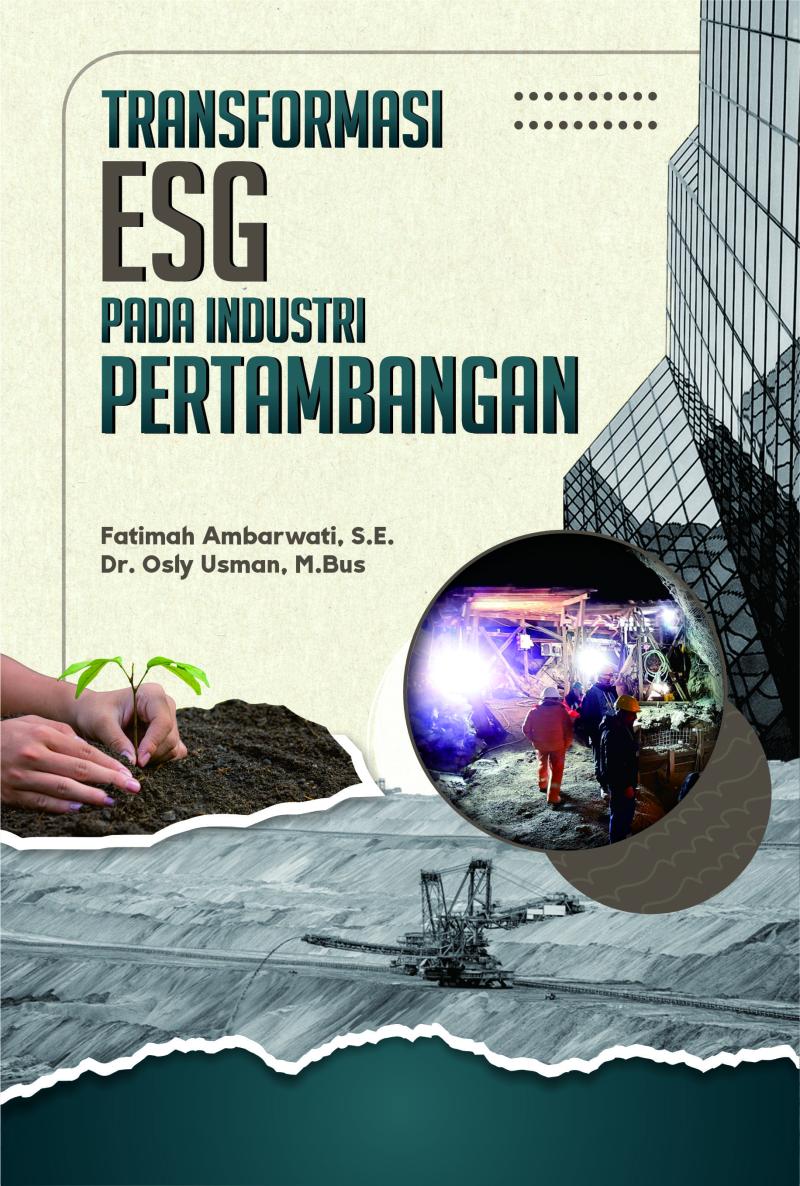
Di tengah meningkatnya tuntutan terhadap praktik bisnis yang berkelanjutan, industri pertambangan menghadapi tantangan besar untuk menyeimbangkan kepentingan ekonomi, kelestarian lingkungan, dan tanggung jawab sosial. Environmental, Social, and Governance (ESG) kini bukan lagi sekadar tren global, melainkan telah menjadi tolok ukur keberhasilan perusahaan dalam menjaga daya saing, memperoleh kepercayaan investor, serta menciptakan nilai jangka panjang. Perubahan tersebut menuntut perusahaan pertambangan untuk bertransformasi secara menyeluruh, tidak hanya pada aspek operasional, tetapi juga dalam cara berpikir, mengambil keputusan, dan membangun tata kelola yang berorientasi pada keberlanjutan.
Melalui buku Transformasi ESG pada Industri Pertambangan, pembaca diajak memahami bagaimana ESG diterapkan dalam praktik industri pertambangan melalui pembahasan mengenai evolusi ESG, integrasinya dengan ISO 14001, penguatan tata kelola perusahaan, dimensi sosial, hingga tantangan transisi energi dan dinamika geopolitik global. Disajikan secara runtut, aktual, dan mudah dipahami, buku ini memberikan perspektif yang lebih luas mengenai arah masa depan industri pertambangan sekaligus menjadi bacaan yang relevan bagi siapa saja yang ingin memahami transformasi menuju pertambangan yang lebih bertanggung jawab, adaptif, dan berkelanjutan.
Downloads
Download data is not yet available.
References
Buku dan Literatur Akademik
Bebbington, J., Larrinaga, C., & Moneva, J. M. (2008). Corporate social reporting and reputation risk management. Accounting, Auditing & Accountability Journal, 21(3), 337–361.
Berg, F., Kölbel, J. F., & Rigobon, R. (2022). Aggregate confusion: The divergence of ESG ratings. Review of Finance, 26(6), 1315–1344.
Carroll, A. B. (1991). The pyramid of corporate social responsibility: Toward the moral management of organizational stakeholders. Business Horizons, 34(4), 39–48.
Clarkson, M. B. E. (1995). A stakeholder framework for analyzing and evaluating corporate social performance. Academy of Management Review, 20(1), 92–117.
Deegan, C. (2002). Introduction: The legitimising effect of social and environmental disclosures – A theoretical foundation. Accounting, Auditing & Accountability Journal, 15(3), 282–311.
Eccles, R. G., Ioannou, I., & Serafeim, G. (2014). The impact of corporate sustainability on organizational processes and performance. Management Science, 60(11), 2835–2857.
Elkington, J. (1997). Cannibals with Forks: The Triple Bottom Line of 21st Century Business. Oxford: Capstone Publishing.
Freeman, R. E. (1984). Strategic Management: A Stakeholder Approach. Boston: Pitman Publishing.
Friede, G., Busch, T., & Bassen, A. (2015). ESG and financial performance: Aggregated evidence from more than 2000 empirical studies. Journal of Sustainable Finance & Investment, 5(4), 210–233.
Harrison, J. S., Bosse, D. A., & Phillips, R. A. (2010). Managing for stakeholders, stakeholder utility functions, and competitive advantage. Strategic Management Journal, 31(1), 58–74.
Jensen, M. C., & Meckling, W. H. (1976). Theory of the firm: Managerial behavior, agency costs and ownership structure. Journal of Financial Economics, 3(4), 305–360.
Kaplan, R. S., & Norton, D. P. (1996). The Balanced Scorecard: Translating Strategy into Action. Boston: Harvard Business School Press.
Krueger, P., Sautner, Z., & Starks, L. T. (2020). The importance of climate risks for institutional investors. Review of Financial Studies, 33(3), 1067–1111.
Porter, M. E., & Kramer, M. R. (2011). Creating shared value. Harvard Business Review, 89(1/2), 62–77.
Porter, M. E., & van der Linde, C. (1995). Toward a new conception of the environment-competitiveness relationship. Journal of Economic Perspectives, 9(4), 97–118.
Suchman, M. C. (1995). Managing legitimacy: Strategic and institutional approaches. Academy of Management Review, 20(3), 571–610.
Wheelen, T. L., & Hunger, J. D. (2018). Strategic Management and Business Policy: Globalization, Innovation, and Sustainability (15th ed.). Pearson.
Standar, Framework, dan Regulasi ESG
Global Reporting Initiative. (2021). GRI Standards. Amsterdam: Global Reporting Initiative.
International Organization for Standardization. (2015). ISO 14001:2015 Environmental Management Systems — Requirements with Guidance for Use. Geneva: ISO.
Sustainability Accounting Standards Board. (2021). SASB Standards. San Francisco: SASB Foundation.
Task Force on Climate-related Financial Disclosures. (2017). Recommendations of the Task Force on Climate-related Financial Disclosures. Basel: Financial Stability Board.
United Nations. (2015). Transforming Our World: The 2030 Agenda for Sustainable Development. New York: United Nations.
United Nations Global Compact. (2004). Who Cares Wins: Connecting Financial Markets to a Changing World. New York: United Nations.
United Nations. (2015). Paris Agreement. Paris: United Nations Framework Convention on Climate Change (UNFCCC).
Laporan Perusahaan dan Dokumen Korporasi
PT Bukit Asam Tbk. (2023). Annual Report 2024. Tanjung Enim: PT Bukit Asam Tbk.
PT Bukit Asam Tbk. (2023). Sustainability Report 2024. Tanjung Enim: PT Bukit Asam Tbk.
PT Bukit Asam Tbk. (2023). Annual Report 2023. Tanjung Enim: PT Bukit Asam Tbk.
PT Bukit Asam Tbk. (2023). Sustainability Report 2023. Tanjung Enim: PT Bukit Asam Tbk.
PT Bukit Asam Tbk. (2022). Annual Report 2022. Tanjung Enim: PT Bukit Asam Tbk.
PT Bukit Asam Tbk. (2022). Sustainability Report 2022. Tanjung Enim: PT Bukit Asam Tbk.
PT Bukit Asam Tbk. (2021). Sustainability Report 2021. Tanjung Enim: PT Bukit Asam Tbk.
Literatur Tambahan ESG dan Sustainability
Carroll, A. B., & Shabana, K. M. (2010). The business case for corporate social responsibility: A review of concepts, research and practice. International Journal of Management Reviews, 12(1), 85–105.
Eccles, R. G., & Klimenko, S. (2019). The investor revolution. Harvard Business Review, 97(3), 106–116.
Hart, S. L. (1995). A natural-resource-based view of the firm. Academy of Management Review, 20(4), 986–1014.
Lozano, R. (2015). A holistic perspective on corporate sustainability drivers. Corporate Social Responsibility and Environmental Management, 22(1), 32–44.
Sachs, J. D. (2015). The Age of Sustainable Development. New York: Columbia University Press.
Schaltegger, S., Burritt, R., & Petersen, H. (2017). An Introduction to Corporate Environmental Management: Striving for Sustainability. London: Routledge.
UNEP. (2021). Adaptation Gap Report 2021. Nairobi: United Nations Environment Programme.
World Economic Forum. (2023). Global Risks Report 2023. Geneva: World Economic Forum.
Referensi Pendukung Industri Pertambangan
Azapagic, A. (2004). Developing a framework for sustainable development indicators for the mining and minerals industry. Journal of Cleaner Production, 12(6), 639–662.
Hilson, G. (2012). Corporate social responsibility in the extractive industries: Experiences from developing countries. Resources Policy, 37(2), 131–137.
Jenkins, H., & Yakovleva, N. (2006). Corporate social responsibility in the mining industry: Exploring trends in social and environmental disclosure. Journal of Cleaner Production, 14(3–4), 271–284.
Prno, J., & Slocombe, D. S. (2012). Exploring the origins of social license to operate in the mining sector. Resources Policy, 37(3), 346–357.
Sánchez, L. E., & Hartlieb, P. (2020). Innovation in the mining industry: Technological trends and a case study of the challenges of disruptive innovation. Mining, Metallurgy & Exploration, 37(5), 1385–1399.
Whitmore, A. (2006). The emperors new clothes: Sustainable mining? Journal of Cleaner Production, 14(3–4), 309–314.
Downloads
PDF
- REPOSITORY.pdf REPOSITORY.pdf
- REPOSITORY.pdf REPOSITORY.pdf
Published
July 11, 2026
Copyright (c) 2026 Fatimah Ambarwati, S.E., Dr. Osly Usman, M.Bus. (Author)
License

This work is licensed under a Creative Commons Attribution-NonCommercial-ShareAlike 4.0 International License.
How to Cite
Fatimah Ambarwati, S.E., & Dr. Osly Usman, M.Bus. (2026). TRANSFORMASI ESG PADA INDUSTRI PERTAMBANGAN. Widina Media Utama. https://doi.org/10.59818/72jyzx40