MANAJEMEN PEMASARAN INTEGRASI STP DAN MARKETING MIX MODERN
Keywords:
Manajemen, Pemasaran, Integrasi, ModernSynopsis
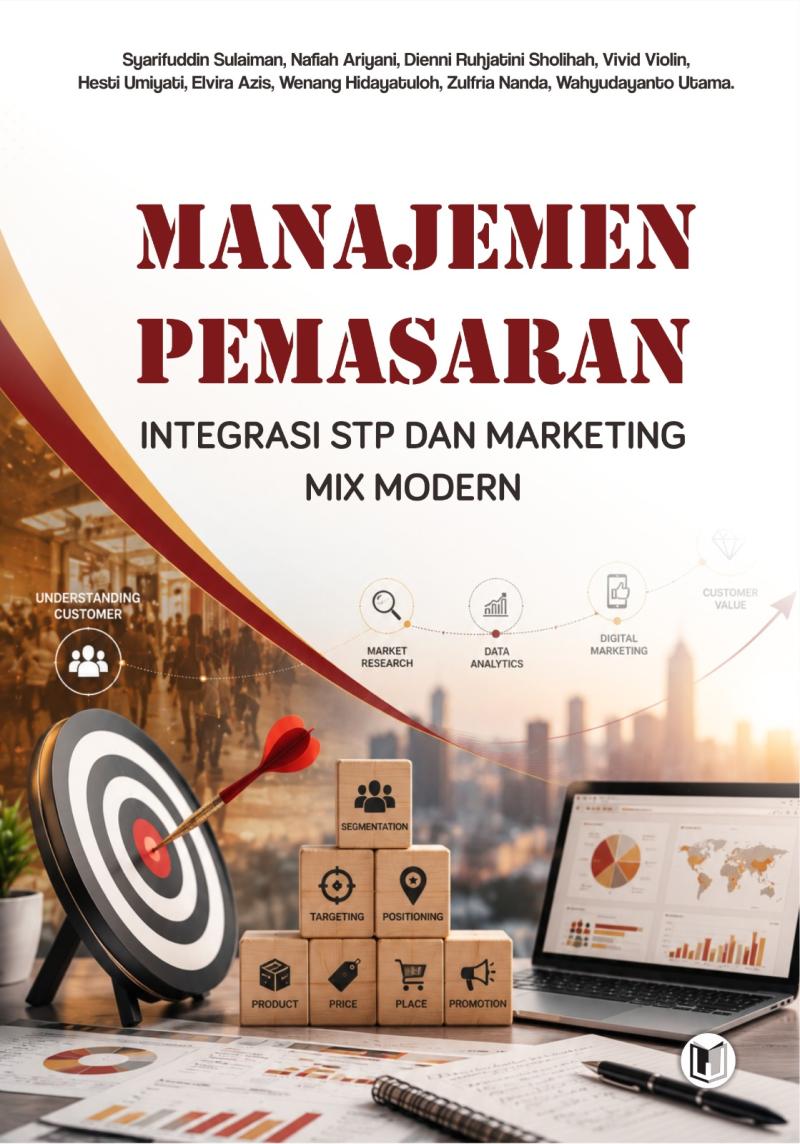
Di tengah persaingan bisnis yang semakin dinamis dan kompleks, perusahaan dituntut untuk mampu memahami kebutuhan pasar serta merancang strategi pemasaran yang tepat guna menciptakan keunggulan kompetitif. Buku Manajemen Pemasaran: Integrasi STP dan Marketing Mix Modern hadir sebagai panduan komprehensif yang menguraikan konsep, strategi, dan implementasi manajemen pemasaran dengan mengintegrasikan pendekatan Segmentation, Targeting, Positioning (STP) dan bauran pemasaran modern sebagai fondasi utama dalam pengambilan keputusan pemasaran.
Buku ini membahas berbagai aspek penting dalam manajemen pemasaran, mulai dari pemahaman perilaku konsumen, analisis lingkungan pemasaran, segmentasi pasar, penentuan target konsumen, hingga strategi positioning yang efektif dalam membangun citra merek. Selain itu, pembahasan mengenai marketing mix modern dikembangkan secara lebih luas dengan menyesuaikan perubahan perilaku konsumen di era digital, sehingga memberikan wawasan yang relevan bagi praktisi maupun akademisi.
Melalui penyajian teori yang sistematis, contoh-contoh aplikatif, serta pembahasan strategi pemasaran kontemporer, buku ini membantu pembaca memahami bagaimana mengintegrasikan STP dan marketing mix dalam menciptakan nilai bagi pelanggan serta meningkatkan kinerja bisnis. Perhatian khusus juga diberikan pada pemanfaatan teknologi digital, pemasaran berbasis data, media sosial, dan inovasi pemasaran yang menjadi kebutuhan utama organisasi pada era transformasi digital.
Buku ini ditujukan bagi mahasiswa, dosen, praktisi bisnis, wirausahawan, dan siapa saja yang ingin memperdalam pemahaman tentang manajemen pemasaran modern. Dengan pendekatan yang teoritis sekaligus praktis, buku ini diharapkan menjadi referensi yang bermanfaat dalam merancang, mengelola, dan mengevaluasi strategi pemasaran yang efektif, adaptif, dan berorientasi pada kebutuhan pasar yang terus berkembang.
Downloads
Download data is not yet available.
References
Bakator, M., Ćoćkalo, D., Makitan, V., Stanisavljev, S., & Nikolić, M. (2024). The three pillars of tomorrow: How Marketing 5.0 builds on Industry 5.0 and impacts Society 5.0? Heliyon, 10(17), e36543. https://doi.org/10.1016/j.heliyon.2024.e36543
Bresciani, S., Ferraris, A., Romano, M., & Santoro, G. (2021). Shifting Paradigms in Modern Marketing. In Digital Transformation Management for Agile Organizations: A Compass to Sail the Digital World (pp. 71–96). Emerald Publishing Limited. https://doi.org/10.1108/978-1-80043-171-320211005
Colovic, G. (2012). Strategic marketing in garment industry. In Strategic Management in the Garment Industry (pp. 21–90). Elsevier. https://doi.org/10.1533/9780857095855.21
Kamila, M. K., & Jasrotia, S. S. (2023). Ethics and marketing responsibility: A bibliometric analysis and literature review. Asia Pacific Management Review, 28(4), 567–583. https://doi.org/10.1016/j.apmrv.2023.04.002
Kotler, P., Keller, K. L., & Chernev, A. (2022). Marketing Management Sixteenth (16th ed.). Pearson Education Limited.
Kumar, P., & Seshadri, U. (2022). A Practitioner’s Perspective of Marketing Theory Evolution. International Journal of Operations Research and Information Systems, 13(1), 1–12. https://doi.org/10.4018/IJORIS.312231
Ma, X., & Gu, X. (2024). New marketing strategy model of E-commerce enterprises in the era of digital economy. Heliyon, 10(8), e29038. https://doi.org/10.1016/j.heliyon.2024.e29038
Makkonen, H., Aspara, J., Kaartemo, V., Mäntymäki, M., & Paavilainen-Mäntymäki, E. (2026). Conceptual fragmentation in marketing science: insights from the value co-creation literature. European Journal of Marketing, 60(13), 475–504. https://doi.org/10.1108/EJM-09-2024-0791
Raj, A. B., & Goute, A. K. (2025). Internal branding and technostress among employees - the mediation role of employee wellbeing and moderating effects of digital internal communication. Acta Psychologica, 255, 104943. https://doi.org/10.1016/j.actpsy.2025.104943
Rajagopal. (2025). Contemporary Marketing Strategy. Springer Nature Switzerland. https://doi.org/10.1007/978-3-031-95921-9
Rodriguez, R., Roberts-Lombard, M., Høgevold, N. M., & Svensson, G. (2022). Organisational and environmental indicators of B2B sellers’ sales performance in services firms. European Business Review, 34(4), 578–602. https://doi.org/10.1108/EBR-05-2021-0123
Sanclemente-Téllez, J. C. (2017). Marketing and Corporate Social Responsibility (CSR). Moving between broadening the concept of marketing and social factors as a marketing strategy. Spanish Journal of Marketing - ESIC, 21, 4–25. https://doi.org/10.1016/j.sjme.2017.05.001
Soetikno, H. W., Maupa, H., Cahyadi, H., & Sulaiman, S. (2024). Elements of Entrepreneurship on the Digital-Based Entrepreneurial Decisions of Women Entrepreneurs in Solo, Indonesia. International Research Journal of Economics and Management Studies, 3(1). https://doi.org/10.56472/25835238/IRJEMS-V3I1P119
Sulaiman, S. (2018). Pengaruh Resource Based View dan Dynamic Capability Terhadap Daya Saing Strategis dan Kinerja Ekspor di Sulawesi Selatan [Dissertation]. Universitas Hasanuddin.
Sulaiman, S. (2025). Memahami Bisnis Digital. In BISNIS DIGITAL (Green Business Model) (pp. 1–15). Lakeisha.
Tang, J. (2025). Digital marketing, transaction costs, and corporate market power. Finance Research Letters, 86, 108374. https://doi.org/10.1016/j.frl.2025.108374
Wind, Y. (Jerry). (2005). Marketing as an engine of business growth: a cross-functional perspective. Journal of Business Research, 58(7), 863–873. https://doi.org/10.1016/j.jbusres.2004.01.002
Wiyanto, H., & Sulaiman, S. (2025). Investigation of the relationship between the digital literacy on decisions related to digital entrepreneurship. ScienceRise, (2), 116–124. https://doi.org/10.21303/2313-8416.2025.003859
Zhan, Y., Kumar, A., Hosany, S., Xia, Y., Schoenherr, T., & Xia, L. (2025). Market competition in the platform economy: new insights, integrative framework and research agenda. Journal of Business Research, 200, 115648. https://doi.org/10.1016/j.jbusres.2025.115648
Zhang, L., Guo, Y., Li, B., Yao, M., Miao, M., & Wu, C.-H. (2025). Research on the Relationship Between Digital Marketing and Corporate Performance. Journal of Organizational and End User Computing, 37(1), 1–23. https://doi.org/10.4018/JOEUC.369156
Aaker, D. A., & Moorman, C. (2023). Strategic market management (12th ed.). John Wiley & Sons.
Cascio, J. (2020). Facing the age of chaos. Medium. https://medium.com/@cascio/facing-the-age-of-chaos-b00687b1f51d
Chernev, A. (2020). Strategic marketing management (4th ed.). SAGE Publications.
Iskandar, Y., & Doli, E. R. (Eds.). (2024). Marketing management: A comprehensive guide and practical insights. Mind Power Publishing.
Kotabe, M. M., & Helsen, K. (2022). Global marketing management (9th ed.). John Wiley & Sons.
Kotler, P., Kartajaya, H., & Setiawan, I. (2024). Marketing 6.0: The future is immersive. John Wiley & Sons.
Kotler, P., Keller, K. L., & Chernev, A. (2022). Marketing management (16th global ed.). Pearson Education.
Samardak, O. (2025). Intelligent marketing information systems. Commodity Science. Technologies. Engineering, 53(1).92–109. doi: 10.31617/2.2025(53)05.
Azzara, J., et al. (2023). Consumer needs and desires in purchasing behavior. Journal of Marketing Research, 60(4), 112–130.
Barysevich, A. (2020). How social media influence 71% consumer buying decisions. Search Engine Watch. https://searchenginewatch.com
Chan, E. Y. (2024). Consumer behavior in practice: Strategic insights for the modern marketer (1st ed.). Springer Nature. https://doi.org/10.1007/978-3-031-50947-6
Dwivedi, Y. K., et al. (2020). Impact of COVID-19 pandemic on information management research and practice. International Journal of Information Management, 55, 102–186.
Emerald Publishing. (2023). A systematic review of customer behavior in business-to-business markets and agenda for future research. Journal of Business & Industrial Marketing, 38(13), 122–142. https://doi.org/10.1108/JBIM-07-2022-0313
Fetscherin, M., & Heinrich, D. (2015). Consumer brand relationships research: A bibliometric citation meta-analysis. Journal of Business Research, 68(2), 380–390.
Hoffmann, S., & Akbar, P. (2022). Consumer behavior: Understanding consumers – Designing marketing activities. Springer Gabler. https://doi.org/10.1007/978-3-658-39476-9
Hung, S., et al. (2022). Consumer attitude toward online purchasing and perceived ease of use. International Journal of Information Management, 37(6), 627–638.
IRJMETS. (2025). Consumer behaviour in the post-COVID era. International Research Journal of Modernization in Engineering Technology and Science, 7(1). https://www.irjmets.com
Kaski, T., et al. (2017). Evolution of B2B marketing from transactional to relationship-based philosophy. Industrial Marketing Management, 62, 81–92.
Kotler, P., & Armstrong, G. (2021). Principles of marketing (18th ed.). Pearson Education.
Kotler, P., & Keller, K. L. (2022). Marketing management (16th ed.). Pearson Education.
Lilien, G. L. (2016). The B2B knowledge gap. International Journal of Research in Marketing, 33(3), 543–556.
Maslow, A. H. (1943). A theory of human motivation. Psychological Review, 50(4), 370–396. https://doi.org/10.1037/h0054346
Maslow, A. H. (1970). Motivation and personality (2nd ed.). Harper & Row.
Moser, A. K. (2015). Thinking green, buying green? Drivers of pro-environmental purchasing behavior. Journal of Consumer Marketing, 32(3), 167–175.
Mothersbaugh, D. L., Kleiser, S. B., & Hawkins, D. I. (2024). Consumer behavior: Building marketing strategy (15th ed.). McGraw-Hill Education.
Natalia, F., & Mulyana, B. (2022). Keputusan pembelian konsumen: Studi kasus produk digital. Jurnal Manajemen Indonesia, 10(1), 45–58.
Preprints.org. (2024). Consumer decision making model process but as independent factors: And its influence on purchasing behavior. https://doi.org/10.20944/preprints202402.1188.v1
ResearchGate. (2024). Exploring the impact of digital technologies on consumer behavior in the post-pandemic era [Bibliometric study]. https://www.researchgate.net
Roggeveen, A. L., & Sethuraman, R. (2020). How the COVID-19 pandemic may change the world of retailing. Journal of Retailing, 96(2), 169–171.
ScienceDirect. (2024). Understanding consumer behavior during and after a pandemic: Implications for customer lifetime value prediction models. Journal of Business Research, 174, Article 114505. https://doi.org/10.1016/j.jbusres.2024.114505
ScienceDirect. (2022). Leveraging consumer behavior research to forge new insights into B2B buyer behavior. Industrial Marketing Management. https://doi.org/10.1016/j.indmarman.2022.05.001
Smith, A. (2024). Consumer behaviour and analytics (2nd ed.). Routledge. ISBN: 9781032388373
Solomon, M. R. (2022). Consumer behavior: Buying, having, and being (13th ed.). Pearson Education.
Taralik, K., et al. (2022). The pivotal role of need recognition in shaping customer experience and purchasing behavior. Journal of Customer Experience, 9(2), 33–50.
Yang, Z., Li, X., & Wang, Q. (2024). Analysis of online consumer purchasing behavior typology after the COVID-19 pandemic. SAGE Open, 14(3). https://doi.org/10.1177/21582440241279684
Aditama, R. R. A., & Pratita, M. P. (2026). Strategi Pemasaran Modern; Dari Konsep Tradisional ke Digitalisasi. REPOSITORY CV INDONESIA IMAJI, 2(1).
Agustini, N. K. Y. (2003). Segmentasi pasar, penentuan target dan penentuan posisi. Equilibrium: Jurnal Ekonomi-Manajemen-Akuntansi, 1(2), 91-106.
Aidah, Y., & Fiyul, A. Y. (2026). Pengaruh Segmentasi Pasar terhadap Efektivitas Strategi Pemasaran: Studi Kasus Nike. Jurnal Manajemen dan Bisnis Indonesia, 1(3), 164-170.
Aidah, Y., & Fiyul, A. Y. (2026). Pengaruh Segmentasi Pasar terhadap Efektivitas Strategi Pemasaran: Studi Kasus Nike. Jurnal Manajemen dan Bisnis Indonesia, 1(3), 164-170.
Alimin, E., Eddy, E., Afriani, D., Agusfianto, N. P., Octavia, Y. F., Mulyaningsih, T., ... & Tabun, M. A. (2022). Manajemen Pemasaran: Kajian Pengantar di Era Bisnis Modern. Seval Literindo Kreasi.
Arifin, S., Irfan, M., Darmawan, D., Putra, A. R., & Al Hakim, Y. R. (2014). Segmentation, Targeting, Positioning untuk Strategi Pemasaran Efektif. Jurnal Ekonomi dan Bisnis, 4(2), 51-62.
Hariansyah, N. (2021). Segmentasi pasar dalam komunikasi pemasaran Islam. Al-Hikmah, 19(2), 127-138.
Hindardjo, A., Zahara, A. E., Ifadhila, I., Judijanto, L., Zahara, R., Anggraini, S. D., ... & Pradopo, L. R. (2026). Manajemen Pemasaran: Strategi dan Praktik yang Efektif. PT. Sonpedia Publishing Indonesia.
Nurahmah, N. (2024). Segmentasi pelanggan B2B berdasarkan perilaku pembelian dan firmografi pada PT. Sukses Riau Permata (SRP). Jurnal Teknologi Informasi dan Ilmu Komputer, 11(1), 11-18.
Purnomo, A. C. (2022). Manajemen pemasaran pendidikan berbasis strategi penentuan pasar sasaran. Jurnal Sosial Humaniora dan Pendidikan, 1(2), 130-137.
Suryono, I. (2026). Manajemen Pemasaran. Media Kunkun Nusantara.
Widjojo, H., Widjaja, S., Poniman, R., Handoko, R., Wibowo, A. I., Hartono, Y., ... & Oktavian, F. (2016). Sari-Sari Pemasaran dan Aplikasinya di Dunia Bisnis. Prasetiya Mulya Publishing.
Armstrong, G., Kotler, P., Harker, M., & Brennan, R. (2020). Marketing: An introduction (14th ed.). Pearson Education.
Chaffey, D., & Ellis-Chadwick, F. (2022). Digital marketing: Strategy, implementation and practice (8th ed.). Pearson Education.
Grant, R. M. (2019). Contemporary strategy analysis (10th ed.). Wiley.
Kotler, P., Keller, K. L., Brady, M., Goodman, M., & Hansen, T. (2021). Marketing management (16th ed.). Pearson Education.
Kumar, V., & Reinartz, W. (2018). Customer relationship management: Concept, strategy, and tools (3rd ed.). Springer.
Lemon, K. N., & Verhoef, P. C. (2016). Understanding customer experience throughout the customer journey. Journal of Marketing, 80(6), 69–96. https://doi.org/10.1509/jm.15.0420
Porter, M. E. (2008). The five competitive forces that shape strategy. Harvard Business Review, 86(1), 78–93.
Wedel, M., & Kannan, P. K. (2023). Marketing analytics for data-rich environments. Journal of Marketing, 87(1), 1–21. https://doi.org/10.1177/00222429221138668
Aaker, D. A. (1996). Building strong brands. Free Press.
Hair, J. F., Black, W. C., Babin, B. J., & Anderson, R. E. (2014). Multivariate data analysis (7th ed.). Pearson.
Hooley, G., Piercy, N., & Nicoulaud, B. (2017). Marketing strategy and competitive Positioning (6th ed.). Pearson.
Keller, K. L. (2013). Strategic brand management: Building, measuring, and managing brand equity (4th ed.). Pearson.
Kotler, P., & Keller, K. L. (2016). Marketing management (15th ed.). Pearson.
Malhotra, N. K. (2010). Marketing research: An applied orientation (6th ed.). Pearson.
Parasuraman, A., Zeithaml, V. A., & Berry, L. L. (1988). SERVQUAL: A multiple-item scale for measuring consumer perceptions of service quality. Journal of Retailing, 64(1), 12–40.
Porter, M. E. (1985). Competitive advantage: Creating and sustaining superior performance. Free Press.
Ries, A., & Trout, J. (2001). Positioning: The battle for your mind. McGraw-Hill.
Smith, T. (2020). Streaming media and digital transformation. Journal of Media Business Studies, 17(2), 45–60.
Elmaghraby, W., & Keskinocak, P. (2003). Dynamic Pricing in the presence of inventory considerations: Research overview, current practices, and future directions. Management Science, 49(10), 1287–1309. https://doi.org/10.1287/mnsc.49.10.1287.17315
Hinterhuber, A. (2008). Customer Value-Based pricing strategies: Why companies resist. Journal of Business Strategy, 29(4), 41–50. https://doi.org/10.1108/02756660810886079
Kotler, P., & Armstrong, G. (2021). Principles of marketing (18th ed.). Pearson Education.
Kotler, P., & Keller, K. L. (2016). Marketing management (15th ed.). Pearson Education.
Liozu, S. M., & Hinterhuber, A. (2013). Pricing orientation, pricing capabilities, and firm performance. Journal of Revenue and Pricing Management, 12(1), 62–79.
Monroe, K. B. (2003). Pricing: Making profitable decisions (3rd ed.). McGraw-Hill/Irwin.
Nagle, T. T., Muller, G., & Zale, J. (2016). The strategy and tactics of pricing: A guide to growing more profitably (6th ed.). Routledge.
Schindler, R. M. (2011). Pricing strategies: A marketing approach. SAGE Publications.
Simon, H., Bilstein, F. F., & Luby, F. (2008). Manage for profit, not for market share. Harvard Business School Press.
Ang, Lawrence (2021). Principles of Integrated marketing communication: Evidence Base Approach. 2nd Edition. Macguarie University, Sidney.
Kapferer (2008). The New Strategic of Brand Management: Creating and Sustaining Brand Equity Long Term. Kogan Page Limited.
Keller L. Kevin (2007). Strategic Brand Management: Building, Measuring, and Managing brand Equity. Third Edition. Pearson International Edition.
Camilleri, M. A. (2018). Integrated marketing communications. In Travel Marketing, Tourism Economics and the Airline Product (Chapter 5 pp. 85-103). Cham, Switzerland: Springer Nature.
Nadube, P. M. (2018). Understanding integrated marketing communication: Concepts, definitions and dimensions. International Journal of Innovations in Economic and Management Science, 8(2), 1-15.
Ogden & Ogden (2014). Integrated marketing communication: Advertising, Public relation and More. Bridgepoint Education, Inc.
Porcu et al (2012). How integrated marketing communication (IMC) works? A Theoretical Review and an Analysis of its Main Drivers and Effects. Communicacion Y Sociedad. Vol XXV. 313-348.
Arafat, W. (2005). The Real Power of Audit Marketing. Elexmedia Komputindo.
Kotler, P., & Keller, K. L. (2022). Marketing Management. Pearson.
Neil T. Bendle, Paul W. Farris, Phillip Edward Pfeifer, D. J. R. (2021). Marketing Metrics: The Manager’s Guide to Measuring Marketing Performance. Pearson.
Parmerlee, D. (2025). Auditing Markets, Products, and Marketing Plans. McGraw-Hill.
Powell, G. R. (2003). Return on Marketing Investment. Pearson.
Downloads
Published
July 10, 2026
Copyright (c) 2026 Syarifuddin Sulaiman, Nafiah Ariyani, Dienni Ruhjatini Sholihah, Vivid Violin, Hesti Umiyati, Elvira Azis, Wenang Hidayatuloh, Zulfria Nanda, Wahyudayanto Utama (Author)
License

This work is licensed under a Creative Commons Attribution-NonCommercial-ShareAlike 4.0 International License.
Details about this monograph
ISBN-13 (15)
978-634-317-087-7
How to Cite
Sulaiman, S., Ariyani, N., Sholihah, D. R., Violin, V., Umiyati, H., Azis, E., Hidayatuloh, W., Nanda, Z., & Utama, W. (2026). MANAJEMEN PEMASARAN INTEGRASI STP DAN MARKETING MIX MODERN. Widina Media Utama. https://doi.org/10.59818/cnx44d93