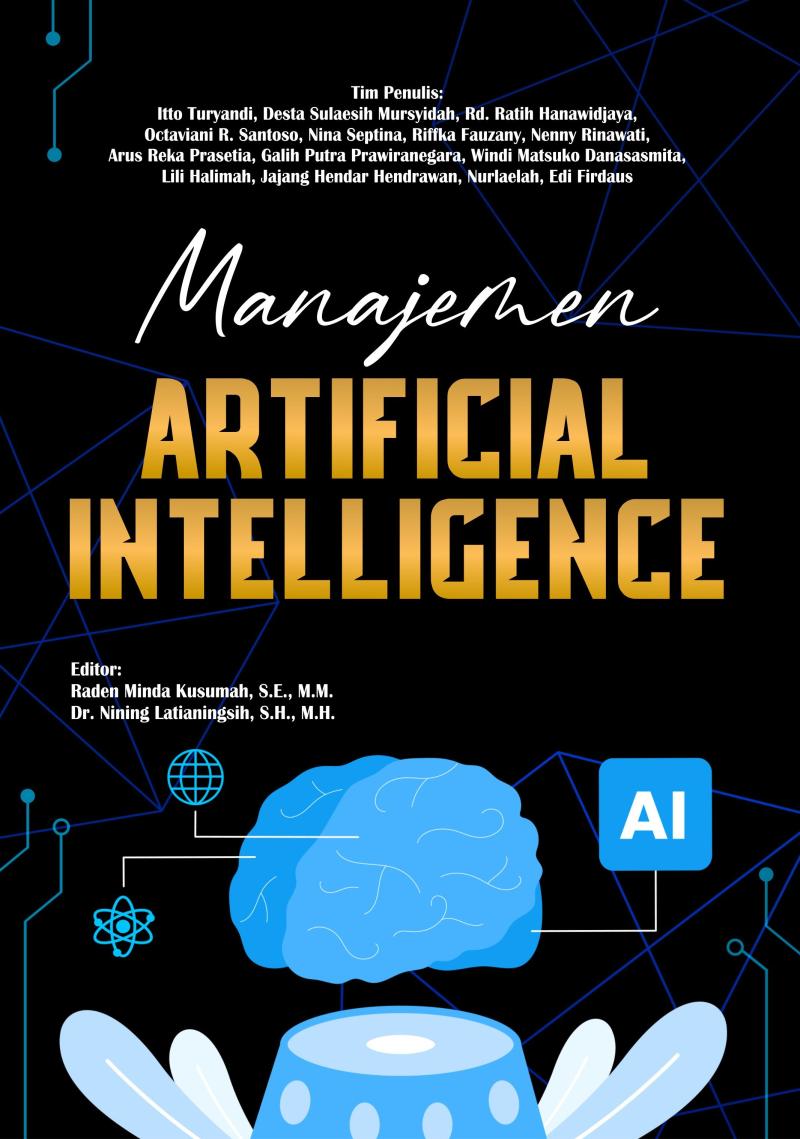
MANAJEMEN ARTIFICIAL INTELLIGENCE
Keywords:
Manajemen Artificial Intelligence, Transformasi Digital, Pengambilan Keputusan, Keunggulan Kompetitif, Etika dan Tata Kelola AI, Analisis Prediktif, Kepemimpinan Digital, Otomatisasi ProsesSynopsis
Buku Manajemen Artificial Intelligence membahas peran strategis kecerdasan buatan dalam mentransformasi praktik manajemen modern di era digital, dimulai dari konsep dasar dan perkembangan Artificial Intelligence hingga perubahan paradigma manajemen, peran manajer, serta integrasi Artificial Intelligence sebagai sumber daya strategis dalam pengambilan keputusan dan penciptaan keunggulan kompetitif. Buku ini juga mengulas penerapan Artificial Intelligence dalam berbagai fungsi manajemen seperti sumber daya manusia, operasional, pemasaran, dan keuangan, termasuk pemanfaatan big data, otomatisasi proses, analisis prediktif, personalisasi layanan, serta manajemen risiko dan kinerja berbasis Artificial Intelligence yang dilengkapi dengan pendekatan manajerial, etika, dan studi kasus. Pada bagian akhir, dibahas isu kepemimpinan digital, etika, hukum, tata kelola, serta tantangan dan peluang masa depan Artificial Intelligence, termasuk kesiapan organisasi dan rekomendasi strategis untuk penerapan Artificial Intelligence yang berkelanjutan dan bertanggung jawab, sehingga buku ini menjadi rujukan akademis dan praktis dalam memahami serta mengelola Artificial Intelligence secara efektif.
Downloads
Download data is not yet available.
References
Acquisti, A., Brandimarte, L., & Loewenstein, G. (2015). Privacy and human behavior in the age of information. Science, 347(6221), 509–514.
Akter, S., & Wamba, S. F. (2016). BDA in E-commerce: A systematic review and agenda for future research. Electronic Markets, 26(2), 173–194.
Al-Dulaimi, M. I. J., & Al-Obaidy, O. F. H. (2025). The integration of artificial intelligence in strategic decision-making: Advantages and challenges. Journal of Management Research and Review, 01(04), 113–118.
Amershi, S., Weld, D., Vorvoreanu, M., Fourney, A., Nushi, B., Collisson, P., … Horvitz, E. (2020). Guidelines for human-AI interaction. Proceedings of the SIGCHI Conference on Human Factors in Computing Systems, 1–13.
Appelbaum, D., Kogan, A., & Vasarhelyi, M. A. (2017). Big data and analytics in the modern audit engagement: Research needs. Auditing: A Journal of Practice & Theory, 36(4), 1–27.
Ardi, M., & Bintari, D. (2023). Analisis keamanan dan risiko pada sistem berbasis artificial intelligence. Jurnal Teknologi Informasi dan Sistem, 5(2), 101–115.
Arnaboldi, M., Busco, C., & Cuganesan, S. (2017). Accounting, accountability, social media and big data: Revolution or hype? Accounting, Auditing & Accountability Journal, 30(4), 762–776.
Arner, D. W., Barberis, J., & Buckley, R. P. (2017). FinTech and regtech: Impact on regulators and banks. Journal of Banking Regulation, 19(4), 1–14.
Autor, D. H. (2022). Why are there still so many jobs? The history and future of workplace automation. Journal of Economic Perspectives, 29(3), 3–30.
Avolio, B. J., Kahai, S., & Dodge, G. E. (2014). E-leadership: Implications for theory, research, and practice. The Leadership Quarterly, 25(1), 105–131.
Bag, S., Srivastava, G., Bashir, M. M. A., Kumari, S., & Chowdhury, A. H. (2022). Journey of customers in this digital era: Understanding the role of AI technologies in user engagement and conversion. Benchmarking: An International Journal, 29(7), 2074–2098.
Baker, H. K., & Powell, G. E. (2005). Understanding Financial Management: A Practical Guide. Malden: Blackwell Publishing.
Barocas, S., & Selbst, A. D. (2016). Big data’s disparate impact. California Law Review, 104(3), 671–732.
Baryannis, G., Validi, S., Dani, S., & Antoniou, G. (2019). Supply chain risk management and artificial intelligence: State of the art and future research directions. International Journal of Production Research, 57(7), 2179–2202.
Basel Committee on Banking Supervision. (2011). Principles for the Sound Management of Operational Risk. Basel: Bank for International Settlements.
Becue, A., Praça, I., & Gama, J. (2021). Artificial intelligence, cyber threats and cybersecurity: A review. Artificial Intelligence Review, 54(5), 385–412.
Bharadwaj, A., El Sawy, O. A., Pavlou, P. A., & Venkatraman, N. (2013). Digital business strategy: Toward a next generation of insights. MIS Quarterly, 37(2), 471–482.
Bhuiyan, M. S. (2024). The role of AI-enhanced personalization in customer experiences. Journal of Computer Science and Technology, 6(1), 162–169.
Black, J. S., & van Esch, P. (2023). AI in recruitment and selection: A review of ethical challenges and opportunities. Ethics and Information Technology, 25(2), 1–12.
Bolton, R. J., & Hand, D. J. (2002). Statistical fraud detection: A review. Statistical Science, 17(3), 235–255.
Bommasani, R., Hudson, D. A., Adeli, E., Altman, R., Arora, S., von Arx, S., … Liang, P. (2021). On the opportunities and risks of foundation models. arXiv preprint arXiv:2108.07258.
Bondarouk, T., & Brewster, C. (2023). Conceptualizing the future of HRM and technology. International Journal of Human Resource Management, 34(10), 1987–2005.
Bostrom, N. (2014). Superintelligence: Paths, Dangers, Strategies. Oxford: Oxford University Press.
Breck, E., Cai, S., Nielsen, E., Salib, M., & Sculley, D. (2017). The ML test score: A rubric for ML production readiness and technical debt reduction. In Proceedings of the 2017 IEEE International Conference on Big Data (pp. 1123–1132). IEEE.
Brigham, E. F., & Houston, J. F. (2019). Fundamentals of Financial Management (15th ed.). Boston: Cengage Learning.
Brock, J. K. U., & von Wangenheim, F. (2019). Demystifying AI: What digital transformation leaders can teach you about realistic artificial intelligence. California Management Review, 61(4), 110–134.
Brougham, D., & Haar, J. (2018). Smart technology, artificial intelligence, robotics, and algorithms (STARA): Employees’ perceptions of our future workplace. Journal of Management & Organization, 24(2), 239–257.
Brynjolfsson, E., & McAfee, A. (2017). Machine, Platform, Crowd: Harnessing Our Digital Future. New York: W. W. Norton & Company.
Brynjolfsson, E., & McAfee, A. (2022). The business of artificial intelligence. Harvard Business Review, 100(4), 60–68.
Brynjolfsson, E., & McAfee, A. (2022). The Second Machine Age: Work, Progress, and Prosperity in a Time of Brilliant Technologies. New York: W. W. Norton & Company.
Brynjolfsson, E., Li, D., & Raymond, L. R. (2023). Generative AI At Work. Cambridge: National Bureau of Economic Research.
Bryson, J. J. (2018). Patiency is not a virtue: The design of intelligent systems and systems of ethics. Ethics and Information Technology, 20(1), 15–26.
Bughin, J., Seong, J., Manyika, J., Chui, M., & Joshi, R. (2018). Notes from the AI Frontier: Modeling the Impact of AI on the World Economy. New York: McKinsey Global Institute.
Bughin, J., Seong, J., Manyika, J., Chui, M., & Joshi, R. (2023). Artificial Intelligence: The Next Digital Frontier. New York: McKinsey Global Institute.
Buolamwini, J., & Gebru, T. (2018). Gender shades: Intersectional accuracy disparities in commercial gender classification. Proceedings of Machine Learning Research, 81, 1–15.
Burrell, J. (2016). How the machine ‘thinks’: Understanding opacity in machine learning algorithms. Big Data & Society, 3(1), 1–12.
Cappelli, P., & Keller, J. R. (2023). Talent management: Conceptual approaches and practical challenges. Annual Review of Organizational Psychology and Organizational Behavior, 10, 1–25.
Cath, C., Wachter, S., Mittelstadt, B., Taddeo, M., & Floridi, L. (2018). Artificial intelligence and the ‘good society’: The US, EU, and UK approach. Science and Engineering Ethics, 24(2), 505–528.
Cavoukian, A. (2011). Privacy by Design: The 7 Foundational Principles. Toronto: Information and Privacy Commissioner of Ontario.
Chakraborty, A., Alam, M., Dey, V., Chattopadhyay, A., & Mukhopadhyay, D. (2021). Adversarial attacks and defences: A survey. Computer Science Review, 39, 100–118.
Chamorro-Premuzic, T., Winsborough, D., Sherman, R. A., & Hogan, R. (2023). New talent signals: Shiny new objects or a brave new world? Industrial and Organizational Psychology, 16(1), 1–24.
Chatterjee, S., Chaudhuri, R., & Vrontis, D. (2022). AI and digitalization in relationship management: Impact of adopting AI-embedded CRM system. Journal of Business Research, 150, 437–450.
Choi, T. M., Wallace, S. W., & Wang, Y. (2018). Big data analytics in operations management. Production and Operations Management, 27 (10), 1868–1883.
Chopra, S., & Meindl, P. (2019). Supply Chain Management: Strategy, Planning, and Operation (7th ed.). Boston: Pearson Education.
Csaszar, F. A., Ketkar, H., & Kim, H. (2024). Artificial intelligence and strategic decision-making: Evidence from entrepreneurs and investors. Strategy Science, 9(4), 322–345.
Damodaran, A. (2012). Investment Valuation: Tools and Techniques for Determining the Value of Any Asset. Hoboken: Wiley.
Davenport, T. H., & Harris, J. G. (2017). Competing on Analytics: The New Science of Winning. Boston: Harvard Business School Press.
Davenport, T. H., & Kirby, J. (2016). Just how smart are smart machines? MIT Sloan Management Review, 57(3), 21–25.
Davenport, T. H., & Kirby, J. (2022). Only Humans Need Apply: Winners and Losers in the Age of Smart Machines. New York: Harper Business.
Davenport, T. H., & Ronanki, R. (2018). Artificial intelligence for the real world. Harvard Business Review, 96(1), 108–116.
Davenport, T. H., Guha, A., Grewal, D., & Bressgott, T. (2019). How artificial intelligence will change the future of marketing. Journal of the Academy of Marketing Science, 48(7553), 1–19.
Deloitte. (2025). State of AI in the Enterprise (5th ed.). New York: Deloitte Insights.
Dietvorst, B. J., Simmons, J. P., & Massey, C. (2015). Algorithm aversion: People erroneously avoid algorithms after seeing them err. Journal of Experimental Psychology: General, 144(1), 114–126.
Dignum, V. (2019). Responsible Artificial Intelligence: How to Develop and Use AI in A Responsible Way. Cham: Springer.
Dreyfus, H. L. (1992). What Computers Still Can’t Do: A Critique of Artificial Reason. Cambridge: MIT Press.
Dwivedi, Y. K., Hughes, L., Ismagilova, E., Aarts, G., Coombs, C., Crick, T., … Williams, M. D. (2019). Artificial intelligence (AI): Multidisciplinary perspectives. International Journal of Information Management, 57(7), 101994.
El Sawy, O. A., Kræmmergaard, P., Amsinck, H., & Vinther, A. L. (2016). How LEGO built the foundations and enterprise capabilities for digital leadership. MIS Quarterly Executive, 15(2), 141–166.
European Commission. (2021). Proposal for A Regulation on Artificial Intelligence (Artificial Intelligence Act). Brussels: European Commission.
European Commission. (2024). Artificial Intelligence Act: Regulatory Framework for AI. Brussels: European Union.
European Commission. (2024). Ethics Guidelines for Trustworthy Artificial Intelligence. Brussels: European Commission.
Fama, E. F. (1970). Efficient capital markets: A review of theory and empirical work. The Journal of Finance, 25(2), 383–417.
Fayaz, M., Amin, M., & Iqbal, M. (2024). Artificial intelligence in decision-making: a descriptive analysis of its impact on strategic planning. Journal of Business and Management Research, 3(2), 222–235.
Ferrario, A., & Loi, M. (2022). How explainability contributes to trust in AI. ACM Conference on Fairness, Accountability and Transparency, 1457–1466.
Fildes, R., & Petropoulos, F. (2023). Forecasting and decision making: The role of hybrid models. International Journal of Forecasting, 39(2), 495–512.
Fischer, T., & Krauss, C. (2018). Deep learning with long short-term memory networks for financial market predictions. European Journal of Operational Research, 270(2), 654–669
Floridi, L. (2016). The Ethics of Information. Oxford: Oxford University Press.
Floridi, L., Cowls, J., Beltrametti, M., Chatila, R., Chazerand, P., Dignum, V., Luetge, C., Madelin, R., Pagallo, U., Rossi, F., Schafer, B., Valcke, P., & Vayena, E. (2018). AI4People—An ethical framework for a good AI society: Opportunities, risks, principles, and recommendations. Minds and Machines, 28(4), 689–707.
Floridi, L., Holweg, M., Taddeo, M., Amaya Silva, J., Mökander, J., & Wen, Y. (2021). Governing AI ethically: A review of frameworks. Philosophy & Technology, 34, 1–30.
Fountaine, T., McCarthy, B., & Saleh, T. (2019). Building the AI-powered organization. Harvard Business Review, 97(4), 62–73.
Frey, C. B., & Osborne, M. A. (2023). The future of employment: How susceptible are jobs to computerisation? Technological Forecasting and Social Change, 114, 254–280.
Gama, J., Žliobaitė, I., Bifet, A., Pechenizkiy, M., & Bouchachia, A. (2022). A survey on concept drift adaptation. ACM Computing Surveys, 46(4), 1–37.
Gao, Y., & Liu, H. (2023). AI-enabled personalization in interactive marketing. Journal of Research in Interactive Marketing, 17(5), 663–680.
Gartner. (2026). Top Strategic Technology Trends: Artificial Intelligence and Implementation Framework. Stamford: Gartner Inc.
Gigerenzer, G. (2007). Gut Feelings: The Intelligence of the Unconscious. New York: Viking.
Glikson, E., & Woolley, A. W. (2020). Human trust in artificial intelligence: Review and research agenda. Academy of Management Annals, 14(2), 627–660.
Goldblum, M., Tsipras, D., Xie, C., Chen, X., Schwarzschild, A., Song, D., & Goldstein, T. (2022). Data poisoning attacks on machine learning. Proceedings of NeurIPS, 1–12.
Granlund, M. (2011). Extending AIS research to management accounting and control issues: A research note. International Journal of Accounting Information Systems, 12(1), 3–19.
Green, B., & Chen, Y. (2021). The principles and limits of algorithm-in-the-loop decision making. Proceedings of the ACM on Human-Computer Interaction, 5(CSCW1), 1–24.
Haenlein, M., & Kaplan, A. M. (2023). Artificial intelligence and strategic decision-making. California Management Review, 65(3), 5–27.
Heizer, J., Render, B., & Munson, C. (2020). Operations Management: Sustainability and Supply Chain Management (13th ed.). Boston: Pearson.
Hopkin, P. (2018). Fundamentals of Risk Management: Understanding, Evaluating and Implementing Effective Risk Management (5th ed.). London: Kogan Page.
Huang, K., Siegel, M., & Madnick, S. (2023). Systematic analysis of AI security vulnerabilities. IEEE Security & Privacy, 21(2), 45–53.
Huang, M. H., & Rust, R. T. (2021). A strategic framework for AI in marketing. Journal of the Academy of Marketing Science, 49(1), 30–50.
Huang, M. H., & Rust, R. T. (2024). Artificial intelligence in service and human resource management: Implications for employee performance. Journal of Service Research, 27(1), 3–18.
Iansiti, M., & Lakhani, K. R. (2023). Competing in the Age of AI: Strategy and Leadership When Algorithms and Networks Run the World. Boston: Harvard Business Review Press.
IBM. (2024). Global AI Adoption Index 2024. Armonk: IBM Institute for Business Value.
International Labour Organization. (2023). Working with Artificial Intelligence. Geneva: ILO.
Ivanov, D., & Dolgui, A. (2020). A digital supply chain twin for managing disruptions. Production and Operations Management, 29(9), 2067–2085.
Jarrahi, M. H. (2018). Artificial intelligence and the future of work: Human-AI collaboration in organizational decision-making. Business Horizons, 61(4), 577–586.
Jarrahi, M. H., Memariani, A., & Guo, X. (2021). The impact of AI on knowledge work. Journal of Business Research, 124, 564–574.
Jobin, A., Ienca, M., & Vayena, E. (2019). The global landscape of AI ethics guidelines. Nature Machine Intelligence, 1(9), 389–399.
Jöhnk, J., Weißert, M., & Wyrtki, K. (2021). Ready or not, AI comes—An interview study of organizational AI readiness factors. Business & Information Systems Engineering, 63(1), 5–20.
Jorion, P. (2007). Value at Risk: The New Benchmark for Managing Financial Risk. New York: McGraw-Hill.
Joshi, S. (2025). The role of artificial intelligence in strategic decision-making: A comprehensive review. SSRN, 1–28.
Kahneman, D. (2011). Thinking, Fast and Slow. New York: Farrar, Straus and Giroux.
Kairouz, P., McMahan, H. B., Avent, B., Bellet, A., Bennis, M., Bhagoji, A., … Zhao, S. (2021). Advances and open problems in federated learning. Foundations and Trends in Machine Learning, 14(1–2), 1–210.
Kane, G. C., Palmer, D., Phillips, A. N., Kiron, D., & Buckley, N. (2015). Strategy, not technology, drives digital transformation. MIT Sloan Management Review.
Kane, G. C., Phillips, A. N., Copulsky, J., & Andrus, G. (2019). The Technology Fallacy: How People Are the Real Key to Digital Transformation. Cambridge: MIT Press.
Kaplan, A. M., & Haenlein, M. (2019). Siri, Siri, in my hand: Who’s the fairest in the land? On the interpretations, illustrations, and implications of artificial intelligence. Business Horizons, 62(1), 15–25.
Kasem, M. S., Hamada, M., & Taj-Eddin, I. (2024). Customer profiling, segmentation, and sales prediction using AI in direct marketing. Neural Computing and Applications, 36(9), 4995–5005.
Kementerian Perencanaan Pembangunan Nasional (Bappenas). (2020). Strategi Nasional Kecerdasan Artifisial Indonesia 2020–2045. Jakarta: Bappenas.
Khairi, A., Pratama, R., & Nugroho, Y. (2024). Integrasi sistem AI dalam organisasi: Tantangan dan risiko. Jurnal Sistem Informasi, 10(1), 55–70.
Koontz, H., & Weihrich, H. (2015). Essentials of Management (9th ed.). New Delhi: McGraw-Hill Education.
Koswara, A. (2025). Analisis kinerja AI Marketing Plan Generator dalam merancang strategi pemasaran. Jurnal Ilmiah Ekonomi Bisnis, 10(3).
Kotler, P., & Armstrong, G. (2018). Principles of Marketing (17th ed.). Harlow: Pearson Education.
Kotler, P., Kartajaya, H., & Setiawan, I. (2021). Marketing 5.0: Technology for Humanity. Hoboken: John Wiley & Sons.
Kotter, J. P. (2012). Leading Change. Boston: Harvard Business Review Press.
Krollner, B., Vanstone, B., & Finnie, G. (2010). Financial time series forecasting with machine learning techniques: A survey. European Journal of Operational Research, 207(2), 539–557.
Kshetri, N., Dwivedi, Y. K., Davenport, T. H., & Panteli, N. (2024). Generative AI in marketing: Applications, opportunities, challenges, and research agenda. International Journal of Information Management, 75, 102716.
Kumar, V., Ramachandran, D., & Kumar, B. (2021). Influence of new-age technologies on marketing. Journal of Business Research, 125, 864–877.
Kurniawan, D. (2020). Big Data dan Kecerdasan Buatan dalam Transformasi Digital. Jakarta: Informatika.
Kusuma, P. J., Purusa, N. A., Aqmala, D., & Chasanah, A. N. (2023). Penerapan AI sebagai stimulus niat beli konsumen dalam pemasaran media sosial. Jurnal Teknologi dan Sistem Informasi Bisnis, 5(4), 521–528.
Kusumah, R. M., Ramalinda, D., Hanawidjaya, R. R., Sumiati, N., Barokah, R. A., Rahayu, T., Wargadinata, B., Putri, R. H., Rukmana, A. R., Anggorowati, R., Simatupang, E. C. M., Ikhram, F., Istikomah, I., Kudiyatno, S. F. L., & Rosadi, B. (2024). Organisasi dan Manajemen. Bandung: Widina Media Utama.
Laudon, K. C., & Laudon, J. P. (2020). Management Information Systems: Managing the Digital Firm (16th ed.). Harlow: Pearson Education.
Leelavathi, R., Philip, B., Madhusudhanan, R., Sony, N., & Mukthar, K. P. J. (2024). AI-driven customer relationship management (CRM): A review of implementation strategies. Proceedings of ICETST. Springer.
Lewaaelhamd, I. (2024). Customer segmentation using machine learning model: An application of RFM analysis. Journal of Data Science and Intelligent Systems, 2(1), 29–36.
Liem, C. C. S., Langer, M., Demetriou, A., Hiemstra, A. M. F., Wessels, M., & Zicari, R. V. (2024). Ethics of AI in recruitment and selection. AI and Ethics, 4(1), 1–15.
Lo, A. W. (2004). The adaptive markets hypothesis: Market efficiency from an evolutionary perspective. The Journal of Portfolio Management, 30(5), 15–29.
Logg, J. M., Minson, J. A., & Moore, D. A. (2019). Algorithm appreciation: People prefer algorithmic to human judgment. Organizational Behavior and Human Decision Processes, 151, 90–103.
Makridakis, S., Spiliotis, E., & Assimakopoulos, V. (2022). The M5 accuracy competition: Results, findings and conclusions. International Journal of Forecasting, 1–41.
McAfee, A., & Brynjolfsson, E. (2012). Big data: The management revolution. Harvard Business Review, 90(10), 60–68.
McCarthy, J. (2007). What Is Artificial Intelligence? Stanford University.
McKinsey & Company. (2025). The State of AI: Global Survey Report 2025. New York: McKinsey Global Institute.
Mehrabi, N., Morstatter, F., Saxena, N., Lerman, K., & Galstyan, A. (2021). A survey on bias and fairness in machine learning. ACM Computing Surveys, 54(6), 1–35.
Meijerink, J., & Bondarouk, T. (2024). The role of artificial intelligence in human resource management: A systematic review and research agenda. International Journal of Human Resource Management, 35(4), 601–629.
Mikalef, P., Pappas, I. O., Krogstie, J., & Giannakos, M. (2019). Big data analytics capabilities and firm performance: Findings from a mixed-method approach. International Journal of Information Management, 44, 94–107.
Minbaeva, D. (2023). Strategic human resource management in the digital age: The role of artificial intelligence. Human Resource Management Review, 33(2), 100876.
Mintzberg, H. (2016). Managing the Myths of Health Care. Oakland: Berrett-Koehler Publishers.
Mishra, S., Ewing, M. T., & Cooper, H. B. (2022). AI focus and firm performance. Journal of the Academy of Marketing Science, 50(6), 1176–97.
Mittelstadt, B. D., Allo, P., Taddeo, M., Wachter, S., & Floridi, L. (2016). The ethics of algorithms: Mapping the debate. Big Data & Society, 3(2), 1–21.
Montgomery, D. C. (2019). Introduction to Statistical Quality Control (8th ed.). Hoboken: Wiley.
Moor, J. H. (2006). The nature, importance, and difficulty of machine ethics. IEEE Intelligent Systems, 21(4), 18–21.
Mu, J. (2023). The application and effect of intelligent marketing technology and personalized recommendation system in e-commerce. Frontiers in Computing and Intelligent Systems, 5(1), 1–4.
Murgado-Armenteros, E. M., Tornero-Molina, J., Aranda-Plata, A., & Soto-Hidalgo, J. M. (2021). Leveraging AI in marketing for social good: An ethical perspective. Journal of Business Ethics, 175(3), 463–483.
Nandavita, A. Y., Fadla, D. A., Lizariani, D., & Hasyima, M. (2025). Etika pemasaran: Upaya mewujudkan keadilan dan perlindungan konsumen di era digital. PENG: Jurnal Ekonomi dan Manajemen, 2(2), 2360–2369.
National Institute of Standards and Technology. (2023). AI Risk Management Framework (AI RMF 1.0). Gaithersburg: NIST.
Ngai, E. W. T., Hu, Y., Wong, Y. H., Chen, Y., & Sun, X. (2011). The application of data mining techniques in financial fraud detection: A classification framework and an academic review. Decision Support Systems, 50(3), 559–569.
Nguyen, T.-M., Quach, S., & Thaichon, P. (2022). The effect of AI quality on customer experience. Journal of Consumer Behaviour, 21(3), 481–493.
Nilsson, N. J. (2010). The Quest for Artificial Intelligence: A History of Ideas and Achievements. Cambridge: Cambridge University Press.
Nissenbaum, H. (2010). Privacy in Context: Technology, Policy, and the Integrity of Social Life. Stanford: Stanford University Press.
Noe, R. A., Clarke, A. D. M., & Klein, H. J. (2023). Learning in the twenty-first-century workplace. Annual Review of Organizational Psychology and Organizational Behavior, 10, 245–275.
North, K., & Maier, R. (2018). Knowledge management in digital change: New findings and practical cases. Journal of Knowledge Management, 22(6), 1350–1367.
Nunan, D., & Di Domenico, M. (2019). Older consumers, digital marketing and public policy. Journal of Public Policy & Marketing, 38(4), 469–483.
O’Neil, C. (2016). Weapons of Math Destruction: How Big Data Increases Inequality and Threatens Democracy. New York: Crown Publishing.
OECD. (2019). OECD Principles on Artificial Intelligence. Paris: OECD Publishing.
OECD. (2021). OECD Framework for the Classification of AI Systems. Paris: OECD Publishing.
OECD. (2024). OECD Artificial Intelligence Policy Observatory Report. Paris: OECD Publishing.
Ozay, D., Demirel, O., Thoben, K.-D., & Karatas, M. (2024). AI-based CRM: A comprehensive bibliometric and systematic literature review with outlook on future research. Journal of Relationship Marketing, 23(2), 1–25.
Pangkey, F. M., Furkan, L. M., & Herman, L. E. (2019). Pengaruh AI dan digital marketing terhadap minat beli. Jurnal MM Unram, 8(3), 21–25.
Porter, M. E., & Heppelmann, J. E. (2015). How smart, connected products are transforming companies. Harvard Business Review, 93(10), 96–114.
Power, D. J. (2024). Decision Support Systems and Artificial Intelligence (2nd ed.). New York: Springer.
Prasetia, A. R. (2015). Nation branding: Komunikasi (kenegaraan) atau komunikasi pemasaran? Conference on COMNEWS. UMN.
Prasetia, A. R. (2025). AI-powered platform business models: A systematic literature review of digital ecosystems for sustainable competitive advantage. The 4th ICEBEF, 1–5.
Prasetia, A. R., Hurriyati, R., & Dirgantari, P. D. (2025). The effect of live-stream e-branding on impulse buying behavior with parasocial interaction as a mediating variable on Shopee Live. Commercium: Journal of Business and Management, 4(1), 41–60.
Prasetia, A. R., Muchamad, W., Noraga, G. B., Suryadi, E., & Rasto. (2026). A systematic literature review on integrating ethics and axiology into organizational digital transformation strategies. Novatio: Journal of Management Technology and Innovation, 4(1), 1–21.
Prasetyo, E., & Sutopo, J. (2018). Data Mining: Konsep dan Aplikasi. Yogyakarta: Andi Offset.
Praveen, U., Sudha, V., & Punithavathy, H. (2024). AI-driven market segmentation and customer insights. IJARESM, 12(10), 1–9.
PwC. (2025). Sizing the Prize: What’s the Real Value of AI for Your Business and How Can You Capitalise? London: PricewaterhouseCoopers.
Rachman, A. (2019). Manajemen Data dan Informasi di Era Digital. Bandung: Alfabeta.
Raj, K., Fredrick, D. P., Kurahattidesai, C., & Hegde, C. S. (2024). AI driven CRM: Harnessing the power of technology to improve business efficiency. IJCNIS, 16(4), 58–65.
Ransbotham, S., Kiron, D., & Prentice, P. K. (2018). Beyond the hype: The business reality of AI. MIT Sloan Management Review.
Ransbotham, S., Kiron, D., Gerbert, P., & Reeves, M. (2017). Reshaping business with artificial intelligence. MIT Sloan Management Review, 59(1), 1–17.
Ransbotham, S., Kiron, D., Gerbert, P., & Reeves, M. (2020). Expanding AI’s impact with organizational learning. MIT Sloan Management Review, 61(4), 1–9.
Ransbotham, S., Kiron, D., Gerbert, P., & Reeves, M. (2023). The cultural benefits of artificial intelligence in the enterprise. MIT Sloan Management Review, 64(3), 1–10.
Republik Indonesia. (2022). Undang-undang Nomor 27 Tahun 2022 tentang Perlindungan Data Pribadi. Jakarta: Pemerintah Republik Indonesia.
Robbins, S. P., & Coulter, M. (2021). Management (14th ed.). Harlow: Pearson Education.
Ross, S. A., Westerfield, R. W., & Jaffe, J. (2016). Corporate Finance (11th ed.). New York: McGraw-Hill Education.
Rudin, C. (2019). Stop explaining black box machine learning models. Nature Machine Intelligence, 1(5), 206–215.
Rudin, C. (2021). Interpretable machine learning: Fundamental principles. Annual Review of Statistics and Its Application, 8, 1–24.
Russell, S. (2019). Human Compatible: Artificial Intelligence and the Problem of Control. New York: Viking.
Russell, S. J., & Norvig, P. (2021). Artificial Intelligence: A Modern Approach (4th ed.). Harlow: Pearson.
Salminen, J., Ginter, M., Kamel, A. M., Jung, S., & Jansen, B. J. (2023). How can algorithms help in segmenting users and customers? A systematic review. Journal of Marketing Analytics, 11(3), 380–399.
Saura, J. R., Skare, V., & Ozretic Dosen, D. (2024). Is AI-based digital marketing ethical? Assessing a new data privacy paradox. Journal of Innovation & Knowledge, 9(3), 100524.
Schein, E. H. (2017). Organizational Culture and Leadership (5th ed.). Hoboken: John Wiley & Sons.
Sculley, D., Holt, G., Golovin, D., Davydov, E., Phillips, T., Ebner, D., Chaudhary, V., Young, M., Crespo, J.-F., & Dennison, D. (2015). Hidden technical debt in machine learning systems. In Advances in Neural Information Processing Systems, 28, 2503–2511.
Setyawan, A. R. T. (2022). Implementasi AI marketing pada e-commerce. Fair Value: Jurnal Ilmiah Akuntansi dan Keuangan, 4(12).
Shankar, V. (2018). How AI is reshaping retailing?. Journal of Retailing, 94(4).
Sharma, A., & Bhardwaj, A. (2024). Emerging trends in ML for marketing analytics. Electronic Commerce Research and Applications, 55, 101249.
Shokri, R., Stronati, M., Song, C., & Shmatikov, V. (2021). Membership inference attacks against machine learning models. IEEE Symposium on Security and Privacy, 3–18.
Shrestha, Y. R., Ben-Menahem, S. M., & von Krogh, G. (2019). Organizational decision-making structures in the age of artificial intelligence. California Management Review, 61(4), 66–83.
Simarmata, J., Banjarnahor, A. R., Sari, M., Ovalia, Hasibuan, A., Sari, O. H., Fajrillah, Sahir, S. H., Rosmawati, Mashud, Apriyadi, D., Harizahayu, Sudarso, A., Pratiwi, I. I., & Bukidz, D. P. (2023). Artificial Intelligence Marketing (Cetakan ke-1). Medan: Yayasan Kita Menulis.
Simon, H. A. (2013). Administrative Behavior (5th ed.). New York: Free Press.
Slattery, P., Saeri, A. K., & Grundy, E. A. (2024). Risks and impacts of AI systems. AI and Ethics, 4(1), 1–15.
Solove, D. J. (2006). A taxonomy of privacy. University of Pennsylvania Law Review, 154(3), 477–564.
Spais, G., & Chryssochoidis, G. (2025). Trends and future of AI, ML algorithms, and data analytics and their applications and implications. Journal of Marketing Analytics, 13, 263–266.
Spais, G., Phau, I., & Jain, V. (2024). AI marketing and AI-based promotions impact on consumer behavior and the avoidance of consumer autonomy threat. Journal of Consumer Behaviour, 23(3), 1053–1056.
Stallings, W. (2018). Effective Cybersecurity: A Guide to Using Best Practices and Standards. Boston: Addison-Wesley.
Stanford University. (2025). Artificial Intelligence Index Report 2025. Stanford: Stanford HAI.
Sudewo, A., Firmansyah, D., & Putri, N. (2023). Tata kelola dan regulasi AI di Indonesia. Jurnal Kebijakan Publik, 8(2), 120–135.
Suhardi, A. R., Marinda, V. S., Rohendra, T., Prasetia, A. R., & Budiawan, B. (2021). Using Instagram in determining purchase decisions for MSME products Kampoeng Rajoet Binong Jati. RIGEO, 11(9), 260–267.
Syukrina, A., & Nugraha, R. (2025). Risiko dan manajemen AI dalam organisasi digital. Jurnal Manajemen Teknologi, 14(1), 45–60.
Tambe, P., Cappelli, P., & Yakubovich, V. (2019). Artificial intelligence in human resource management: Challenges and a path forward. Human Resource Management Review, 29(1), 15–42.
Tanjung, B. N., Elfrianto, E., & Nasution, M. A. (2025). Strategi digital marketing yang efektif untuk menarik minat konsumen Generasi Z. ECONOBIS: Journal of Economics, Business and Management, 1(1), 6–10.
Terry, G. R. (2014). Principles of Management. Homewood: Richard D. Irwin.
Tsimiklis, G., Linardis, A., & Agrafioti, A. (2024). AI-driven chatbots in CRM: Economic and managerial implications across industries. Administrative Sciences, 14(8), 182.
UNESCO. (2023). Recommendation on the Ethics of Artificial Intelligence. Paris: UNESCO.
United Nations. (2023). The Sustainable Development Goals Report. New York: United Nations.
Upadhyay, A. K., & Khandelwal, K. (2022). Artificial intelligence-based recruitment and selection: A review. Strategic HR Review, 21(3), 123–130.
Vaiman, V., Sparrow, P., Schuler, R. S., & Collings, D. G. (2023). Global Talent Management. New York: Routledge.
Vasilopoulou, C., Theodorakopoulos, L., & Giotopoulos, K. (2023). Big data and consumer behavior: The power and pitfalls of analytics in the digital age. Technium Social Sciences Journal, 45(1), 469–480.
Verhoef, P. C., Broekhuizen, T., Bart, Y., Bhattacharya, A., Dong, J. Q., Fabian, N., & Haenlein, M. (2021). Digital transformation: A multidisciplinary reflection and research agenda. Journal of Business Research, 122, 889–901.
Vial, G. (2019). Understanding digital transformation: A review and a research agenda. Journal of Strategic Information Systems, 28(2), 118–144.
Vinuesa, R., Azizpour, H., Leite, I., et al. (2020). The role of artificial intelligence in achieving the sustainable development goals. Nature Communications, 11, 233.
Walter, S. (2023). Artificial intelligence in supply chain management: A case study approach. Operations Management Review, 3(1), 45–60.
Wamba, S. F., Akter, S., Edwards, A., Chopin, G., & Gnanzou, D. (2021). Artificial intelligence and firm performance. Business Research, 14(2), 1–25.
Wamba, S. F., Gunasekaran, A., Akter, S., Ren, S. J. F., Dubey, R., & Childe, S. J. (2024). Impact of artificial intelligence on firm performance and strategy. International Journal of Production Economics, 256, 108756.
Wau, D., Santoso, H., & Prabowo, A. (2024a). Model governance dalam sistem AI. Jurnal Teknologi Digital, 6(1), 33–48.
Wau, D., Santoso, H., & Prabowo, A. (2024b). Risiko bias dalam sistem AI berbasis data historis. Jurnal Data Science Indonesia, 5(2), 77–90.
Wau, D., Santoso, H., & Prabowo, A. (2024c). Ketergantungan organisasi terhadap AI. Jurnal Sistem Informasi Bisnis, 9(1), 12–25.
Weidinger, L., Mellor, J., Rauh, M., Griffin, C., Uesato, J., Huang, P., … Gabriel, I. (2022). Ethical and social risks of large language models. arXiv preprint arXiv:2112.04359.
Westerman, G., Bonnet, D., & McAfee, A. (2014). Leading Digital: Turning Technology into Business Transformation. Boston: Harvard Business Review Press.
Wieringa, M. (2020). What to account for when accounting for algorithms: A systematic literature review on algorithmic accountability. In Proceedings of the 2020 Conference on Fairness, Accountability, and Transparency (pp. 1–18).
Wilson, H. J., & Daugherty, P. R. (2018). Collaborative intelligence: Humans and AI are joining forces. Harvard Business Review, 96(4), 114–123.
Wirtz, B. W., Weyerer, J. C., & Geyer, C. (2024). Artificial intelligence in business: Implementation and strategy. Business & Information Systems Engineering, 66(2), 145–161.
Wirtz, J., Patterson, P. G., Kunz, W. H., Gruber, T., Lu, V. N., Paluch, S., & Martins, A. (2018). Brave new world: Service robots in the frontline. Journal of Service Management, 29(5), 907–931.
World Economic Forum. (2024). The Future of Jobs Report 2024. Geneva: World Economic Forum.
Yin, R. K. (2018). Case Study Research and Applications: Design and Methods (6th ed.). Thousand Oaks: Sage Publications.
Zein, A. (2025). Artificial intelligence in strategic decision making. IJSS: International Journal of Social Science, 1(1), 17–25.
Zetzsche, D. A., Buckley, R. P., Arner, D. W., & Barberis, J. (2020). Regulating a revolution: From regulatory sandboxes to smart regulation. Fordham Journal of Corporate & Financial Law, 23(1), 31–103.
Zhang, Q., Yang, L., & Li, X. (2021). Operational risks in AI systems. IEEE Transactions on Engineering Management, 1–12.
Zhang, Y., Wang, S., & Li, X. (2022). Application of artificial intelligence in quality control: A review and case study. Journal of Manufacturing Systems, 64, 245–258.
Downloads
Published
July 8, 2026
Copyright (c) 2026 Itto Turyandi, Desta Sulaesih Mursyidah, Rd. Ratih Hanawidjaya, Octaviani R. Santoso, Nina Septina, Riffka Fauzany, Nenny Rinawati, Arus Reka Prasetia, Galih Putra Prawiranegara, Windi Matsuko Danasasmita, Lili Halimah, Jajang Hendar Hendrawan, Nurlaelah Nurlaelah, Edi Firdaus (Author)
License

This work is licensed under a Creative Commons Attribution-NonCommercial-ShareAlike 4.0 International License.
How to Cite
Itto Turyandi, Desta Sulaesih Mursyidah, Rd. Ratih Hanawidjaya, Octaviani R. Santoso, Nina Septina, Riffka Fauzany, Nenny Rinawati, Arus Reka Prasetia, Galih Putra Prawiranegara, Windi Matsuko Danasasmita, Lili Halimah, Jajang Hendar Hendrawan, Nurlaelah Nurlaelah, & Edi Firdaus. (2026). MANAJEMEN ARTIFICIAL INTELLIGENCE. Widina Media Utama. https://doi.org/10.59818/83n7k887