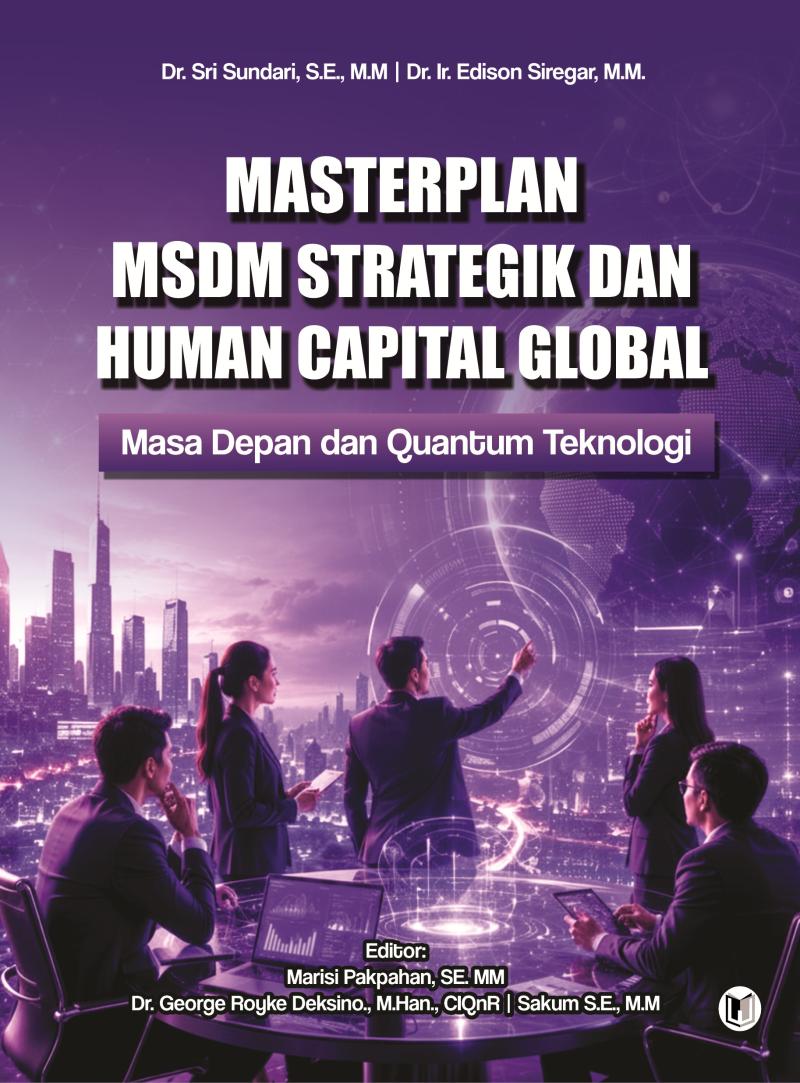
MASTERPLAN MSDM STRATEGIK DAN HUMAN CAPITAL GLOBALMASA DEPAN DAN QUANTUM TEKNOLOGI
Keywords:
Manajemen dan BisnisSynopsis
Buku Masterplan MSDM Strategik dan Human Capital Global Masa Depan dan Quantum Teknologi menghadirkan sebuah perspektif yang tajam dan terstruktur tentang bagaimana manusia menjadi pusat dari keunggulan organisasi di era yang terus berubah. Di tengah gelombang transformasi digital dan kompleksitas global, buku ini menempatkan manajemen sumber daya manusia bukan sekadar fungsi administratif, melainkan sebagai kekuatan strategis yang menentukan arah, daya tahan, dan keberlanjutan organisasi. Dengan pendekatan yang sistematis dan berbasis pemikiran mutakhir, pembaca diajak memahami bagaimana talenta dikelola, dikembangkan, dan dioptimalkan untuk menjawab tantangan masa depan.
Lebih dari sekadar membahas konsep, buku ini menelusuri pergeseran besar menuju era baru yang dipengaruhi oleh teknologi canggih, termasuk artificial intelligence hingga quantum technology. Di dalamnya tergambar bagaimana organisasi perlu bertransformasi tidak hanya pada sistem dan proses, tetapi juga pada cara berpikir, budaya kerja, serta model kepemimpinan. Integrasi antara human capital dan teknologi menjadi benang merah yang menghubungkan setiap gagasan, memperlihatkan bahwa masa depan tidak dimenangkan oleh yang paling kuat, tetapi oleh yang paling adaptif dan mampu belajar secara berkelanjutan.
Dengan gaya yang elegan dan argumentasi yang kuat, buku ini menawarkan sebuah peta jalan yang relevan bagi akademisi, praktisi, maupun pengambil kebijakan. Ia tidak hanya menjelaskan apa yang harus dilakukan, tetapi juga mengapa dan bagaimana melakukannya secara strategis. Sebuah karya yang tidak berisik, namun meninggalkan kesan mendalam mengajak pembaca untuk melihat bahwa investasi terbesar organisasi dan bangsa bukanlah pada teknologi semata, melainkan pada kualitas manusia yang menggerakkannya.
Downloads
Download data is not yet available.
References
AbuGhanem, M. (2025). IBM quantum computers: Evolution, performance, and future directions. The Journal of Supercomputing.
Alavi, S., Wahab, D. A., Muhamad, N., & Arbab Shirani, B. (2014). Organic structure and organisational learning as the main antecedents of workforce agility. International Journal of Production Research, 52(21), 6273–6295.
Allen, T. D., et al. (2013). Flexible work arrangements. Journal of Management.
Albi, K., Artha, T., & Subandi, I. (2024). Application of talent management model in improving company competitiveness. American Journal of Economics and Management Business.
Ambler, T., & Barrow, S. (1996). The employer brand. Journal of Brand Management, 4(3), 185–206.
Angrave, D., Charlwood, A., Kirkpatrick, I., Lawrence, M., & Stuart, M. (2016). HR and analytics: Why HR is set to fail the big data challenge. Human Resource Management Journal, 26(1), 1–11.
Anisa, A., Medriati, R., & Putri, D. H. (2019). Quantum learning model and student achievement improvement. Jurnal Pendidikan Indonesia.
Arute, F., et al. (2019). Quantum supremacy using a programmable superconducting processor. Nature, 574(7779), 505–510.
Armstrong, M., & Brown, D. (2019). Strategic human resource management. Institute for Employment Studies.
Aydin, O., Karaarslan, E., & Narin, N. G. (2024). AI, VR, AR and metaverse technologies for human resource management. arXiv preprint.
Backhaus, K. (2016). Employer branding revisited. Organization Management Journal, 13(4), 193–201.
Backhaus, K., & Tikoo, S. (2004). Conceptualizing and researching employer branding. Career Development International, 9(5), 501–517.
Barney, J. (1991). Firm resources and sustained competitive advantage. Journal of Management, 17(1), 99–120.
Bass, B. M. (1985). Leadership and performance beyond expectations. Free Press.
Becker, B. E., & Huselid, M. A. (1998). High performance work systems and firm performance. Academy of Management Journal, 41(1), 8–29.
Becker, G. S. (1993). Human capital: A theoretical and empirical analysis. University of Chicago Press.
Bennett, N., & Lemoine, G. J. (2014). What VUCA really means for you. Harvard Business Review, 92(1/2), 27–42.
Berthon, P., Ewing, M., & Hah, L. L. (2005). Captivating company: Dimensions of attractiveness in employer branding. International Journal of Advertising, 24(2), 151–172.
Bhamra, R., Dani, S., & Burnard, K. (2011). Resilience: The concept, a literature review and future directions. International Journal of Production Research, 49(18), 5375–5393.
Biamonte, J., et al. (2017). Quantum machine learning. Nature, 549(7671), 195–202.
Black, J. S., & van Esch, P. (2021). AI-enabled recruiting. Business Horizons, 64(2), 215–226.
Bonneton, D., et al. (2019). Global talent management programs. The International Journal of Human Resource Management, 33(2), 203–238.
Boudreau, J. W., & Cascio, W. F. (2017). Human capital analytics. Journal of Organizational Effectiveness.
Boudreau, J. W., & Ramstad, P. M. (2007). Beyond HR: The new science of human capital. Harvard Business School Press.
BPS. (2024). Laporan literasi digital Indonesia. Badan Pusat Statistik.
Brewster, C., Mayrhofer, W., & Morley, M. (2016). New challenges for European human resource management. Palgrave Macmillan.
Brynjolfsson, E., & McAfee, A. (2014). The second machine age. W. W. Norton.
Budhwar, P., & Debrah, Y. (2013). Human resource management in developing countries. Routledge.
Caligiuri, P., & Tarique, I. (2012). Dynamic cross-cultural competencies. Journal of World Business.
Cahaya, R., et al. (2025). Strategic HRM in Society 5.0. Jurnal Riset Multidisiplin.
Collings, D. G., & Mellahi, K. (2009). Strategic talent management. Human Resource Management Review, 19(4), 304–313.
Collings, D. G., Scullion, H., & Vaiman, V. (2015). Talent management progress. Human Resource Management Review, 25(3), 233–235.
Collings, D. G., et al. (2019). Global talent management. Journal of World Business, 54(2), 100–110.
Crook, T. R., et al. (2011). Human capital and firm performance meta-analysis. Journal of Applied Psychology, 96(3), 443–456.
Davenport, T. H., & Ronanki, R. (2018). Artificial intelligence for the real world. Harvard Business Review, 96(1), 108–116.
DePorter, B., & Hernacki, M. (2011). Quantum learning. Kaifa.
Delery, J. E., & Doty, D. H. (1996). Strategic HRM modes. Academy of Management Journal, 39(4), 802–835.
Deming, D. J. (2022). Social skills in labor market. Quarterly Journal of Economics, 137(3), 1235–1280.
Denison, D. R., et al. (2014). Organizational culture and effectiveness. Organizational Dynamics.
Deloitte. (2023). Global human capital trends report.
Dineen, B. R., & Allen, D. G. (2016). Employer branding. Journal of Applied Psychology.
Duchek, S. (2020). Organizational resilience. Business Research, 13, 215–246.
Earley, P. C., & Ang, S. (2003). Cultural intelligence. Stanford University Press.
Edwards, M. R. (2010). Employer branding review. Journal of Management Reviews, 12(1), 5–23.
Etzkowitz, H., & Leydesdorff, L. (2000). Innovation dynamics. Research Policy.
EU Commission. (2018). General Data Protection Regulation (GDPR).
Floridi, L., et al. (2018). AI ethics framework. Minds and Machines, 28(4), 689–707.
García-Morales, V. J., et al. (2012). Leadership and innovation. Journal of Business Research.
Garvin, D. A., et al. (2013). Google Project Oxygen. Harvard Business School Case Study.
Gartner. (2022). AI in HR report.
Georgescu, I. M., et al. (2013). Quantum simulation. Reviews of Modern Physics, 86(1), 153–185.
Goorney, S., et al. (2026). Quantum job market analysis. EPJ Quantum Technology.
Grant, R. M. (1996). Knowledge-based view. Strategic Management Journal.
Graen, G. B., & Uhl-Bien, M. (1995). Leadership theory. Leadership Quarterly.
Greinert, F., et al. (2024). Quantum workforce development. arXiv preprint.
Gupta, A. K., & Govindarajan, V. (2002). Global mindset. Academy of Management Executive.
Hanushek, E. A., & Woessmann, L. (2015, 2020). Knowledge capital studies. MIT Press.
Hecklau, F., et al. (2016). Industry 4.0 HR management. Procedia CIRP.
Hofstede, G. (2011). Cultural dimensions model.
Holtom, B. C., et al. (2008). Employee turnover. Academy of Management Annals.
Horodecki, R., et al. (2009). Quantum entanglement. Reviews of Modern Physics.
IBM. (2025). HR analytics report.
Ireland, R. D., & Hitt, M. A. (2005). Strategic competitiveness.
International Labour Organization. (2022). Global employment trends.
Jaja, I., & Gabriel, P. D. I. (2025). Quantum HR management.
Javidan, M., et al. (2010). Global leadership. Harvard Business Review.
Kaplan, R. S., & Norton, D. P. (2000). Balanced scorecard.
Kane, G. C., et al. (2015). Digital transformation.
Kaur, M., & Venegas-Gomez, A. (2022). Quantum workforce.
KemenPANRB. (2023). Laporan SPBE nasional.
Kotter, J. P. (1996). Leading change.
Krelina, M. (2021). Quantum military applications.
Kusumawijaya, I. K., & Astuti, P. D. (2024). Human capital innovation Bali.
Ladd, T. D., et al. (2010). Quantum computers.
Levenson, A. (2018). Workforce analytics.
Lengnick-Hall, C. A., et al. (2011). Organizational resilience.
Lee, K. B., & Searles, T. A. (2021). Quantum HBCU initiative.
Liu, J., & Jiang, L. (2023). Quantum data center.
Marler, J. H., & Boudreau, J. W. (2017). HR analytics review.
Martin, M., et al. (2022). Quantum data centers energy.
McCann, J., & Selsky, J. (2012). Organizational agility.
Men, L. R., & Stacks, D. W. (2014). Organizational reputation.
Minbaeva, D. (2018). Human capital analytics.
Minchington, B. (2010). Employer branding.
Mosca, M. (2018). Quantum cybersecurity.
NATO CCDCOE. (2021, 2023). Cyber defence workforce reports.
Nielsen, M. A., & Chuang, I. L. (2010). Quantum computation and information.
Noe, R. A., et al. (2017). Human resource management.
OECD. (2019, 2021, 2023). Skills and AI reports.
Prasojo, E., et al. (2020). Digital governance Indonesia.
Preskill, J. (2018). NISQ quantum era.
Raisch, S., & Krakowski, S. (2021). AI management.
Rampl, L. V., & Kenning, P. (2014). Employer branding trust.
Ransbotham, S., et al. (2017). AI transformation.
Roberson, Q. M. (2019). Workplace diversity.
Rockstuhl, T., et al. (2017). Cultural intelligence.
Saks, A. M. (2006). Employee engagement.
Schneider, B., et al. (2013). Organizational climate.
Schultz, T. W. (1961). Human capital investment.
Schwab, K. (2020). The Fourth Industrial Revolution.
Schuler, R. S., et al. (2011). Global talent management.
Setiawan, S., et al. (2025). Digital HR transformation.
Sharda, R., et al. (2020). Business analytics.
Snider, D. M., & Matthews, L. J. (2012). Military profession.
Stahl, G. K., et al. (2010, 2012). Cultural diversity.
Strohmeier, S. (2020). Digital HRM.
Susanto, A., et al. (2022). Digital HR Indonesia.
Sundari, S., & Nugroho, N. T. (2024). HR digital era.
Tambe, P., et al. (2019). AI in HR.
Tarique, I., & Schuler, R. (2010). Talent management.
Teece, D. J., et al. (2016). Dynamic capabilities.
Theurer, C. P., et al. (2018). Employer branding review.
Troyer, M., et al. (2024). Quantum societal impact.
Twenge, J. M., et al. (2010). Generational differences.
UNESCO. (2022). Future of education.
Upadhyay, A. K., & Khandelwal, K. (2018). AI in HR.
Ulrich, D., et al. (2017). HR competencies.
van Laar, E., et al. (2017). Digital skills.
Vial, G. (2019). Digital transformation.
Wagh, S., et al. (2026). Quantum HR analytics.
Wagner, C. S., et al. (2018). International collaboration.
World Bank. (2022). Human Capital Index.
World Economic Forum. (2023). Future of Jobs Report.
Westerman, G., et al. (2020). Digital leadership.
Wright, P. M., & McMahan, G. C. (2011). Human capital SHRM.
Yukl, G. (2013). Leadership in organizations.
Yulianah. (2023). Digital HR transformation.
Downloads
Published
July 8, 2026
Copyright (c) 2026 Sri Sundari, Edison Siregar (Author); Marisi Pakpahan, George Royke Deksino, Sakum Sakum (Volume editor)
License

This work is licensed under a Creative Commons Attribution-NonCommercial-ShareAlike 4.0 International License.
How to Cite
Sundari, S., & Siregar, E. (2026). MASTERPLAN MSDM STRATEGIK DAN HUMAN CAPITAL GLOBALMASA DEPAN DAN QUANTUM TEKNOLOGI (M. Pakpahan, G. R. Deksino, & S. Sakum, Eds.). Widina Media Utama. https://doi.org/10.59818/5c2nsn72