FILSAFAT ILMU DAN ETIKA DALAM RISET BIOMEDIK
Keywords:
Filsafat Ilmu (Philosophy of Science), Riset Biomedik (Biomedical Research), Bioetika (Bioethics), Integritas Ilmiah (Scientific Integrity), Sapta Bayu, Ontologi dan Epistemologi, Etika Publikasi (Publication Ethics)Synopsis
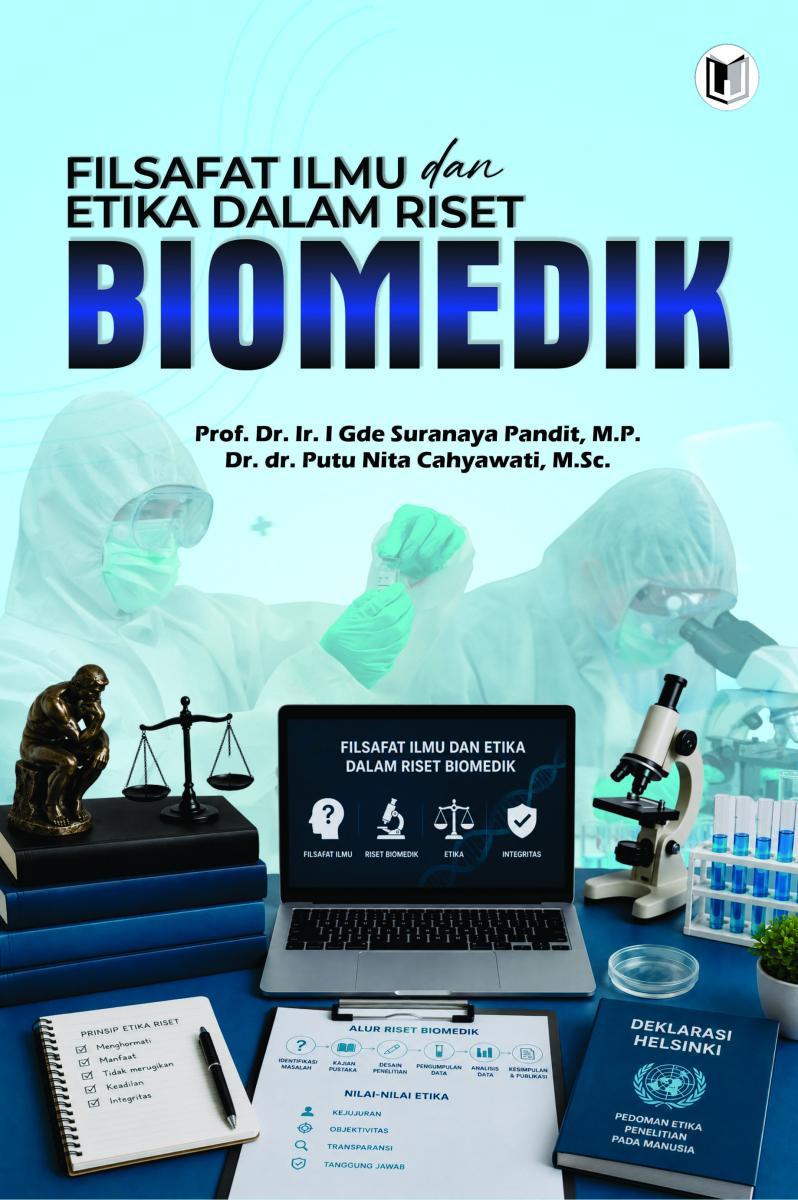
Filsafat Ilmu dan Etika dalam Riset Biomedik adalah buku ajar yang menjawab pertanyaan mendasar yang sering diabaikan dalam pendidikan sains: mengapa seorang peneliti perlu memahami lebih dari sekadar keterampilan teknis di laboratorium? Buku ini dibagi dalam dua alur besar.
Bagian pertama membangun fondasi filosofis melalui tiga pilar utama, yaitu ontologi yang mengajak pembaca mempertanyakan hakikat realitas objek-objek biomedik, epistemologi yang menelaah cara pengetahuan ilmiah dibangun dan divalidasi, serta aksiologi yang menggugat tujuan dan tanggung jawab moral di balik setiap penelitian. Keistimewaan buku ini terletak pada upayanya mengintegrasikan nilai-nilai Sapta Bayu Sri Kesari Warmadewa sebagai landasan karakter peneliti, memperlihatkan bahwa kearifan lokal seperti kejujuran dan pengabdian justru selaras dengan tuntutan integritas ilmiah global. Pemikiran Thomas Kuhn tentang paradigma dan revolusi sains turut dihadirkan untuk mengingatkan bahwa ilmu pengetahuan adalah proses yang dinamis, bukan kumpulan fakta yang statis.
Bagian kedua bergerak ke ranah etika penelitian biomedik yang konkret. Berangkat dari sejarah Kode Nuremberg hingga Deklarasi Helsinki, buku ini mengurai prinsip-prinsip bioetika sebagai panduan praktis, bukan sekadar teori, mulai dari persoalan informed consent lintas budaya, etika penggunaan hewan coba, isu kepemilikan sampel biologis, ancaman biopirasi, keadilan dalam kolaborasi internasional, hingga integritas publikasi ilmiah di era kecerdasan buatan.
Buku ini menjelaskan bahwa menjadi ilmuwan yang baik tidak dapat dipisahkan dari menjadi manusia yang bermoral. Ia tidak hanya mengajarkan aturan, tetapi menawarkan sebuah cara pandang, kompas bagi peneliti yang akan bernavigasi di lanskap sains yang semakin kompleks dan sarat konsekuensi kemanusiaan.
Downloads
Download data is not yet available.
References
Adashi, E. Y., Walters, L. B., & Menikoff, J. A. (2022). The Belmont Report at 40: A need for a new beginning. The American Journal of Bioethics, 22(4), 1–10. https://doi.org/10.1080/15265161.2022.2045431
Adler, M. J. (2021). How to think about the great ideas: A new introduction to the classic questions. Open Road Media.
Afrasiabian, F., Attaran, H., & Mehraeen, E. (2023). The role of metaphysics in modern medical science. Journal of Education and Health Promotion, 12, 321. https://doi.org/10.4103/jehp.jehp_185_23
Afriandi, B., Bumi, H., Kamal, T., Hakim, R., Hanafi, H., & Julhadi, J. (2024). Objek-Objek Kajian Filsafat Ilmu (Ontologi, Epistemologi, Aksiologi) dan Urgensinya Dalam Kajian Keislaman. Jurnal Kajian dan Pengembangan Umat. https://doi.org/10.31869/jkpu.v7i1.5524
Andersen, H. (2020). The Kuhnian paradigm. In The Routledge Companion to Philosophy of Science (pp. 209–219). Routledge.
Annas, G. J. (2022). The Nuremberg Code in the 21st century: A 75th anniversary tribute. The American Journal of Public Health, 112(8), 1124–1127. https://doi.org/10.2105/AJPH.2022.306911
Armond, A., Gordijn, B., Lewis, J., Hosseini, M., Bodnár, J., Holm, S., & Kakuk, P. (2021). A scoping review of the literature featuring research ethics and research integrity cases. BMC Medical Ethics, 22. https://doi.org/10.1186/s12910-021-00620-8
Atef, M. (2024). Ethics of Scientific Research in Forensic Medicine. Egyptian Society of Clinical Toxicology Journal. https://doi.org/10.21608/esctj.2024.284098.1054
Ateljevic, I. (2020). Transforming the (tourism) world for good and (re)generating the potential for tourist studies. Tourism Geographies, 22(3), 467–478. https://doi.org/10.1080/14616688.2020.1755354
Baker, D. J. (2022). Quantum information and the foundations of quantum mechanics. In The Routledge Companion to Philosophy of Physics (pp. 534–549). Routledge.
Bannigan, K., & Watson, R. (2020). Reliability and validity in a nutshell. Journal of Clinical Nursing, 29(15–16), 2736–2738. https://doi.org/10.1111/jocn.15243
Baylis, F. (2022). Human germline genome editing: A case for a global moratorium. Nature Medicine, 28(11), 2219–2222. https://doi.org/10.1038/s41591-022-02029-7
Beauchamp, T. L. (2019). A defense of the common morality. Kennedy Institute of Ethics Journal, 29(3), 197–216. https://doi.org/10.1353/ken.2019.0016
Beima-Sofie, K., Kristjanson, A., & John-Stewart, G. (2021). Building and sustaining equitable academic partnerships for global health research. The American Journal of Tropical Medicine and Hygiene, 105(4 Suppl), 24–30. https://doi.org/10.4269/ajtmh.20-1498
Bird, A. (2021). The epistemology of science. In E. N. Zalta (Ed.), The Stanford Encyclopedia of Philosophy (Fall 2021 Edition). https://plato.stanford.edu/archives/fall2021/entries/science-epistemology/
Borry, P., Evers-Kiebooms, G., & Cornel, M. C. (2020). Genetic counseling and the ethical issues around genomic medicine. The New England Journal of Medicine, 382(25), 2449–2457. https://doi.org/10.1056/NEJMra1914212
Boudry, M., & Pigliucci, M. (2021). The structure of scientific revolutions and the unwarranted triumph of Kuhnian relativism. Skeptic, 26(4), 48–55.
Brainard, J. (2023). Journals adopt new policies on AI-generated text. Science, 379(6631), 423–424. https://doi.org/10.1126/science.adg8314
Budimir, D., Polasek, O., Marusic, A., Kolcic, I., & Zemunik, T. (2021). Ethical aspects of human biobanks: A systematic review. Croatian Medical Journal, 62(4), 369–378. https://doi.org/10.3325/cmj.2021.62.369
Canali, S., & Leonelli, S. (2022). Reframing the data journey: A prospective view on data-intensive research. Harvard Data Science Review, 4(2). https://doi.org/10.1162/99608f92.7fc17199
Carel, H. (2021). Illness, phenomenology, and the difference a paradigm makes. Journal of the British Society for Phenomenology, 52(2), 115–129. https://doi.org/10.1080/00071773.2020.1862590
Carlson, R. V., Boyd, K. M., & Webb, D. J. (2023). The Declaration of Helsinki and clinical research: A closer look at the inconsistencies. Journal of Medical Ethics, 49(6), 403–408. http://dx.doi.org/10.1136/jme-2022-108422
Caulfield, T., & Murdoch, B. (2017). Genes, cells, and biobanks: Yes, there's a property problem. PLoS Biology, 15(7), e2002854. https://doi.org/10.1371/journal.pbio.2002854
Caulfield, T., Greely, H. T., & Knoppers, B. M. (2021). The Helsinki Declaration and the ethics of human material transfer. Nature Medicine, 27(5), 763–766. https://doi.org/10.1038/s41591-021-01358-x
Cetin, E., Civaner, M., & Arda, B. (2019). The role of research ethics committees in monitoring and responding to serious adverse events in clinical trials. Journal of Medical Ethics, 45(12), 795–800. http://dx.doi.org/10.1136/medethics-2019-105504
Chalmers, A. F. (2019). What is this thing called science? (4th ed.). Hackett Publishing Company.
Cho, H. M., Johnson, R., & Bull, S. (2022). The role of full board review in the current U.S. research ethics system. Journal of Empirical Research on Human Research Ethics, 17(1–2), 22–30. https://doi.org/10.1177/15562646211054415
Committee on Publication Ethics (COPE). (2023). COPE Core Practices. Retrieved from https://publicationethics.org/core-practices
De Cruz, H. (2022). The epistemology of rationalism and empiricism. In The Oxford Handbook of the Cognitive Science of Religion (pp. 31–48). Oxford University Press.
DeTora, L., Lane, T., Sykes, A., DiBiasi, F., Toroser, D., & Citrome, L. (2023). Good Publication Practice (GPP) Guidelines for Company-Sponsored Biomedical Research: 2022 Update. Annals of Internal Medicine, 176. https://doi.org/10.7326/l22-0490
Doshi, P., Gupta, A., & Badyal, D. (2021). The drug industry's marketing-driven business model: A challenge to medical professionalism. BMJ, 374, n1835. https://doi.org/10.1136/bmj.n1835
Douglas, H. (2021). The role of values in science: The case for methodological standards. Cambridge University Press.
du Sert, N. P., Ahluwalia, A., Alam, S., Avey, M. T., Baker, M., Bate, S. T., ... & Lings, B. (2020). The ARRIVE guidelines 2.0: Updated guidelines for reporting animal research. PLoS Biology, 18(7), e3000410. https://doi.org/10.1371/journal.pbio.3000410
Durocher, E., Lanteigne, C., & LeBlanc, A. (2021). The challenge of maintaining research ethics board independence: A qualitative study of institutional pressures. Journal of Academic Ethics, 19(3), 369–387. https://doi.org/10.1007/s10805-020-09386-z
Emanuel, E. J., Wendler, D., & Grady, C. (2020). The Oxford textbook of clinical research ethics (2nd ed.). Oxford University Press.
Fauzi, A., & Paham, K. (2021). Honesty as a Cornerstone of Scientific Integrity: A Philosophical Inquiry. Science and Engineering Ethics, 27(3), 34. https://doi.org/10.1007/s11948-021-00298-y
Findlater, A., O’Cathain, A., & Tso, M. (2022). The role of tourism in the spread of infectious diseases: A systematic review. Journal of Travel Medicine, 29(4), taac065. https://doi.org/10.1093/jtm/taac065
French, S. (2020). The role of observation and experimentation in science. In The Routledge Companion to Philosophy of Science (pp. 222–232). Routledge.
Fuller, S. (2022). Thomas Kuhn: A philosophical history for our times (2nd ed.). University of Chicago Press.
Garrard, E., & Dawson, A. (2019). The CIOMS International Ethical Guidelines for Health-Related Research Involving Humans, 2016: A review. Bioethics, 33(5), 523–530. https://doi.org/10.1111/bioe.12555
Gasparyan, A. Y., Nurmashev, B., Yessirkepov, M., Endovitskiy, D. A., Voronov, A. A., & Kitas, G. D. (2022). The text similarity software: A wider perspective. Journal of Korean Medical Science, 37(29), e224. https://doi.org/10.3346/jkms.2022.37.e224
Gaukroger, S. (2021). The Failures of Philosophy: A Historical Essay. Princeton University Press.
Glass, D. J. (2021). The role of the hypothesis in science. The American Biology Teacher, 83(2), 86–91. https://doi.org/10.1525/abt.2021.83.2.86
Goetz, L. H., & Schork, N. J. (2018). Personalized medicine: Motivation, challenges, and progress. Fertility and Sterility, 109(6), 952–963. https://doi.org/10.1016/j.fertnstert.2018.05.006
Goldacre, B. (2022). Bad pharma: How drug companies mislead doctors and harm patients (Revised ed.). Signal.
Goldenberg, M. J. (2021). Vaccine hesitancy: Public trust, expertise, and the war on science. University of Pittsburgh Press.
Gössling, S., & Reiser, D. (2021). The sociology of tourism. CABI.
Gould, S. J. (2002). Rocks of Ages: Science and religion in the fullness of life. Ballantine Books.
Gower, B. (2012). Scientific method: An historical and philosophical introduction. Routledge.
Grady, C. (2020). The challenge of assuring voluntariness in research. The American Journal of Bioethics, 20(10), 5–7. https://doi.org/10.1080/15265161.2020.1806657
Green, R. C., Glessner, J. T., & Kong, S. W. (2019). GINA, genetic discrimination, and the future of genetic medicine. JAMA, 322(16), 1555–1556. https://doi.org/10.1001/jama.2019.14134
Greenhalgh, T., & Papoutsi, C. (2019). Spreading and scaling up innovation and improvement: A systematic review of the literature on diffusion, dissemination and sustainability. BMJ Open, 9(6), e027100. https://doi.org/10.1136/bmjopen-2018-027100
Grote, T., & Berens, P. (2020). On the ethics of algorithmic decision-making in healthcare. Journal of Medical Ethics, 46(3), 205–211. http://dx.doi.org/10.1136/medethics-2019-105586
Haack, S. (2022). The pragmatist theory of truth. In E. N. Zalta & U. Nodelman (Eds.), The Stanford Encyclopedia of Philosophy (Winter 2022 Edition). https://plato.stanford.edu/archives/win2022/entries/truth-pragmatist/
Hamid, A., Zekkour, H., & Supriyatno, T. (2024). The Concept of Education Religion, Philosophy, Ethics and Science. Indonesian Journal of Islamic Education Studies (INJURIES). https://doi.org/10.61227/injuries.v2i3.128
Hansson, M. G. (2021). The "gift" and "stewardship" models in biobanking. Journal of Medical Ethics, 47(12), e81. http://dx.doi.org/10.1136/medethics-2020-106574
Heide, F. A. (2021). Property rights in human biological material: A moral-legal analysis. Journal of Bioethical Inquiry, 18(2), 333–345. https://doi.org/10.1007/s11673-021-10099-0
Hens, K. (2022). Chance Encounters. Open Book Publishers. https://doi.org/10.11647/obp.0320
Hidayat, R. (2020). Cultural competence in cross-cultural research: A guideline for researchers in Indonesia. Makara Journal of Health Research, 24(1), 1–5. https://doi.org/10.7454/msk.v24i1.1180
Hidayat, T., & Sugiarto, B. (2021). Objectivity in scientific research: A philosophical perspective. Jurnal Filsafat Indonesia, 4(3), 220–228.
Horbach, S. P., & Halffman, W. (2019). The extent and causes of academic text recycling or "self-plagiarism". Research Policy, 48(2), 492–502. https://doi.org/10.1016/j.respol.2017.09.004
Hyder, A. A., & Pratt, B. (2020). The ethics of global health research in a multicultural world. In Oxford Textbook of Global Public Health (7th ed.). Oxford University Press.
Hyun, I. (2022). The bioethics of creating human-animal chimeras. Nature Reviews Genetics, 23(10), 569–570. https://doi.org/10.1038/s41576-022-00525-4
International Committee of Medical Journal Editors (ICMJE). (2023). Defining the Role of Authors and Contributors. Retrieved from https://www.icmje.org/recommendations/browse/roles-and-responsibilities/defining-the-role-of-authors-and-contributors.html
Ioannidis, J. P. (2018). The study of the entire corpus of evidence: A new paradigm for medicine. Journal of the Royal Society of Medicine, 111(1), 7–10. https://doi.org/10.1177/0141076817741639
Ioannidis, J. P. A. (2023). Reproducibility, validity, and the ecology of science. PLoS Biology, 21(5), e3002133. https://doi.org/10.1371/journal.pbio.3002133
Irawan, B. (2023). Kepemimpinan Berbasis Kearifan Lokal: Relevansi Nilai-Nilai Tradisional dalam Manajemen Modern. Jurnal Manajemen dan Kepemimpinan, 6(2), 112–125.
Jago, M. (2021). What is materialism? Routledge.
Jardine, J., Golder, S., & Vale, L. (2023). Cross-cultural adaptation of informed consent documents in clinical trials: A systematic review. Trials, 24(1), 586. https://doi.org/10.1186/s13063-023-07616-z
Jouanna, J. (2012). Greek Medicine from Hippocrates to Galen: Selected Papers. Brill.
Kandeel, M., Al-Nazawi, M., & El-Garhy, O. (2020). The importance of progress reports in ensuring ethical conduct of research: A perspective from an REC. IRB: Ethics & Human Research, 42(6), 18–21. https://doi.org/10.1002/irb.20677
Kaye, J., Lo, A., & Mahomed, S. (2022). Dynamic consent: A new paradigm for medical research. Annual Review of Genomics and Human Genetics, 23, 343–361. https://doi.org/10.1146/annurev-genom-111220-101740
Khushf, G. (2021). The challenge of nosology and the definition of disease. In The Oxford Handbook of Philosophy and Medicine (pp. 577–596). Oxford University Press.
Killian, T. (2021). The expedited review paradox: How streamlining research ethics review can inadvertently increase burden. Accountability in Research, 28(8), 494–511. https://doi.org/10.1080/08989621.2021.1895697
Krimsky, S. (2021). The troubling case of the "CRISPR babies". The American Journal of Bioethics, 21(1), 4–13. https://doi.org/10.1080/15265161.2020.1852445
Krubiner, C. B., Faden, R. R., & Jaworski, A. (2021). A precision-justice approach to new drug approvals: The case of aducanumab for Alzheimer's disease. The Lancet, 398(10302), 738–740. https://doi.org/10.1016/S0140-6736(21)01824-2
Kuhn, T. S. (2012). The structure of scientific revolutions (4th ed.). University of Chicago Press.
Lange, M. M., Lignou, S., Lorke, D. E., & Trojan, J. (2022). Ethical considerations in research with vulnerable groups: The case of research with refugees. BMC Medical Ethics, 23(1), 12. https://doi.org/10.1186/s12910-022-00750-9
Lennox, J. G. (2021). Aristotle on inquiry: Erotetic frameworks and domain-specific norms. Cambridge University Press.
Liston, G. (2021). Scientific realism, the history of science, and the ontology of theories. Synthese, 199(3), 8567–8588. https://doi.org/10.1007/s11229-021-03173-z
Lubowitz, J., Matzkin, E., & Rossi, M. (2024). Troubling trends in biomedical research publication: "Publish or perish" results in a propensity for ethical violations. Arthroscopy: The Journal of Arthroscopic & Related Surgery. https://doi.org/10.1016/j.arthro.2024.12.017
Marcum, J. A. (2020). Is evidence-based medicine a Kuhnian paradigm? Journal of Evaluation in Clinical Practice, 26(3), 859–868. https://doi.org/10.1111/jep.13374
Marx, V. (2021). A new dawn for AI in science. Nature Methods, 18(10), 1129–1133. https://doi.org/10.1038/s41592-021-01283-3
Mastroleo, I., & Bianchini, A. (2021). Why the biomedical sciences need philosophy: Theoretical and practical reasons illustrated with examples from the BioThera Institute of Philosophy. Journal of Science, Humanities and Arts (JOSHA), 8. https://doi.org/10.17160/josha.8.1.728
Mavrogenis, A., & Scarlat, M. (2021). Writing for International Orthopaedics: Authorship, fraud, and ethical concerns. International Orthopaedics, 45, 2461–2464. https://doi.org/10.1007/s00264-021-05226-8
Mellor, D. J. (2021). The Five Domains Model: A tool for assessing and managing animal welfare. Journal of Animal Science, 99(8), skab250. https://doi.org/10.1093/jas/skab250
Menon, V., & R, J. (2022). Ethics vs. law: Understanding the nuances. Journal of Medical Evidence, 3(1), 1–3. https://doi.org/10.4103/jme.jme_150_21
Merton, R. K. (1973). The normative structure of science. In The sociology of science: Theoretical and empirical investigations (pp. 267–278). University of Chicago Press.
Mikkelsen, R. B., Gjerris, M., & Waldemar, G. (2019). Broad consent for biobanks: A survey of potential participants' views and the impact of a brief educational intervention. BMC Medical Ethics, 20(1), 89. https://doi.org/10.1186/s12910-019-0428-2
Morgera, E., & Tsioumani, E. (2021). The Nagoya Protocol on Access and Benefit-sharing: A study of its contribution to international environmental law. Review of European, Comparative & International Environmental Law, 30(2), 173–185. https://doi.org/10.1111/reel.12385
Munip, A. (2024). Ilmu dalam Tinjauan Filsafat: Ontologi, Epistemologi, dan Aksiologi. Al-Aulia: Jurnal Pendidikan dan Ilmu-Ilmu Keislaman. https://doi.org/10.46963/aulia.v10i1.1875
Muth, C. (2020). On the shoulders of giants: The value of history for medical students and doctors. Journal of Medical Biography, 28(3), 167–173. https://doi.org/10.1177/0967772017739504
Nuryana, Z., & Fauzi, A. (2020). The role of spiritual intelligence in academic integrity: A study of university students. Journal of Moral Education, 49(4), 496–511. https://doi.org/10.1080/03057240.2019.1680909
Okasha, S. (2022). Philosophy of science: A very short introduction (2nd ed.). Oxford University Press.
O'Malley, M. A. (2021). From genomes to ecosystems: A new paradigm for microbiology. The Quarterly Review of Biology, 96(1), 1–32. https://doi.org/10.1086/713339
Panadés, R., & Yuguero, O. (2025). Cyber-bioethics: The new ethical discipline for digital health. Frontiers in Digital Health, 6. https://doi.org/10.3389/fdgth.2024.1523180
Parascandola, M. (2021). The Bradford Hill criteria and their discontents. Perspectives in Biology and Medicine, 64(1), 107–120. https://doi.org/10.1353/pbm.2021.0006
Pauzi, I., Sarjan, M., Muliadi, A., Azizi, A., Hamidi, H., Yamin, M., Muttaqin, M., Ardiansyah, B., Rahmatiah, R., Sudirman, S., Rasyidi, M., & Khery, Y. (2022). Peranan Filsafat dalam Pendidikan Ilmu Kesehatan (Kajian Ontologi, Epistemologi, dan Aksiologi). Educatoria: Jurnal Ilmiah Ilmu Pendidikan. https://doi.org/10.36312/ejiip.v2i4.134
Pennock, R. T. (2021). The virtues of the scientist. Theoria: An International Journal for Theory, History and Foundations of Science, 36(2), 249–268. https://doi.org/10.1387/theoria.22329
Pievani, T. (2022). The incommensurability of scientific paradigms: A new look at an old question. Synthese, 200(4), 304. https://doi.org/10.1007/s11229-022-03767-7
Pleshchev, I., Shishkin, A., & Ivashkovskaya, A. (2025). Ethics in medical research and publications. Медицинская этика. https://doi.org/10.24075/medet.2025.004
Popper, K. (2020). The logic of scientific discovery. Routledge.
Potochnik, A. (2021). The diverse aims of science. Studies in History and Philosophy of Science Part A, 87, 1–10. https://doi.org/10.1016/j.shpsa.2021.01.001
Powers, M., Faden, R. R., & Tilburt, J. C. (2020). Justice and the allocation of medical resources. The New England Journal of Medicine, 382(22), 2089–2091. https://doi.org/10.1056/NEJMp2005472
Pratiwi, U., Karneli, Y., & Marsidin, S. (2024). Pemahaman Mendasar tentang Hakekat Ilmu dalam Tinjauan Filsafat: Ontologi, Epistemologi, dan Aksiologi. Jurnal Pendidikan Siber Nusantara. https://doi.org/10.38035/jpsn.v2i2.170
Pratt, B., Hyder, A. A., & Beco, A. (2020). A study of the principles of fair research collaboration. Health Research Policy and Systems, 18(1), 12. https://doi.org/10.1186/s12961-020-0526-7
Pray, L. (2020). Discovery of DNA structure and function: Watson and Crick. Nature Education, 1(1), 100.
Psillos, S. (2021). Induction and confirmation. In E. N. Zalta (Ed.), The Stanford Encyclopedia of Philosophy. https://plato.stanford.edu/archives/win2021/entries/induction-problem/
Rachmawati, I. N. (2021). Enhancing global competitiveness through local genius: A strategy for Indonesian researchers. Journal of Higher Education Policy and Management, 43(5), 488–502. https://doi.org/10.1080/1360080X.2020.1862125
Rahman, M. H., & Kuan, Y. A. (2020). The role of Material Transfer Agreements in academic research: A systematic review. Science and Engineering Ethics, 26(6), 3209–3236. https://doi.org/10.1007/s11948-020-00262-2
Rescher, N. (2020). The coherence theory of truth. Routledge.
Resnik, D. B. (2022). The ethics of science: An introduction. Routledge.
Robinson, D. F. (2020). Biopiracy and the innovations of indigenous peoples. The Journal of World Intellectual Property, 23(5–6), 256–271. https://doi.org/10.1111/jwip.12160
Robinson, H. (2023). Dualism. In E. N. Zalta & U. Nodelman (Eds.), The Stanford Encyclopedia of Philosophy. https://plato.stanford.edu/archives/win2023/entries/dualism/
Rosenberg, A., & McShea, D. W. (2020). Philosophy of biology: A contemporary introduction. Routledge.
Rovelli, C. (2023). Anaximander and the nature of science. Allen Lane.
Sampat, B. N., & Williams, H. L. (2020). How do private firms respond to publicly funded research? American Economic Review, 110(3), 728–763. https://doi.org/10.1257/aer.20180468
Sariola, S., Gairdner, A., & Nyamnjoh, F. (2021). "Helicopter research": The coloniality of Western research practices in Africa. The Sociological Review, 69(6), 1368–1384. https://doi.org/10.1177/00380261211025515
Sarkar, S., & Plutynski, A. (Eds.). (2021). A companion to the philosophy of biology. John Wiley & Sons.
Saw, J. H. (2021). Idealism in the philosophy of medicine. Theoretical Medicine and Bioethics, 42(3–4), 101–118. https://doi.org/10.1007/s11017-021-09559-8
Sawicka-Gutaj, N., Gruszczyński, D., Guzik, P., Mostowska, A., & Walkowiak, J. (2022). Publication ethics of human studies in the light of the Declaration of Helsinki: A mini-review. Journal of Medical Science. https://doi.org/10.20883/medical.e700
Schroeder, D. (2023). Dual-use research of concern: A decade of policy debate. Science and Engineering Ethics, 29(1), 5. https://doi.org/10.1007/s11948-023-00424-x
Segal, R. A. (2018). Myth: A very short introduction (2nd ed.). Oxford University Press.
Shapiro, L. (2020). Revolutions in cognitive science. Philosophy Compass, 15(8), e12689. https://doi.org/10.1111/phc3.12689
Shuster, E. (2022). The Nuremberg Code: A critique. In The Ethics of Medical-Military Research (pp. 119–130). Routledge.
Silaen, I. S., Tumbelaka, P. S., & Wulandari, L. P. L. (2022). The role of the National Health Research and Development Ethics Commission (KEPPKN) in Indonesia. Journal of Public Health in Africa, 13(S1). https://doi.org/10.4081/jphia.2022.2155
Singh, B., Kumar, R., & Singh, R. (2022). Nanotechnology in drug delivery: A comprehensive review. Journal of Drug Delivery Science and Technology, 71, 103289. https://doi.org/10.1016/j.jddst.2022.103289
Skirton, H., Goldsmith, L., & Jackson, L. (2022). The experience of receiving a variant of uncertain significance (VUS) from genomic testing: A systematic review. European Journal of Human Genetics, 30(6), 624–632. https://doi.org/10.1038/s41431-022-01058-2
Smith, A. J., & Farnaud, S. (2022). The 3Rs: A historical and a future-oriented perspective. Animals, 12(23), 3376. https://doi.org/10.3390/ani12233376
Smith, G. E. (2022). The Newtonian style in Book II of the Principia. In The Oxford Handbook of Isaac Newton. Oxford University Press.
Stanton, C. (2023). Community-based participatory research: A framework for ethical engagement and social justice. Journal of Empirical Research on Human Research Ethics, 18(4), 183–195. https://doi.org/10.1177/15562646231189498
Stark, L. (2021). The role of sanctions in ensuring research integrity: A comparative analysis. Science and Engineering Ethics, 27(5), 62. https://doi.org/10.1007/s11948-021-00336-9
Steup, M., & Neta, R. (2020). Epistemology. In E. N. Zalta (Ed.), The Stanford Encyclopedia of Philosophy (Fall 2020 Edition). https://plato.stanford.edu/archives/fall2020/entries/epistemology/
Sugarman, J. (2020). The role of bioethics in navigating the COVID-19 pandemic. The Journal of the American Medical Association, 323(21), 2135–2136. https://doi.org/10.1001/jama.2020.7303
Sulaeman, A. (2021). Common sense knowledge versus scientific knowledge: A critical review. International Journal of Social Science and Human Research, 4(8), 1938–1943.
Sulasmini, S., & Putra, I. D. G. A. D. (2022). The philosophy of Tri Hita Karana in Balinese community health research: A scoping review. Jurnal Ners dan Kebidanan Indonesia (Indonesian Journal of Nursing and Midwifery), 10(1), 55–63. https://doi.org/10.21927/jnki.2022.10(1).55-63
Sumartias, S., & Sumartias, S. (2019). The role of local wisdom in fostering tolerance among youths in a multicultural society. Journal of Intercultural Communication Research, 48(5), 449–465. https://doi.org/10.1080/17475759.2019.1656828
Susanto, A. (2022). The scientific method: Principles and practices in research. Jurnal Metode Penelitian, 1(1), 1–12.
Thorp, H. H. (2023). ChatGPT is fun, but not an author. Science, 379(6630), 313. https://doi.org/10.1126/science.adg7879
Tiliouine, H. (2022). Faith and reason in theistic traditions. In The Palgrave Handbook of Global Religion and Spirituality (pp. 1–21). Palgrave Macmillan.
Törnqvist, E., Annas, A., & Olsson, I. A. S. (2023). The role of refinement in improving the welfare of research animals. Lab Animal, 52(2), 33–40. https://doi.org/10.1038/s41684-022-01099-0
Ullmann, A. (2019). Pasteur-Koch: Distinctive ways of thinking about infectious diseases. Microbe Magazine, 4(9), 405–409.
Vanzo, A. (2021). The evolution of the distinction between rationalism and empiricism. Philosophical Papers, 50(3), 445–474. https://doi.org/10.1080/05568641.2021.1994270
Véliz, C. (2021). The case against privacy-invading research. The American Journal of Bioethics, 21(5), 45–56. https://doi.org/10.1080/15265161.2021.1896894
Wakefield, J. C. (2022). The concept of mental disorder: A realist/constructivist hybrid approach. World Psychiatry, 21(2), 194–195. https://doi.org/10.1002/wps.20967
Weber-Wulff, D. (2019). Plagiarism detectors are a crutch, and a problem. Nature, 567(7749), 435. https://doi.org/10.1038/d41586-019-00893-5
Widyanto, E., & Setiawan, B. (2022). Integrating local wisdom into character education to enhance students’ environmental awareness. Pegem Journal of Education and Instruction, 12(4), 218–228. https://doi.org/10.47750/pegegog.12.04.23
Williams, A., & Martinez, P. (2022). Indigenous knowledge systems and their intersection with Western science: A call for collaborative research. AlterNative: An International Journal of Indigenous Peoples, 18(2), 220–231. https://doi.org/10.1177/11771801221098691
Wolkenhauer, O. (2021). Why is systems biology a "challenge to research traditions" in the life sciences? History and Philosophy of the Life Sciences, 43(1), 12. https://doi.org/10.1007/s40656-021-00371-x
Wootton, D. (2019). The invention of science: A new history of the scientific revolution. Penguin Books.
Wurtz, N., Hotez, P. J., & Lavergne, A. (2021). Biosafety and biosecurity in the era of COVID-19. PLoS Neglected Tropical Diseases, 15(8), e0009585. https://doi.org/10.1371/journal.pntd.0009585
Yasri, Y., Susanto, P., & Hidayat, R. (2021). Harmonizing science and religion: Case studies of Muslim scientists in Indonesia. Zygon®, 56(3), 678–695. https://doi.org/10.1111/zygo.12705
Ylikoski, P. (2022). Scientific revolutions. In The Cambridge Handbook of the Philosophy of Science (pp. 119–141). Cambridge University Press. https://doi.org/10.1017/9781108658296.008
Downloads
Published
July 6, 2026
Copyright (c) 2026 Prof. Dr. Ir. I Gde Suranaya Pandit, M.P. Widina, Dr. dr. Putu Nita Cahyawati, M.Sc. Widina (Author)
License

This work is licensed under a Creative Commons Attribution-NonCommercial-ShareAlike 4.0 International License.
How to Cite
Widina, P. D. I. I. G. S. P. M., & Widina, D. dr. P. N. C. M. (2026). FILSAFAT ILMU DAN ETIKA DALAM RISET BIOMEDIK. Widina Media Utama. https://doi.org/10.59818/xnh30b02