PERMASALAHAN BELAJAR DAN INOVASI PEMBELAJARAN
Keywords:
Permasalahan, Belajar, Inovasi, PembelajaranSynopsis
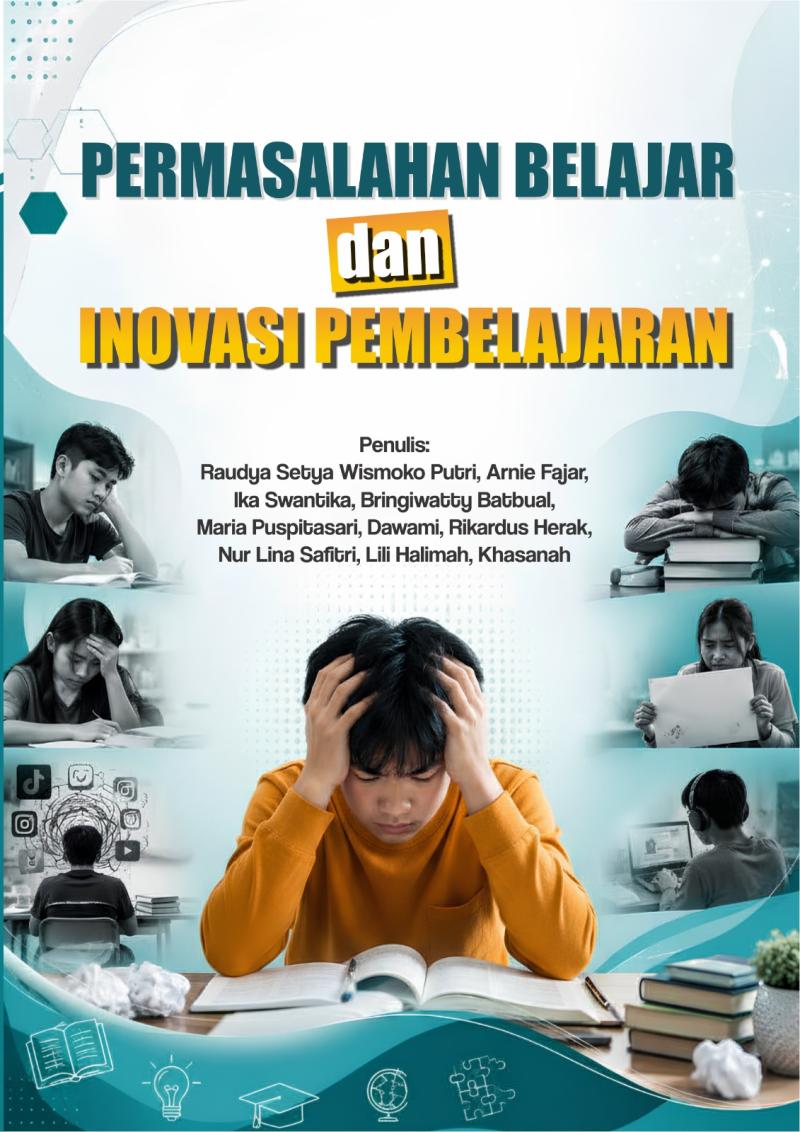
Buku ini membahas secara komprehensif berbagai permasalahan belajar yang dialami peserta didik serta strategi inovatif dalam menciptakan pembelajaran yang efektif, relevan, dan adaptif terhadap perkembangan zaman.
Pembahasan diawali dengan konsep dasar belajar, meliputi hakikat belajar, teori-teori belajar, faktor-faktor yang memengaruhi proses belajar, serta indikator keberhasilan belajar. Selanjutnya, buku ini menguraikan berbagai bentuk permasalahan belajar, seperti kesulitan belajar, rendahnya motivasi, kecemasan akademik, prokrastinasi, burnout, serta gangguan psikologis yang dapat memengaruhi prestasi peserta didik.
Buku ini juga membahas tantangan pembelajaran di era digital, termasuk distraksi gawai, kecanduan media sosial, dan kesenjangan akses teknologi. Sebagai solusi, disajikan berbagai inovasi pembelajaran modern, seperti Problem Based Learning, Project Based Learning, Flipped Classroom, Discovery Learning, e-learning, artificial intelligence, gamifikasi, dan pembelajaran berdiferensiasi.
Buku ini diharapkan menjadi referensi bagi mahasiswa, guru, peneliti, dan praktisi pendidikan dalam memahami permasalahan belajar serta mengembangkan inovasi pembelajaran yang berkualitas
Downloads
Download data is not yet available.
References
Abdiyah, L., & Subiyantoro, S. (2021). PENERAPAN TEORI KONSTRUKTIVISTIK DALAM PEMBELAJARAN TEMATIK DI SEKOLAH DASAR. ELSE (Elementary School Education Journal) Jurnal Pendidikan Dan Pembelajaran Sekolah Dasar, 5(2), 127. https://doi.org/10.30651/else.v5i2.6951
Abidin, A. M. (2022). PENERAPAN TEORI BELAJAR BEHAVIORISME DALAM PEMBELAJARAN (STUDI PADA ANAK). AN-NISA, 15(1), 1. https://doi.org/10.30863/an.v15i1.3315
Andriani, R., & Suratman, A. (2021). Media pembelajaran berbasis andrioid untuk meningkatkan motivasi dan hasil belajar siswa. Jurnal Analisa, 7(1), 56. https://doi.org/10.15575/ja.v7i1.10654
Anggreani, R., & Khairuna, K. (2022). THE INFLUENCE OF COOPERATIVE LEARNING MODEL WITH THE ASSISTANCE OF AUDIO-VISUAL MEDIA. Ta Dib Jurnal Pendidikan Islam, 11(2), 261. https://doi.org/10.29313/tjpi.v11i2.10136
Armedyatama, F. (2021). Teori Belajar Humanistik dan Implikasinya dalam Mata Pelajaran Pendidikan Agama Islam. An-Nuha, 1(1), 11. https://doi.org/10.24036/annuha.v1i1.12
Asmareni, J., Ramadhani, E., & Nurlela, N. (2022). Hubungan Antara Kondisi Lingkungan Sekolah Dengan Aktivitas Belajar Siswa SMA Shailendra Palembang. Indonesian Research Journal On Education, 3(1), 103. https://doi.org/10.31004/irje.v3i1.126
Basyir, M. S., Dinana, A., & Devi, A. D. (2022). Kontribusi Teori Belajar Kognitivisme David P. Ausubel dan Robert M. Gagne dalam Proses Pembelajaran. Jurnal Pendidikan Madrasah, 7(1), 89. https://doi.org/10.14421/jpm.2022.71.12
Daga, A. T. (2022). THE ROLE OF TEACHERS IN IMPLEMENTING THE POLICY OF INDEPENDENT LEARNING IN ELEMENTARY SCHOOL. ELSE (Elementary School Education Journal) Jurnal Pendidikan Dan Pembelajaran Sekolah Dasar, 6(1), 1. https://doi.org/10.30651/else.v6i1.9120
Diana, M. N., & Wiyatmo, Y. (2023). KEEFEKTIFAN PEMBELAJARAN FISIKA BERBASIS FLIPPEDLEARNING MENGGUNAKAN EDMODO DITINJAU DARI PENINGKATAN HASIL BELAJAR ASPEK KOGNITIF DAN KEMANDIRIAN BELAJAR PESERTA DIDIK SMA MUHAMMADIYAH 1 YOGYAKARTA. Jurnal Pendidikan Fisika, 10(2), 1. https://doi.org/10.21831/jpf.v10i2.11096
Faizah, H., & Kamal, R. (2024). Belajar dan Pembelajaran. Jurnal Basicedu, 8(1), 466. https://doi.org/10.31004/basicedu.v8i1.6735
Faizah, S. N. (2020). Hakikat Belajar Dan Pembelajaran. At-Thullab Jurnal Pendidikan Guru Madrasah Ibtidaiyah, 1(2), 175. https://doi.org/10.30736/atl.v1i2.85
Fitri, S. W., Nofitri, N., Say, W., & Ilmi, D. (2023). Teori Belajar Konstruktivistik dan Penerapannya Dalam Pembelajaran PAI. ANTHOR Education and Learning Journal, 2(3), 434. https://doi.org/10.31004/anthor.v2i3.173
Gunarto, E., Huriyah, H., & Rosidin, D. N. (2023). Manajemen Pembelajaran Berbasis Smart Classroom untuk Meningkatkan Hasil Belajar Siswa SMA. JIEM (Journal of Islamic Education Management), 7(1), 63. https://doi.org/10.24235/jiem.v7i1.13295
Habsy, B. A., Zakirah, A., Rahmah, M., & Nafisah, C. A. (2023). Implementasi Teori Kognitif dan Konstruktivisme dalam Pembelajaran bagi Peserta Didik. TSAQOFAH, 4(1), 326. https://doi.org/10.58578/tsaqofah.v4i1.2182
Hambali, H., Rozi, F., & Nuraini, D. (2022). HUMANISTIC LEARNING THEORY; UPAYA DALAM MENINGKATKAN PRESTASI BELAJAR SISWA DI MADRASAH. Autentik Jurnal Pengembangan Pendidikan Dasar, 6(2), 349. https://doi.org/10.36379/autentik.v6i2.268
Hastiwi, F., Khasanah, U., & Wahyuningsih, S. (2023). Peningkatan Keaktifan dan Hasil Belajar IPAS Menggunakan Model Problem Based Learning Kelas IV SD Muhammadiyah Kleco 2 Tahun Ajaran 2022/2023. Kalam Cendekia Jurnal Ilmiah Kependidikan, 11(2). https://doi.org/10.20961/jkc.v11i2.75334
Hayati, M., Murdiana, M., & Arifmiboy, A. (2023). Teori-Teori Belajar dan Kaitannya Dengan Pengembangan Kurikulum PAI. ANTHOR Education and Learning Journal, 2(5), 662. https://doi.org/10.31004/anthor.v1i5.219
Herdian, H., Nuraeni, N., & Septiningsih, D. S. (2021). Pelatihan Identifikasi Gaya Belajar Siswa pada Kelompok Guru SD Muhammadiyah 1 dan SD Muhammadiyah 2 Kecamatan Cimanggu Kabupaten Cilacap. Community Empowerment, 6(2), 105. https://doi.org/10.31603/ce.4396
Hotìmah, I. H. (2022). Landasan Filosofis dan Teori Pendidikan Sejarah dalam Buku Teks Sejarah Kelas X Karya Ratna Hapsari dan M. Adil. SOCIA Jurnal Ilmu-Ilmu Sosial, 19(2), 51. https://doi.org/10.21831/socia.v19i2.54288
Husin, M. R., Hassan, N. M., Sheng, V. Y. Z., Tormizi, A. S. M., Zulkapli, N. S. A., George, M., Rosli, R., Hishamuddin, N. I. R. A. M., Shaharudin, N. S., & Adampai, C. S. (2021). Perspektif Guru Terhadap Pembelajaran Pelajar Remaja. Journal of Humanities and Social Sciences (JHASS), 3(1), 40. https://doi.org/10.36079/lamintang.jhass-0301.211
Ikhtiarini, R. U., Utomo, S. W., & Sulistyowati, N. W. (2021). Faktor Yang Mempengaruhi Motivasi Belajar Siswa Pada Materi Akuntansi Dasar. Tangible Journal, 6(1), 102. https://doi.org/10.47221/tangible.v6i1.138
Indrawan, D. (2021). Implikasi Aliran Behavioristik dan Kognitif Terhadap Perkembangan Belajar dan Tingkah Laku dalam Pembelajaran. Jurnal Basicedu, 5(6), 5151. https://doi.org/10.31004/basicedu.v5i6.1581
Ita, C. S., & Sihotang, H. (2021). HARMONISASI POLA ASUH ORANG TUA DALAM MENINGKATKAN PRESTASI BELAJAR PADA TINGKAT SEKOLAH MENENGAH ATAS. Jurnal Handayani, 12(1), 128. https://doi.org/10.24114/jh.v12i1.26558
Iwani, F. N., Mardianah, M., & Alwi, B. M. (2025). Perbedaan Individu Dalam Belajar: Telaah Atas Faktor-Faktor Yang Mempengaruhinya. PESHUM Jurnal Pendidikan Sosial Dan Humaniora, 4(5), 7047. https://doi.org/10.56799/peshum.v4i5.9982
Jamaluddin, J., Mustami, M. K., Ismail, M., & Mania, S. (2022). Pengaruh Pemanfaatan Bahan Ajar Berbasis Tik dan Bahan Cetak Terhadap Motivasi Belajar pada Mata Pelajaran Aqidah Akhlak di MAN 1 Sinjai. Edukasi Islami Jurnal Pendidikan Islam, 11(1), 621. https://doi.org/10.30868/ei.v11i01.1956
Jumarniati, J., & Anas, A. (2019). Pengaruh Motivasi Belajar dan Aktivitas Belajar terhadap Hasil Belajar Mahasiswa Program Studi PGSD. Cokroaminoto Journal of Primary Education, 2(2), 41. https://doi.org/10.30605/cjpe.222019.113
Magdalena, I., Nurchayati, A., Uyun, N., & Rean, G. T. (2023). Implikasi Teori Psikologi Kognitif dalam Proses Belajar dan Pembelajaran. Al-DYAS, 2(3). https://doi.org/10.58578/aldyas.v2i3.1465
Makhsura, S., Agustin, R., Rifma, Jasrial, J., & Syahril, S. (2023). Implementasi Behaviorisme dan Humanisme dalam Proses Pembelajaran. Aulad Journal on Early Childhood, 6(3), 501. https://doi.org/10.31004/aulad.v6i3.548
Malikah, S., Fauzıatı, E., & Maryadi, M. (2022). Perspektif Connectivisme terhadap Pembelajaran Daring Berbasis Google Workspace For Education. EDUKATIF JURNAL ILMU PENDIDIKAN, 4(2), 2050. https://doi.org/10.31004/edukatif.v4i2.2355
Marlina, Y., Muliawati, T., & Erihadiana, M. (2023). IMPLEMENTATION OF KURIKULUM MERDEKA IN INTEGRATED ISLAMIC SCHOOL. Tatar Pasundan Jurnal Diklat Keagamaan, 17(1), 69. https://doi.org/10.38075/tp.v17i1.312
Marwah, H. S., Suchyadi, Y., & Mahajani, T. (2021). PENGARUH MODEL PROBLEM BASED LEARNING TERHADAP HASIL BELAJAR SUBTEMA MANUSIA DAN BENDA DI LINGKUNGANNYA. Journal of Social Studies Arts and Humanities (JSSAH), 1(1), 42. https://doi.org/10.33751/jssah.v1i01.3977
Melyani, N. K. S. A., & Ratnadi, N. M. D. (2023). Motivasi Belajar, Perilaku Belajar, Lingkungan Belajar dan Tingkat Pemahaman Akuntansi Selama Pandemi Covid-19. E-Jurnal Akuntansi, 33(12). https://doi.org/10.24843/eja.2023.v33.i12.p10
Mulyadi, M. (2022). Teori Belajar Konstruktivisme Dengan Model Pembelajaran (Inquiry). Al Yasini Jurnal Keislaman Sosial Hukum Dan Pendidikan, 7(2), 174. https://doi.org/10.55102/alyasini.v7i2.4482
Mustafa, P. S., & Roesdiyanto, R. (2021). Penerapan Teori Belajar Konstruktivisme melalui Model PAKEM dalam Permainan Bolavoli pada Sekolah Menengah Pertama. Jendela Olahraga, 6(1), 50. https://doi.org/10.26877/jo.v6i1.6255
Muzakki, Z., Illahi, N., & Muljawan, A. (2022). ETIKA BELAJAR DALAM AL-QURAN. JIQTA Jurnal Ilmu Al-Qur an Dan Tafsir, 1(1), 72. https://doi.org/10.36769/jiqta.v1i1.216
NIRMALA, Y. (2023). PIAGET PENERAPAN TEORI PEMBELAJARAN PIAGET DALAM KBM. Jurnal Bocil Journal of Childhood Education Development and Parenting, 1(2), 111. https://doi.org/10.28926/bocil.v1i2.960
Pratama, R. W., & Nurrochmah, S. (2023). Hubungan antara hasil tes kebugaran jasmani dengan hasil belajar semester gasal. Jurnal Porkes, 6(2), 605. https://doi.org/10.29408/porkes.v6i2.21395
Putri, F. A., Akmal, J., & Gusmaneli, G. (2024). Prinsip-prinsip dan Teori-teori belajar dalam Pembelajaran. Jurnal Budi Pekerti Agama Islam, 2(2), 332. https://doi.org/10.61132/jbpai.v2i2.279
Putri, F. K. A., Husna, M. J., & Nihayah, S. A. (2023). Implementasi Teori Belajar Humanistik dalam Pembelajaran dan Pembentukan Karakter Anak. Tinta Emas Jurnal Pendidikan Islam Anak Usia Dini, 2(1), 33. https://doi.org/10.35878/tintaemas.v2i1.772
Qalsum, U. (2020). Peningkatan Hasil Belajar Bahasa Indonesia Melalui Model Pembelajaran Kooperatif dengan Tipe Numbered Heads Together (NHT) Siswa Kelas VII.C SMP Datok Sulaiman Palopo pada Materi Teks Narasi (Cerita Imajinasi). Jurnal Onoma Pendidikan Bahasa Dan Sastra, 6(1), 481. https://doi.org/10.30605/onoma.v6i1.255
Rahayu, J., & Imami, A. I. (2022). Pengaruh self-regulated learning terhadap minat belajar siswa SMP pada pembelajaran matematika. AKSIOMA Jurnal Matematika Dan Pendidikan Matematika, 13(3), 489. https://doi.org/10.26877/aks.v13i3.13899
Rahman, A., Hayati, M., Rusmani, M. A., & Ilmi, D. (2023). Teori Belajar Humanistik dan Implikasinya Dalam Pembelajaran. ANTHOR Education and Learning Journal, 2(3), 402. https://doi.org/10.31004/anthor.v2i3.156
Rizqi, A. F., Adilla, B. L., Sulistiyawati, E., & Taufiqurrohmah, T. (2023). ANALISIS KESULITAN BELAJAR MATEMATIKA PADA SISWA SEKOLAH DASAR DAN ALTERNATIF PEMECAHANNYA. Jurnal Pendidikan Dasar Flobamorata, 4(1), 481. https://doi.org/10.51494/jpdf.v4i1.588
Salsabila, Y. R., & Muqowim, M. (2024). KORELASI ANTARA TEORI BELAJAR KONSTRUKTIVISME LEV VYGOTSKY DENGAN MODEL PEMBELAJARAN PROBLEM BASED LEARNING (PBL). LEARNING Jurnal Inovasi Penelitian Pendidikan Dan Pembelajaran, 4(3), 813. https://doi.org/10.51878/learning.v4i3.3185
Saumantri, T. (2022). Pemberdayaan Siswa Melalui Peningkatan Kemampuan Baca-Tulis Kitab Ta’lim Al-Muta’allim: Studi Pembelajaran Siswa Masjid Al-Ma’had Dukupuntang Kabupaten Cirebon. Empower Jurnal Pengembangan Masyarakat Islam, 7(1), 111. https://doi.org/10.24235/empower.v7i1.10028
Selvia, D. (2021). Motivasi Belajar Siswa dalam Pembelajaran Fisika. Science and Physics Education Journal (SPEJ), 4(2), 47. https://doi.org/10.31539/spej.v4i2.1899
Seroja, M., & Gultom, I. (2015). PENGARUH PENGGUNAAN MEDIA PEMBELAJARAN DAN MOTIVASI BERPRESTASI TERHADAP HASIL BELAJAR GEOGRAFI SISWA SMP NEGERI KECAMATAN SINGKIL. JURNAL TEKNOLOGI INFORMASI & KOMUNIKASI DALAM PENDIDIKAN, 2(1). https://doi.org/10.24114/jtikp.v2i1.3283
Sihombing, H. W., Afandi, M., & Subhan, M. (2024). Faktor-Faktor yang Mempengaruhi Proses Pembelajaran. Ar Rumman, 1(2), 685. https://doi.org/10.57235/arrumman.v1i2.4320
Simanjuntak, A. F., Husein, R., & Sudrajat, A. (2022). Pengaruh Model Inkuiri Terbimbing dan Keterampilan Sosial terhadap Hasil Belajar IPS Siswa Kelas V Sekolah Dasar. EDUKATIF JURNAL ILMU PENDIDIKAN, 4(6), 7477. https://doi.org/10.31004/edukatif.v4i6.4076
Suarim, B., & Neviyarni, N. (2021). Hakikat Belajar Konsep pada Peserta Didik. EDUKATIF JURNAL ILMU PENDIDIKAN, 3(1), 75. https://doi.org/10.31004/edukatif.v3i1.214
Subroto, T., Sahroni, S., & Gumelar, A. (2024). Analisis Unsur Pembelajaran Reflektif Berbasis Alur “MERDEKA†sebagai Penguatan Karakter Mahasiswa Pendidikan Profesi Guru Prajabatan. Jurnal Moral Kemasyarakatan, 9(1), 175. https://doi.org/10.21067/jmk.v9i1.10267
Suderajat, E., Herpratiwi, H., & Widodo, S. (2022). Pengembangan Bahan Ajar Materi Pembelajaran IPS Terpadu Menggunakan Multimedia Interaktif Sway di Sekolah Menengah Pertama. EDUKATIF JURNAL ILMU PENDIDIKAN, 4(4), 5323. https://doi.org/10.31004/edukatif.v4i4.3110
Sugiyanta, G., Trisnani, N., & Santika, Y. (2023). EFEKTIVITAS MEDIA PEMBELAJARAN DAKOTA (DAKON MATEMATIKA) DALAM MENINGKATKAN HASIL BELAJAR MATEMATIKA DI SEKOLAH DASAR. SCHOOL EDUCATION JOURNAL PGSD FIP UNIMED, 13(1), 27. https://doi.org/10.24114/sejpgsd.v13i1.42876
Sultani, S., Alfitri, A., & Noorhaidi, N. (2023). TEORI BELAJAR HUMANISTIK DAN PENERAPANNYA DALAM PEMBELAJARAN PENDIDIKAN AGAMA ISLAM. ANSIRU PAI Pengembangan Profesi Guru Pendidikan Agama Islam, 7(1), 177. https://doi.org/10.30821/ansiru.v7i1.16108
Sumiyati, S., Nisa, A. F., Muammar, M., Rahayu, M. S., Astuti, Y., & Purwati, P. (2021). PENGARUH MODEL BELAJAR BLENDED LEARNING MENGGUNAKAN PHET SIMULATION TERHADAP HASIL BELAJAR SISWA KELAS VI SEKOLAH DASAR. El Midad, 13(2), 66. https://doi.org/10.20414/elmidad.v13i2.4337
Supriatna, U., & Rahayu, P. (2021). Hubungan pembelajaran akidah akhlak dan perilaku siswa. Journal of Nusantara Education, 1(1), 19. https://doi.org/10.57176/jn.v1i1.2
Sutomo, F. G., & Aini, M. R. Q. (2024). Pemahaman Karakteristik Peserta Didik Dalam Mengoptimalkan Pembelajaran. Jurnal Kajian Penelitian Pendidikan Dan Kebudayaan, 2(4), 60. https://doi.org/10.59031/jkppk.v2i4.499
Sutrisna, A. A., Ruswandi, D. N. A., Tambunan, P. S., Maysyarah, M., & Khairunnisa, K. (2024). Analisis Permasalahan Belajar Pada Anak Sekolah Dasar. Journal on Education, 6(4), 20828. https://doi.org/10.31004/joe.v6i4.6206
Suwarta, N. S. (2022). NILAI PENDIDIKAN DAN IDENTITAS SOSIAL CALON BRAHMANA DALAM NOVEL AROK DEDES. Lingua Franca Jurnal Bahasa Sastra Dan Pengajarannya, 6(2), 190. https://doi.org/10.30651/lf.v6i2.14697
Syarifuddin, S. (2022). TEORI HUMANISTIK DAN APLIKASINYA DALAM PEMBELAJARAN DI SEKOLAH. TAJDID Jurnal Pemikiran Keislaman Dan Kemanusiaan, 6(1), 106. https://doi.org/10.52266/tadjid.v6i1.837
Umar, A. F. F., Yusuf, A., Amini, A. R., & Alhadi, A. (2023). Pengaruh Motivasi Belajar Terhadap Peningkatan Prestasi Akademik Siswa. Wacana Jurnal Bahasa Seni Dan Pengajaran, 7(2), 121. https://doi.org/10.29407/jbsp.v7i2.20670
Vitriani, V., Hera, T., & Rizhardi, R. (2022). PENGARUH MODEL PEMBELAJARAN EXAMPLES NON-EXAMPLES TERHADAP HASIL BELAJAR TEMATIK SISWA. JS (JURNAL SEKOLAH), 6(4), 65. https://doi.org/10.24114/js.v6i4.38621
Wahyuni, T., Uswatun, N., & Fauzıatı, E. (2023). Merdeka Belajar dalam Perspektif Teori Belajar Kognitivisme Jean Piaget. TSAQOFAH, 3(1), 129. https://doi.org/10.58578/tsaqofah.v3i1.834
Witasari, R. (2024). Belajar dan Pembelajaran dari perspektif Teori kognitif, behaviorisme Konstruktivisme dan sosiokultural. BASICA Journal of Arts and Science in Primary Education, 3(2), 257. https://doi.org/10.37680/basica.v3i2.5764
Yana, V., Dani, M., & Purnomo, E. (2022). Menumbuhkan motivasi belajar perspektif Hadits Sunan Ibnu Majah. Tawazun Jurnal Pendidikan Islam, 15(3), 369. https://doi.org/10.32832/tawazun.v15i3.7620
Bronfenbrenner, U. (1979). The ecology of human development: Experiments by nature and design. Harvard University Press.
Cortiella, C., & Horowitz, S. H. (2014). The state of learning disabilities: Facts, trends and emerging issues. National Center for Learning Disabilities Research & Practice, 29(2), 65–73.
Djamarah, S. B. (2011). Psikologi belajar. Rineka Cipta.
Hattie, J. (2009). Visible learning: A synthesis of over 800 meta-analyses relating to achievement. Routledge.
Jeynes, W. (2012). A meta-analysis on the effects of parental involvement on students’ academic outcomes. Urban Education, 47(4), 706–742.
Lerner, J. W., & Johns, B. (2015). Learning disabilities and related disabilities: Strategies for success (13th ed.). Cengage Learning.
Pintrich, P. R., & De Groot, E. V. (1990). Motivational and self-regulated learning components of classroom academic performance. Journal of Educational Psychology, 82(1), 33–40.
Santrock, J. W. (2018). Educational psychology (6th ed.). McGraw-Hill Education.
Schunk, D. H., & Greene, J. A. (2018). Handbook of self-regulation of learning and performance (2nd ed.). Routledge.
Slameto. (2015). Belajar dan faktor-faktor yang mempengaruhinya. Rineka Cipta.
Snowling, M. J., & Hulme, C. (2012). Annual research review: The nature and classification of reading disorders – A commentary on proposals for DSM-5. Journal of Child Psychology and Psychiatry, 53(5), 593–607.
Syah, M. (2017). Psikologi pendidikan dengan pendekatan baru. Remaja Rosdakarya.
Winkel, W. S., & Hastuti, S. (2013). Bimbingan dan konseling di institusi pendidikan. Media Abadi.
Woolfolk, A. (2019). Educational psychology (14th ed.). Pearson.
Zimmerman, B. J. (2002). Becoming a self-regulated learner: An overview. Theory Into Practice, 41(2), 64–70.
Abdurrahman, M. (2003). Pendidikan Bagi Anak Berkesulitan Belajar. Jakarta: Rineka Cipta.
Anam, S., Nurlatifah., & Mega (2020). Lupa, Jenuh, dan Kesulitan Dalam Belajar. At – Turots. Jurnal Pendidikan Islam. 2(1). ISSN: 2656-7577.
Djamarah, Syaiful. B. (2015). Psikologi Belajar. Jakarta. Rineka Cipta
Fiqih Ananda, A., Tirta, W., Patonah, S., Nurtamala, E., Maesaroh, T., & Syekh Manshur, S. (2025). Serumpun Mengajar Volume 02 Nomor 01. 02(April), 40–46.
Guru, S., Mengatasi, D., & Belajar, K. (2025). Cemara Journal. III(Iii).
Kumano. (2001). Psikologi Pendidikan. In Erlangga (Vol. 6, Issue 2).
Pipit Muliyah, Dyah Aminatun, Sukma Septian Nasution, Tommy Hastomo, Setiana Sri Wahyuni Sitepu, T. (2020). Diaknosis Kesulitan Belajar. In Journal GEEJ (Vol. 7, Issue 2).
Setiyatna, H., Islam, P., Usia, A., Islam, U., Raden, N., & Said, M. (2025). Strategi Guru dalam Penanganan Kesulitan Belajar Disleksia Pada Anak Usia Dini. 9, 32325–32331.
Syah. Muhibbin. (2001). Psikologi Pendidikan dengan Pendekatan Baru Bandung. Remaja Rosdakarya.
Syah. Muhibbin. (2003). Psikologi Belajar. Jakarta. PT. Raja Grafindo Persada
Syah. Muhibbin. (2013). Psikologi Pendidikan dengan Pendekatan Baru Bandung. Remaja Rosdakarya.
Wijaya, E. (2020). Identification and Intervention of Specific Learning Disorder in Children. Damianus Journal of Medicine, 19(1), 70–79. https://ejournal.atmajaya.ac.id/index.php/damianus/article/view/1279
Abdurraman, A., et al. (2025) Teori Belajar dan Implementasinya dalam Pendidikan. Jakarta: Prenadamedia Group.
Ashoolihah, Q.A.N. (2026) ‘Peran Konseling dalam Mengatasi Kesulitan Belajar’, Jurnal Pendidikan Konseling, 8(1), pp. 45–56.
Azmi, Z. (2025) ‘Refleksi Guru dalam Meningkatkan Kreativitas Pembelajaran’, Prosiding Seminar Nasional Pendidikan, pp. 120–128.
Black, P. and Wiliam, D. (2021) ‘Classroom Assessment and Learning Improvement’, Assessment in Education, 28(3), pp. 295–310.
Brookhart, S.M. (2021) How to Give Effective Feedback to Students. 2nd edn. Alexandria: ASCD.
Doboli, S., et al. (2022) ‘Student Learning Challenges in Higher Education’, Education Sciences, 12(4), pp. 1–12.
Faliki, A.N. (2025) ‘Peran Guru dalam Pembelajaran Abad 21’, Jurnal Pendidikan, 10(2), pp. 150–160.
Fithriyah, N. (2024) Psikologi Pendidikan dan Teori Belajar. Yogyakarta: Deepublish.
Fullan, M. (2020) Leading in a Culture of Change. San Francisco: Jossey-Bass.
Hattie, J. (2020) Visible Learning: Feedback and Achievement. London: Routledge.
Herlina, L. (2025) Evaluasi Pembelajaran: Teori, Praktik, dan Inovasi. Bandung: Alfabeta.
Ismaya, S.Z. (2025) ‘Strategi Penanganan Kesulitan Belajar’, Jurnal Pendidikan Inovatif, 7(2), pp. 88–99.
Kurniawan, D. (2021) ‘Analisis Kesulitan Belajar dan Penanganannya’, Jurnal Pendidikan Dasar, 6(1), pp. 34–42.
Kusumawati, R., et al. (2023) ‘Pengaruh Sarana dan Metode Pembelajaran terhadap Hasil Belajar’, Jurnal Pendidikan Modern, 5(3), pp. 210–220.
Maghfiroh, L. (2026) Konsep Belajar dalam Perspektif Pendidikan Modern. Malang: UM Press.
Margareta, L.E. (2023) ‘Inovasi Pembelajaran dalam Pendidikan Tinggi’, Jurnal Pendidikan Tinggi, 9(1), pp. 12–25.
Mukaddam, M.F. (2025) ‘Pengembangan Kompetensi Guru Berkelanjutan’, Jurnal Riset Pendidikan, 11(2), pp. 98–110.
Muthmainnah, et al. (2025) ‘Komunitas Belajar Guru dan Pengembangan Profesional’, Jurnal Pendidikan dan Kebudayaan, 10(1), pp. 55–66.
OECD (2021) Education at a Glance 2021: OECD Indicators. Paris: OECD Publishing.
Owoc, M.L., et al. (2021) ‘Artificial Intelligence in Education: Applications and Challenges’, Computers & Education, 170, pp. 1–10.
Paputungan, S.B. and Buhungo, R.A. (2026) ‘Kreativitas Guru dalam Pembelajaran Abad 21’, Jurnal Edukasi, 12(1), pp. 77–89.
Permana, A. (2025) ‘Motivasi Belajar dan Faktor Internal Peserta Didik’, Jurnal Psikologi Pendidikan, 8(2), pp. 65–75.
Redhana, I.W. (2025) Konstruktivisme dalam Pembelajaran Modern. Denpasar: Udayana Press.
Rusmawati, V. (2025) ‘Kompetensi Guru Profesional’, Jurnal Pendidikan Nasional, 9(2), pp. 130–140.
Slavin, R.E. (2020) Educational Psychology: Theory and Practice. 13th edn. Boston: Pearson.
Subiyantoro (2024) ‘Behaviorisme dalam Pembelajaran’, Jurnal Pendidikan Dasar, 7(1), pp. 23–30.
Taruna, A. (2025) ‘Strategi Layanan Bimbingan Konseling’, Jurnal Ilmu Pendidikan, 6(2), pp. 100–112.
UNESCO (2021) Reimagining Our Futures Together: A New Social Contract for Education. Paris: UNESCO.
UNESA (2024) ‘Transformasi Peran Guru di Era Digital’, Jurnal Pendidikan Digital, 3(1), pp. 1–10.
Wiggins, G. (2021) Educative Assessment: Designing Assessments to Inform and Improve Student Performance. San Francisco: Jossey-Bass.
Alter, A. (2017). Irresistible: The Rise of Addictive Technology and the Business of Keeping Us Hooked. Penguin Press.
Attewell, P. (2001). The First and Second Digital Divides. Sociology of Education, 74(3), 252–259. doi.org
Azizi, S. M., Khatony, A., Nayery, Y., Rajati, F., & Geravandi, S. (2019). The relationship between social networking addiction and academic performance in nursing students: A multicenter study. Journal of Education and Health Promotion, 8(1), 52
Bosch, T. 2016. “Twitter and participatory citizenship” #FeesMustFall in South Africa,” dalam Mustvairo, B. 2016. Digital activism in the the social media era: critical reflections on emerging trends in Sub-Saharan Africa. UK: Springer Nature, p. 159-173
Calzada, I., 2020. “Democratising Smart Cities? Penta-Helix Multistakeholder Social Innovation Framework.” Smart Cities 2020, 3, 1145–1173; doi:10.3390/smartcities3040057 www.mdpi.com/journal/smartcities
Da-anton, CLF & Dioso, ED. 2025. The Effects of Electronic Gadgets on the Learning Behavior of Students: A Research Article Correlation. International Journal of Interdisciplinary Viewpoints Volume 1 Issue 4, pages 529-551, July 2025
Guo, Y. (2025). The impact of the digital divide on educational equity. SHS Web of Conferences, 222, 04004. doi.org
Hawi, N. S., & Samaha, M. (2016). The relations among social media addiction, self-esteem, and life satisfaction in university students. Social Science Computer Review, 35(5), 576-586. doi.org
Hou, Y., Xiong, D., Jiang, T., Song, L., & Wang, Q. (2019). Social media addiction: Its impact, mediation, and intervention. Cyberpsychology: Journal of Psychosocial Research on Cyberspace, 13(1). doi.org
Hoskyns, T. 2014. The Empty Place: Democracy and public space. New York: Routledge
Kuss, D. J., & Griffiths, M. D. (2017). Social Networking Sites and Addiction: Ten Lessons Learned. International Journal Environment Res. Public Health, 14(3), 311.
Leroy, S. (2009). Why is it so hard to do my work? The challenge of attention residue when switching between work tasks. Organization Science, 20(1), 168-181
Le, V., Tran, B. N., Nguyen, H. L., Duong, T. T. P., & Hoang, N. M. (2025). The Role of Technology, Emotions, and Classroom Environment: Technology Usage Frequency and Cognitive Load are Key Predictors of Digital Distraction, while Self-Regulation Ability Serves as a Protective Factor. International Journal of Multidisciplinary Research and Analysis, 8(3)
Luo, J., Hostetler, K., Sayinzoga-Cass, E., & Abdelfattah, G. (2020). Digital distraction in the classroom: Exploring the role of self-regulation. Journal of Computer Assisted Learning, 36(3), 289-299. doi.org
Martin, F., Long, S. Haywood, K., & Xie, K. 2025. “Digital distractions in education: a systematic review of research on causes, consequences and prevention strategies” dalam Education Tech Research Dev (2025) 73:3423–3451 https://doi.org/10.1007/s11423-025-10550-6
Nasution, R. 2026. "Schools urged to reinforce responsible gadget use culture” https://en.antaranews.com/news/410454/schools-urged-to-reinforce-responsible-gadget-use-culture#
OECD. (2021). OECD Digital Education Outlook 2021: Pushing the Frontier with AI, Blockchain and Robots. OECD Publishing
Papacharissi, Z. 2002. “The virtual sphere, The internet as a public sphere”. Journal of New Media & Society, Vol.4 no.1 pp. 9–27
Puspitasari, M. 2026. Manajemen krisis dalam memulihkan reputasi pada personal branding dalam Wardhana, MA. 2026. Personal branding dalam strategi pemasaran modern. Badung: Infest Media
Tarafdar, M., Tu, Q., Pu, R., & Ragu-Nathan, T. S. (2015). A dual-stage model of technostress: From an antecedent to an outcome. Information Systems Journal, 25(2), 103–132. doi.org
Thapa, P. , Sharma, P., Goundar, S. Tsirkas, P. Valamontes, A. & Adamopoulos, I. 2025. “Digital Distractions in the Classroom Among Students: A Cross-Sectional Study” dalam Preprints.org. doi:10.20944/preprints202502.1931.v1
Van Deursen, A. J. A. M. & Van Dijk, J. A. G. M. (2011). Internet Skills and the Digital Divide. New Media & Society, 13(6), 893–911.
Ahmad, D., Akib, S., Wahyuni, R. S., Dawami, D., Stellarosa, Y., Nugraheni, E. S., et al. (2025). Komunikasi pendidikan. CV Widina Media Utama.
Akbar, M. R., & Dawami, D. (2023). Communication development people in the revolutionary era industry 4.0 & Covid-19. Linguanusa: Social Humanities, Education and Linguistic, 1(1), 10–18.
Baharuddin. (2025). Inovasi pembelajaran blended learning dalam pendidikan matematika. Jurnal Citra Pendidikan, 5(3), 54–62. https://doi.org/10.38048/jcp.v5i3.6283
Bruner, J. S. (1966). Toward a theory of instruction. Harvard University Press.
Dawami, D., Akbar, M. R., & Nurmatias, W. (2025). Kearifan lokal dalam pendidikan moderasi beragama: Telaah nilai filosofis makna simbolik tepak sirih. Instructional Development Journal, 8(2), 449–457.
Dawami, D., Helmiati, H., & Nazir, M. (2024). Analisis kebijakan integrasi pendidikan agama Islam dalam kurikulum pendidikan di negara sekuler Belanda. Instructional Development Journal, 7(3), 620–629.
Dawami, D., Zaitun, & Murhayati, S. (2025). Integrasi nilai Islam dalam model kurikulum berbasis TIK. Iqra: Jurnal Ilmu Kependidikan dan Keislaman, 20(1), 58–66.
Dewey, J. (1938). Experience and education. Macmillan.
Freire, P. (2005). Pedagogy of the oppressed. Continuum.
Lase, R. S., Zega, J. H. K., Laowo, E. N., Telaumbanua, V. H., & Waruwu, Y. (2025). Inovasi pembelajaran: Mengintegrasikan teknologi untuk meningkatkan keterlibatan siswa dalam pembelajaran. Jurnal Education and Development, 13(1), 505–512.
Lasswell, H. D. (1948). The structure and function of communication in society. In L. Bryson (Ed.), The communication of ideas (pp. 37–51). Harper & Row.
Piaget, J. (1972). The psychology of the child. Basic Books.
Prajayana, M. I., Febriantika, I., & Yayuk, E. (2025). Inovasi project-based learning dalam pembelajaran IPAS: Studi kreativitas siswa pada diorama ekosistem. Pendas: Jurnal Ilmiah Pendidikan Dasar, 10(2).
Rogers, C. R. (1969). Freedom to learn. Merrill Publishing.
Rogers, E. M. (2003). Diffusion of innovations (5th ed.). Free Press.
Saleh, M. S., Dawami, D., et al. (2023). Teori komunikasi pembelajaran. PT Global Eksekutif Teknologi.
Siti Anisyah, Imlessh, M. M. M., Kusumaningrum, S., Haryati, N. S., & Santoso, J. T. B. (2024). Augmented reality: Interactive and fun learning media to improve student learning outcomes. Jurnal Kependidikan: Penelitian Inovasi Pembelajaran, 8(2).
Skinner, B. F. (1968). The technology of teaching. Appleton-Century-Crofts.
Umami, T. S., Agustini, K., & Suartama, I. K. (2025). Discovery learning widely applied at junior level with positive learning outcome. Indonesian Journal of Innovation Studies, 26(3).
Vygotsky, L. S. (1978). Mind in society: The development of higher psychological processes. Harvard University Press.
Woolfolk, A. (2022). Educational psychology (15th ed.). Pearson.
Aje, A. U. (2020). Model pembelajaran kooperatif tipe student achievement division (stad) & team games tournament (tgt). CV. Azka Pustaka.
Arsil, Hamengkubuwono, & Abdul Rahman. (2025). The Effect of the Implementation of the Cooperative Learning Model Type Student Teams Achievement Division (STAD) on Creativity, Initiative, Motivation and Student Learning Outcomes. Jurnal Iqra’ : Kajian Ilmu Pendidikan, 10(1), 54–74. https://doi.org/10.25217/ji.v10i1.5026
Aulls, M. W., & Shore, B. M. (2023). Inquiry in education, Volume I:The Conceptual Foundations for Research as a Curricular Imperative. Routledge, Taylor & Francis Group.
Barbalho, S. C. M., Reis, A. C. B., Bitencourt, J. A., Leão, M. C. L. D. A., & Silva, G. L. D. (2017). A Project Based Learning approach for Production Planning and Control: Analysis of 45 projects developed by students. Production, 27(spe). https://doi.org/10.1590/0103-6513.225916
Daly, R., Tunney, E., Spooner, M., Offiah, G., Flood, K., & Kent, F. (2026). Case-based learning (CBL) in undergraduate health professions education: A realist review. Medical Education. https://doi.org/10.1111/medu.70179
El Miedany, Y. (2019). Flipped Learning. In Y. El Miedany, Rheumatology Teaching (pp. 285–303). Springer International Publishing. https://doi.org/10.1007/978-3-319-98213-7_15
Gonzalez, L. (2019). The Problem-Based Learning Model. 2019 Eighth International Conference on Educational Innovation through Technology (EITT), 180–183. https://doi.org/10.1109/EITT.2019.00042
Hero, L.-M., & Lindfors, E. (2019). Students’ learning experience in a multidisciplinary innovation project. Education + Training, 61(4), 500–522. https://doi.org/10.1108/ET-06-2018-0138
Johnson, D. W., & Johnson, T. T. (2018). Cooperative learning: The foundation for active learning.
Lee, V. S., Greene, D. B., Odom, J., Schechter, E., & Slatta, R. W. (2023). What is inquiry-guided learning?. In Teaching and learning through inquiry (pp. 3–16). Routledge.
Ozdem-Yilmaz, Y., & Bilican, K. (2025). Discovery Learning—Jerome Bruner. In B. Akpan & T. J. Kennedy (Eds.), Science Education in Theory and Practice (pp. 173–187). Springer Nature Switzerland. https://doi.org/10.1007/978-3-031-81351-1_11
Rahmawati, Y., Mu’ti, A., Suyanto, S., & Herianingtyas, N. L. R. (2025). PEMBELAJARAN MENDALAM: TRANSFORMASI PEMBELAJARAN MENUJU PENDIDIKAN BERMUTU. Jurnal Penelitian Kebijakan Pendidikan, 18(1). https://doi.org/10.24832/jpkp.v18i1.1281
Rohmat, R., Hakim, L., & Canda Sakti, N. (2019). Implementation of Jigsaw Type Cooperative Learning Model to Improve Economics Learning Results. International Journal of Educational Research Review, 4(3), 350–357. https://doi.org/10.24331/ijere.573871
Ukowitz, M. (2023). Who defines innovation in education? Participatory action research and organisational learning. Educational Action Research, 31(2), 366–383. https://doi.org/10.1080/09650792.2021.1944245
Yang, C. (2025). Adapting Teaching Methods to Accommodate Diverse Learning Styles in Education. Journal of Higher Education Research, 5(6), 535–540. https://doi.org/10.32629/jher.v5i6.3382
Baidoo-Anu, D., & Owusu Ansah, L. (2023). Education in the era of generative artificial intelligence (AI): Understanding the potential benefits of ChatGPT in promoting teaching and learning. Journal of AI, 7(1), 52–62. https://doi.org/10.61969/jai.1337500
Baker, R. S., & Inventado, P. S. (2021). Educational data mining and learning analytics. In J. A. Larusson & B. White (Eds.), Learning analytics: From research to practice (pp. 61–75). Springer. https://doi.org/10.1007/978-1-4614-3305-7_4
Basilaia, G., & Kvavadze, D. (2020). Transition to online education in schools during a SARS-CoV-2 coronavirus (COVID-19) pandemic in Georgia. Pedagogical Research, 5(4), em0060. https://doi.org/10.29333/pr/7937
Churiyah, M., Sholikhan, S., Filianti, F., & Sakdiyyah, D. A. (2020). Indonesia education readiness conducting distance learning in COVID-19 pandemic situation. International Journal of Multicultural and Multireligious Understanding, 7(6), 491–507. https://doi.org/10.18415/ijmmu.v7i6.1833
Csikszentmihalyi, M. (2019). Flow: The psychology of optimal experience (2nd ed.). Harper & Row.
Deci, E. L., & Ryan, R. M. (2017). Self-determination and intrinsic motivation in human behavior. Guilford Press. https://doi.org/10.1007/978-1-4899-2271-7
Deterding, S., Dixon, D., Khaled, R., & Nacke, L. (2020). From game design elements to gamefulness: Defining gamification. Proceedings of the 15th International Academic MindTrek Conference (pp. 9–15). ACM. https://doi.org/10.1145/2181037.2181040
Dhawan, S. (2020). Online learning: A panacea in the time of COVID-19 crisis. Journal of Educational Technology Systems, 49(1), 5–22. https://doi.org/10.1177/0047239520934018
Dziuban, C., Graham, C. R., Moskal, P. D., Norberg, A., & Sicilia, N. (2021). Blended learning: The new normal and emerging technologies. International Journal of Educational Technology in Higher Education, 15(1), 3. https://doi.org/10.1186/s41239-017-0087-5
Graham, C. R. (2022). Blended learning systems: Definition, current trends, and future directions. In C. J. Bonk & C. R. Graham (Eds.), The handbook of blended learning (pp. 3–21). Pfeiffer. https://doi.org/10.1177/2158244015584165
Hamari, J., Koivisto, J., & Sarsa, H. (2020). Does gamification work? A literature review of empirical studies on gamification. Proceedings of the 47th Hawaii International Conference on System Sciences (pp. 3025–3034). IEEE. https://doi.org/10.1109/HICSS.2014.377
Hamilton, D., McKechnie, J., Edgerton, E., & Wilson, C. (2021). Immersive virtual reality as a pedagogical tool in education: A systematic literature review. Journal of Computers in Education, 8(1), 1–32. https://doi.org/10.1007/s40692-020-00169-2
Horn, M. B., & Staker, H. (2021). Blended: Using disruptive innovation to improve schools. Jossey-Bass.
Kapp, K. M. (2020). The gamification of learning and instruction. Pfeiffer. https://doi.org/10.1145/2532748.2532803
Kasneci, E., Sessler, K., Küchemann, S., Bannert, M., Dementieva, D., Fischer, F., & Kasneci, G. (2023). ChatGPT for good? On opportunities and challenges of large language models for education. Learning and Individual Differences, 103, 102274. https://doi.org/10.1016/j.lindif.2023.102274
Kemdikbudristek. (2022). Panduan Merdeka Belajar. Kementerian Pendidikan, Kebudayaan, Riset, dan Teknologi Republik Indonesia. https://merdekabelajar.kemdikbud.go.id
Luckin, R., Holmes, W., Griffiths, M., & Forcier, L. B. (2022). Intelligence unleashed: An argument for AI in education. Pearson Education. https://doi.org/10.13140/RG.2.1.2236.3282
Means, B., Toyama, Y., Murphy, R., & Jones, K. (2020). Evaluation of evidence-based practices in online learning: A meta-analysis and review of online learning studies. U.S. Department of Education. https://doi.org/10.1177/0022487110374975
Mishra, P., & Koehler, M. J. (2020). Technological pedagogical content knowledge: A framework for teacher knowledge. Teachers College Record, 108(6), 1017–1054. https://doi.org/10.1177/016146810410800610
Pane, J. F., Steiner, E. D., Baird, M. D., Hamilton, L. S., & Pane, J. D. (2019). Informing progress: Insights on personalized learning implementation and effects. RAND Corporation. https://doi.org/10.7249/RR2042-1
Punie, Y., & Redecker, C. (2021). European framework for the digital competence of educators: DigCompEdu. Publications Office of the European Union. https://doi.org/10.2760/159770
Rachmat, A., & Krisnadi, I. (2020). Analysis of effectiveness of online learning system based on e-learning in higher education. Jurnal Teknodik, 24(2), 111–124. https://doi.org/10.32550/teknodik.v24i2.567
Radianti, J., Majchrzak, T. A., Fromm, J., & Wohlgenannt, I. (2020). A systematic review of immersive VR applications for higher education. Computers & Education, 147, 103778. https://doi.org/10.1016/j.compedu.2019.103778
Setiawan, A. R., & Iasha, V. (2020). Science learning with technology-based media. Jurnal Basicedu, 4(2), 412–421. https://doi.org/10.31004/basicedu.v4i2.357
Shortt, M., Tilak, S., Kuznetcova, I., Martens, B., & Bhatt, B. (2021). Gamification in mobile-assisted language learning: A systematic review of Duolingo literature 2012–2020. Computer Assisted Language Learning, 36(3), 517–554. https://doi.org/10.1080/09588221.2021.1933540
Simonson, M., Smaldino, S., & Zvacek, S. (2019). Teaching and learning at a distance: Foundations of distance education (7th ed.). Information Age Publishing.
Sulisworo, D. (2021). The contribution of the education system quality to improve the national competitiveness of Indonesia. Journal of Education and Learning, 7(2), 1–7. https://doi.org/10.11591/edulearn.v7i2.3388
Sung, Y. T., Yang, J. M., & Lee, H. Y. (2019). The effects of mobile-computer-supported collaborative learning: Meta-analysis and critical synthesis. Review of Educational Research, 87(4), 768–805. https://doi.org/10.3102/0034654317704610
VanLehn, K. (2021). The relative effectiveness of human tutoring, intelligent tutoring systems, and other tutoring systems. Educational Psychologist, 46(4), 197–221. https://doi.org/10.1080/00461520.2011.611369
Black, P., & Wiliam, D. (2009). Developing the theory of formative assessment. Educational Assessment, Evaluation and Accountability, 21(1), 5–31. https://doi.org/10.1007/s11092-008-9068-5
Blakemore, S. J., & Mills, K. L. (2014). Is adolescence a sensitive period for sociocultural processing? Annual Review of Psychology, 65, 187–207. https://doi.org/10.1146/annurev-psych-010213-115202
Boyd, d. (2014). It’s complicated: The social lives of networked teens. Yale University Press.
Bruner, J. S. (1960). The process of education. Harvard University Press.
Carr, N. (2010). The shallows: What the Internet is doing to our brains. W. W. Norton.
Clark, R. C., & Mayer, R. E. (2016). E-learning and the science of instruction (4th ed.). Wiley.
Dede, C. (2005). Planning for neomillennial learning styles. Educause Quarterly, 28(1), 7–12.
Deunk, M. I., Smale-Jacobse, A. E., de Boer, H., Doolaard, S., & Bosker, R. J. (2018). Effective differentiation practices: A systematic review and meta-analysis. Educational Research Review, 24, 31–54. https://doi.org/10.1016/j.edurev.2018.02.002
Eccles, J. S., & Roeser, R. W. (2011). Schools as developmental contexts during adolescence. Journal of Research on Adolescence, 21(1), 225–241. https://doi.org/10.1111/j.1532-7795.2010.00725.x
Erikson, E. H. (1968). Identity: Youth and crisis. Norton.
Halimah, L., Pandikar, E., & Azhari, N. (2021). Upaya guru dan orang tua dalam membangun karakter mandiri siswa autis di sekolah luar biasa negeri A Kota Cimahi. Jurnal Hurriah: Jurnal Evaluasi Pendidikan dan Penelitian.
Halimah, L., Redjeki, F., Herlina, H., & Halibanon, D. S. (2025). Penguatan komunitas dan dukungan emosional sebagai bentuk bhakti sosial guna pemulihan trauma pasca bencana tanah bergerak. Jurnal Pengabdian Masyarakat.
Halimah, L., Romlah, O. Y., Heryani, H., & Setiawati, L. (2024). Navigating online learning for citizenship education through parenthood in the digital era. Jurnal Civics: Media Kajian Kewarganegaraan. https://doi.org/10.21831/jc.v21i1.XXXX
Hurlock, E. B. (1980). Developmental psychology: A life-span approach (5th ed.). McGraw-Hill.
Kirschner, P. A. (2017). Stop propagating the learning styles myth. Computers & Education, 106, 166–171. https://doi.org/10.1016/j.compedu.2016.12.006
Kirschner, P. A., & De Bruyckere, P. (2017). The myths of the digital native and the multitasker. Teaching and Teacher Education, 67, 135–142. https://doi.org/10.1016/j.tate.2017.06.001
Kohlberg, L. (1984). Essays on moral development: Vol. 2. The psychology of moral development. Harper & Row.
Meyer, A., Rose, D. H., & Gordon, D. (2014). Universal design for learning: Theory and practice. CAST.
Pane, J. F., Steiner, E. D., Baird, M. D., & Hamilton, L. S. (2015). Continued progress: Promising evidence on personalized learning. RAND Corporation.
Pashler, H., McDaniel, M., Rohrer, D., & Bjork, R. (2008). Learning styles: Concepts and evidence. Psychological Science in the Public Interest, 9(3), 105–119. https://doi.org/10.1111/j.1539-6053.2009.01038.x
Piaget, J. (1972). The psychology of the child. Basic Books.
Prensky, M. (2001). Digital natives, digital immigrants. On the Horizon, 9(5), 1–6. https://doi.org/10.1108/10748120110424816
Rosen, L. D. (2010). Rewired: Understanding the iGeneration and the way they learn. Palgrave Macmillan.
Ryan, R. M., & Deci, E. L. (2000). Self-determination theory and the facilitation of intrinsic motivation, social development, and well-being. American Psychologist, 55(1), 68–78. https://doi.org/10.1037/0003-066X.55.1.68
Smale-Jacobse, A. E., Meijer, A., Helms-Lorenz, M., & Maulana, R. (2019). Differentiated instruction in secondary education: A systematic review. International Journal of Educational Research, 95, 1–18. https://doi.org/10.1016/j.ijer.2019.02.009
Twenge, J. M. (2017). iGen. Atria Books.
Vygotsky, L. S. (1978). Mind in society: The development of higher psychological processes. Harvard University Press.
Wilmer, H. H., Sherman, L. E., & Chein, J. M. (2017). Smartphones and cognition: A review. Frontiers in Psychology, 8, 605. https://doi.org/10.3389/fpsyg.2017.00605
Khasanah, Violy, A., Yustantina, E. Y., & Yasin, M. F. (2024). Development of STEAM-Based Video Learning Media for Early Childhood Education with the Inclusion of Religious and Moral Values. Tafkir: Interdisciplinary Journal of Islamic Education, 5(1), 136-152.
Khasanah, & Lestari, A. (2021). The Effect of Quizizz and Learning Motivation on Students' Science Learning Outcomes. Tadris: Jurnal Keguruan dan Ilmu Tarbiyah, 6(1), 63-74.
Khasanah, & Mistinurasih. (2023). Development of Authentic Assessment Instruments of Observation Report Writing Skills. Akademika: Jurnal Teknologi Pendidikan UIA Jakarta, 12(1), 171-181.
Khasanah, & Ispuwanti. (2024). Persepsi Tentang Manajemen Kurikulum dan Kecerdasan Spiritual Siswa dengan Hasil Belajar Siswa pada Mata Pelajaran Aqidah Akhlak. Akademika: Jurnal Teknologi Pendidikan UIA Jakarta, 13(1).
Khasanah, dkk. (2025). Asesmen Digital: Studi Kasus di Sekolah Islam Terpadu. Bandung: Widina Media Utama.
Khasanah, dkk. (2025). Mengajar Generasi Alpha: Strategi Mengajar Anak Digital di Era Disrupsi. Bandung: Widina Media Utama.
Safari, & Khasanah. (2023). Assessment of Student Numeration Literacy Levels Based on the 2021 National Assessment Data Study. RSF Conference Proceeding Series: Business, Management and Social Science, 3(2).
Brookhart, S. M. (2020). Performance Assessment: Showing What Students Know and Can Do. ASCD.
Hattie, J., & Clarke, S. (2023). Visible Learning: Feedback. Routledge.
Siemens, G. (2023). Learning Analytics: Envisioning the Future of Education. Educational Technology Publications.
Tomlinson, C. A. (2022). How to Differentiate Instruction in Academically Diverse Classrooms. ASCD.
Wiliam, D. (2021). Creating the Schools Our Children Need: Why What We're Doing Now Won't Help. Learning Sciences International.
Zhang, K., & Aslan, S. (2021). AI in Education: A Review of Recent Research and Future Directions. Journal of Educational Computing Research, 59(8), 1532-1558.
Khasanah, et al. (2024). Development of STEAM-Based Video Learning Media for Early Childhood Education. Tafkir Journal.
Khasanah, et al. (2025). Mengajar Generasi Alpha: Strategi Mengajar Anak Digital. Bandung: Widina.
Khasanah, et al. (2025). Asesmen Digital: Studi Kasus Sekolah Islam Terpadu. Bandung: Widina.
Wajdi, F., Khasanah, dkk. (2025). Psikologi Pendidikan: Strategi Pembelajaran Efektif. Bandung: Widina.
Safari & Khasanah. (2023). Assessment of Student Numeration Literacy Levels. RSF Proceedings.
Khasanah & Ispuwanti. (2024). Persepsi Manajemen Kurikulum & Kecerdasan Spiritual. Jurnal Akademika UIA.
Dweck, C. S. (2017). Mindset: The New Psychology of Success. Ballantine Books.
Vygotsky, L. S. (1978). Mind in Society. Harvard University Press.
Downloads
Published
July 4, 2026
Copyright (c) 2026 Raudya Setya Wismoko Putri, Lili Halimah, Nur Lina Safitri, Rikardus Herak, Dawami Dawami, Maria Puspitasari, Bringiwatty Batbual, Ika Swantika, Arnie Fajar, Khasanah Khasanah (Author)
License

This work is licensed under a Creative Commons Attribution-NonCommercial-ShareAlike 4.0 International License.
Details about this monograph
ISBN-13 (15)
978-634-317-037-2
How to Cite
Wismoko Putri, R. S., Halimah, L., Safitri, N. L., Herak, R., Dawami, D., Puspitasari, M., Batbual, B., Swantika, I., Fajar, A., & Khasanah, K. (2026). PERMASALAHAN BELAJAR DAN INOVASI PEMBELAJARAN. Widina Media Utama. https://doi.org/10.59818/v8exzf40