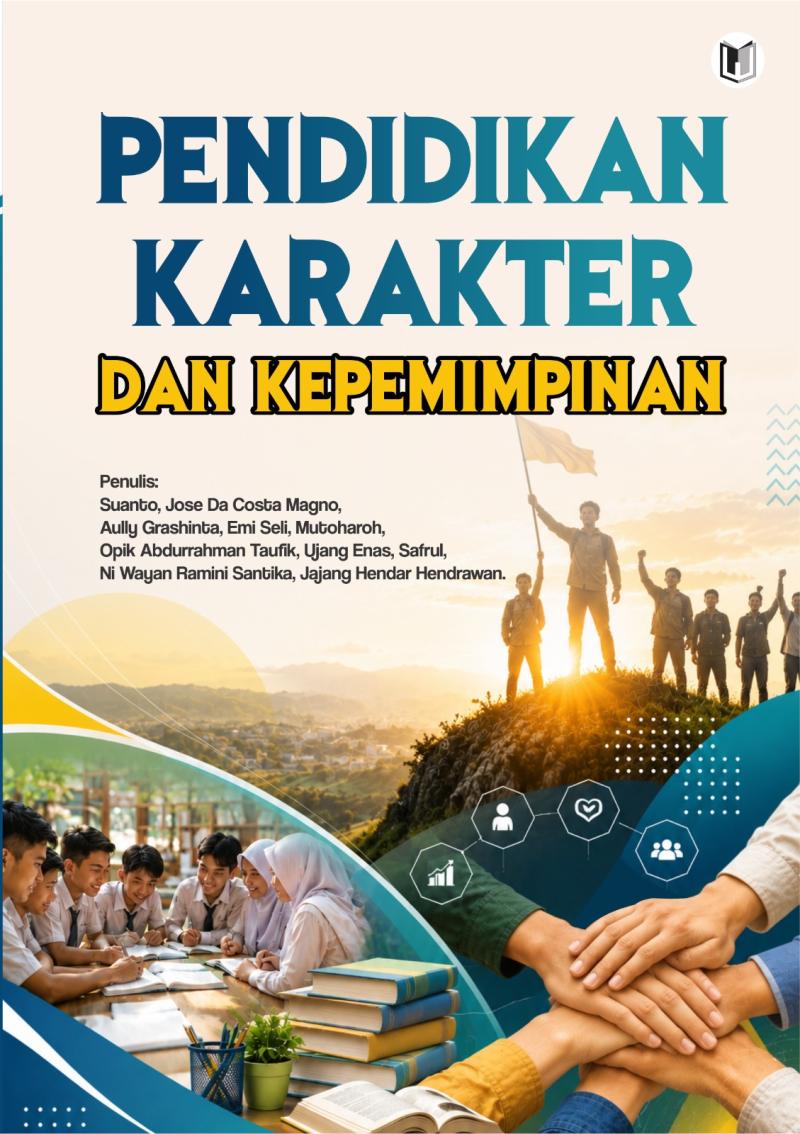
PENDIDIKAN KARAKTER DAN KEPEMIMPINAN
Keywords:
Pendidikan, Karakter, KepemimpinanSynopsis
Buku ini hadir sebagai kajian komprehensif mengenai pentingnya pembentukan karakter dan pengembangan kepemimpinan dalam dunia pendidikan serta kehidupan sosial masyarakat. Buku ini membahas konsep dasar pendidikan karakter yang meliputi landasan filosofis, teoritis, psikologis, dan nilai-nilai universal yang menjadi fondasi pembentukan pribadi yang bermoral, bertanggung jawab, dan berintegritas. Pembahasan disusun secara sistematis agar pembaca dapat memahami bahwa pendidikan karakter bukan sekadar proses transfer pengetahuan, tetapi juga pembentukan sikap, kebiasaan, dan perilaku positif dalam kehidupan sehari-hari.
Selain mengulas teori-teori pendidikan karakter dari berbagai tokoh dan pendekatan, buku ini juga menyoroti implementasi pendidikan karakter dalam lingkungan sekolah, keluarga, dan masyarakat. Pembaca diajak memahami bagaimana budaya sekolah, keteladanan guru, pola asuh keluarga, serta keterlibatan komunitas memiliki peranan penting dalam membentuk karakter peserta didik. Melalui pembahasan yang kontekstual, buku ini memberikan gambaran bahwa keberhasilan pendidikan karakter memerlukan sinergi berbagai pihak untuk menciptakan lingkungan yang mendukung perkembangan moral dan sosial individu.
Pada bagian kepemimpinan, buku ini membahas hakikat kepemimpinan, teori dan model kepemimpinan modern, serta hubungan erat antara karakter dan efektivitas seorang pemimpin. Nilai-nilai seperti integritas, kejujuran, empati, tanggung jawab, dan keberanian moral dijelaskan sebagai fondasi utama dalam membangun kepemimpinan yang berorientasi pada nilai dan kemanusiaan. Selain itu, pembaca juga diperkenalkan pada konsep pengembangan kepemimpinan peserta didik melalui organisasi sekolah, mentoring, coaching, dan berbagai program pembinaan kepemimpinan yang relevan dengan kebutuhan generasi muda.
Buku ini juga mengangkat isu-isu kontemporer seperti kepemimpinan berbasis kearifan lokal, kepemimpinan digital di era Revolusi Industri 4.0 dan Society 5.0, serta kepemimpinan perempuan dan keberagaman. Dengan pendekatan multidisipliner dan relevan terhadap perkembangan zaman, buku ini diharapkan dapat menjadi sumber referensi bagi mahasiswa, pendidik, calon pemimpin, maupun masyarakat umum dalam memahami pentingnya karakter dan kepemimpinan sebagai dua unsur utama dalam membangun individu, organisasi, dan bangsa yang unggul.
Downloads
Download data is not yet available.
References
Fadilah, Rabi’a, Alim, W. S., Zumrudiana, A., Lestari, I. W., Baidawi, A., & Elisanti, A. D. (2021). Pendidikan Karakter. CV. Agrapana Media.
Fitrah, M., Umar, U., Jayanti, M. I., & Syafruddin, S. (2024). Penguatan Pendidikan Karakter di Indonesia: Landasan Filosofis dan Yuridis dalam Membentuk Generasi yang Berkarakter. EL-Muhbib Jurnal Pemikiran Dan Penelitian Pendidikan Dasar, 8(2), 378-393. https://ejournal.iaimbima.ac.id/index.php/eL-Muhbib/article/view/4007
Khatimah, H., Kartika, I. M., & Santika, I. G. N. (2022). Pengaruh Implementasi Pendidikan Karakter Terhadap Sikap Sosial Pada Siswa. Widya Accarya: Jurnal Kajian Pendidikan FKIP Universitas Dwijendra, 13(2), 127–132. https://doi.org/10.46650/wa.13.2.1266.127-132
Kosim, M. (2011). Urgensi Pendidikan Karakter. KARSA Journal of Social and Islamic Culture, IXI(1), 84–92.
Ma’rufah, A. (2022). Implementasi Pendidikan Karakter Dalam Digitalisasi Pendidikan. Jurnal Pendidikan Dan Pembelajaran, 3(1), 17–29.
Mardiyanto, A.M, M. I., Asmara, A., Switri, E., Sukmawati, E., Sitorus, R. H., Amalia, I., Indrawati, N., & Suryaningrum, S. (2023). Pendidikan Karakter (Mendidik Karakter dalam Dunia Modern). In PT. Mifandi Mandiri Digital (Vol. 9, Issue 1). PT. Mifandi Mandiri Digital. http://repository.petra.ac.id/15665/
Matrapi. (2017). PENDIDIKAN KARAKTER: Sebuah Tinjauan Histori. JOIES: Journal of Islamic Education Studies, 2(1), 1–59.
Mu’id Aris Shofa, A., Zusron Alfaqi, M., Mujtaba Habibi, M., & Ayu Mawarti, R. (2020). Sejarah Panjang Pendidikan Karakter di Indonesia Pada Era Proklamasi Kemerdekaan Sampai Era Reformasi. Jurnal Rontal Keilmuan Pancasila Dan Kewarganegaraan, 6(1), 73–90. https://www.jurnal.stkippgritulungagung.ac.id/index.php/rontal/article/view/1660
Najili, H., Juhana, H., Hasanah, A., & Arifin, B. S. (2022). Landasan Teori Pendidikan Karakter. JIIP - Jurnal Ilmiah Ilmu Pendidikan, 5(7), 2099–2107. https://doi.org/10.54371/jiip.v5i7.675
Peraturan Menteri Pendidikan Dan Kebudayaan Republik Indonesia Nomor 20 Tahun 2018 Tentang Penguatan Pendidikan Karakter Pada Satuan Pendidikan Formal, JDIH Kemdikdasmen (2018).
Peraturan Presiden No 87 Tahun 2017 Tentang Penguatan Pendidikan Karakter, JDIH Kementerian Sekretariat Negara (2017).
Permana, D., Rahman, A., Wildan, D., Harsing, & Hasanah, A. (2025). Landasan Teori Pendidikan Karakter dalam Perspektif Teori Perkembangan Moral, Kognitif, dan Sosial. Jurnal BELAINDIKA (Pembelajaran Dan Inovasi Pendidikan), 7(2), 215–223. https://doi.org/10.52005/belaindika.v7i2.355
Rahayu, D. I. (2016). Membentuk Karakter Bangsa Sejak Usia Dini. Jurnal Kesejahteraan Keluarga Dan Pendidikan, 6(1), 66–76.
Salim, N. A., Avicenna, A., Suesilowati, Ermawati, E. A., Panjaitan, M. M. J., Yustita, A. D., Susanti, S. S., Saputro, A. N. C., Muslimin, T. P., Soputra, D., Lestari, H., Yuniwati, I., Suhartati, T., & Sari, I. N. (2022). Dasar-Dasar Pendidikan Karakter. In Yayasan Kita Menulis.
Siswanto, E., Switri, E., Pattiasina, P. J., Gianistika, C., Ratnasari, Kurniawan, Nurislamiah, M., Noveny, R. M., Chairudin, M., Hamidah, Susilatun, R., Nurasiah, S., Priyana, I., Larosa, E., Suryaningsih, & Subhan, R. (2024). Pendidikan Karakter. CV. Aina Media Baswara.
Suanto, S., & Nurdiyana, N. (2020). Implementasi Peraturan Presiden Nomor 87 Tahun 2017 Tentang Penguatan Pendidikan Karakter (PPK). Jurnal Pendidikan Kewarganegaraan, 7(2), 107. https://doi.org/10.32493/jpkn.v7i2.y2020.p107-114
Suarningsih, N. M., Santika, I. G. N., Roni, A. R. B., & Kristiana, R. J. (2024). Pendidikan Karakter Di Indonesia Dalam Berbagai Perspektif (Definisi, Tujuan, Landasan dan Prakteknya). JOCER: Journal of Civic Education Research, 2(2), 61–73.
Suriaman, S., Sundawa, D., Nurgiansah, T. H., & Insani, N. N. (2024). Analisis Perkembangan dan Dinamika Pendidikan Karakter dan Budaya Bangsa Indonesia: Sebuah Upaya Pencapaian Tujuan Pendidikan. Jurnal Pendidikan Karakter, 15(2), 90–97. https://doi.org/10.21831/jpka.v15i2.73497
Trisiana, A., Sugiaryo, & Rispantyo. (2019). Buku Panduan: Model Pendidikan Karakter Di Perguruan Tinggi Berbasis Nasionalisme Dan Implikasinya Terhadap Implementasi Revolusi Mental. Deepublish.
Undang-Undang Dasar Negara Republik Indonesia Tahun 1945, Sekretariat Jenderal MPR RI (1945).
Undang-Undang Republik Indonesia Nomor 17 Tahun 2007 Tentang Rencana Pembangunan Jangka Panjang Nasional Tahun 2005-2025 (2007).
Undang-Undang Republik Indonesia Nomor 20 Tahun 2003 Tentang Sistem Pendidikan Nasional, JDIH Kementerian Sekretariat Negara (2003).
Aristotle. (2009). Nicomachean ethics (W. D. Ross, Trans.). Oxford University Press.
Bandura, A. (1977). Social learning theory. Prentice Hall.
Geertz, C. (1973). The interpretation of cultures. Basic Books.
Koentjaraningrat. (2009). Pengantar ilmu antropologi. Rineka Cipta.
Kohlberg, L. (1981). The philosophy of moral development: Moral stages and the idea of justice. Harper & Row.
Lickona, T. (1991). Educating for character: How our schools can teach respect and responsibility. Bantam Books.
MacIntyre, A. (1981). After virtue: A study in moral theory. University of Notre Dame Press.
Piaget, J. (1932). The moral judgment of the child. Free Press.
Tilaar, H. A. R. (2004). Multikulturalisme: Tantangan-tantangan global masa depan dalam transformasi pendidikan nasional. Grasindo.
UNESCO. (2017). Education for sustainable development goals: Learning objectives. UNESCO Publishing.
Bandura, A. (1977). Social learning theory. Prentice Hall.
Berkowitz, M. W., & Bier, M. C. (2005). What works in character education: A research-driven guide for educators. Journal of Research in Character Education, 3(1), 29–48.
Brackett, M. A., Rivers, S. E., & Salovey, P. (2011). Emotional intelligence: Implications for personal, social, academic, and workplace success. Social and Personality Psychology Compass, 5(1), 88–103. https://doi.org/10.1111/j.1751-9004.2010.00334.x
Bronfenbrenner, U., & Morris, P. A. (2006). The bioecological model of human development. In R. M. Lerner (Ed.), Handbook of child psychology: Vol. 1. Theoretical models of human development (6th ed., pp. 793–828). Wiley.
Collaborative for Academic, Social, and Emotional Learning. (2020). CASEL’s SEL framework: What are the core competence areas and where are they promoted? https://casel.org/casel-sel-framework-11-2020/
Dweck, C. S. (2006). Mindset: The new psychology of success. Random House.
Eisenberg, N., Spinrad, T. L., & Morris, A. S. (2006). Empathy-related responding in children. In M. Killen & J. G. Smetana (Eds.), Handbook of moral development (pp. 517–549). Lawrence Erlbaum Associates.
Erikson, E. H. (1968). Identity: Youth and crisis. W. W. Norton & Company.
Goleman, D. (1995). Emotional intelligence: Why it can matter more than IQ. Bantam Books.
Kementerian Pendidikan, Kebudayaan, Riset, dan Teknologi Republik Indonesia. (2022). Penguatan pendidikan karakter (PPK). https://internal-portal.kemdikbud.go.id/program/Penguatan%20Pendidikan%20Karakter
Kementerian Pendidikan Dasar dan Menengah Republik Indonesia. (2023). Gerakan 7 kebiasaan anak Indonesia hebat. Kemdikdasmen.
Kohlberg, L. (1984). Essays on moral development: Vol. 2. The psychology of moral development. Harper & Row.
Lickona, T. (1991). Educating for character: How our schools can teach respect and responsibility. Bantam Books.
Löper, M. F., & Hellmich, F. (2024). Teacher modeling and student attitudes toward peers with learning difficulties: The role of teacher–student relationship quality. Frontiers in Education, 9, Article 1400471. https://doi.org/10.3389/feduc.2024.1400471
Masten, A. S. (2014). Ordinary magic: Resilience in development. Guilford Press
Masten, A. S. (2001). Ordinary magic: Resilience processes in development. American Psychologist, 56(3), 227–238. https://doi.org/10.1037/0003-066X.56.3.227
Osterman, K. F. (2000). Students’ need for belonging in the school community. Review of Educational Research, 70(3), 323–367. https://doi.org/10.3102/00346543070003323
Peterson, C., & Seligman, M. E. P. (2004). Character strengths and virtues: A handbook and classification. Oxford University Press.
Piaget, J. (1965). The moral judgment of the child (M. Gabain, Trans.). Free Press. (Original work published 1932)
Rest, J. R. (1986). Moral development: Advances in research and theory. Praeger.
Salovey, P., & Mayer, J. D. (1990). Emotional intelligence. Imagination, Cognition and Personality, 9(3), 185–211. https://doi.org/10.2190/DUGG-P24E-52WK-6CDG
Seligman, M. E. P. (2011). Flourish: A visionary new understanding of happiness and well-being. Free Press.
Skinner, B. F. (1953). Science and human behavior. Macmillan.
Stojanovic, M., Wood, W., & Neal, D. T. (2024). Habit formation and behavior change: A review and synthesis. Current Opinion in Psychology, 52, 101678. https://doi.org/10.1016/j.copsyc.2024.101678
Taylor, R. D., Oberle, E., Durlak, J. A., & Weissberg, R. P. (2019). Promoting positive youth development through social and emotional learning: A meta-analysis. Child Development, 90(4), e684–e700. https://doi.org/10.1111/cdev.13060
Wesarg-Menzel, C., et al. (2023). Co-regulation and self-regulation development in educational contexts. Frontiers in Education, 8, 1503867. https://doi.org/10.3389/feduc.2023.1503867
Wood, W. (2017). Habit in personality and social psychology
Zhou, X., Wang, M., & Zhang, Q. (2024). School climate and adolescent depression: The mediating role of school belonging. Frontiers in Psychology, 15, 1368451. https://doi.org/10.3389/fpsyg.2024.1368451
Zimmerman, B. J. (2002). Becoming a self-regulated learner: An overview. Theory Into Practice, 41(2), 64–70. https://doi.org/10.1207/s15430421tip4102_2
Bandura, A. (1977). Social learning theory. Prentice Hall.
Berkowitz, M. W., & Bier, M. C. (2005). What works in character education. Journal of Research in Character Education, 3(1), 29–48.
Cohen, J., McCabe, E., Michelli, N. M., & Pickeral, T. (2009). School climate: Research, policy, practice, and teacher education. Teachers College Record, 111(1), 180–213.
Deal, T. E., & Peterson, K. D. (2009). Shaping school culture: Pitfalls, paradoxes, and promises. Jossey-Bass.
Dewantara, K. H. (2013). Pemikiran, konsepsi, keteladanan, sikap merdeka (Pendidikan). UST-Press.
Durkheim, É. (1961). Moral education: A study in the theory and application of the sociology of education. Free Press.
Eccles, J. S., & Barber, B. L. (1999). Student council, volunteering, basketball, or marching band: What kind of extracurricular involvement matters? Journal of Adolescent Research, 14(1), 10–43.
Fahmi, M., & Susanto, H. (2021). Implementasi penguatan pendidikan karakter berbasis budaya sekolah. Jurnal Pendidikan Karakter, 11(2), 189–203.
Furco, A. (2010). The community as a resource for learning: An analysis of academic service-learning in primary and secondary education. The Nature of Learning. OECD Publishing.
Hmelo-Silver, C. E. (2004). Problem-based learning: What and how do students learn? Educational Psychology Review, 16(3), 235–266.
Johnson, D. W., & Johnson, R. T. (2009). An educational psychology success story: Social interdependence theory and cooperative learning. Educational Researcher, 38(5), 365–379.
Kementerian Pendidikan dan Kebudayaan Republik Indonesia. (2017). Penguatan pendidikan karakter. Kemendikbud.
Kohlberg, L. (1984). Essays on moral development: The psychology of moral development. Harper & Row.
Lickona, T. (1991). Educating for character: How our schools can teach respect and responsibility. Bantam Books.
Muslich, M. (2018). Pendidikan karakter: Menjawab tantangan krisis multidimensional. Bumi Aksara.
Noddings, N. (2005). The challenge to care in schools: An alternative approach to education (2nd ed.). Teachers College Press.
Nucci, L., & Narvaez, D. (2008). Handbook of moral and character education. Routledge.
Prasetyo, D., & Minsih. (2024). Kepemimpinan berbasis nilai dalam penguatan karakter peserta didik. Jurnal Pendidikan Indonesia, 13(1), 77–90.
Prasetyo, D., & Minsih. (2024). Peran guru sebagai role model dalam penguatan karakter peserta didik. Jurnal Pendidikan Indonesia, 13(1), 77–90.
Priansa, D. J. (2017). Pengembangan strategi & model pembelajaran: Inovatif, kreatif, dan prestatif dalam memahami peserta didik. Pustaka Setia.
Rahmawati, Y., & Suyanto. (2023). Integrasi pendidikan karakter dalam Kurikulum Merdeka. Jurnal Cakrawala Pendidikan, 42(1), 112–126.
Republik Indonesia. (2005). Undang-Undang Nomor 14 Tahun 2005 tentang Guru dan Dosen.
Ryan, K., & Bohlin, K. E. (1999). Building character in schools. Jossey-Bass.
Samani, M., & Hariyanto. (2013). Konsep dan model pendidikan karakter. Remaja Rosdakarya.
Schein, E. H. (2010). Organizational culture and leadership (4th ed.). Jossey-Bass.
Wibowo, A., & Gunawan, I. (2022). Strategi internalisasi nilai karakter dalam pembelajaran abad 21. Jurnal Manajemen Pendidikan, 9(1), 45–58.
Zubaedi. (2011). Desain pendidikan karakter: Konsepsi dan aplikasinya dalam lembaga pendidikan. Kencana.
Assingkily, M. S., & Mesiono, M. (2019). Karakteristik Kepemimpinan Transformasional di Madrasah Ibtidaiyah (MI) serta Relevansinya dengan Visi Pendidikan Abad 21. MANAGERIA: Jurnal Manajemen Pendidikan Islam. https://doi.org/10.14421/manageria.2019.41-09
Aurannisa, N., & Azhari, W. P. (2025). Integrasi Kepemimpinan Spiritual dalam Fungsi Perencanaan dan Actuating Manajemen Pendidikan Islam. In Journal of Education and Islamic Studies (Vol. 1, Number 1). https://ejournal.magisterpaiunira.com/index.php/annahdloh
Barry, E. S., & Grunberg, N. E. (2020). A Conceptual Framework to Guide Leader and Follower Education, Development, and Assessment. Journal of Leadership, Accountability and Ethics, 17(1), 127.
Benmira, S., & Agboola, M. (2021). Evolution of leadership theory. In BMJ Leader (Vol. 5, Number 1, pp. 3–5). BMJ Publishing Group. https://doi.org/10.1136/leader-2020-000296
Beşliu, D.-C. (2017). LEADERSHIP – ESSENTIAL QUALITY OF AN EFFICIENT MANAGER. 15, 149–154. https://doi.org/10.19062/1842-9238.2017.15.3.19
Bíziková, V., & Žitný, R. (2025). Profile of the Managers in the Destination Management Organisations (DMOS) in Slovakia. Journal of Posthumanism. https://doi.org/10.63332/joph.v5i5.1808
Chen, J., & Meng, J. (2025). Leadership and Decision-Making Mechanisms in Educational Management. International Journal of Sociologies and Anthropologies Science Reviews. https://doi.org/10.60027/ijsasr.2025.7207
Chkheidze, S. (2023). ROLE OF LEADER IN EDUCATIONAL MANAGEMENT. PUPIL: International Journal of Teaching, Education and Learning. https://doi.org/10.20319/pijtel.2023.72.171179
Christy, I. L., & Safira, A. R. (2025). Kepemimpinan Kepala Sekolah PGRI Banyuajuh dalam Melaksanakan Supervisi Pendidikan. JIEEC, 7(1). https://doi.org/10.30587/jieec.v%vi%i.9069
Connolly, M., James, C., & Fertig, M. (2019a). The difference between educational management and educational leadership and the importance of educational responsibility. Educational Management Administration & Leadership, 47, 504–519. https://doi.org/10.1177/1741143217745880
Connolly, M., James, C., & Fertig, M. (2019b). The difference between educational management and educational leadership and the importance of educational responsibility. Educational Management Administration & Leadership, 47, 504–519. https://doi.org/10.1177/1741143217745880
Dhea Fujha Raniayu, Andriani Sariwardini, M. (2025). Peran Kepemimpinan Transformasional dan Kompetensi Profesional Guru Terhadap Hasil Belajar Siswa Sekolah Dasar di SDN Se Kecamatan Serang. Journal of Innovative and Creativity, 5(2), 2477–2482.
Em, S. (2023). A Review of Different Ideas Concerning the Characteristics of a Good Leader and Shaping New Ideas of an Effective 21st Century Leader. Journal of General Education and Humanities, 2(1), 13–34. https://doi.org/10.58421/gehu.v2i1.53
Fahrudin, R. (2025). TRANSFORMATIONAL LEADERSHIP STYLE IN IMPROVING EMPLOYEE PERFORMANCE: A LITERATURE REVIEW. Journal Management And Business, 3(1), 53–63. https://doi.org/10.61912/lajumen.v3i1.114
Fauzi, F. (2025). Kepemimpinan Digital Dalam Dunia Pendidikan: Tinjauan Systematic Literature Review. TA’LIM : Jurnal Studi Pendidikan Islam, 8(2), 215–237. https://doi.org/10.3390/educsci15020215.4
Fikstif Donal Lintong, et. al. (2025). Pengelolaan Pendidikan.
Grunberg, N. E., Barry, E. S., Callahan, C. W., Kleber, H. G., McManigle, J. E., & Schoomaker, E. B. (2019). A conceptual framework for leader and leadership education and development. International Journal of Leadership in Education, 22(5), 644–650. https://doi.org/10.1080/13603124.2018.1492026
Honig, D. (2022). Managing for Motivation as Public Performance Improvement Strategy in Education & Far Beyond. Research on Improving Systems of Education (RISE). https://doi.org/10.35489/BSG-RISE
Hujah, I., Yusuf, F. A., Mutoharoh, M., & Maarif, M. (2025). Digital Transformation in Learning : A Systematic Review of Digital Technology Utilization to Enhance Student-Centered Learning Effectiveness. Southeast Asian Journal Of Science and Technology, 9(2), 56–64.
Husen Waedoloh, Purwanta, H., & Ediyono, S. (2022). Gaya Kepemimpinan dan Karekteristik Pemimpin yang Efektif. https://jurnal.uns.ac.id/shes
Islahiyah, Ramdan, Atikah, M. (2025). Peran Kepemimpinan Transformasional Kepala Sekolah dan Iklim Sekolah yang Kondusif Terhadap Kinerja Guru di Sekolah Islam Terpadu Bina Bangsa Serang. Journal of Innovative and Creativity, 5(2), 6315–6328.
Judijanto, L., De Araújo Sarmento, A., Saefrudin, S., Runtu, A. R., & Meydiansyah, H. (2024a). PENTINGNYA KEPEMIMPINAN DALAM MANAJEMEN PENDIDIKAN. Jurnal Ilmiah Edukatif. https://doi.org/10.37567/jie.v10i2.3310
Judijanto, L., De Araújo Sarmento, A., Saefrudin, S., Runtu, A. R., & Meydiansyah, H. (2024b). PENTINGNYA KEPEMIMPINAN DALAM MANAJEMEN PENDIDIKAN. Jurnal Ilmiah Edukatif. https://doi.org/10.37567/jie.v10i2.3310
Kessler, V. (2010). Leadership and power. 75, 527–550. https://doi.org/10.4102/koers.v75i3.95
Krykun, O. (2021). ABILITY OF THE MANAGER TO ORGANIZE MANAGERIAL WORK. Market Infrastructure. https://doi.org/10.32843/infrastruct60-19
Lumby, J. (2019a). Leadership and power in higher education. Studies in Higher Education, 44, 1619–1629. https://doi.org/10.1080/03075079.2018.1458221
Lumby, J. (2019b). Leadership and power in higher education. Studies in Higher Education, 44, 1619–1629. https://doi.org/10.1080/03075079.2018.1458221
Lunenburg, F. (2012). POWER AND LEADERSHIP: AN INFLUENCE PROCESS. INTERNATIONAL JOURNAL OF MANAGEMENT, BUSINESS, AND ADMINISTRATION, 15, 1–9. https://consensus.app/papers/power-and-leadership-an-influence-process-lunenburg/183c86ed04e0554cbdb9db88b6119dda/
Lynch, R., Asavisanu, P., Rungrojngarmcharoen, K.-O., & Ye, Y. (2020). Educational Management. Oxford Research Encyclopedia of Education. https://doi.org/10.1093/acrefore/9780190264093.013.701
Marron, J., & Cunniff, D. (2014). What Is an Innovative Educational Leader. Contemporary Issues in Education Research, 7, 145–150. https://doi.org/10.19030/cier.v7i2.8485
Mawardi, M., Citriadin, Y., & Azzahra, S. F. (2025). Leadership Theory in Organizations. Unram Journal of Community Service, 6(1), 34–38. https://doi.org/10.29303/ujcs.v6i1.812
Mubiarto, A. N., & Syarifuddin, S. (2021). MOTIVASI KEPEMIMPINAN DALAM LEMBAGA PENDIDIKAN. Al-Khair Journal : Management, Education, And Law. https://doi.org/10.29300/kh.v1i1.5448
Muhammad Firdaus, & M. Imamul Muttaqin. (2024a). Konsep Kepemimpinan: Pengertian, Sebab Munculnya, Sifat, dan Tipe Pemimpin. Student Research Journal, 2(6), 150–161. https://doi.org/10.55606/srj-yappi.v2i6.1634
Muhammad Firdaus, & M. Imamul Muttaqin. (2024b). Konsep Kepemimpinan: Pengertian, Sebab Munculnya, Sifat, dan Tipe Pemimpin. Student Research Journal, 2(6), 150–161. https://doi.org/10.55606/srj-yappi.v2i6.1634
Mutoharoh, Hufad, A., & Rusdiyani, I. (2023). The Correlation between Innovative Leadership and Early Childhood Education Teacher Performance. Journal of Educational and Social Research, 13(3), 154–163. https://doi.org/10.36941/jesr-2023-0065
Mutoharoh, M., Yusuf, F. A., & Nuryati, N. (2025). Strategies for Innovative Leadership and Educational Management : A Systematic Review. Asian Journal of Multidisciplinary Studies, 8(1), 132–140.
Mutoharoh Mutoharoh, Edi Junaedi, Tadius, Anselmus Sudirman, Uyu Mu’awwanah, Mardiani Masuku, R. (2025). Pengelolaan Pendidikan.
Mutoharoh Mutoharoh, Y. H. (2025). Kepemimpinan Transformatif Dalam Meningkatkan Kinerja Guru : Systematic Literature Review ( SLR ). Journal of Innovative and Creativity, 5(2), 3365–3376.
Mutoharoh, Yumna, A. S. (2025). Analisis Gaya Kepemimpinan Kepala Sekolah : Studi Kasus di SD IT Kasih Ananda. Journal of Innovative and Creativity, 5(2), 3146–3152.
Ndonye, D. M. (2022a). Followership in Leadership Process and Organizational Performance: A Review of Literature. In International Journal of Organizational Leadership (Vol. 11). https://www.ijol.cikd.ca
Ndonye, D. M. (2022b). Followership in Leadership Process and Organizational Performance: A Review of Literature. In International Journal of Organizational Leadership (Vol. 11). https://www.ijol.cikd.ca
Nilam Zahara, P. R., Kadri, H. Al, Sabandi, A., & Achyar, N. (2023). Persepsi Guru Tentang Pelaksanaan Fungsi Kepemimpinan Kepala Sekolah. Journal of Practice Learning and Educational Development, 3(2), 177–184. https://doi.org/10.58737/jpled.v3i2.146
Nor, T., & Suriansyah, A. (2025). KEPEMIMPINAN VISIONER KEPALA SEKOLAH DALAM MENINGKATKAN MUTU PENDIDIKAN. MANAJERIAL : Jurnal Inovasi Manajemen Dan Supervisi Pendidikan, 4(4), 256–268.
Oc, B. (2018). Contextual leadership: A systematic review of how contextual factors shape leadership and its outcomes. The Leadership Quarterly, 29(1), 218–235. https://doi.org/10.1016/J.LEAQUA.2017.12.004
Oluwatosin Abdul-Azeez, Alexsandra Ogadimma Ihechere, & Courage Idemudia. (2024). Transformational leadership in SMEs: Driving innovation, employee engagement, and business success. World Journal of Advanced Research and Reviews, 22(3), 1894–1905. https://doi.org/10.30574/wjarr.2024.22.3.1888
Porath, U. (2023). Ideal Characteristics of Managers in Manufacturing Companies. Modern Economy. https://doi.org/10.4236/me.2023.148054
Putri, B., Irianto, P., Jatnika, A., & Yunita, D. (2021). FUNGSI KEPEMIMPINAN CAMAT DALAM MENINGKATKAN KINERJA BIROKRASI. Jurnal Administrasi Pemerintahan (Janitra), 1(2).
Romero, J. N. (2025). Leadership in Perspective: Nature, Challenges, and Future Directions. International Journal of Multidisciplinary: Applied Business and Education Research, 6(9), 4429–4442. https://doi.org/10.11594/ijmaber.06.09.18
Ruslandi, U., Istikhori, I., & Rizkiyana, A. (2025). Peranan Kepemimpinan Manajemen Pendidikan dalam Sekolah. Katalis Pendidikan : Jurnal Ilmu Pendidikan Dan Matematika. https://doi.org/10.62383/katalis.v2i1.1197
Sabri, S., Sumardin, S., & Mustaqim, H. (2024). The effect of human resource development and leadership on employee performance with organizational commitment. JPPI (Jurnal Penelitian Pendidikan Indonesia). https://doi.org/10.29210/020243166
Suarga. (2020). FUNGSI KEPEMIMPINAN PENDIDIKAN ISLAM. Jurnal Pendidikan Kreatif. https://doi.org/10.24252/jpk.v1i1.14987
Suharti, S., Fajri, R., & Suharyat, Y. (2024a). ANALISIS FUNGSI KEPEMIMPINAN DALAM ERA ORGANISASI MODERN. NUSRA: Jurnal Penelitian Dan Ilmu Pendidikan, 5(1), 22–36. https://doi.org/10.55681/nusra.v5i1.1838
Suharti, S., Fajri, R., & Suharyat, Y. (2024b). ANALISIS FUNGSI KEPEMIMPINAN DALAM ERA ORGANISASI MODERN. NUSRA: Jurnal Penelitian Dan Ilmu Pendidikan, 5(1), 22–36. https://doi.org/10.55681/nusra.v5i1.1838
Suparyo, S., Hanif, M., & Suratno, S. (2024). Peran Kepemimpinan Visioner dalam Pengembangan Kualitas Pendidikan: Studi Kasus MTs Raudlatul Huda Cilacap. Juwara Jurnal Wawasan Dan Aksara, 4(1), 53–62. https://doi.org/10.58740/juwara.v4i1.85
Suryani, N., Mutoharoh, M., & Maarif, M. (2025a). Transformative Leadership within Global Educational Ecosystems : A Systematic Literature Review on School Innovation. Asian Journal of Multidisciplinary Studies, 8(1), 102–112.
Suryani, N., Mutoharoh, M., & Maarif, M. (2025b). Transformative Leadership within Global Educational Ecosystems : A Systematic Literature Review on School Innovation. Asian Journal of Multidisciplinary Studies, 8(1), 102–112.
TAUFIK NOR, A. S. (2024). KEPEMIMPINAN VISIONER KEPALA SEKOLAH DALAM MENINGKATKAN MUTU PENDIDIKAN. MANAJERIAL: Jurnal Inovasi Manajemen Dan Supervisi Pendidikan.
Taufiq Hidayah. (2025). The Role of Transformational Leadership in Improving Organisational Performance: A Human Resource Management Perspective. International Journal of Economics (IJEC), 4(1), 234–244. https://doi.org/10.55299/ijec.v4i1.1271
Thakore, D. (2024). Servant Leadership. Dental Abstracts. https://doi.org/10.18052/www.scipress.com/ilshs.7.23
Tourish, D. (2016). Leadership from a Communication Perspective. Oxford University Press. https://doi.org/10.1093/acrefore/9780190228613.013.13
Tri, K., Nainggolan, A., Dan, S., Kepemimpinan, F., Pagar, G., Kusnanto, B., Anggoro, T., Nainggolan, Nadeak, R., & Gea, I. (2023). Struktur dan Fungsi Kepemimpinan GKPI Pagar Beringin. Sinar Kasih: Jurnal Pendidikan Agama Dan Filsafat. https://doi.org/10.55606/sinarkasih.v1i2.140
Van Dijke, M. (2020). Power and leadership. Current Opinion in Psychology, 33, 6–11. https://doi.org/10.1016/j.copsyc.2019.06.012
Vender, R. J. (2015). Leadership: An Overview. Official Journal of the American College of Gastroenterology | ACG, 110(3). https://journals.lww.com/ajg/fulltext/2015/03000/leadership__an_overview.2.aspx
Vrinceanu, V. (2025). Social leadership in education: essential skills for managers of educational institutions. The Contemporary Issues of the Socio-Humanistic Sciences. https://doi.org/10.54481/pcss2025.51
Wahdini, D., & Mutoharoh, Andriani Sariwardani. (2025). Komitmen sebagai Pemediasi Kepemimpinan Visioner terhadap Mutu Pembelajaran dengan Dukungan Kompetensi Guru SD Negeri Sepang. Journal of Innovative and Creativity, 5(2), 3123–3132.
Wang, Y., Zhou, X., Han, M., & Zhang, Z. (2022a). Understanding of Leadership: Leaders, Followers, Goals, Context. Atlantis Press. http://info.stvincent.edu/faculty-
Wang, Y., Zhou, X., Han, M., & Zhang, Z. (2022b). Understanding of Leadership: Leaders, Followers, Goals, Context. Atlantis Press. http://info.stvincent.edu/faculty-
Zahara, P. R. N., Kadri, H. Al, Sabandi, A., & Achyar, N. (2023). Persepsi Guru Tentang Pelaksanaan Fungsi Kepemimpinan Kepala Sekolah. Journal of Practice Learning and Educational Development. https://doi.org/10.58737/jpled.v3i2.146
Avolio, B. J., Sosik, J. J., Kahai, S. S., & Baker, B. (2014). E-leadership: Re-examining transformations in leadership source and transmission. The Leadership Quarterly, 25(1), 105–131. https://doi.org/10.1016/j.leaqua.2013.11.003
Bass, B. M., & Riggio, R. E. (2006). Transformational Leadership. Psychology Press. https://doi.org/10.4324/9781410617095
Chen, C., & Yin, H. (2025). Investigating the relationship between instructional leadership and teacher well-being: A moderated mediation analysis of PISA 2022. International Journal of Educational Research, 133, 102699. https://doi.org/10.1016/j.ijer.2025.102699
Claudet, J. (2012). Redesigning Staff Development as Organizational Case Learning: Tapping into School Stakeholders’ Collaborative Potential for Critical Reflection and Transformative Leadership Action. Open Journal of Leadership, 01(04), 22–36. https://doi.org/10.4236/ojl.2012.14005
Hallinger, P., & Murphy, J. (1985). Assessing the Instructional Management Behavior of Principals. The Elementary School Journal, 86(2), 217–247. https://doi.org/10.1086/461445
Hersey, P., & Blanchard, K. H. (1969). Life cycle theory of leadership. Training & Development Journal.
Hulsbos, F., van Langevelde, S., Evers, A., & Martens, R. (2025). Distributed leadership in action: Different manifestations and what they require from school leaders. British Educational Research Journal, 51(4), 1648–1668. https://doi.org/10.1002/berj.4142
Lahtero, T. J., Ahtiainen, R., & Vainikainen, M.-P. (2020). Examining Distributed Leadership and School Outcomes in Finnish Compulsory School. American Journal of Educational Research, 8(12), 893–898. https://doi.org/10.12691/education-8-12-2
Leithwood, K., Harris, A., & Hopkins, D. (2020). Seven strong claims about successful school leadership revisited. School Leadership & Management, 40(1), 5–22. https://doi.org/10.1080/13632434.2019.1596077
Robinson, V. M. J., Lloyd, C. A., & Rowe, K. J. (2008). The Impact of Leadership on Student Outcomes: An Analysis of the Differential Effects of Leadership Types. Educational Administration Quarterly, 44(5), 635–674. https://doi.org/10.1177/0013161X08321509
Safitri, Y., Yakin, N., & Ahyar, A. (2025). Pengaruh Gaya Kepemimpinan Intruksional, Gaya Kepemimpinan Situasional, dan Gaya Kepemimpinan Transformasional Kepala Sekolah Terhadap Keberhasilan Kinerja Guru di Gugus 7 Gerung, Kecamatan Gerung, Kabupaten Lombok Barat. Jurnal Ilmiah Profesi Pendidikan, 10(1), 162–172. https://doi.org/10.29303/jipp.v10i1.2996
School Leadership for Learning. (2016). OECD. https://doi.org/10.1787/9789264258341-en
Sheninger, E. (2014). Digital Leadership: Changing Paradigms for Changing Times. SAGE Publications. https://books.google.co.id/books?id=YUIbnwEACAAJ
Skrabut, S. A. (2014). Digital leadership: Changing paradigms for changing times. Journal of Adult Education, 43(2), 26.
Spillane, J. P. (2006). Distributed Leadership. Jossey-Bass.
Suhadi, S., Kusrina, T., & Suriswo, S. (2025). Pengaruh Model Kepemimpinan Transformasional Kepala Sekolah Terhadap Peningkatan Kompetensi Pedagogik Dalam Pengembangan Kurikulum Dan Pemanfaatan Teknologi Informasi Pada Guru Smk Negeri Se Kabupaten Demak. Jurnal Pendidikan Indonesia, 6(8), 4233–4251. https://doi.org/10.59141/japendi.v6i8.8525
Afsari, N., 2019. Pengaruh kepemimpinan inklusif terhadap kinerja karyawan melalui mediasi psychological safety. Jakarta : Universitas Negeri Jakarta Press.
Bangun, W., 2012. Manajemen Sumber Daya Manusia. Jakarta : Erlangga.
Fahmi, I., 2016. Manajemen Kepemimpinan : Teori dan Aplikasi. Bandung : Alfabeta.
Hasibuan, M. S.P., 2016. Manajemen Sumber Daya Manusia. Jakarta : Bumi Aksara.
Kidder, Rushworth M. (2005). Moral Courage. New York: HarperCollins.
Mangkunegara, A. P., 2017. Manajemen Sumber Daya Manusia Perusahaan. Bandung : Remaja Rosdakarya.
Rivai, V., 2014. Kepemimpinan dan Perilaku Organisasi. Jakarta : Raja Grafindo Persada.
Robbins, Stephen P., & Judge, Timothy A. (2017). Organizational Behavior. New York : Pearson Education.
Sutrisno, E., 2017. Manajemen Sumber Daya Manusia. Jakarta : Kencana.
Trevino, Linda K., & Nelson, Katherine A. (2017). Managing Business Ethics. Hoboken : Wiley.
Wibowo, 2016. Manajemen Kinerja. Jakarta : Raja Grafindo Persada.
Yukl, Gary. (2013). Leadership in Organizations. Boston : Pearson Education.
Avolio, B. J., & Gardner, W. L. (2005). Authentic leadership development. The Leadership Quarterly, 16(3), 315–338.
Bandura, A. (1977). Social Learning Theory. Englewood Cliffs: Prentice Hall.
Bass, B. M. (1985). Leadership and Performance Beyond Expectations. New York: Free Press.
Bass, B. M., & Riggio, R. E. (2006). Transformational Leadership. Mahwah: Lawrence Erlbaum.
Blau, P. M. (1964). Exchange and Power in Social Life. New York: Wiley.
Boyatzis, R. E. (2008). Competencies in the 21st century. Journal of Management Development, 27(1), 5–12.
Brown, M. E., & Treviño, L. K. (2006). Ethical leadership. The Leadership Quarterly, 17(6), 595–616.
Colquitt, J. A. (2001). On the dimensionality of organizational justice. Journal of Applied Psychology, 86(3), 386–400.
Copeland, M. K. (2014). The emerging significance of values-based leadership. International Journal of Leadership Studies, 8(2), 105–135.
Dirks, K. T., & Ferrin, D. L. (2002). Trust in leadership. Journal of Applied Psychology, 87(4), 611–628.
Goleman, D. (1995). Emotional Intelligence. New York: Bantam Books.
Greenleaf, R. K. (1977). Servant Leadership. New York: Paulist Press.
Jensen, M. C., & Meckling, W. H. (1976). Theory of the firm. Journal of Financial Economics, 3(4), 305–360.
Kant, I. (1785). Groundwork of the Metaphysics of Morals.
Kidder, R. M. (2005). Moral Courage. New York: HarperCollins.
Kohlberg, L. (1981). Essays on Moral Development. San Francisco: Harper & Row.
Maak, T., & Pless, N. M. (2006). Responsible leadership. Journal of Business Ethics, 66(1), 99–115.
Mill, J. S. (1863). Utilitarianism.
Northouse, P. G. (2018). Leadership: Theory and Practice. Thousand Oaks: Sage.
Rest, J. R. (1986). Moral Development. New York: Praeger.
Treviño, L. K. (1986). Ethical decision making in organizations. Academy of Management Review, 11(3), 601–617.
Walumbwa, F. O., et al. (2008). Authentic leadership. Journal of Management, 34(1), 89–126.
Zaccaro, S. J. (2007). Trait-based perspectives of leadership. American Psychologist, 62(1), 6–16.
Dadi, Kanisius Komsiah.(2024). Karakter Kepemimpinan Generasi Muda Indonesia Dalam Masyarakat 5.0 CREDENDUM : Jurnal Pendidikan Agama Vol. 6, No. 1, Mei 2024, https://doi.org/10.34150/credendum.v2i2.781
Gunawan,Heri. (2017). Pendidikan Karakter Konsep dan Implementasi. Bandung. Penerbit CV Alfabeta.
Hermino,Agustinus. (2014). Manajemen Kurikulum Berbasis Karakter Konsep, Pendekatan, dan Aplikasi. Bandung. Penerbit CV Alfabeta.
Kaswan, Akhyadi,Ade Sadikin. (2015). Pengembangan Sumber Daya Manusia Dari Konsepsi, Paradigma, dan Fungsi Sampai Aplikasi. Bandung. Penerbit CV Alfabeta.
Priansa, Donni Juni, dan Setiana, Sonny Suntani. (2018). Manajemen dan Supervisi Pendidikan. Bandung. Penerbit CV. Pustaka Setia.
Suharsaputra,Uhar. (2013). Administrasi Pendidikan. Bandung. PT Refika Aditama.
Santika,Ni Wayan Ramini. Manajemen Sumber Daya Manusia Dalam Pendidikan Karakter. Jurnal Satya Sastraharing Vol 04No.01Tahun2020 https://ejournal.iahntp.ac.id/index.php/SatyaSastraharing
Santika, Ni Wayan Ramini. Manajemen Pendidikan Dalam Konsep Tri Hita Karana. Jurnal Satya-Sastraharing Vol.6 . No.1.Tahun2022 https://ejournal.iahntp.ac.id/index.php/SatyaSastraharing
Usman, Husaini. (2019). Administrasi, Manajemen, dan Kepemimpinan Pendidikan, Teori dan Praktik. Jakarta. PT Bumi Aksara.
Wahab, Abdul Azis. (2011) Anatomi Organisasi Dan Kepemimpinan Pendidikan (Telaah Terhadap Organisasi dan Pengelolaan Organisasi Pendidikan). Bandung. Penerbit CV Alfabeta.
Ali, H., Hussain, F., & Khan, A. (2020). Organizational Identification, Leadership, and Job Security | 212. 7(1), 212–234.
Astuti, D., & Kabri. (2024). KAJIAN KEPEMIMPINAN BUDDHA. Dharmasmrti: Jurnal Ilmu Agama Dan Kebudayaan. https://doi.org/10.32795/ds.v24i1.5917
Azra, A. (2007). Indonesia, Islam, and Democracy: Dynamics in a Global Context. Solstice Publishing.
Beekun, R., & Badawi, J. (1998). Leadership : An Islamic Perspective.
Carrasco, B., Rahemtulla, H. A., & Rohdewohld, R. (2023). Decentralization, Local Governance , and Localizing the Sustainable Development Goals in Asia and the Pacific, provided in Cooperation with :
Eva, N., Robin, M., Sendjaya, S., van Dierendonck, D., & Liden, R. C. (2019). Servant Leadership: A systematic review and call for future research. The Leadership Quarterly, 30(1), 111–132. https://doi.org/https://doi.org/10.1016/j.leaqua.2018.07.004
Gibson, C., & Woolcock, M. (2008). Empowerment, Deliberative Development, and Local-Level Politics in Indonesia: Participatory Projects as a Source of Countervailing Power. Studies in Comparative International Development, 43(2), 151–180. https://doi.org/10.1007/s12116-008-9021-0
Greenleaf, R. (2013). Servant Leadership. https://doi.org/10.4135/9781452276090.n216
Hemamalini, K. (2020). Nilai-nilai kepemimpinan dalam perspektif ajaran Hindu. Dharma Duta, 18(2), 115–126.
Hendrawan, J. H. (2020). Kepemimpinan Adiluhung. STKIP Pasundan Press.
Hendrawan, J. H., Halimah, L., & Kokom, K. (2022). Penguatan Karakter Cinta Tanah Air melalui Tari Narantika Rarangganis. Journal Basicedu, 6(5), 7978–7985. https://doi.org/10.31004/basicedu.v6i5.3716
House, R. J., Hanges, P. J., Javidan, M., Dorfman, P. W., & Gupta, V. (2006). Culture, Leadership, and Organizations : The GLOBE Study of 62 Culture, Leadership, and Organizations : The GLOBE Study of 62 Societies. 1(1), 55–71.
Jandhyala, S., & Kumar, N. (2023). INDIAN PHILOSOPHICAL MODEL OF AUTHENTIC LEADERSHIP AND MANAGEMENT Shivani Jandhyala and Navin Kumar, 3(September), 393–406.
Kamali, M. H. (2020). Principles of Islamic Jurisprudence. Ilmiah Press.
Kasali, R. (2022). Disruption: Tak ada yang tak bisa diubah sebelum dihadapi, motivasi saja tidak cukup (Edisi terbaru). Mizan.
Latif, Y. (2020). Negara paripurna: historisitas, rasionalitas, dan aktualitas Pancasila. Gramedia Pustaka Utama. https://books.google.co.id/books?id=0NBtWmlj1soC
Maak, T., Pless, N. M., & Voegtlin, C. (2021). Responsible leadership in a stakeholder society – A relational perspective. Journal of Business Ethics, 170(2), 343–357. https://doi.org/10.1007/s10551-019-04353-y
Mahfud, M. D. (2021). Membangun kepemimpinan nasional berkarakter. Rajawali Press.
Murdianto, R. B., Alamsyah, M. N., Desa, D., Agung, K., Musyawarah, P., Pembangunan, R., Agung, K., Agama, T., & Pemuda, T. (2025). Demokrasi deliberatif dalam musyawarah rencana pembangunan desa di Desa Kayu Agung, Kecamatan Mepanga, Kabupaten Parigi Moutong. 1(04), 204–216.
Nguyen, P., & Tran, T. (2021). Cultural fit and leadership effectiveness in Southeast Asia. Leadership & Organization Development Journal, 42(4), 567–582. https://doi.org/10.1108/LODJ-02-2020-0062
Pless, N. M., Maak, T., & Waldman, D. A. (2023). Different approaches toward doing the right thing: Mapping the responsibility orientations of leaders. Academy of Management Perspectives, 37(1), 1–18. https://doi.org/10.5465/amp.2019.0063
Putra, I. N., Wibowo, A., & Pratama, R. (2022). Peran institusi adat dan norma lokal dalam menjaga kohesi sosial desa. Jurnal Antropologi Indonesia, 40(2), 55–71. https://doi.org/10.22146/jai.14259
Rahmawati, N. (2021). Integrasi nilai budaya dalam manajemen pendidikan. Jurnal Administrasi Pendidikan, 28(1), 1–10. https://doi.org/10.24832/jpnk.v28i1.1935
Rockstuhl, T., Dulebohn, J. H., Ang, S., & Shore, L. M. (2012). Leader-member exchange (LMX) and culture: a meta-analysis of correlates of LMX across 23 countries. The Journal of Applied Psychology, 97 6, 1097–1130. https://api.semanticscholar.org/CorpusID:36090012
Slikkerveer, L. (2019). Gotong Royong: An Indigenous Institution of Communality and Mutual Assistance in Indonesia. Cooperative Management. https://doi.org/10.1007/978-3-030-05423-6_14
Stone, R. (2021). Observations of Dominant Behaviors and Habits of an Effective Leader. Open Journal of Social Sciences. https://doi.org/10.4236/jss.2021.910035
Supriyanto, A. S., Ekowati, V. M., & Islamic, S. (2020). Spiritual Leadership and Islamic Organisational Citizenship Behaviour : Examining Mediation- Moderated Process. 13(3), 166–185.
Sutrisno. (2021). Transformasi digital berbasis kearifan lokal dalam pembangunan sosial. Jurnal Pembangunan Pendidikan: Fondasi Dan Aplikasi, 9(1), 1–12. https://journal.uny.ac.id/index.php/jppfa
Tan, C. (2023). Integrating Moral Personhood and Moral Management: A Confucian Approach to Ethical Leadership. Journal of Business Ethics, 191, 167–177. https://doi.org/10.1007/s10551-023-05447-4
Yukl, G., Mahsud, R., Hassan, S., & Prussia, Gregory E. (2013). An Improved Measure of Ethical Leadership. Journal of Leadership & Organizational Studies, 20(1), 38–48. https://doi.org/10.1177/1548051811429352
Downloads
Published
July 4, 2026
Copyright (c) 2026 Suanto Suanto, Ni Wayan Ramini Santika, Safrul Safrul, Ujang Enas, Opik Abdurrahman Taufik, Mutoharoh Mutoharoh, Emi Seli, Aully Grashinta, Jose Da Costa Magno, Jajang Hendar Hendrawan (Author)
License

This work is licensed under a Creative Commons Attribution-NonCommercial-ShareAlike 4.0 International License.
Details about this monograph
ISBN-13 (15)
978-634-317-072-3
How to Cite
Suanto, S., Costa Magno, J. D., Grashinta, A., Seli, E., Mutoharoh, M., Abdurrahman Taufik, O., Enas, U., Safrul, S., Ramini Santika, N. W., & Hendrawan, J. H. (2026). PENDIDIKAN KARAKTER DAN KEPEMIMPINAN. Widina Media Utama. https://doi.org/10.59818/41xjv818