
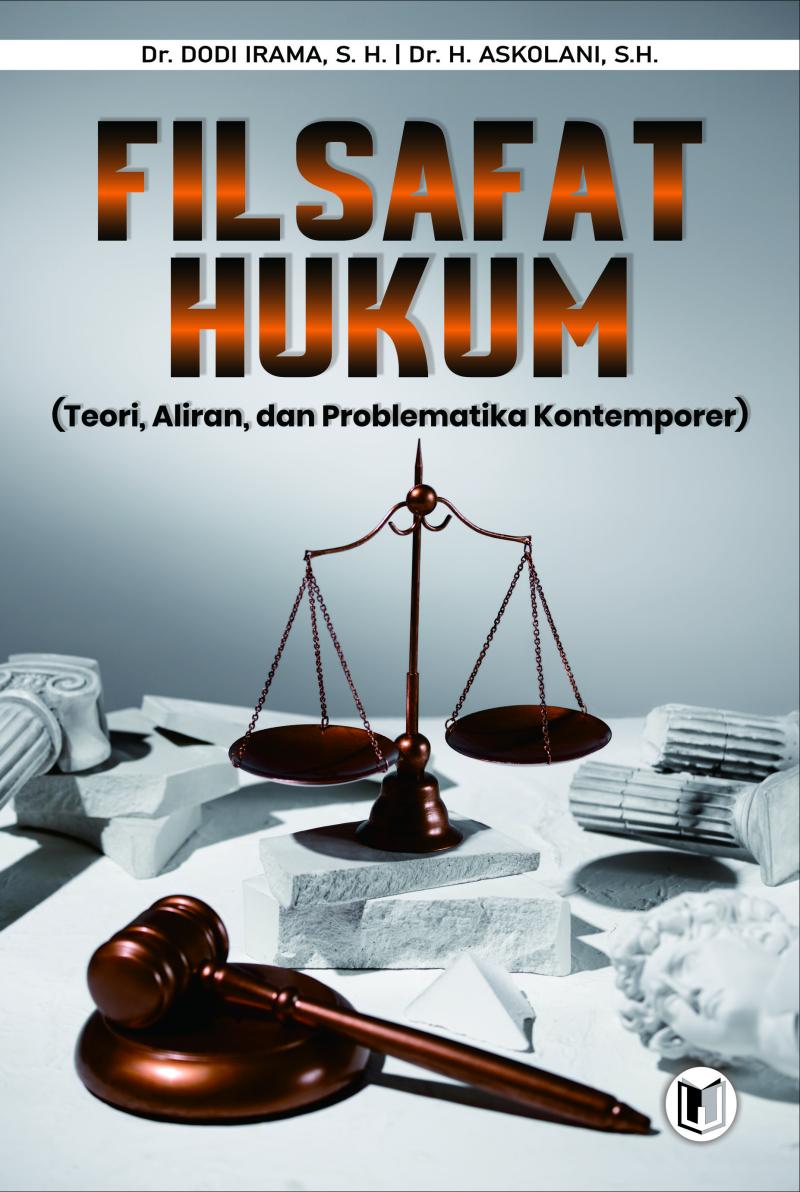
FILSAFAT HUKUM (Teori, Aliran, dan Problematika Kontemporer)
Keywords:
Filsafat Hukum (Legal Philosophy), Aliran Pemikiran Hukum (Legal Theory), Keadilan (Justice), Positivisme Hukum (Legal Positivism), Hukum Alam (Natural Law), Disrupsi Teknologi (Technological Disruption), Keadilan Restoratif (Restorative Justice), Hak Asasi Manusia (Human Rights)Synopsis
Hukum bukan sekadar kumpulan aturan yang wajib dipatuhi, ia adalah cerminan nilai, filosofi, dan cita-cita keadilan dari sebuah peradaban. Buku ini hadir untuk menjawab tantangan tersebut dengan mengajak pembaca menyelami lapisan terdalam ilmu hukum, melampaui teks perundang-undangan menuju fondasi filosofis yang menopangnya. Diawali dengan pengantar ruang lingkup filsafat hukum, buku ini membangun kerangka berpikir yang kokoh melalui tiga pilar utama: ontologi yang mempertanyakan hakikat dan keberadaan hukum, epistemologi yang menggali sumber dan kebenaran pengetahuan hukum, serta aksiologi yang menelaah tujuan dan nilai-nilai luhur yang hendak diwujudkan, yakni keadilan, kepastian, dan kemanfaatan.
Dari kerangka dasar tersebut, buku ini mengurai secara sistematis aliran-aliran besar dalam pemikiran hukum. Pembaca akan diajak menelusuri Hukum Alam yang berakar pada nilai universal dan martabat manusia, berdampingan dengan Positivisme Hukum yang tegas memisahkan hukum dari moralitas dan membangun sistem norma yang hierarkis. Tak ketinggalan, Utilitarianisme yang mengukur kebaikan hukum dari seberapa besar kemanfaatan yang diciptakannya bagi masyarakat, serta Mazhab Sejarah yang meyakini bahwa hukum tumbuh secara organik dari jiwa bangsa atau Volksgeist. Aliran-aliran seperti Sociological Jurisprudence yang mempertemukan hukum dengan realitas sosial, Realisme Hukum yang menggeser perhatian dari teks ke perilaku nyata hakim di ruang peradilan, hingga Critical Legal Studies yang membongkar mitos netralitas hukum dan menyoroti bagaimana hukum kerap menjadi instrumen dominasi kekuasaan, turut dibahas secara mendalam.
Buku ini mengangkat problematika hukum di era disrupsi teknologi. Pertanyaan-pertanyaan kritis seperti apakah kecerdasan buatan menjadi subjek hukum, siapa yang bertanggung jawab atas keputusan algoritma yang otonom, serta bagaimana hukum menjaga keadilan di ruang siber yang tanpa batas, semua dihadapkan pada filsafat hukum sebagai alat refleksi yang tidak pernah usang. Buku ini juga menekankan dimensi hak asasi manusia, termasuk ketegangan antara universalisme dan relativisme budaya dalam perlindungan HAM kontemporer, serta mengupas gagasan tentang keadilan restoratif yang mengedepankan pemulihan hubungan korban, pelaku, dan masyarakat.
Buku ini diakhiri dengan pembahasan proyeksi masa depan hukum yang humanis dan adaptif yang menegaskan bahwa filsafat hukum bukanlah ilmu yang berdiri di menara gading. Ia adalah penjaga gawang keadilan yang terus relevan di setiap zaman, memastikan bahwa hukum tidak hanya tajam secara teknis, tetapi juga matang secara filosofis dan kritis. Buku ini sangat sesuai bagi mahasiswa hukum, akademisi, dan praktisi yang ingin memiliki pemahaman hukum yang utuh, tidak hanya sebagai perangkat aturan, tetapi sebagai cermin peradaban manusia itu sendiri.
Downloads
Download data is not yet available.
References
Abbott, R. (2022). The Reasonable Robot: Artificial Intelligence and the Law. Cambridge University Press.
Al-Faruqi, I. (2024). Revelation as a Source of Law: An Epistemological Inquiry. Journal of Islamic Jurisprudence, 15(2), 210–225.
Amalia, N. (2022). Utilitarianisme dalam Hukum dan Kebijakan Publik di Indonesia. Jurnal Hukum Pembangunan, 52(3), 345–360.
Amirov, S. (2024). Theory of Natural Law and Its Essence. Jurisprudence, 4(4). https://doi.org/10.51788/tsul.jurisprudence.4.4./dmoq8776
Antonchenko, V. (2025). The Value Content and Goals of Criminal Law. Rossijskoe Pravosudie. https://doi.org/10.37399/issn2072-909x.2025.9.78-86
Austin, J. (2021). The Province of Jurisprudence Determined (P. J. D'Agostino, Ed.). Cambridge University Press.
Becker, G. S. (2021). Crime and Punishment: An Economic Approach. In The Economic Approach to Human Behavior. University of Chicago Press.
Benjamin, R. (2022). Race After Technology: Abolitionist Tools for the New Jim Code. Polity.
Benkler, Y. (2023). The Wealth of Networks: How Social Production Transforms Markets and Freedom (Updated ed.). Yale University Press.
Bentham, J. (2023). An Introduction to the Principles of Morals and Legislation (J. H. Burns & H. L. A. Hart, Eds.). Oxford University Press.
Bezpalova, O., Khar, I., Ilchyshyn, V., Isaienko, Y., & Doroshenko, K. (2023). Principles of Law: Methodological Approaches to Understanding in the Context of Modern Globalization Transformations. Revista do Curso de Direito do UNIFOR, 14(1). https://doi.org/10.24862/rcdu.v14i1.1706
Bix, B. H. (2021). Natural Law Theory. In The Cambridge Companion to the Philosophy of Law (pp. 57–72). Cambridge University Press.
Bohinich, O. (2022). Lawmaking – Separate Ontological and Epistemological Principles. Yearly Journal of Scientific Articles "Pravova Derzhava", (33), 164–173. https://doi.org/10.33663/1563-3349-2022-33-164-173
Brink, D. O. (2022). Mill's Progressive Principles. Oxford University Press.
Brownsword, R. (2021). Law, Technology and Society: Re-imagining the Regulatory Environment. Routledge.
Chalfin, A., & McCrary, J. (2017). Criminal Deterrence: A Review of the Literature. Journal of Economic Literature, 55(1), 5–48.
Chen, L. (2022). Coherence and Legal Justification. Law and Philosophy, 41(3), 259–287.
Chestnov, I. (2025). Prospects and Problematic Issues of Naturalistic Jurisprudence. Journal of Russian Law. https://doi.org/10.61205/s160565900033126-2
Coeckelbergh, M. (2022). AI Ethics. MIT Press.
Crenshaw, K., Gotanda, N., Peller, G., & Thomas, K. (Eds.). (2021). Critical Race Theory: The Key Writings That Formed the Movement. The New Press.
Dare, T. (2022). The Counsel of Rogues? A Defence of the Standard Conception of the Lawyer's Role. Routledge.
De Filippi, P., & Wright, A. (2022). Blockchain and the Law: The Rule of Code. Harvard University Press.
DeNardis, L. (2020). The Internet in Everything: Freedom and Security in a World with No Off Switch. Yale University Press.
Donnelly, J. (2022). Universal Human Rights in Theory and Practice (4th ed.). Cornell University Press.
Driver, J. (2022). The History of Utilitarianism. In E. N. Zalta (Ed.), The Stanford Encyclopedia of Philosophy.
Dworkin, R. (2021). Taking Rights Seriously (New ed.). Harvard University Press.
Eubanks, V. (2022). Automating Inequality: How High-Tech Tools Profile, Police, and Punish the Poor. St. Martin's Press.
Fagan, A. (2023). Human Rights. In E. N. Zalta & U. Nodelman (Eds.), The Stanford Encyclopedia of Philosophy (Fall 2023 ed.).
Finnis, J. (2020). Natural Law and Natural Rights (2nd ed.). Oxford University Press.
Floridi, L. (2021). The Ethics of Information. Oxford University Press.
Frank, J. (2023). Law and the Modern Mind (B. H. Bix, Ed.). Routledge.
Garcia, S. (2025). The Myth of Objectivity: A CLS Perspective on Legal Knowledge. Critical Legal Inquiry, 8(1), 45–62.
Green, L. (2022). Legal Positivism. In E. N. Zalta (Ed.), The Stanford Encyclopedia of Philosophy.
Griffin, J. (2021). On Human Rights. Oxford University Press.
Gruzdev, G. (2025). The Problem of Doctrinal Justification of Legal Sources in the Context of the Theory of Legal Argumentation, Hermeneutics, and Ronald Dworkin's Integrative Jurisprudence. Право и политика. https://doi.org/10.7256/2454-0706.2025.10.76348
Gunkel, D. J. (2023). Robot Rights. MIT Press.
Haara, H. (2021). The Rationalist Natural Law Tradition. In A History of Natural Law. Routledge.
Harris, B. (2022). Legal Rationalism and Its Limits. Ratio Juris, 35(1), 18–35.
Harris, J. W. (2021). Legal Philosophies (3rd ed.). Oxford University Press.
Hart, H. L. A. (2012). The Concept of Law (3rd ed.). Oxford University Press.
Hazmi, R., Jahar, A., & Adhha, N. (2021). Construction of Justice, Certainty, and Legal Use in the Decision of the Supreme Court Number 46 P/HUM/2018. Jurnal Cita Hukum, 9(1). https://doi.org/10.15408/jch.v9i1.11583
Heriyanto, H. (2021). The Nuremberg Trials and Their Contribution to the Development of International Law. Lex Publica, 8(1), 15–28.
Hesselink, M. W. (2022). The Indeterminacy of Law Regarding the Protection of Weak Parties. European Review of Private Law, 30(1), 3–24.
Holmes, O. W. (2021). The Path of the Law. The Floating Press.
Indriati, E., Ana, S., & Nugroho, N. (2022). Philosophy of Law and the Development of Law as a Normative Legal Science. International Journal of Educational Research & Social Sciences, 3(1), 205–212. https://doi.org/10.51601/ijersc.v3i1.293
Ivanov, D. (2023). The Logic of Codification: From Chaos to System. International Journal for the Semiotics of Law, 36(2), 581–599.
Kelsen, H. (2009). Pure Theory of Law (M. Knight, Trans.). The Lawbook Exchange, Ltd.
Kennedy, D. (2022). The Critique of Rights in Critical Legal Studies. In Left Legalism/Left Critique. Duke University Press.
Kovacs, M. (2023). The Pragmatic Turn in Legal Theory. Journal of Legal Philosophy, 48(2), 115–134.
Lang, H. S. (2022). Stoicism and the Foundation of Roman Law. Journal of the History of Philosophy, 60(3), 363–385.
Leiter, B. (2020). Legal Realism and Legal Positivism Reconsidered. Ethics, 111(2), 278–301.
Lessig, L. (2021). Code: Version 2.0. Basic Books.
Lestari, F. (2023). Ius Constituendum dan Reformasi Hukum: Studi Kasus Perancangan KUHP Baru di Indonesia. Jurnal Legislasi Indonesia, 20(2), 112–128.
Likhter, P. (2025). The Concept of "Truth" in Legal Science: A Theoretical Exploration. RUDN Journal of Law, 29(2), 313–326. https://doi.org/10.22363/2313-2337-2025-29-2-313-326
Llewellyn, J. J., Archibald, B. P., & Clairmont, D. (2023). Restorative Justice: Living the Law. University of Toronto Press.
Llewellyn, K. N. (2022). The Bramble Bush: The Classic Lectures on the Law and Law Schools. Quid Pro Books.
Lovett, F. (2022). John Rawls' A Theory of Justice. In The Cambridge Companion to Political Philosophy. Cambridge University Press.
Luban, D. (2023). Legal Ethics and Human Dignity. Cambridge University Press.
Macleod, C. (2021). John Stuart Mill. In E. N. Zalta (Ed.), The Stanford Encyclopedia of Philosophy.
Matthias, A. (2020). The Responsibility Gap: Ascribing Responsibility for the Actions of Learning Automata. Ethics and Information Technology, 6(3), 175–183.
Mill, J. S. (2021). Utilitarianism (R. Crisp, Ed.). Oxford University Press.
Minkkinen, P. (2021). Thinking Without Desire: A First Philosophy of Law. Hart Publishing.
Morozov, E. (2020). To Save Everything, Click Here: The Folly of Technological Solutionism. PublicAffairs.
Motyl, V. (2025). The Concept and Legal Nature of EU Values. Review of European and Comparative Law. https://doi.org/10.31743/recl.17770
Moyn, S. (2022). The Last Utopia: Human Rights in History. Belknap Press.
Mueller, M. L. (2021). Will the Internet Fragment? Sovereignty, Globalization and Cyberspace. Polity.
Murphy, J. G. (2020). Getting Even: Forgiveness and Its Limits. Oxford University Press.
Murray, A. (2023). Information Technology Law: The Law and Society. Oxford University Press.
Mutua, M. (2021). Savages, Victims, and Saviors: The Metaphor of Human Rights. Harvard International Law Journal, 42(1), 201–245.
Nugraha, A. (2024). Regulatory Impact Assessment dan Kualitas Legislasi di Era Digital. Jurnal Legislasi Indonesia, 21(1), 45–62.
O'Neil, C. (2021). Weapons of Math Destruction: How Big Data Increases Inequality and Threatens Democracy. Crown.
Pagallo, U. (2023). The Laws of Robots: Crimes, Contracts, and Torts. Springer.
Partha, P., Puspita, P., & Rato, D. (2024). Ideal Concept in the Implementation of Legal Philosophy in the Perspective of Sociological Jurisprudence in Indonesia. Journal of Law, Politic and Humanities, 4(3), 371–382. https://doi.org/10.38035/jlph.v4i3.371
Pasquale, F. (2021). The Black Box Society: The Secret Algorithms That Control Money and Information. Harvard University Press.
Peterson, A. (2021). The Empirical Foundation of Law: A Critique of Legal Empiricism. Socio-Legal Studies, 30(4), 512–530.
Pevko, S. (2023). Axiology of Law in Civil Society. Law and Safety, (3). https://doi.org/10.32631/pb.2023.3.12
Pogge, T. (2022). On the Idea of Justice by Amartya Sen. The Philosophical Quarterly, 72(1), 198–204.
Posner, R. A. (2022). Economic Analysis of Law (10th ed.). Wolters Kluwer.
Postema, G. J. (2021). Bentham and the Common Law Tradition. Oxford University Press.
Pound, R. (2022). Social Control Through Law. Transaction Publishers.
Radbruch, G. (2022). Statutory Lawlessness and Supra-Statutory Law. Oxford Journal of Legal Studies, 42(1), 1–10.
Rahardjo, S. (2022). Penegakan Hukum: Suatu Tinjauan Sosiologis. Genta Publishing.
Raynor, P., & Robinson, G. (2024). Rehabilitation, Crime and Justice. Palgrave Macmillan.
Raz, J. (2023). The Morality of Freedom: A Reply to Critics. Oxford Journal of Legal Studies, 43(1), 1–18.
Raz, J. (2025). Exploring the Ontological Basis of Law: Joseph Raz's Views on Normativity within the Framework of Legal Realism. International Review of Humanities Studies. https://doi.org/10.7454/irhs.v10i1.1374
Redani, R., & Ambarini, N. (2025). Integration of Philosophy of Science in the Reform of Notary Law in the Digital Age. Bengkoelen Justice: Jurnal Ilmu Hukum, 15(1). https://doi.org/10.33369/jbengkoelenjust.v15i1.39756
Reimann, M. (2022). The Historical School of Jurisprudence. In The Oxford Handbook of European Legal History. Oxford University Press.
Ripstein, A. (2022). Corrective Justice. In The Oxford Handbook of Jurisprudence and Philosophy of Law. Oxford University Press.
Safaryan, G., & Ikilikyan, A. (2024). Legal Axiology: General Characteristics. The POLITNOMOS: Journal of Political and Legal Studies, 3(1), 66–76. https://doi.org/10.54503/2953-8165-2024.3(1)-66
Salim, P., Candra, D., & Rasji, R. (2023). Interpretation of Legal Philosophy of Contemporary Law. Jurnal Indonesia Sosial Teknologi, 4(12), 834–842. https://doi.org/10.59141/jist.v4i12.834
Santoso, A. (2025). New Legal Theory Concept: Integrative-Tetradic Realism Theory. The Easta Journal Law and Human Rights, 3(3). https://doi.org/10.58812/eslhr.v3i03.632
Sartono, B. (2024). Kekuasaan dan Norma: Analisis Ontologis terhadap Pembentukan Hukum di Negara Berkembang. Jurnal Filsafat Hukum, 12(1), 45–60.
Savigny, F. C. von. (1975). Of the Vocation of Our Age for Legislation and Jurisprudence (A. Hayward, Trans.). Arno Press.
Schauer, F. (2021). Thinking Like a Lawyer: A New Introduction to Legal Reasoning. Harvard University Press.
Scherer, M. U. (2022). Regulating Artificial Intelligence Systems: Risks, Challenges, Competencies, and Strategies. Harvard Journal of Law & Technology, 29(2), 353–400.
Schmidt, H. (2024). Abstracting Norms from Social Facts: A Luhmannian Perspective. Zeitschrift für Rechtssoziologie, 44(1), 78–95.
Schofield, M. (2021). Plato's Political Philosophy. In The Oxford Handbook of Plato. Oxford University Press.
Schofield, P. (2021). Utility and Democracy: The Political Thought of Jeremy Bentham. Oxford University Press.
Serediuk, V., & Bogdan, O. (2025). The Neo-Kantian Epistemological Background of Hans Kelsen's Pure Theory of Law. Uzhhorod National University Herald. Series: Law, 88(4). https://doi.org/10.24144/2307-3322.2025.88.4.27
Simmonds, N. E. (2022). Central Issues in Jurisprudence: Justice, Law and Rights (6th ed.). Sweet & Maxwell.
Solum, L. B. (2021). Procedural Justice. In The Cambridge Companion to the Philosophy of Law. Cambridge University Press.
Spaak, T. (2020). A Critical Introduction to the Philosophy of Law: Scandinavian Legal Realism. Bloomsbury Publishing.
Stump, E. (2021). Augustine's Political Philosophy. In The Cambridge Companion to Augustine. Cambridge University Press.
Sulistyo, E. (2023). Hukum dan Pembangunan Ekonomi: Meninjau Ulang Teori Mochtar Kusumaatmadja. Jurnal Hukum Nasional, 15(2), 112–128.
Tamanaha, B. Z. (2021). A Realistic Theory of Law. Cambridge University Press.
Taylor, C. (2021). Conditions of an Unforced Consensus on Human Rights. In The East Asian Challenge for Human Rights. Cambridge University Press.
Unger, R. M. (2021). The Critical Legal Studies Movement: Another Time, A Greater Task. Verso Books.
Walen, A. (2021). Retributive Justice. In E. N. Zalta (Ed.), The Stanford Encyclopedia of Philosophy.
Walters, G. (2023). Truth and Fact-Finding in Adjudication. International Journal of Evidence & Proof, 27(3), 195–210.
Ward, I. (2021). Introduction to Critical Legal Theory (3rd ed.). Routledge.
Waro, A. (2023). The Legacy of the Frankfurt School in Contemporary Critical Legal Thought. Jurisprudence, 14(2), 150–168.
Weinrib, E. J. (2021). The Idea of Private Law (2nd ed.). Oxford University Press.
Wenar, L. (2021). Rights. In E. N. Zalta (Ed.), The Stanford Encyclopedia of Philosophy.
Whitman, J. Q. (2020). The Legacy of Roman Law in the German Historical School. In The Cambridge Companion to Roman Law. Cambridge University Press.
Wiguna, M. (2023). Implikasi Filsafat Positivisme terhadap Ilmu Hukum dan Penegakannya. UNES Journal of Swara Justisia, 7(2), 374–385. https://doi.org/10.31933/ujsj.v7i2.374
Winston, K. I. (2021). Lon Fuller's Procedural Natural Law. In The Cambridge Companion to the Philosophy of Law. Cambridge University Press.
Wischmeyer, T. (2023). Artificial Intelligence and Transparency: A Legal Perspective. Philosophy & Technology, 33(1), 73–95.
Zehr, H. (2023). The Little Book of Restorative Justice (Revised & Updated ed.). Good Books.
Zuboff, S. (2023). The Age of Surveillance Capitalism: The Fight for a Human Future at the New Frontier of Power. PublicAffairs.
Zuckert, M. P. (2022). Locke's Natural Rights and the Foundations of Modernity. University of Notre Dame Press.
Downloads
Published
April 29, 2026
Copyright (c) 2026 DODI IRAMA, ASKOLANI Widina (Author)
License

This work is licensed under a Creative Commons Attribution-NonCommercial-ShareAlike 4.0 International License.
How to Cite
IRAMA, D., & Widina, A. (2026). FILSAFAT HUKUM (Teori, Aliran, dan Problematika Kontemporer). Widina Media Utama. https://doi.org/10.59818/3ybq8n75