
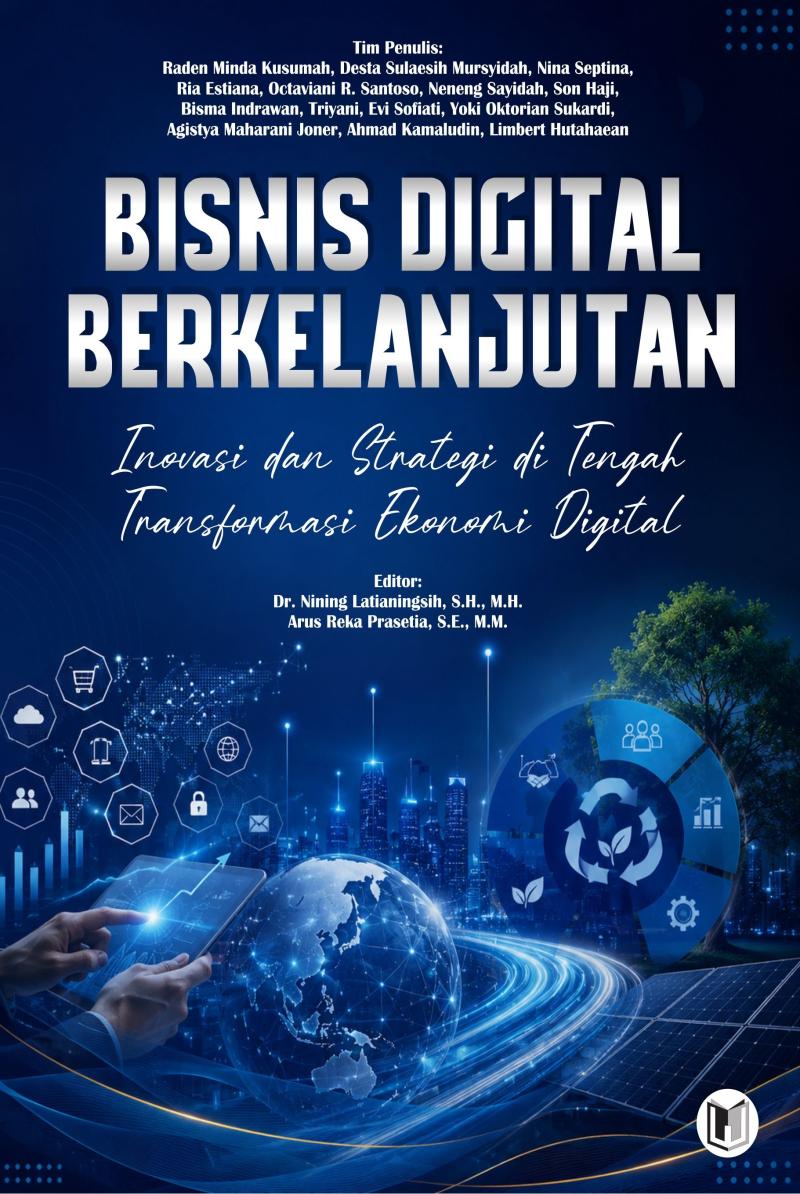
BISNIS DIGITAL BERKELANJUTAN: INOVASI DAN STRATEGI DI TENGAH TRANSFORMASI EKONOMI DIGITAL
Keywords:
Bisnis Digital Berkelanjutan (Sustainable Digital Business), Transformasi Ekonomi Digital (Digital Economic Transformation), Inovasi Model Bisnis (Business Model Innovation), Teknologi Digital (AI, Big Data, IoT, Blockchain), ESG (Environmental, Social, and Governance), Keamanan Siber (Cybersecurity), Strategi Pertumbuhan (Growth Strategy)Synopsis
Buku Bisnis Digital Berkelanjutan: Inovasi dan Strategi di Tengah Transformasi Ekonomi Digital membahas perkembangan bisnis digital yang dipengaruhi oleh transformasi teknologi dan ekonomi global. Buku ini menguraikan konsep bisnis digital berkelanjutan, inovasi model bisnis, pemasaran digital, keuangan digital, hingga peran teknologi seperti AI, Big Data, IoT, dan blockchain dalam meningkatkan daya saing bisnis modern. Selain itu, buku ini menyoroti pentingnya tata kelola digital, keamanan siber, ESG, serta strategi pertumbuhan bisnis yang berorientasi pada keberlanjutan dan ramah lingkungan. Dengan pendekatan teoritis dan praktis, buku ini diharapkan menjadi referensi bagi akademisi, mahasiswa, dan praktisi dalam memahami strategi bisnis digital di era ekonomi modern.
Downloads
Download data is not yet available.
References
Abubakar, R., & Ozdamli, F. (2026). Securing financial systems: The role of DSS in cybersecurity. In Signals and communication technology. Springer. (In press 2026).
Accenture. (2024). Embedded finance global outlook. New York: Accenture.
Adner, R. (2017). Ecosystem as structure: An actionable construct for strategy. Journal of Management, 43(1), 39-58.
https://doi.org/10.1177/0149206316678451
Aldossary, A., Algirim, T., Almubarak, I., & Almuhish, K. (2024). Cyber security in data breaches. Journal of Cyber Security and Risk Auditing, 2024(1), 14-22. https://doi.org/10.63180/jcsra.thestap.2024.1.3
Ali, F., Rasoolimanesh, S. M., Sarstedt, M., Ringle, C. M., & Ryu, K. (2023). An assessment of the use of partial least squares structural equation modeling (PLS-SEM) in hospitality research. International Journal of Contemporary Hospitality Management, 35(1), 1-20.
https://doi.org/10.1108/IJCHM-04-2022-0500
Alshahrani, H. M., Alotaibi, S. S., Ansari, M. T. J., Asiri, M. M., Agrawal, A., Khan, R. A., Mohsen, H., & Hilal, A. M. (2022). Analysis and ranking of IT risk factors using fuzzy TOPSIS-based approach. Applied Sciences, 12(12), 5911. https://doi.org/10.3390/app12125911
Amit, R., & Zott, C. (2021). Business model innovation strategy: Transformational concepts and tools for entrepreneurial leaders. Hoboken: John Wiley & Sons.
Arduin, P.-E. (2018). Information systems and security: Insider threats (Vol. 10). ISTE Ltd. https://doi.org/10.1002/9781119419785
Arner, D. W., Barberis, J., & Buckley, R. P. (2024). Fintech and the transformation of financial services. London: Routledge.
Assauri, S. (2020). Manajemen operasi produksi. Jakarta: Rajawali Pers.
Atzori, L., Iera, A., & Morabito, G. (2017). Understanding the Internet of Things: Definition, potentials, and societal role of a fast evolving paradigm. Ad Hoc Networks, 56, 122-140.
https://doi.org/10.1016/j.adhoc.2016.12.004
Avolio, B. J., Kahai, S., & Dodge, G. E. (2001). E-leadership: Implications for theory, research, and practice. The leadership quarterly.
Bank for International Settlements. (2024). Cross-border payments and CBDC development report. Basel: BIS.
Bank for International Settlements. (2025). Decentralized finance and financial stability report. Basel: BIS.
Bank Indonesia. (2025). Blueprint sistem pembayaran Indonesia dan project Garuda. Jakarta: Bank Indonesia.
Bank Indonesia. (2025). Digitalisasi UMKM dan ekonomi nasional. Jakarta: Bank Indonesia.
Bank Indonesia. (2025). Laporan perkembangan QRIS dan sistem pembayaran nasional. Jakarta: Bank Indonesia.
Bazi, S., Filieri, R., & Gorton, M. (2023). Social media content aesthetic quality and customer engagement. Journal of Business Research, 160, 113778. https://doi.org/10.1016/j.jbusres.2023.113633
Bharadwaj, A., El Sawy, O. A., Pavlou, P. A., & Venkatraman, N. (2013). Digital business strategy: Toward a next generation of insights. MIS Quarterly, 37(2), 471-482. https://doi.org/10.25300/MISQ/2013/37:2.3
Bhattacharya, C. B., & Sen, S. (2004). Doing better at doing good: When, why, and how consumers respond to corporate social initiatives. California Management Review, 47(1), 9-24.
BlackRock. (2025). Global sustainable investing report. New York: BlackRock.
Blank, S., & Dorf, B. (2020). The startup owner’s manual. Pescadero: K&S Ranch.
Bocken, N. M. P., Short, S. W., Rana, P., & Evans, S. (2014). A literature and practice review to develop sustainable business model archetypes. Journal of Cleaner Production, 65, 42-56.
https://doi.org/10.1016/j.jclepro.2013.11.039
Brandenburger, A., & Nalebuff, B. (2021). The rules of co-opetition. Harvard Business Review, 99(1), 48-57.
Brigham, E. F., & Ehrhardt, M. C. (2024). Financial management: Theory and practice (17th ed.). Boston: Cengage Learning.
Brown, T. (2019). Change by design: How design thinking transforms organizations and inspires innovation (Rev. ed.). New York: HarperBusiness.
Brynjolfsson, E., & McAfee, A. (2014). The second machine age. New York: W. W. Norton & Company.
Budiarti, E., Pristiana, U., & Rahmiyati, N. (2026). Green marketing management in the digital era: A study of website content and corporate social media in Surabaya. Jurnal Ilmiah Manajemen Kesatuan, 14(1), 359-370. https://doi.org/10.37641/jimkes.v14i1.4923
Bughin, J., Catlin, T., Hirt, M., & Willmott, P. (2022). Why digital strategies fail and how to build a winning digital strategy. McKinsey Quarterly, 18(2), 45-62.
Bukht, R., & Heeks, R. (2017). Defining, conceptualising and measuring the digital economy. Development Informatics Working Paper No. 68. Centre for Development Informatics, University of Manchester. https://doi.org/10.2139/ssrn.3431732
Carroll, A. B. (1991). The pyramid of corporate social responsibility: Toward the moral management of organizational stakeholders. Business Horizons, 34(4), 39-48.
Castells, M. (2010). The rise of the network society (2nd ed.). Malden: Wiley-Blackwell.
Chaffey, D., Ellis-Chadwick, F., & Abed-Rabbo, M. (2025). Digital marketing (9th ed.). Harlow: Pearson Education Ltd.
Chakkaravarthy, A. P., Jaganathan, D., Mohan, A., & Rajesh, S. (2025). Information security management in IT service environments. In Cases on information systems service management. IGI Global. (In press 2025).
Chauhan, R., Kapoor, A. D., Kapoor, S., & Sijoria, C. (2025). Fostering a resilient organisational culture through digital transformation. In Digital transformation of business world: A managerial perspective (pp. 83–95). Emerald Publishing. https://doi.org/10.1108/978-1-83662-046-420251006
Chen, M., Mao, S., & Liu, Y. (2023). Big data: A survey of opportunities and challenges for business intelligence and analytics. IEEE Access, 11, 45320–45339. https://doi.org/10.1109/ACCESS.2023.3270591
Chesbrough, H. (2020). To recover faster from Covid-19, open up: Managerial implications from an open innovation perspective. Industrial Marketing Management, 88, 410-413. https://doi.org/10.1016/j.indmarman.2020.04.010
Cholifah, F. (2025). Bridging sustainability and digitalization in green marketing: A systematic review. International Conference Proceedings.
Christensen, C. M., Raynor, M. E., & McDonald, R. (2015). What is disruptive innovation? Harvard Business Review, 93(12), 44-53.
Chui, M., Hall, B., Mayhew, H., & Singla, A. (2022). The state of AI in 2022 and a half decade in review. McKinsey Global Institute.
https://www.mckinsey.com/capabilities/quantumblack/our-insights/the-state-of-ai-in-2022
Codara, L., & Sgobbi, F. (2023). Resilience, complexity and digital transformation: Three case studies in the valves industry. Journal of Manufacturing Technology Management, 34(9), 1-19.
https://doi.org/10.1108/JMTM-05-2022-0214
Cohn, M. (2020). Succeeding with agile: Software development using Scrum (2nd ed.). Boston: Addison-Wesley Professional.
Committee of Sponsoring Organizations of the Treadway Commission. (2023). Internal control integrated framework. New York: COSO.
Czinkota, M. R., & Ronkainen, I. A. (2019). International marketing (11th ed.). Boston: Cengage Learning.
Damodaran, A. (2024). The dark side of valuation (4th ed.). New York: Wiley.
Dananjoyo, R., Udin, U., & Idris, A. (2024). Mediating roles of customer engagement and satisfaction in the connection between e-retail customer experience and loyalty. International Journal of Sustainable Development and Planning, 19(2), 751-759. https://doi.org/10.18280/ijsdp.190232
Das, M., Nayak, R., & Behera, R. (2024). Digital sustainability communication and consumer engagement. Journal of Business Research.
Davenport, T. H., & Harris, J. G. (2017). Competing on analytics: Updated, with a new introduction: The new science of winning (2nd ed.). Boston: Harvard Business Review Press.
Davenport, T. H., & Kirby, J. (2016). Only humans need apply: Winners and losers in the age of smart machines. New York: Harper Business.
Deloitte. (2024). Digital payment trends in Southeast Asia. Singapore: Deloitte Insights.
Deng, H., Lan, Y., Chen, G., Zheng, Y., & Zhang, M. (2025). Sustainable marketing performance in the digital transformation era. Sustainability, 17(17), 7995.
Dessler, G. (2020). Human resource management (16th ed.). Boston: Pearson Education.
Dhaigude, R., & Pabalkar, V. (2025). Creative destruction of risk in financial institutions through technology. In Lecture notes in networks and systems. Springer. (In press 2025).
Đukić, S. (2025). Cyber security and data protection. Moderna Arhivistika, 8(1), 78-85. https://doi.org/10.54356/MA/2025/HAZD7569
Elkington, J. (1997). Cannibals with forks: The triple bottom line of 21st century business. Oxford: Capstone Publishing.
Ellen MacArthur Foundation. (2015). Towards a circular economy: Business rationale for an accelerated transition. Cowes: Ellen MacArthur Foundation Publishing.
Farmani, M., & Scott, M. (2026). Smart grid cybersecurity. In Handbook of power electronics in smart grids and intelligent energy (pp. 243-281). Elsevier. https://doi.org/10.1016/B978-0-323-95045-9.00028-7
Feng, X., & Wu, X. (2026). Strategic orientations and organizational resilience: The moderating role of digital technology. Systems, 14(2), 159. https://doi.org/10.3390/systems14020159
Firmansyah, B. (2024). Cybersecurity fundamentals. In Challenges in large language model development and AI ethics (pp. 280-320). IGI Global.
https://doi.org/10.4018/979-8-3693-3860-5.ch009
Firmansyah, E. A., & Anwar, M. (2023). Digital financial inclusion in Indonesia: The role of fintech in bridging the gap. Journal of Financial Services Marketing, 28(1), 112-127. https://doi.org/10.1057/s41264-022-00155-2
Freitag, C., Berners-Lee, M., Widdicks, K., Knowles, B., Blair, G. S., & Friday, A. (2021). The real climate and transformative impact of ICT: A critique of estimates, trends, and regulations. Patterns, 2(9), 100385.
https://doi.org/10.1016/j.patter.2021.100385
Frenken, K., & Schor, J. (2017). Putting the sharing economy into perspective. Environmental Innovation and Societal Transitions, 23, 3–10.
https://doi.org/10.1016/j.eist.2017.01.003
Friede, G., Busch, T., & Bassen, A. (2022). ESG and financial performance: Aggregated evidence from more than 2000 empirical studies. Journal of Sustainable Finance & Investment, 5(4), 210-233.
https://doi.org/10.1080/20430795.2015.1118917
Fukuyama, M. (2018). Society 5.0: Aiming for a new human-centered society. Japan: Japan SPOTLIGHT.
Gangwar, H., & Date, H. (2018). Exploring information security governance in cloud computing organisation. In Cyber security and threats: Concepts, methodologies, tools, and applications (pp. 44-61). IGI Global.
https://doi.org/10.4018/978-1-5225-5634-3.ch003
Gangwar, H., Date, H., & Ramaswamy, R. (2022). Understanding determinants of cloud computing adoption using an integrated TAM-TOE model. Journal of Enterprise Information Management, 28(1), 107-130. https://doi.org/10.1108/JEIM-08-2014-0096
Gartner. (2026). Top strategic technology trends for 2026. Retrieved from Gartner Official Website
Geissdoerfer, M., Pieroni, M. P. P., Pigosso, D. C. A., & Soufani, K. (2021). Circular business models: A review. Journal of Cleaner Production, 277, 123741. https://doi.org/10.1016/j.jclepro.2020.123741
Gillan, S. L., Koch, A., & Starks, L. T. (2021). Firms and social responsibility: A review of ESG and CSR research in corporate finance. Journal of Corporate Finance, 66, 101889. https://doi.org/10.1016/j.jcorpfin.2021.101889
Gillis, A. S. (2022). Cloud computing benefits, types and challenges. TechTarget. https://www.techtarget.com/searchcloudcomputing/definition/cloud-computing
Gitman, L. J., & Zutter, C. J. (2023). Principles of managerial finance (15th ed.). Boston: Pearson.
Goel, A., Masurkar, S., & Pathade, G. R. (2024). An overview of digital transformation and environmental sustainability: Threats, opportunities, and solutions. Sustainability, 16(24), 11079.
https://doi.org/10.3390/su162411079
Google, Temasek, & Bain & Company. (2022). e-Conomy SEA 2022: Through the waves, towards a sea of opportunity. Singapore: Google Asia Pacific Pte. Ltd.
Grewal, D., Hulland, J., Kopalle, P. K., & Karahanna, E. (2023). The future of technology and marketing: A multidisciplinary perspective. Technological Forecasting and Social Change, 187, 122199.
https://doi.org/10.1016/j.techfore.2022.122199
Gupta, M., Sharman, R., Walp, J., & Mulgund, P. (Eds.). (2017). Information technology risk management and compliance in modern organizations. IGI Global. https://doi.org/10.4018/978-1-5225-2604-9
Halim, H., & Yusof, M. M. (2019). Framework for digital data access control from internal threat in the public sector. International Journal of Advanced Computer Science and Applications, 10(9), 123-130.
https://doi.org/10.14569/IJACSA.2019.0100809
Hamari, J., Sjöklint, M., & Ukkonen, A. (2021). The sharing economy: Why people participate in collaborative consumption. Journal of the Association for Information Science and Technology, 67(9), 2047-2059.
https://doi.org/10.1002/asi.23552
Heizer, J., Render, B., & Munson, C. (2020). Operations management: Sustainability and supply chain management (13th ed.). Boston: Pearson Education.
Hill, C. W. L. (2020). International business: Competing in the global marketplace (13th ed.). New York: McGraw-Hill Education.
Horngren, C. T., Datar, S. M., & Rajan, M. V. (2023). Cost accounting: A managerial emphasis (17th ed.). New York: Pearson.
Huddin, M. N., Kurnia, D., Deviyantoro, D., & Nafiudin, N. (2024). The relationship between customer experience, customer satisfaction, customer trust, and customer loyalty in tourism destination. Diponegoro International Journal of Business, 6(2), 142-154.
https://doi.org/10.14710/dijb.6.2.2023.142-154
Hull, J. C. (2024). Risk management and financial institutions (6th ed.). Hoboken: Wiley.
IBM Security. (2025). Cost of a data breach report 2025. Armonk: IBM Corporation.
IBM Think. (2026). AI and technology predictions 2026. Retrieved from IBM Official Website
Indrajit, R. E. (2020). Manajemen sistem informasi dan teknologi digital. Jakarta: Elex Media Komputindo.
Indrajit, R. E. (2021). Transformasi digital dan strategi bisnis modern. Jakarta: Elex Media Komputindo.
International Monetary Fund. (2024). Fintech liquidity and systemic resilience. Washington: International Monetary Fund.
ISO. (2010). ISO 26000: Guidance on social responsibility. Geneva: International Organization for Standardization.
Jacobides, M. G., Cennamo, C., & Gawer, A. (2018). Towards a theory of ecosystems. Strategic Management Journal, 39(8), 2255-2276.
https://doi.org/10.1002/smj.2904
Jogiyanto, H. M. (2020). Sistem informasi manajemen. Yogyakarta: Andi Offset.
Kannan, P. K., & Li, H. (2017). Digital marketing: A framework, review and research agenda. Journal of Marketing Research, 54(1), 22-45.
https://doi.org/10.1509/jmr.15.0417
Kaplan, R. S., & Norton, D. P. (2024). The balanced scorecard revisited. Boston: Harvard Business Review Press.
Kaur, G., & Lashkari, A. H. (2021). Information technology risk management. In K. Daimi & G. Francia III (Eds.), Advances in cybersecurity management (pp. 269-287). CRC Press. https://doi.org/10.1007/978-3-030-71381-2_13
Kementerian Komunikasi dan Informatika RI. (2019). Peraturan Pemerintah Nomor 71 Tahun 2019 tentang Penyelenggaraan Sistem dan Transaksi Elektronik. Sekretariat Negara Republik Indonesia.
Klaus, P. P., Kuppelwieser, V. G., & Heinonen, K. (2023). Quantifying the influence of customer experience on consumer share of category. Journal of Retailing and Consumer Services, 73, 103375.
https://doi.org/10.1016/j.jretconser.2023.103375
Koay, K. Y., Ong, D. L. T., Khoo, K. L., & Yeoh, H. J. (2024). Perceived social media marketing activities and consumer-based brand equity: Testing a moderated mediation model. Journal of Retailing and Consumer Services, 76, 103548. https://doi.org/10.1016/j.jretconser.2023.103548
Kotler, P., & Keller, K. L. (2021). Marketing management (16th ed.). Harlow: Pearson Education.
Krupa, C. R., Kavitha, R. K., Vasundhra, G., & Kavidharshini, I. (2025). Safeguarding digital learning environments in the era of advanced technologies. In Cyber security and data science innovations for sustainable development of HEICC: Healthcare, education, industry, cities, and communities (pp. 228-244). CRC Press.
https://doi.org/10.1201/9781032711300-16
Kulikovskaja, V., Hubert, M., Grunert, K. G., & Zhao, H. (2023). Driving marketing outcomes through social media based customer engagement. Journal of Retailing and Consumer Services, 74, 103445.
https://doi.org/10.1016/j.jretconser.2023.103445
Kumari, A. (2025). Integrating digital technologies for climate action: Driving innovation to achieve SDG 13. In Examining human rights at the intersection of digitalization and society (pp. 245-271). IGI Global.
https://doi.org/10.4018/979-8-3373-3685-5.ch010
Kusumah, R. (2025). Digital finance literacy and strategic learning. Jakarta: Nusantara Press.
Laudon, K. C., & Laudon, J. P. (2022). Management information systems: Managing the digital firm (17th ed.). New York: Pearson.
Laudon, K. C., & Traver, C. G. (2024). E-commerce: Business, technology, society. Boston: Pearson.
Lemon, K. N., & Verhoef, P. C. (2023). Understanding customer experience throughout the customer journey. Journal of Marketing, 61, 1-15. https://doi.org/10.1016/j.intmar.2022.10.001
Liedtka, J. (2023). Experiencing design: The innovator's journey. New York: Columbia Business School Publishing.
Lou, C., & Xie, Q. (2023). Something social, something entertaining? How digital content marketing augments consumer experience and brand loyalty. International Journal of Advertising, 42(3), 376-402.
https://doi.org/10.1080/02650487.2022.2049987
Mahmudi. (2020). Manajemen kinerja sektor publik. Yogyakarta: UPP STIM YKPN.
Malmodin, J., & Lundén, D. (2018). The energy and carbon footprint of the global ICT and E&M sectors 2010–2015. Sustainability, 10(9), 3027. https://doi.org/10.3390/su10093027
Manyika, J., Chui, M., Miremadi, M., Bughin, J., George, K., Willmott, P., & Dewhurst, M. (2021). A future that works: Automation, employment, and productivity. San Francisco: McKinsey Global Institute.
Mavilinda, H. F., Rosa, A. R., & Putri, Y. H. (2024). Ephemeral marketing trends. Diponegoro International Journal of Business.
https://doi.org/10.14710/dijb.7.2.2024.115-132
McKinsey & Company. (2025). AI in banking and financial services. New York: McKinsey Global Institute.
Mell, P., & Grance, T. (2018). The NIST definition of cloud computing (NIST Special Publication 800-145, updated reprint). National Institute of Standards and Technology. https://doi.org/10.6028/NIST.SP.800-145
Moazed, A., & Johnson, N. L. (2016). Modern monopolies: What it takes to dominate the 21st century economy. New York: St. Martin's Press.
Monks, R. A. G., & Minow, N. (2020). Corporate governance (6th ed.). Hoboken: Wiley.
Morgan, P. J. (2022). Assessing the risks associated with green digital finance and policies for coping with them. In F. Taghizadeh-Hesary & S. Hyun (Eds.), Green digital finance and sustainable development goals (pp. 51-68). Springer. https://doi.org/10.1007/978-981-19-2662-4_3
Muda, I., Ray, S., & Yadav, R. (2023). Impact of social media marketing activities on customer engagement: A meta analysis. SSRN.
https://doi.org/10.2139/ssrn.4383121
Naguib, A., Aslan, H. K., & Fouad, K. M. (2025). Effective integration of database security tools into SDLC phases: A structured framework. Journal of Cybersecurity and Information Management. (DOI belum tersedia / in press 2025).
Nambiar, P., & Chitty, N. (2014). Meaning making by managers: Corporate discourse on environment and sustainability in India. Journal of Business Ethics, 123(3), 385-400. https://doi.org/10.1007/s10551-013-1845-z
Nandhini, S., Yamini, B., Anurekha, G., et al. (2025). The role of risk management in modern business and technology. In AI methods for environmental protection and resource conservation. IGI Global. https://doi.org/10.4018/979-8-3373-3246-8.ch009
Negi, D., & Bajaj, D. (2025). Risk management strategies in construction project management. In D. Bajaj (Ed.), Handbook of construction project management. Springer. https://doi.org/10.1007/978-981-96-7631-6_7
Nguyen, M. S. (2024). Bibliometric insights into digital marketing trends. Innovative Marketing.
Noe, R. A. (2021). Employee training and development (8th ed.). New York: McGraw-Hill Education.
Northouse, P. G. (2021). Leadership: Theory and practice (9th ed.). Thousand Oaks: Sage Publications.
Nosratabadi, S., Mosavi, A., Shamshirband, S., Zavadskas, E. K., Rakotonirainy, A., & Chau, K. W. (2019). Sustainable business models: A review. Sustainability, 11(6), 1663. https://doi.org/10.3390/su11061663
Nzimakwe, T. I. (2019). Government’s dynamic approach to addressing challenges of cybersecurity in South Africa. In Cyber law, privacy, and security: Concepts, methodologies, tools, and applications (pp. 139-156). IGI Global. https://doi.org/10.4018/978-1-5225-8897-9.ch008
OECD. (2015). G20/OECD principles of corporate governance. Paris: OECD Publishing.
OECD. (2025). Digital economy outlook 2025. Paris: OECD Publishing.
Oppermann, D. (2021). Dimensions of cybersecurity in Brazil. In CyberBRICS: Cybersecurity regulations in the BRICS countries (pp. 35–65). Springer. https://doi.org/10.1007/978-3-030-56405-6_2
Osterwalder, A., & Pigneur, Y. (2015). Business model generation: A handbook for visionaries, game changers, and challengers. Hoboken: John Wiley & Sons.
Otoritas Jasa Keuangan. (2025). Laporan perkembangan fintech lending Indonesia. Jakarta: Otoritas Jasa Keuangan.
Otoritas Jasa Keuangan. (2025). Survei nasional literasi dan inklusi keuangan Indonesia 2025. Jakarta: Otoritas Jasa Keuangan.
Pan, Q., Lan, M., Tan, C. Y., Tao, S., Liang, Q., & Law, N. (2024). Protective factors contributing to adolescents’ multifaceted digital resilience for their wellbeing: A socio-ecological perspective. Computers in Human Behavior, 155, 108164. https://doi.org/10.1016/j.chb.2024.108164
Panangian, J., & Masnita, Y. (2024). The influence of social media marketing activities on consumer brand engagement, willingness to pay a premium price, and purchase intentions. Enrichment: Journal of Management, 14(1), 1-9. https://doi.org/10.35335/enrichment.v14i1.1856
Parker, G. G., Van Alstyne, M. W., & Choudary, S. P. (2016). Platform revolution: How networked markets are transforming the economy and how to make them work for you. New York: W. W. Norton & Company.
Porter, M. E. (2015). Competitive advantage: Creating and sustaining superior performance. New York: Free Press.
Porter, M. E., & Kramer, M. R. (2011). Creating shared value. Harvard Business Review, 89(1-2), 62-77.
Porter, M. E., & Kramer, M. R. (2019). Creating shared value: How to reinvent capitalism and unleash a wave of innovation and growth. Boston: Harvard Business Review Press.
Prakesh, V., Khare, S., Talwandi, N. S., et al. (2025). Strategic framework for cybersecurity risk management: Enhancing resilience in an evolving threat landscape. In Lecture notes in networks and systems. Springer. https://doi.org/10.1007/978-981-96-3284-8_13
Prasetyo, P. E., & Trisyanti, U. (2022). Digital economy ecosystem and sustainable development: Evidence from Indonesia. Journal of Asian Finance, Economics and Business, 9(6), 215-225.
https://doi.org/10.13106/jafeb.2022.vol9.no6.0215
Praveenkumar, K., Balasm, Z., Bharathi, P., Premalatha, B., Ataev, S., & Priya, P. (2025). Digital twins driven by artificial intelligence to mitigate, detect, and simulate virtual space cyber threats. 2025 International Conference on Computational Innovations and Engineering Sustainability (ICCIES). https://doi.org/10.1109/ICCIES63851.2025.11032312
Prema, V., & Kumar, M. (2023). Internet of Things: Architecture, applications, security, and privacy. Journal of Network and Computer Applications, 206, 103-119. https://doi.org/10.1016/j.jnca.2022.103119
Pujawan, I. N. (2021). Supply chain management (4th ed.). Yogyakarta: Andi Offset.
Pujawan, I. N., & Mahendrawathi. (2022). Supply chain management (4th ed.). Yogyakarta: Andi Offset.
PwC. (2025). AI in finance: Future forecasting and automation report. New York: PwC.
PwC. (2025). Global economic crime and fraud survey. London: PwC.
Radianti, J. (2025). Navigating digital resilience in complex emergency management environments. Proceedings of the International ISCRAM Conference.
Rahimi, F., Møller, C., & Hvam, L. (2022). Business process management and IT management: The missing integration. International Journal of Information Management, 62, 102-118.
https://doi.org/10.1016/j.ijinfomgt.2021.102118
Rangkuti, F. (2021). Manajemen rantai pasok dan logistik. Jakarta: Gramedia Pustaka Utama.
Rasenda, R., Rizal, M., Wiyana, H., & Subagja, S. N. (2025). Digitalisasi UMKM: Strategi dan model bisnis berbasis teknologi untuk keberlanjutan. Jurnal Bisnis Digital, 4(1), 1-18.
Rather, R. A., Hollebeek, L. D., & Rasoolimanesh, S. M. (2022). First-time versus repeat tourism customer engagement, experience, and value co-creation: An empirical investigation. Journal of Business Research, 139, 140-152. https://doi.org/10.1016/j.jbusres.2021.09.051
Ravikumar, R. N., & Aarthi, S. (2026). Web-based cybersecurity architectures: Safeguarding identity, trust, and resilience in the digital era. In Impact of web technologies on digital transformation (pp. 187-216). IGI Global. https://doi.org/10.4018/979-8-3373-5167-4.ch007
Rawangngam, N., Pongsakornrungsilp, P., Siriwong, C., Ketkaew, K., Tonsakunthaweeteam, S., & Kumar, V. (2025). Social media and consumer engagement: A bibliometric analysis and future research directions. Innovative Marketing, 21(3), 197-214.
https://doi.org/10.21511/im.21(3).2025.15
Refsdal, A., Solhaug, B., & Stølen, K. (2015). Cybersecurity. In SpringerBriefs in computer science (pp. 29-32). Springer. https://doi.org/10.1007/978-3-319-23570-7_4
Rennings, K. (2023). Redefining innovation: Eco-innovation research and the contribution from ecological economics. Ecological Economics, 32(2), 319-332. https://doi.org/10.1016/S0921-8009(99)00112-3
Ries, E. (2017). The lean startup. New York: Crown Business.
Ries, E. (2017). The startup way: How modern companies use entrepreneurial management to transform culture and drive long term growth. New York: Crown Business.
Rizaldi, A., Margareta, F., Simehate, K., Hikmah, S. N., Albar, C. N., & Rafdhi, A. A. (2021). Digital marketing as a marketing communication strategy. International Journal of Research and Applied Technology (INJURATECH), 1(1), 61-69. https://doi.org/10.34010/injuratech.v1i1.5639
Robbins, S. P., & Judge, T. A. (2022). Organizational behavior (19th ed.). Harlow: Pearson Education.
Romney, M. B., & Steinbart, P. J. (2023). Accounting information systems (15th ed.). New York: Pearson.
Rosário, A. T., Raimundo, R., & Cruz, N. (2025). The role of digital marketing in shaping sustainable consumption. Sustainability, 17(17), 7784.
Ross, S. A., Westerfield, R. W., & Jordan, B. D. (2023). Fundamentals of corporate finance (14th ed.). New York: McGraw-Hill Education.
Russell, S., & Norvig, P. (2021). Artificial intelligence: A modern approach (4th ed.). Hoboken: Pearson.
Saharan, P., & Mishra, U. S. (2025). A systematic review of digital transformation and business sustainability. European Economic Letters, 15(1), 233-249.
Salonen, A. (2024). The effect of timely content delivery on customer engagement. Industrial Marketing Management.
https://doi.org/10.1016/j.indmarman.2024.01.022
Sanjaya, M. I., & Setyanoor, E. (2024). The implication of green marketing in the digital era. Proceedings of Islamic Economics Studies.
Sankar, R., Alwin Christopher, T., Daden, W. A., & Rajan Kirthy, G. (2024). Cybersecurity enabled improved bigdata privacy management measures to preserve information with privacy concerns. Proceedings of 9th International Conference on Science, Technology, Engineering and Mathematics (ICONSTEM 2024).
https://doi.org/10.1109/ICONSTEM60960.2024.10568845
Saranya, G., Bavadharika, P., Bansi, A. J. V., & Ananya, A. (2025). Investigation and enhancement of digital system security against emerging cyber threats. Proceedings of the 6th International Conference on Inventive Research in Computing Applications (ICIRCA 2025), 28-35. https://doi.org/10.1109/ICIRCA65293.2025.11089645
Sarathkumar, D., Raj, R. A., Saravanan, T. P., & Karthikeyan, J. (2025). An extensive critique cybersecurity threats and mitigation strategies in smart grid networks. 2025 IEEE 2nd International Conference on Green Industrial Electronics and Sustainable Technologies (GIEST).
Schaltegger, S., Hansen, E. G., & Lüdeke-Freund, F. (2016). Business models for sustainability: Origins, present research, and future avenues. Organization & Environment, 29(1), 3-10.
https://doi.org/10.1177/1086026615599806
Schein, E. H., & Schein, P. (2021). Organizational culture and leadership (6th ed.). Hoboken: Wiley.
Schwab, K. (2017). The fourth industrial revolution. New York: Crown Business.
Serafeim, G. (2020). Social-impact efforts that create real value. Harvard Business Review, 98(5), 38-48.
Seuring, S., & Müller, M. (2022). From a literature review to a conceptual framework for sustainable supply chain management. Journal of Cleaner Production, 16(15), 1699-1710. https://doi.org/10.1016/j.jclepro.2022.1699
Shahzad, M. A., Zhao, X., Zhang, J., Rasheed, M., & Qin, S. (2025). Livelihood resilience and digitalization: Food security strategies for marginalized rural communities affected by floods in Pakistan. Climate Services, 40, 100612. https://doi.org/10.1016/j.cliser.2025.100612
Shankar, V., Grewal, D., Sunder, S., Fossen, B., Peters, K., & Agarwal, A. (2021). Marketing in a data-driven digital world: Implications for the role and scope of marketing. Journal of Business Research, 125, 772-779. https://doi.org/10.1016/j.jbusres.2020.06.062
Shen, Z. (2023). Platform or content strategy? Exploring engagement with brand posts on different social media platforms. SAGE Open, 13(4). https://doi.org/10.1177/21582440231219096
Soedjono, M. R., & Wibawa, B. M. (2025). Transformasi digital dan keberlanjutan operasional usaha mikro dan kecil: Studi literatur. El-Mal: Jurnal Kajian Ekonomi & Bisnis Islam, 6(3), 1-15.
Sousa, M. J., & Rocha, Á. (2023). Digital transformation and AI-driven business models: Competitive differentiation in the platform economy. Journal of Business Research, 155, 113-127.
https://doi.org/10.1016/j.jbusres.2022.113127
Srnicek, N. (2017). Platform capitalism. Cambridge: Polity Press.
Sumargo, A. S., Angeli, G., Solechan, A., Wahyuningsih, R. D., & Christianti, A. E. (2026). Strategi transformasi digital dan keberlanjutan: Tinjauan literatur manajemen strategik. Jurnal Ilmiah Manajemen, Ekonomi dan Akuntansi, 10(1), 45-62.
Sutabri, T. (2020). Konsep sistem informasi. Yogyakarta: Andi Offset.
Swan, M. (2023). Blockchain: Blueprint for a new economy (2nd ed.). Sebastopol: O'Reilly Media.
Swetha, T., Kumaran, U., Meena, V. P., & Hameed, I. A. (2025). Leveraging AI for enhanced cybersecurity: A comprehensive review. Discover Applied Sciences, 7(6). https://doi.org/10.1007/s42452-025-06773-0
Tapscott, D. (2024). The digital economy: Promise and peril in the age of networked intelligence (Updated ed.). New York: McGraw-Hill.
Tapscott, D., & Tapscott, A. (2016). Blockchain revolution: How the technology behind bitcoin is changing money, business, and the world. New York: Portfolio/Penguin.
Teece, D. J. (2018). Business models and dynamic capabilities. Long Range Planning, 51(1), 40-49. https://doi.org/10.1016/j.lrp.2017.06.007
Tidd, J., & Bessant, J. (2018). Managing innovation: Integrating technological, market and organizational change (6th ed.). Hoboken: Wiley.
Tien, N. H. (2020). The subscription business model and business performance: A case of Netflix. International Journal of Research in Marketing Management and Sales, 2(1), 72-78.
Tipton, H. F., & Nozaki, M. K. (Eds.). (2016). Information security management handbook (6th ed., Vol. 6). CRC Press.
https://doi.org/10.1201/9781439893159
Tiwari, M., Tiwari, T., Ticku, A., Dadhwal, H., & Singh, T. (2023). Methodologies and challenges of cybersecurity techniques in cloud computing environment. ACM International Conference Proceeding Series. https://doi.org/10.1145/3647444.3652492
Tran, Q. X., Truong, H. T. H., & Vo, T. Q. (2023). The impacts of omnichannel retailing properties on customer experience and brand loyalty: A study in the banking sector. Cogent Business & Management.
https://doi.org/10.1080/23311975.2023.2244765
Tsujii, S. (2004). Paradigm of information security as interdisciplinary comprehensive science. Proceedings-2004 International Conference on Cyberworlds (CW 2004), 388-394. https://doi.org/10.1109/CW.2004.42
Turban, E., Pollard, C., & Wood, G. (2021). Information technology for management: Driving digital transformation to increase local and global performance, growth and sustainability (12th ed.). Hoboken: Wiley.
Tuten, T. L., & Solomon, M. R. (2023). Social media marketing (4th ed.). Thousand Oaks: SAGE Publications.
Tvrdikova, M. (2008). Information system integrated security. Proceedings 7th Computer Information Systems and Industrial Management Applications (CISIM 2008), 153-154. https://doi.org/10.1109/CISIM.2008.41
Ullah, M. W., Alam, M. T., Sultana, T., et al. (2024). A systematic review on information security policies in the USA banking system and global banking: Risks, rewards, and future trends. Edelweiss Applied Science and Technology, 8(6), 3816. https://doi.org/10.55214/25768484.v8i6.3816
United Nations Environment Programme. (2021). Making peace with nature: A scientific blueprint to tackle the climate, biodiversity and pollution emergencies. UNEP.
United Nations. (2023). The sustainable development goals report 2023. New York: United Nations Publications.
Verhoef, P. C., Broekhuizen, T., Bart, Y., Bhattacharya, A., Dong, J. Q., Fabian, N., & Haenlein, M. (2021). Digital transformation: A multidisciplinary reflection and research agenda. Journal of Business Research, 122, 889–901. https://doi.org/10.1016/j.jbusres.2019.09.022
Villalón-Fonseca, R. (2022). The nature of security: A conceptual framework for integral-comprehensive modeling of IT security and cybersecurity. Computers and Security, 120. https://doi.org/10.1016/j.cose.2022.102805
Visser, W., & Kymal, C. (2015). Integrated value creation (IVC): Beyond corporate social responsibility (CSR) and creating shared value (CSV). Journal of International Business Ethics, 8(1), 29-43.
West, J., & Bogers, M. (2022). Leveraging external sources of innovation: A review of research on open innovation. Journal of Product Innovation Management, 38(4), 814-831. https://doi.org/10.1111/jpim.12662
Westerman, G., Bonnet, D., & McAfee, A. (2014). Leading digital: Turning technology into business transformation. Boston: Harvard Business Review Press.
Wheelen, T. L., & Hunger, J. D. (2018). Strategic management and business policy: Globalization, innovation and sustainability (15th ed.). Boston: Pearson Education.
Whitman, M. E., & Mattord, H. J. (2021). Principles of information security (7th ed.). Boston: Cengage Learning.
World Bank. (2024). Indonesia digital economy and financial inclusion report. Washington: World Bank.
World Economic Forum. (2023). The Future of Jobs Report 2023. Geneva: World Economic Forum.
Zhao, Y., Pinto Llorente, A. M., & Sánchez Gómez, M. C. (2022). Digital competence in higher education research: A systematic literature review. Computers & Education, 168, 104212.
https://doi.org/10.1016/j.compedu.2021.104212
Zighan, S. (2024). Navigating the cyber landscape: A framework for transitioning from business continuity to digital resilience. 2024 2nd International Conference on Cyber Resilience (ICCR).
Downloads
Published
July 3, 2026
Copyright (c) 2026 Raden Minda Kusumah, Desta Sulaesih Mursyidah, Nina Septina, Ria Estiana, Octaviani R. Santoso, Neneng Sayidah, Son Haji, Bisma Indrawan, Triyani Triyani, Evi Sofiati, Yoki Oktorian Sukardi, Agistya Maharani Joner, Ahmad Kamaludin, Limbert Hutahaean (Author)
License

This work is licensed under a Creative Commons Attribution-NonCommercial-ShareAlike 4.0 International License.
How to Cite
Raden Minda Kusumah, Desta Sulaesih Mursyidah, Nina Septina, Ria Estiana, Octaviani R. Santoso, Neneng Sayidah, Son Haji, Bisma Indrawan, Triyani Triyani, Evi Sofiati, Yoki Oktorian Sukardi, Agistya Maharani Joner, Ahmad Kamaludin, & Limbert Hutahaean. (2026). BISNIS DIGITAL BERKELANJUTAN: INOVASI DAN STRATEGI DI TENGAH TRANSFORMASI EKONOMI DIGITAL. Widina Media Utama. https://doi.org/10.59818/mt4fbd30