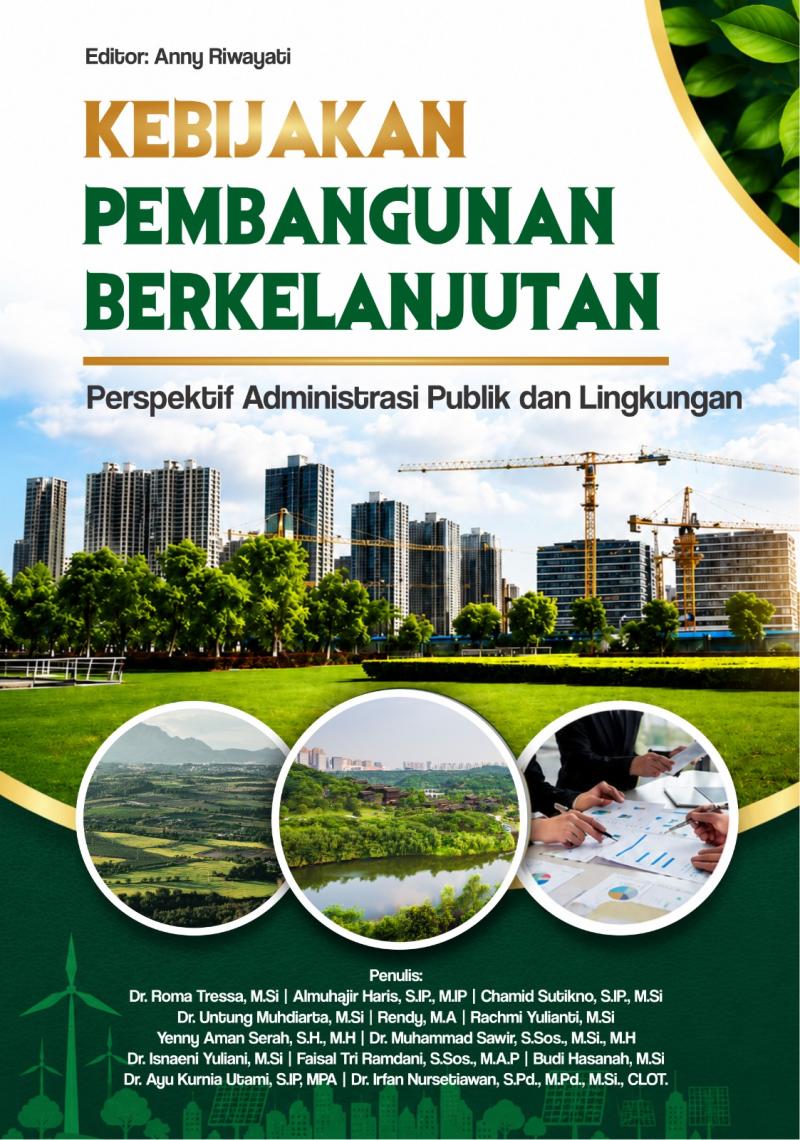
KEBIJAKAN PEMBANGUNAN BERKELANJUTAN: Perspektif Administrasi Publik dan Lingkungan
Keywords:
Kebijakan, Pembangunan, Berkelanjutan, Administrasi PublikSynopsis
Buku “Kebijakan Pembangunan Berkelanjutan: Perspektif Administrasi Publik dan Lingkungan” membahas konsep, kebijakan, dan strategi pembangunan yang mengintegrasikan aspek ekonomi, sosial, dan lingkungan secara seimbang. Buku ini menegaskan bahwa pembangunan tidak hanya berorientasi pada pertumbuhan ekonomi, tetapi juga harus mampu menjaga kelestarian lingkungan, memperkuat keadilan sosial, serta menjawab berbagai tantangan seperti perubahan iklim, transisi energi, ketahanan pangan, pengelolaan sampah, dan mitigasi bencana.
Melalui perspektif administrasi publik, buku ini menyoroti pentingnya tata kelola pembangunan yang transparan, partisipatif, akuntabel, dan kolaboratif. Berbagai pendekatan seperti good governance, collaborative governance, adaptive governance, kebijakan berbasis bukti (evidence-based policy), serta pemanfaatan transformasi digital dan kearifan lokal dipaparkan sebagai fondasi pembangunan berkelanjutan. Secara keseluruhan, buku ini menegaskan bahwa keberhasilan pembangunan diukur tidak hanya dari capaian ekonomi, tetapi juga dari kemampuan menciptakan keseimbangan antara kesejahteraan masyarakat, kelestarian lingkungan, dan keberlanjutan bagi generasi mendatang.
Downloads
Download data is not yet available.
References
Biesbroek, R., Dupuis, J., Jordan, A., Wellstead, A., Howlett, M., Cairney, P., & Rayner, J. (2021). Opening up the black box of adaptation decision-making. Nature Climate Change, 11(6), 493–501. https://doi.org/10.1038/s41558-021-01053-x
Curtis, P. G., Slay, C. M., Harris, N. L., Tyukavina, A., & Hansen, M. C. (2018). Classifying drivers of global forest loss. Science, 361(6407), 1108–1111. https://doi.org/10.1126/science.aau3445
Hickel, J. (2020). Quantifying national responsibility for climate breakdown: An equality-based attribution approach for carbon dioxide emissions in excess of the planetary boundary. The Lancet Planetary Health, 4(9), e399–e404. https://doi.org/10.1016/S2542-5196(20)30196-0
Howlett, M. (2019). Designing public policies: Principles and instruments. Routledge.
Intergovernmental Panel on Climate Change (IPCC). (2022). Climate change 2022: Impacts, adaptation and vulnerability. Cambridge University Press.
Jordan, A., & Lenschow, A. (2019). Environmental policy integration: A state of the art review. Environmental Policy and Governance, 29(3), 163–176. https://doi.org/10.1002/eet.1849
Leal Filho, W., Azul, A. M., Brandli, L., Özuyar, P. G., & Wall, T. (2020). Climate change and sustainable development. International Journal of Climate Change Strategies and Management, 12(2), 123–138.
Mensah, J. (2019). Sustainable development: Meaning, history, principles. Cogent Social Sciences, 5(1), 1653531. https://doi.org/10.1080/23311886.2019.1653531
Pendrill, F., Persson, U. M., Godar, J., & Kastner, T. (2022). Deforestation displaced: Trade in forest-risk commodities and the prospects for a global forest transition. Environmental Research Letters, 17(3), 034041. https://doi.org/10.1088/1748-9326/ac4c6d
Peters, B. G. (2021). Institutional theory in political science: The new institutionalism (4th ed.). Edward Elgar Publishing.
Purvis, B., Mao, Y., & Robinson, D. (2019). Three pillars of sustainability: In search of conceptual origins. Sustainability Science, 14(3), 681–695. https://doi.org/10.1007/s11625-018-0627-5
Rockström, J., Gupta, J., Qin, D., Lade, S. J., Abrams, J. F., Andersen, L. S., … (2021). Safe and just Earth system boundaries. Nature, 619, 102–111. https://doi.org/10.1038/s41586-021-03876-4
Sachs, J. D., Lafortune, G., Kroll, C., Fuller, G., & Woelm, F. (2022). Sustainable development report 2022. Cambridge University Press.
Santosa, P., Wibowo, A., & Rahmawati, D. (2022). Eksploitasi sumber daya alam dan dampaknya terhadap lingkungan di Indonesia. Jurnal Ekonomi dan Pembangunan Indonesia, 22(1), 67–82.
Todaro, M. P., & Smith, S. C. (2020). Economic development (13th ed.). Pearson.
United Nations Office for Disaster Risk Reduction (UNDRR). (2022). Global assessment report on disaster risk reduction 2022: Our world at risk. UNDRR.
Almuhajir Haris. (2023). Perubahan lingkungan fisik akibat dampak aktivitas tambang galian C di Kabupaten Barru. Jurnal Tata Kelola dan Inovasi Kebijakan, 3(2), 54–60.
Almuhajir Haris & Eko Priyo, P. (2016). Implementasi CSR PT Agung Perdana dalam mengurangi dampak kerusakan lingkungan. Jurnal Ilmu Pemerintahan & Kebijakan Publik, 4(1), 45–60.
Marpaung, L., & Utomo, H. (2023). Penguatan kapasitas perencana daerah untuk integrasi lingkungan dalam pembangunan. Jurnal Tata Kelola Lingkungan, 13(2), 45–60.
Nurhayati, P., & Pratama, B. (2023). Kolaborasi aktor dalam tata kelola lingkungan: Studi kasus daerah perkotaan Indonesia. Jurnal Pemerintahan dan Kebijakan, 10(2), 93–110.
Nurmalia, S., & Prasetyo, R. (2023). Pengelolaan lingkungan dan pembangunan berkelanjutan: Analisis dampak ekonomi jangka panjang. Jurnal Kebijakan Pembangunan, 11(2), 78–95.
Putra, G., & Dewi, R. (2024). Multipihak governance dalam pembangunan berkelanjutan di Indonesia. Jurnal Kebijakan Publik, 14(1), 25–42.
Rahmaningsih, M., & Efendi, T. (2024). Kesadaran publik dan partisipasi dalam pembangunan berkelanjutan: Studi di wilayah pesisir Indonesia. Jurnal Sosial Lingkungan, 10(1), 75–92.
Santoso, A., & Anggraeni, S. (2023). Peran sektor swasta dalam pembangunan berkelanjutan: Studi di Indonesia. Jurnal Tata Kelola Lingkungan, 13(3), 68–85.
Wicaksono, A., & Haryanto, F. (2024). Kearifan lokal dan partisipasi masyarakat dalam pembangunan berkelanjutan. Jurnal Sosial Lingkungan, 11(1), 45–62.
Wijaya, B., & Haryanto, F. (2024). Kearifan lokal dan partisipasi masyarakat dalam pembangunan berkelanjutan. Jurnal Sosial Lingkungan, 11(1), 45–62.
Wijaya, B., & Suryani, N. (2024). Integrasi kebijakan pengelolaan lingkungan dan pembangunan daerah: Studi di kota Jayapura. Jurnal Cakrawala, 15(1), 25–42.
Adebayo,Waidi Gbenro (2024). Resilience in the face of ecological challenges: Strategies for integrating environmental considerations into social policy planning in Africa, Sustainable Development. 2024;1–18, wileyonlinelibrary.com/journal/sd.
Candra, Hari, Syamsul Amar, Joan Marta (2024). Ecological Restoration and Sustainable Development: The Impact of Wakaf Forest Institutions on Socio-Economic Benefits, https://ecohumanism.co.uk/joe/ecohumanism. Volume: 3, No: 3, pp. 1371 – 1386.
Castilho, Rossoni, Renata Luiza de, Diogo Barbosa Leite, Renata Benigna Goncalves and Mario Henrique Ogasavara, (2025). Sustainable International Expansion:,Raizen's Path to Green Leadership/Expansao Internacional Sustentavel: Os Caminhos da Raizen para a Lideranca Verde. DOI: http://dx.doi.org/10.1590/1982-7849rac2025240146.por
De Jong, Eileen, Marjanneke J. Vijge (2020). From Millennium to Sustainable Development Goals: Evolving discourses and their reflection in policy coherence for development, https://doi.org/10.1016/j.esg.2020.100087.
Deng, Zhongqi, Shunfeng Song, Nan Jiang, Ruizhi Pang (2023). Sustainable development in China? A nonparametric decomposition of economic growth, https://doi.org/10.1016/j.chieco.2023.102041.
Du, Chuanjia, Chengjun Wang and Tao Feng (2023). The Impact of China’s National Sustainable Development Experimental Zone Policy on Energy Transition, Sustainability,315.https://doi.org/10.3390/su15108315.
Ferrannini, Andrea, Elisa Barbieri, Mario Biggeri, Marco R. Di Tommaso (2021). Industrial policy for sustainable human development in the post-Covid19 era, World Development 137 ,105215, https://doi.org/10.1016/j.worlddev.10521.
Haris, A. (2014). Memahami Pendekatan Pemberdayaan Masyarakat Melalui Pemanfaatan Media. Jupiter, 13(2), 50–62. Journal.unhas.ac.id.
He Jing and Umer Zaman, (2024). Sustainable sojourns: Fostering sustainable hospitality practices to meet UN-SDGs. DOI: http://dx.doi.org/10.1371/journal.pone.0307469.
Hou, Yanliang, Ruyin Long, Linling Zhang, Meifen Wu, (2020). Dynamic analysis of the sustainable development capability of coal cities, Resources Policy 66 (2020) 101607, journal homepage: http://www.elsevier.com/locate/resourpol.
Isnaini, Mochtar Dani (2021). Indonesi’a Climate Change Policies: Under the Tug Domestik and International Influence, Jurnal Ilmu Sosial Volume 20, Edisi 2,http/jis.undip.ac.id
James S. Russell. (2011). The Agile City: Building Weil-Being and Wealth in an Era of Climate Change. Washington, DC: Island Press, 2011, 290 pp. In The Agile City, James S. Russell offers a blueprint for restructuring the settlement system of the United States to reduce greenhouse gas emissions
Karjoko, Lego, I Gusti Ayu Ketut Rachmi Handayani1, Abdul Kadir Jaelani, Muhammad Jihadul Hayat (2022). Indonesia's Sustainable Development Goals Resolving Waste Problem: Informal to Formal Policy. Journal homepage: http://iieta.org/journals/ijsdp. Vol. 17, No. 2, pp. 649-658.
Kim, Seulki, Jiyong Eom, Ying Zhang and Stephanie Waldhoff, (2025).The impact of climate change on Korea's agricultural sector under the national self-sufficiency policy.DOI:http://dx.doi.org/10.1371/journal.pone.0313748
Kusiawati, D. (2017). Pemberdayaan Masyarakat. Universitas Negeri Malang.
Liang, Pan, 2024. The Influence of Policy Investment on the Sustainable Development of Universities in Underdeveloped Regions: An Empirical Analysis of China’s Higher EducationLandscape,Sustainability,2024,16,8068.https://doi.org/10.3390/su1618808
Liu, Min, Thanapauge Chamaratan (2024). A sustainable framework for urban ecotourism development: A comparative literature review of policy and practices in Thailand and China, Journal of Infrastructure, Policy and Development 8(8), 7961. https://doi.org/10.24294/jipd.v8i8.7961.
Mahmudi. (2016). Pendekatan Baru Dalam Manajemen Sektor Publik. Journal uii.ac.id/index.sinergi artikel.
Melkote, S. R., & Steeves, H. R. (2001). Communication For Development In The Third World: Theory And Practice For Empowerment. London: Sage Publications
Moustafa, Manal Saleh, Hanan Elsaid Elsabahy, Sahar Abdel-Latif Abdel-Sattar, Zaineb Naiem Abd-Elhamid, Abdulellah Al Thobaity and Sahar Mohammed Aly, (2024). Fostering green transformational leadership: the influence of green educational intervention on nurse managers' green behavior and creativity. DOI: http://dx.doi.org/10.1186/s12912-024-01991-0.
Mugiarti. (2020). “Pengelolaan Sampah Di Kabupaten Banyumas”. Dalam https://kkp.go.id/pendukung/DitJaskel/publikasi-materi-2/talkshow-sampah, Diakses pada tanggal 28 November 2021, Pukul: 21.00 WIB.
Nur Azizah, Widhah, et.al. (2020). Bank Sampah Sebagai Alternatif Strategi Pemberdayaan Masyarakat Dalam Mengembangkan Kampung Wisata Tematik “Kampung Putih” Kota Malang.
Restuningdiah,et.al. (2021). Literasi Bank Sampah Dan Asuransi Sampah Sebagai Upaya Peningkatan Kesejahteraan Masyarakat.http//Journal Riset Unisma.
Supriansyah, Muhammad, et al. (2020). Community Empowerment Through Waste Bank Program In Mandar Sari Kelurahan Banjar Regency
Tobirin, et.al. (2019). Pemberdayaan KSM Dan Komunitas Zero Waste Dalam Mengatasi Sampah Rumah Tangga Di Desa Ledug Kembaran Banyumas.
Tumanggor, et al. (2014). Pemberdayaan Masyarakat Berbasis Pengelolaan Lingkungan. E-Jounal.Lingkungan.ac.id.index.
Trio Putra, Wegi dan Ismaniar. (2020). Pemberdayaan Masyarakat Melalui Pengelolaan Sampah Di Bank Sampah.
Trisnawati dan Khasanah. (2020). Penyuluhan Pengelolaan Sampah Dengan Konsep 3R Dalam Mengurangi Limbah Rumah Tangga. http://E-Journal Manajemen Ekonomi.iainu.ac.id//index.
Triyono, Agus. (2014). Pemberdayaan Masyarakat Melalui Comunity Development Dalam Program Pos Daya PT Holcim Indonesia Di Kabupaten Cilacap.
Usman, Sunyoto. (2021). Pembangunan Dan Pemberdayaan Masyarakat. Pustaka Pelajar Yogyakarta.
Utami, P., & Puspaningtyas, D. E. (2013). The Miracle Of Herbs. Jakarta: PT Agro Media Pustaka.
Wu, Yang Andrew, Artie W. Ng, Zichao Yu, Jie Huang, Ke Meng, Z.Y. Dong (2020). A review of evolutionary policy incentives for sustainable development of electric vehicles in China: Strategic implications, https://doi.org/10.1016/j.enpol.2020.111983.
Xue Eryong, Jian Li, and Xingcheng Li, (2021). Sustainable Development of Education in Rural Areas for Rural Revitalization in China: A Comprehensive Policy Circle Analysis,Sustainability,2021,13,13101.https://www.mdpi.com/journal/sustainability.
Yi Jiahui , Sheng Dai, Jinhua Cheng, (2021). Qiaosheng Wu, Kailei LiuProduction quota policy in China: Implications for sustainable supply capacity of critical minerals, Resources Policy 72 (2021) 102046,journalhomepage:http://www.elsevier.com/locate/resourpol.
Anderson, J. E. (2015). Public policymaking (8th ed.). Cengage Learning.
Ansell, C., & Gash, A. (2008). Collaborative governance in theory and practice. Journal of Public Administration Research and Theory, 18(4), 543–571.
Arnstein, S. R. (1969). A ladder of citizen participation. Journal of the American Institute of Planners, 35(4), 216–224.
Bachrach, P., & Baratz, M. S. (1962). Two faces of power. American Political Science Review, 56(4), 947–952.
Cohen, J. L., & Arato, A. (1992). Civil society and political theory. MIT Press.
Dunn, W. N. (2018). Public policy analysis: An integrated approach (6th ed.). Routledge.
Emerson, K., Nabatchi, T., & Balogh, S. (2012). An integrative framework for collaborative governance. Journal of Public Administration Research and Theory, 22(1), 1–29.
Evans, P. (1995). Embedded autonomy: States and industrial transformation. Princeton University Press.
Hall, P. A. (1993). Policy paradigms, social learning, and the state. Comparative Politics, 25(3), 275–296.
Kingdon, J. W. (1995). Agendas, alternatives, and public policies (2nd ed.). HarperCollins.
Leftwich, A. (1994). Governance, the state and the politics of development. Development and Change, 25(2), 363–386.
Leftwich, A. (2000). States of development: On the primacy of politics in development. Polity Press.
Lukes, S. (2005). Power: A radical view (2nd ed.). Palgrave Macmillan.
Marsh, D., & Rhodes, R. A. W. (1992). Policy networks in British government. Oxford University Press.
Migdal, J. S. (2001). State in society: Studying how states and societies transform and constitute one another. Cambridge University Press.
Pierre, J., & Peters, B. G. (2000). Governance, politics and the state. Macmillan.
Pressman, J. L., & Wildavsky, A. (1984). Implementation (3rd ed.). University of California Press.
Rhodes, R. A. W. (1996). The new governance: Governing without government. Political Studies, 44(4), 652–667.
Sabatier, P. A., & Jenkins-Smith, H. C. (1993). Policy change and learning: An advocacy coalition approach. Westview Press.
Sabatier, P. A., & Weible, C. M. (2007). The advocacy coalition framework. In P. A. Sabatier (Ed.), Theories of the policy process (2nd ed., pp. 189–220). Westview Press.
Scharpf, F. W. (1997). Games real actors play: Actor-centered institutionalism in policy research. Westview Press.
Todaro, M. P., & Smith, S. C. (2015). Economic development (12th ed.). Pearson.
UNDP. (1997). Governance for sustainable human development. UNDP Policy Document.
World Bank. (1997). World development report 1997: The state in a changing world. Oxford University Press.
Auty, R. M. (2001). Resource Abundance and Economic Development (Auty, Ed.). Oxford University Press.
Celios (2023). Percepatan Transisi Energi Berkeadilan: Tantangan dan Peluang untuk Daerah, Juli. CELIOS & Yayasan Indonesia Cerah.
Fouquet, R. (2020). The Slow Search for Solutions: Lesson from Historical Energy Transitions by Sector and Service. Energy Policy, Vol.38 (11).
Indonesia Environmental & Energy Center (IEC). (2023). ‘Dampak Positif Transisi Energi bagi Ekonomi dan Lingkungan’. https://environment-indonesia.com/dampak-positif-transisi-energi-bagi-ekonomi-dan-lingkungan/. Diakses 6 Maret 2026.
Jenkins, K., Sovacool, B.K., McCauley, D. (2018). Humanizing sociotechnical transitions through energy justice: An ethical framework for global transformative change. Energy Policy, 117.
JETP Indonesia. (2023). Implementasi Just Energy Transition Partnership Indonesia., yang disampaikan pada 12/6/2023.
Kern, F. dan Markard, J. (2016). Analysing Energy Transitions: Combining Insights From Transition Studies and International Political Economy dalam Van de Graaf, T., Sovacool, B.K., Ghost, A., Kern, F., & Klare, M.T., (Eds). The Palgrave Handbook of the International Political Economy of Energi. London: Palgrave Macmillan (291-318).
Konorop, S.Y. (2025). Ekonomi Hijau dan Transisi Energi: Tantangan Kebijakan Pemerintah Dalam Menghadapi Perubahan Iklim. JICN: Jurnal Intelek dan Cendekiawan Nusantara, Vol.1 (6). https://jicnusantara.com/index.php/jicn/article/download/2722/2883/13426. Diakses 6 Maret 2026.
Markard, J., Geels, F.W., & Raven, R., (2020). Challenges in the Acceleration of Sustainability Transitions. Environmental Research Letters, Vol.15 (8). https://iopscience.iop.org/article/10.1088/1748-9326/ab9468. Diakses 10 Februari 2026.
Pradana, A. (2024). Faktor pendukung transisi energi. Dalam Radjawane, L.E., (Ed.), Transisi energi baru terbarukan guna mencapai ‘net zero emssion’ sektor transportasi. Bandung, Media Sains Indonesia.
Jakartapost, 2021. PLN pledges carbon neutrality by 2050. https://www.thejakartapost.com/paper/2021/05/10/pln-pledges-carbon-neutrality-by-2050.html. Diakses 10 April 2026.
Sovacool, B. K. (2016). The History and Politics of Energy Transitions: Comparing Contested Views and Finding Common Ground. WIDER Working Paper 2016/81. The United Nations University World Institute for Development Economics Research (UNU-WIDER), Helsinki. https://doi.org/10.35188/UNU-WIDER/2016/124-6. Diakses 10 April 2026.
Sovacool, B.K., (2016). How long will it take? Conceptualizing the temporal dynamics of energy transitions. Energy Research & Social Science, 13, 202-215. https://doi.org/10.1016/j.erss.2015.12.020. Diakses 30 Maret 2026.
Syahrir, R., (2026). Di Balik Euforia AI: Mineral, Energi, dan Kembalinya Geopolitik Klasik. CNCB Indonesia. https://www.cnbcindonesia.com/opini/20260121132431-14-704034/di-balik-euforia-ai-mineral-energi-dan-kembalinya-geopolitik-klasik. Diakses 20 Maret 2026.
Tampubolon, A., Ilham, I., & Harsamto, V. (2023). Mulai dari Sini: Memahami Transisi Energgi di Indonesia. Project Clean, Affordable and Secure Energy for Southeast Asia. https://caseforsea.org/wp-content/uploads/2023/09/Mulai-dari-Sini-Memahami-Transisi-Energi-di-Indonesia_Final-compressed.pdf. Diakses pada 6 Maret 2026.
Winanti, P.S., Mas’udi, W., Nandyatama, R.W., Rum. M., Marwa., & Muwani, A., (2021). Ekonomi Politik Transisi Energi di Indonesia. Peran Gas dalam Transisi Energi Baru dan Terbarukan. Monograf Fisipol UGM- Yogyakarta.
Winanti, P.S. et al., (2019). Diplomasi Energi Indonesia. Monografi, Yogyakarta: Fisipol UGM.
Zhang, D & Kong, Q. (2022). Renewable Energy Policy, Green Investment, and Sustainability of Energy Firms. Renewable Energy, Vol.192. https://doi.org/10.1016/j.renene.2022.04.092. Diakses 5 Maret 2026.
Kementerian ESDM. (2024). Pemerintah Kejar Tingkatkan Bauran Energi Baru Terbarukan. Siaran Pers Kementerian Energi & Sumber Daya Mineral Nomor.55.Pers/04/SJI/2024.
Kementerian ESDM (2023). Indonesia Tetapkan E-NDC, Sektor Energi Miliki Target Tekan Emisi 358 juta C02 di 2030. Siaran Pers Kemenderian Energi & Sumber Daya Mineral Nomor.601.Pers/04/SJI/2023.
NRDC- Natural Resources Defence Council. (2021). Climate Change and Clean Energy Solutions. Dikutip dari https://nrdc.org/issues/climate-change. Diakses pada 25 Maret 2026.
Berkes, F. (2012). Sacred Ecology (3rd ed.). New York: Routledge. (membahas hubungan antara sistem kepercayaan dann pengelolaan sumber daya).
Cohen, L., Manion, L., & Morrison, K. (2017). Research methods in education. routledge.
Dove, M. R., & Carpenter, C. (Eds.). (2008). Environmental Change and Indigenous Peoples: The Social Impacts of Global Warning. Santa Fe: School for Advanced Research Press.
Iskandar, J. (2010) Ekologi Budaya: Interaksi Manusia dan Lingkungan di Indonesia. Bandung: ITB Press.
Kementrian Lingkungan Hidup dan Kehutanan (KLHK). (2023). Status Hutan dan Kehutanan Indonesia Tahun 2022. Jakarta: KLHK RI
Keraf, A. Sonny. 2010. Etika Lingkungan Hidup. Jakarta: Kompas.
Lansing, J. S. (2006). Perfect Order: Recognizing Complexity in Bali. Princeton: Princeton University Press. (Studi mendalami tentang sistem Subak).
Maryani, A., et al. (2021). “Revitalisasi Pranata Mangsa sebagai Strategi adaptasi Perubahan Iklim di Jawa Tengah”. Jurnal Ilmu Lingkungan, 19(1), 45-58.
Mathieson, M. (2023). The Preachers of Culture (1975): A Study of English and its Teachers. Taylor & Francis.
Marfai, Muh Aris. 2012. Pengantar Etika Lingkungan dan Kearifan Lokal. Yogyakarta: Gadjah Mada University Press.
Nazarea, V.D (2009). Ethnoecology: Situated Knowledge/Located Lives. Tucson: University Of Arizona Press.
Purnomo, H., & Guizol, P. (2008). “Local Wisdom in Forest Management: The Case Of The Dayak People In Kalimantan”. Journal of Tropical Forest Science, 20(2), 112-125.
Putusan Mahkamah Konstitusional Republik Indonesia Nomor 35/PUU-X/2012 tentang Pengujian UU Kehutanan terkait Hutan Adat.
Sutlive, V.H., & Sultlive, J. (2001). The Encylopaedia of Iban Studies. Kuching: Tun Jugah Foundation.
Undang-undang Nomor 32 Tahun 2009 tentang Perlindungan dan Pengelolaan Lingkungan Hidup.
Undang-Undang Nomor 41 Tahun 1999 tentang Kehutanan (sebagaimana telah diubah beberapa kali)
United Nations Educational, Scientific and Cultural Organization (UNESCO). (2018). Local and Indigenous Knowledge Systems (LINKS) Programme: Report on Climate Change Adaptation. Paris: UNESCO
Word Bank. (2020). Indigenous People and Local Communityes: Partners in Sustainable Development Washington, DC: World Bank Group.
Zulkarnaik, I. (2019). “Sasi Laut: Tradisi Konservasi Berbasis Masyarakat di Maluku”. Oseanologi dan Limnologi di Indonesia, 45(2), 89-104.
Adanma, U., & Ogunbiyi, E. (2024). A comparative review of global environmental policies for promoting sustainable development and economic growth. International Journal of Applied Research in Social Sciences, 6(5), 1-17. https://doi.org/10.51594/ijarss.v6i5.1147
Basheer, M., Nechifor, V., Calzadilla, A., Ringler, C., Hulme, D., & Harou, J. (2022). Balancing national economic policy outcomes for sustainable development. Nature Communications, 13(1), 4726. https://doi.org/10.1038/s41467-022-32415-9
Guarini, M., Ghiani, G., & Sica, F. (2025). To What Extent Are the Green Public Procurement Criteria in National Policies and Action Plans? Commonalities Across European Countries for Environmentally Harmonized Valuations. Land, 14(6), 1215. https://doi.org/10.3390/land14061215
Hazemba, M., & Halog, A. (2021). Systematic review of how Environmental Management policies are incorporated into National Development Plans in order to achieve Sustainable Development. Environmental Challenges, 3, 100041. https://doi.org/10.1016/j.envc.2021.100041
Hirpha, H., Mpandeli, S., Dagnew, A., Chibsa, T., & Abebe, C. (2021). Assessing the integration of climate change adaptation and mitigation into national development planning of Ethiopia. International Journal of Climate Change Strategies and Management, 13(4/5), 453-471. https://doi.org/10.1108/ijccsm-07-2020-0082
Liu, H., Zafar, M., Sinha, A., & Khan, I. (2023). The path to sustainable environment: Do environmental taxes and governance matter? Sustainable Development, 31(4), 2465-2479. https://doi.org/10.1002/sd.2505
Ljubičić, I. (2025). Tax Instruments as a Key Driver of the Green Transition: The Role of Fiscal Policy in Sustainable Development. Journal of Agronomy, Technology and Engineering Management (JATEM), 4(1), 1-12. https://doi.org/10.55817/gzog5027
Prodanyk, V., & Vorotin, V. (2025). Sustainable development of public administration: political and administrative aspect. State Formation, 1(1), 101-110. https://doi.org/10.26565/1992-2337-2025-1-10
Semenchuk, T., & Postika, B. (2023). Public management of sustainable development of territories. Theoretical and Empirical Scientific Research: Concept and Trends, (1), 76-79. https://doi.org/10.36074/logos-23.06.2023.10
Sokhatska, O. (2024). Environmental policy in the public administration system: challenges of sustainable development. Philosophy and Governance, 2(1), 47-59. https://doi.org/10.70651/3041-248x/2024.2.04
Arsyad, L. (2010). Ekonomi Pembangunan, ed. 5, cet. Unit Penerbit dan Percetakan STIM YKPN Yogyakarta.
Digdowiseiso, K. (2020). Teori Pembangunan Daerah (Eko Sugiyanto (Ed.); 1st ed.). LPU-UNAS.
Endah, K. (2020). Pemberdayaan Masyarakat: Menggali Potensi Lokal Desa. Moderat: Jurnal Ilmiah Ilmu Pemerintahan, 6(1), 135–143.
Harun, R. & E. A. (2011). Komunikasi Pembangunan & Perubahan Sosial: Perspektif Dominan, Kaji Ulang dan Teori Kritis, Edisi Pertama. Rajawali Pers.
Hasan, M., & Muhammad, A. (2018). Pembangunan Ekonomi dan Pemberdayaan Masyarakat (Zaiful (Ed.); 1st ed.). CV. Nur Lina.
Kuncoro, M. (2018). Perencanaan Pembangunan Daerah Teori dan Aplikasi. PT Gramedia Pustaka Utama.
Lopes, N., Rao, H. R., McKenna, S. A., Yang, S., Estevez, E., & Nielsen, M. (2019). Pannel: Digital Transformation Impact on Society. International Conference on EDemocracy & EGovernment (ICEDEG), 1(1), 19–21. https://doi.org/10.1109/icedeg.2019.8734405
Mardikanto, Totok dan Soebiato, P. (2017). Pemberdayaan Masyarakat Dalam Perspektif Kebijakan Publik. Alfabeta.
Riady, B. S. D. (2003). Perncanaan Pembangunan Daerah. PT Raja Grafindo.
Risyanti, R. D. R. (2006). Pemberdayaan Masyarakat. Alqaprit Jatinegoro.
Soebianto, M. T. dan P. (2012). Pemberdayaan Masyarakat dalam Perspektif Kebijakan Publik Edisi Refisi. Alfabeta.
Subandi. (2014). Ekonomi Pembangunan. Alfabeta.
Sugarto, E. (2005). Membangun Masyarakat Memberdayakan Rakayat Kajian Strategis Pembangunan Kesejahteraan Sosial Dan Pekerja Sosial,. PT Ravika Adimatama.
Suharto, E. (2005). Membangun Masyarakat Memberdayakan Rakyat: Kajian Strategis Pembangunan Kesejahteraan Sosial & Pekerja Sosial. PT. Refika Aditama.
Trigunarso, M. &. (2017). Perencanaan Pembangunan Daerah Teori dan Aplikasi. Kencana.
UNDP. (2011). Governance for Sustainable Human Development: A UNDP Policy Document. United Nations.
Andika, M. R. (2025). Bureaucratic Reform Towards A Transparent and Accountable Government in The Digital Era. JOURNAL OF SOCIAL, JUSTICE AND POLICY, 3(6), 23–27. https://doi.org/10.56015/sjp.v3i6.77
Asker Guenduez, A. (2022). Digital Government. In Elgar Encyclopedia of Public Management (pp. 222–228). Edward Elgar Publishing Limited. https://doi.org/10.4337/9781800375499.digital.government
Asrijal, A., Indrawati, R. A., & Zulkifli, Z. (2025). Public Policy and Digital Participation: Their Impact on Government Transparency and Accountability. Socious Journal, 2(5), 86–96. https://doi.org/10.62872/2qw6bs75
Boehmke, F. J., & Pacheco, J. (2016). Introduction to SPPQ Special Issue on Policy Diffusion. State Politics & Policy Quarterly, 16(1), 3–7. https://doi.org/10.1177/1532440015610366
Filgueiras, F., & Almeida, V. (2021). Digital Technologies for Governance. In Governance for the Digital World (pp. 43–73). Springer International Publishing. https://doi.org/10.1007/978-3-030-55248-0_3
Goyal, N., & Howlett, M. (2024). Types of learning and varieties of innovation: how does policy learning enable policy innovation? Policy & Politics, 52(4), 564–585. https://doi.org/10.1332/030557321X16841388707452
Lindquist, E. A. (2022). The digital era and public sector reforms: Transformation or new tools for competing values? Canadian Public Administration, 65(3), 547–568. https://doi.org/10.1111/capa.12493
Mintrom, M. (1997). Policy Entrepreneurs and the Diffusion of Innovation. American Journal of Political Science, 41(3), 738. https://doi.org/10.2307/2111674
Mubarok, A. S., Susandi, A., & Mantoro, T. (2022). Applications of Artificial Intelligence and Big Data for Strengthening the Role of Intelligence in Human Security. 2022 IEEE 8th International Conference on Computing, Engineering and Design (ICCED), 1–5. https://doi.org/10.1109/ICCED56140.2022.10010514
Mutlu, I., den Hartigh, E., & Ucler, C. (2022). Digital Technology and the Stages of Digital Business Transformation. 2022 IEEE 28th International Conference on Engineering, Technology and Innovation (ICE/ITMC) & 31st International Association For Management of Technology (IAMOT) Joint Conference, 1–8. https://doi.org/10.1109/ICE/ITMC-IAMOT55089.2022.10033256
Ohoiwutun, S. K., & Zacharias, T. (2024). Public Administration Policy Innovation Towards the Realization of Good Public Policy Governance. Asian Journal of Social and Humanities, 2(6), 1285–1293. https://doi.org/10.59888/ajosh.v2i6.268
Rizal, J., Sudjatmiko, I. G., & Soesilo, A. S. (2025). Bureaucratic transformation through digital governance: Insights from Jakarta smart city and Bourdieu’s habitus theory. International Journal of Innovative Research and Scientific Studies, 8(6), 3469–3479. https://doi.org/10.53894/ijirss.v8i6.10370
Shi, J., Ai, X., & Cao, Z. (2017). Can big data improve public policy analysis? Proceedings of the 18th Annual International Conference on Digital Government Research, 552–561. https://doi.org/10.1145/3085228.3085319
Suacana, I. W. G., Faqih, M., Yusuf A., N. R., Riduan, A., & Judijanto, L. (2024). Public Policy Innovation: Analyzing the Implementation and Outcomes of Progressive Initiatives. Global International Journal of Innovative Research, 1(3), 298–305. https://doi.org/10.59613/global.v1i3.40
Wahyuni, M. D., Sudiari, M., Murdiati, N. K., & Kapu, M. O. (2025). Analisis Peran Birokrasi dalam Implementasi Kebijakan Publik di Era Digital. Jurnal Ilmiah Cakrawarti, 8(01), 97–103. https://doi.org/10.47532/jic.v8i01.1258
Djalante, R., & Lassa, J. A. (2025). Governing disaster risks in the Anthropocene: Policy challenges and opportunities for sustainable development. Progress in Disaster Science, 19, 100288. https://doi.org/10.1016/j.pdisas.2024.100288
Djalante, R., et al. (2020). Review and analysis of laws and policies on disaster management in Indonesia. Progress in Disaster Science, 7, 100107. https://doi.org/10.1016/j.pdisas.2020.100107
Enjolras, B., Wøien Hansen, V., & Slagsvold Winsvold, M. (2024). Collaborative governance and effectiveness during emergency response actions in Norway. International Journal of Disaster Risk Reduction, 111, 104651. https://doi.org/10.1016/j.ijdrr.2024.104651
Fajria, R., Putera, R. E., & Kusdarini, K. (2024). Disaster mitigation through the disaster resilient village program in Padang Pariaman District. Bisnis & Birokrasi: Jurnal Ilmu Administrasi dan Organisasi, 31(1), Article 2. https://doi.org/10.20476/jbb.v31i1.1370
Hadi, S. P., et al. (2022). Strategi mitigasi bencana berbasis masyarakat dalam pembangunan berkelanjutan di Indonesia. Jurnal Administrasi Publik, 18(1). https://doi.org/10.14710/jap.v18i1.35421
Khoirurrohman, M., Setyawan, D., & Firdausi, F. (2024). Mitigasi bencana dalam perspektif kebijakan publik di Kota Malang. JADMENT: Journal of Administration and Development, 1(2), 67–76. https://doi.org/10.62085/jadment.v1i2.11
Lestari, A. W., Firdausi, F., Sari, Y. I., & Dewanata, A. P. (2024). Collaborative governance model in disaster mitigation in Malang Regency. Publisia: Jurnal Ilmu Administrasi Publik, 9(1), 47–56. https://doi.org/10.26905/pjiap.v9i1.10777
Mulyasari, F., & Shaw, R. (2023). The role of risk governance in disaster risk reduction: Perspectives from Indonesia. International Journal of Disaster Risk Management, 5(1). https://doi.org/10.18485/ijdrm.2023.5.1.2
Najoan, S. B., Angwirawan, L. S., Faddila, D. A., & Firdausy, I. A. (2025). The role of public administration in disaster risk management: A study on the responsiveness of Banjarnegara Regency local government to natural disasters. Community Engagement and Emergence Journal (CEEJ), 6(4). https://doi.org/10.37385/ceej.v6i4.8835
Schipper, E. L. F., Dubash, N. K., & Mulugetta, Y. (2024). Climate-resilient development: Pathways to convergence between climate change mitigation and adaptation. World Development, 175, 106485. https://doi.org/10.1016/j.worlddev.2023.106485
Setiadi, A., & Al-Ikhsan, A. (2024). Risk-informed development: Integrasi mitigasi bencana dalam perencanaan pembangunan daerah. Jurnal Perencanaan Wilayah dan Kota, 35(1). https://doi.org/10.5614/jpwk.2024.35.1.4
Sumina, S., Hariyoko, Y., & Hidayat, W. (2025). Collaborative governance dalam mitigasi bencana banjir di Kabupaten Gresik. Parlementer, 2(4), 1–15. https://doi.org/10.62383/parlementer.v2i4.1359
Anisa Nurpita, Latri Wihastuti, Ike Yuli Andjani. (2018). DAMPAK ALIH FUNGSI LAHAN TERHADAP KETAHANAN PANGAN. Jurnal Gama Societa, 1(1), 18, 103 - 1.
BPN. (2022). Indeks Ketahanan Pangan. Jakarta: Deputi Bidang Kerawanan pangan dan Gizi Badan Pangan Nasional.
COOPI. (2023). Food Security Policy. Milan-Italy: Cooperazione Internazionale.
Devit Bagus Indranika, Denok Kurniasih. (2025). STRATEGI KETAHANAN PANGAN DAERAH. Dinamika : Jurnal Ilmiah Ilmu Administrasi Negara, 12(3), 684-704.
Elizabeth, R. (2019). PENINGKATAN PARTISIPASI PETANI, PEMBERDAYAAN. urnal Agribisnis dan Sosial Ekonomi Pertanian UNPAD, 48-61.
Franceline Adella, Nurma Sapriana. (2026). Analisis Konseptual Strategi Pemberdayaan Masyarakat dalam. KREATIF: Jurnal Pengabdian Masyarakat Nusantara, 6(1), 223-236. doi:https://doi.org/10.55606/kreatif.v6i1.9905
Gufran, Taufik Firmanto. (2024). Mewujudkan Ketahanan Pangan Berbasis Kearifan Lokal. FUNDAMENTAL: JURNAL ILMIAH HUKUM, 13(2), 13-41.
Habib, M. H. (2024). Studi ragam perspektif kebijakan pangan di Indonesia. SUDEIJ: Sustainable Urban Development and Environmental Impact, 1(1), 34–42. doi:https://doi.org/10.61511/sudeij.v1i1.2024.908
Hakim, M. L. (2023). Kebijakan Sosial. Malang: UB Press.
Indriana Diani Putri, Rochmat Martanto, Rohmat Junarto. (2024). Dampak Alih Fungsi Lahan Terhadap Ketahanan Pangan, Lingkungan, dan Keberlanjutan Pertanian. JURNAL WIDYA BHUMI, 4(2), 192-210.
Istizabatuddawat , Allisya Indriyani, Erni Mulyanie. (2025). ANALISIS ALIH FUNGSI LAHAN DAN PENGARUHNYA TERHADAP. 21(2), 253-261.
IUCN. (2013). Food security policies: making the ecosystem connections. Switzerland: IUCN, Gland, Switzerland.
Katerere M.J.C and Smith M. (2013). The role of ecosystems in food security. unasylva, 64(2), 14-22.
Kristiawan. (2021). Ketahanan Pangan. Surabaya: SCOPINDO Media Pustaka.
Laurisz. (2021). social policy. (W. A, Ed.) KRAKOW: IGNATIANUM UNIVERSITY PRESS.
Mahmud Saleh; Banik Bijoy K. (2020). Evolution and Development of Food Security Concept:. Rajshahi University journal of social science and business studies, 28, 29-45.
Manganti, G. S. (2023). Analisis Partisipasi Masyarakat dalam Pelaksanaan Kebijakan Publik. 3(11), 380 – 389.
Mariyanto, J. (2025). KRISIS GLOBAL DAN IMPLIKASINYA BAGI PERTANIAN. Jurnal Perencanaan Pembangunan Pertanian, 2(1), 22-43.
Mirzabaev, et.al. (2023). Severe climate change risks to food security and nutrition. Climate Risk Management, 39, 1-10. doi:https://doi.org/10.1016/j.crm.2022.100473
Mubarik Achmad, Lulu Labida, Febby Firdian Djuarsa, Ernah. (2025). Valuasi Ekologis terhadap Alih Fungsi Lahan Sawah di Kabupaten Bandung,. Mimbar Agribisnis: Jurnal Pemikiran Masyarakat Ilmiah Berwawasan Agribisnis, 11(2), 4099-4111.
Nabila Zahra, Ropiah Daulay, Ahmad Wahyudi Zein. (2025). Strategi Pemerintah dalam Menjaga Ketahanan Pangan Melalui Kebijakan Publik. Moneter: Jurnal Ekonomi dan Keuangan, 3(3), 363-375.
Nursalam, Bun'yana Saleh. (2020). PARTISIPASI KELEMBAGAAN PANGAN PEDESAAN DALAM. Jurnal Administrasi Publik, 16(1), 58-70.
Partini, Sari I. (2022). KEBIJAKAN PENGEMBANGAN KETAHANAN PANGAN LOKAL. Agribisnis, 11(1), 78-83. Retrieved from https://ejournal.unisi.ac.id/index.php/agribisnis/index
Peng Wen; Berry Elliot M. (2019). The Concept of Food Security. Encyclopedia of Food Security and, 2, 1-7.
Rasdiana Mudatsir, Asriyanti Syari. (2023). Peningkatan Kapasitas Kelembagaan dalam Mendukung Ketahanan Pangan Kabupaten Jeneponto. Jurnal Galung Tropika, 12(2), 262-272. doi:https://doi.org/10.31850/jgt.v12i2.1112
Rika Harini, Rina Dwi Ariani, Yola Yulianda dan Rizka Widyantari. (2022). Strategi adaptasi ketahanan pangan terhadap perubahan iklim di pinggiran. 36(1), 1-9.
Septiawan, F. (2025, Februari 19). Membangun Ketahanan Pangan Berbasis Agroekologi dan Pertanian Organik.
Setia Budhi, Sri Hidayah, Mahtia Safitri, Ribka Aprilia, Salamah, Dwi Litha Diyana. (2022). STRATEGI KETAHANAN PANGAN PETANI LAHAN BASAH MENGHADAPI. Prosiding Seminar Nasional Lingkungan Lahan Basah , 7, pp. 286-292.
Sindi Arista Rahman, et.al. (2026). Sustainable Agriculture: Dukungan Pemerintah Desa Terhadap Kebijakan Pangan. Mimbar Agribisnis: Jurnal Pemikiran Masyarakat Ilmiah Berwawasan Agribisnis, 1111-1120.
Sutrisno. (2022). KEBIJAKAN SISTEM KETAHANAN PANGAN DAERAH. Kebijakan: Jurnal Ilmu Administrasi, 28-42.
Taryono. (2020). Berkebun Sayur untuk Meningkatkan Kesehatan dan Ketahanan Pangan Keluarga. In e. Triwibowo Yuwono, Pembangunan Pertanian - Memabangun Kemandirian Pangan dalm masa Bencana dan Pandemi (pp. 65-82). Yogyakarta: Lily Publisher.
(n.d.). Undang-undang Pangan No. 18 Tahun 2012.
Wardhana, d. (2022). PERAN NEGARA DALAM MENJAMIN HAK BEBAS DARI. IBLAM Law Review, 98-107.
Widada AW, M. M. (2017). DETERMINANT FACTORS OF FOOD SECURITY IN INDONESIA. Agro Ekonomi, 28(2), 205-2019.
Wirata, G. (2022). Kebijakan Sosial Kebijakan Pemerintah untuk Meningkatkan Kesejahteraan Masyarakat dan Pengentasan Kemiskinan. Banyumas, Jawa Tengah, Purwokerto: CV. Pena Persada.
Yustika sari, d. (2023). Peran Masyarakat dalam Kegiatan Meningkatkan Ketahanan Pangan dengan. Copyright: Yustika Sari, Rina Devianty, Errika Febi Lusianti, Dila Rizki Amanda, Siti Putri Aprilia,Widya Utami, 11-18.
Badan Perencanaan Pembangunan Nasional (BAPPENAS). (2020). Pedoman Teknis Penyusunan Rencana Aksi Tujuan Pembangunan Berkelanjutan (TPB)/ Sustainable Development Goals (SDGs). Kementerian PPN/Bappenas.
Biermann, F., Kanie, N., & Kim, R. E. (2017). Global governance by goal-setting: The novel approach of the UN Sustainable Development Goals. Current Opinion in Environmental Sustainability, 26–27, 26–31. https://doi.org/10.1016/j.cosust.2017.01.010
Dunn, W. N. (2003). Pengantar Analisis Kebijakan Publik (Samodra WIbawa, Diah Asitadani, Agus Heruanto Hadna, & Erwan Agus Purwanto, Penerj.; 2 ed.). Gadjah Mada University Press. (Original work published Prentice-Hall)
Fischer, F., Miller, G. J., & Sidney, M. S. (Eds.). (2007). Handbook of Public Policy Analysis: Theory, Politics, and Methods. CRC Press.
Howlett, M., & Ramesh, M. (2003). Studying public policy: Policy cycles and policy subsystems. Oxford University Press.
Kendi, I. K. (2024). Implementasi Kebijakan Publik Aktor, Perangkat, Manajemen, dan Isu-Isu Otonomi Khusus Papua (Yono Ali Achmad, Ed.). Manggu Makmur Tanjung Lestari.
Ndubuisi, O. G., OBIORAH, C. A., Ugah, T. A., Agbakhamen, C. O., Ali, S. E., & Nesiama, O. (2025). Environmental Policies and Governance in a Globalized World. International Journal of Innovative Development and Policy Studies, 13(3). https://doi.org/10.5281/ZENODO.16094555
Nilsson, M., Griggs, D., & Visbeck, M. (2016). Policy: Map the interactions between Sustainable Development Goals. Nature, 534(7607), 320–322. https://doi.org/10.1038/534320a
OECD (Ed.). (2021). Applying evaluation criteria thoughtfully. OECD Publishing. https://doi.org/10.1787/543e84ed-en
Rochaeni, A. (2025). Pembangunan dan Kesejahteraan Publik (A. S. Hamidin, Ed.; 1 ed.). Manggu Makmur Tanjung Lestari.
United Nation. (2015). Transforming our world: The 2030 Agenda for Sustainable Development (A/RES/70/1; Agenda items 15 and 116). United Nations. https://docs.un.org/en/A/RES/70/1
Vedung, E. (2017). Public Policy and Program Evaluation (1 ed.). Routledge. https://doi.org/10.4324/9781315127767
World Commission on Environment and Development. (1987). Our Common Future (General Assembly A/42/427). United Nation. https://digitallibrary.un.org/record/139811?v=pdf#files
Adebayo, W. G. (2025). Resilience in the face of ecological challenges: Strategies for integrating environmental considerations into social policy planning in Africa. Sustainable Development, 33(1), 203–220. https://doi.org/10.1002/sd.3113
Ara, E., Seddiky, Md. A., Basit, A., & Khanam, R. (2024). Enhancing Community Participation in Local Development Projects: The Bangladesh Context. European Scientific Journal, ESJ, 20(19), 84. https://doi.org/10.19044/esj.2024.v20n19p84
Çakmakçı, R., Salık, M. A., & Çakmakçı, S. (2023). Assessment and Principles of Environmentally Sustainable Food and Agriculture Systems. In Agriculture (Switzerland) (Vol. 13, Number 5, pp. 1–27). MDPI. https://doi.org/10.3390/agriculture13051073
Chen, K., Meng, Q., Sun, Y., & Wan, Q. (2024). How does industrial policy experimentation influence innovation performance? A case of Made in China 2025. Humanities and Social Sciences Communications, 11(1). https://doi.org/10.1057/s41599-023-02497-x
Fatahillah, Arnita, & Nurarafah. (2024). Legitimasi Hukum Terhadap Perlindungan Ekologi dan Pembangunan Berkelanjutan di Aceh. JSIM: Jurnal Ilmu Sosial Dan Pendidikan, 4(6), 709–721. https://doi.org/10.36418/syntax-imperatif.v4i6.303
Gustafsson, M., Matveieva, O., Wihlborg, E., Borodin, Y., Mamatova, T., & Kvitka, S. (2025). Adaptive governance amidst the war: Overcoming challenges and strengthening collaborative digital service provision in Ukraine. Government Information Quarterly, 42(3), 1–11. https://doi.org/10.1016/j.giq.2025.102056
Hanandini, D. (2024). Social Transformation in Modern Society: A Literature Review on the Role of Technology in Social Interaction. JIEE, 4(1), 82–95. https://doi.org/https://doi.org/10.69989/j0m6cg84
Kammer-Kerwick, M., Takasaki, K., Kellison, J. B., & Sternberg, J. (2022). Asset-Based, Sustainable Local Economic Development: Using Community Participation to Improve Quality of Life Across Rural, Small-Town, and Urban Communities. Applied Research in Quality of Life, 17(5), 3023–3047. https://doi.org/10.1007/s11482-022-10051-1
Kruahong, S., Tankumpuan, T., Kelly, K., Davidson, P. M., & Kuntajak, P. (2023). Community empowerment: A concept analysis. In Journal of Advanced Nursing (Vol. 79, Number 8, pp. 2845–2859). John Wiley and Sons Inc. https://doi.org/10.1111/jan.15613
Midgley, G., & Lindhult, E. (2021). A systems perspective on systemic innovation. Systems Research and Behavioral Science, 38(5), 635–670. https://doi.org/10.1002/sres.2819
Nahruddin, Z. (2024). Synergy of Government, Community, and Private Sector Regarding Effective Collaboration in Regional Governance. https://doi.org/https://doi.org/10.37899/mjdpp.v1i4.120
Salvador, M., & Sancho, D. (2021). The role of local government in the drive for sustainable development public policies. An analytical framework based on institutional capacities. Sustainability (Switzerland), 13(11). https://doi.org/10.3390/su13115978
Sheng, J., & Li, C. (2026). Bridging waters and power: Hydrosocial territories with socio-natural resilience in China’s Great Yangtze River protection programme. Environmental Science and Policy, 178. https://doi.org/10.1016/j.envsci.2026.104357
Shutaleva, A., Nikonova, Z., Savchenko, I., & Martyushev, N. (2020). Environmental education for sustainable development in Russia. Sustainability (Switzerland), 12(18). https://doi.org/10.3390/su12187742
Wu, Y., & Tham, J. (2023). The impact of environmental regulation, Environment, Social and Government Performance, and technological innovation on enterprise resilience under a green recovery. Heliyon, 9(10). https://doi.org/10.1016/j.heliyon.2023.e20278
Published
June 30, 2026
Copyright (c) 2026 Roma Tressa, Ayu Kurnia Utami, Budi Hasanah, Faisal Tri Ramdani, Isnaeni Yuliani, Muhammad Sawir, Yenny Aman Serah, Rachmi Yulianti, Rendy Rendy, Untung Muhdiarta, Chamid Sutikno, Almuhajir Haris, Irfan Nursetiawan (Author)
License

This work is licensed under a Creative Commons Attribution-NonCommercial-ShareAlike 4.0 International License.
How to Cite
Tressa, R., Utami, A. K., Hasanah, B., Ramdani, F. T., Yuliani, I., Sawir, M., Aman Serah, Y., Yulianti, R., Rendy, R., Muhdiarta, U., Sutikno, C., Haris, A., & Nursetiawan, I. (2026). KEBIJAKAN PEMBANGUNAN BERKELANJUTAN: Perspektif Administrasi Publik dan Lingkungan. Widina Media Utama. https://doi.org/10.59818/z47vhk56