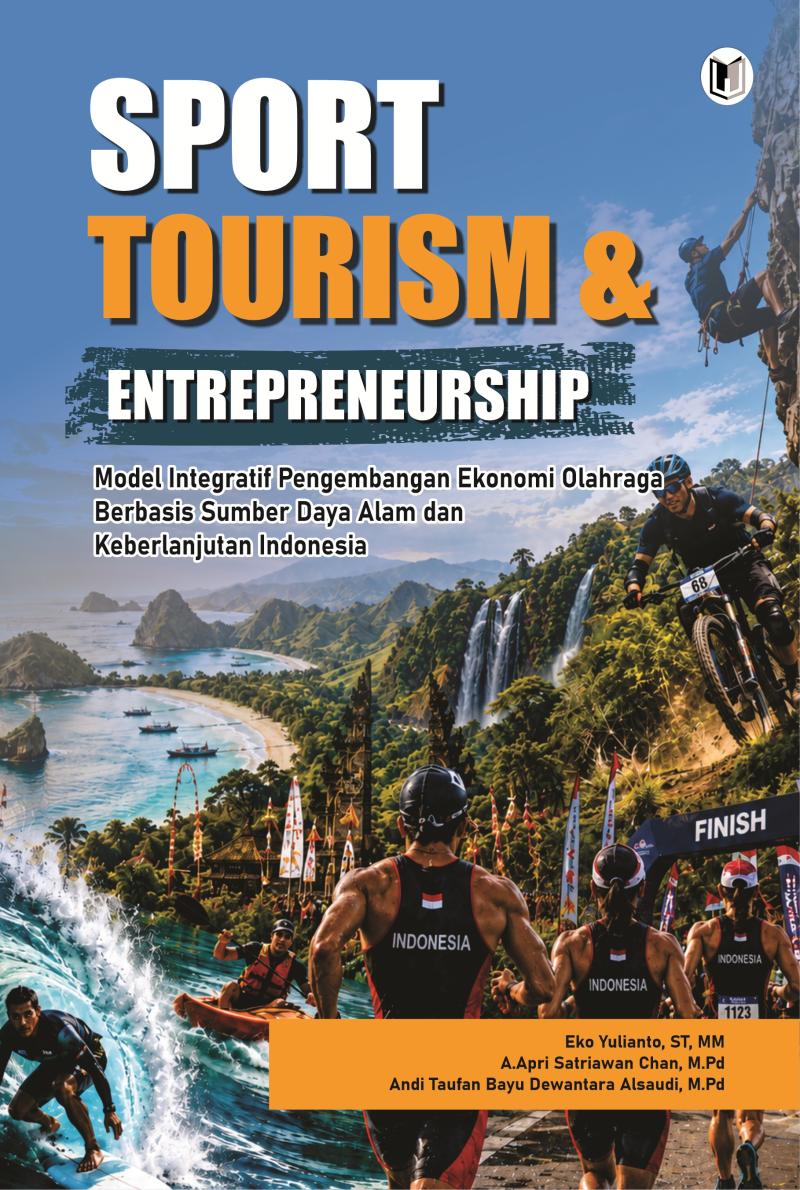
SPORT TOURISM & ENTREPRENEURSHIP Model Integratif Pengembangan Ekonomi Olahraga Berbasis Sumber Daya Alam dan Keberlanjutan Indonesia
Keywords:
Ekonomi. Bisnis dan PariwisataSynopsis
Perkembangan industri olahraga global telah melampaui batas fungsi rekreatif dan kompetitif, bertransformasi menjadi kekuatan ekonomi baru yang terintegrasi dengan sektor pariwisata. Dalam konteks Indonesia, potensi tersebut menemukan relevansinya melalui kekayaan sumber daya alam yang melimpah, mulai dari bentang maritim, pegunungan, hingga keanekaragaman budaya lokal yang membuka peluang besar bagi pengembangan sport tourism. Buku ini hadir sebagai respons akademik terhadap dinamika tersebut, dengan menawarkan perspektif interdisipliner yang menggabungkan manajemen, kewirausahaan, ekonomi, dan pariwisata dalam satu kerangka pemikiran yang komprehensif.
Lebih dari sekadar kajian konseptual, buku ini menempatkan kewirausahaan olahraga (sport entrepreneurship) sebagai motor penggerak utama dalam menciptakan nilai tambah ekonomi yang berkelanjutan. Melalui pendekatan strategis yang berbasis inovasi, transformasi digital, serta penguatan sumber daya manusia, pembaca diajak memahami bagaimana ekosistem sport tourism dapat dibangun secara adaptif dan kompetitif. Di tengah era disrupsi teknologi dan perubahan perilaku wisatawan, integrasi antara digitalisasi, pemasaran modern, dan pengelolaan destinasi menjadi kunci dalam menciptakan pengalaman wisata olahraga yang bernilai tinggi dan berdaya saing global.
Pada akhirnya, buku ini tidak hanya menawarkan kerangka teoritis, tetapi juga merumuskan model integratif pengembangan sport tourism Indonesia yang berlandaskan prinsip keberlanjutan. Keseimbangan antara eksploitasi potensi ekonomi dan pelestarian lingkungan menjadi landasan utama dalam setiap strategi yang diusulkan. Dengan demikian, buku ini diharapkan dapat menjadi referensi akademik sekaligus panduan praktis bagi mahasiswa, peneliti, praktisi, dan pembuat kebijakan dalam mendorong terwujudnya ekosistem sport tourism Indonesia yang inklusif, inovatif, dan berkelanjutan di masa depan.
Downloads
Download data is not yet available.
References
Adi, S. (2019). Manajemen Event Olahraga Modern. Deepublish.
Adner, R. (2017). Ecosystem As Structure: An Actionable Construct For Strategy. Journal of Management, 43(1), 39–58.
Andreff, W., & Szymanski, S. (2006). Handbook on The Economics of Sport. Edward Elgar Publishing.
Anholt, S. (2007). Competitive Identity: The New Brand Management For Nations, Cities and Regions. Palgrave Macmillan.
Ardika, I. W. (2018). Kepariwisataan Berkelanjutan: Rintis Jalan Lewat Komunitas. Kompas.
Atzori, L., Iera, A., & Morabito, G. (2010). The internet of things: A survey. Computer Networks, 54(15), 2787–2805.
Badan Kebijakan Fiskal. (2022). Kajian Ekonomi dan Kebijakan Fiskal Indonesia. Kementerian Keuangan RI.
Badan Pusat Statistik. (2019). Analisis Dampak Ekonomi Asian Games 2018. Jakarta: BPS.
Badan Pusat Statistik. (2023). Statistik pariwisata Indonesia. Jakarta: BPS RI.
Barney, J. (1991). Firm Resources And Sustained Competitive Advantage. Journal of Management, 17(1), 99–120.
Bass, B. M., & Riggio, R. E. (2006). Transformational Leadership. Psychology Press.
Baum, T. (2015). Human Resources in Tourism: Still Waiting for Change? Tourism Management, 50, 204–212.
Becken, S., & Hay, J. E. (2007). Tourism And Climate Change: Risks And Opportunities. Channel View Publications.
Beech, J., & Chadwick, S. (2013). The Business of Sport Management (2nd ed.). Pearson Education.
Boardman, A. E., Greenberg, D. H., Vining, A. R., & Weimer, D. L. (2018). Cost Benefit Analysis: Concepts and Practice (5th ed.). Cambridge University Press.
Boyatzis, R. E. (2008). Competencies in The 21st Century. Journal of Management Development, 27(1), 5–12.
Bramwell, B., & Lane, B. (2000). Tourism Collaboration And Partnerships: Politics, Practice And Sustainability. Channel View Publications.
Buckley, R. (2012). Sustainable Tourism: Research and Reality. Annals of Tourism Research, 39(2), 528–546.
Buhalis, D., & Amaranggana, A. (2014). Smart Tourism Destinations. In Information and Communication Technologies in Tourism 2014 (pp. 553–564). Springer.
Buhalis, D., & Law, R. (2008). Progress in Information Technology and Tourism Management: 20 Years on And 10 Years After The Internet. Tourism Management, 29(4), 609–623.
Butler, R. W. (1999). Sustainable tourism: A state-of-the-art review. Tourism Geographies, 1(1), 7–25.
Chadwick, S. (2018). Routledge Handbook of Sport Management. Routledge.
Chappelet, J.-L., & Mrkonjic, M. (2019). Basic Indicators for Better Governance in International Sport (BIBGIS). International Academy of Sport Science and Technology.
Chelladurai, P. (2014). Managing Organizations For Sport And Physical Activity. Routledge.
Collins, A., Jones, C., & Munday, M. (2009). Assessing the Environmental Impacts of Mega Sporting events. Tourism Management, 30(6), 828–837.
Coombs, W. T. (2015). Ongoing Crisis Communication: Planning, Managing, And Responding (4th ed.). Sage Publications.
Cribb, R., & Ford, M. (2015). Indonesia Beyond The Water’s Edge: Managing An Archipelagic State. Institute of Southeast Asian Studies.
Crompton, J. L. (1979). Motivations for Pleasure Vacation. Annals of Tourism Research, 6(4), 408–424.
Damanik, J., & Weber, H. F. (2006). Perencanaan Ekowisata: Dari Teori ke Aplikasi. Yogyakarta: Andi.
Dann, G. M. S. (1977). Anomie, Ego-Enhancement and Tourism. Annals of Tourism Research, 4(4), 184–194.
De Dreu, C. K. W., & Weingart, L. R. (2003). Task versus relationship conflict. *Journal of Applied Psychology*, 88(4), 741–749.
Deci, E. L., & Ryan, R. M. (1985). Intrinsic Motivation and Self-Determination in Human Behavior. New York: Plenum.
Denning, S. (2018). The Age Of Agile. AMACOM.
Drucker, P. F. (2007). Innovation And Entrepreneurship. HarperCollins.
EBSCO Information Services. (2023). Indonesia: Geography And Cartography. EBSCO Research Starters.
Eccles, R. G., Ioannou, I., & Serafeim, G. (2014). The Impact of Corporate Sustainability on Organizational Processes. Management Science, 60(11), 2835–2857.
Eraut, M. (1994). Developing Professional Knowledge And Competence. Falmer Press.
European Commission. (2016). Study on The economic Impact of Sport Through Sport Satellite Accounts. Brussels: European Union.
Ewaldo, K., Kurniasa, M., & Takarina, N. D. (2023). Suitability Of Mangrove Forests For Sustainable Tourism. Advances in Tropical Biodiversity and Environmental Sciences.
Faulkner, B. (2001). Towards A Framework For Tourism Disaster Management. Tourism Management, 22(2), 135–147.
FIFA. (2021). FIFA Governance Regulations and Principles. Fédération Internationale de Football Association.
Fried, G. (2015). Managing Sport Facilities. Human Kinetics.
Gawer, A. (2021). Digital Platforms’ Boundaries: The Interplay Of Firm Scope, Platform Sides, And Digital Interfaces. Long Range Planning, 54(5).
Geissdoerfer, M., Savaget, P., Bocken, N. M., & Hultink, E. J. (2017). The Circular Economy A New Sustainability Paradigm? Journal of Cleaner Production, 143, 757–768.
Getz, D. (2008). Event Studies: Theory, Research And Policy for Planned Events. Routledge.
Getz, D. (2013). Event Tourism: Concepts, International Case Studies, and Research. Cognizant Communication Corporation.
Getz, D., & Page, S. J. (2016). Event Studies: Theory, Research and Policy for Planned Events (3rd ed.). Routledge.
Getz, D., & Page, S. J. (2016). Progress and Prospects for Event Tourism Research. Tourism Management, 52, 593–631.
Gibson, H. J. (1998). Sport Tourism: A Critical Analysis of Research. Sport Management Review, 1(1), 45–76.
Gibson, H. J. (2005). Towards An Understanding of ‘Why Sport Tourists Do What They Do’. Sport in Society, 8(2), 198–217.
Giulianotti, R., & Robertson, R. (2009). Globalization and Football. Sage Publications.
Gössling, S., Hall, C. M., & Weaver, D. B. (2015). Sustainable tourism futures: Perspectives on systems, restructuring and innovations. Routledge.
Gössling, S., Scott, D., & Hall, C. M. (2015). Intermarket Variability in CO₂ Emission Intensities in Tourism. Tourism Management, 46, 113–123.
Gretzel, U., Sigala, M., Xiang, Z., & Koo, C. (2015). Smart Tourism: Foundations and Developments. Electronic Markets, 25(3), 179–188.
GRI. (2021). Global Reporting Initiative Standards.
Grix, J., & Carmichael, F. (2012). Why Do Governments Invest In Elite Sport? .International Journal of Sport Policy and Politics, 4(1), 73–90.
Gunn, C. A., & Var, T. (2002). Tourism Planning: Basics, Concepts, Cases. Routledge.
Habibi, P., Widjaya, I. G. N. O., & Ginting, Y. M. (2024). Sustainable Tourism At The Edge of Biodiversity. Advances in Tourism Studies.
Hall, C. M. (2005). Tourism: Rethinking the Social Science of Mobility. Harlow: Pearson Education.
Hall, C. M. (2008). Tourism Planning: Policies, Processes and Relationships. Pearson Education.
Hall, C. M. (2010). Crisis Events In Tourism: Subjects of Crisis In Tourism. Current Issues in Tourism, 13(5), 401–417.
Hall, C. M. (2011). Policy Learning and Policy Failure in Sustainable Tourism Governance. Tourism Management, 32(4), 649–658.
Harsuki. (2012). Pengantar Manajemen Olahraga. Jakarta: Rajawali Pers.
Higgins-Desbiolles, F. (2006). More Than an “Industry”: The Forgotten Power of Tourism. Tourism Management, 27(6), 1192–1208.
Higham, J. (2005). Sport Tourism Destinations: Issues, Opportunities and Analysis. Elsevier.
Higham, J., & Hinch, T. (2009). Sport and Tourism: Globalization, Mobility and Identity. Routledge.
Higham, J., & Hinch, T. (2018). Sport Tourism Development (3rd ed.). Bristol: Channel View Publications.
Hinch, T., & Higham, J. (2011). Sport Tourism Development (2nd ed.). Channel View Publications.
Hjalager, A. M. (2010). A Review of Innovation Research In Tourism. Tourism Management, 31(1), 1–12.
Hodges, D., & Burchell, N. (2003). Business Graduate Competencies. Education & Training, 45(2), 68–76.
Horne, J. (2006). Sport in Consumer Culture. Palgrave Macmillan.
Hoye, R., & Cuskelly, G. (2018). Sport Governance. Routledge.
Hoye, R., Smith, A. C. T., Nicholson, M., & Stewart, B. (2018). Sport management: Principles and applications. Routledge.
Hoye, R., Smith, A., Nicholson, M., & Stewart, B. (2015). Sport management: Principles and applications (4th ed.). Routledge.
Hudson, S., & Thal, K. (2013). The Impact of Social Media on The Consumer Decision Process. Journal of Travel & Tourism Marketing, 30(1-2), 156–160.
Hutchins, B., & Rowe, D. (2012). Sport Beyond Television: The Internet, Digital Media And The Rise Of Networked Media Sport. Routledge.
International Olympic Committee. (2020). Basic Universal Principles of Good Governance of The Olympic and Sports Movement. IOC.
ISO. (2012). ISO 20121: Event Sustainability Management Systems. International Organization for Standardization.
Jamal, T., & Getz, D. (1995). Collaboration Theory and Community Tourism Planning. Annals of Tourism Research, 22(1), 186–204.
Kane, G. C., et al. (2015). Strategy, Not Technology, Drives Digital Transformation. MIT Sloan Management Review.
Kaplan, A. M., & Haenlein, M. (2010). Users Of The World, Unite! Business Horizons, 53(1), 59–68.
Kaplan, R. S., & Norton, D. P. (2004). Strategy Maps: Converting Intangible Assets into Tangible Outcomes. Harvard Business School Press.
Kementerian Pariwisata dan Ekonomi Kreatif Republik Indonesia. (2021). Tren Pariwisata Indonesia di Tengah Ekosistem Digital dan Keberlanjutan. Jakarta: Kemenparekraf RI.
Kementerian Pariwisata dan Ekonomi Kreatif Republik Indonesia. (2021). Pedoman Pengembangan Sport Tourism Indonesia. Jakarta: Kemenparekraf RI.
Kementerian Pariwisata dan Ekonomi Kreatif Republik Indonesia. (2021). Strategi Pengembangan Sport Tourism Indonesia. Kementerian Pariwisata dan Ekonomi Kreatif Republik Indonesia.
Kementerian Pariwisata dan Ekonomi Kreatif Republik Indonesia. (2021). Rencana Strategis Kemenparekraf 2020–2024. Jakarta: Kemenparekraf RI.
Kementerian Pariwisata dan Ekonomi Kreatif Republik Indonesia. (2022). Pedoman Pengembangan Desa Wisata dan Pariwisata Berkelanjutan. Jakarta: Kemenparekraf RI.
Kementerian Pariwisata dan Ekonomi Kreatif Republik Indonesia. (2021). Pedoman Pengembangan Pariwisata Berkelanjutan. Jakarta: Kemenparekraf RI.
Kementerian Pariwisata dan Ekonomi Kreatif Republik Indonesia. (2023). Laporan Kinerja Sektor Pariwisata dan Ekonomi Kreatif. Jakarta: Kemenparekraf.
Kementerian Pariwisata dan Ekonomi Kreatif Republik Indonesia. (2021). Rencana Strategis Pengembangan Pariwisata Berbasis Olahraga. Jakarta: Kemenparekraf.
Kementerian Pariwisata dan Ekonomi Kreatif Republik Indonesia. (2023). Laporan Kinerja Sektor Pariwisata dan Ekonomi Kreatif. Jakarta: Kemenparekraf RI.
Kementerian Pariwisata dan Ekonomi Kreatif Republik Indonesia. (2021). Rencana Strategis Pariwisata dan Ekonomi Kreatif 2020–2024. Kemenparekraf RI.
Kementerian Pariwisata dan Ekonomi Kreatif Republik Indonesia. (2022). Strategi pengembangan pariwisata berkelanjutan. Kemenparekraf RI.
Kementerian Pariwisata dan Ekonomi Kreatif. (2021). Laporan Kinerja Ekonomi Kreatif Indonesia. Jakarta: Kemenparekraf.
Kementerian Pariwisata dan Ekonomi Kreatif. (2021). Rencana Strategis Pengembangan Pariwisata Indonesia.
Kementerian Pariwisata dan Ekonomi Kreatif. (2022). Laporan Kinerja Sektor Pariwisata dan Ekonomi Kreatif. Jakarta: Kemenparekraf RI.
Kementerian Pariwisata. (2019). Pengembangan Wisata Olahraga (Sport Tourism) di Indonesia: Strategi dan Implementasi. Jakarta: Kementerian Pariwisata Republik Indonesia.
Kementerian Pemuda dan Olahraga Republik Indonesia. (2020). Rencana Strategis Kemenpora 2020–2024. Jakarta: Kemenpora RI.
Kementerian Pemuda dan Olahraga Republik Indonesia. (2021). Laporan pengembangan industri olahraga nasional. Kemenpora RI.
Kementerian Pemuda dan Olahraga Republik Indonesia. (2022). Desain Besar Olahraga Nasional (DBON). Kemenpora RI.
Kementerian PPN/Bappenas. (2021). Pedoman Evaluasi Proyek Pembangunan Nasional. Jakarta: Bappenas.
Kotler, P., & Keller, K. L. (2016). Marketing Management (15th ed.). Pearson Education.
Kotler, P., Bowen, J. T., & Makens, J. C. (2017). Marketing For Hospitality And Tourism. Pearson.
Kotler, P., Kartajaya, H., & Setiawan, I. (2017). Marketing 4.0: Moving From Traditional To Digital. John Wiley & Sons.
Lashley, C. (2008). Studying Hospitality: Insights From Social Sciences. Scandinavian Journal of Hospitality and Tourism, 8(1), 69–84.
Laudon, K. C., & Traver, C. G. (2021). E-commerce: Business, Technology, Society. Pearson.
Li, S., Robinson, P., & Oriade, A. (2018). Destination Marketing: The Use of Technology Since The Millennium. Journal of Destination Marketing & Management, 9, 101–113.
Lussier, R. N., & Kim, J. (2019). Sport Management Principles And Applications. New York: Routledge.
Mallen, C., & Chard, C. (2012). “A Framework For Advancing Environmental Sustainability in Sport Management.” Sport Management Review, 15(1), 1–12.
Mankiw, N. G. (2021). Principles of Economics (9th ed.). Cengage Learning.
Masteralexis, L. P., Barr, C. A., & Hums, M. A. (2015). Principles and Practice of Sport Management (5th ed.). Jones & Bartlett Learning.
Masterman, G. (2014). Strategic Sports Event Management. Routledge.
Mazzucato, M. (2013). The Entrepreneurial State: Debunking Public Vs. Private Sector Myths. Anthem Press.
McCullough, B. P., Orr, M., & Kellison, T. (2020). Sport Ecology: Concepts and Applications. Routledge.
McDonald, G. (2010). Business Ethics: A Contemporary Approach. Journal of Business Ethics, 97(3), 455–466.
Middleton, V. T. C., & Clarke, J. (2001). Marketing In Travel And Tourism (3rd ed.). Butterworth-Heinemann.
Misener, L., & Darcy, S. (2014). Managing Disability Sport. Sport Management Review, 17(1), 1–7.
Morgan, N., Pritchard, A., & Pride, R. (2011). Destination Brands: Managing Place Reputation (3rd ed.). Routledge.
Mullin, B. J., Hardy, S., & Sutton, W. A. (2014). Sport Marketing (4th ed.). Human Kinetics.
Mulyana, B. (2019). Pengembangan Sumber Daya Manusia Industri Olahraga Dalam Meningkatkan Daya Saing Sport Tourism Indonesia. Jurnal Keolahragaan, 7(2), 145–156.
Mulyana, D. (2020). Kewirausahaan Berbasis Inovasi dan Digitalisasi. Alfabeta.
Muniz, A. M., & O’Guinn, T. C. (2001). Brand Community. Journal of Consumer Research, 27(4), 412–432.
Naparin, M. (2025). Wetland Conservation Tourism Marketing And Biodiversity Knowledge. Cogent Social Sciences.
Neuhofer, B., Buhalis, D., & Ladkin, A. (2015). Smart Technologies for Personalized Experiences. Tourism Management, 47, 243–254.
Newsome, D., Moore, S. A., & Dowling, R. K. (2013). Natural Area Tourism: Ecology, Impacts and Management.
Northouse, P. G. (2018). Leadership: Theory And Practice. Sage.
Northouse, P. G. (2021). Leadership: Theory and Practice (9th ed.). Sage Publications.
Nugroho, I. (2018). Perencanaan Pembangunan Ekowisata dan Destinasi Pariwisata. Jakarta: Prenadamedia Group.
Nugroho, I. (2018). Perencanaan Pembangunan Ekowisata dan Pariwisata Berkelanjutan. Yogyakarta: Pustaka Pelajar.
Nugroho, R. (2018). Public Policy: Teori, Manajemen, Dinamika, Analisis, Konvergensi, dan Kimia Kebijakan. Jakarta: Elex Media Komputindo.
Nugroho, S. (2019). Tata Kelola Organisasi Olahraga Dalam Perspektif Kebijakan Publik. Jurnal Keolahragaan Indonesia, 5(2), 115–128.
OECD. (2018). Tourism Trends and Policies. OECD Publishing.
OECD. (2019). Measuring the Digital Transformation: A Roadmap for the Future. OECD Publishing.
OECD. (2020). Tourism Trends And Policies 2020. OECD Publishing.
OECD. (2020). Measuring GDP And Economic Activity. Paris: OECD Publishing.
Organisation for Economic Co-operation and Development (OECD). (2018). The Contribution of Sport to Economic And Social Development. OECD Publishing.
Organisation for Economic Co-operation and Development (OECD). (2020). The Economic Impact of Sports: Policy and Practice. Paris: OECD Publishing.
Organisation for Economic Co-operation and Development. (2020). Tourism Trends And Policies. Paris: OECD Publishing.
Osborne, S. P. (2010). The New Public Governance? Emerging Perspectives on The Theory And Practice of Public Governance. Routledge.
Osterwalder, A., & Pigneur, Y. (2010). Business Model Generation. Wiley.
Parker, G. G., Van Alstyne, M. W., & Choudary, S. P. (2016). Platform Revolution. W. W. Norton.
Patel, S., Park, H., Bonato, P., Chan, L., & Rodgers, M. (2012). A Review of Wearable Sensors and Systems. Journal of NeuroEngineering and Rehabilitation, 9(1), 21.
Pedersen, P. M., Miloch, K. S., & Laucella, P. C. (2007). Strategic Sport Communication. Human Kinetics.
Peredo, A. M., & Chrisman, J. J. (2006). Toward A Theory of community‐based enterprise. Academy of Management Review, 31(2), 309–328.
Pine, B. J., & Gilmore, J. H. (1999). The Experience Economy: Work is Theatre and Every Business a Stage. Boston: Harvard Business School Press.
Pitana, I. G., & Diarta, I. K. S. (2019). Pengantar Ilmu Pariwisata. Yogyakarta: Andi Publisher.
Pitana, I. G., & Gayatri, P. G. (2005). Sosiologi Pariwisata. Yogyakarta: Andi.
Pitts, B. G., & Stotlar, D. K. (2013). Fundamentals of Sport Marketing (4th ed.). Fitness Information Technology.
Porter, M. E. (2008). The Competitive Advantage of Nations. Free Press.
Porter, M. E., & Kramer, M. R. (2011). Creating Shared Value. Harvard Business Review, 89(1–2), 62–77.
Porter, M. E., & van der Linde, C. (1995). Toward A New Conception of The Environment Competitiveness Relationship. Journal of Economic Perspectives, 9(4), 97–118.
Prasetyo, B., & Hidayat, T. (2022). Digital tourism ecosystem and sport industry transformation in Indonesia. Jurnal Manajemen dan Kewirausahaan, 24(1), 44–56.
Preuss, H. (2004). The Economics of Staging The Olympics: A Comparison of The Games. Edward Elgar Publishing.
Preuss, H. (2015). A Framework For Identifying the Legacies of A Mega Sport Event. Leisure Studies.
Putra, A. D., & Santoso, B. (2020). Pengembangan Sport Tourism Sebagai Strategi Peningkatan Daya Saing Pariwisata Indonesia. Jurnal Kepariwisataan Indonesia, 15(2), 85–98.
Putra, A. R., & Nugraheni, D. (2021). Kearifan Lokal dalam Pengembangan Pariwisata Olahraga Berbasis Masyarakat. Jurnal Pariwisata Nusantara, 3(1), 33–44.
Putra, R. S., & Nugroho, S. (2020). Sport Tourism Development Strategy in Indonesia. Jurnal Kepariwisataan Indonesia, 14(2), 101–112.
Putra, R. S., & Wijaya, N. M. S. (2020). Strategi Pengembangan Sport Tourism sebagai Daya Tarik Wisata Unggulan di Indonesia. Jurnal Kepariwisataan Indonesia, 14(2), 85–96.
Rahayu, S., & Utama, I. G. B. R. (2020). Sport Tourism Development Strategy In Indonesia Tourism Industry. Jurnal Kepariwisataan Indonesia, 14(2), 115–126.
Rahim, F. (2012). Pedoman Kelompok Sadar Wisata. Jakarta: Kementerian Pariwisata dan Ekonomi Kreatif Republik Indonesia.
Rangkuti, Y. A., et al. (2025). Cultural Heritage And Sports Tourism: A Systematic Literature review. Frontiers in Sports and Active Living.
Ratten, V. (2012). Sport Entrepreneurship: Challenges and Directions For Future Research. International Journal of Entrepreneurial Venturing, 4(1), 65–76.
Ratten, V. (2012). Sport Entrepreneurship: Challenges and Directions for Future Research. International Journal of Entrepreneurial Behaviour & Research, 18(5), 557–570.
Ratten, V. (2012). Sport Entrepreneurship: Towards a Conceptualisation. International Journal of Entrepreneurial Behavior & Research, 18(5), 557–578.
Ratten, V. (2016). Sport Innovation Management. Edward Elgar Publishing.
Ratten, V. (2016). Sport Innovation Management: Towards A Research Agenda. Innovation: Management, Policy & Practice, 18(3), 238–250.
Ratten, V. (2016). Sport Innovation Management: Towards a Research Agenda. Innovation: Management, Policy & Practice, 18(3), 238–250.
Ratten, V. (2018). Sport Entrepreneurship: Developing and Sustaining an Entrepreneurial Sports Culture. Springer.
Ratten, V. (2019). Sport Entrepreneurship and Innovation. Routledge.
Ratten, V. (2020). Sport entrepreneurship: Developing And Sustaining An Entrepreneurial Sports Culture. Springer.
Richards, G. (2018). Cultural Tourism: A Review of Recent Research And Trends. Journal of Hospitality and Tourism Management, 36, 12–21.
Rigby, D. K., Sutherland, J., & Takeuchi, H. (2016). Embracing Agile. Harvard Business Review.
Ritchie, B. W. (2004). Chaos, Crises And Disasters: A Strategic Approach To Crisis Management In The Tourism Industry. Tourism Management, 25(6), 669–683.
Ritchie, B. W. (2004). Chaos, Crises And Disasters: A Strategic Approach To Crisis Management In The Tourism Industry. Tourism Management, 25(6), 669–683.
Robbins, S. P., & Coulter, M. (2018). Management (14th ed.). Pearson.
Robbins, S. P., & Judge, T. A. (2017). Organizational Behavior. Pearson.Amabile, T. M. (1996). Creativity in context. Westview Press.
Robinson, L., & Hoye, R. (2017). Management of Sport Development. Routledge.
Robinson, P., Cheer, J., & Locke, S. (2018). Tourism. CABI Publishing.
Samuelson, P. A., & Nordhaus, W. D. (2010). Economics (19th ed.). McGraw-Hill.
Saputra, S. Y., et al. (2024). Identifying The Socio Economic Impact of Sports Tourism. Indonesian Journal of Sport Management.
Scheyvens, R. (1999). Ecotourism and The Empowerment of Local Communities. Tourism Management, 20(2), 245–249.
Schumpeter, J. A. (1934). The Theory of Economic Development. Harvard University Press.
Setiawan, H., & Rahayu, S. (2020). Pengembangan Sport Tourism Berbasis Sumber Daya Alam di Indonesia. Jurnal Kepariwisataan Indonesia, 14(2), 115–128.
Setiawan, H., & Rahmawati, D. (2021). Sustainable Sport Tourism Development Model in Indonesia. Jurnal Ilmu Keolahragaan, 20(2), 88–99.
Shane, S., & Venkataraman, S. (2000). The Promise of Entrepreneurship As A Field of Research. Academy of Management Review, 25(1), 217–226.
Shank, M. D., & Lyberger, M. R. (2015). Sports Marketing: A Strategic Perspective (5th ed.). Routledge.
Shanti Travel. (2024). Geography of Indonesia. Shanti Travel.
Shone, A., & Parry, B. (2013). Successful Event Management: A Practical Handbook. Cengage Learning.
Siry, H. Y. (2019). Indonesia’s Maritime Policy: Challenges And Opportunities. Marine Policy, 103, 1–7.
Smith, A. G. (2018). Sustainable Sport Management. Human Kinetics.
Smith, A., & Stewart, B. (2010). The Special Features of Sport: A Critical Revisit. Sport Management Review, 13(1), 1–13.
Smith, A., & Stewart, B. (2015). Introduction to Sport Marketing. Routledge.
Smith, M., & Robinson, M. (2006). Cultural Tourism in A Changing World.
Sofyan, M. (2020). Strategi Pengembangan Sport Tourism di Indonesia dalam Meningkatkan Daya Saing Pariwisata. Jurnal Kepariwisataan Indonesia, 14(2), 85–98.
Spencer, L. M., & Spencer, S. M. (1993). Competence at Work: Models for Superior Performance. John Wiley & Sons.
Stynes, D. J. (1997). Economic Impacts of Tourism: A Handbook For Tourism Professionals. University of Illinois.
Sugiama, A. G. (2017). Manajemen Aset Pariwisata. Bandung: Guardaya Intimarta.
Supriyadi, D. (2019). Pariwisata Olahraga dan Pembangunan Ekonomi Daerah. Jurnal Ilmu Keolahragaan, 18(1), 45–57.
Supriyadi, H., & Roedjinandari, N. (2017). Perencanaan dan Pengembangan Destinasi Pariwisata. Malang: Polinema Press.
Suryadana, M. L. (2017). Sosiologi Pariwisata: Kajian Kepariwisataan dalam Perspektif Integratif-Transformatif. Humaniora.
Suwantoro, G. (2017). Dasar-Dasar Pariwisata. Yogyakarta: Andi Publisher.
Tapscott, D. (1996). The Digital Economy: Promise and Peril in the Age of Networked Intelligence. McGraw-Hill.
Taylor, T., Doherty, A., & McGraw, P. (2015). Managing People In Sport Organizations: A Strategic Human Resource Management Perspective. Routledge.Robbins, S. P., & Judge, T. A. (2017). Organizational behavior. Pearson.
Teece, D. J. (2010). Business Models, Business Strategy And Innovation. Long Range Planning, 43(2–3), 172–194.
Tiwana, A. (2014). Platform Ecosystems: Aligning Architecture, Governance, And Strategy. Morgan Kaufmann.
Toohey, K., & Taylor, T. (2008). Mega Events, Fear, And Risk: Terrorism At The Olympic Games. Journal of Sport Management, 22(4), 451–469.
UNCTAD. (2010). Creative Economy Report. United Nations.
UNEP & UNWTO. (2005). Making Tourism More Sustainable: A Guide For Policy Makers.
United Nations World Tourism Organization (UNWTO). (2013). Sustainable tourism for development guidebook. UNWTO.
United Nations World Tourism Organization (UNWTO). (2018). Sport Tourism and Sustainable Development. Madrid: UNWTO.
United Nations World Tourism Organization (UNWTO). (2018). Tourism For Development – Volume I: Key Areas For Action. Madrid: UNWTO.
United Nations World Tourism Organization (UNWTO). (2021). Tourism For Rural Development: A Policy Perspective. Madrid: UNWTO.
UNWTO. (2018). Tourism for Development Volume I: Key Areas For Action. World Tourism Organization.
UNWTO. (2018). Tourism For Sustainable Development.
UNWTO. (2019). Global Report on Adventure Tourism. Madrid: World Tourism Organization.
UNWTO. (2019). Sport Tourism and Sustainable Development. Madrid: UNWTO.
UNWTO. (2020). Crisis Management And Recovery Guidelines. World Tourism Organization.
UNWTO. (2021). Sustainable Development of Tourism. Madrid: World Tourism Organization.
UNWTO. (2022). Tourism Recovery Tracker. Madrid: World Tourism Organization.
Chalip, L. (2004). Beyond impact: A General Model For Sport Event Leverage. Sport Tourism: Interrelationships, Impacts and Issues, 226–252.
Velasquez, M. G. (2012). Business Ethics: Concepts And Cases. Pearson.
Wahyudi, A. (2021). Transformasi Digital Pariwisata Olahraga di Indonesia. Jurnal Pariwisata Nusantara, 3(1), 55–67.
Weed, M. (2005). Sports Tourism Theory and Method. Journal of Sport & Tourism, 10(3), 229–242.
Weed, M. (2009). Progress in Sports Tourism Research? A Meta-Review and Exploration of Futures. Tourism Management, 30(5), 615–628.
Weed, M., & Bull, C. (2004). Sports Tourism: Participants, Policy and Providers. Oxford: Elsevier Butterworth-Heinemann.
Weed, M., & Bull, C. (2009). Sports Tourism: Participants, Policy and Providers. Routledge.
Weed, M., & Bull, C. (2009). Sports Tourism: Participants, Policy and Providers (2nd ed.). Butterworth-Heinemann.
Westerbeek, H., Smith, A., Turner, P., Emery, P., Green, C., & Van Leeuwen, L. (2019). Managing Sport Facilities And Major Events. Routledge.
Westerman, G., Bonnet, D., & McAfee, A. (2014). Leading Digital. Harvard Business Review Press.
Wicker, P. (2019). “The Carbon Footprint of Active Sport Participants.” *Sport Management Review, 22(4), 513–526.
World Bank. (2022). World Development Indicators. Washington, DC: World Bank.
World Bank. (2023). Gross Domestic Product (GDP). World Bank Publications.
World Economic Forum. (2019). The Global Economic Impact of Sport. Geneva: WEF.
World Economic Forum. (2020). The Travel & Tourism Competitiveness Report 2019: Travel and Tourism at A Tipping Point. World Economic Forum.
World Tourism Organization (UNWTO). (2019). Global Report on Sport Tourism. UNWTO.
World Tourism Organization. (2019). Global Report on Adventure And Sport Tourism. Madrid: UNWTO.
Xiang, Z., & Gretzel, U. (2010). Role of Social Media in Online Travel Information Search. Tourism Management, 31(2), 179–188.
Xiang, Z., Magnini, V. P., & Fesenmaier, D. R. (2015). Information technology and consumer behavior in travel and tourism. Tourism Management, 48, 244–249.
Xiang, Z., Magnini, V. P., & Fesenmaier, D. R. (2015). Information Technology And Consumer Behavior in Travel And Tourism. Journal of Travel Research, 54(4), 511–527.
Xiang, Z., Schwartz, Z., Gerdes, J., & Uysal, M. (2015). What Can Big Data Tell Us About Tourists?. Journal of Travel Research, 54(1), 13–25.
Yoeti, O. A. (2008). Perencanaan dan Pengembangan Pariwisata. Jakarta: Pradnya Paramita.
Yoeti, O. A. (2016). Perencanaan dan Pengembangan Pariwisata. Jakarta: Balai Pustaka.
Yulianti, E. (2020). Budaya Lokal dan Penguatan Daya Tarik Sport Tourism Indonesia. Jurnal Kajian Pariwisata, 12(2), 88–99.
Zahra, S. A., Gedajlovic, E., Neubaum, D. O., & Shulman, J. M. (2009). A Typology of Social Entrepreneurs. Journal of Business Venturing, 24(5), 519–532.
Downloads
Published
June 30, 2026
Copyright (c) 2026 Eko Yulianto, A. Apri Satriawan Chan, Andi Taufan Bayu Dewantara Alsaudi (Author)
License

This work is licensed under a Creative Commons Attribution-NonCommercial-ShareAlike 4.0 International License.
How to Cite
Yulianto, E., Satriawan Chan, A. A., & Bayu Dewantara Alsaudi, A. T. (2026). SPORT TOURISM & ENTREPRENEURSHIP Model Integratif Pengembangan Ekonomi Olahraga Berbasis Sumber Daya Alam dan Keberlanjutan Indonesia. Widina Media Utama. https://doi.org/10.59818/y56dbp97