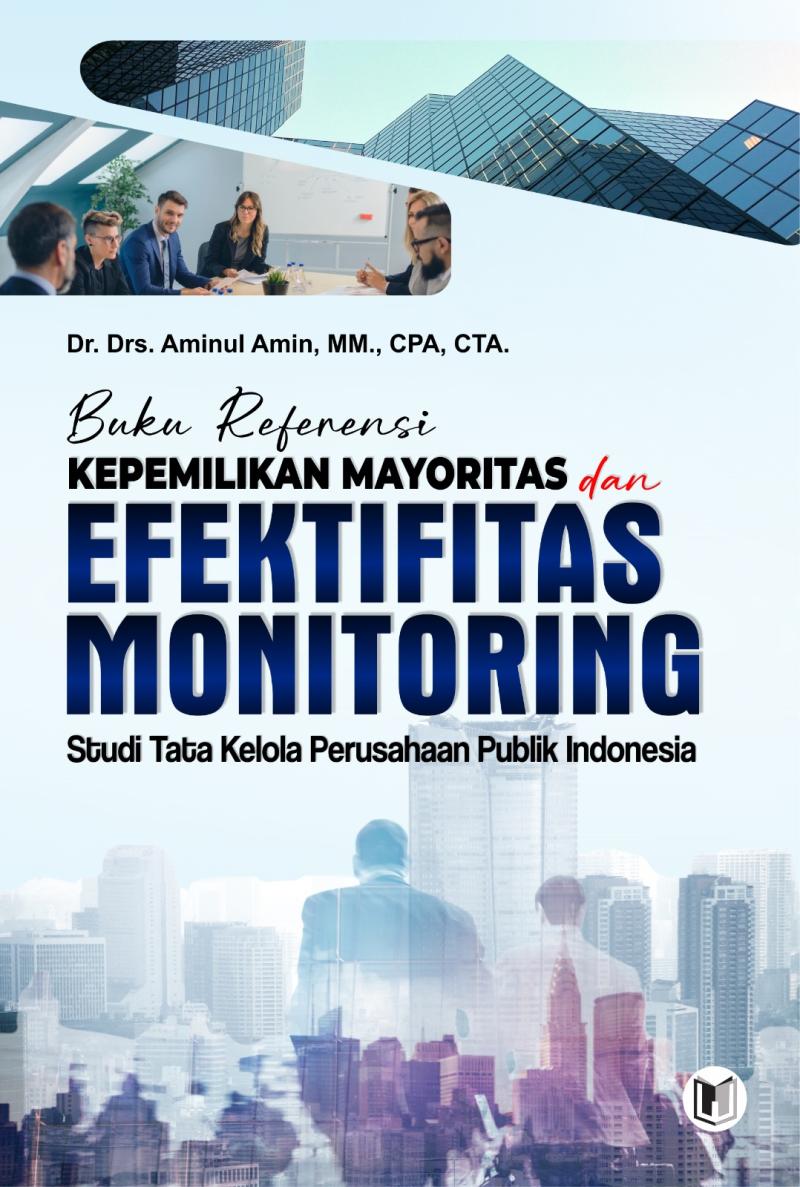
KEPEMILIKAN MAYORITAS DAN EFEKTIVITAS MONITORING: STUDI TATA KELOLA PERUSAHAAN PUBLIK INDONESIA
Keywords:
Mayoritas, Monitoring, Tata Kelola, PerusahaanSynopsis
Buku ini membahas secara mendalam bagaimana struktur kepemilikan yang terkonsentrasi membentuk wajah tata kelola perusahaan publik di Indonesia. Di tengah dominasi pemegang saham mayoritas, mekanisme pengawasan seperti Dewan Komisaris, Komite Audit, dan auditor eksternal tidak selalu bekerja dalam ruang yang netral; efektivitasnya dapat menguat, tetapi juga dapat melemah ketika berada di bawah bayang-bayang kekuatan pengendali. Dengan mengaitkan teori agensi, konflik antara pemegang saham mayoritas dan minoritas, kualitas audit, kualitas laba, serta nilai perusahaan, buku ini menawarkan pemahaman yang kontekstual tentang tantangan governance di pasar modal Indonesia.
Tidak hanya menyoroti risiko manajemen laba, ekspropriasi, tunneling, dan pelemahan independensi organ pengawasan, buku ini juga mengedarkan refleksi penting mengenai perlunya regulasi yang lebih kuat, transparansi kepemilikan, serta perlindungan yang lebih adil bagi pemegang saham minoritas. Karya ini menjadi bacaan penting bagi akademisi, peneliti, regulator, praktisi pasar modal, dan siapa pun yang ingin memahami bahwa tata kelola perusahaan bukan sekadar kepatuhan. formal, melainkan perjuangan menjaga akuntabilitas, kepercayaan investor, dan keberlanjutan perusahaan publik di Indonesia.
Dr. Drs. Aminul Amin, MM., CPA, CTA, lahir di Jombang, 7 Maret 1963. Penulis adalah seorang akademisi, peneliti, dan prakatisi bidang akuntansi, keuangan, auditing dan perpajakan. Penulis bekerja di STIE Malangkucecwara (ABM) Malang sebagai dosen tetap jurusan/program studi akuntansi. Jabatan strutural sebagai Direktur Pendidikan Profesi Akuntansi (PPAK) dan CPA Test Center STIE Malangkucecwara/ABM Malang. Penulis menyelesaikan studi S1 Jurusan Adminstrasi Bisnis, S1 Jurusan Akuntansi, S2 Jurusan Magister Manajemen (Keuangan), S3 Jurusan Akuntansi (Keuangan). Penulis pernah menempuh pendidikan profesi penilai bisnis dan profesi akuntan publik yang bergelar CPA. Selain sebagai dosen, penulis aktif menulis artikel di beberapa jurnal ilmiah Imiah baik nasional maupun internasional. internas Penulis juga aktif sebagai konsultan individu bidang akuntansi, keuangan, perpajakan, pengelolaan aset, dan investasi di beberapa entitas bisnis dan pemerintah daerah
Downloads
Download data is not yet available.
References
Agustiningsih, S. W., Djuminah, Suhardjanto, D., Rahmawati, & Amin, A. (2020). Independent board, earnings management, and audit quality. Test Engineering & Management, 82, 5035–5045.
Al-Ahdal, W. M., Alsamhi, M. H., Tabash, M. I., & Farhan, N. H. S. (2020). The impact of corporate governance on financial performance of Indian and GCC listed firms: An empirical investigation. Research in International Business and Finance, 51, 101083.
Alzoubi, E. S. S. (2018). Audit quality, debt financing, and earnings management: Evidence from Jordan. Journal of International Accounting, Auditing and Taxation, 30, 69–84.
Amin, A. (2016). Independensi komite audit, kualitas audit dan kualitas laba: Bukti empiris perusahaan dengan kepemilikan terkonsentrasi. Jurnal Akuntansi dan Keuangan, 18(1), 1–14. https://doi.org/10.9744/jak.18.1.1-14
Amin, A. (2017). Karakteristik Dewan Komisaris dan kualitas laba: Kualitas auditor sebagai pemoderasi [Disertasi doktoral, Universitas Sebelas Maret].
Amin, A., Arniati, T., & Puspita, D. A. (2020). How the corporate governance ratings affect the firm value: Empirical evidence from the Indonesia Stock Exchange. RJOAS, 2(98), 37–48.
Amin, A., Djuminah, Suhardjanto, D., & Agustiningsih, S. W. (2017). Board-auditor interaction and earnings management: The model of company with concentrated ownership. Review of Integrative Business and Economics Research, 6(3), 217–233.
Arniati, T., Puspita, D. A., Amin, A., & Pirzada, K. (2019). The implementation of good corporate governance model and auditor independence in earnings quality improvement. Entrepreneurship and Sustainability Issues, 7(1), 188–199.
Balsam, S., Krishnan, J., & Yang, J. S. (2003). Auditor industry specialization and earnings quality. Auditing: A Journal of Practice & Theory, 22(2), 71–97.
Barth, M. E., Cram, D. P., & Nelson, K. K. (2001). Accruals and the prediction of future cash flows. The Accounting Review, 76(1), 27–58.
Bebchuk, L. A., Cohen, A., & Ferrell, A. (2009). What matters in corporate governance? The Review of Financial Studies, 22(2), 783–827.
Becker, C. L., DeFond, M. L., Jiambalvo, J., & Subramanyam, K. R. (1998). The effect of audit quality on earnings management. Contemporary Accounting Research, 15(1), 1–24.
Bispo, O. N. A. (2021). Standard Jones and Modified Jones: An earnings management tutorial. Revista de Administração Contemporânea, 25(6), 1–18.
Bounini, N., & Gana, M. R. (2020). Corporate governance quality, ownership structure, agency costs and firm performance: Evidence from an emerging economy. Journal of Risk and Financial Management, 13(7), 154.
Chan, K., Chan, L. K. C., Jegadeesh, N., & Lakonishok, J. (2004). Earnings quality and stock returns. The Journal of Business, 79(3), 1041–1082.
Chen, Y., Ke, B., & Yang, Z. (2022). Controlling shareholder’s ownership, control rights and related-party transactions: Analysis of regulatory effects based on board characteristics. International Entrepreneurship and Management Journal. https://doi.org/10.1007/s11365-022-00801-w
Claessens, S., Djankov, S., Fan, J. P. H., & Lang, L. H. P. (2002). Disentangling the incentive and entrenchment effects of large shareholdings. The Journal of Finance, 57(6), 2741–2771.
Claessens, S., & Yurtoglu, B. B. (2013). Corporate governance in emerging markets: A survey. Emerging Markets Review, 15, 1–33.
DeAngelo, L. E. (1981). Auditor size and audit quality. Journal of Accounting and Economics, 3(3), 183–199.
Dechow, P., Ge, W., & Schrand, C. (2010). Understanding earnings quality: A review of the proxies, their determinants and their consequences. Journal of Accounting and Economics, 50(2–3), 344–401.
Dechow, P. M., Sloan, R. G., & Sweeney, A. P. (1995). Detecting earnings management. The Accounting Review, 70(2), 193–225.
Demsetz, H., & Lehn, K. (1985). The structure of corporate ownership: Causes and consequences. Journal of Political Economy, 93(6), 1155–1177.
Djankov, S., La Porta, R., Lopez-de-Silanes, F., & Shleifer, A. (2008). The law and economics of self-dealing. Journal of Financial Economics, 88(3), 430–465.
Eccles, R. G., Ioannou, I., & Serafeim, G. (2014). The impact of corporate sustainability on organizational processes and performance. Management Science, 60(11), 2835–2857.
Faccio, M., & Lang, L. H. P. (2002). The ultimate ownership of Western European corporations. Journal of Financial Economics, 65(3), 365–395.
Fan, J. P. H., & Wong, T. J. (2002). Corporate ownership structure and the informativeness of accounting earnings in East Asia. Journal of Accounting and Economics, 33(3), 401–425.
Fan, J. P. H., & Wong, T. J. (2005). Do auditors play a corporate governance role in emerging markets? Evidence from East Asia. Journal of Accounting Research, 43(1), 35–72.
Farooq, O., & El Jai, H. (2012). Ownership structure and earnings management: Evidence from the Casablanca Stock Exchange. International Research Journal of Finance and Economics, 84, 95–104.
Francis, J., LaFond, R., Olsson, P., & Schipper, K. (2005). The market pricing of accruals quality. Journal of Accounting and Economics, 39(2), 295–327.
Gompers, P., Ishii, J., & Metrick, A. (2003). Corporate governance and equity prices. The Quarterly Journal of Economics, 118(1), 107–156.
Graham, J. R., Harvey, C. R., & Rajgopal, S. (2005). The economic implications of corporate financial reporting. Journal of Accounting and Economics, 40(1–3), 3–73.
Habib, A. (2004). Impact of earnings management on value relevance of accounting information: Empirical evidence from Japan. Managerial Finance, 30(11), 1–15.
Hasan, M. S., Omar, N., & Hossain, S. Z. (2015). Corporate governance and earnings management: Evidence from listed non-financial companies in Bangladesh. International Journal of Accounting and Financial Reporting, 5(1), 92–108.
Healy, P. M., & Wahlen, J. M. (1999). A review of the earnings management literature and its implications for standard setting. Accounting Horizons, 13(4), 365–383.
Huyghebaert, N., & Wang, L. (2012). Expropriation of minority investors in Chinese listed firms: The role of internal and external corporate governance mechanisms. Corporate Governance: An International Review, 20(3), 308–332.
Ikatan Akuntan Indonesia. (2013). PSAK 65: Laporan keuangan konsolidasian. Dewan Standar Akuntansi Keuangan Ikatan Akuntan Indonesia.
Ikatan Akuntan Indonesia. (2019). Kerangka Konseptual Pelaporan Keuangan. Dewan Standar Akuntansi Keuangan Ikatan Akuntan Indonesia.
Ikatan Akuntan Publik Indonesia. (2021). Standar Audit 315 (Revisi 2021): Pengidentifikasian dan penilaian risiko kesalahan penyajian material. IAPI.
Ikatan Akuntan Publik Indonesia. (2021). Standar Audit 540: Audit atas estimasi akuntansi dan pengungkapan terkait. IAPI.
International Finance Corporation. (2014). The Indonesia Corporate Governance Manual. International Finance Corporation.
International Finance Corporation. (2018). Indonesia Corporate Governance Manual (2nd ed.). IFC.
Jaya, T. E., Septiarini, T., & Arafat, Y. (2016). Educational background of the board of commissioners, leverage, profitability and voluntary disclosure. Review of Integrative Business and Economics Research, 5(2), 260–271.
Jensen, M. C., & Meckling, W. H. (1976). Theory of the firm: Managerial behavior, agency costs, and ownership structure. Journal of Financial Economics, 3(4), 305–360.
Johnson, S., La Porta, R., Lopez-de-Silanes, F., & Shleifer, A. (2000). Tunneling. American Economic Review, 90(2), 22–27.
Jones, J. J. (1991). Earnings management during import relief investigations. Journal of Accounting Research, 29(2), 193–228.
Klein, A. (2002). Audit committee, board of director characteristics, and earnings management. Journal of Accounting and Economics, 33(3), 375–400.
Kothari, S. P., Leone, A. J., & Wasley, C. E. (2005). Performance matched discretionary accrual measures. Journal of Accounting and Economics, 39(1), 163–197.
Kyere, M., & Ausloos, M. (2021). Corporate governance and firms financial performance in the United Kingdom. International Journal of Finance & Economics, 26(2), 1871–1885. https://doi.org/10.1002/ijfe.1883
La Porta, R., Lopez de Silanes, F., & Shleifer, A. (1999). Corporate ownership around the world. The Journal of Finance, 54(2), 471–517.
Lakshan, A. M. I., & Wijekoon, W. M. H. N. (2012). Corporate governance and corporate failure. Procedia Economics and Finance, 2, 191–198.
Lin, S., Pizzini, M., Vargus, M., & Bardhan, I. (2011). The role of the internal audit function in the disclosure of material weaknesses. The Accounting Review, 86(1), 287–323.
Lukviarman, N. (2016). Corporate governance: Menuju penguatan konseptual dan implementasi di Indonesia. Era Adicitra Intermedia.
Mahrani, M., & Soewarno, N. (2018). The effect of good corporate governance mechanism and corporate social responsibility on financial performance with earnings management as mediating variable. Asian Journal of Accounting Research, 3(1), 41–60.
Manita, R., Elommal, N., Baudier, P., & Hikkerova, L. (2020). The digital transformation of external audit and its impact on corporate governance. Technological Forecasting and Social Change, 150, 119751.
OECD. (2015). G20/OECD Principles of Corporate Governance. OECD Publishing.
Otoritas Jasa Keuangan. (2014). Peraturan Otoritas Jasa Keuangan Nomor 33/POJK.04/2014 tentang Direksi dan Dewan Komisaris Emiten atau Perusahaan Publik. Otoritas Jasa Keuangan.
Otoritas Jasa Keuangan. (2015). Peraturan Otoritas Jasa Keuangan Nomor 21/POJK.04/2015 tentang Penerapan Pedoman Tata Kelola Perusahaan Terbuka. Otoritas Jasa Keuangan.
Otoritas Jasa Keuangan. (2015). Peraturan Otoritas Jasa Keuangan Nomor 31/POJK.04/2015 tentang Keterbukaan atas Informasi atau Fakta Material oleh Emiten atau Perusahaan Publik. Otoritas Jasa Keuangan.
Otoritas Jasa Keuangan. (2015). Peraturan Otoritas Jasa Keuangan Nomor 55/POJK.04/2015 tentang Pembentukan dan Pedoman Pelaksanaan Kerja Komite Audit. Otoritas Jasa Keuangan.
Otoritas Jasa Keuangan. (2016). Peraturan Otoritas Jasa Keuangan Nomor 29/POJK.04/2016 tentang Laporan Tahunan Emiten atau Perusahaan Publik. Otoritas Jasa Keuangan.
Otoritas Jasa Keuangan. (2020). Peraturan Otoritas Jasa Keuangan Nomor 15/POJK.04/2020 tentang Rencana dan Penyelenggaraan Rapat Umum Pemegang Saham Perusahaan Terbuka. Otoritas Jasa Keuangan.
Otoritas Jasa Keuangan. (2020). Peraturan Otoritas Jasa Keuangan Nomor 17/POJK.04/2020 tentang Transaksi Material dan Perubahan Kegiatan Usaha. Otoritas Jasa Keuangan.
Otoritas Jasa Keuangan. (2020). Peraturan Otoritas Jasa Keuangan Nomor 42/POJK.04/2020 tentang Transaksi Afiliasi dan Transaksi Benturan Kepentingan. Otoritas Jasa Keuangan.
Republik Indonesia. (2007). Undang-Undang Nomor 40 Tahun 2007 tentang Perseroan Terbatas. Pemerintah Republik Indonesia.
Republik Indonesia. (2011). Undang-Undang Nomor 5 Tahun 2011 tentang Akuntan Publik. Pemerintah Republik Indonesia.
Shleifer, A., & Vishny, R. W. (1997). A survey of corporate governance. The Journal of Finance, 52(2), 737–783.
Sloan, R. G. (1996). Do stock prices fully reflect information in accruals and cash flows about future earnings? The Accounting Review, 71(3), 289–315.
Srinidhi, B., Gul, F. A., & Tsui, J. (2011). Female directors and earnings quality. Contemporary Accounting Research, 28(5), 1610–1644.
Velury, U., & Jenkins, D. S. (2006). Institutional ownership and the quality of earnings. Journal of Business Research, 59(9), 1043–1051.
Xie, B., Davidson, W. N., III, & DaDalt, P. J. (2003). Earnings management and corporate governance: The role of the board and the audit committee. Journal of Corporate Finance, 9(3), 295–316.
Yeh, Y. H. (2001). Corporate governance and financing methods. Journal of International Financial Management & Accounting, 12(2), 150–169.
Downloads
Published
December 15, 2023
Copyright (c) 2026 Aminul Amin (Author)
License

This work is licensed under a Creative Commons Attribution-NonCommercial-ShareAlike 4.0 International License.
Details about this monograph
ISBN-13 (15)
978-634-317-050-1
How to Cite
Amin, A. (2023). KEPEMILIKAN MAYORITAS DAN EFEKTIVITAS MONITORING: STUDI TATA KELOLA PERUSAHAAN PUBLIK INDONESIA. Widina Media Utama. https://doi.org/10.59818/t02vx091