ETNOPEDAGOGI DALAM PENDIDIKAN IPS
Keywords:
Pendidikan, Ilmu Pengetahuan Sosial, EtnopedagogiSynopsis
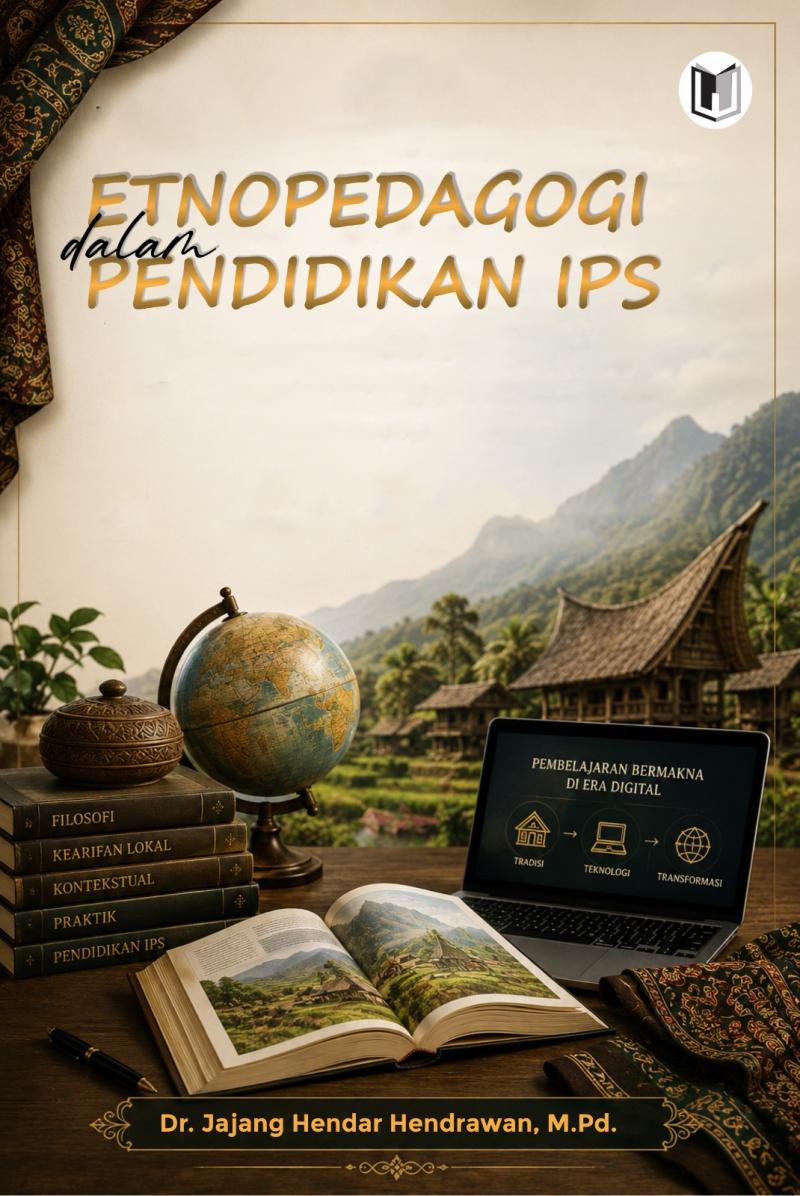
Buku Etnopedagogi dalam Pendidikan IPS membahas pentingnya pemanfaatan budaya dan kearifan lokal sebagai landasan dalam pembelajaran Ilmu Pengetahuan Sosial. Di tengah perkembangan global yang semakin pesat, pendidikan IPS tidak hanya berfungsi sebagai sarana transfer pengetahuan, tetapi juga sebagai wahana pembentukan identitas, karakter, dan kesadaran sosial peserta didik. Melalui pendekatan etnopedagogi, budaya lokal dipandang sebagai sumber belajar yang kaya nilai dan relevan dengan kehidupan masyarakat.
Buku ini menguraikan konsep dasar, landasan filosofis, serta kerangka teoretik etnopedagogi dalam pendidikan IPS. Selain itu, dibahas pula bagaimana kearifan lokal dapat diintegrasikan ke dalam proses pembelajaran sehingga peserta didik mampu memahami fenomena sosial dan budaya secara lebih kontekstual. Pendekatan ini mendorong pembelajaran yang dekat dengan pengalaman nyata dan lingkungan sekitar.
Sebagai penguatan kajian, buku ini menyajikan berbagai studi kasus pada komunitas adat, seperti Kampung Naga, Kampung Cireundeu, dan Kampung Mahmud. Melalui contoh-contoh tersebut, pembaca dapat memahami bagaimana nilai budaya diwariskan, dilestarikan, dan dimanfaatkan dalam pembentukan karakter serta penguatan kehidupan sosial masyarakat.
Pada bagian akhir, buku ini membahas strategi implementasi etnopedagogi dalam pembelajaran IPS, termasuk tantangan dan peluang pengembangannya di era modern. Dengan pembahasan yang sistematis dan aplikatif, buku ini diharapkan menjadi referensi bagi mahasiswa, guru, peneliti, dan praktisi pendidikan dalam mengembangkan pembelajaran IPS yang berakar pada budaya dan kearifan lokal.
Downloads
Download data is not yet available.
References
Alwasilah, A. C., Suryadi, K., & Karyono, T. (2009). Etnopedagogi: Landasan Praktik Pendidikan dan Pendidikan Guru. Kiblat Buku Utama.
Anderson, T., & Dron, J. (2022). Teaching Crowds: Learning and Social Media. Athabasca University Press. https://www.aupress.ca/books/120177-teaching-crowds/
Antika, W. T., Abidah, K., & Nur, D. M. M. (2025). Integrasi Nilai Kearifan Lokal dalam Pembelajaran IPS Sebagai Upaya Penguatan Profil Pelajar Pancasila di Sekolah Menengah Pertama. Jurnal Penelitian Ilmiah Multidisipliner, 02(03), 2869–2874.
Apple, M. W. (2019). Ideology and Curriculum (4th ed.). Routledge. https://www.routledge.com/Ideology-and-Curriculum/Apple/p/book/9781138316461
Ausubel, D. P. (1968). Educational Psychology: A Cognitive View. Holt, Rinehart and Winston.
Bandura, A. (1977). Social Learning Theory. Prentice-Hall.
Banks, J. A. (2015). Cultural Diversity and Education: Foundations, Curriculum, and Teaching. Routledge.
Banks, J. A. (2016). Cultural Diversity and Education Foundations, Curriculum, and Teaching.
Banks, J. A. (2017). Multicultural Education: Characteristics and Goals. John Wiley & Sons.
Banks, J. A. (2019). An Introduction to Multicultural Education. Pearson. https://books.google.co.id/books?id=QUJ2swEACAAJ
Banks, J. A. (2020). An Introduction to Multicultural Education (6th ed.). Pearson.
Berger, P. L., & Luckmann, T. (1966). The Social Construction of Reality: A Treatise in the Sociology of Knowledge. Anchor Books.
Berkes, F. (2018). Sacred Ecology (4th ed.). Routledge. https://doi.org/10.4324/9781315114644
Bransford, J. D., Brown, A. L., & Cocking, R. R. (2000). How People Learn: Brain, Mind, Experience, and School (J. D. Bransford, A. L. Brown, & R. R. Cocking (Eds.)). National Academy Press.
Bruner, J. (1996). The Culture of Education. Harvard University Press.
Cassirer, E. (1944). An Essay on Man: An Introduction to a Philosophy of Human Culture. Yale University Press.
Castells, M. (2010). The Rise of the Network Society (2nd ed.). Wiley-Blackwell. https://doi.org/10.1002/9781444319514
Cochran-Smith, M., & Lytle, S. L. (2009). Inquiry as Stance: Practitioner Research for the Next Generation. Teachers College Press. https://www.tcpress.com/inquiry-as-stance-9780807748304
Dewantara, K. H. (2013). Pendidikan. Majelis Luhur Persatuan Taman Siswa.
Dewey, J. (1916). Democracy and Education. Macmillan. https://www.gutenberg.org/ebooks/852
Dewey, J. (1997). Demokrasi dan Pendidikan (13th ed.). The Free Press.
Dewey, J. (2016). Democracy and Education. Free Press.
Ekadjati, E. S. (1995). Kebudayaan Sunda: Suatu Pendekatan Sejarah. Pustaka Jaya.
Freire, P., Freire, P., & Freire, P. P. (2020). Pendidikan multikultural persepektif paulo freire. 01(01), 108–124.
Gay, G. (2018). Culturally Responsive Teaching: Theory, Research, and Practice. Teachers College Press.
Geertz, C. (1973). The Interpretation of Cultures. Basic Books.
Geertz, C. (1983). Local Knowledge: Further Essays in Interpretive Anthropology. Basic Books.
Giddens, A. (1991). The Consequences of Modernity. Polity Press.
Giddens, A. (2000). Runaway World: How Globalization Is Reshaping Our Lives. Routledge. https://doi.org/10.4324/9780203992999
Giroux, H. A. (2011). On Critical Pedagogy. Continuum. https://www.bloomsbury.com/us/on-critical-pedagogy-9781441115902
Grundy, S. (1987). Curriculum: Product or Praxis. Falmer Press. https://www.routledge.com/Curriculum-Product-or-Praxis/Grundy/p/book/9781850000440
Gulikers, J. T. M., Bastiaens, T. J., & Kirschner, P. A. (2006). Authentic assessment 1 Catchline Running head. Journal of Vocational Education and Training, X(X).
Hadi, S. (2019). Kearifan Lokal sebagai Sumber Pembelajaran dalam Pendidikan Sosial. Rajawali Pers.
Hammond, Z. (2015). Culturally Responsive Teaching and the Brain: Promoting Authentic Engagement and Rigor Among Culturally and Linguistically Diverse Students. Corwin Press.
Hendrawan, J. H. (2019). The Inculcation of Sundanese Local Wisdom Values in Millennial Generation. 458(Icssgt 2019), 307–314.
Hendrawan, J. H. (2020). Kepemimpinan Adiluhung. STKIP Pasundan Press.
Hendrawan, J. H., Halimah, L., Ratnahayati, A., & Barat, J. (2025). Revitalizing the Value of Cireundeu Local Wisdom through the Utilization of Artificial Intelligence Towards a Sustainable Society in the Society 5.0 Era. 01(01), 72–80.
Hendrawan, J. H., Syobar, K., & Rudiana, H. (2024). Integrasi Nilai-Nilai Kearifan Lokal dalam Pembangunan Berkelanjutan: Studi Kasus Kampung Naga sebagai Model Ekologi dan Sosial Budaya untuk SDGs.
Hermawan, J. S., & Rizqi, Y. F. (2025). Penyusunan Pendekatan Etnopedagogi Berbasis E-book Untuk Meningkatkan Literasi Budaya dan Kewarganegaraan Peserta Didik di Sekolah Dasar. Jurnal Pengabdian Masyarakat Ilmu Pendidikan, 4(2 SE-Articles), 270–282. https://doi.org/10.23960/jpm-ip.vol.4i.2.1295
Hidayati, N., Waluyo, H., Winarni, R., & Suyitno, S. (2020). Exploring the Implementation of Local Wisdom-Based Character Education among Indonesian Higher Education Students. International Journal of Instruction, 13, 179–198. https://doi.org/10.29333/iji.2020.13213a
Hmelo-Silver, C. E. (2004). Problem-Based Learning: What and How Do Students Learn? Educational Psychology Review, 16(3), 235–266. https://doi.org/10.1023/B:EDPR.0000034022.16470.f3
Iskandar, J. (2018). Etnobiologi, Etnoekologi dan Pembangunan Berkelanjutan (1st ed.). Plantaxia.
Johnson, E. B. (2002). Contextual Teaching and Learning: What It Is and Why It Is Here to Stay. Corwin Press.
Joyce, B., Weil, M., & Calhoun, E. (2009). Models of Teaching (8th ed.). Pearson Education.
Kemendikbudristek RI. (2022). Peraturan Menteri Pendidikan, Kebudayaan, Riset, dan Teknologi Nomor 21 Tahun 2022 tentang Standar Penilaian Pendidikan pada Pendidikan Anak Usia Dini, Jenjang Pendidikan Dasar, dan Jenjang Pendidikan Menengah. Kemendikbudristek.
Kluckhohn, C. (1951). The Study of Culture. Stanford University Press.
Koentjaraningrat. (2009a). Pengantar Ilmu Antropologi. Rineka Cipta.
Koentjaraningrat, R. M. (2009b). Pengantar ilmu Antropologi. Rineka Cipta.
Kolb, D. A. (2021). Experiential Learning: Experience as the Source of Learning and Development. Prentice-Hall.
Lickona, T. (2013). Educating for Character: How Our Schools Can Teach Respect and Responsibility. Bantam Books.
McLaren, P. (2015). Life in Schools: An Introduction to Critical Pedagogy in the Foundations of Education (6th ed.). Routledge. https://www.routledge.com/Life-in-Schools/McLaren/p/book/9781138786012
NCSS. (2018). College, career, and civic life (C3) framework for social studies state standards. NCSS.
OECD. (2021). Global competence and intercultural education. OECD Publishing.
Paris, D., & Alim, H. S. (Eds.). (2017). Culturally Sustaining Pedagogies: Teaching and Learning for Justice in a Changing World. Teachers College Press.
Patras, Y. E., Juliani, A., Nurhasanah, N., Maksum, A., & Hidayat, R. (2023). A Review of Culture-Based Learning at Primary Level In Indonesia. 15(2020), 3923–3936. https://doi.org/10.35445/alishlah.v15i3.3525
Prince, M., & Felder, R. M. (2006). Inductive Teaching and Learning Methods: Definitions, Comparisons, and Research Bases. Journal of Engineering Education, 95(2), 123–138. https://doi.org/10.1002/j.2168-9830.2006.tb00884.x
Pujilestari, W., & Hendrawan, J. H. (2024). SOCIAL STUDIES OF SUSTAINABLE DEVELOPMENT ( A Case of Study at Kampung Mahmud ). 01(01), 277–282.
Putnam, R. D. (2000). Bowling Alone: The Collapse and Revival of American Community. Simon & Schuster.
Rosidi, A. (2020). Kearifan Lokal dalam Perspektif Budaya Sunda (1st ed.). Kiblat Buku Utama.
Safitri, D., Suzanti, L., & Widjayatri, R. D. (2022). Persepsi Pendidik PAUD Terhadap Aplikasi EduGame MARU sebagai Alternatif Media Pembelajaran Jarak Jauh. Aulad Journal on Early Childhood, 5(2), 253–262. https://doi.org/10.31004/aulad.v5i2.369
Sakti, S. A., Endraswara, S., & Rohman, A. (2024). Revitalizing local wisdom within character education through ethnopedagogy apporach: A case study on a preschool in Yogyakarta. Heliyon, 10(10). https://doi.org/10.1016/j.heliyon.2024.e31370
Santos, B. de S. (2014). Epistemologies of the South: Justice Against Epistemicide (1st ed.). Routledge. https://doi.org/10.4324/9781315634876
Santos, B. de S. (2018). The End of the Cognitive Empire: The Coming of Age of Epistemologies of the South. Duke University Press. https://doi.org/10.1515/9781478002000
Santrock, J. (2021). Educational Psychology. McGraw-Hill Companies,Incorporated. https://books.google.co.id/books?id=l8wxPwAACAAJ
Selasih, N. N., & Sudarsana, I. K. (2025). Etnopedagogi dan penguatan karakter berbasis kearifan lokal dalam pendidikan. Jurnal Pendidikan Dan Kebudayaan, 7(1), 1–15. https://jurnaldikbud.kemdikbud.go.id/index.php/jpnk
Sibarani, R. (2018). Kearifan Lokal: Hakikat, Peran, dan Metode Tradisi Lisan. Asosiasi Tradisi Lisan.
Smith, L. T. (1999). Decolonizing Methodologies: Research and Indigenous Peoples. Zed Books.
Smith, L. T. (2021). Decolonizing Methodologies: Research and Indigenous Peoples (3rd ed.). Zed Books.
Sugara, H., & Sugito. (2022). Etnopedagogi sebagai pendekatan pembelajaran berbasis budaya lokal. Jurnal Pendidikan Dan Kebudayaan, 27(3), 345–357. https://jurnaldikbud.kemdikbud.go.id/index.php/jpnk
Sumardjo, J. (2014). Sunda: Pola Rasionalitas Budaya (1st ed.). Kelir.
Supriatna, N. (2021). Etnopedagogi dan Pembelajaran IPS Berbasis Kearifan Lokal. Remaja Rosdakarya.
Tilaar, H. A. R. (2012). Perubahan Sosial dan Pendidikan: Pengantar Pedagogik Transformatif untuk Indonesia. Rineka Cipta.
UNESCO. (2022). Education for Sustainable Development: Learning Objectives and Competencies for the Future. UNESCO Publishing. https://www.unesco.org/en/education/sustainable-development
UNESCO. (2023). Report On The Evaluation Of The Implementation Of The Renewed Mandate Of The International Bureau For Education (IBE). General Conference 42nd Session.
Vygotsky, L. S. (1978). Mind in Society: The Development of Higher Psychological Processes. Harvard University Press. https://www.hup.harvard.edu/books/9780674576292
Zuraidah, S., & Malmar, M. (2026). Integrasi Kearifan Lokal dalam Pembelajaran Pendidikan Kewarganegaraan. 3(3), 891–897.
Downloads
Published
June 26, 2026
Copyright (c) 2026 Jajang Hendar Hendrawan (Author)
License

This work is licensed under a Creative Commons Attribution-NonCommercial-ShareAlike 4.0 International License.
Details about this monograph
ISBN-13 (15)
978-634-317-028-0
How to Cite
Hendrawan, J. H. (2026). ETNOPEDAGOGI DALAM PENDIDIKAN IPS. Widina Media Utama. https://doi.org/10.59818/e5tcd632