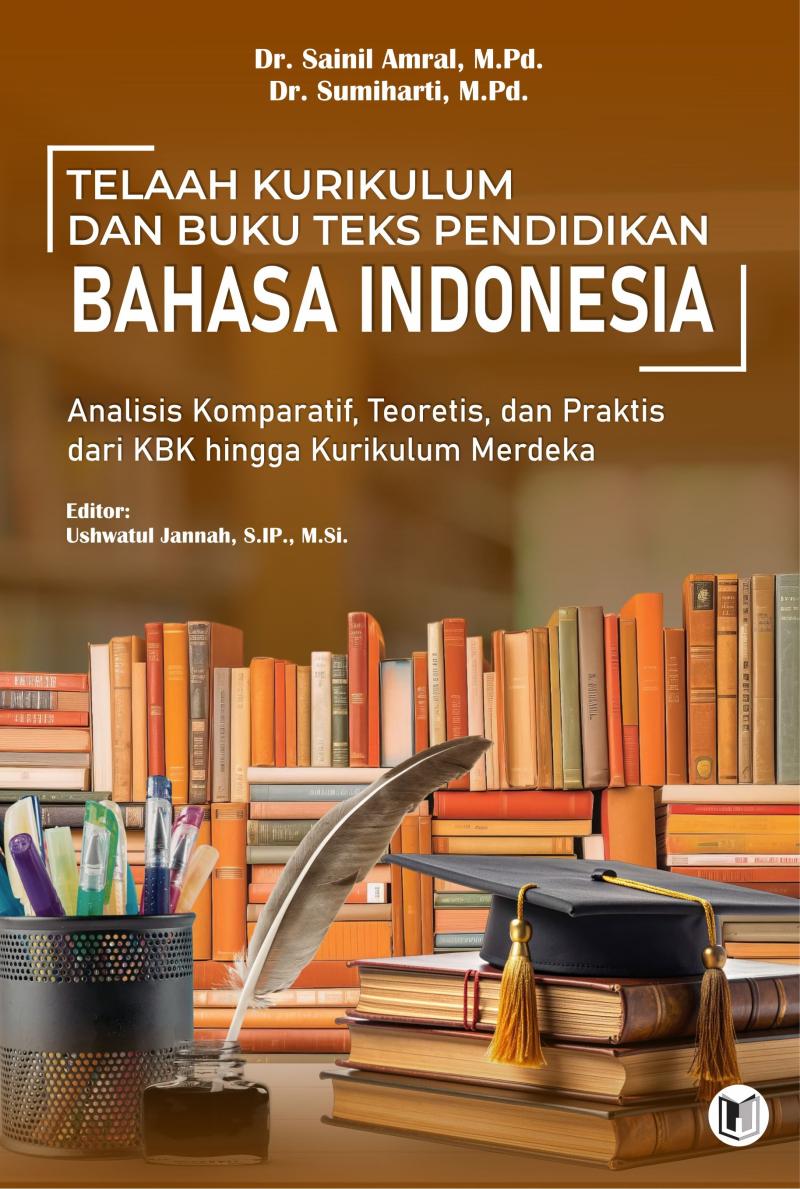
TELAAH KURIKULUM DAN BUKU TEKS PENDIDIKAN BAHASA INDONESIA: Analisis Komparatif, Teoritis, dan Praktis dari KBK hingga Kurikulum Merdeka
Keywords:
Kurikulum Bahasa Indonesia, Kurikulum Merdeka, Implementasi Pembelajaran, Literasi dan Numerasi, Kecerdasan Buatan (Artificial Intelligence), Analisis Buku Teks, Perangkat Pembelajaran, Deep LearningSynopsis
Kurikulum adalah jantung pendidikan yang terus bertransformasi demi menjawab tantangan zaman. Buku ini menghadirkan potret komprehensif mengenai perjalanan panjang dan dinamika perubahan kurikulum pendidikan Bahasa Indonesia di tanah air. Dengan pendekatan analisis yang mendalam, penulis membedah evolusi kurikulum mulai dari Kurikulum Berbasis Kompetensi (KBK), KTSP, Kurikulum 2013, hingga paradigma terbaru Kurikulum Merdeka.
Buku ini tidak hanya berhenti pada tataran teoritis dan filosofis, namun juga menyajikan panduan praktis yang esensial bagi para pendidik. Pembaca akan diajak untuk memahami jembatan antara kebijakan makro pemerintah dengan implementasi mikro di ruang kelas, mulai dari penyusunan Alur Tujuan Pembelajaran (ATP), Modul Ajar, hingga teknik evaluasi yang adaptif. Isu-isu mutakhir seperti integrasi Deep Learning, penguatan literasi dan numerasi (ANBK), pemanfaatan Kecerdasan Buatan (AI) dalam pembelajaran, serta prinsip pendidikan inklusif dibahas secara lugas dan sistematis. Salah satu kekuatan utama buku ini terletak pada analisis kritisnya terhadap buku teks sebagai instrumen utama pembelajaran. Penulis memberikan kriteria baku dalam menelaah kualitas isi, penyajian, dan keterbacaan bahan ajar agar relevan dengan kebutuhan dunia kerja serta perkembangan masyarakat digital.
Buku ini merupakan referensi wajib bagi mahasiswa kependidikan, guru Bahasa Indonesia, praktisi kurikulum, serta pengamat pendidikan yang ingin memiliki pemahaman utuh mengenai strategi pengembangan perangkat pembelajaran yang visioner, profesional, dan berorientasi pada masa depan.
Downloads
Download data is not yet available.
References
Adler, M. J. (1982). The paideia proposal: An educational manifesto. Macmillan.
Afdal, A., Masruri, A., Anugrah, A., Wulandari, A., Fitria, A., & Mukhlis, M. (2022). Analisis Kelayakan Penyajian Buku Teks Bahasa Indonesia Kelas XII Kurikulum 2013 Terbitan Kemendikbud 2018. Sajak: Jurnal Penelitian dan Pengabdian Sastra, Bahasa, dan Pendidikan, 1(1), 1-10. https://doi.org/10.25299/s.v1i1.8764
Afflerbach, P., Pearson, P. D., & Paris, S. G. (2008). Clarifying differences between reading skills and reading strategies. The Reading Teacher, 61(5), 364-373. https://doi.org/10.1598/RT.61.5.1
Ainscow, M. (2020). Promoting inclusion and equity in education: lessons from international experiences. Nordic Journal of Studies in Educational Policy, 6(1), 7-16.
https://doi.org/10.1080/20020317.2020.1722597
Alsubaie, M. A. (2016). Curriculum Development: Teacher Involvement in Curriculum Development. Journal of Education and Practice, 7(9), 106-107.
Alyafatin, R., Pasah, I., Mila, N., Setiani, D., Melani, H., Ramadania, A., Purwo, A., Utomo, Y., Fahruddin, A., & Hatmanto, D. (2024). Analisis Kesalahan Berbahasa dalam Teks Nonfiksi pada Buku Pelajaran Bahasa Indonesia Kelas VIII Terbitan Pusat Kurikulum dan Perbukuan Balitbang Kementerian Pendidikan dan Kebudayaan sebagai Upaya Meningkatkan Kualitas Pembelajaran Membaca. Bhinneka: Jurnal Bintang Pendidikan dan Bahasa, 2(4), 1011-1020.
https://doi.org/10.59024/bhinneka.v2i4.1011
Anderson, L. W., & Krathwohl, D. R. (Eds.). (2001). A taxonomy for learning, teaching, and assessing: A revision of Bloom's Taxonomy of educational objectives. Longman.
Apple, M. W. (2018). Ideology and curriculum (4th ed.). Routledge.
Arends, R. I. (2012). Learning to teach (9th ed.). McGraw-Hill.
Astuti, P. (2022). Implementasi Kurikulum Merdeka untuk meningkatkan motivasi belajar pada pembelajaran diferensiasi. Jurnal Pendidikan dan Konseling, 4(6), 8431-8438.
https://doi.org/10.31004/jpdk.v4i6.9452
Badan Standar Nasional Pendidikan (BSNP). (2006). Panduan Penyusunan Kurikulum Tingkat Satuan Pendidikan Jenjang Pendidikan Dasar dan Menengah. BSNP.
Banks, J. A. (2015). Cultural diversity and education: Foundations, curriculum, and teaching (6th ed.). Pearson.
Barrows, H. S. (1996). Problem-based learning in medicine and beyond: A brief overview. New Directions for Teaching and Learning, 1996(68), 3-12. https://doi.org/10.1002/tl.37219966804
Beane, J. A. (1997). Curriculum integration: Designing the core of democratic education. Teachers College Press.
Bell, S. (2010). Project-Based Learning for the 21st Century: Skills for the Future. The Clearing House, 83(2), 39-43.
https://doi.org/10.1080/00098650903505415
Bernstein, B. (1971). On the classification and framing of educational knowledge. In M. F. D. Young (Ed.), Knowledge and control: New directions for the sociology of education (pp. 47-69). Collier-Macmillan.
Biggs, J., & Tang, C. (2011). Teaching for quality learning at university (4th ed.). McGraw-Hill/Society for Research into Higher Education & Open University Press.
Black, P., & Wiliam, D. (1998). Assessment and classroom learning. Assessment in Education: Principles, Policy & Practice, 5(1), 7-74. https://doi.org/10.1080/0969595980050102
Bloom, B. S. (1971). Mastery learning. In J. H. Block (Ed.), Mastery learning: Theory and practice (pp. 47–63). Holt, Rinehart & Winston.
Booth, T., & Ainscow, M. (2011). Index for inclusion: Developing learning and participation in schools (3rd ed.). Centre for Studies on Inclusive Education (CSIE).
Bourdieu, P. (1986). The forms of capital. In J. Richardson (Ed.), Handbook of theory and research for the sociology of education (pp. 241-258). Greenwood Press.
Bransford, J. D., Brown, A. L., & Cocking, R. R. (Eds.). (2000). How people learn: Brain, mind, experience, and school. National Academy Press.
Brookfield, S. D. (2017). Becoming a critically reflective teacher (2nd ed.). John Wiley & Sons.
Brookhart, S. M. (2013). How to create and use rubrics for formative assessment and grading. ASCD.
Brookhart, S. M., & Nitko, A. J. (2019). Educational assessment (8th ed.). Pearson.
Browne, M. N., & Keeley, S. M. (2018). Asking the right questions: A guide to critical thinking (12th ed.). Pearson.
Bruner, J. S. (1960). The process of education. Harvard University Press.
BSNP. (2014). Instrumen Penilaian Buku Teks Pelajaran Pendidikan Dasar dan Menengah. Badan Standar Nasional Pendidikan.
CAST. (2018). Universal Design for Learning Guidelines version 2.2. Retrieved from http://udlguidelines.cast.org
Cavaleri, M., & Dianati, S. (2016). You want me to check your grammar again? The usefulness of an online grammar checker as perceived by students. Journal of Academic Language and Learning, 10(1), A223-A236.
Clandinin, D. J., & Connelly, F. M. (1992). Teacher as curriculum maker. In P. W. Jackson (Ed.),Handbook of research on curriculum (pp. 363-401). Macmillan.
Clark, R. C., & Mayer, R. E. (2016). E-learning and the science of instruction: Proven guidelines for consumers and designers of multimedia learning (4th ed.). Wiley.
Cochran-Smith, M., & Lytle, S. L. (2009). Inquiry as stance: Practitioner research for the next generation. Teachers College Press.
Cunningsworth, A. (1995). Choosing your coursebook. Heinemann.
Darling-Hammond, L. (2000). Teacher quality and student achievement: A review of state policy evidence. Education Policy Analysis Archives, 8(1). https://doi.org/10.14507/epaa.v8n1.2000
Darling-Hammond, L. (2006). Constructing 21st-century teacher education. Journal of Teacher Education, 57(3), 300-314.
https://doi.org/10.1177/0022487105285962
Darling-Hammond, L., & Adamson, F. (2014). Beyond the bubble test: How performance assessments support 21st century learning. John Wiley & Sons.
Darling-Hammond, L., Flook, L., Cook-Harvey, C., Barron, B., & Osher, D. (2020). Implications for educational practice of the science of learning and development. Applied Developmental Science, 24(2), 97-140. https://doi.org/10.1080/10888691.2018.1537791
Darling-Hammond, L., Hyler, M. E., & Gardner, M. (2017). Effective teacher professional development. Learning Policy Institute.
Datnow, A., & Park, V. (2019). Professional collaboration with a purpose: Teacher learning and leadership in vulnerable schools. Routledge.
Davies, G., & Rendall, H. (2008). The language laboratory: A phoenix from the ashes? Journal of the IATEFL Learning Technologies SIG, 2, 14-22.
Day, C. (1999). Developing teachers: The challenges of lifelong learning. Falmer Press.
Depdiknas. (2002). Kurikulum Berbasis Kompetensi: Konsep Dasar. Pusat Kurikulum, Balitbang.
Depdiknas. (2003). Pelayanan Profesional Kurikulum Berbasis Kompetensi. Pusat Kurikulum, Balitbang.
Depdiknas. (2003). Standar Kompetensi Mata Pelajaran Bahasa dan Sastra Indonesia Sekolah Menengah Atas dan Madrasah Aliyah. Pusat Kurikulum, Balitbang.
Depdiknas. (2003). Undang-Undang RI Nomor 20, Tahun 2003, tentang Sistem Pendidikan Nasional.
Depdiknas. (2004). Standar Kompetensi Guru.
Depdiknas. (2006). Peraturan Menteri Pendidikan Nasional Nomor 22 Tahun 2006 tentang Standar Isi untuk Satuan Pendidikan Dasar dan Menengah.
Depdiknas. (2006). Peraturan Menteri Pendidikan Nasional Nomor 23 Tahun 2006 tentang Standar Kompetensi Lulusan untuk Satuan Pendidikan Dasar dan Menengah.
Depdiknas. (2006). Peraturan Menteri Pendidikan Nasional Nomor 24 Tahun 2006 tentang Pelaksanaan Peraturan Menteri Pendidikan Nasional Nomor 22 dan 23 Tahun 2006.
Depdiknas. (2007). Model-Model Pembelajaran Inovatif. Pusat Kurikulum, Balitbang.
DeVito, J. A. (2015). The essential elements of public speaking (5th ed.). Pearson.
Dewantara, K. H. (1962). Karya Ki Hadjar Dewantara, Bagian Pertama: Pendidikan. Majelis Luhur Persatuan Taman Siswa.
Dewey, J. (1938). Experience and education. Kappa Delta Pi.
Ditjen Mandikdasmen. (2007). Model Penilaian Kelas Kurikulum Tingkat Satuan Pendidikan. Departemen Pendidikan Nasional.
Drake, S. M., & Reid, J. L. (2020). 21st Century Competencies in Light of the History of Integrated Curriculum. Brock Education Journal, 29(2), 31-48. https://doi.org/10.26522/brocked.v29i2.809
Duke, N. K., & Cartwright, K. B. (2021). The science of reading progresses: Communicating advances beyond the simple view of reading. Reading Research Quarterly, 56(S1), S25-S44. https://doi.org/10.1002/rrq.411
Dunn, R., & Dunn, K. (1993). Teaching secondary students through their individual learning styles: Practical approaches for grades 7-12. Allyn & Bacon.
Dweck, C. S. (2006). Mindset: The new psychology of success. Random House.
Entwistle, N. (2009). Teaching for understanding at university: Deep approaches and distinctive ways of thinking. Palgrave Macmillan.
Fadillah, M. (2014). Implementasi Kurikulum 2013 dalam Pembelajaran SD/MI, SMP/MTs, & SMA/MA. Ar-Ruzz Media.
Fahmi, D., Siburian, D., Lestari, D., Rezeki, E., Yulis, D., & Mukhlis, M. (2022). Analisis Kelayakan Bahasa Buku Teks Bahasa Indonesia Kelas IX Kurikulum 2013 Terbitan Kemendikbud. Sajak: Jurnal Penelitian dan Pengabdian Sastra, Bahasa, dan Pendidikan, 1(1), 20-29.
https://doi.org/10.25299/s.v1i1.8812
Fattah, N. (2004). Konsep Manajemen Berbasis Sekolah (MBS) & Dewan Sekolah. Pustaka Bani Quraisy.
Febriyenti, D., Putri, N., Asmendri, A., & Sari, M. (2023). Perkembangan Kurikulum di Indonesia dalam Perspektif Sejarah. Al-Idaroh: Jurnal Studi Manajemen Pendidikan Islam, 7(2), 932-945.
https://doi.org/10.54437/alidaroh.v7i2.932
Firmansyah, A., & Marlina, S. (2025). Analisis Kritis Buku Teks Cerdas Cergas untuk Pembelajaran Bahasa Indonesia. Stilistika: Jurnal Pendidikan Bahasa dan Sastra, 18(2), 1-15.
https://doi.org/10.30651/st.v18i2.25344
Flavell, J. H. (1979). Metacognition and cognitive monitoring: A new area of cognitive–developmental inquiry. American Psychologist, 34(10), 906–911. https://doi.org/10.1037/0003-066X.34.10.906
Fogarty, R. (1991). How to integrate the curricula. Palatine, IL: IRI/Skylight Publishing.
Freire, P. (1970). Pedagogy of the oppressed. Herder and Herder.
Friend, M., & Bursuck, W. D. (2018). Including students with special needs: A practical guide for classroom teachers (8th ed.). Pearson.
Fullan, M. (2007). The new meaning of educational change (4th ed.). Teachers College Press.
Fullan, M. (2016). The new meaning of educational change (5th ed.). Teachers College Press.
G. (2023). ChatGPT for good? On opportunities and challenges of large language models for education. Learning and Individual Differences, 103, 102274. https://doi.org/10.1016/j.lindif.2023.102274
Gargiulo, R. M., & Metcalf, D. (2022). Teaching in today's inclusive classrooms: A universal design for learning approach (4th ed.). Cengage Learning.
Garr, R. (2011). Presentation Zen: Simple design principles and techniques to enhance your presentations. New Riders.
Gewerc, A., Martínez-Piñeiro, E., & Mon-Varela, S. (2021). Podcasting in Higher Education: A review of the state of the art. Education and Information Technologies, 26(4), 4887-4903.
https://doi.org/10.1007/s10639-021-10497-8
Gilakjani, A. P. (2012). Visual, auditory, kinesthetic learning styles and their impacts on English language teaching. Journal of Studies in Education, 2(1), 104-113. https://doi.org/10.5296/jse.v2i1.1007
Gillies, R. M. (2016). Cooperative learning: Review of research and practice. Australian Journal of Teacher Education, 41(3), 39-54.
http://dx.doi.org/10.14221/ajte.2016v41n3.3
Glasser, W. (1998). The quality school: Managing students without coercion. Harper Perennial.
Gordon, J., & Halász, G. (Eds.). (2010). Key Competences in Europe: Opening Doors for Lifelong Learners Across the School Curriculum and Teacher Education. ARES. https://doi.org/10.2307/j.ctt130h6fn
Graves, K. (2000). Designing language courses: A guide for teachers. Heinle & Heinle.
Gray, E. (2010). Workplace communication. Wadsworth, Cengage Learning.
Hajar, S., & Anasy, Z. (2023). Filosofi Pendidikan Ki Hajar Dewantara dan Relevansinya pada Kurikulum Merdeka. Jurnal Penelitian dan Pengembangan Pendidikan, 7(1), 127-134.
https://doi.org/10.23887/jppp.v7i1.61111
Hall, G. E., & Hord, S. M. (2015). Implementing change: Patterns, principles, and potholes (4th ed.). Pearson.
Hamalik, O. (2008). Manajemen Pengembangan Kurikulum. PT Remaja Rosdakarya.
Hamalik, O. (2019). Pengembangan Kurikulum: Dasar-dasar dan pengembangannya. Mandar Maju.
Hannafin, M. J., & Land, S. M. (1997). The foundations and assumptions of technology-enhanced student-centered learning environments. Instructional Science, 25(3), 167-202.
https://doi.org/10.1023/A:1002997414652
Harden, R. M. (2000). The integration ladder: a tool for curriculum planning and evaluation.
Hargreaves, A. (2005). Educational change takes ages: Life, career and generational factors in teachers' emotional responses to educational change. Teaching and Teacher Education, 21(8), 967-983.
https://doi.org/10.1016/j.tate.2005.06.007
Hargreaves, A., & Fullan, M. (2012). Professional capital: Transforming teaching in every school. Teachers College Press.
Haryati, S. (2021). Analisis Pengembangan Kurikulum Tingkat Satuan Pendidikan (KTSP) di Era Merdeka Belajar. Jurnal Papeda: Jurnal Publikasi Pendidikan Dasar, 3(2), 125-133.
https://doi.org/10.36232/jurnalpendidikandasar.v3i2.1009
Hattie, J. (2009). Visible learning: A synthesis of over 800 meta-analyses relating to achievement. Routledge.
Hayes, D., Mills, M., Christie, P., & Lingard, B. (2006). Teachers and schooling making a difference: Productive pedagogies, assessment and performance. Allen & Unwin.
Henri, J., Hay, L., & Oberg, D. (2002). The school library as a mission and space: A new paradigm for learning. IFLA.
Hmelo-Silver, C. E. (2004). Problem-based learning: What and how do students learn? Educational Psychology Review, 16(3), 235–266. https://doi.org/10.1023/B:EDPR.0000034022.16470.f3
Hobbs, R. (2017). Create to learn: Introduction to digital literacy. John Wiley & Sons.
Hosnan, M. (2014). Pendekatan Saintifik dan Kontekstual dalam Pembelajaran Abad 21. Ghalia Indonesia.
Hutchinson, T., & Torres, E. (1994). The textbook as agent of change. ELT Journal, 48(4), 315-328. https://doi.org/10.1093/elt/48.4.315
Jackson, P. W. (1968). Life in classrooms. Holt, Rinehart & Winston.
Jackson, R., Harper, K., & Jackson, J. (2006). The curb-cut effect: A twenty-year retrospective. National Center on Universal Design for Learning.
Jacobs, H. H. (Ed.). (1989). Interdisciplinary curriculum: Design and implementation. Association for Supervision and Curriculum Development.
Johnson, D. W., & Johnson, R. T. (1999). Learning together and alone: Cooperative, competitive, and individualistic learning (5th ed.). Allyn & Bacon.
Johnson, D. W., Johnson, R. T., & Smith, K. A. (2014). Cooperative learning: Improving university instruction by basing practice on validated theory. Journal on Excellence in College Teaching, 25(3&4), 85-118.
Johnson, E. B. (2002). Contextual teaching and learning: What it is and why it's here to stay. Corwin Press.
Jonassen, D. H., Peck, K. L., & Wilson, B. G. (1999). Learning with technology: A constructivist perspective. Prentice Hall. Kasneci, E., Sessler, K., Küchemann, S., Bannert, M., Dementieva, D., Fischer, F., ... & Kasneci,
Joyce, B., Weil, M., & Calhoun, E. (2015). Models of teaching (9th ed.). Pearson.
Kemdikbud. (2013). Peraturan Menteri Pendidikan dan Kebudayaan Nomor 65 Tahun 2013 tentang Standar Proses Pendidikan Dasar dan Menengah.
Kemdikbudristek. (2021). Asesmen Nasional: Lembar Tanya Jawab.
Kemdikbudristek. (2021). Buku Panduan Perencanaan Berbasis Data (PBD) di Satuan Pendidikan.
Kemdikbudristek. (2021). Panduan Pengembangan Projek Penguatan Profil Pelajar Pancasila. Badan Standar, Kurikulum, dan Asesmen Pendidikan.
Kemdikbudristek. (2022). Buku Saku Tanya Jawab Kurikulum Merdeka.
Kemdikbudristek. (2022). Keputusan Kepala Badan Standar, Kurikulum, dan Asesmen Pendidikan (BSKAP) Nomor 033/H/KR/2022 tentang Perubahan Atas Keputusan Kepala BSKAP Nomor 008/H/KR/2022 tentang Capaian Pembelajaran pada Pendidikan Anak Usia Dini, Jenjang Pendidikan Dasar, dan Jenjang Pendidikan Menengah pada Kurikulum Merdeka.
Kemdikbudristek. (2022). Panduan Pembelajaran dan Asesmen Kurikulum Merdeka.
Kemdikbudristek. (2022). Panduan Pembelajaran dan Asesmen Pendidikan Anak Usia Dini, Pendidikan Dasar, dan Menengah. Badan Standar, Kurikulum, dan Asesmen Pendidikan.
Kemdikbudristek. (2022). Pembelajaran dan Asesmen Kurikulum 2013, Kurikulum Darurat, dan Kurikulum Merdeka. Pusat Asesmen dan Pembelajaran.
Kemendikbud. (2013). Peraturan Menteri Pendidikan dan Kebudayaan Nomor 65 Tahun 2013 tentang Standar Proses Pendidikan Dasar dan Menengah.
Kemendikbud. (2013). Peraturan Menteri Pendidikan dan Kebudayaan Nomor 81A Tahun 2013 tentang Implementasi Kurikulum.
Kemendikbud. (2014). Materi Pelatihan Guru Implementasi Kurikulum 2013. Badan Pengembangan Sumber Daya Manusia Pendidikan dan Kebudayaan dan Penjaminan Mutu Pendidikan.
Kemendikbud. (2014). Peraturan Menteri Pendidikan dan Kebudayaan Nomor 104 Tahun 2014 tentang Penilaian Hasil Belajar oleh Pendidik pada Pendidikan Dasar dan Pendidikan Menengah.
Kemendikbud. (2016). Panduan Gerakan Literasi Sekolah di Sekolah Menengah Pertama. Direktorat Jenderal Pendidikan Dasar dan Menengah.
Khasanah, U., & Tinus, A. S. (2022). Peran Kurikulum Darurat dalam Mengatasi Learning Loss di Masa Pandemi Covid-19. Jurnal Basicedu, 6(3), 3567-3576. https://doi.org/10.31004/basicedu.v6i3.2709
Kirkpatrick, J. D., & Kirkpatrick, W. K. (2016). Kirkpatrick's four levels of training evaluation. ATD Press.
Kliebard, H. M. (2004). The struggle for the American curriculum, 1893-1958 (3rd ed.). Routledge.
Komalasari, K. (2010). Pembelajaran Kontekstual: Konsep dan Aplikasi. Refika Aditama.
Krippendorff, K. (2018). Content analysis: An introduction to its methodology (4th ed.). Sage publications.
Kuhlthau, C. C. (2010). Guided inquiry: School libraries in the 21st century. School Libraries Worldwide, 16(1), 1-12.
Kunandar. (2008). Langkah Mudah Penelitian Tindakan Kelas sebagai Pengembangan Profesi Guru. Rajawali Pers.
Kunandar. (2011). Guru Profesional: Implementasi Kurikulum Tingkat Satuan Pendidikan (KTSP) dan Sukses dalam Sertifikasi Guru. Rajawali Pers.
Kunandar. (2013). Penilaian Autentik (Penilaian Hasil Belajar Peserta Didik Berdasarkan Kurikulum 2013): Suatu Pendekatan Praktis. Rajawali Pers.
Kuntze, M., Golos, D., & Enns, C. (2014). Rethinking literacy: Broadening the scope of "reading" in a deaf bilingual-bimodal classroom. Sign Language Studies, 14(2), 209-232.
https://doi.org/10.1353/sls.2014.0000
Lankshear, C., & Knobel, M. (2015). Digital literacies. In The Routledge Handbook of Language and Digital Communication (pp. 54-66). Routledge.
Lawton, D. (1973). Social change, educational theory, and curriculum planning. University of London Press.
Lewis, C., Perry, R., & Murata, A. (2006). How should research contribute to instructional improvement? The case of lesson study. Educational Researcher, 35(3), 3-14.
https://doi.org/10.3102/0013189X035003003
Lo, P. (2014). The sustainable development of school libraries in the 21st century. Libri, 64(3), 256-263. https://doi.org/10.1515/libri-2014-0020
Madison, B. L., & Steen, L. A. (Eds.). (2008). Calculation vs. context: Quantitative literacy and its implications for teacher education. Mathematical Association of America.
Marton, F., & Säljö, R. (1976). On qualitative differences in learning: I, Outcome and process. British Journal of Educational Psychology, 46(1), 4-11. https://doi.org/10.1111/j.2044-8279.1976.tb02980.x
Marzano, R. J., Pickering, D. J., & Pollock, J. E. (2001). Classroom instruction that works: Research-based strategies for increasing student achievement. Association for Supervision and Curriculum Development.
Marzuqi, B., & Ahid, N. (2023). Perkembangan Kurikulum Pendidikan Di Indonesia: Prinsip Dan Faktor Yang Mempengaruhi. JoIEM (Journal of Islamic Education Management), 4(2), 153-167.
https://doi.org/10.30762/joiem.v4i2.1284
Mayer, R. E. (Ed.). (2014). The Cambridge handbook of multimedia learning (2nd ed.). Cambridge University Press.
Mazhud, N. (2024). Analisis Buku Teks Bahasa Indonesia SMA Kelas X Ditinjau dari Aspek Kesesuaian Materi Ajar dengan Kurikulum. DIDAKTIS: Jurnal Pendidikan Bahasa dan Sastra Indonesia, 2(2), 735-745. https://doi.org/10.33096/didaktis.v2i2.735
Medical Education, 34(7), 551-557.
https://doi.org/10.1046/j.1365-2923.2000.00697.x
Mishra, P., & Koehler, M. J. (2006). Technological Pedagogical Content Knowledge: A framework for teacher knowledge. Teachers College Record, 108(6), 1017-1054.
https://doi.org/10.1111/j.1467-9620.2006.00684.x
Mitchell, D. (2014). What really works in special and inclusive education: Using evidence-based teaching strategies (2nd ed.). Routledge.
Mulyasa, E. (2003). Kurikulum Berbasis Kompetensi: Konsep, Karakteristik, dan Implementasi. PT Remaja Rosdakarya.
Mulyasa, E. (2007). Kurikulum Tingkat Satuan Pendidikan: Sebuah Panduan Praktis. PT Remaja Rosdakarya.
Mulyasa, E. (2014). Pengembangan dan Implementasi Kurikulum 2013. PT Remaja Rosdakarya.
Muslich, M. (2007). KTSP: Kurikulum Tingkat Satuan Pendidikan, Dasar Pemahaman dan Pengembangan. Bumi Aksara.
Nadiem, A. M. (2019, 11 Desember). Pidato Menteri Pendidikan dan Kebudayaan pada Peringatan Hari Guru Nasional 2019. Kementerian Pendidikan dan Kebudayaan.
Nieto, S. (2017). Affirming diversity: The sociopolitical context of multicultural education (7th ed.). Pearson.
Nurhadi, & Senduk, A. G. (2003). Pembelajaran Kontekstual dan Penerapannya dalam KBK. Universitas Negeri Malang Press.
OECD. (2018). The Future of Education and Skills: Education 2030. OECD Publishing.
OECD. (2019). PISA 2018 Assessment and Analytical Framework. OECD Publishing.
O'Neill, G., & McMahon, T. (2005). Student-centred learning: What does it mean for students and lecturers? In Emerging issues in the practice of university learning and teaching. AISHE.
O'Neill, R., & Mello, D. P. (2021). Automated writing evaluation: A meta-analysis of its impact on L2 writing. Journal of Second Language Writing, 54, 100854. https://doi.org/10.1016/j.jslw.2021.100854
Ornstein, A. C. (1991). The philosophy of education and curriculum specialists. The Educational Forum, 55(2), 143-152.
https://doi.org/10.1080/00131729109335593
Ornstein, A. C., & Hunkins, F. P. (2018). Curriculum: Foundations, principles, and issues (7th ed.). Pearson.
Paul, R., & Elder, L. (2007). Critical thinking: The art of Socratic questioning. Foundation for Critical Thinking.
Paulson, F. L., Paulson, P. R., & Meyer, C. A. (1991). What makes a portfolio a portfolio? Educational Leadership, 48(5), 60-63.
Pellegrino, J. W., & Hilton, M. L. (Eds.). (2012). Education for life and work: Developing transferable knowledge and skills in the 21st century. National Academies Press.
Peraturan Menteri Negara Pendayagunaan Aparatur Negara dan Reformasi Birokrasi Nomor 16 Tahun 2009 tentang Jabatan Fungsional Guru dan Angka Kreditnya.
Peraturan Pemerintah Republik Indonesia Nomor 19 Tahun 2005 tentang Standar Nasional Pendidikan.
Phillips, D. C. (Ed.). (2000). Constructivism in education: Opinions and second opinions on controversial issues. University of Chicago Press.
Prastowo, A. (2023). Panduan Lengkap Menyusun Modul Ajar Kurikulum Merdeka. DIVA Press.
Priestley, M., & Biesta, G. (2013). Reinventing the curriculum: New trends in curriculum policy and practice. Bloomsbury.
Print, M. (1993). Curriculum development and design (2nd ed.). Allen & Unwin.
Puentedura, R. R. (2013). SAMR: A contextualized introduction. Hippasus.
Pusat Asesmen dan Pembelajaran (Pusmenjar). (2020). Desain Pengembangan Soal Asesmen Kompetensi Minimum. Badan Penelitian dan Pengembangan dan Perbukuan, Kemendikbud.
Pusat Kurikulum dan Perbukuan. (2018). Pedoman Penilaian Buku Teks. Kementerian Pendidikan dan Kebudayaan.
Pusat Kurikulum. (2002). Kebijakan Pengembangan Kurikulum Berbasis Kompetensi. Departemen Pendidikan Nasional.
Putra, R. S., & Adiprima, P. (2020). Otonomi Sekolah: Analisis Kebijakan Kurikulum Tingkat Satuan Pendidikan (KTSP) dan Kurikulum 2013. Jurnal Kebijakan Pendidikan, 7(1), 45-56.
Rahmadani, D., & Mulyani, E. A. (2023). Analisis Capaian Pembelajaran (CP), Tujuan Pembelajaran (TP) dan Alur Tujuan Pembelajaran (ATP) dalam Kurikulum Merdeka. Jurnal Inovasi Pendidikan dan Pembelajaran, 3(2), 526-535. https://doi.org/10.53624/jipp.v3i2.213
Redish, J. C. (2012). Letting go of the words: Writing web content that works (2nd ed.). Morgan Kaufmann.
Retnaningdyah, P. (2016). The Indonesian Curriculum 2013: A Paradigm Shift in ELT. In The 63rd TEFLIN International Conference Proceedings (pp. 51-57).
Richards, J. C. (2014). The role of textbooks in a language program. Cambridge University Press.
Richards, J. C., & Farrell, T. S. (2005). Professional development for language teachers: Strategies for teacher learning. Cambridge University Press.
Richards, J. C., & Rodgers, T. S. (2014). Approaches and methods in language teaching (3rd ed.). Cambridge University Press.
Rogers, E. M. (2003). Diffusion of innovations (5th ed.). Free Press.
Rosenblatt, L. M. (1995). Literature as exploration (5th ed.). Modern Language Association.
Sadovnik, A. R. (Ed.). (2019). Sociology of Education: A Critical Reader (3rd ed.). Routledge.
Sahlberg, P. (2021). Finnish lessons 3.0: What can the world learn from educational change in Finland?. Teachers College Press.
Salvia, J., Ysseldyke, J. E., & Bolt, S. (2016). Assessment: In special and inclusive education (13th ed.). Cengage Learning.
Sani, R. A. (2014). Pembelajaran Saintifik untuk Implementasi Kurikulum 2013. Bumi Aksara.
Sanjaya, W. (2008). Kurikulum dan Pembelajaran: Teori dan Praktik Pengembangan Kurikulum Tingkat Satuan Pendidikan. Kencana Prenada Media Group.
Sanjaya, W. (2008). Strategi Pembelajaran Berorientasi Standar Proses Pendidikan. Kencana Prenada Media Group.
Sanjaya, W. (2015). Kurikulum dan pembelajaran: Teori dan praktik pengembangan kurikulum tingkat satuan pendidikan (KTSP). Kencana.
Sanoff, H. (2001). School building assessment methods. National Clearinghouse for Educational Facilities.
Saputro, D., Sabardila, A., Prayitno, H., & Markhamah, M. (2021). Integrasi Keterampilan Berpikir Kritis dalam Buku Teks Bahasa Indonesia Kurikulum 2013 Berperspektif HOTS. Diglosia: Jurnal Kajian Bahasa, Sastra, dan Pengajarannya, 4(3), 168-179.
https://doi.org/10.30872/diglosia.v4i3.168
Sari, E. K., & Elihami, E. (2020). Implementasi Gerakan Literasi Sekolah (GLS) di Sekolah Dasar. EDUKATIF: JURNAL ILMU PENDIDIKAN, 2(1), 71-78. https://doi.org/10.31004/edukatif.v2i1.70
Schiro, M. S. (2013). Curriculum theory: Conflicting visions and enduring concerns (2nd ed.). Sage publications.
Schleppegrell, M. J. (2007). The linguistic challenges of mathematics teaching and learning: A research review. Reading & Writing Quarterly, 23(2), 139-159.
https://doi.org/10.1080/10573560601158461
Schön, D. A. (1983). The reflective practitioner: How professionals think in action. Basic Books.
Schriver, K. A. (1989). Evaluating text quality: The continuum from expert-focused to reader-focused methods. IEEE Transactions on Professional Communication, 32(4), 238-255. https://doi.org/10.1109/47.44536
Schunk, D. H. (2020). Learning theories: An educational perspective (8th ed.). Pearson.
Schwab, K. (2016). The Fourth Industrial Revolution. World Economic Forum.
Senge, P. M. (2006). The fifth discipline: The art & practice of the learning organization. Doubleday/Currency.
Setiadi, H., & Adhima, F. (2022). Asesmen Kompetensi Minimum (AKM) sebagai Alternatif Pengganti Ujian Nasional (UN) dalam Sistem Evaluasi Pendidikan di Indonesia. Jurnal Educatio, 8(1), 173-180. https://doi.org/10.31949/educatio.v8i1.1895
Shakespeare, T. (2017). Disability rights and wrongs revisited (2nd ed.). Routledge.
Shams, L., & Seitz, A. R. (2008). Benefits of multisensory learning. Trends in Cognitive Sciences, 12(11), 411-417.
https://doi.org/10.1016/j.tics.2008.07.006
Sheldon, L. E. (Ed.). (1988). ELT textbooks and materials: Problems in evaluation and development. Modern English Publications.
Shulman, L. S. (1987). Knowledge and teaching: Foundations of the new reform. Harvard Educational Review, 57(1), 1-23.
https://doi.org/10.17763/haer.57.1.j463w79r56455411
Slavin, R. E. (2014). Cooperative learning and academic achievement: Why does groupwork work?. Anales de Psicología, 30(3), 785-791.
https://doi.org/10.6018/analesps.30.3.201201
Sleeter, C. E., & Grant, C. A. (2011). Making choices for multicultural education: Five approaches to race, class, and gender (7th ed.). John Wiley & Sons.
Smaldino, S. E., Lowther, D. L., Mims, C., & Russell, J. D. (2015). Instructional technology and media for learning (11th ed.). Pearson.
Spady, W. G. (1994). Outcome-based education: Critical issues and answers. American Association of School Administrators.
Stenhouse, L. (1975). An introduction to curriculum research and development. Heinemann.
Stiggins, R. J. (2002). Assessment crisis: The absence of assessment for learning. Phi Delta Kappan, 83(10), 758-765.
Stroobants, V. (2018). Competence-Based Education from a Historical-Philosophical Perspective. In M. Mulder (Ed.), Competence-based Vocational and Professional Education (pp. 55-73). Springer.
https://doi.org/10.1007/978-3-319-41713-4_3
Stufflebeam, D. L., & Coryn, C. L. S. (2014). Evaluation theory, models, and applications. Jossey-Bass.
Suh, J. (2021). A Critical Review on Curriculum Reform Driven by National Level Assessment: A Case of South Korea. Asia-Pacific Education Researcher, 30(6), 517-525. https://doi.org/10.1007/s40299-021-00588-w
Sumarsih, S., & Mulyoto, M. (2023). Implementasi Platform Merdeka Mengajar untuk Meningkatkan Kompetensi Guru. Jurnal Pendidikan dan Kewirausahaan, 11(2), 651-660.
https://doi.org/10.47668/pkwu.v11i2.791
Suparlan. (2015). Manajemen Kurikulum dan Pembelajaran. Bumi Aksara.
Suryosubroto, B. (2009). Manajemen Pendidikan di Sekolah. Rineka Cipta.
Susilawati, E., & Suryadi, D. (2022). Teaching at the Right Level: A Curriculum Reform in Indonesia. Journal of Curriculum and Teaching, 11(5), 19-27. https://doi.org/10.5430/jct.v11n5p19
Sutrisno, S. (2021). Pancasila as the foundation of the national education system. International Journal of Social Science and Human Research, 4(8), 2095-2101. https://doi.org/10.47191/ijsshr/v4-i8-25
Taba, H. (1962). Curriculum development: Theory and practice. Harcourt, Brace & World.
Tan, O. S. (2003). Problem-based learning innovation: Using problems to power learning in the 21st century. Cengage Learning.
Tardif, J. (2017). L'évaluation des compétences: Documenter le parcours de développement. Chenelière Éducation.
Tim Pengembang Kurikulum. (2007). Model-Model Pengembangan Silabus dan Rencana Pelaksanaan Pembelajaran. Pusat Kurikulum, Balitbang Depdiknas.
Tim Platform Merdeka Mengajar (PMM). (2022). Panduan Pemanfaatan Platform Merdeka Mengajar. Kemdikbudristek.
Tomlinson, B. (Ed.). (2011). Materials development in language teaching (2nd ed.). Cambridge University Press.
Tomlinson, C. A. (2001). How to differentiate instruction in mixed-ability classrooms (2nd ed.). Association for Supervision and Curriculum Development.
Tomlinson, C. A. (2014). The differentiated classroom: Responding to the needs of all learners (2nd ed.). ASCD.
Topping, K. J. (2005). Trends in peer learning. Educational Psychology, 25(6), 631-645. https://doi.org/10.1080/01443410500345172
Trier, U. P. (2003). The European Union’s ‘Key Competences’ initiative. In D. S. Rychen & L. H. Salganik (Eds.), Key Competencies for a Successful Life and a Well-Functioning Society (pp.57-68). Hogrefe & Huber.
Tyack, D., & Cuban, L. (1995). Tinkering toward utopia: A century of public school reform. Harvard University Press.
Tyas, I., Mutiah, A., & Rahman, A. (2024). Analisis Aspek Kebahasaan dan Penyajian Materi pada Elemen Menulis Teks Pidato dalam Buku Teks Bahasa Indonesia Kelas VIII Kurikulum Merdeka. Stilistika: Jurnal Pendidikan Bahasa dan Sastra, 17(2), 228-238.
https://doi.org/10.30651/st.v17i2.22884
Tyler, R. W. (1949). Basic principles of curriculum and instruction. University of Chicago Press.
Undang-Undang Republik Indonesia Nomor 14 Tahun 2005 tentang Guru dan Dosen.
Undang-Undang Republik Indonesia Nomor 20 Tahun 2003 tentang Sistem Pendidikan Nasional.
UNESCO. (2017). Education for Sustainable Development Goals: Learning Objectives. UNESCO.
UNESCO. (2017). Literacy for all. UNESCO
UNESCO. (2021). Digital literacy global framework. UNESCO.
Vars, G. F. (1991). Integrated curriculum in the middle school. Educational Leadership, 49(2), 52-55.
Vescio, V., Ross, D., & Adams, A. (2008). A review of research on the impact of professional learning communities on teaching practice and student learning. Teaching and Teacher Education, 24(1), 80-91. https://doi.org/10.1016/j.tate.2007.01.004
Vygotsky, L. S. (1978). Mind in society: The development of higher psychological processes. Harvard University Press.
Walsh, M. (2010). Multimodal literacy: What does it mean for classroom practice? Australian Journal of Language and Literacy, 33(3), 211-239.
Warschauer, M., & Liaw, M. L. (2011). The personal learning environment: A new look at the language lab. ReCALL, 23(1), 1-5.
https://doi.org/10.1017/S095834401000028X
Warsita, B. (2016). Pembelajaran Tematik Terpadu dalam Kurikulum 2013: Konsep dan Aplikasi. Jurnal Inovasi Pendidikan Dasar, 1(1), 1-15.
Warwick, P. (2022). Autonomy, curriculum and the new professionalism of teachers in England. Journal of Curriculum Studies, 54(3), 323-337. https://doi.org/10.1080/00220272.2021.1983088
Watkins, J., & Wilkins, M. (2011). Using YouTube in the EFL classroom. Language Education in Asia, 2(1), 113-119.
https://doi.org/10.5746/leia/11/v2/i1/a09/watkins_wilkins
Wenger, E. (2011). Communities of practice: A brief introduction. In C. F. School (Ed.), Learning in Landscapes of Practice (pp. 1-13).
Westwood, P. (2018). Inclusive and adaptive teaching: Meeting the challenge of diversity in the classroom. Routledge.
Widana, I. W. (2017). Modul Penyusunan Soal Higher Order Thinking Skill (HOTS). Direktorat Jenderal Pendidikan Dasar dan Menengah.
Widodo, A., & Pujiastuti, H. (2021). Implementasi Asesmen Kompetensi Minimum (AKM) untuk Literasi Membaca dan Numerasi. Jurnal Inovasi Pendidikan, 2(1), 1-10.
Wiggins, G. (1998). Educative assessment: Designing assessments to inform and improve student performance. Jossey-Bass.
Wiggins, G., & McTighe, J. (2005). Understanding by design (2nd ed.). Association for Supervision and Curriculum Development
Wijaya, A. (2019). Integrating numeracy into the Indonesian curriculum: A critical review. Journal on Mathematics Education, 10(3), 343-356. https://doi.org/10.22342/jme.10.3.8967.343-356
Wiliam, D. (2011). Embedded formative assessment. Solution Tree Press.
Woolfolk, A. (2018). Educational Psychology (14th ed.). Pearson.
World Economic Forum. (2023). Future of Jobs Report 2023. World Economic Forum.
Wortham, S. (2005). Socialization Beyond the Classroom: A Multilevel Study of Language and Social Identity. Rowman & Littlefield Publishers.
Young, M. F. D. (2014). Bringing knowledge back in: From social constructivism to social realism in the sociology of education. Routledge.
Yulia, Y. (2023). Peran Platform Merdeka Mengajar dalam Implementasi Kurikulum Merdeka di Satuan Pendidikan. Jurnal Ilmiah Pendidikan dan Pembelajaran, 7(1), 1-10.
https://doi.org/10.23887/jipp.v7i1.60987
Zaim, M. (2017). The implementation of the scientific approach in English language teaching in the senior high schools in West Sumatra. In International Conference on Education, Science, and Technology (pp. 120-127). Atlantis Press. https://doi.org/10.2991/icest-17.2017.27
Zainil, Y., & Haryanto, H. (2021). The integration of Sustainable Development Goals (SDGs) in EFL teaching materials. Journal of English Language Teaching, 10(1), 127-138.
https://doi.org/10.24036/jelt.v10i1.11145
Zainuddin, Z., & Halili, S. H. (2016). Flipped classroom research and trends from different fields of study. International Review of Research in Open and Distributed Learning, 17(3), 313-340.
https://doi.org/10.19173/irrodl.v17i3.2274
Zais, R. S. (1976). Curriculum: Principles and foundations. Harper & Row.
Zimmerman, B. J. (2002). Becoming a self-regulated learner: An overview. Theory into Practice, 41(2), 64-70.
https://doi.org/10.1207/s15430421tip4102_2
Zou, D., Luo, S., & Li, J. (2022). A systematic review of research on the integration of artificial intelligence in language learning. Journal of Educational Technology & Society, 25(3), 1-17.
Zuhdi, D., & Budimansyah, D. (2009). The implementation of the competency-based curriculum and its implications for the teaching of civics in Indonesia. The Journal of Social Studies Research, 33(2), 221-240.
Zuhri, F., & Setyawan, B. W. (2022). Analisis kebutuhan soft skill mahasiswa dalam menghadapi dunia kerja. Jurnal Ilmiah Wahana Pendidikan, 8(1), 221-228. https://doi.org/10.5281/zenodo.5898864
Zulfa, V. (2021). Kolaborasi Guru Melalui Lesson Study untuk Meningkatkan Kualitas Pembelajaran. Jurnal Pendidikan dan Konseling (JPDK), 3(1), 143-148. https://doi.org/10.31004/jpdk.v3i1.1396
Downloads
Published
June 25, 2026
Copyright (c) 2026 Sainil Amral, Sumiharti Sumiharti (Author)
License

This work is licensed under a Creative Commons Attribution-NonCommercial-ShareAlike 4.0 International License.
How to Cite
Sainil Amral, & Sumiharti Sumiharti. (2026). TELAAH KURIKULUM DAN BUKU TEKS PENDIDIKAN BAHASA INDONESIA: Analisis Komparatif, Teoritis, dan Praktis dari KBK hingga Kurikulum Merdeka. Widina Media Utama. https://doi.org/10.59818/pbcadm80