
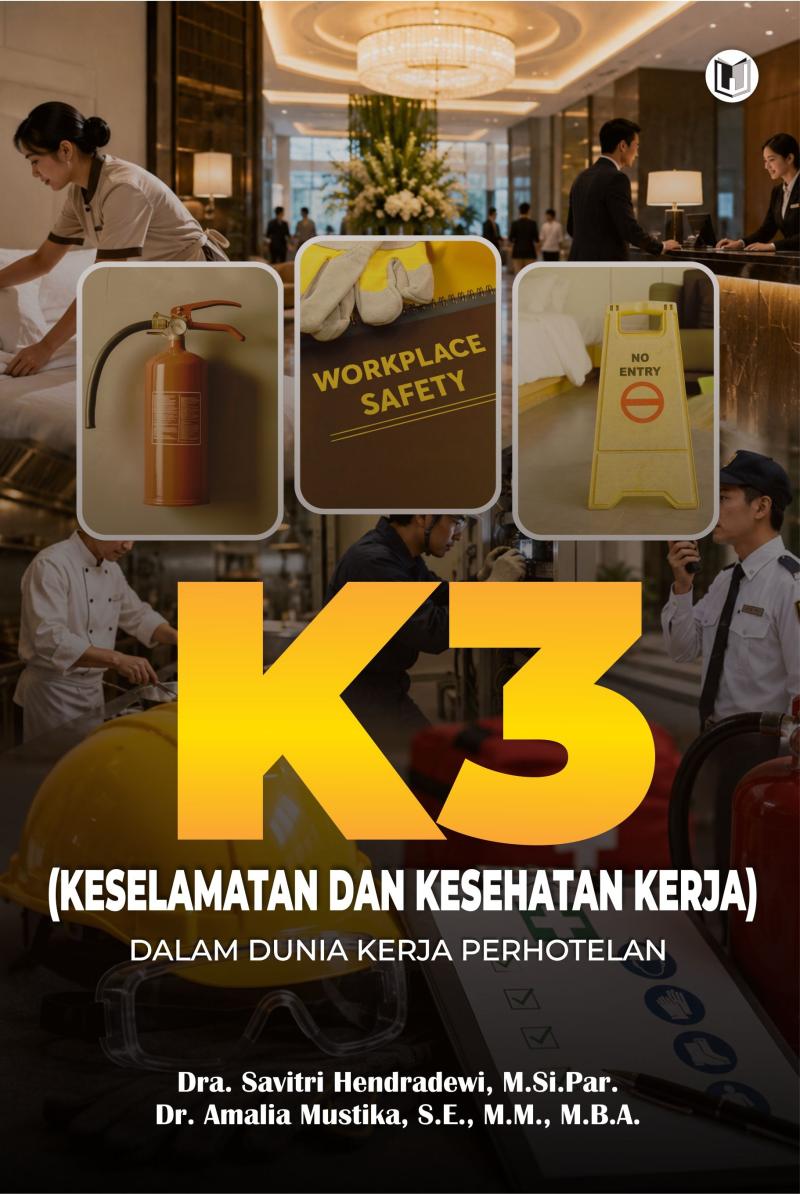
K3 (KESELAMATAN DAN KESEHATAN KERJA) DALAM DUNIA KERJA PERHOTELAN
Keywords:
Keselamatan dan Kesehatan Kerja (K3), Industri Perhotelan, Sistem Manajemen K3 (SMK3), Identifikasi Bahaya dan Pengendalian Risiko, ISO 45001, Budaya Keselamatan Kerja, Kesehatan KerjaSynopsis
Buku ini membahas secara komprehensif tentang Keselamatan dan Kesehatan Kerja (K3) dalam industri perhotelan yang memiliki karakteristik kerja dinamis, padat interaksi, dan berisiko tinggi di berbagai departemen. Pada bagian awal, buku menjelaskan konsep dasar K3, ruang lingkupnya, serta karakteristik industri perhotelan yang membuat penerapan K3 menjadi sangat penting. Selain itu, dibahas pula peran K3 dalam meningkatkan kualitas layanan hotel serta manfaatnya bagi pekerja, manajemen, dan tamu hotel.
Selanjutnya, buku ini menguraikan landasan hukum dan standar K3 yang berlaku di tingkat nasional maupun internasional, termasuk regulasi pemerintah, standar ILO, dan ISO 45001. Pembahasan juga mencakup tanggung jawab hukum manajemen dan pekerja dalam penerapan K3, serta bagaimana K3 diintegrasikan dalam kebijakan dan Standard Operating Procedure (SOP) hotel. Hal ini memberikan pemahaman bahwa K3 bukan hanya kewajiban moral, tetapi juga kewajiban hukum yang harus dipatuhi oleh seluruh pihak di lingkungan kerja.
Pada bagian berikutnya, buku menjelaskan sistem manajemen K3 (SMK3) dan pentingnya membangun budaya keselamatan kerja di hotel. Ditekankan peran setiap elemen organisasi, mulai dari manajemen hingga karyawan operasional, dalam menciptakan lingkungan kerja yang aman. Integrasi K3 ke dalam operasional hotel juga menjadi fokus penting agar keselamatan tidak berdiri sendiri, melainkan menyatu dalam setiap aktivitas kerja.
Kemudian, buku membahas identifikasi bahaya dan pengendalian risiko kerja di lingkungan hotel. Berbagai jenis bahaya di setiap area kerja diuraikan secara rinci, disertai dengan proses penilaian risiko, strategi pengendalian, serta pentingnya dokumentasi dan pelaporan. Pembahasan ini membantu pembaca memahami bagaimana risiko dapat dicegah dan diminimalkan secara sistematis di lingkungan kerja perhotelan.
Pada bagian akhir, buku mengulas penerapan K3 di berbagai departemen hotel seperti front office, housekeeping, food and beverage, engineering, maintenance, dan security, termasuk aspek kesehatan kerja, keadaan darurat, serta evaluasi dan audit K3. Disertai studi kasus kecelakaan kerja, buku ini memberikan pembelajaran nyata tentang pentingnya evaluasi berkelanjutan untuk meningkatkan standar keselamatan kerja di industri perhotelan secara keseluruhan.
Downloads
Download data is not yet available.
References
Ajmal, M. A., Isha, A. N. S., Allread, W. G., & Vossenas, P. (2022). Comparisons of Trunk Motions and Low Back Injury Risk between Alternative Hotel Room Cleaning Methods. International Journal of Environmental Research and Public Health, 19(22), 14907.
https://doi.org/10.3390/ijerph192214907
Alsetoohy, O., Alzuman, A., Mathew, V., Al-Monawer, N. S., Espino Rodríguez, T. F., Abou Kamar, M., Alhamdi, F. M., El-Sherbeeny, A. M., & Sheikhelsouk, S. (2026). Occupational health and safety management practices and safety outcomes in hotels: Influences of knowledge, motivation, and innovation in supply chain and housekeeping operations. International Journal of Hospitality Management, 133, 104448.
https://doi.org/10.1016/j.ijhm.2025.104448
Archangelidi, O., Sathiyajit, S., Consonni, D., Jarvis, D., & De Matteis, S. (2021). Cleaning products and respiratory health outcomes in occupational cleaners: A systematic review and meta-analysis. Occupational and Environmental Medicine, 78(8), 604–617.
https://doi.org/10.1136/oemed-2020-106776
ASHRAE. (2021). ANSI/ASHRAE Standard 188-2021: Legionellosis: Risk management for building water systems. American Society of Heating, Refrigerating and Air-Conditioning Engineers.
ASHRAE. (2022). ANSI/ASHRAE Standard 62.1-2022: Ventilation and acceptable indoor air quality. American Society of Heating, Refrigerating and Air-Conditioning Engineers.
Baum, T. (2018). Human resource management for tourism, hospitality and leisure: An international perspective. Cengage Learning.
Bell, J. L., Collins, J. W., & Chiou, S. (2019). Effectiveness of a no-cost-to-workers, slip-resistant footwear program for reducing slipping-related injuries in food service workers: A cluster randomized trial. Scandinavian Journal of Work, Environment & Health, 45(2), 194–202.
https://doi.org/10.5271/sjweh.3790
Bitzas, S., Ma, S., Pesanelli, K., & Zaia, A. M. (2022). Risk factors and impacts of slips, trips, and falls in janitorial populations: A literature review. Applied Ergonomics, 102, 103745.
https://doi.org/10.1016/j.apergo.2022.103745
Broker, E., Ciarlante, K., & Mejia, C. (2024). A research agenda for occupational safety, health, & well-being in hospitality & tourism management. International Journal of Hospitality Management, 123, 103887. https://doi.org/10.1016/j.ijhm.2024.103887
Buchanan, S., Vossenas, P., Krause, N., Moriarty, J., Frumin, E., Shimek, J. A. M., Mirer, F., Orris, P., & Punnett, L. (2010). Occupational injury disparities in the US hotel industry. American Journal of Industrial Medicine, 53(2), 116–125. https://doi.org/10.1002/ajim.20724
Chan, E. S., & Lam, D. (2013). Hotel safety and security systems: Bridging the gap between managers and guests. International Journal of Hospitality Management, 32, 202–216.
https://doi.org/10.1016/j.ijhm.2012.05.010
Clayton, D. A., & Griffith, C. J. (2004). Observation of food safety practices in catering using notational analysis. British Food Journal, 106(3), 211–227. https://doi.org/10.1108/00070700410528790
Codex Alimentarius Commission. (2022). General principles of food hygiene (CXC 1-1969). FAO/WHO.
Drupsteen, L., & Guldenmund, F. W. (2014). What is learning? A review of the safety literature to define learning from incidents, accidents and disasters. Journal of Contingencies and Crisis Management, 22(2), 81–96. DOI:10.1111/1468-5973.12039
Ederle, C., Donnay, C., Khayath, N., Mielcarek, M., & de Blay, F. (2018). Asthma and cleaning: What’s new? Current Treatment Options in Allergy, 5, 29–40. https://doi.org/10.1007/s40521-018-0153-9
Goetsch, D. L. (2020). Occupational safety and health for technologists, engineers, and managers (9th ed.). Pearson.
Harris, D., Johnson, M., & Ginocchio, M. (2000). Burn injury in kitchen workers: A cause for prevention. Journal of Burn Care & Rehabilitation, 21(6), 563–564. https://doi.org/10.1097/00004630-200021060-00017
Hassanain, M. A. (2009). Approaches to qualitative fire safety risk assessment in hotel facilities. Structural Survey, 27(4), 287–300. DOI:10.1108/02630800910985081
Huang, Y.-H., Verma, S. K., Chang, W.-R., Courtney, T. K., Lombardi, D. A., Brennan, M. J., & Perry, M. J. (2012). Supervisor vs. employee safety perceptions and association with future injury in US limited-service restaurant workers. Accident Analysis & Prevention, 47, 45–51. https://doi.org/10.1016/j.aap.2011.11.023
Hughes, P., & Ferrett, E. (2021). Introduction to health and safety at work for the NEBOSH National General Certificate in occupational health and safety (7th ed.). Routledge.
IEC. (2016). IEC 60204-1:2016: Safety of machinery—Electrical equipment of machines—Part 1: General requirements. International Electrotechnical Commission. IEC Webstore
IEEE. (2018). IEEE Std 1584-2018: IEEE guide for performing arc-flash hazard calculations. IEEE Standards Association.
International Labour Organization. (1981). Occupational Safety and Health Convention, 1981 (No. 155). ILO.
International Labour Organization. (2001). Guidelines on occupational safety and health management systems (ILO-OSH 2001). ILO
International Labour Organization. (2022). Safety and health at the heart of the future of work. ILO.
International Organization for Standardization. (2018). ISO 45001:2018 Occupational health and safety management systems—Requirements with guidance for use. ISO
International Organization for Standardization. (2018). ISO 45001:2018: Occupational health and safety management systems—Requirements with guidance for use. ISO.
ISO. (2018). ISO 45001: Occupational health and safety management systems—Requirements with guidance for use. International Organization for Standardization.
ISO. (2024). ISO 55000:2024: Asset management—Vocabulary, overview and principles. International Organization for Standardization.
Jeong, B. Y. (2015). Cooking processes and occupational accidents in commercial restaurant kitchens. Safety Science, 80, 87–93.
https://doi.org/10.1016/j.ssci.2015.07.014
Kementerian Ketenagakerjaan Republik Indonesia. (2018). Peraturan Menteri Ketenagakerjaan Republik Indonesia Nomor 5 Tahun 2018 tentang Keselamatan dan Kesehatan Kerja Lingkungan Kerja.
Kroemer, K. H. E., & Grandjean, E. (1997). Fitting the task to the human: A textbook of occupational ergonomics (5th ed.). Taylor & Francis.
Kuo, N.-T., Cheng, Y.-S., Chang, K.-C., & Ying, W.-H. (2020). Establishing a measurement scale for safety culture in the hotel industry. Journal of Hospitality and Tourism Management, 42, 12–28.
https://doi.org/10.1016/j.jhtm.2019.11.007
Lee, J. W., Lee, J. J., Mun, H. J., Lee, K.-J., & Kim, J. J. (2013). The relationship between musculoskeletal symptoms and work-related risk factors in hotel workers. Annals of Occupational and Environmental Medicine, 25, 20. doi: 10.1186/2052-4374-25-20.
Lindberg, A.-K., Hansson, S. O., & Rollenhagen, C. (2010). Learning from accidents – What more do we need to know? Safety Science, 48(6), 714–721. https://doi.org/10.1016/j.ssci.2010.02.004
Lingard, H., & Holmes, N. (2011). Understanding of occupational health and safety risk control in small business construction firms: Barriers to implementing technological controls. Construction Management and Economics, 19(2), 217-226. DOI:10.1080/01446190010002570
Mansfeld, Y., & Pizam, A. (Eds.). (2006). Tourism, security and safety: From theory to practice. Routledge.
National Fire Protection Association. (2022). NFPA 72: National Fire Alarm and Signaling Code (2022 ed.). NFPA.
National Fire Protection Association. (2024). NFPA 101: Life Safety Code (2024 ed.). NFPA
Neal, A., & Griffin, M. A. (2006). A study of the lagged relationships among safety climate, safety motivation, safety behavior, and accidents. Journal of Applied Psychology, 91(4), 946–953. DOI:10.1037/0021-9010.91.4.946
NFPA. (2024). NFPA 70E: Standard for electrical safety in the workplace (2024 ed.). National Fire Protection Association.
Occupational Safety and Health Administration, & National Institute for Occupational Safety and Health. (2012). Protecting workers who use cleaning chemicals (OSHA–NIOSH Infosheet DHHS (NIOSH) Publication No. 2012–126; OSHA 3512-02 2012). U.S. Department of Labor / U.S. Department of Health and Human Services.
Occupational Safety and Health Administration. (2025). 29 CFR Part 1910 Subpart I—Personal Protective Equipment. U.S. Department of Labor.
Paraskevas, A., & Arendell, B. (2007). A strategic framework for terrorism prevention and mitigation in tourism destinations. Tourism Management, 28(6), 1560–1573.
https://doi.org/10.1016/j.tourman.2007.02.012
Parasuraman, A., Zeithaml, V. A., & Berry, L. L. (1988). SERVQUAL: A multiple-item scale for measuring consumer perceptions of service quality. Journal of Retailing, 64(1), 12–40.
Reason, J. (1997). Managing the risks of organizational accidents. Ashgate.
Republik Indonesia. (1970). Undang-Undang Republik Indonesia Nomor 1 Tahun 1970 tentang Keselamatan Kerja. JDIH Kementerian Ketenagakerjaan
Republik Indonesia. (2012). Peraturan Pemerintah Republik Indonesia Nomor 50 Tahun 2012 tentang Penerapan Sistem Manajemen Keselamatan dan Kesehatan Kerja..
Ritchie, B. W. (2004). Chaos, crises and disasters: A strategic approach to crisis management in the tourism industry. Tourism Management, 25(6), 669–683. https://doi.org/10.1016/j.tourman.2003.09.004
Rivilis, I., Van Eerd, D., Cullen, K., Cole, D. C., Irvin, E., Tyson, J., & Mahood, Q. (2008). Effectiveness of participatory ergonomic interventions on health outcomes: A systematic review. Applied Ergonomics, 39(3), 342–358. https://doi.org/10.1016/j.apergo.2007.08.006
Samir, A. (2021). Occupational Health Hazards in Hospitality Industry and Their Prevention (Review article). Egyptian Journal of Occupational Medicine, 45(1), 65-80. DOI:10.21608/ejom.2021.143334
Sánchez-Rodríguez, C., Capitán-Moyano, L., Malih, N., Yáñez, A. M., Bennasar-Veny, M., Velasco-Roldán, O., Bulilete, O., & Llobera-Canaves, J. (2024). Prevalence of musculoskeletal disorders among hotel housekeepers and cleaners: A systematic review with meta-analysis. Musculoskeletal Science and Practice, 69, 102890.
https://doi.org/10.1016/j.msksp.2023.102890
Walker, J. R. (2021). Introduction to hospitality management (8th ed.). Pearson.
World Health Organization. (2006). Five keys to safer food manual. World Health Organization
Zhang, J., Xie, C., Wang, J., Morrison, A. M., & Coca-Stefaniak, J. A. (2020). Responding to a major global crisis: The effects of hotel safety leadership on employee safety behavior during COVID-19. International Journal of Contemporary Hospitality Management, 32(11), 3365–3389. https://doi.org/10.1108/IJCHM-04-2020-0335
Zhou, Y., Mistry, T. G., Kim, W. G., & Cobanoglu, C. (2021). Workplace mistreatment in the hospitality and tourism industry: A systematic literature review and future research suggestions. Journal of Hospitality and Tourism Management, 49, 309–320.
https://doi.org/10.1016/j.jhtm.2021.09.024
Zock, J.-P., Plana, E., Jarvis, D., Antó, J. M., Kromhout, H., Kennedy, S. M., Künzli, N., Villani, S., Olivieri, M., Torén, K., Radon, K., Sunyer, J., Dahlman-Hoglund, A., Norbäck, D., & Kogevinas, M. (2007). The use of household cleaning sprays and adult asthma. American Journal of Respiratory and Critical Care Medicine, 176(8), 735–741.
Downloads
Published
June 24, 2026
Copyright (c) 2026 Savitri Hendradewi, Amalia Mustika (Author)
License

This work is licensed under a Creative Commons Attribution-NonCommercial-ShareAlike 4.0 International License.
How to Cite
Savitri Hendradewi, & Amalia Mustika. (2026). K3 (KESELAMATAN DAN KESEHATAN KERJA) DALAM DUNIA KERJA PERHOTELAN. Widina Media Utama. https://doi.org/10.59818/qghat533