
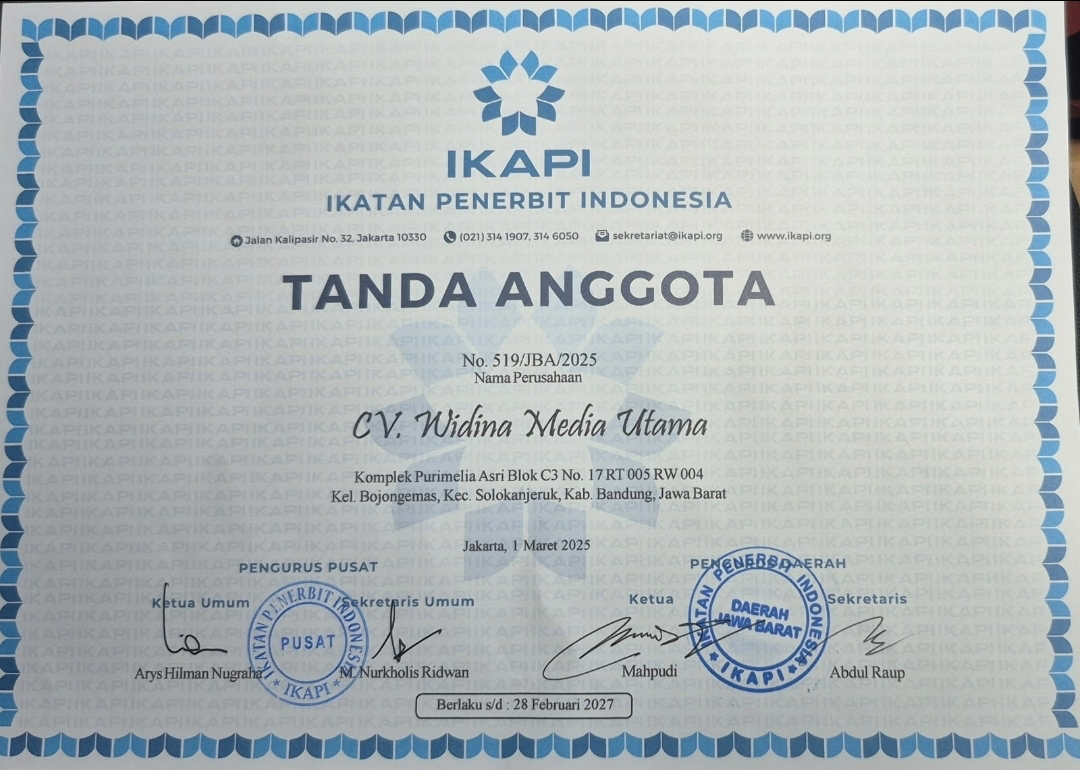
PSIKOLOGI PENDIDIKAN PERKEMBANGAN, MOTIVASI, DAN REGULASI PESERTA DIDIK
Keywords:
Psikologi, Pendidikan, Perkembangan, MotivasiSynopsis
Buku ini membahas berbagai konsep penting dalam psikologi pendidikan yang berkaitan dengan perkembangan peserta didik, proses belajar, motivasi, dan regulasi diri. Materi disusun secara sistematis mulai dari ruang lingkup psikologi pendidikan, prinsip perkembangan manusia, hingga teori perkembangan kognitif, sosial, dan emosional yang memengaruhi proses pembelajaran.
Buku ini juga menguraikan berbagai teori belajar dan perbedaan individual peserta didik, seperti intelegensi, kreativitas, kepribadian, serta pengaruh lingkungan sosial dan budaya. Pembahasan disajikan secara aplikatif sehingga membantu pembaca memahami hubungan antara aspek psikologis dan keberhasilan belajar di lingkungan pendidikan.
Selain itu, buku ini menekankan pentingnya motivasi berprestasi, self-efficacy, dan self-regulated learning dalam membentuk kemandirian belajar peserta didik. Konsep metakognisi, keterlibatan belajar, emosi akademik, dan ketahanan akademik turut dibahas sebagai bagian penting dalam pengembangan potensi peserta didik secara optimal.
Pada bagian akhir, buku ini mengintegrasikan konsep perkembangan, motivasi, dan regulasi diri dalam satu kerangka psikologi pendidikan yang utuh. Buku ini cocok digunakan oleh mahasiswa, dosen, guru, dan praktisi pendidikan sebagai referensi untuk memahami dinamika psikologis peserta didik dalam proses pembelajaran.
Downloads
Download data is not yet available.
References
Haryanto, S. (2024). Psikologi Pendidikan. Tahta Media Group. Jawa Tengah.
Hasanah, U., Fatonah, I., Chasanatin, H., & Deiniatur, M. (2018). Psikologi Pendidikan (Pertama). PT Raja Grafindo Persada. Jawa Barat.
Nasution, F., Jannah, W., Hasnan, A., & Luqiana, J. N. (2023). Jurnal mudabbir. Journal Research and Education Studies (Mudabbir), 3(1), 27–35.
Rahman, S. (2021). Pentingnya Motivasi Belajar Dalam Meningkatkan Hasil Belajar. Merdeka Belajar Dalam Menyambut Era Masyarakat 5.0, 33(November), 289–302.
Rahmat, P. S. (2022). Psikologi Pendidikan. PT. Bumi Aksara. Jakarta Timur.
Sama’, Wahyuni, A., Anggraeni, A. D., Tonasih, Yoniartini, D. M., Amni, S. S., Ismarianti, Pentury, H. J., Pelangi, I., & Widiastuti, R. (2021). Psikologi Pendidikan (Pertama). Yayasan Penerbit Muhammad Zaini.
Sandria, F., Andriana, N., & Rahman, I. K. (2025). Aspek Psikologi Dalam Belajar: Sebuah Studi Literatur. Al-Isyraq: Jurnal Bimbingan, Penyuluhan, Dan Konseling Islam, 6(3), 485–492.
Syaftinentias, W., Jayanti, W., & Wiriani. (2024). Psikologi Pendidikan (Pertama). PT. Literasi Nusantara Abadi Grup. Malang, Jawa Timur.
Huda, S. T., & Susdarwono, E. T. (2023). Hubungan antara teori perkembangan kognitif Piaget dan teori belajar Bruner. Jurnal Muassis Pendidikan Dasar, 2(1), 54-66.
Ibda, F. (2015). Perkembangan kognitif: teori jean piaget. Intelektualita, 3(1), 242904.
Juwantara, R. A. (2019). Analisis teori perkembangan kognitif piaget pada tahap anak usia operasional konkret 7-12 tahun dalam pembelajaran Matematika. Jurnal Ilmiah Pendidikan Guru Madrasah Ibtidaiyah, 9(1), 27-34.
Khotimah, K., & Agustini, A. (2023). Implementasi teori perkembangan kognitif Jean Piaget pada anak usia dini. Al Tahdzib: Jurnal Pendidikan Islam Anak Usia Dini, 2(1), 11-20.
Marinda, L. (2020). Teori perkembangan kognitif Jean Piaget dan problematikanya pada anak usia sekolah dasar. An-Nisa Jurnal Kajian Perempuan dan Keislaman, 13(1), 116-152.
Mifroh, N. (2020). Teori perkembangan kognitif Jean Piaget dan implementasinya dalam pembelajaran di SD/MI. JPT: Jurnal Pendidikan Tematik, 1(1), 123-133.
Mu'min, S. A. (2013). Teori perkembangan kognitif jean piaget. Al-TA'DIB: Jurnal Kajian Ilmu Kependidikan, 89-99.
Nainggolan, A. M., & Daeli, A. (2021). Analisis teori perkembangan kognitif Jean Piaget dan implikasinya bagi pembelajaran. Journal of Psychology" Humanlight", 2(1), 31-47.
Nuryati, N., & Darsinah, D. (2021). Implementasi teori perkembangan kognitif jean piaget dalam pembelajaran matematika di sekolah dasar. Jurnal Papeda: Jurnal Publikasi Pendidikan Dasar, 3(2), 153-162.
Qiptiyah, T. M. (2024). Teori perkembangan kognitif anak (Vygotsky). Childhood Education: Jurnal Pendidikan Anak Usia Dini, 5(1), 204-220.
Aldao, A., Nolen-Hoeksema, S., & Schweizer, S. (2010). Emotion-regulation strategies across psychopathology: A meta-analytic review. Clinical Psychology Review, 30(2), 217–237.
Anderson, B. (2006). Imagined communities: Reflections on the origin and spread of nationalism (Rev. ed.). Verso.
Baumeister, R. F., & Leary, M. R. (1995). The need to belong: Desire for interpersonal attachments. Psychological Bulletin, 117(3), 497–529.
Berger, C. R., & Calabrese, R. J. (1975). Some explorations in initial interaction. Human Communication Research, 1(2), 99–112.
Blau, P. M. (1964). Exchange and power in social life. Wiley.
Bowlby, J. (1988). A secure base: Parent-child attachment and healthy human development. Basic Books.
Brackett, M. A., Rivers, S. E., & Salovey, P. (2011). Emotional intelligence: Implications for personal, social, academic, and workplace success. Social and Personality Psychology Compass, 5(1), 88–103.
Burns, R. B. (1993). Konsep diri: Teori, pengukuran, perkembangan dan perilaku (Eddy, Terj.). Jakarta: Arcan.
Castells, M. (2010). The power of identity (2nd ed.). Wiley-Blackwell.
Castells, M. (2010). The rise of the network society (2nd ed.). Wiley-Blackwell.
Cole, P. M., Martin, S. E., & Dennis, T. A. (2004). Emotion regulation as a scientific construct. Child Development, 75(2), 317–333.
Denham, S. A., Bassett, H. H., & Wyatt, T. (2012). The socialization of emotional competence. Dalam Handbook of socialization (hlm. 590–613).
Deutsch, M. (1973). The resolution of conflict. Yale University Press.
DeVito, J. A. (2016). The interpersonal communication book (14th ed.). Pearson.
Eisenberg, N., Spinrad, T. L., & Cumberland, A. (2000). Emotion-related regulation and its relation to children's maladjustment. Annual Review of Psychology, 51, 665–697.
Erikson, E. H. (1968). Identity: Youth and crisis. W. W. Norton & Company.
Goffman, E. (1959). The presentation of self in everyday life. Doubleday.
Gross, J. J. (1998). The emerging field of emotion regulation: An integrative review. Review of General Psychology, 2(3), 271–299.
Gross, J. J., & John, O. P. (2003). Individual differences in two emotion regulation processes. Journal of Personality and Social Psychology, 85(2), 348–362.
Habermas, J. (1996). Between facts and norms: Contributions to a discourse theory of law and democracy. MIT Press.
Hogg, M. A., & Abrams, D. (1988). Social identifications: A social psychology of intergroup relations and group processes. Routledge.
Homans, G. C. (1958). Social behavior as exchange. American Journal of Sociology, 63(6), 597–606.
James, W. (1890). The principles of psychology. Henry Holt.
Kamilla, K. N., Saputri, A. N. E., Fitriani, D. A., Zahrah, S. A. A., Andryana, P. F., Ayuningtyas, I., & Firdausia, I. S. (2021). Teori perkembangan psikososial Erik Erikson. Early Childhood Journal, 3(2), 77–87.
Kopp, C. B. (1989). Regulation of distress and negative emotions: A developmental view. Developmental Psychology, 25(3), 343–354.
Larson, R. W., Moneta, G., Richards, M. H., & Wilson, S. (2002). Continuity, stability, and change in daily emotional experience across adolescence. Child Development, 73(4), 1151–1165.
Matsumoto, D., Yoo, S. H., & Nakagawa, S. (2008). Culture, emotion regulation, and adjustment. Journal of Personality and Social Psychology, 94(6), 925–937.
Mead, G. H. (1934). Mind, self, and society. University of Chicago Press.
Morris, A. S., Silk, J. S., Steinberg, L., Myers, S. S., & Robinson, L. R. (2007). The role of the family context in the development of emotion regulation. Social Development, 16(2), 361–388.
Parsons, T. (1951). The social system. Free Press.
Rahim, M. A. (2002). Toward a theory of managing organizational conflict. The International Journal of Conflict Management, 13(3), 206–235.
Rogers, C. R. (1961). On becoming a person: A therapist’s view of psychotherapy. Houghton Mifflin.
Sen, A. (2006). Identity and violence: The illusion of destiny. W. W. Norton & Company.
Soewito, G. (2025). Erik Erikson: Teori perkembangan psikososial. Psikologi Perkembangan.
Steinberg, L. (2005). Cognitive and affective development in adolescence. Trends in Cognitive Sciences, 9(2), 69–74.
Tajfel, H. (1978). Differentiation between social groups: Studies in the social psychology of intergroup relations. Academic Press.
Tajfel, H. (1981). Human groups and social categories: Studies in social psychology. Cambridge University Press.
Tajfel, H., & Turner, J. C. (1979). An integrative theory of intergroup conflict. Dalam W. G. Austin & S. Worchel (Eds.), The social psychology of intergroup relations (hlm. 33–47). Brooks/Cole.
Thabroni, G. (2022). Teori perkembangan Erikson: 8 tahapan dan rinciannya. Serupa.id.
Thomas, K. W. (1992). Conflict and negotiation processes in organizations. Dalam M. D. Dunnette & L. M. Hough (Eds.), Handbook of industrial and organizational psychology (hlm. 651–717). Consulting Psychologists Press.
Thompson, R. A. (1994). Emotion regulation: A theme in search of definition. Monographs of the Society for Research in Child Development, 59(2–3), 25–52.
Turkle, S. (2011). Alone together: Why we expect more from technology and less from each other. Basic Books.
Zelazo, P. D., & Carlson, S. M. (2012). Hot and cool executive function in childhood and adolescence. Child Development Perspectives, 6(4), 354–360.
Domjan, M. (2018). The principles of learning and behavior (7th ed.). Cengage Learning.
Flavell, J. H. (1979). Metacognition and cognitive monitoring. American Psychologist, 34(10), 906–911.
Maslow, A. H. (1943). A theory of human motivation. Psychological Review, 50(4), 370–396.
Ormrod, J. E. (2020). Human learning (8th ed.). Pearson.
Ormrod, Jeanne Ellis (2008). Psikologi Pendidikan-Membantu Siswa Bertumbuh dan Berkembang Jilid 2. Penerbit Erlangga.
Pavlov, I. P. (1927). Conditioned reflexes. Oxford University Press.
Pintrich, P. R. (2002). The role of metacognitive knowledge in learning. Educational Psychologist, 37(2), 95–106
Rogers, C. R. (1969). Freedom to learn. Merrill.
Santrock, J. W. (2014). Educational psychology (5th ed). McGraw-Hill.
Schunk, D. H. (2020). Learning theories: An educational perspective (8th ed.). Pearson.
Skinner, B. F. (1953). Science and human behavior. Free Press.
Suralaga, F. (2021). Psikologi Pendidikan : Implikasi Dalam Pembelajaran. PT Rajagrafindo Persada
Vygotsky, L. S. (1978). Mind in society. Harvard University Press.
Watson, J. B. (1913). Psychology as the behaviorist views it. Psychological Review, 20(2), 158–177.
Wood, D., Bruner, J. S., & Ross, G. (1976). The role of tutoring in problem solving. Journal of Child Psychology and Psychiatry, 17(2), 89–100.
Zimmerman, B. J. (2002). Becoming a self-regulated learner. Theory Into Practice, 41(2), 64–70.
Alturki, U., & Aldraiweesh, A. (2024). The impact of self-determination theory: the moderating functions of social media (SM) use in education and affective learning engagement. Humanities and Social Sciences Communications, 11(1), 693. https://doi.org/10.1057/s41599-024-03150-x
Autin, K. L., Herdt, M. E., Garcia, R. G., & Ezema, G. N. (2022). Basic Psychological Need Satisfaction, Autonomous Motivation, and Meaningful Work: A Self-Determination Theory Perspective. Journal of Career Assessment, 30(1), 78–93. https://doi.org/10.1177/10690727211018647
Basileo, L. D., Otto, B., Lyons, M., Vannini, N., & Toth, M. D. (2024). The role of self-efficacy, motivation, and perceived support of students’ basic psychological needs in academic achievement. Frontiers in Education, 9. https://doi.org/10.3389/feduc.2024.1385442
Beymer, P. N., Benden, D. K., & Sachisthal, M. S. M. (2022). Exploring the dynamics of situated expectancy-value theory: A panel network analysis. Learning and Individual Differences, 100, 102233. https://doi.org/10.1016/j.lindif.2022.102233
Breetzke, J., & Bohndick, C. (2024). Expectancy-value interactions and dropout intentions in higher education: can study values compensate for low expectancies? Motivation and Emotion, 48(5), 700–713. https://doi.org/10.1007/s11031-024-10088-9
Cai, Y., & Lin, J. (2024). The moderation of culture dimensions on the relationships between expectancy-value factors and reading achievement. Learning and Individual Differences, 115, 102542. https://doi.org/10.1016/j.lindif.2024.102542
Eccles, J. S., & Wigfield, A. (2020). From expectancy-value theory to situated expectancy-value theory: A developmental, social cognitive, and sociocultural perspective on motivation. Contemporary Educational Psychology, 61, 101859. https://doi.org/10.1016/j.cedpsych.2020.101859
Flake, J. K., Barron, K. E., Hulleman, C., McCoach, B. D., & Welsh, M. E. (2015). Measuring cost: The forgotten component of expectancy-value theory. Contemporary Educational Psychology, 41, 232–244. https://doi.org/10.1016/j.cedpsych.2015.03.002
Gaspard, H., Wigfield, A., Jiang, Y., Nagengast, B., Trautwein, U., & Marsh, H. W. (2018). Dimensional comparisons: How academic track students’ achievements are related to their expectancy and value beliefs across multiple domains. Contemporary Educational Psychology, 52, 1–14. https://doi.org/10.1016/j.cedpsych.2017.10.003
Hagger, M. S., & McAnally Star, K. (2026). Self‐Determination Theory and Workplace Outcomes: A Meta‐Analysis. Stress and Health, 42(1). https://doi.org/10.1002/smi.70151
Harackiewicz, J. M., & Asher, M. W. (2023). The utility value of a broad, comprehensive theory of motivation. Motivation Science, 9(1), 13–14. https://doi.org/10.1037/mot0000279
Howard, J. L., Gagné, M., & Bureau, J. S. (2017). Testing a continuum structure of self-determined motivation: A meta-analysis. Psychological Bulletin, 143(12), 1346–1377. https://doi.org/10.1037/bul0000125
Hulleman, C. S., & Harackiewicz, J. M. (2020). The Utility Value Intervention. 100–125.
Jiang, Y., & Yang, X. (2022). Individual and contextual determinants of students’ learning and performance. Educational Psychology, 42(4), 397–400. https://doi.org/10.1080/01443410.2022.2055958
Kim, Y. (2026). Exploring the Interplay of Psychological Need Satisfaction, Well-Being, and Behavioral Intentions in Tourism: A Self-Determination Theory Perspective. Journal of Travel Research, 65(1), 222–241. https://doi.org/10.1177/00472875241283404
Kurniasih, I. I., Eliyana, A., & Rosadi, O. I. (2023). TINJAUAN LITERATUR SISTEMATIS : MOTIVASI DARI EMPLOYEE SELF-DETERMINATION. Jurnal Ilmiah Manajemen, Ekonomi, & Akuntansi (MEA), 7(2), 987–1002. https://doi.org/10.31955/mea.v7i2.3093
Leaper, C. (2011). More Similarities than Differences in contemporary Theories of social development? (pp. 337–378). https://doi.org/10.1016/B978-0-12-386491-8.00009-8
Ma, J., Zheng, M., & Feng, X. (2025). A situated expectancy-value theoretical perspective of teaching presence and student engagement in blended learning environments. The Internet and Higher Education, 64, 100974. https://doi.org/10.1016/j.iheduc.2024.100974
Matthews, J. S., & Wigfield, A. (2024). Past due! Racializing aspects of situated expectancy-value theory through the lens of critical race theory. Motivation Science, 10(3), 182–196. https://doi.org/10.1037/mot0000337
McAnally, K., & Hagger, M. S. (2024). Self-Determination Theory and Workplace Outcomes: A Conceptual Review and Future Research Directions. Behavioral Sciences, 14(6), 428. https://doi.org/10.3390/bs14060428
Ryan, R. M., & Deci, E. L. (2020). Intrinsic and extrinsic motivation from a self-determination theory perspective: Definitions, theory, practices, and future directions. Contemporary Educational Psychology, 61, 101860. https://doi.org/10.1016/j.cedpsych.2020.101860
Ryan, R. M., & Deci, E. L. (2023). Self-Determination Theory. In Encyclopedia of Quality of Life and Well-Being Research (pp. 6229–6235). Springer International Publishing. https://doi.org/10.1007/978-3-031-17299-1_2630
Schunk, D. H., & DiBenedetto, M. K. (2020). Motivation and social cognitive theory. Contemporary Educational Psychology, 60, 101832. https://doi.org/10.1016/j.cedpsych.2019.101832
Shang, C., Moss, A. C., & Chen, A. (2023). The expectancy-value theory: A meta-analysis of its application in physical education. Journal of Sport and Health Science, 12(1), 52–64. https://doi.org/10.1016/j.jshs.2022.01.003
Sjogren, A. L., Robinson, K. A., & Koenka, A. C. (2023). Profiles of afterschool motivations: A situated expectancy-value approach. Contemporary Educational Psychology, 74, 102197. https://doi.org/10.1016/j.cedpsych.2023.102197
Slemp, G. R., Kern, M. L., Patrick, K. J., & Ryan, R. M. (2018). Leader autonomy support in the workplace: A meta-analytic review. Motivation and Emotion, 42(5), 706–724. https://doi.org/10.1007/s11031-018-9698-y
Song, J., & Choi, W. (2025). Expectancy-value theories applied in Korean physical activity contexts: a meta-analysis. Frontiers in Psychology, 16(September), 1–13. https://doi.org/10.3389/fpsyg.2025.1678503
Sutter, C. C., Totonchi, D. A., DeCoster, J., Barron, K. E., & Hulleman, C. S. (2024). How does expectancy-value-cost motivation vary during a semester? An intensive longitudinal study to explore individual and situational sources of variation in statistics motivation. Learning and Individual Differences, 113, 102484. https://doi.org/10.1016/j.lindif.2024.102484
Van den Broeck, A., Ferris, D. L., Chang, C.-H., & Rosen, C. C. (2016). A Review of Self-Determination Theory’s Basic Psychological Needs at Work. Journal of Management, 42(5), 1195–1229. https://doi.org/10.1177/0149206316632058
Vasconcellos, D., Parker, P. D., Hilland, T., Cinelli, R., Owen, K. B., Kapsal, N., Lee, J., Antczak, D., Ntoumanis, N., Ryan, R. M., & Lonsdale, C. (2020). Self-Determination theory applied to physical education: A systematic review and meta-analysis. Journal of Educational Psychology, 112(7), 1444–1469. https://doi.org/10.1037/edu0000420
Wang, Y., Wang, H., Wang, S., Wind, S. A., & Gill, C. (2024). A systematic review and meta-analysis of self-determination-theory-based interventions in the education context. Learning and Motivation, 87, 102015. https://doi.org/10.1016/j.lmot.2024.102015
West, R. L., Ebner, N. C., & Hastings, E. C. (2013). Linking Goals and Aging: Experimental and Lifespan Approaches. In New Developments in Goal Setting and Task Performance (pp. 439–459). Psychology Press.
Wu, S. H., & Corpus, J. H. (2023). The role of perceived cost in college students’ motivational experiences and long-term achievement outcomes: A mixed-methods approach. International Journal of Educational Research Open, 4, 100229. https://doi.org/10.1016/j.ijedro.2023.100229
Zimmerman, B. J. (2020). Self-Regulated Learning and Academic Achievement. Educational Psychology Review, 32, 321–335.
Bandura, A. (1997). Self-efficacy: The exercise of control. W.H. Freeman.
Dweck, C. S. (1986). Motivational processes affecting learning. American Psychologist, 41(10), 1040–1048.
Dweck, C. S. (2006). Mindset: The new psychology of success. Random House.
Eccles, J. S., & Wigfield, A. (2002). Motivational beliefs, values, and goals. Annual Review of Psychology, 53, 109–132.
Elliot, A. J., & McGregor, H. A. (2001). A 2 × 2 achievement goal framework. Journal of Personality and Social Psychology, 80(3), 501–519.
McClelland, D. C., Atkinson, J. W., Clark, R. A., & Lowell, E. L. (1953). The achievement motive. Appleton-Century-Crofts.
McClelland, D. C. (1961). The achieving society. Van Nostrand.
McClelland, D. C. (1987). Human motivation. Cambridge University Press.
Schunk, D. H., Meece, J. L., & Pintrich, P. R. (2014). Motivation in education: Theory, research, and applications (4TH ed.). Pearson.
Weiner, B. (1985). An attributional theory of achievement motivation and emotion. Psychological Review, 92(4), 548–573.
Weiner, B. (2010). The development of an attribution-based theory of motivation: A history of ideas. Educational Psychologist, 45(1), 28–36.
Bandura, A. (1997). Self-efficacy: The exercise of control. W.H. Freeman.
Efklides, A. (2006). Metacognition and affect: What can metacognitive experiences tell us? Educational Research Review, 1(1), 3–14.
Flavell, J. H. (1979). Metacognition and cognitive monitoring: A new area of cognitive–developmental inquiry. American Psychologist, 34(10), 906–911.
King, A. (1992). Facilitating elaborative learning through guided student-generated questioning. Educational Psychologist, 27(1), 111–126.
Locke, E. A., & Latham, G. P. (2002). Building a practically useful theory of goal setting and task motivation. American Psychologist, 57(9), 705–717.
Pintrich, P. R. (2000). The role of goal orientation in self-regulated learning. In M.
Boekaerts, P. R. Pintrich, & M. Zeidner (Eds.), Handbook of self-regulation (pp. 451–502). Academic Press.
Schraw, G., & Dennison, R. S. (1994). Assessing metacognitive awareness. Contemporary Educational Psychology, 19(4), 460–473.
Schraw, G., & Moshman, D. (1995). Metacognitive theories. Educational Psychology Review, 7(4), 351–371.
Weiner, B. (1985). An attributional theory of achievement motivation and emotion. Psychological Review, 92(4), 548–573.
Zimmerman, B. J. (2000). Attaining self-regulation: A social cognitive perspective. In M. Boekaerts, P. R. Pintrich, & M. Zeidner (Eds.), Handbook of self-regulation (pp. 13–39). Academic Press.
Zimmerman, B. J. (2002). Becoming a self-regulated learner: An overview. Theory Into Practice, 41(2), 64–70.
Fitriyah, & Wijayadi. (2024). Hubungan efikasi diri dan stabilitas emosional dalam proses pembelajaran di lembaga pendidikan. Jurnal Psikologi Pendidikan, 12(2), 145–158.
Frenzel, A. C., & Goetz, T. (2025). Emosi epistemik dan desain instruksional kelas modern. Penerbit Ilmu Pendidikan.
Frenzel, A. C., & Goetz, T. (2025). Learning and Emotions: Epistemic, Topic-Related, and Social Dynamics. Educational Psychology Review, 37(1), 12-28.
Goetz, T., et al. (2023). State vs. Trait Academic Emotions: Assessing Fluctuation in University Lectures. Studies in Higher Education, 48(3), 445-461.
Goetz, T., Pekrun, R., & Linnenbrink-Garcia, L. (2023). Fluktuasi emosi akademik dalam perkuliahan: Analisis mikro real-time. Educational Psychologist, 58(1), 34–49.
James, W. (2026). Pertempuran regulasi emosi di era distraksi digital. Pustaka Akademika.
James, W. (Edisi Kontemporer 2026). Dinamika Pikiran, Emosi, dan Tindakan: Bagaimana Manusia Berpikir, Bergerak, Bereaksi, dan Merasa. Diva Press.
Li, M. (2024). Application of structural equation modeling (SEM) in classroom engagement: The mediating role of self-efficacy. Journal of Educational Quantitative Research, 8(3), 210–225.
Li, M. (2024). Positive Emotions, Self-Efficacy, and Classroom Engagement: A Structural Equation Modeling Approach. Frontiers in Psychology, 15, Article 103244.
Muis, K. R., et al. (2021). The Role of Epistemic Emotions in Deep Cognitive Processing during Complex Learning Tasks. Journal of Educational Psychology, 113(4), 712-730.
Muis, K. R., Psaradellis, C., Lajoie, S. P., Di Leo, I., & Chevrier, M. (2021). The role of epistemic emotions in deeply cognitive processing and problem-solving. Contemporary Educational Psychology, 64, Article 101931.
Pekrun, R., & Linnenbrink-Garcia, L. (2022). Academic Emotions and Student Engagement in Higher Education. Routledge.
Pekrun, R., & Linnenbrink-Garcia, L. (2022). Academic emotions as mediators of student engagement and learning dynamics. Dalam Handbook of Educational Psychology (hlm. 250–275). Routledge.
Pekrun, R., et al. (2023). Boredom in the University Classroom: Antecedents, Control-Value Appraisals, and Outcomes. Contemporary Educational Psychology, 72, 102143.
Pekrun, R., Marsh, H. W., & Dicke, T. (2023). The pathology of boredom in university lectures: Control-value appraisals and cognitive deactivation. Learning and Instruction, 85, Article 101742.
Putwain, D. W., et al. (2022). Academic Anxiety and Achievement: Reciprocal Relations Mediated by Behavioral Engagement. British Journal of Educational Psychology, 92(2), 567-585.
Putwain, D. W., Wood, P., & Symes, W. (2022). Reciprocal relationships between academic anxiety, working memory, and performance: A vicious cycle. British Journal of Educational Psychology, 92(2), 415–432.
Roos, A. L., Goetz, T., Vor-Bifangs, A., & Bieg, M. (2021). Retrospective emotions and pride: The power of control-value appraisals as a reinforcer of learning behavior. Frontiers in Psychology, 12, Article 654321.
Sansoto, A. (2021). Mengontrol Emosi Menjadi Seni: Dinamika Regulasi Emosi. Global Aksara Pres.
Sansoto. (2021). Pengelolaan emosi individu dan regulasi diri dalam aktivitas belajar sehari-hari. Sanata Press.
Wang, Y., & Derakhshan, A. (2023). Managing technostress in smart classrooms: The power of student self-efficacy and emotional interaction. Computers & Education, 195, Article 104710.
Wang, Y., & Derakhshan, A. (2023). The Interplay Among Academic Emotions, Classroom Engagement, and Self-Efficacy in Smart Classrooms. Australian Journal of Psychology, 75(1), 230-245.
Ansari, A., & Crosnoe, R. (2015). Children’s early school readiness. Developmental Psychology, 51(10), 1448–1460. https://doi.org/10.1037/dev0000030
Berk, L. E. (2013). Child development. Pearson Education.
Bronfenbrenner, U. (1979). The ecology of human development. Harvard University Press.
Bronfenbrenner, U., & Morris, P. (2006). The bioecological model of human development. https://doi.org/10.1002/9780470147658.chpsy0114
Darling-Hammond, L., Flook, L., Cook-Harvey, C., Barron, B., & Osher, D. (2020). Implications for educational practice of the science of learning and development. Applied Developmental Science, 24(2), 97–140. https://doi.org/10.1080/10888691.2018.1537791
Hill, N., & Tyson, D. (2009). Parental involvement in middle school. Developmental Psychology, 45(3), 740–763. https://doi.org/10.1037/a0015362
Jeynes, W. (2012). A meta-analysis on the effects of parental involvement. Urban Education, 47(4), 706–742. https://doi.org/10.1177/0042085912445643
Mahmud., Hariman Surya Siregar., & Koko Khoerudin. (2015). Pendidikan lingkungan sosial budaya. UIN Sunan Gunung Djati.
OECD. (2021). Education at a glance. https://doi.org/10.1787/b35a14e5-en
Pinquart, M. (2017). Associations of parenting styles with children’s outcomes. Educational Psychology Review, 29, 465–488. https://doi.org/10.1007/s10648-016-9373-5
Prinstein, M., & Dodge, K. (2008). Understanding peer influence in children and adolescents. https://doi.org/10.1037/11625-000
ResearchGate. (2019). Baumrind’s parenting styles model [Gambar]. ResearchGate. https://www.researchgate.net/figure/Baumrinds-parenting-styles-model_fig1_335970747
Santrock, J. W. (2020). Educational psychology (7th ed.). McGraw-Hill.
Sarah Lee, (2025) The ultimate guide to ecological theory. Number Analytics. Diakses tanggal 12 Maret 2026 dari https://rotel.pressbooks.pub/whole-child/chapter/ecological-theory-2/
Selvam, T. (2017). Functions of peer group in adolescence life. International Journal of Scientific Research and Review, 6(11), 131–136.
Sirin, S. (2005). Socioeconomic status and academic achievement. Review of Educational Research, 75(3), 417–453. https://doi.org/10.3102/00346543075003417
Vygotsky, L. (1978). Mind in society. Harvard University Press.
Vygotsky, L. S. (1978). Mind in society: The development of higher psychological processes. Harvard University Press.
Wang, M., & Sheikh-Khalil, S. (2014). Does parental involvement matter. Child Development, 85(2), 610–625. https://doi.org/10.1111/cdev.12160
Wentzel, K., Russell, S., & Baker, S. (2016). Peer relationships and academic motivation. Educational Psychologist, 51(2), 168–181. https://doi.org/10.1080/00461520.2016.1155454
Agil Nurwahid. (2023). Integrasi Manajemen dan Psikologi Pendidikan untuk Meningkatkan Kualitas Pembelajaran Sekolah. Jurnal Ilmu Pendidikan Dan Psikologi, 1(1), 1–6. https://journal.pipuswina.com/index.php/jippsi/about
Deci, E. L., & Ryan, R. M. (2000). The “what” and “why” of goal pursuits: Human needs and the self-determination of behavior. Psychological Inquiry, 11(4), 227–268. https://doi.org/https://doi.org/10.1207/S15327965PLI1104_01
Hadi, S. N. (2020). Hubungan Motivasi Belajar dengan Regulasi Diri dalam Belajar pada Mahasiswa Skripsi. Jurnal Pendidikan Tambusai, 4(3), 1369–1376.
Locke, E. A., & Latham, G. P. (2002). Building a practically useful theory of goal setting and task motivation. American Psychologist.
Martin, A. J., & Marsh, H. W. (2009). Academic resilience and its psychological foundations.
Nadiya Zulfa. (2025). Model Integratif Psikologi untuk Karakter Siswa. Semesta Mendidik, 2(1). https://www.scribd.com/document/939906991/MODEL-INTEGRATIF-PSIKOLOGI-PENDIDIKAN-DALAM-PEMBENTUKAN-KARAKTER-SISWA-SEKOLAH-DASAR
Panadero, E. (2017). A Review of Self-regulated Learning: Six Models and Four Directions for Research. Front Psychol, 28(8), 422. https://doi.org/10.3389/fpsyg.2017.00422
Rina Erlina. (2019). HUBUNGAN ANTARAREGULASI DIRI DENGANMOTIVASI BELAJARPADASISWA SMA. Universitas Semarang. https://eskripsi.usm.ac.id/files/skripsi/F11A/2015/F.111.15.0075/F.111.15.0075-15-File-Komplit-20190305044527.pdf
Ruminta, Tiatri, S., & Mularsih, H. (2017). PERBEDAAN REGULASI DIRI BELAJAR PADA SISWA SEKOLAH DASAR KELAS VI DITINJAU DARI JENIS KELAMIN. Jurnal Muara Ilmu Sosial, Humaniora, Dan SeniMuara Ilmu Sosial, Humaniora, Dan Seni, 1(2), 286–294.
Ryan, R. M., & Deci, E. L. (2017). Basic psychological needs in motivation, development, and wellness. In Self-determination theory. Guilford Press.
Santrock, J. W. (2011). Educational psychology (5th ed.). McGraw-Hill.
Schunk, D. H. (2012). Learning theories: An educational perspective (6th ed). Pearson Education.
Siti Badriah1*, S. 2. (n.d.). Peran Self-Determination dalam Meningkatkan Ketekunan Belajar Mahasiswa di Era Digital. Jurnal Publikasi Ilmu Psikologi, 3(3). https://doi.org/https://doi.org/10.61132/observasi.v3i3.1506
Vygotsky, L. S. (1978). Mind in society: The development of higher psychological processes. Harvard University Press.
Weiner, B. (1985). NAn attributional theory of achievement motivation and emotion. Psychological Review.
Zimmerman, B. J. (2000). Attaining self-regulation: A social cognitive perspective. In M. Boekaerts, P. R. Pintrich, & M. Zeidner (Eds.), Handbook of self-regulation. Academic Press.
Zimmerman, B. J. (2002). Becoming a self-regulated learner: An overview. Theory Into Practice. https://doi.org/https://doi.org/10.1207/s15430421tip4102_2
Downloads
Published
June 24, 2026
Copyright (c) 2026 Dewi Asriani Ridzal, Cece Nurhikmah, Swiejti Maghfira Regita, Jose Da Costa Magno, Sri Endang Herudiati, Febri Endra Budi Setyawan, Aully Grashinta, Raistin Nur Abidin, Eka Rini Widya Astuti, Yudho Bawono, Aria Nur Farida Muslicha (Author)
License

This work is licensed under a Creative Commons Attribution-NonCommercial-ShareAlike 4.0 International License.
Details about this monograph
ISBN-13 (15)
978-634-317-026-6
How to Cite
Ridzal, D. A., Nurhikmah, C., Regita, S. M., Costa Magno, J. D., Herudiati, S. E., Budi Setyawan, F. E., Grashinta, A., Abidin, R. N., Widya Astuti, E. R., Bawono, Y., & Muslicha, A. N. F. (2026). PSIKOLOGI PENDIDIKAN PERKEMBANGAN, MOTIVASI, DAN REGULASI PESERTA DIDIK. Widina Media Utama. https://doi.org/10.59818/5atx4053