
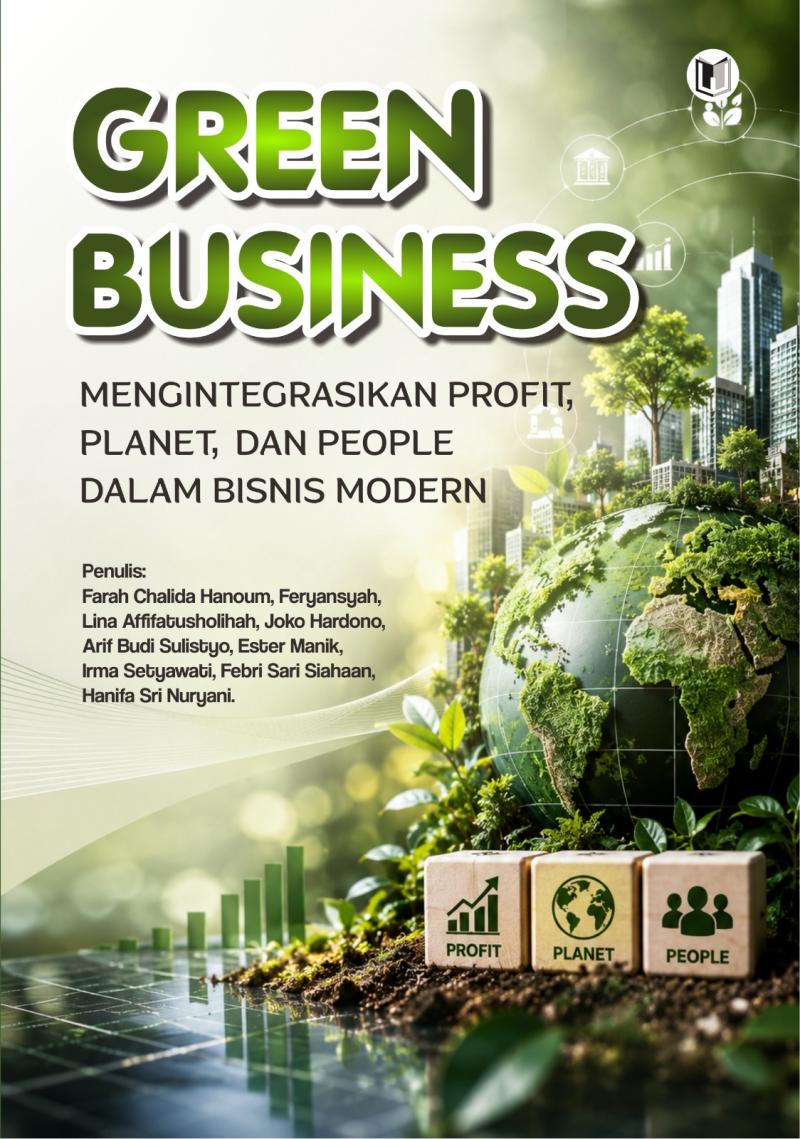
GREEN BUSINESS MENGINTEGRASIKAN PROFIT, PLANET, DAN PEOPLE DALAM BISNIS MODERN
Keywords:
Green, Business, Profit, People, BisnisSynopsis
Buku ini membahas transformasi dunia bisnis menuju paradigma keberlanjutan yang menempatkan keuntungan ekonomi, kepedulian terhadap lingkungan, dan tanggung jawab sosial sebagai satu kesatuan yang saling mendukung. Pembaca diajak memahami konsep dasar green business, sejarah perkembangannya, strategi penerapan bisnis hijau, hingga evolusi keberlanjutan dari sekadar tren pemasaran menjadi strategi bisnis yang mampu menciptakan keunggulan kompetitif. Berbagai konsep penting seperti green marketing, green product, green supply chain management, green accounting, green consumerism, serta triple bottom line (Profit, Planet, People) dibahas secara sistematis dan aplikatif.
Lebih jauh, buku ini mengulas implementasi green business melalui pembahasan etika bisnis, tanggung jawab sosial perusahaan (CSR), ecopreneurship, inovasi hijau, ekonomi sirkular, efisiensi sumber daya, serta pengelolaan lingkungan yang berorientasi pada pembangunan berkelanjutan. Disertai contoh penerapan, studi kasus, dan strategi implementasi di berbagai sektor industri, buku ini memberikan gambaran nyata mengenai bagaimana perusahaan dapat membangun nilai ekonomi sekaligus memberikan manfaat bagi masyarakat dan lingkungan tanpa mengabaikan daya saing bisnis.
Melalui penyajian materi yang komprehensif, buku ini menjadi referensi yang bermanfaat bagi mahasiswa, akademisi, praktisi bisnis, wirausahawan, pembuat kebijakan, maupun masyarakat umum yang ingin memahami dan menerapkan prinsip-prinsip bisnis berkelanjutan. Dengan mengintegrasikan aspek profit, planet, dan people dalam setiap keputusan bisnis, buku ini diharapkan mampu mendorong lahirnya organisasi yang inovatif, bertanggung jawab, adaptif terhadap tantangan global, serta berkontribusi nyata dalam mewujudkan pembangunan ekonomi yang inklusif dan berkelanjutan.
Downloads
Download data is not yet available.
References
Beveridge, R., & Guy, S. (2005). The rise of the eco-preneur and the messy world of environmental innovation. Local Environment, 10(6), 665–676. https://doi.org/10.1080/13549830500321972
Elkington, J. (1997). Cannibals with Forks: The Triple Bottom Line of 21st Century Business. Capstone.
Isaak, R. (2000). Green Logic: Eco-preneurship theory and ethics. Greenleaf Publishing.
Linnanen, L. (2002). An insider’s experiences with environmental entrepreneurship. Greener Management International, 38, 71–80.
Porter, M. E., & Kramer, M. R. (2011). Creating shared value. Harvard Business Review.
Slaper, T. F., & Hall, T. J. (2011). The triple bottom line: What is it and how does it work? Indiana Business Review.
Walley, E. E., & Taylor, D. W. (2002). Opportunists, champions, mavericks…? Greener Management International, 38, 31–43.
World Bank. (2019). Renewable Energy and Jobs: Annual Review 2019.
Alnawas Ibrahim and Farha Allam Abu. (2020). Strategic orientations and capabilities’ effect on SMEs’ performance. Marketing Intelligence & Planning Vol. 38 No. 7, 2020 pp. 829-845. DOI 10.1108/MIP-11-2019-0548
Al-Tuwaijri, S. A., Christensen, T. E., & Hughes, K. E. (2004). The relations among environmental disclosure, environmental performance, and economic performance: A simultaneous equations approach. Accounting, Organizations and Society, 29(5–6), 447–471. https://doi.org/10.1016/S0361-3682(03)00032-1.
Artiach et al. (2010). The Determinant of Corporate Social Sustainability. Accounting and Finance . 31-5
Guo, Y., Wang, L., & Yang, Q. (2020). Do corporate environmental ethics in fl uence fi rms ’ green practice ? The mediating role of green innovation and the moderating role of personal ties. Journal of Cleaner Production, 266, 122054. https://doi.org/10.1016/j.jclepro.2020.122054
Hutahuruk, M., Sudarno, S., Andi, A., Suhardjo, S., & Kudri, M. W. (2023). Etika bisnis, keunggulan bersaing hijau, dan kepemimpinan lingkungan terhadap kinerja bisnis berkelanjutan. Procuratio: Jurnal Ilmiah Manajemen, 11(4). https://doi.org/10.35145/procuratio.v11i4.4140
Najib, M., Fahma, F., Abror, A., & Suhartanto, D. (2022). Organizational Capability, Market Perspective, and Green Innovation Adoption: Insight From Indonesian Food Processing Small and Medium-Sized Enterprises. Journal of Small Business Strategy, 32(2), 51–66. https://doi.org/10.53703/001c.32293
Roscoe, S., Subramanian, N., Jabbour, C. J. C., & Chong, T. (2019). Green human resource management and the enablers of green organisational culture: Enhancing a firm’s environmental performance for sustainable development. Business Strategy and the Environment, 28(5), 737–749. https://doi.org/10.1002/bse.2277
World Bank. (2019). Renewable Energy and Jobs: Annual Review 2019.
Aaker, D. A. (1996). Building strong brands. Free Press.
Danone-AQUA. (2024). Sustainability report. https://www.aqua.co.id
Delmas, M. A., & Burbano, V. C. (2011). The drivers of greenwashing. California Management Review, 54(1), 64–87. https://doi.org/10.1525/cmr.2011.54.1.64
Elkington, J. (1997). Cannibals with forks: The triple bottom line of 21st century business. Capstone.
Ellen MacArthur Foundation. (2015). Towards a circular economy: Business rationale for an accelerated transition. Ellen MacArthur Foundation.
Geissdoerfer, M., Savaget, P., Bocken, N. M. P., & Hultink, E. J. (2017). The circular economy: A new sustainability paradigm? Journal of Cleaner Production, 143, 757–768. https://doi.org/10.1016/j.jclepro.2016.12.048
IKEA. (2024). People and Planet Positive Report. https://www.ikea.com
Kotler, P., Kartajaya, H., & Setiawan, I. (2021). Marketing 5.0: Technology for humanity. Wiley.
Kotler, P., & Keller, K. L. (2016). Marketing management (15th ed.). Pearson.
Ottman, J. A. (2017). The new rules of green marketing: Strategies, tools, and inspiration for sustainable branding. Routledge.
Patagonia. (2023). Our environmental responsibility. https://www.patagonia.com
Peattie, K., & Crane, A. (2005). Green marketing: Legend, myth, farce or prophesy? Qualitative Market Research: An International Journal, 8(4), 357–370. https://doi.org/10.1108/13522750510619733
Polonsky, M. J. (1994). An introduction to green marketing. Electronic Green Journal, 1(2). https://doi.org/10.5070/G31210177
Srivastava, S. K. (2007). Green supply-chain management: A state-of-the-art literature review. International Journal of Management Reviews, 9(1), 53–80. https://doi.org/10.1111/j.1468-2370.2007.00202.x
Andersen, I. (2023). UNEP in 2022.
Heizer, Jay., Render, Barry., & Munson, Chuck. (2020). Operations management : sustainability and supply chain management. Pearson.
ISO. (2018). Energy management systems-Requirements with guidance for use COPYRIGHT PROTECTED DOCUMENT. www.iso.org
Liedtke, -----Christa, Kühlert, M., Wiesen, K., Stinder, A. K., Brauer, J., Beckmann, J., Fedato, C., Mourabit, X. El, & Büttgen, A. (2021). Sustainable Supply Chains Global cooperative regional economies for prosperity and resilience. Wuppertal Institute for Climate, Environment and Energy. www.wupperinst.org
Porter, M. E., & Van Der Linde, C. (1995). Green and Competitive: Ending the Stalemate Harvard Business Review.
Pujawan, I. N., & ER, M. (2024). Supply Chain Management (4th ed.). Lautan Pustaka.
Slack, N., Chambers, S., & Johnston, R. (2010). 4. operations_management_6th_ed_Nigel Slack at all (6th ed.). Rotolito Lombarda, Italy.
Stark, R., Seliger, G., & Bonvoisin, J. (2017). Sustainable Production, Life Cycle Engineering and Management Sustainable Manufacturing Challenges, Solutions and Implementation Perspectives (C. Herrmann, S. Kara, & Braunschweig, Eds.). Springer Nature. https://doi.org/10.1007/978-3-319-48514-0
(Persero), P. T. P. L. N. (2023). Peresmian PLTS Terapung Cirata 192 MWp. PT PLN (Persero). https://web.pln.co.id
Al-rawashdeh, M., Keikhosrokiani, P., Belaton, B., Alawida, M., & Zwiri, A. (2022). IoT Adoption and Application for Smart Healthcare: A Systematic Review. Sensors, 22(14), 5377. https://doi.org/10.3390/s22145377
Al Yarubi, K. S., Khairy, S. O. F., Hossain, S. M. E., & Hayder, G. (2025). Internet of Things-Driven Waste Management: Paving the Way for Sustainable Smart Cities. Processes, 13(4), 1140. https://doi.org/10.3390/pr13041140
Bogdanov, D., Ram, M., Aghahosseini, A., Gulagi, A., Oyewo, A. S., Child, M., Caldera, U., Sadovskaia, K., Farfan, J., De Souza Noel Simas Barbosa, L., Fasihi, M., Khalili, S., Traber, T., & Breyer, C. (2021). Low-cost renewable electricity as the key driver of the global energy transition towards sustainability. Energy, 227, 120467. https://doi.org/10.1016/J.ENERGY.2021.120467
Bras, D., Silva, A. C., Azevedo, T., Fangueiro, R., & Ferreira, D. P. (2026). Advancing secondary raw material flows through cleaner production: integrating mechanical recycling and eco-design of post-industrial textile waste. Journal of Cleaner Production, 561, 148400. https://doi.org/10.1016/j.jclepro.2026.148400
Calzolari, T., Genovese, A., & Brint, A. (2021). The adoption of circular economy practices in supply chains - An assessment of European Multi-National Enterprises. Journal of Cleaner Production, 312, 127616. https://doi.org/10.1016/j.jclepro.2021.127616
Cirne, A., Sousa, P. R., Resende, J. S., & Antunes, L. (2024). Hardware Security for Internet of Things Identity Assurance. IEEE Communications Surveys & Tutorials, 26(2), 1041–1079. https://doi.org/10.1109/COMST.2024.3355168
Danone-AQUA. (2021). Gerakan BijakBerplastik dan Kemasan 100 Persen Daur Ulang (rPET). Danone Indonesia. https://www.sehataqua.co.id
Dehghani, M., Azad, Z., Erisian, Z., Naeini, A. B., Naeini, H. S., & Rahmani, A. (2026). Advancing sustainability through eco-design in the circular economy: A bibliometric analysis. Cleaner and Responsible Consumption, 22, 100436. https://doi.org/10.1016/j.clrc.2026.100436
Di Fraia, S., Shah, M., & Vanoli, L. (2023). A biomass-based polygeneration system for a historical building: A techno-economic and environmental analysis. Energy Conversion and Management, 291, 117336. https://doi.org/10.1016/J.ENCONMAN.2023.117336
Di Nardo, M., Gallab, M., Popolo, V., Pandey, S., & Ricciardi, L. (2026). A Smart Lean-IoT Framework for Advanced Medical Device Manufacturing. Procedia Computer Science, 277, 217–224. https://doi.org/10.1016/j.procs.2026.02.063
Feldman, D., Ramasamy, V., Fu, R., Ramdas, A., Desai, J., & Margolis, R. (2021). U.S. Solar Photovoltaic System and Energy Storage Cost Benchmark: Q1 2020. National Renewable Energy Laboratory (NREL). https://www.nrel.gov/docs/fy21osti/77324.pdf
Filipovic, S., Lior, N., & Radovanovic, M. (2022). The green deal - just transition and sustainable development goals Nexus. Renewable and Sustainable Energy Reviews, 168, 112759. https://doi.org/10.1016/j.rser.2022.112759
Gomez, J., Framinan, J. M., Escano, J. M., & Bordons, C. (2026). An energy management system for industrial manufacturing: A hybrid approach with demand response. Renewable Energy, 256, 123814. https://doi.org/10.1016/j.renene.2025.123814
Guimaraes, A., Oliveira, E. e, Oliveira, M., & Pereira, T. (2025). Effects of Lean Tools and Industry 4.0 technology on productivity: An empirical study. Journal of Industrial Information Integration, 44, 100787. https://doi.org/10.1016/j.jii.2025.100787
Guo, D., & Mantravadi, S. (2025). The role of digital twins in lean supply chain management: review and research directions. International Journal of Production Research, 63(5), 1851–1872. https://doi.org/10.1080/00207543.2024.2372655
Hassan, Q., Algburi, S., Sameen, A. Z., Salman, H. M., & Jaszczur, M. (2023). A review of hybrid renewable energy systems: Solar and wind-powered solutions: Challenges, opportunities, and policy implications. Results in Engineering, 20, 101621. https://doi.org/10.1016/J.RINENG.2023.101621
He, B., & Yu, Q. (2021). Product sustainable design for carbon footprint during product life cycle. Journal of Engineering Design, 32(9), 478–495. https://doi.org/10.1080/09544828.2021.1921130
Hu, Y., Zhang, L., Zhang, Z., Li, Z., & Tang, Q. (2024). Matheuristic and learning-oriented multi-objective artificial bee colony algorithm for energy-aware flexible assembly job shop scheduling problem. Engineering Applications of Artificial Intelligence, 133, 108634. https://doi.org/10.1016/j.engappai.2024.108634
IEA. (2022). World Energy Outlook 2022. International Energy Agency. https://www.iea.org/reports/world-energy-outlook-2022
IEA. (2025). World Energy Outlook 2025. International Energy Agency. https://www.iea.org/reports/world-energy-outlook-2025
IPCC. (2023). Climate Change 2022 - Mitigation of Climate Change. Cambridge University Press. https://doi.org/10.1017/9781009157926
Judijanto, L. (2025). Navigating the Energy Transition: Green Economy Strategies in the Face of Global Climate Change Challenges. International Journal of Financial Economics (IJEFE), 2(5), 286–295.
Kamalakkannan, S., & Kulatunga, A. K. (2021). Optimization of eco-design decisions using a parametric life cycle assessment. Sustainable Production and Consumption, 27, 1297–1316. https://doi.org/10.1016/j.spc.2021.03.006
Kouloumpis, V., & Yan, X. (2021). Sustainable energy planning for remote islands and the waste legacy from renewable energy infrastructure deployment. Journal of Cleaner Production, 307, 127198. https://doi.org/10.1016/j.jclepro.2021.127198
Kumar, S. (2023). Role of Lean Six Sigma in manufacturing setting: a systematic literature review and agenda for future research. In TQM Journal. https://doi.org/10.1108/TQM-12-2022-0338
Kumar, S., Darshna, A., & Ranjan, D. (2023). A review of literature on the integration of green energy and circular economy. Heliyon, 9(11), e21091. https://doi.org/10.1016/j.heliyon.2023.e21091
Lehtola, T., & Zahedi, A. (2019). Solar energy and wind power supply supported by storage technology: A review. Sustainable Energy Technologies and Assessments, 35, 25–31. https://doi.org/10.1016/J.SETA.2019.05.013
Mattos Batista de Moraes, F., Kulay, L., & Trianni, A. (2025). Integrating life cycle assessment and ecodesign to improve product effectiveness and environmental performance: A novel approach. Sustainable Production and Consumption, 55, 76–89. https://doi.org/10.1016/j.spc.2025.02.006
Mineral, K. E. dan S. D. (2024). Kapasitas Terpasang dan Potensi Panas Bumi Indonesia. Kementerian ESDM Republik Indonesia. https://www.esdm.go.id
Munaro, M. R., Tavares, S. F., & Braganca, L. (2022). The ecodesign methodologies to achieve buildings’ deconstruction: A review and framework. Sustainable Production and Consumption, 30, 566–583. https://doi.org/10.1016/j.spc.2021.12.032
Pache, G. (2024). Kalundborg Industrial Symbiosis: Circular Strategy in the Light of Mutualism. Journal of Strategic Innovation and Sustainability, 19(3). https://doi.org/10.33423/jsis.v19i3.7330
Rafiq, M., Akbar, A., Maqbool, S., Sokolova, M., Haider, S. A., Naz, S., & Danish, S. M. (2022). Corporate Risk Tolerance and Acceptability towards Sustainable Energy Transition. Energies, 15(2), 459. https://doi.org/10.3390/en15020459
Ramesh, M., & Saini, R. P. (2020). Dispatch strategies based performance analysis of a hybrid renewable energy system for a remote rural area in India. Journal of Cleaner Production, 259, 120697. https://doi.org/10.1016/J.JCLEPRO.2020.120697
Ranade, A., Gomez, J., de Juan, A., Chicaiza, W. D., Ahern, M., Escano, J. M., Hryshchenko, A., Casey, O., Cloonan, A., O’Sullivan, D., Bruton, K., & McGibney, A. (2024). Implementing Industry 4.0: An In-Depth Case Study Integrating Digitalisation and Modelling for Decision Support System Applications. Energies, 17(8), 1818. https://doi.org/10.3390/en17081818
Reslan, M., Triebe, M. J., Venketesh, R., & Hartwell, A. J. (2025). Automation of Value Stream Mapping: A Case Study on Enhancing Lean Manufacturing Tools Through Digital Twins. Procedia CIRP, 134, 455–460. https://doi.org/10.1016/j.procir.2025.02.159
Salmenpera, H., Pitkanen, K., Kautto, P., & Saikku, L. (2021). Critical factors for enhancing the circular economy in waste management. Journal of Cleaner Production, 280, 124339. https://doi.org/10.1016/j.jclepro.2020.124339
Scott, M., Lennon, M., Tubridy, F., Marchman, P., Siders, A. R., Main, K. L., Herrmann, V., Butler, D., Frank, K., Bosomworth, K., Blanchi, R., & Johnson, C. (2020). Climate Disruption and Planning: Resistance or Retreat? Planning Theory & Practice, 21(1), 125–154. https://doi.org/10.1080/14649357.2020.1704130
Sondh, S., Upadhyay, D. S., Patel, S., & Patel, R. N. (2024). Strategic approach towards sustainability by promoting circular economy-based municipal solid waste management system - A review. Sustainable Chemistry and Pharmacy, 37, 101337. https://doi.org/10.1016/j.scp.2023.101337
Song, Y., Yang, B., Liu, X., Zhang, J., Li, F., Tong, X., & Feldman, J. (2025). Research on the Development Mode and Path of Green Design of Industrial Products in China (pp. 194–201). Springer. https://doi.org/10.1007/978-3-031-77429-4_22
Sovacool, B. K., Hook, A., Martiskainen, M., Brock, A., & Turnheim, B. (2020). The decarbonisation divide: Contextualizing landscapes of low-carbon exploitation and toxicity in Africa. Global Environmental Change, 60, 102028. https://doi.org/10.1016/j.gloenvcha.2019.102028
Sulistyo, A. B., Karningsih, P. D., & Alvandi, S. (2024). Developing an Industry-Specific Lean 4.0 Readiness Assessment Tool: A Case for the Chemical Sector. Jurnal Optimasi Sistem Industri, 23(2), 283–298. https://doi.org/10.25077/josi.v23.n2.p283-298.2024
Sulistyo, A. B., Karningsih, P. D., & Prelita R, P. O. (2025). How Lean and IR 4.0 Ready is your Company? 2024 IEEE Technology & Engineering Management Conference - Asia Pacific (TEMSCON-ASPAC), 1–10. https://doi.org/10.1109/temscon-aspac62480.2024.11024890
Tang, H., Wu, J., Chen, W., & Li, C. (2024). Building energy saving of a rotatable radiative cooling-photovoltaic system by alternate utilization of solar energy and radiative cooling. Energy and Buildings, 316, 114350. https://doi.org/10.1016/J.ENBUILD.2024.114350
Taniguchi, S., Hong, Y., & Nakatsuchi, H. (2026). Circular Economy Innovation for Maximizing the Life Cycle Value of Resources. Procedia CIRP, 140, 1253–1261. https://doi.org/10.1016/j.procir.2026.05.211
Tanveer, M., & Tayser Alsharah, A. M. (2026). From innovation to sustainability: exploring how digital transformation and green innovation foster sustainable waste management through circular economy practices. Frontiers in Sustainability, 7. https://doi.org/10.3389/frsus.2026.1739524
Tortorella, G. L., Giglio, R., & van Dun, D. H. (2019). Industry 4.0 adoption as a moderator of the impact of lean production practices on operational performance improvement. International Journal of Operations & Production Management, 39(6/7/8), 860–886. https://doi.org/10.1108/IJOPM-01-2019-0005
Utama, D. M., & Abirfatin, M. (2023). Sustainable Lean Six-sigma: A new framework for improve sustainable manufacturing performance. Cleaner Engineering and Technology, 17, 100700. https://doi.org/10.1016/j.clet.2023.100700
Utama, D. M., Ardiyanti, N., & Putri, A. A. (2022). A new hybrid method for manufacturing sustainability performance assessment: a case study in furniture industry. Production & Manufacturing Research, 10(1), 760–783. https://doi.org/10.1080/21693277.2022.2141366
Utebay, B., Celik, P., & Cay, A. (2023). Valorization of fabric wastes through production of recycled cotton yarns by compact ring and open-end rotor spinning. Journal of Cleaner Production, 409, 137135. https://doi.org/10.1016/j.jclepro.2023.137135
Uwuigbe, U., Issah, O., Ranti, U. O., Zubeiru, M., Anaba, S., & Seidu, A.-A. J. (2024). Circular Economy: A Bibliometric Review of Research in Emerging Economies (2010-2024). International Journal of Energy Economics and Policy, 15(1), 77–89. https://doi.org/10.32479/ijeep.17021
Wang, Q., Ahmad, S., & Zehra, N. (2026). Green finance and environmental sustainability: evaluating the role of urbanization, energy, and institutional quality in Asia’s low-carbon transition. Scientific Reports, 16(1), 16705. https://doi.org/10.1038/s41598-026-46502-0
Wang, S., & Zhang, H. (2023). A matheuristic for flowshop scheduling with batch processing machines in textile manufacturing. Applied Soft Computing, 145, 110594. https://doi.org/10.1016/j.asoc.2023.110594
Wojnowska-Baryla, I., Bernat, K., & Zaborowska, M. (2022). Strategies of Recovery and Organic Recycling Used in Textile Waste Management. International Journal of Environmental Research and Public Health, 19(10), 5859. https://doi.org/10.3390/ijerph19105859
Xie, X., Zhu, H., & Zhao, J. (2024). How effective is digital transformation? Heterogeneous insights from listed companies’ ESG performance. Humanities and Social Sciences Communications, 11(1), 1534. https://doi.org/10.1057/s41599-024-04039-5
Xu, W., Xu, J., & Zhang, W. (2025). Driving Green Transformation in Equipment Manufacturing Enterprises: The Role of Digital Technologies. Systems, 13(5), 332. https://doi.org/10.3390/systems13050332
Yadav, A. K., Kanwal, P., & Dewasiri, N. J. (2024). Circular Business Models With Resource Sharing and Product-as-a-Service (pp. 197–234). IGI Global. https://doi.org/10.4018/979-8-3693-9241-6.ch008
Yagi, D., Nakatsuchi, H., Shimada, R., & Kobayashi, K. (2022). Quality Stabilization of Molded Parts Made of Recycled Materials by Optimizing Injection Molding Process Conditions. Seikei-Kakou, 34(11), 419–422. https://doi.org/10.4325/seikeikakou.34.419
Arifin, J., Sudirman, I., & Manik, E. (2026). Enhancing Manufacturing Sustainability: The Impact of Green Supply Chain Integration and Total Quality Management on Firm Performance in Karawang. Al-Kharaj: Journal of Islamic Economic and Business, 8(1).
Ester Manik, M. M. (2025). GREEN LEADERSHIP. Penerbit Widina.
Green Jr, K. W., Zelbst, P. J., Meacham, J., & Bhadauria, V. S. (2012). Green supply chain management practices: impact on performance. Supply chain management: an international journal, 17(3), 290-305.
Manik, E., Dwiyanisa, A., Prawiranegara, G. P., Nuraini, A., Astuti, R. Y., Mardhiyyah, I., & Herawati, O. (2024). Leveraging waste banks for green environment sustainability: A case study of community collaboration in the Gemuruh District, Bandung City, Indonesia. Majalah Bisnis & IPTEK, 17(2), 140-153.
Nafisah, K. H., & Ratnamurni, E. D. (2025). Green Supply Chain Management and Sustainability Performance: The Mediating Role of Competitive Advantage in Bandung SMEs. Asian Journal of Economics, Business and Accounting, 25(2), 131-144.
Sarkis, J., Zhu, Q., & Lai, K. H. (2011). An organizational theoretic review of green supply chain management literature. International journal of production economics, 130(1), 1-15.
Srivastava, S. K. (2007). Green supply‐chain management: a state‐of‐the‐art literature review. International journal of management reviews, 9(1), 53-80.
Tseng, M. L., Islam, M. S., Karia, N., Fauzi, F. A., & Afrin, S. (2019). A literature review on green supply chain management: Trends and future challenges. Resources, conservation and recycling, 141, 145-162.
Rismawati, D., Hadian, D., Manik, E., & Titi, T. (2021). Pengaruh kompensasi dan motivasi kerja terhadap kinerja karyawan: Survey pada salah satu perusahaan outsourcing di Kota Bandung. Majalah Bisnis & IPTEK, 14(2), 83-93.
Manik, E. (2020). Role of Trust On Organizational Citizenship Behavior (OCB): Perspective from The Employee On the Retail Sector in Bandung, Indonesia. Jurnal Ekonomi, Bisnis & Entrepreneurship, 14(2), 44-55.
Ahmed, H., Mohieldin, M., Verbeek, J., & Aboulmagd, F. (2022). On the sustainable development goals and the role of Islamic finance. World Bank Publications.
Alamsyah, D. P., Suhartini, T., Rahayu, Y., Setyawati, I., & Hariyanto, O. I. B. (2018). Green advertising, green brand image and green awareness for environmental products. IOP Conference Series: Materials Science and Engineering, 434(1). https://doi.org/10.1088/1757-899X/434/1/012160
Almasabi, S. S., Singh, S., Mehraj, D., Kurucz, A., Gregori, G. L., & Del Giudice, M. (2026). Driving circular financial performance and circular economic value added: Insights from institutional pressures and dynamic circular reconfiguration. Technology in Society, 86, 103291. https://doi.org/https://doi.org/10.1016/j.techsoc.2026.103291
Berg, F., Kölbel, J. F., & Rigobon, R. (2022). Aggregate confusion: The divergence of ESG ratings. Review of Finance, 26(6), 1315–1344.
Bo, S., & Battisti, E. (2024). Green finance and greenwashing: charting a sustainable path forward. Qualitative Research in Financial Markets, 18(1), 85–104. https://doi.org/10.1108/QRFM-05-2024-0125
Bo, S., Christofi, M., Battisti, E., & Papa, A. (2026). Technological Forecasting & Social Change ESG and resource acquisition in Chinese startups : The role of financing strategies and resource constraints. Technological Forecasting & Social Change, 228(June 2025), 124652. https://doi.org/10.1016/j.techfore.2026.124652
Boffo, R., & Patalano, R. (2020). ESG Investing: Practices, Progress and Challenges. OECD Publishing.
Bugg-Levine, A., & Emerson, J. (2018). Impact investing: Transforming how we make money while making a difference. Jossey-Bass.
Busch, T., Friede, G., & Bassen, A. (2024). ESG and financial performance: Updated evidence from sustainable investment research. Business Strategy and the Environment, 33(2), 451–470.
Carroll, A. B., & Brown, J. A. (2018). Corporate social responsibility: A review of current concepts, research, and issues. Business and Society, 57(1), 39–69.
Chen, A., Gupta, D., Starmans, J., Brøgger, A., Castiglionesi, F., Döttling, R., Efing, M., Elul, R., Han, J., Hollifield, B., Jin, D., Karakas, O., Kopytov, A., Kurbatov, A., Lee, S., Lester, B., Lovo, S., Malenko, N., Miglietta, S., … Shen, L. (2026). Sustainable investing and market governance. Journal of Financial Economics, 181(April), 104273. https://doi.org/10.1016/j.jfineco.2026.104273
Climate Bonds Initiative. (2024). Sustainable debt market summary 2024.
Crifo, P., Escobar, O., & Diaye, M. A. (2022). Sustainability and finance: Recent developments and future directions. Finance Research Letters, 47, 102789.
Debrah, C., Ping, A., Chan, C., Darko, A., Ries, R. J., Debrah, S. B., Ghansah, F. A., Debrah, C., Ping, A., Chan, C., Darko, A., & Ries, R. J. (2026). Fuzzy modelling of the interrelationships among risk factors of green finance in green building. International Journal of Construction Management, 0(0), 1–24. https://doi.org/10.1080/15623599.2026.2664481
Delmas, M. A., & Burbano, V. C. (2011). The drivers of greenwashing. California Management Review, 54(1), 64–87.
Elbouknify, I., Machado, M. R., & Iannario, M. (2026). Designing green artificial intelligence ( Green AI ) models for finance : a novel approach for sustainable and responsible adoption.
Elkington, J. (2018). 25 years ago I coined the phrase “Triple Bottom Line.” Here’s why it’s time to rethink it. Harvard Business Review, 25, 2–5.
European Commission. (2024). Overview of sustainable finance.
European Securities and Markets Authority. (2023). Progress Report on Greenwashing Monitoring and Supervision. ESMA.
Friede, G. (2023). ESG Investing and Sustainable Finance. Springer Nature.
Gillan, S. L., Koch, A., & Starks, L. T. (2021). Firms and social responsibility: A review of ESG and CSR research in corporate finance. Journal of Corporate Finance, 66, 101889.
Global Impact Investing Network. (2024). What you need to know about impact investing.
Global Impact Investing Network. (2024). What you need to know about impact investing.
Hakanen, E., & Holmstr, J. (2026). Impact pathways : geo-operations for turning plastic waste into. International Journal of Operations & Production Management, 46(13), 52–62. https://doi.org/10.1108/IJOPM-05-2025-0401
Henderson, K., & Loreau, M. (2023). A model of Sustainable Development Goals : Challenges and opportunities in promoting human well-being and environmental sustainability. Ecological Modelling, 475(September 2022), 110164. https://doi.org/10.1016/j.ecolmodel.2022.110164
Intergovernmental Panel on Climate Change. (2023). Synthesis Report of the Sixth Assessment Report.
International Capital Market Association. (2021). Green Bond Principles and Sustainability Bond Guidelines.
International Energy Agency. (2024). World Energy Investment 2024.
International Energy Agency. (2024). World Energy Investment 2024.
Kachef, R. L., & Kwan, G. C. (2026). Waste is Not a Waste : The Material and Temporal Value of Waste in the Anthropogenic Era. Journal of Sustainability, 21, 1–14.
Lee, F.-P., Kiong Ting, I. W., & Lu, W.-M. (2026). Driving sustainability: ESG and business strategy in global autonomous driving industry. Technology in Society, 85, 103225. https://doi.org/https://doi.org/10.1016/j.techsoc.2026.103225
Ma, L., Lv, X., Shen, Z., Yu, C., & Zhang, Q. (2026). How green bonds influence corporate environmental behaviour : A heterogeneous analysis. Research in International Business and Finance, 83(March 2025), 103290. https://doi.org/10.1016/j.ribaf.2026.103290
Mocanu Steliana, Câmpeanu Cătălin, & Sbîrcea Robert Ștefan. (2025). Overview of The ESG Trends Among Countries Part of OECD. Annals of the „Constantin Brâncuşi” University of Târgu Jiu, Economy Series, 1961(2), 247–260.
Murtaza, M. R., Qin, Q., Ullah, A., & Zaman, M. (2026). A sustainable societal transformation in central and Southern Asia: Examining the synergy of digital inclusive finance and E-governance. Technology in Society, 87, 103380. https://doi.org/https://doi.org/10.1016/j.techsoc.2026.103380
OECD. (2023). OECD business and finance outlook 2023: Financing climate and sustainable development.
Oral-kulturel, D., & Hamouda, M. (2026). International Journal of Hospitality Management Understanding behaviors of sustainable dining and online engagement : An application of the triple bottom line perspective. International Journal of Hospitality Management, 138(May), 104754. https://doi.org/10.1016/j.ijhm.2026.104754
Pérez, L., Hunt, V., Samandari, H., Nuttall, R., & Biniek, K. (2023). Does ESG really matter — and why ? McKinsey Quarterly, 60(1), 9p.
Pollman, E. (2023). The Making and Meaning of ESG. Harvard Business Law Review, 14, 404–453.
Principles for Responsible Investment. (2023). A practical guide to ESG integration for equity investing.
Rizavi, S. S., Amir, M., Siddique, M., Ali, K., & Umal Banin, S. (2025). Greening the path to firms’ success: unveiling “Going Green” strategies through natural resource orchestration for sustainable development. Asia-Pacific Journal of Business Administration, 18(2), 356–386. https://doi.org/10.1108/APJBA-02-2024-0073
Rizwanullah, M., Nasrullah, M., Peng, X., & Almojel, S. (2026). Article in Press The impact of Environmental , Social , and Governance ( ESG ) policies on national environmental performance in OECD countries IN IN.
Salehi, M., Adibian, M. S., & Khansalar, E. (2026). How Do Economic Policy Uncertainty Affect the Environment, Society, and Governance? Business and Society Review, 131(2), e70055. https://doi.org/https://doi.org/10.1111/basr.70055
Schoenmaker, D., & Schramade, W. (2019). Principles of Sustainable Finance. Oxford University Press.
Setyawati, I. (2021). Financial Performance Analysis Using Economic Value Added (EVA) Method and Economic Rentability of PT Bumi Resources Tbk. Enrichment: Journal of Management, 12(2), 1532–1539.
Setyawati, I., Suryanti, H., & Alamsyah, D. P. (2024). The Role of Technology in Financial Management: A Study on Economic Value Added. 5th Technology Innovation Management and Engineering Science International Conference, TIMES-ICON 2024 - Proceedings. https://doi.org/10.1109/TIMES-ICON61890.2024.10630769
Setyawati, I., The, H. Y., Yulianti, M. L., Zamrud, Q. T., Atmaja, U., Roswinna, W., Dhonal, R., Yunus, M. H., Engelina, N., Ibrahim, M. M., & Ardhana, M. A. (2025). Manajemen Risiko Keuangan. In Manajemen Keuangan: Prinsip dan Kebijakan. Widina Media Utama.
Stanberry, J., & Janis Bragan Balda. (2023). A conceptual review of Sustainable Development Goal 17 : Picturing politics , proximity and progress. Journal of Tropical Futures, 1(1), 110–139. https://doi.org/10.1177/27538931231170509
Torri, G., Giacometti, R., Dentcheva, D., & Rachev, S. T. (2026). An Axiomatic Risk-Reward Framework for Sustainable Investing. Quantitative Finance, 2020.
United Nations Environment Programme. (2021). State of Finance for Nature 2021.
United Nations Environment Programme. (2024). Global Waste Management Outlook 2024.
United Nations Environment Programme Finance Initiative. (2024). Principles for Responsible Banking.
United Nations Global Compact. (2023). Business and Human Rights Guidance.
World Bank. (2023). State and Trends of Carbon Pricing 2023.
World Economic Forum. (2023). Global Gender Gap Report 2023.
World Health Organization. (2023). WHO report on the global tobacco epidemic 2023.
Wu, J., Zhao, Y., & Zhu, J. (2026). Artificial intelligence, green finance and urban energy efficiency: Evidence from Chinese 282 cities. Socio-Economic Planning Sciences, 104, 102425. https://doi.org/https://doi.org/10.1016/j.seps.2026.102425
Yang, Z., Ding, S., Ye, D., & Cao, X. (2026). Enhancing country-level social-pilar performance through environmental policy : Evidence from ASEAN countries. Research in International Business and Finance, 84(June 2025), 103286. https://doi.org/10.1016/j.ribaf.2026.103286
Yoshino, N., Taghizadeh-Hesary, F., & Otsuka, M. (2021). Covid-19 and optimal portfolio selection for sustainable development goals. Finance Research Letters, 38, 101695.
Zerbib, O. D. (2019). The effect of pro-environmental preferences on bond prices: Evidence from green bonds. Journal of Banking & Finance, 98, 39–60.
Zhou, X., Kim, K., Ao, R., Chen, J., Yan, J., & Kogler, D. F. (2026). Technological Forecasting & Social Change Bridging industry and technology : The spatial and sectoral embedded dynamics of green technology diversification. Technological Forecasting & Social Change, 230(May), 124759. https://doi.org/10.1016/j.techfore.2026.124759
Belz, F. M., & Peattie, K. (2012). Sustainability marketing: A global perspective. Wiley.
Bocken, N. M. P., Short, S. W., Rana, P., & Evans, S. (2014). A literature and practice review to develop sustainable business model archetypes. Journal of Cleaner Production, 65, 42–56.
Delmas, M. A., & Burbano, V. C. (2011). The drivers of greenwashing. California Management Review, 54(1), 64–87.
Elkington, J. (1997). Cannibals with forks: The triple bottom line of 21st century business. Capstone.
Google, Temasek, & Bain. (2025). e-Conomy SEA 2025: Indonesia digital economy report. Google, Temasek, and Bain & Company.
Hart, S. L. (1995). A natural-resource-based view of the firm. Academy of Management Review, 20(4), 986–1014.
International Energy Agency. (2025). Energy and AI: Energy demand from AI. IEA.
ITU & UNITAR. (2024). The global e-waste monitor 2024. International Telecommunication Union and United Nations Institute for Training and Research.
Kementerian Lingkungan Hidup/Badan Pengendalian Lingkungan Hidup. (2025). KLH-BPLH tegaskan arah baru menuju Indonesia bebas sampah 2029 dalam Rakornas Pengelolaan Sampah 2025.
Kotler, P., Kartajaya, H., & Setiawan, I. (2021). Marketing 5.0: Technology for humanity. Wiley.
Porter, M. E., & Kramer, M. R. (2011). Creating shared value. Harvard Business Review, 89(1/2), 62–77.
Schaltegger, S., Hansen, E. G., & Lüdeke-Freund, F. (2016). Business models for sustainability: Origins, present research, and future avenues. Organization & Environment, 29(1), 3–10.
Ellen MacArthur Foundation. (2024). Breaking new ground: The Ellen MacArthur Foundation annual impact report 2024.
Organisation for Economic Co-operation and Development. (2024). Monitoring progress towards a resource-efficient and circular economy. OECD Publishing.
United Nations Environment Programme. (2024). Global resources outlook 2024. UNEP International Resource Panel.
World Business Council for Sustainable Development. (2025). Global Circularity Protocol for Business (GCP).
World Economic Forum. (2025). Already a multi-trillion-dollar market: CEO guide to growth in the green economy. World Economic Forum.
Downloads
Published
August 10, 2026
Copyright (c) 2026 Farah Chalida Hanoum, Feryansyah Feryansyah, Lina Affifatusholihah, Joko Hardono, Arif Budi Sulistyo, Ester Manik, Irma Setyawati, Febri Sari Siahaan, Hanifa Sri Nuryani (Author)
License

This work is licensed under a Creative Commons Attribution-NonCommercial-ShareAlike 4.0 International License.
Details about this monograph
ISBN-13 (15)
978-634-317-194-2
How to Cite
Hanoum, F. C., Feryansyah, F., Affifatusholihah, L., Hardono, J., Sulistyo, A. B., Manik, E., Setyawati, I., Sari Siahaan, F., & Nuryani, H. S. (2026). GREEN BUSINESS MENGINTEGRASIKAN PROFIT, PLANET, DAN PEOPLE DALAM BISNIS MODERN. Widina Media Utama. https://doi.org/10.59818/pjtph188