
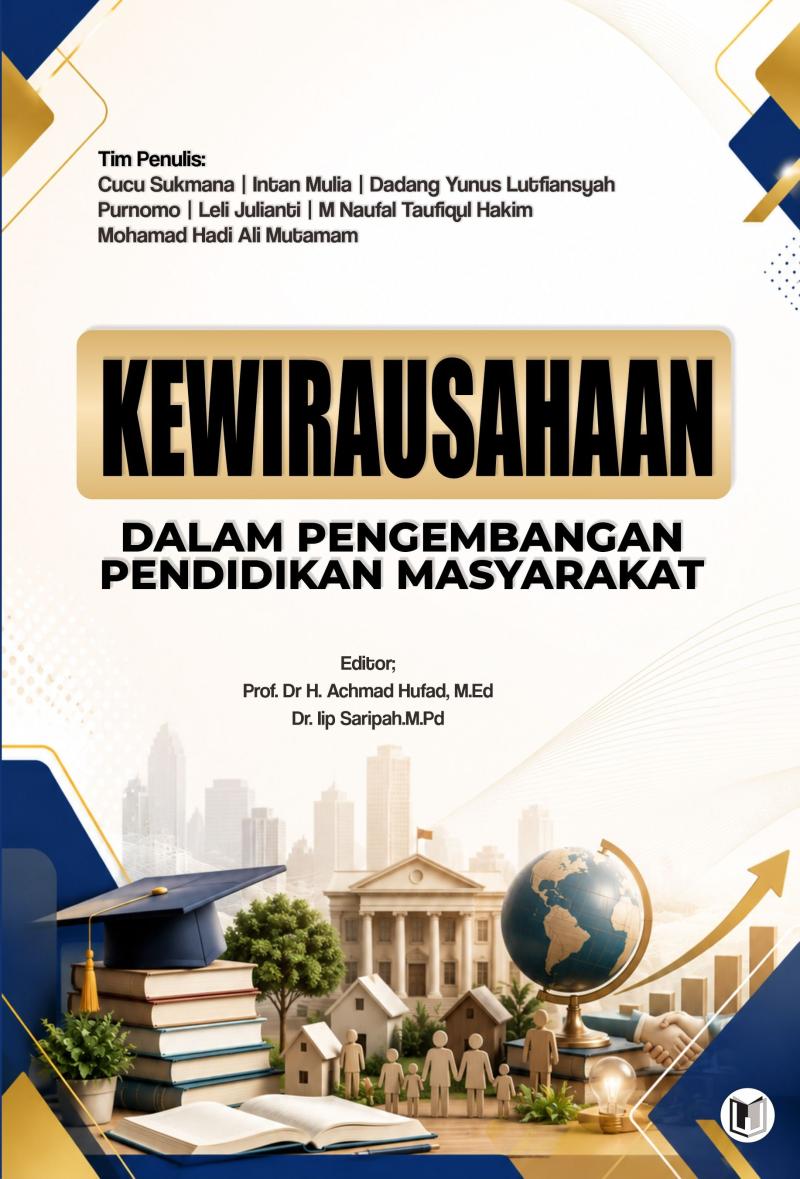
KEWIRAUSAHAAN DALAM PENGEMBANGANPENDIDIKAN MASYARAKAT
Keywords:
PENDIDIKAN MASYARAKATSynopsis
Kewirausahaan telah menjadi salah satu kompetensi penting dalam menjawab berbagai tantangan sosial, ekonomi, dan pendidikan di era global. Dalam konteks pendidikan masyarakat, kewirausahaan tidak hanya dimaknai sebagai kemampuan membangun usaha, tetapi juga sebagai cara berpikir kreatif, inovatif, mandiri, dan berorientasi pada pemecahan masalah yang mampu meningkatkan kualitas hidup individu maupun komunitas. Pendidikan masyarakat memiliki peran strategis dalam menumbuhkan jiwa kewirausahaan melalui proses pembelajaran yang kontekstual, partisipatif, dan berbasis pada potensi lokal, sehingga masyarakat mampu menciptakan peluang ekonomi sekaligus memperkuat pembangunan yang inklusif dan berkelanjutan.
Buku Kewirausahaan dalam Pengembangan Pendidikan Masyarakat membahas secara komprehensif konsep, teori, dan implementasi kewirausahaan sebagai bagian integral dari pengembangan pendidikan masyarakat. Pembahasan diawali dengan landasan filosofis dan konsep dasar kewirausahaan serta pendidikan masyarakat, kemudian dilanjutkan dengan pengembangan karakter kewirausahaan, identifikasi potensi lokal, inovasi sosial, pemberdayaan masyarakat, perencanaan dan pengelolaan usaha, pemasaran digital, literasi keuangan, pemanfaatan teknologi, hingga kolaborasi antara pemerintah, dunia usaha, lembaga pendidikan, dan komunitas dalam menciptakan ekosistem kewirausahaan yang produktif. Buku ini juga mengulas strategi pembelajaran kewirausahaan berbasis pengalaman (experiential learning) yang mendorong peserta didik dan masyarakat untuk belajar melalui praktik nyata serta menghasilkan solusi yang berdampak bagi lingkungan sekitarnya.
Selain menyajikan landasan konseptual, buku ini dilengkapi dengan berbagai contoh praktik baik, studi kasus, dan rekomendasi implementasi program kewirausahaan dalam berbagai bentuk pendidikan masyarakat. Kehadiran buku ini diharapkan dapat menjadi referensi bagi dosen, mahasiswa, pendidik, pengelola program pendidikan nonformal, pendamping masyarakat, praktisi pemberdayaan, serta pembuat kebijakan dalam mengembangkan program pendidikan yang mampu melahirkan masyarakat yang kreatif, inovatif, mandiri, dan berdaya saing. Dengan demikian, kewirausahaan diposisikan sebagai instrumen penting dalam mewujudkan pendidikan masyarakat yang transformatif, adaptif terhadap perubahan, dan berkontribusi nyata terhadap pembangunan sosial dan ekonomi yang berkelanjutan.
Downloads
Download data is not yet available.
References
Aldrich, H. E., & Ruef, M. (2018). Unicorns, gazelles, and other distractions on the way to understanding real entrepreneurship in the United States. Academy of Management Perspectives, 32(4), 458–472.
Alkire, S. (2005). Subjective quantitative studies of human agency. Social Indicators Research, 74(1), 217–260.
Alkire, S., Malapit, H., Meinzen-Dick, R., Peterman, A., Quisumbing, A., Seymour, G., & Vaz, A. (2013). Instructional guide on the Women's Empowerment in Agriculture Index. International Food Policy Research Institute.
Anderson, J., & Markides, C. (2007). Strategic innovation at the base of the pyramid. MIT Sloan Management Review, 49(1), 83–88.
Apple, M. W. (2006). Educating the 'right' way: Markets, standards, God, and inequality. Routledge.
Arnstein, S. R. (1969). A ladder of citizen participation. Journal of the American Institute of Planners, 35(4), 216–224.
Austin, J. E. (2000). Strategic collaboration between nonprofits and businesses. Nonprofit and Voluntary Sector Quarterly, 29(1), 69–97.
Badan Pusat Statistik. (2023). Perkembangan UMKM dan ekonomi digital Indonesia. BPS.
Bandura, A. (1997). Self-efficacy: The exercise of control. Freeman.
Berkes, F. (1999). Sacred ecology: Traditional ecological knowledge and resource management. Taylor & Francis.
Berkes, F., Colding, J., & Folke, C. (2003). Navigating social-ecological systems: Building resilience for complexity and change. Cambridge University Press.
Bryson, J. M., Crosby, B. C., & Stone, M. M. (2006). The design and implementation of cross-sector collaborations: Propositions from the literature. Public Administration Review, 66(s1), 44–55.
Chambers, R. (1983). Rural development: Putting the last first. Longman.
Chambers, R. (1994). Participatory rural appraisal (PRA): Analysis of experience. World Development, 22(9), 1253–1268.
Christensen, C. M., Ojomo, E., & Dillon, K. (2019). The prosperity paradox: How innovation can lift nations out of poverty. HarperCollins Publishers.
Cope, J. (2005). Toward a dynamic learning perspective of entrepreneurship. Entrepreneurship Theory and Practice, 29(4), 373–397.
Dana, L. P. (2007). Handbook of research on ethnic minority entrepreneurship. Edward Elgar.
Davies, R., & Dart, J. (2005). The 'Most Significant Change' (MSC) technique: A guide to its use. CARE International.
Dees, J. G. (1998). The meaning of social entrepreneurship. Stanford Social Innovation Review, 1(2), 44–51.
Delors, J. (1996). Learning: The treasure within. Report to UNESCO of the International Commission on Education for the Twenty-first Century. UNESCO Publishing.
Doherty, B., Haugh, H., & Lyon, F. (2014). Social enterprises as hybrid organizations: A review and research agenda. International Journal of Management Reviews, 16(4), 417–436.
Drucker, P. F. (1985). Innovation and entrepreneurship: Practice and principles. Harper & Row.
Ecklund, E., & Torsvik, G. (2019). Mission drift in for-profit social enterprises: The role of social entrepreneurship. Journal of Business Ethics, 158(3), 723–738.
Eckhardt, J. T., & Shane, S. A. (2003). Opportunities and entrepreneurship. Journal of Management, 29(3), 333–349.
Effendi, R. (2019). Model bisnis sosial YCAB Foundation dalam pemberdayaan anak marjinal. Jurnal Kewirausahaan Sosial Indonesia, 4(2), 134–152.
Elkington, J. (1997). Cannibals with forks: The triple bottom line of 21st century business. Capstone.
Fals-Borda, O., & Rahman, M. A. (1991). Action and knowledge: Breaking the monopoly with participatory action research. Apex Press.
Freire, P. (1970). Pedagogy of the oppressed. Continuum.
Hartini, S., & Kusumawati, N. (2021). Model bisnis berbasis kearifan lokal: Studi kasus UMKM agroindustri Jawa Barat. Jurnal Manajemen dan Bisnis Indonesia, 9(2), 123–140.
Hasan, N. A., & Wahab, K. A. (2022). Digital platform and entrepreneurial learning in developing countries: A systematic review. Journal of Community Education Research, 14(2), 45–63.
Hobart, M. (Ed.). (1993). An anthropological critique of development: The growth of ignorance. Routledge.
Isenberg, D. J. (2011). The entrepreneurship ecosystem strategy as a new paradigm for economy policy: Principles for cultivating entrepreneurship. Babson College.
Jarvis, P. (2007). Globalization, lifelong learning and the learning society. Routledge.
Kamil, M. (2012). Model pendidikan dan pelatihan: Konsep dan aplikasi. Alfabeta.
Kania, J., & Kramer, M. (2011). Collective impact. Stanford Social Innovation Review, 9(1), 36–41.
Kementerian Komunikasi dan Informatika. (2023). Laporan tahunan ekonomi digital Indonesia. Kemenkominfo.
Knowles, M. S. (1984). Andragogy in action. Jossey-Bass.
Knowles, M. S., Holton, E. F., & Swanson, R. A. (2015). The adult learner: The definitive classic in adult education and human resource development (8th ed.). Routledge.
Kolb, D. A. (1984). Experiential learning: Experience as the source of learning and development. Prentice Hall.
Kotler, P., & Armstrong, G. (2021). Principles of marketing (18th ed.). Pearson Education.
Kretzmann, J., & McKnight, J. (1993). Building communities from the inside out: A path toward finding and mobilizing a community's assets. ACTA Publications.
Krueger, N. F. (2007). What lies beneath? The experiential essence of entrepreneurial thinking. Entrepreneurship Theory and Practice, 31(1), 123–138.
Lave, J., & Wenger, E. (1991). Situated learning: Legitimate peripheral participation. Cambridge University Press.
Mair, J., & Martí, I. (2006). Social entrepreneurship research: A source of explanation, prediction, and delight. Journal of World Business, 41(1), 36–44.
Mardikanto, T., & Soebiato, P. (2019). Pemberdayaan masyarakat dalam perspektif kebijakan publik (Edisi Revisi). Alfabeta.
Masinambouw, V. (2015). Efektivitas kurikulum berbasis kearifan lokal dalam pendidikan kesetaraan. Jurnal Pendidikan Nonformal Indonesia, 10(2), 45–62.
Mathie, A., & Cunningham, G. (2003). From clients to citizens: Asset-based community development as a strategy for community-driven development. Development in Practice, 13(5), 474–486.
McKnight, J., & Kretzmann, J. (1993). Mapping community capacity. Institute for Policy Research, Northwestern University.
Means, B., Toyama, Y., Murphy, R., & Baki, M. (2013). The effectiveness of online and blended learning: A meta-analysis of the empirical literature. Teachers College Record, 115(3), 1–47.
Merriam, S. B., & Bierema, L. L. (2014). Adult learning: Linking theory and practice. Jossey-Bass.
Mezirow, J. (1991). Transformative dimensions of adult learning. Jossey-Bass.
Mikkelsen, B. (2005). Methods for development work and research: A new guide for practitioners (2nd ed.). SAGE Publications.
Miles, M. B., Huberman, A. M., & Saldaña, J. (2014). Qualitative data analysis: A methods sourcebook (3rd ed.). SAGE Publications.
Mustofa, M. (2018). Manajemen lembaga pendidikan nonformal: Studi kasus di PKBM. Jurnal Pendidikan Nonformal, 13(2), 87–98.
Nicholls, A. (2006). Social entrepreneurship: New models of sustainable social change. Oxford University Press.
Nussbaum, M. C. (2011). Creating capabilities: The human development approach. Harvard University Press.
OECD. (2023). Digital transformation and the future of entrepreneurship education. OECD Publishing.
Osterwalder, A., & Pigneur, Y. (2010). Business model generation: A handbook for visionaries, game changers, and challengers. John Wiley & Sons.
Patton, M. Q. (2008). Utilization-focused evaluation (4th ed.). SAGE Publications.
Pluye, P., Potvin, L., & Denis, J. L. (2004). Making public health programs last: Conceptualizing sustainability. Evaluation and Program Planning, 27(2), 121–133.
Porter, M. E. (1980). Competitive strategy: Techniques for analyzing industries and competitors. Free Press.
Porter, M. E. (1985). Competitive advantage: Creating and sustaining superior performance. Free Press.
Porter, M. E., & Kramer, M. R. (2011). Creating shared value. Harvard Business Review, 89(1/2), 62–77.
Prahalad, C. K. (2004). The fortune at the bottom of the pyramid: Eradicating poverty through profits. Wharton School Publishing.
Prahalad, C. K., & Hart, S. L. (2002). The fortune at the bottom of the pyramid. Strategy + Business, 26, 54–67.
Putnam, R. D. (1993). Making democracy work: Civic traditions in modern Italy. Princeton University Press.
Putnam, R. D. (2000). Bowling alone: The collapse and revival of American community. Simon & Schuster.
Rae, D. (2004). Practical theories from entrepreneurs' stories: Discursive approaches to entrepreneurial learning. Journal of Small Business and Enterprise Development, 11(2), 195–202.
Rahayu, S., & Kusuma, D. (2022). Efektivitas platform e-learning dalam pendidikan kewirausahaan masyarakat: Studi kasus program Kartu Prakerja. Jurnal Pendidikan Nonformal, 17(1), 23–41.
Rappaport, J. (1981). In praise of paradox: A social policy of empowerment over prevention. American Journal of Community Psychology, 9(1), 1–25.
Ries, E. (2011). The lean startup: How today's entrepreneurs use continuous innovation to create radically successful businesses. Crown Business.
Rossi, P. H., Lipsey, M. W., & Freeman, H. E. (2004). Evaluation: A systematic approach (7th ed.). SAGE Publications.
Sartini. (2004). Menggali kearifan lokal Nusantara: Sebuah kajian filsafati. Jurnal Filsafat, 37(2), 111–120.
Schumpeter, J. A. (1934). The theory of economic development. Harvard University Press.
Sen, A. (1999). Development as freedom. Oxford University Press.
Seng, A., Yusof, M., & Rahman, A. (2023). Community-based digital entrepreneurship education: Lessons from Southeast Asia. Asian Journal of Community Education, 8(3), 112–130.
Setyawan, A. A., & Purwanto, B. (2020). Pengembangan model bisnis UMKM berbasis potensi lokal: Pendekatan rantai nilai inklusif. Jurnal Ekonomi dan Bisnis, 23(1), 45–62.
Shane, S., & Venkataraman, S. (2000). The promise of entrepreneurship as a field of research. Academy of Management Review, 25(1), 217–226.
Shiferaw, A., & Muriithi, B. (2022). Market analysis for rural development: A practical guide. International Food Policy Research Institute.
Siemens, G. (2005). Connectivism: A learning theory for the digital age. International Journal of Instructional Technology and Distance Learning, 2(1), 3–10.
Sudjana, D. (2010). Pendidikan nonformal: Wawasan, sejarah perkembangan, filsafat, teori pendukung, asas. Falah Production.
Sukmana, Y. (2016). Model pendidikan kesetaraan berbasis kewirausahaan di PKBM Bina Insan Mandiri Bandung. Jurnal Pendidikan Luar Sekolah, 12(3), 156–172.
Suryana. (2013). Kewirausahaan: Kiat dan proses menuju sukses (Edisi 4). Salemba Empat.
UNDP. (2018). Inclusive business: Creating value in Latin America. United Nations Development Programme.
UNESCO. (2015). Rethinking education: Towards a global common good? UNESCO Publishing.
UNIDO. (2011). Value chain analysis: A training manual. United Nations Industrial Development Organization.
Wahyuni, S., & Jantan, M. (2020). Kapasitas manajerial pengelola lembaga pendidikan masyarakat di Indonesia. Indonesian Journal of Community Education, 8(2), 112–128.
WCED. (1987). Our common future (The Brundtland Report). Oxford University Press.
Yunus, M. (2010). Building social business: The new kind of capitalism that serves humanity's most pressing needs. PublicAffairs.
Yunus, M. (2020). Inovasi pusat kewirausahaan komunitas di Sanggar Kegiatan Belajar. Jurnal Inovasi Pendidikan Masyarakat, 6(1), 78–95.
Zimmerman, M. A. (1995). Psychological empowerment: Issues and illustrations. American Journal of Community Psychology, 23(5), 581–599.
Zimmermann, B. J. (2000). Self-efficacy: An essential motive to learn. Contemporary Educational Psychology, 25(1), 82–91.
Downloads
Published
August 7, 2026
Copyright (c) 2026 Cucu Sukmana, Intan Mulia, Dadang Yunus Lutfiansyah, Purnomo Purnomo, Leli Julianti, M Naufal Taufiqul Hakim, Mohamad Hadi Ali Mutamam (Author)
License

This work is licensed under a Creative Commons Attribution-NonCommercial-ShareAlike 4.0 International License.
How to Cite
Sukmana, C., Mulia, I., Yunus Lutfiansyah, D., Purnomo, P., Julianti, L., Taufiqul Hakim, M. N., & Ali Mutamam, M. H. (2026). KEWIRAUSAHAAN DALAM PENGEMBANGANPENDIDIKAN MASYARAKAT. Widina Media Utama. https://doi.org/10.59818/2g524645