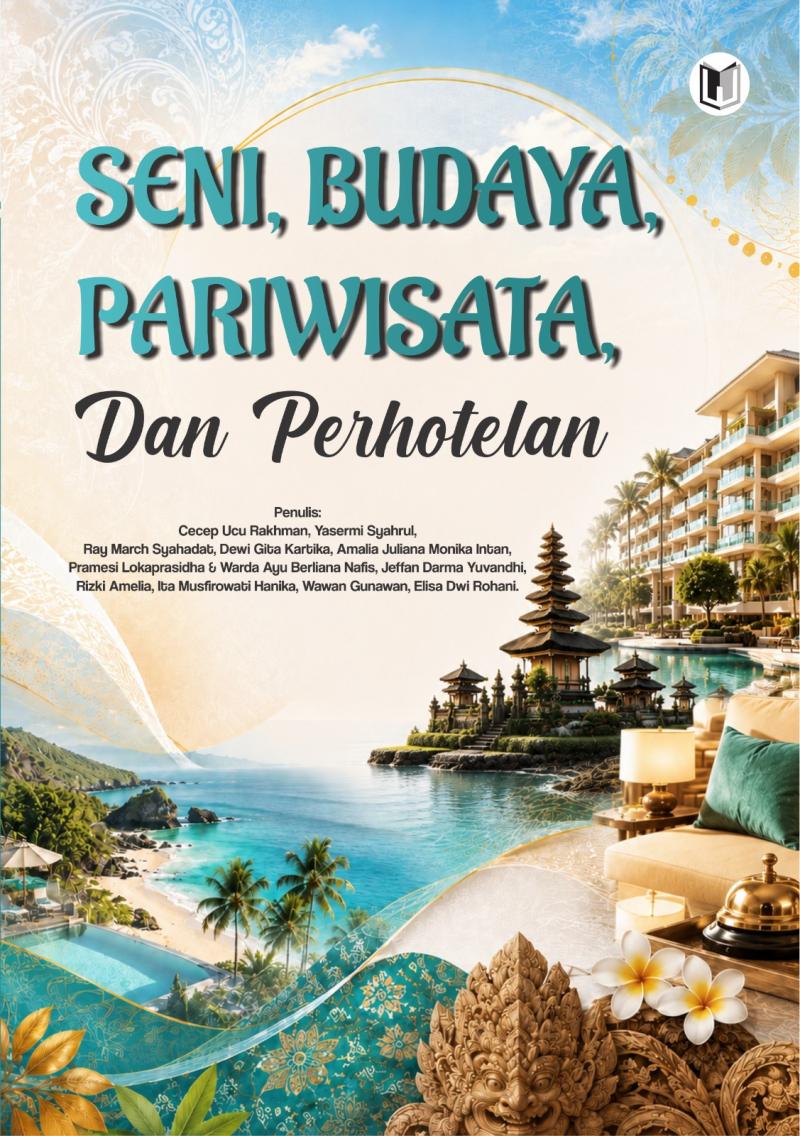
SENI, BUDAYA, PARIWISATA DAN PERHOTELAN
Keywords:
Seni, Budaya, Pariwisata, HotelSynopsis
Buku Seni, Budaya, Pariwisata dan Perhotelan membahas hubungan antara seni, budaya, industri pariwisata, dan dunia perhotelan sebagai bagian penting dalam pengembangan ekonomi kreatif dan pelayanan wisata modern. Seni dan budaya tidak hanya menjadi identitas suatu daerah, tetapi juga menjadi daya tarik utama yang mampu meningkatkan kunjungan wisatawan serta memperkuat citra destinasi wisata.
Pembahasan dalam buku ini mencakup konsep dasar seni dan budaya, peran budaya lokal dalam pariwisata, pengembangan destinasi wisata, pelayanan perhotelan, hingga strategi pengelolaan industri hospitality di era modern. Buku ini juga mengulas pentingnya pelestarian budaya dalam mendukung keberlanjutan sektor pariwisata serta peningkatan kualitas pelayanan kepada wisatawan.
Selain membahas aspek teoritis, buku ini menyajikan berbagai contoh penerapan seni dan budaya dalam industri pariwisata dan perhotelan. Materi disusun secara sistematis agar pembaca dapat memahami keterkaitan antara budaya lokal, pengalaman wisata, dan kualitas pelayanan dalam menciptakan industri pariwisata yang kompetitif dan berkelanjutan.
Dengan bahasa yang mudah dipahami dan pembahasan yang aplikatif, buku ini diharapkan menjadi referensi bagi mahasiswa, akademisi, praktisi pariwisata, pelaku industri perhotelan, serta masyarakat umum yang ingin memahami perkembangan seni, budaya, dan hospitality dalam konteks global dan lokal.
Downloads
Download data is not yet available.
References
Butler, R. W. (1999). Sustainable tourism: A state-of-the-art review. Tourism Geographies, 1(1), 7–25. https://doi.org/10.1080/14616689908721291
Danto, A. C. (2013). What Art Is. Yale University Press.
Dredge, D., Phi, G. T. L., Mahadevan, R. M. E., & Popescu, E. (2019). Digitalisation in Tourism: In-depth analysis of challenges and opportunities. https://ec.europa.eu/docsroom/documents/33163/attachments/1/translations/en/renditions/native
Getz, D., & Page, S. J. (2020). Event Studies: Theory, Research and Policy for Planned Events (Fourth Edition). Taylor & Francis.
Gretzel, U., Sigala, M., Xiang, Z., & Koo, C. (2015). Smart tourism: foundations and developments. Electronic Markets, 25(3), 179–188. https://doi.org/10.1007/s12525-015-0196-8
Kim, M., & Thapa, B. (2018). Perceived value and flow experience: Application in a nature-based tourism context. Journal of Destination Marketing and Management, 8, 373–384. https://doi.org/10.1016/j.jdmm.2017.08.002
Koentjaraningrat. (2009). Pengantar Ilmu Antropologi. Rineka Cipta.
OECD. (2022). OECD Tourism Trends and Policies 2022. OECD Publishing. https://doi.org/10.1787/a8dd3019-en
Pine, B. Joseph., & Gilmore, J. H. . (2011). The experience economy. Harvard Business Review Press.
Richards, G. (2021). Rethinking Cultural Tourism.
Scheyvens, R. (2020). Tourism for development: Empowering communities. Pearson.
Smith, M. K. (2015). Issues in Cultural Tourism Studies.
Su, M. M., Wall, G., Wang, Y., & Jin, M. (2019). Livelihood sustainability in a rural tourism destination - Hetu Town, Anhui Province, China. Tourism Management, 71, 272–281. https://doi.org/10.1016/j.tourman.2018.10.019
UNWTO. (2019). International Tourism Highlights, 2019 Edition. In International Tourism Highlights, 2019 Edition. World Tourism Organization (UNWTO).
Walker, J. R. (2017). Introduction to Hospitality (7th ed.). Pearson.
Adnyana, I. W. K. (2015). Arena Seni Pita Maha : Ruang Sosial dan Estetika Seni Lukis Bali 1930 ‘ an. 249–263.
Agung, A., Bagus, G., Sn, S., Si, M., & Seni, F. (2020). DISRUPSI TEKNOLOGI DIGITAL : TUMBUH KEMBANGNYA INDUSTRI KREATIF BERBASIS BUDAYA. 1–16.
Agustinova, D. E., & Agustinova, D. E. (2022). STRATEGY FOR MAINTAINING CULTURAL HERITAGE OBJECTIVES. 18(2), 60–68.
Ali, M., Suharto, B., Maulidy, A. M., Lestari, Q., Putu, L., Laksmi, G., & Penelitian, A. L. B. (2023). Analisis faktor sustainabilitas festival budaya di kota jember studi tentang jember fesyen carnaval. 15(2), 179–189. https://doi.org/10.33153/brikolase.v15i2.5513
Archangela Yudi Aprianingrum, A. H. N. (2009). BATIK INDONESIA, PELESTARIAN MELALUI MUSEUM.
Arifian, F. R., & Ayundasari, L. (2021). Kebudayaan Tabuik sebagai upacara adat di Kota Pairaman Sumatra Barat. 1(6), 726–731. https://doi.org/10.17977/um063v1i62021p726-731
Budiana Setiawan, R. R. N. S. (2014). STRATEGI PENGEMBANGAN TENUN IKAT KUPANG PROVINSI NUSA TENGGARA TIMUR. 353–367.
Diva Harfi Mutmainah, Najwa Aulia, Aninda Fitri Zulkarnaen, M. F. A.-R. (2026). Analisis nila-nilai religi dan sosial pada tari saman aceh. 2(2), 69–78.
Doe, J. (2025). Eksistensi dan Komersialisasi : Sejarah Perkembangan Ritual Tari Tulak Bala dan Dampaknya terhadap Perekonomian Masyarakat Kerinci. 49–54.
Helida, A., Zuhud, E. A. M., Purwanto, Y., & Hikmat, A. (2012). Perhelatan kenduri sko sebagai sebuah pesan kebudayaan masyarakat Kerinci di taman nasional Kerinci Seblat Cultural message of kenduri sko in the society of Kerinci Seblat National Park. Zakaria, 34–43.
Kartika, S. (2017). Seni Rupa Modern. Rekayasa Sains.
Kecak, T., Pura, D. I., & Uluwatu, L. (2025). Representasi pariwisata bali melalui komodifikasi tari kecak di pura luhur uluwatu. 4(1), 61–67.
Koentjaraningrat. (2015). Pengantar Ilmu Antropologi. Rineka Cipta.
Nuraini, S., & Miftahul, A. (2022). Eksistensi Kain Tenun di Era Modern. 162–169.
Pambudi, B. (2015). Semiotika Karapan Sapi dan Transformasi Simbolik Masyarakat Madura. 05.
Patji, A. R. (2010). PENGEMBANGAN DAN P ERLINDUNGAN K EKAYAAN B UDAYA D AERAH : RESPON PEMERINTAH INDONESIA TERHADAP ADANYA KLAIM PIHAK LAIN. 167–188.
Prasiska, S. A., & Wati, R. (2024). Jurnal Dinamika Sosial Budaya Seni Ukir Jepara sebagai Bentuk Identitas Budaya. 26(1), 42–46.
Sakka, W., & Reski, R. (2025). Analisis Nilai Religius dan Sosial dalam Upacara Ngaben di Bali. 5(2), 629–635.
Subagya, T. (2013). NILAI-NILAI ESTETIS BENTUK WAYANG KULIT. 11(2), 266–274.
Sugiyarto, E. A., & Anggraeni, P. D. (2025). Perancangan Komunikasi Visual Sebagai Media Promosi Kotagede Silver Yogyakarta. 9(3), 668–678.
Sukadari. (2020). PERANAN BUDAYA SEKOLAH DALAM MENINGKATKAN MUTU PENDIDIKAN. 1(1), 75–86.
Syahrul, Y. (2020). DESAIN USER INTERFACE AKSARA INCUNG SEBAGAI PENGENALAN KEARIFAN LOKAL KERINCI. GESTALT, 2(1), 87–98. https://doi.org/https://doi.org/10.33005/gestalt.v2i1.41
Wa’afini, Suci Fajrina, Rosta Minawati, N. Y. F. (2025). PEMBELAJARAN SENI RANDAI SEBAGAI UPAYA PELESTARIAN BUDAYA MINANGKABAU DI SEKOLAH. 10, 341–354.
Winarno, T. (2016). Perbandingan Karakteristik Lempung Kasongan dan Godean Sebagai Bahan Baku Industri Gerabah Kasongan. 37(1), 41–46.
Yulika, F. (2016). JEJAK SENI DALAM SEJARAH ISLAM. Institut Seni Indonesia Padangpanjang.
Zuriyah, Eskak, E. (2025). PEMBINAAN INDUSTRI ANYAMAN BAMBU GIRITONTRO KABUPATEN WONOGIRI MELALUI BIMBINGAN TEKNIS DIVERSIFIKASI PRODUK UNTUK MENINGKATKAN DAYA SAING IKM.
Agustinova, D. E. (2022). Strategi Pelestarian Cagar Budaya Melalui Digitalisasi. Istoria, 18(2), 60–68. https://doi.org/10.21831/istoria.v18i2.52991
Akyildiz, Ü. N. A., & Olğun, T. N. (2020). Evaluation of the intangible cultural heritage in the context of conservation and sustainability of historical settlements in anatolia. Milli Folklor, 2020(128), 234–243. https://www.scopus.com/inward/record.uri?eid=2-s2.0-85097682355&partnerID=40&md5=2eebca9ac543075defdec48fb9302bdb
Amoiradis, C., Velissariou, E., Stankova, M., & Poulios, T. (2022). Spatial Analysis of Cultural Resources and Their Contribution to the Sustainable Tourism Development of Greece. In K. V. & Ş. A.C. (Eds.), Springer Proceedings in Business and Economics (pp. 3–31). Springer Science and Business Media B.V. https://doi.org/10.1007/978-3-030-92491-1_1
Apollonio, F. I., Gaiani, M., & Bertacchi, S. (2019). Managing cultural heritage with integrated services platform. In P. V., S. M., G. A., C. L., P. M., B. R., & R. F. (Eds.), ISPRS Annals of the Photogrammetry, Remote Sensing and Spatial Information Sciences (Vol. 42, Issue 2/W11, pp. 91–98). Copernicus GmbH. https://doi.org/10.5194/isprs-Archives-XLII-2-W11-91-2019
Arumugam, A., Nakkeeran, S., & Subramaniam, R. (2023). Exploring the Factors Influencing Heritage Tourism Development: A Model Development. Sustainability (Switzerland), 15(15). https://doi.org/10.3390/su151511986
Bacsi, Z. (2024). The Influence of Heritage on the Revealed Comparative Advantage of Tourism—A Worldwide Analysis from 2011 to 2022. Heritage, 7(9), 5232–5250. https://doi.org/10.3390/heritage7090246
Baiquni, M. (2021). Geografi Pariwisata Nasional. Penerbit Universitas Terbuka.
Bhati, H. V. (2025). Implementing cultural heritage conservation and energy sustainability in the UNESCO World Heritage site of Jaipur city, India. Frontiers in Sustainable Cities, 7. https://doi.org/10.3389/frsc.2025.1548279
Bowitz, E., & Ibenholt, K. (2009). Economic impacts of cultural heritage - Research and perspectives. Journal of Cultural Heritage, 10(1), 1–8. https://doi.org/10.1016/j.culher.2008.09.002
Brahmantara. (2020). Pelestarian Warisan Budaya Kota (Urban Heritage) Melalui Pendekatan Heritage Urban Landscape (HUL) dan Cultural Heritage Integrated Management Plans (CHIMP). Borobudur, 14(1), 60–70. https://scholar.archive.org/work/xefteur5dfdtzdqvgiliwyi6xq/access/wayback/http://borobudur.kemdikbud.go.id/index.php/jurnalkonservasicagarbudaya/article/download/230/194
Buckley, R., Shekari, F., Mohammadi, Z., Azizi, F., & Ziaee, M. (2020). World Heritage Tourism Triggers Urban–Rural Reverse Migration and Social Change. Journal of Travel Research, 59(3), 559–572. https://doi.org/10.1177/0047287519853048
Bulić, N. (2002). Need for stronger political support in favour of tapping Europe’s tourism potential. Tourism, 50(2), 189–201. https://www.scopus.com/inward/record.uri?eid=2-s2.0-0036407012&partnerID=40&md5=e8ab1810fa8168853561c95d93a5607b
Calle, I. M. (2020). Indigenous people and intangible cultural heritage: Commons as their identity. Cuhso, 30(2), 149–159. https://doi.org/10.7770/cuhSO-v30N2-art2112
Chan, S. N. H. M. A., Ulang, N. M., & Yun, V. W. S. (2025). Sustainable Adaptive Reuse of Heritage Buildings in George Town, Penang: Integrating Management, Financial, and Technology. Paper Asia, 41(6b), 411–426. https://doi.org/10.59953/paperasia.v41i6b.881
Chea, C. C. (2017). Open distance learning in heritage recognition and appreciation: Building capacity and strengthening Malaysian livelihoods. In Open and Distance Learning Initiatives for Sustainable Development (pp. 189–211). IGI Global. https://doi.org/10.4018/978-1-5225-2621-6.ch010
Duran, E. (2012). Protecting social and cultural identity in sustainable tourism: The case of Gökçeada, Turkey. Advances in Culture, Tourism and Hospitality Research, 6, 345–368. https://doi.org/10.1108/S1871-3173(2012)0000006022
Figueiredo, V. G. B. (2014). Cultural heritage, city, sustainability: What is the role of urban legislation in preservation and development? Ambiente e Sociedade, 17(2), 91–110. https://doi.org/10.1590/S1414-753X2014000200007
Geçikli, R. M., Turan, O., Lachytová, L., Dağlı, E., Kasalak, M. A., Uğur, S. B., & Guven, Y. (2024). Cultural Heritage Tourism and Sustainability: A Bibliometric Analysis. In Sustainability (Vol. 16, Issue 15, p. 6424). https://doi.org/10.3390/su16156424
Henson, D. (2016). Finding people in the heritage of bankside, southwark. In Who Needs Experts?: Counter-mapping Cultural Heritage (pp. 147–164). Taylor and Francis. https://doi.org/10.4324/9781315547251-18
Holden, A. (2000). Environment and Tourism. Routledge.
Iliodromitis, A., Tsilimantou, E., Kopelou, P., Anastasiou, D., Koulidou, S., Spanodimos, C., Chrysostomou, G., Dimou, V., & Pagounis, V. (2025). Three-Dimensional Digital Geospatial Documentation for Cultural Heritage Preservation and Sustainable Management of Tourism Through a Web Platform: The Case Study of the Archaeological Park of Dion, Greece. Land, 14(5). https://doi.org/10.3390/land14051062
Jassim, A. H., Hasan, S. A., Ebraheem, A. K., Ebraheem, M. A., AL-Rawe, M. K., Alkinani, A. S., & Almosawi, F. (2025). A Comprehensive Framework for Heritage Site Management: Challenges and Strategies for Sustainable Preservation. International Journal of Sustainable Development and Planning, 20(4), 1525–1533. https://doi.org/10.18280/ijsdp.200415
Jha-Thakur, U., Khosravi, F., Quattrone, G., Bandyopadhyay, S., Magedera, I., & Garikipati, S. (2021). Exploring the role of strategic environmental assessment in cultural heritage tourism planning: a case study of the Srirangapatna-Mysore region in India. Impact Assessment and Project Appraisal, 39(2), 138–150. https://doi.org/10.1080/14615517.2020.1841595
Kawathekar, V. (2024). Building Sustainable Futures for Asia’s Historic Towns: A Holistic Legal Framework. In Sustainable Development Goals Series: Vol. Part F4211 (pp. 35–51). Springer. https://doi.org/10.1007/978-981-97-6736-6_3
Khater, M., Zouair, N., Saad, M. A., Bayoumy, M., & Al-Salim, F. (2025). Reviving heritage through regenerative tourism and community empowerment for sustainable futures. Social Sciences and Humanities Open, 12. https://doi.org/10.1016/j.ssaho.2025.102004
Lanciotti, A. (2021). Cultural Heritage in International Law: (Still) Looking for a Definition? The Taxonomy of Cultural Heritage Across the Spectrum of UNESCO Conventions and Beyond. In Transcultural Diplomacy and International Law in Heritage Conservation: A Dialogue between Ethics, Law, and Culture (pp. 191–208). Springer Singapore. https://doi.org/10.1007/978-981-16-0309-9_13
Landorf, C. (2009). Managing for sustainable tourism: A review of six culturalWorld Heritage Sites. Journal of Sustainable Tourism, 17(1), 53–70. https://doi.org/10.1080/09669580802159719
Lekakis, S., Shakya, S., & Kostakis, V. (2018). Bringing the community back: A case study of the post-earthquake heritage restoration in Kathmandu valley. Sustainability (Switzerland), 10(8). https://doi.org/10.3390/su10082798
Lenzerini, F. (2023). The Spirit and the Substance. The Human Dimension of Cultural Heritage from the Perspective of Sustainability. In Cultural Heritage, Sustainable Development and Human Rights: Towards an Integrated Approach (pp. 46–65). Taylor and Francis. https://doi.org/10.4324/9781003357704-5
Mohanty, S., Mishra, S., & Mohanty, S. (2019). A Stakeholder’s perspective on Holistic Heritage tourism- A special reference to the temple city Bhubaneswar, India. African Journal of Hospitality, Tourism and Leisure, 8(5). https://www.scopus.com/inward/record.uri?eid=2-s2.0-85074417010&partnerID=40&md5=57c61e20113a2e7afdfd1b49a325c3bc
Mughni, A., Sutrisno, E., & Hidayat, M. T. (2025). Manajemen Strategi Pelestarian Cagar Budaya dalam Konteks Peningkatan Kinerja Pelayanan Publik (Studi di Dinas Kebudayaan dan Pariwisata Kabupaten Cirebon). COMSERVA: Jurnal Penelitian Dan Pengabdian Masyarakat, 4(12), 5709–5718. https://doi.org/10.59141/comserva.v4i12.3088
Mukuya, T., Nyambiya, H., & Mutyandaedza, B. (2025). Local communities and protected areas: The case of Great Zimbabwe and Khami Ruins world heritage properties. In Community Development Insights on Cultural Heritage Tourism (pp. 59–95). IGI Global. https://doi.org/10.4018/979-8-3693-6512-0.ch004
Olagoke, O., Adetola, B. O., & Ayeni, D. A. (2026). Assessing the interplay between tourism development, cultural preservation, and economic growth in Nigeria: a case of the Osun Groves, Osogbo. Journal of Cultural Heritage Management and Sustainable Development, 1–18. https://doi.org/10.1108/JCHMSD-05-2025-0143
Park, H. Y. (2013). Heritage Tourism. In Heritage Tourism. Taylor and Francis. https://doi.org/10.4324/9781315882093
Purnomo, E. P., & Khairunnisa, T. (2024). Green Economy: Increasing Economic Growth to Support Sustainable Tourism in Super Priority Destinations. International Journal of Sustainable Development and Planning, 19(10), 4021–4031. https://doi.org/10.18280/ijsdp.191031
Raghav, A., Singh, R., Mathew, J. E., Gupta, K., & Kaushik, T. K. (2025). Ecologically sustainable adaptation planning for mountain tourism and cultural heritage under climate change: An integrated paradigm of preservation and conservation optimization. In Balancing Mountain Tourism, Cultural Heritage, and Environmental Stability (pp. 141–154). IGI Global. https://doi.org/10.4018/979-8-3693-8764-1.ch009
Rahmat, K. D. (2021). Pelestarian Cagar Budaya Melalui Pemanfaatan Pariwisata Berkelanjutan. Jurnal Pariwisata Terapan, 5(1), 26–37. https://doi.org/10.22146/jpt.58505
Sangchumnong, A., & Kozak, M. (2018). Sustainable cultural heritage tourism at Ban Wangka Village, Thailand. Anatolia, 29(2), 183–193. https://doi.org/10.1080/13032917.2017.1414435
Sethupathy, K. (2024). Exploring Community Engagement on Heritage Conservation in North Eastern India: SWOT and AHP Analysis through the Eisenhower Matrix. In Digital Cultural Heritage: Challenges, Solutions, and Future Directions (pp. 186–205). CRC Press. https://doi.org/10.1201/9781032630564-10
Shabalala, L. P. (2025). Community development insights on cultural heritage tourism. In Community Development Insights on Cultural Heritage Tourism. IGI Global. https://doi.org/10.4018/979-8-3693-6512-0
Singh, A., & Supina, S. (2023). Community’s attitude towards the development of cultural and heritage tourism: An exploratory study. In Exploring Culture and Heritage Through Experience Tourism (pp. 76–83). IGI Global. https://doi.org/10.4018/978-1-6684-9957-3.ch006
Siswanto. (2024). Pariwisata dan Pelestarian Warisan Budaya. Berkala Arkeologi, 27(1), 118–130. https://doi.org/10.30883/jba.v27i1.946
Škrabić Perić, B., Šimundić, B., Muštra, V., & Vugdelija, M. (2021). The Role of UNESCO Cultural Heritage and Cultural Sector in Tourism Development: The Case of EU Countries. In Sustainability (Vol. 13, Issue 10, p. 5473). https://doi.org/10.3390/su13105473
Spennemann, D. H. R. (2006). Your solution, their problem - Their solution, your problem. DISP, 164(1), 30–40. https://doi.org/10.1080/02513625.2006.10556945
Sun, J. (2022). Intangible Cultural Heritage Management and Protection Based on Spatial Information Technology under the Background of Internet of Things. Computational Intelligence and Neuroscience, 2022. https://doi.org/10.1155/2022/4941617
Susanty, S., Rohani, E. D., Ayu, J. P., Putra, P. T., Octaviani, L. K., Rakhman, C. U., Syahadat, R. M., Adriani, H., Oktawirani, P., & Rawali, S. (2025). Geografi Pariwisata Nasional. Penerbit Widina Media Utama. https://repository.penerbitwidina.com/publications/589144/geografi-pariwisata-nasional
Syahadat, R. M., Baiquni, M., Fandeli, C., & Widiyastuti, D. (2024a). Losing the sense of the fortress: Tourists’ perceptions of adaptation strategy of Fort Vredeburg in Yogyakarta, Indonesia. RJOAS: Russian Journal of Agricultural and Socio-Economics Sciences, 6(150), 169–176.
Syahadat, R. M., Baiquni, M., Fandeli, C., & Widiyastuti, D. (2024b). Negative sentiments study of Buton Kraton Fortress: How environmental factors play role in maintaining the historical and cultural site. Tataloka, 26(3), 195–207. https://doi.org/10.14710/tataloka.26.3.195-207
Timothy, D. J. (2014). Contemporary cultural heritage and tourism: Development issues and emerging trends. Public Archaeology, 13(1–3), 30–47. https://doi.org/10.1179/1465518714Z.00000000052
Tu, L. (2024). Optimization of Heritage Management Mechanisms through the Prism of Historic Urban Landscape: A Case Study of the Xidi and Hongcun World Heritage Sites. Sustainability (Switzerland), 16(12). https://doi.org/10.3390/su16125136
Tulbure, I., & Eduard, E. M. (2024). Opportunities and Challenges in Achieving Sustainable Tourism on Regional Level. In R. B., R. B., & T. O. (Eds.), International Multidisciplinary Scientific GeoConference Surveying Geology and Mining Ecology Management, SGEM (Vol. 24, Issue 5.1, pp. 165–172). International Multidisciplinary Scientific Geoconference. https://doi.org/10.5593/sgem2024/5.1/s20.23
UNESCO World Heritage Center. (2005). Operational Guidelines for the Implementation of the World Heritage Convention. UNESCO World Heritage Centre.
UNESCO World Heritage Convention. (2026). Indonesia. UNESCO World Heritage Convention. https://whc.unesco.org/en/statesparties/id
Volkova, T., Minenkova, V., Ivlieva, O., Konovalova, A., Komarevtseva, N., Anisimova, V., & Filobok, A. (2025). Preservation of Historical and Cultural Resources Amid Rapid Urbanization and Sustainable Development Goals, Case Study: Russia, Krasnodar Krai. International Journal of Ecosystems and Ecology Science, 15(3), 185–196. https://doi.org/10.31407/ijees15.321
Wahyudianto, F., & Hardjati, S. (2023). Manajemen Asset sebagai Upaya Pelestarian Bangunan Cagar Budaya di Kota Surabaya (Studi pada Dinas Kebudayaan Kepemudaan dan Olah Raga serta Pariwisata Kota Surabaya). Irpia: Jurnal Ilmiah Riset Dan Pengembangan, 8(4), 9–18. https://doi.org/10.71040/irpia.v8i7.234
Wang, C.-H. (2023). Cultural Landscape in Taiwan: The Principles Underpinning the Conservation and Management Plan of Tainan Park. Historic Environment: Policy and Practice, 14(1), 5–29. https://doi.org/10.1080/17567505.2023.2170567
Wang, S., Isa, N. M., Li, L., & Shi, K. (2024). Bibliometric visualization analysis of “World Heritage” topic in web of science database using citespace. Multidisciplinary Reviews, 7(11). https://doi.org/10.31893/multirev.2024272
Wani, M. D., Shah, S. A., & Dada, Z. A. (2024). Fostering Sustainable Tourism in India: Harnessing Cultural and Heritage Assets for Enduring Development. In Integrating Architecture and Design Into Sustainable Tourism Development (pp. 179–214). IGI Global. https://doi.org/10.4018/979-8-3693-7388-0.ch007
Yani Said, S., Syafiqa Abdullah, N., & Ithnin, Z. (2017). The impact of heritage tourism to local culture and economy. Pertanika Journal of Social Sciences and Humanities, 25(February), 315–322. https://www.scopus.com/inward/record.uri?eid=2-s2.0-85054206463&partnerID=40&md5=36fe9086460275456d47f8ac635058f5
Zhang, S., Liang, J., Su, X., Chen, Y., & Wei, Q. (2023). Research on global cultural heritage tourism based on bibliometric analysis. Heritage Science, 11(1). https://doi.org/10.1186/s40494-023-00981-w
Zhu, H., Zhang, J., Yu, X., & Hu, S. (2019). Sustainable tourism development strategies and practices of world heritage sites in China: A case study of Mt. Huangshan. International Journal of Sustainable Development and Planning, 14(4), 297–306. https://doi.org/10.2495/SDP-V14-N4-297-306
Butler, R., & Hinch, T. (2007). Tourism and indigenous peoples: Issues and implications. In Tourism and Indigenous Peoples: Issues and Implications. https://doi.org/10.4324/9780080553962
Fennell, D. (2007). Ecotourism: Third edition. In Ecotourism: Third Edition. https://doi.org/10.4324/9780203939581
Getz, D. (2008). Event tourism: Definition, evolution, and research. Tourism Management, 29(3). https://doi.org/10.1016/j.tourman.2007.07.017
Jadesta Kemenpar. (2026). Klasifikasi Desa Wisata. Https://Jadesta.Kemenpar.Go.Id/Home. https://jadesta.kemenpar.go.id/home
Kastenholz, E., & Gronau, W. (2022). Enhancing Competences For Co-Creating Appealing and Meaningful Cultural Heritage Experiences in Tourism. Journal of Hospitality and Tourism Research, 46(8). https://doi.org/10.1177/1096348020951637
Kemenparekraf. (2024). 4 Desa Wisata Berkelas Internasional Di Indonesia. Https://Kemenpar.Go.Id/Berita/4-Desa-Wisata-Berkelas-Internasional-Di-Indonesia. https://kemenpar.go.id/berita/4-desa-wisata-berkelas-internasional-di-indonesia
Malik, Y. M. (2020). Cultural Tourism Destination Elements and Attributes: An Interpretive Planning. Journal of International Cooperation and Development, 3(2). https://doi.org/10.36941/jicd-2020-0016
Petroman, I., Petroman, C., Marin, D., Ciolac, R., Văduva, L., & Pandur, I. (2013). Types of Cultural Tourism. Scientific Papers: Animal Science and Biotechnologies, 46(1).
Pitana, I. G., & Diarta, I. K. S. (2009). Pengantar Ilmu Pariwisata. Andi.
PP No. 50 Tahun 2011 Tentang Rencana Induk Pembangunan Kepariwisataan Nasional Tahun 2010 - 2025, Pemerintah Republik Indonesia (2011).
Richards, G. (2018). Cultural tourism: A review of recent research and trends. Journal of Hospitality and Tourism Management, 36. https://doi.org/10.1016/j.jhtm.2018.03.005
Ross, S., & Wall, G. (1999). Ecotourism: Towards congruence between theory and practice. Tourism Management, 20(1). https://doi.org/10.1016/S0261-5177(98)00098-3
Safarwati Putri, M., Syahrulyati, D., DrUci Sulandari, Ms., Hj Amanda Lestari Putri Lubis, M., Retno Utami, A., Kania Ratnasari, M., & Kusuma Devi, N. (2024). TANTANGAN DAN PELUANG DESA WISATA Menuju Desa Wisata Mandiri. www.penerbitlitnus.co.id
Scheyvens, R., & van der Watt, H. (2021). Tourism, empowerment and sustainable development: A new framework for analysis. Sustainability (Switzerland), 13(22). https://doi.org/10.3390/su132212606
Smith, M. K. (2015). Issues in cultural tourism studies: Third edition. In Issues in Cultural Tourism Studies: Third Edition. https://doi.org/10.4324/9781315767697
UNWTO. (2019). UNWTO Tourism Definitions. In UNWTO Tourism Definitions | Définitions du tourisme de l’OMT | Definiciones de turismo de la OMT. UNWTO. https://doi.org/https://doi.org/10.18111/9789284420858
Utami, A., Gunawan, W., & Fedryansyah, M. (2024). Interaksi Sosial Pada Masyarakat Adat di Kampung Adat Kuta Ciamis. SOSIOGLOBAL : Jurnal Pemikiran Dan Penelitian Sosiologi, 9(1), 1–18. https://doi.org/https://doi.org/10.24198/jsg.v9i1.55602
Wall, G., & Mathieson, A. (2006). Tourism : change, impacts, and opportunities. In Pearson Prentice Hall.
Weaver, D. B. (2001). The Encyclopedia of Ecotourism. In The Encyclopedia of Ecotourism. CABI Publishing. https://doi.org/10.1079/9780851993683.0000
Beck, L., & Cable, T. T. (2002). Interpretation for the 21st Century: Fifteen Guiding Principles for Interpreting Nature and Culture (2nd ed.). Sagamore Publishing.
Confederation of Tourism and Hospitality. (2011). Travel Agency and Tour Guide Operations. Learning Media.
Galih Kusumah, A. H., & Andrianto, T. (2023). Narrative Crafting in Tourism Destinations: An Autoethnographic Exploration of Storytelling Techniques for Tour Guides. Journal of Tourism Sustainability, 3(1), 19–27. https://doi.org/10.35313/jtospolban.v3i1.72
Kelly, I., & Mankervis, T. (2001). Visitor Destination. John Wiley & Sons, Australia Ltd.
Knudson, D. M., Cable, T. T., & Beck, L. (2003). Interpretation of Cultural and Natural Resources (2nd ed.). Venture Pub.
Pastorelli, J. (2003). Enriching the Experience - An Interpretative Approach to Tour Guiding. Hospitality Press.
Pitana, I. G. (2005). Sosiologi Pariwisata, Kajian sosiologis terhadap struktur, sistem, dan dampak-dampak pariwisata. Andi Offset.
Uysal, M., & Jurowski, C. (1994). Testing the push and pull factors. Annals of Travel Research.
Uysal, M., & Noe, F. (2003). Satisfaction in outdoor recreation and tourism settings. Continuum Publisher.
Wardhani, U. E., Viverawati, & Mustafa. (2008). Usaha Jasa Pariwisata Jilid 1. Departemen Pendidikan Nasional.
Aeberhard, M., Conrady, R., Grandy, S., Illes, T. P., Parken, A., Pokorny, N., Vogler, R., Wenske, M., & Wohltorf, J. (2020). Luxury and the Tourism Offer. In R. Conrady, D. Ruetz, & M. Aeberhard (Eds.), Luxury Tourism (pp. 157–211). Springer International Publishing. https://doi.org/10.1007/978-3-030-59893-8_6
Astuti, E., Harsono, I., Uhai, S., Muthmainah, H. N., & Vandika, A. Y. (2024). Application of Artificial Intelligence Technology in Customer Service in the Hospitality Industry in Indonesia: A Literature Review on Improving Efficiency and User Experience. Sciences Du Nord Nature Science and Technology, 1(01), 28–36. https://doi.org/10.71238/snst.v1i1.15
Barry O’Mahony, G., & Clark, I. D. (2013). From inns to hotels: The evolution of public houses in Colonial Victoria. International Journal of Contemporary Hospitality Management, 25(2), 172–186. https://doi.org/10.1108/09596111311301586
Bonin, H. (2015). Le Grand Hôtel. L’invention du luxe hôtelier, 1862–1972. Business History, 57(2), 343–345. https://doi.org/10.1080/00076791.2014.974320
Budarma, I. K., & Suarta, K. (2017). THE ROLE OF LOCAL VALUE IN GLOBAL SUSTAINABLE TOURISM DEVELOPMENT PARADIGM. THE CASE OF TOURISM IN BALI. Journal of Business on Hospitality and Tourism, 2(1), 218. https://doi.org/10.22334/jbhost.v2i1.58
Buhagiar, K., Pace, L. A., & Dingli, S. M. (2024). Defining attributes of boutique hotels: A systematic literature review. Journal of Hospitality and Tourism Insights, 7(1), 207–226. https://doi.org/10.1108/JHTI-09-2022-0435
Claudine Sykimte. (2023). Evaluating Self-Service Kiosks in Hotel Check-in Processes. International Journal of Advanced Research in Science, Communication and Technology, 688–692. https://doi.org/10.48175/IJARSCT-12356
Constable, O. R. (2004). Housing the Stranger in the Mediterranean World: Lodging, Trade, and Travel in Late Antiquity and the Middle Ages (1st ed.). Cambridge University Press. https://doi.org/10.1017/CBO9780511496264
Edgett, S., & Parkinson, S. (1993). Marketing for Service Industries-A Revie. The Service Industries Journal, 13(3), 19–39. https://doi.org/10.1080/02642069300000048
Gelézeau, V. (2003). Quand le luxe standard fabrique la ville: Construction urbaine et grands hôtels à Séoul. In T. Sanjuan (Ed.), Les grands hôtels en Asie (pp. 55–76). Éditions de la Sorbonne. https://doi.org/10.4000/books.psorbonne.2573
Gough, J., & Hamrell, M. (2009). Standard Operating Procedures (SOPs): Why Companies Must Have Them, and Why They Need Them. Drug Information Journal, 43(1), 69–74. https://doi.org/10.1177/009286150904300112
Gurol, M. N., & Bilen, M. H. (2015). Segmenting the Hotel Market. In J. C. Rogers Iii & C. W. Lamb, (Eds.), Proceedings of the 1983 Academy of Marketing Science (AMS) Annual Conference (pp. 541–544). Springer International Publishing. https://doi.org/10.1007/978-3-319-16937-8_130
Hays, D., & Ozretić-Došen, Đ. (2014). Greening hotels—Building green values into hotel services. Tourism and Hospitality Management, 20(1), 85–102. https://doi.org/10.20867/thm.20.1.7
I Wayan Wijayasa. (2023). Hospitality in Bali after COVID-19: Navigating the Path to Recovery. Samā Jiva Jnānam (International Journal of Social Studies), 1(1), 34–40. https://doi.org/10.25078/ijoss.v1i1.2978
Jablonska, J., Tarczewski, R., & Trocka-Leszczynska, E. (2018). Ergonomic Solutions in Capsule Hotels? In J. Charytonowicz (Ed.), Advances in Human Factors, Sustainable Urban Planning and Infrastructure (Vol. 600, pp. 239–248). Springer International Publishing. https://doi.org/10.1007/978-3-319-60450-3_23
Khairune Nisa, A. N. (2024). COVID-19 and the Future of the Hospitality Industry: An Indonesian Case Study on the Industry’s Adaptation, Recovery Plan, and Resilience. Jurnal Toursci, 1(5). https://doi.org/10.62885/toursci.v1i5.251
Klimkeit, D., Tang, C. M., & Thirumaran, K. (2021). Introduction: Service Excellence in Asian Tourism and Hospitality. In K. Thirumaran, D. Klimkeit, & C. M. Tang (Eds.), Service Excellence in Tourism and Hospitality (pp. 1–7). Springer International Publishing. https://doi.org/10.1007/978-3-030-57694-3_1
Le Guennec, M.-A. (2015). Temporalités du séjour hôtelier dans la Méditerranée romaine occidentale: Des uiatores de passage aux inhabitatores perpetui. Pallas, 99, 141–156. https://doi.org/10.4000/pallas.3061
Linderman, M. C. (2013). Royal accommodations: Pilgrim rest houses in early colonial South India. International Journal of Contemporary Hospitality Management, 25(2), 187–203. https://doi.org/10.1108/09596111311301595
Loo PohTheng, L. P. (2019). Emotional intelligence and service encounters. In E. Koc (Ed.), Emotional intelligence in tourism and hospitality (1st ed., pp. 46–61). CAB International. https://doi.org/10.1079/9781786398314.0046
Madsen, D. Ø., & Maris, A. M. (n.d.). Glamping (pp. 418–420). https://doi.org/10.4337/9781800377486.glamping (Original work published 2022)
Maudlin, D. (2020). Inns And Elite Mobility In Late Georgian Britain*. Past & Present, 247(1), 37–76. https://doi.org/10.1093/pastj/gtz050
Özdemir, A. İ., Çolak, A., & Shmilli, J. (2019). Business process management in hotels: With a focus on delivering quality guest service. Quality & Quantity, 53(5), 2305–2322. https://doi.org/10.1007/s11135-018-0727-4
Pankiv, N. (2013). Evolution of transport infrastructure and its’ influence on the development of traveling and tourism. Visnyk of the Lviv University. Series Geography, 2(43), 39–47. https://doi.org/10.30970/vgg.2013.43.1678
Peyer, H. C. (1982). GASTFREUNDSCHAFT UND KOMMERZIELLE GASTLICHKEIT IM MITTELALTER. Historische Zeitschrift, 235(1), 265–288. https://doi.org/10.1524/hzhz.1982.235.jg.265
Pope, R. (2001). Railway Companies and Resort Hotels between the Wars. The Journal of Transport History, 22(1), 62–73. https://doi.org/10.7227/TJTH.22.1.5
Pratama, I. B. G. Y. W., Trianasari, & Andiani, N. D. (2025). Penerapan Pelatihan LEARN Model Untuk Meningkatkan Penanganan Keluhan Tamu di Evolution Restaurant and Bar Four Points by Sheraton Bali Ungasan. Jurnal Manajemen Perhotelan Dan Pariwisata, 8(1), 75–85. https://doi.org/10.23887/jmpp.v8i1.96981
Ramdani, D. (2025). Digital Tourism and the Recovery of International Tourist Arrivals to Indonesia Post-COVID-19. Journal of Economics and Management Scienties, 283–290. https://doi.org/10.37034/jems.v7i3.133
Smith, J. (2004). Do airport hotels continue to be a growth opportunity, and which airports present the best opportunities? Journal of Retail & Leisure Property, 4(1), 9–17. https://doi.org/10.1057/palgrave.rlp.5090193
Subakti, A. G., Pratomo, A., & Wiastuti, R. D. (2016). Hotel As Heritage Site Building; From Indonesia Perspective. 2(2), 67–88. https://research.binus.ac.id/publication/1E93EE81-594B-47A9-B9C4-74A0F8986B10/hotel-as-heritage-site-building-from-indonesia-perspective/
Syofian, S. (2018). ANALISIS FAKTOR-FAKTOR YANG MEMPENGARUHI KUALITAS PELAYANAN TERHADAP KEPUASAN PELANGGAN PT. PELINDO II CABANG BENGKULU. Creative Research Management Journal, 1(1), 1. https://doi.org/10.32663/crmj.v1i1.618
Tanay Panchal, S. B. (2024). Smart Hotel System: Keyless Freedom Effortless Room Entry with Secure Cloud-Powered Access. https://doi.org/10.5281/ZENODO.14211003
Tarczewski, R., Trocka-Leszczynska, E., & Jablonska, J. (2016). Shift of the Function of “Temple of the Travelling” from Railway Stations to Airports. In J. Charytonowicz (Ed.), Advances in Human Factors and Sustainable Infrastructure (Vol. 493, pp. 137–149). Springer International Publishing. https://doi.org/10.1007/978-3-319-41941-1_13
Tissot, L. (2007). L’hôtellerie de luxe à Genève (1830-2000): De ses espaces à ses usages. Entreprises et Histoire, n o 46(1), 17–33. https://doi.org/10.3917/eh.046.0017
Tissot, L. (2018). “Exclusively for the Happy Few”: Luxury Hotels and Globalisation: The Emergence of a New Sector (1980–2010)? In P.-Y. Donzé & R. Fujioka (Eds.), Global Luxury (pp. 239–256). Springer Singapore. https://doi.org/10.1007/978-981-10-5236-1_12
Van Der Meer, A. (2024). “Come to Java”: Colonial Tourism and the Fragile Illusion of an “Island Paradise.” Itinerario, 48(3), 294–314. https://doi.org/10.1017/S0165115324000342
Растегин, А. Ю. (2024). ACTUAL PROBLEMS OF CLASSIFICATION OF ACCOMMODATION FACILITIES: ANALYSIS AND RECOMMENDATIONS FOR THE MODERN HOTEL MARKET. Вестник Академии права и управления, (2(77)), 156–164. https://doi.org/10.47629/2074-9201_2024_2_156_164
Aggett, M. (2007). What has influenced growth in the UK’s boutique hotel sector? International Journal of Contemporary Hospitality Management, 19(2), 169–177. https://doi.org/10.1108/09596110710729274
Agustiantini, P., Jaya, I. M. M., Negara, I. G. N. W., Dewi, K. R., Arinatha, P. A. B., Marsutayasa, D. M. A., & Astuti, A. A. A. G. K. (2024). Strategi marketing berbasis budaya dan keagamaan di The Westin Hotel Nusa Dua untuk pariwisata berkelanjutan. Cultoure: Jurnal Ilmiah Pariwisata Budaya Hindu, 5(2), 207–213. https://journal.mpukuturan.ac.id/index.php/cultoure/article/view/580/366
Bachri, B. (2024). Peran hospitality industry dalam pengembangan pariwisata berkelanjutan. Khasanah Ilmu - Jurnal Pariwisata Dan Budaya, 15(2), 163–171. https://doi.org/10.31294/khi.v15i2.25152
Baiquni, M. (2021). Geografi Pariwisata Nasional. Penerbit Universitas Terbuka.
Bessière, J. (1998). Local development and heritage: Traditional food and cuisine as tourist attractions in rural areas. Sociologia Ruralis, 38(1), 21–34. https://doi.org/10.1111/1467-9523.00061
Ching, F. D. K. (2007). Architecture: Form, Space, and Order. John Wiley & Sons. https://rsd2-alert-durden-reading-room.weebly.com/uploads/6/7/1/6/6716949/ching-architecture_form_space_order.pdf
Cohen, E., & Avieli, N. (2004). Food in tourism: Attraction and impediment. Annals of Tourism Research, 31(4), 755–778. https://doi.org/10.1016/j.annals.2004.02.003
Geertz, C. (1973). The Interpretation of Cultures. Basic Books.
Hall, M., & Mitchell, R. (2001). Wine and food tourism. In N. Douglas, N. Douglas, & R. Derrett (Eds.), Special Interest Tourism (pp. 307–325). Wiley.
Harsana, M., Baiquni, M., Harmayani, E., & Widyaningsih, Y. A. (2018). Potensi makanan tradisional kue kolombeng sebagai daya tarik wisata di Daerah Istimewa Yogyakarta. Home Economics Journal, 2(2), 40–47. https://doi.org/10.21831/hej.v2i2.23291
Kotler, P., Bowen, J. T., Makens, J. C., & Baloglu, S. (2017). Marketing for Hospitality and Tourism. Pearson Education. https://www.slithm.edu.lk/wp-content/uploads/2022/02/marketing_for_hospitalitytourism.pdf
Latif, B. S. (2019). Pengaruh nilai budaya Asia dalam keramahtamahan Asia. Jurnal Ilmu Dan Budaya, 41(65), 7757–7768. https://doi.org/10.47313/jib.v41i65.718
MacCannell, D. (2013). The Tourist: A New Theory of the Leisure Class. Univ of California Press.
Palupi, S., & Abdillah, F. (2019). Local Cuisine as a Tourism Signature: Indonesian Culinary Ecosystem. In Bridging Tourism Theory and Practice (Vol. 11, pp. 299–312). Emerald Group Holdings Ltd. https://doi.org/10.1108/S2042-144320190000011018
Pile, J. F. (2014). A History of Interior Design. Laurence King Publishing. https://archive.org/details/HistoryOfInteriorDesign
Pine, B. J., & Gilmore, J. H. (2011). The Experience Economy. Harvard Business Press.
Primadewi, S. P. N. (2023). Tema pariwisata budaya dalam desain hospitality: Studi karya SHL ASIA. Jurnal Bakti Saraswati, 12(1), 51–61. https://doi.org/10.36733/jbs.v12i1
Rapoport, A. (1969). House Form and Culture. Prentice-Hall.
Richards, G. (2011). Cultural tourism trends in Europe: a context for the development of Cultural Routes. In K. Khovanova-Rubicondo (Ed.), Impact of European Cultural Routes on SMEs’ Innovation and Competitiveness (pp. 21-39.). Council of Europe Publishing. https://rm.coe.int/1680706995
Richards, G. (2018). Cultural tourism: A review of recent research and trends. Journal of Hospitality and Tourism Management, 36, 12–21.
Susanty, S., Rohani, E. D., Ayu, J. P., Putra, P. T., Octaviani, L. K., Rakhman, C. U., Syahadat, R. M., Adriani, H., Oktawirani, P., & Rawali, S. (2025). Geografi Pariwisata Nasional. Penerbit Widina Media Utama. https://repository.penerbitwidina.com/publications/589144/geografi-pariwisata-nasional
Syahadat, R. M. (2024). Study of cultural spatial patterns, why it is important? International Journal of Asian Culture, 1(1), 58–71. https://www.researchgate.net/publication/387230573_Study_of_Cultural_Spatial_Patterns_Why_It_Is_Important
Syahadat, R. M., & Kusworo, H. A. (2022). Ketidakberlanjutan dalam konsumerisme pariwisata: Sebuah tinjauan kritis. Pariwisata Budaya: Jurnal Ilmiah Pariwisata Agama Dan Budaya, 7(1), 14–23. https://doi.org/10.25078/pariwisata.v7i1.176
Syahadat, R. M., Yuvandhi, J. D., & Pratama, B. A. (2025). How Indonesia implements its culture and heritage in hotel and resort design: A case study. In P. T. Putra, F. Nurhasanah, & C. Hyun Jin (Eds.), Beyond Boundaries: Cultural Landscape in a Globalized World (pp. 209–220). Widina Media Utama. https://repository.penerbitwidina.com/publications/639984/beyond-boundaries-cultural-landscape-in-a-globalized-world
Utami, M. P., & Hardianti. (2024). Integrasi budaya lokal dan asing dalam destinasi pariwisata: Studi kasus Zulu Park Kabupaten Pangkep Sulawesi Selatan. Juparita: Jurnal Pariwisata Tawangmangu, 2(2), 54–61. https://doi.org/10.61696/juparita.v2i2.391
World Tourism Organization. (2018). Tourism and Culture Synergies. UNWTO. https://doi.org/10.18111/9789284418978
Armstrong, M. (2020). Armstrong’s handbook of human resource management practice (15th ed.). London: Kogan Page.
Baum, T. (2018). Human resource management for tourism, hospitality and leisure: An international perspective. London: Thomson Learning.
Baum, T. (2020). Human resource management in tourism, hospitality and events (3rd ed.). London: Routledge.
Dessler, G. (2020). Human resource management (16th ed.). New York: Pearson Education.
Hayes, D. K., & Ninemeier, J. D. (2017). Human resources management in the hospitality industry (2nd ed.). New Jersey: John Wiley & Sons.
Nickson, D. (2019). Human resource management for the hospitality and tourism industries (2nd ed.). London: Routledge.
Noe, R. A., Hollenbeck, J. R., Gerhart, B., & Wright, P. M. (2021). Fundamentals of human resource management (9th ed.). New York: McGraw-Hill Education.
Robbins, S. P., & Judge, T. A. (2022). Organizational behavior (19th ed.). New York: Pearson.
Tracey, J. B. (2014). A review of human resources management research in hospitality and tourism: Recent advances and future directions. International Journal of Contemporary Hospitality Management, 26(5), 679–705.
Walsh, K., & Taylor, M. S. (2018). Developing in-house careers and retaining management talent: What hospitality professionals want from their jobs. Cornell Hospitality Quarterly, 59(2), 194–204.
Ahmad, K., & Gharde, Y. (2026). Digital marketing in hospitality and tourism: A bibliometric journey and future research directions. Sustainable Futures, 11, 101841. https://doi.org/10.1016/j.sftr.2026.101841
Akkaşoğlu, S. (2025). The mediating effect of sales promotion activities on the effect of consumers' crisis perception on purchase intention in the tourism sector. GeoJournal of Tourism and Geosites, 62(4), 2119–2127. https://doi.org/10.30892/gtg.62411-1577
Andrews, J. C., & Shimp, T. A. (2018). Advertising, promotion, and other aspects of integrated marketing communications (10th ed.). Cengage Learning.
Arini, I. A. D. (2022). Influencer strategi marketing efektif untuk mempromosikan pariwisata Kabupaten Buleleng. Cultoure: Jurnal Ilmiah Pariwisata Budaya Hindu, 3(1). e-ISSN: 2745-7915.
Avraham, E. (2013). Crisis communication, image restoration, and battling stereotypes of terror and wars: Media strategies for attracting tourism to Middle Eastern countries. American Behavioral Scientist, 57(9), 1350–1367. https://doi.org/10.1177/0002764213487733
Badan Pusat Statistik. (2025). Statistik kunjungan wisatawan mancanegara 2019–2025. BPS Republik Indonesia. https://www.bps.go.id
Belch, G. E., & Belch, M. A. (2018). Advertising and promotion: An integrated marketing communications perspective (11th ed.). McGraw-Hill Education.
Blakeman, R. (2018). Integrated marketing communication: Creative strategy from idea to implementation (3rd ed.). Rowman & Littlefield.
Bonilla-Quijada, M., Ripoll-i-Alcon, J., & del Olmo-Arriaga, J. L. (2026). Social media and urban tourism: A comparative analysis of digital communication strategies in six cities. Cities, 172, 106888. https://doi.org/10.1016/j.cities.2026.106888
Chen, C.-M., Lin, L., & Chiu, H.-H. (2016). Advertising medium effect on tourist satisfaction. Annals of Tourism Research, 57, 268–272. https://doi.org/10.1016/j.annals.2015.11.016
Ďaďová, I., & Soviar, J. (2021). The application of online marketing tools in marketing communication of the entities with the tourism offer in 2020 in Slovakia. Transportation Research Procedia, 55, 1791–1799. https://doi.org/10.1016/j.trpro.2021.07.167
Fathy, D., Naguib, H. M., Elsharnouby, M. H., & Shazly, R. E. (2024). From social media marketing to sustainable tourism development: How functionalities and destination image support sustainable tourism development. Management & Sustainability: An Arab Review. https://doi.org/10.1108/MSAR-06-2024-0045
Fill, C. (2009). Marketing communications: Interactivity, communities and content. Pearson Education.
Fill, C. (2013). Marketing communications: Brands, experiences and participation (6th ed.). Pearson Education.
Fog, K., Budtz, C., & Yakaboylu, B. (2010). Storytelling: Branding in practice (2nd ed.). Springer.
Gato, M., Dias, Á., Pereira, L., Lopes da Costa, R., & Gonçalves, R. (2022). Marketing communication and creative tourism: An analysis of the local destination management organization. Journal of Open Innovation: Technology, Market, and Complexity, 8(1), 40. https://doi.org/10.3390/joitmc8010040
GoodStats. (2024). Indonesia jadi negara dengan influencer terbanyak ke-5 di dunia. https://goodstats.id/article/indonesia-jadi-negara-dengan-influencer-terbanyak-ke-5-di-dunia-63HrA
Hamouda, M. (2018). Understanding social media advertising effect on consumers' responses: An empirical investigation of tourism advertising on Facebook. Journal of Enterprise Information Management, 31(3), 426–445. https://doi.org/10.1108/JEIM-07-2017-0101
Hanika, I. M. (2022). Komunikasi pemasaran. In Perencanaan pemasaran. Widina Bhakti Persada Bandung.
Hanika, I. M. (2022). Konsep pemasaran digital. In Manajemen pemasaran (Konsep pemasaran digital). Media Sains Indonesia.
Hanika, I. M. (2022). Media komunikasi dan psikologi komunikasi. In Ilmu komunikasi dan informasi & transaksi elektronik. Media Sains Indonesia.
Henderson, J. C. (2003). Terrorism and tourism: Managing the consequences of the Bali bombings. Journal of Travel & Tourism Marketing, 15(1), 41–58. https://doi.org/10.1300/J073v15n01_03
Henderson, J. C. (2010). Natural disasters, tourism crises and marketing challenges: An Indonesian perspective. International Journal of Tourism and Travel, 3(1), 15.
International Monetary Fund. (2025, Oktober). World economic outlook update: Global economy: Tenuous resilience amid persistent uncertainty. IMF. https://www.imf.org
Kartikasari, N. P. (2014). Pengaruh komunikasi pemasaran terpadu terhadap ekuitas merek. Interaksi: Jurnal Ilmu Komunikasi, 3(2), 162–167.
Keke, Y. (2015). Komunikasi pemasaran terpadu terhadap brand awareness. Jurnal Manajemen Bisnis Transportasi dan Logistik, 2(1), 172–186.
Kementerian Pariwisata Republik Indonesia. (2025, 15 November). Pariwisata tumbuh kuat, kunjungan wisman lampaui 1,39 juta pada September 2025. https://kemenpar.go.id/berita/pariwisata-tumbuh-kuat-kunjungan-wisman-lampaui-139-juta-pada-september-2025
Kotler, P., & Armstrong, G. (2018). Principles of marketing (17th ed.). Pearson Education.
Kotler, P., Bowen, J. T., & Makens, J. C. (2017). Marketing for hospitality and tourism (7th ed.). Pearson Education.
Kotler, P., & Keller, K. L. (2006). Manajemen pemasaran (B. Molan, Penerjemah.; Edisi 12, Jilid 2). PT Indeks.
Liu-Lastres, B., Wen, H., & Okumus, F. (2024). Exploring the impacts of internal crisis communication on tourism employees: Insights from a mixed-methods study. Tourism Management, 100, 104796.
Lou, C., & Yuan, S. (2019). Influencer marketing: How message value and credibility affect consumer trust of branded content on social media. Journal of Interactive Advertising, 19(1), 58–73.
Möller, C., Wang, J., & Nguyen, H. T. (2018). #Strongerthanwinston: Tourism and crisis communication through Facebook following tropical cyclones in Fiji. Tourism Management, 69, 272–284. https://doi.org/10.1016/j.tourman.2018.05.014
Morgan, N., Pritchard, A., & Pride, R. (Eds.). (2011). Destination brands: Managing place reputation (3rd ed.). Elsevier.
Panca, G., Graha, P., Turgarini, D., & Ningsih, C. (2022). Peran influencer marketing dalam meningkatkan travel intention. Jurnal Ilmiah Hospitality, 11(1), 417–422. https://doi.org/10.47492/jih.v11i1.1667
Park, D., Kim, W. G., & Choi, S. (2019). Application of social media analytics in tourism crisis communication. Current Issues in Tourism, 22(15), 1810–1824.
Percy, L. (2018). Strategic integrated marketing communications (3rd ed.). Routledge.
Petrovici, A. (2014). Public relations in tourism: A research on the perception of the Romanian public upon responsible tourism. Procedia - Social and Behavioral Sciences, 163, 67–72. https://doi.org/10.1016/j.sbspro.2014.12.287
Pickton, D., & Broderick, A. (2005). Integrated marketing communications (2nd ed.). Pearson Education.
Richards, G. (2018). Cultural tourism: A review of recent research and trends. Journal of Hospitality and Tourism Management, 36, 12–21.
Saeed, M. R., Cohen, J., Yousaf, N., & Sands, S. (2026). Granfluencers and the power of positive ageing in tourism marketing. Tourism Management, 115, 105397. https://doi.org/10.1016/j.tourman.2026.105397
Sesar, V., Hunjet, A., & Kozina, G. (2021). Influencer marketing in travel and tourism: Literature review. Proceedings of the 73rd International Scientific Conference on Economic and Social Development — Sustainable Tourism in Post-pandemic World, Dubrovnik, 21–22 October 2021 (pp. 182–191).
Shimp, T. A., & Andrews, J. C. (2013). Advertising, promotion, and other aspects of integrated marketing communications (9th ed.). South-Western Cengage Learning.
Shimp, T. A., & Andrews, J. C. (2018). Advertising, promotion, and other aspects of integrated marketing communications (10th ed.). Cengage Learning.
Soeswoyo, D. M., & Amalia, C. (2023). The influence of advertising, sales promotion and personal selling toward purchasing decision to hotel stay in East Java. East Asian Journal of Multidisciplinary Research, 2(3), 1005–1018. https://doi.org/10.55927/eajmr.v2i3.3208
UN Tourism. (2025, 5 Juli). World tourism barometer May 2025. https://www.unwto.org
UN Tourism. (2025). UN tourism data dashboard. https://www.unwto.org/tourism-data/un-tourism-tourism-dashboard
Aaker, D. A. (2014). Aaker on branding. Morgan James.
Anholt, S. (2010). Places: Identity, image and reputation. Palgrave Macmillan.
Buhalis, D., & Law, R. (2008). Progress in information technology and tourism management. Tourism
Management, 29(4), 609–623.
Chaffey, D., & Ellis-Chadwick, F. (2019). Digital marketing (7th ed.). Pearson.
Dinnie, K. (2011). City branding. Palgrave Macmillan.
Goeldner, C. R., & Ritchie, J. R. B. (2012). Tourism: Principles, practices, philosophies. Wiley.
Hasan, A. (2015). Marketing pariwisata. CAPS.
Kotler, P., & Keller, K. L. (2016). Marketing management (15th ed.). Pearson.
Kotler, P., Haider, D., & Rein, I. (1993). Marketing places. Free Press.
Morrison, A. (2019). Marketing and managing tourism destinations. Routledge.
Munar, A. M., & Jacobsen, J. K. S. (2014). Motivations for sharing tourism experiences. Tourism
Management, 43, 46–54.
Pike, S. (2015). Destination marketing. Routledge.
Richards, G. (2018). Cultural tourism: A review. Tourism Management Perspectives, 28, 12–21.
Ritchie, J. R. B., & Crouch, G. (2003). The competitive destination. CABI.
Smith, M. K. (2009). Issues in cultural tourism studies. Routledge.
Tjiptono, F. (2015). Strategi pemasaran. Andi.
UN Tourism. (2023). Global tourism report. UN Tourism.
Wang, Y. (2011). Destination marketing and management. Journal of Travel Research, 50(4), 345–356.
Yulianti, D. (2020). Pariwisata berbasis masyarakat. Jurnal Kepariwisataan Indonesia.
Zeithaml, V., Bitner, M. J., & Gremler, D. (2018). Services marketing. McGraw-Hill.
Anvianna, S. (2017). Peran Biro Perjalanan Wisata Sunrise Holiday Tour & Travel Dalam Meningkatkan Minat Wisata Ke Gunung Bromo. Jurnal Pariwisata Pesona, 2(2), 10–20.
Desky, M. . (2001). Pengantar Bisnis Biro Perjalanan Wisata (2nd ed.). Adicita Karya Nusa.
Kesrul, M. (2003). Penyelenggaraan Oprasional Perjalanan Wisata. PT. Grasindo.
Nuriata, T. (1999). Perencanaan Perjalanan Wisata (1st ed.). CV. Amalia Bhakti Jaya.
Nuriata, T. (2014). Paket Wisata Penyusunan Produk dan Perhitungan Harga (D. Nurjamal (ed.)). Alfabeta.
Rohani, E. D., & Pradana, C. S. (2020). Implementasi Permenparekraf No. 4 Tahun 2014 Tentang Standar Usaha Biro Perjalanan Wisata Pada Pelaku Usaha Biro Pejalanan Wisata Haji Dan Umroh Di Yogyakarta. Jurnal IPTA (Industri Perjalanan Wisata), 8(2), 191–202.
Yoeti,O, A. (2003). Tour and Travel Marketing. PT. Pradnya Paramita.
Downloads
Published
June 20, 2026
Copyright (c) 2026 Cecep Ucu Rakhman, Wawan Gunawan, Ita Musfirowati Hanika, Rizki Amelia, Jeffan Darma Yuvandhi, Warda Ayu Berliana Nafis, Pramesi Lokaprasidha, Amalia Juliana Monika Intan, Dewi Gita Kartika, Ray March Syahadat, Yasermi Syahrul, Elisa Dwi Rohani (Author)
License

This work is licensed under a Creative Commons Attribution-NonCommercial-ShareAlike 4.0 International License.
Details about this monograph
ISBN-13 (15)
978-634-317-025-9
How to Cite
Rakhman, C. U., Gunawan, W., Hanika, I. M., Amelia, R., Yuvandhi, J. D., Berliana Nafis, W. A., Lokaprasidha, P., Monika Intan, A. J., Kartika, D. G., Syahadat, R. M., Syahrul, Y., & Rohani, E. D. (2026). SENI, BUDAYA, PARIWISATA DAN PERHOTELAN. Widina Media Utama. https://doi.org/10.59818/ng9qks35