
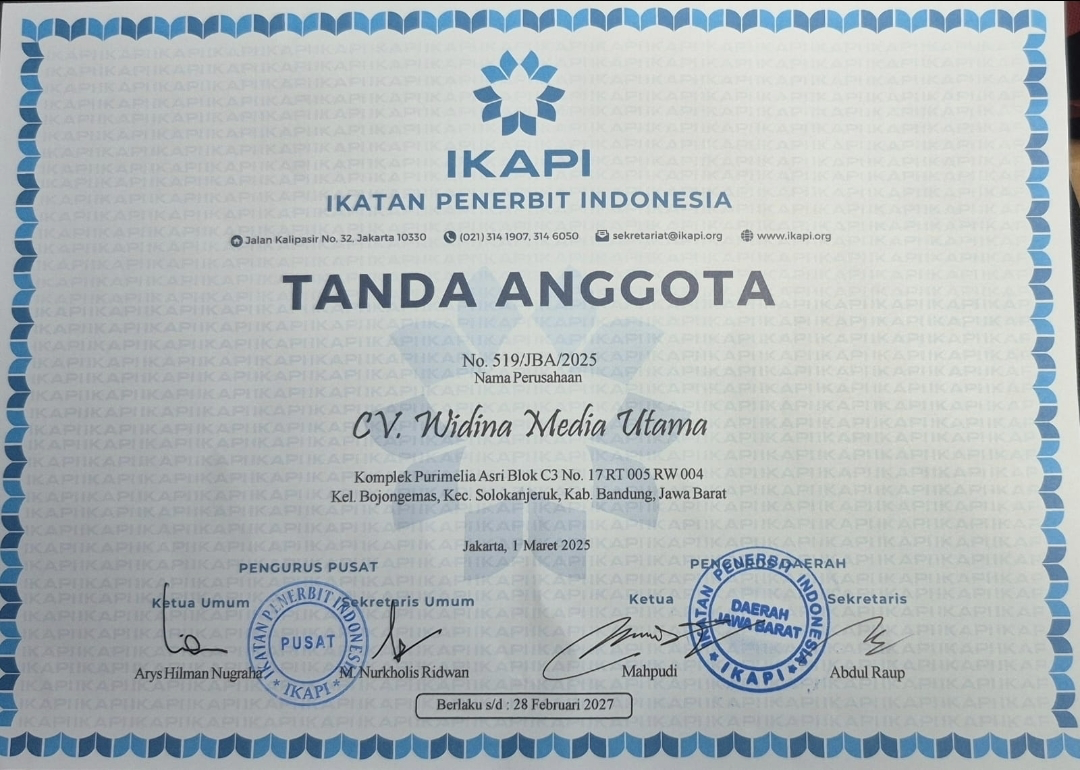
PERILAKU ORGANISASI TERPADU: DARI KONSEP DIRI HINGGA TRANSFORMASI GLOBAL
Keywords:
Perilaku Organisasi (Organizational Behavior), Konsep Diri (Self-concept), Kepemimpinan Transformasional (Transformational Leadership)Synopsis
Buku ini menghadirkan pendekatan holistik dalam memahami perilaku organisasi, dimulai dari fondasi paling mendasar yaitu konsep diri individu. Penulis mengupas bagaimana kesadaran diri, nilai-nilai personal, dan persepsi membentuk pola interaksi seseorang di lingkungan kerja. Selanjutnya, pembahasan meluas ke dinamika kelompok, komunikasi, kepemimpinan, serta budaya organisasi yang memengaruhi efektivitas kolektif.
Yang membedakan buku ini adalah integrasinya antara teori klasik dan kontemporer dengan tantangan nyata era global. Pembaca diajak menelusuri bagaimana organisasi beradaptasi terhadap perubahan teknologi, keberagaman tenaga kerja, dan tuntutan transformasi digital. Bagian akhir menyoroti strategi manajemen perubahan lintas budaya, etika global, serta kepemimpinan transformasional yang mampu menjembatani visi lokal dengan eksekusi internasional.
Dengan studi kasus dari berbagai sektor dan kajian reflektif, buku ini tidak hanya menjadi pegangan akademis bagi mahasiswa manajemen, tetapi juga panduan praktis bagi para pemimpin dan praktisi HR. Tujuannya adalah menciptakan organisasi yang adaptif, berkelanjutan, dan berdaya saing tinggi tanpa kehilangan fondasi kemanusiaan dari kesadaran diri hingga aksi kolektif yang berdampak global.
Downloads
Download data is not yet available.
References
Adare HRM. (2024). Do you know what your employees really want? Adare International.
Affandi, M. Y., & Susanto, E. (2015). Pengaruh motivasi Alderfer ERG (existence, relatedness, growth) dan kepemimpinan yang memberdayakan terhadap loyalitas karyawan Gen Y [Tesis magister, Universitas Gadjah Mada]. UGM.
Ahmad Zaidi, S. H. (2016). The relationship between role overload, role conflict and role ambiguity on job stress among employees at Kementerian Perdagangan Dalam Negeri, Koperasi Dan Kepenggunaan Temerloh [Skripsi, Universiti Teknologi MARA Pahang].
Alblooshi, M., Alblooshi, S., & Alshamsi, S. (2024). Leaders' behavioral approach in the digital era: Task vs relationship. Journal of Organizational Effectiveness, 11(1), 135–161.
Alderfer, C. P. (1969). An empirical test of a new theory of human needs. Organizational Behavior and Human Performance, 4(2), 142–175.
Alderfer, C. P. (1972). Existence, relatedness, and growth: Human needs in organizational settings. Free Press.
Al-Khasawneh, A., Alshurideh, M., Al Kurdi, B., Salloum, S. A., & AlHamad, A. Q. (2024). A systematic literature review of soft skills in information technology education. Behavioral Sciences, 14(10), 894.
Allen, T. J. (1977). Managing the flow of technology: Technology transfer and the dissemination of technological information within the R&D organization. MIT Press.
Allport, G. W. (1961). Pattern and growth in personality. Holt, Rinehart and Winston.
Alo, O., & Arslan, A. (2022). The antecedents of leader–member exchange (LMX) relationships in African context: The influence of the supervisor's feedback delivery-tactic. International Journal of Organizational Analysis, 30(7), 1–19.
Ang, S., Van Dyne, L., Koh, C., Ng, K. Y., Templer, K. J., Tay, C., & Chandrasekar, N. A. (2007). Cultural intelligence: Its measurement and effects on cultural judgment and decision making, cultural adaptation and task performance. Management and Organization Review, 3(3), 335–371.
AOM Proceedings. (2025). The lonely road of injustice: How perceived unfairness influences knowledge hiding and well-being. Academy of Management Proceedings, 2025(1), 17250.
Aprinawati, Harahap, A. W., Aditya, F., Yazid, M. U., Prayoga, W., & Khaira, I. (2024). Analisis literatur tentang konsep dasar perilaku organisasi dan implikasi manajerialnya. INNOVATIVE: Journal Of Social Science Research, 4(5), 9049–9058.
Arni, M. (2005). Komunikasi organisasi. Bumi Aksara.
Ashkanasy, N. M., & Dorris, A. D. (2017). Organizational behavior. In Oxford Research Encyclopedia of Psychology. Oxford University Press.
Atiku, S. O., & Fields, Z. (2016). Multicultural orientations for 21st century global leadership. In Management Education for Global Leadership (pp. 28–51). IGI Global.
Azwar, S. (1995). Sikap manusia: Teori dan pengukurannya. Pustaka Pelajar.
Bagyo, Y., & Ratnasari, S. D. (2023). The quality of leader-member exchange, engagement, and performance: A systematic literature review. Journal of Economics, Finance and Management Studies, 6(8), 3927–3935.
Bamberger, P. A. (2023). Evidence for a negative loss spiral between co-worker social support and burnout: Can psychosocial safety climate break the cycle? Healthcare, 11(24), 3168.
Barkhordari Ahmadi, F., Esmaeeli, B., Shariat Moghani, S., Rahimi, R., & Shariati, K. (2023). A literature review of group decision-making: The case study of Delphi method. Medical Education Bulletin, 4(4), 823–832.
Barling, J. (1977). A critical review of the application of Maslow's motivation theory in industry. SA Journal of Industrial Psychology, 1–18.
Barrick, M. R., Mount, M. K., & Judge, T. A. (2001). Personality and performance at the beginning of the new millennium: What do we know and where do we go next? International Journal of Selection and Assessment, 9(1–2), 9–30.
Bartlett, C. A., & Ghoshal, S. (1990). Matrix management: Not a structure, a frame of mind. Harvard Business Review, 68(4), 138–145.
Bauer, T. N., & Erdogan, B. (Eds.). (2016). The Oxford handbook of leader-member exchange. Oxford University Press.
Berkovich, I., Waked, J., Gumus, S., & Demathews, D. (2025). Meeting students' motivational needs based on Maslow's framework in challenging contexts: The role of integrated leadership in advancing social justice. International Journal of Leadership in Education. Advance online publication.
Bernstein, E. S., & Turban, S. (2018). The impact of the 'open' workspace on human collaboration. Philosophical Transactions of the Royal Society B: Biological Sciences, 373(1753), 20170239.
Blanchard, K. H., Zigarmi, P., & Zigarmi, D. (1985). Leadership and the one minute manager: Increasing effectiveness through situational leadership. William Morrow.
Campbell, J. P., & Wiernik, B. M. (2015). The modeling and assessment of work performance. Annual Review of Organizational Psychology and Organizational Behavior, 2(1), 47–74.
Ceri-Booms, M., Curseu, P. L., & Oerlemans, L. A. G. (2020). Task and person-focused leadership behaviors and team performance: A meta-analysis. Human Resource Management Review, 30(4), 100717.
Chandler, A. D. (1962). Strategy and structure: Chapters in the history of the industrial enterprise. MIT Press.
Chen, Y.-Y., & Park, J. (2011, January 16). The effect of existence, relatedness, and growth needs on workforce retention in public child welfare [Paper presentation]. Society for Social Work and Research 15th Annual Conference, Tampa, FL, United States.
Cheng, S. (2025). Research on the EAP for middle-aged and elderly employees in private colleges based on Maslow's hierarchy of needs theory. In Proceedings of the 1st International Conference on Lifespan Innovation (ICLI 2025) (pp. 1–8). Atlantis Press.
Ciampa, V., & Steffens, N. K. (2024). Organizational justice and employee stress: The mediating role of ambivalent identification. Frontiers in Psychology, 15, 1260768. https://doi.org/10.3389/fpsyg.2024.1260768
Cohoon, J. (2010). Flatarchy. In Encyclopedia of management theory (pp. 291–292). Sage Publications.
Colquitt, J. A., LePine, J. A., & Wesson, M. J. (2019). Organizational behavior: Improving performance and commitment in the workplace (6th ed.). McGraw-Hill.
da Silva, L. F., de Oliveira, A. C., & Pereira, R. C. (2026). Hybrid leadership in multicultural contexts: A systematic literature review. Periodico Journal of Business and Management, 15(1), 45–67.
Daft, R. L. (2003). Management (6th ed.). South-Western.
Dansereau, F., Graen, G., & Haga, W. J. (1975). A vertical dyad linkage approach to leadership in formal organizations. Organizational Behavior and Human Performance, 13(1), 46–78.
Dawuda, A., Amadu, S., Adam, A.-R., Akabutu, C., Abdallah, M. H., & Fianku, B. (2026). Impact of leader-member exchange (LMX) on organizational performance: Synthesis of literature (2015–25). Oklahoma Humanities Research Journal, 11(1), 39–57.
Derue, D. S., Nahrgang, J. D., Wellman, N., & Humphrey, S. E. (2011). Trait and behavioral theories of leadership: An integration and meta-analytic test of their relative validity. Personnel Psychology, 64(1), 7–52.
Desalegn, E. G., & Joao, M. (2024). Disentangling organizational agility from flexibility, adaptability, and versatility: A systematic review. Future Business Journal, 10(1).
Dewi, W. P., Baharsyah, N. A., Dewi, E. R., & Hartono, B. (2025). Perilaku organisasi: Literature review. Jurnal Kesehatan Tambusai, 6(1).
Dodel, M., & Mesch, G. (2023). Digital literacy, the use of collaborative technologies, and perceived social proximity in a hybrid work environment: Technology as a social binder. Technology in Society, 75, 102321.
Ebbesen, E. B., Kjos, G. L., & Konecni, V. J. (1976). Spatial ecology: Its effects on the choice of friends and enemies. Journal of Experimental Social Psychology, 12(6), 505–518.
Elgeka, H. W. S., Hidayat, R., & Pratono, A. H. (2026). Psychometric validation of the Existence, Relatedness, and Growth (ERG) scale for Indonesian generation Z employees. BMC Psychology.
Elkington, J. (1997). Cannibals with forks: The triple bottom line of 21st century business. Capstone Publishing.
Encyclopedia of Psychology. (2025). Existence, relatedness, and growth theory (ERG theory): Foundations and application. In Encyclopedia of Psychology.
Espinosa, J. A., Pickering, C., & Cummings, J. N. (2007). The spatial, temporal, and configurational characteristics of geographic dispersion in teams. MIS Quarterly, 31(3), 433–452.
Evans, C. R., & Dion, K. L. (1991). Group cohesion and performance: A meta-analysis. Small Group Research, 22(2), 175–186.
Excelsior University. (2019, May 15). The psychology behind personality tests.
Festinger, L., Schachter, S., & Back, K. (1950). Social pressures in informal groups: A study of human factors in housing. Harper.
Fiedler, F. E. (1967). A theory of leadership effectiveness. McGraw-Hill.
Fiedler, F. E. (1978). The contingency model and the dynamics of the leadership process. Advances in Experimental Social Psychology, 11, 59–112.
Forsyth, D. R. (2019). Group dynamics (7th ed.). Cengage.
Frei-Landau, R., & Levin, O. (2023). Simulation-based learning in teacher education: Using Maslow's Hierarchy of needs to conceptualize instructors' needs. Frontiers in Psychology, 14, Article 1149576.
Gao, S. (2023). Analysis of Maslow's hierarchy theory in today's team management. In H. Mallick et al. (Eds.), Proceedings of the 2022 4th International Conference on Economic Management and Cultural Industry (ICEMCI 2022) (pp. 1106–1112). Atlantis Press.
Geoffroy, F., & Francois, L. (2025). The 'big tools' – Do we still need to teach Maslow's hierarchy of needs? Revue Francaise de Gestion, 51(323), 235–254.
Gerhart, B. (2008). Cross-cultural management research: Assumptions, evidence and suggested directions. International Journal of Cross Cultural Management, 8(3), 259–274.
Gilley, A., Gilley, J. W., & McMillan, H. S. (2010). Leadership competencies for implementing planned organizational change. The Leadership Quarterly, 21(3), 422–438.
Gottlieb, T., & Gotzsche-Astrup, O. (2020). Personality and work-related outcomes through the prism of socioanalytic theory: A review of meta-analyses. Nordic Psychology, 72(4), 346–362.
Graen, G. B., & Uhl-Bien, M. (1995). Relationship-based approach to leadership: Development of leader-member exchange (LMX) theory of leadership over 25 years: Applying a multi-level multi-domain perspective. The Leadership Quarterly, 6(2), 219–247.
Green, M. J. (2024). Adaptation vs authenticity: Achieving leader effectiveness in intercultural encounters with followers – towards an integrated model. International Journal of Cross Cultural Management, 24(2), 189–208.
Greenberg, J., & Baron, R. A. (2003). Behavior in organizations: Understanding and managing the human side of work (8th ed.). Prentice Hall.
Griffin, R. W., & Moorhead, G. (2010). Organizational behavior: Managing people and organizations (9th ed.). South-Western Cengage Learning.
Guo, J., Argote, L., Kush, J., & Park, J. (2023). Communication networks and team performance: Selecting members to network positions. Frontiers in Psychology, 14.
Haekal, M. A., & Mas'ud, F. (2025). Adaptasi karyawan terhadap budaya inovasi perusahaan (Studi kasus PT Spilla Kreasi Kriya) [Undergraduate thesis, Universitas Diponegoro].
Hall, R. H. (2002). Organizations: Structures, processes, and outcomes (8th ed.). Prentice Hall.
Hamidi, A. (2024). Embracing complexity: Descaling organisations to enhance influence. LinkedIn Article.
Harb, S. I., Tao, L., & Pelaez, S. (2021). Methodological options of the nominal group technique for survey item elicitation in health research: A scoping review. Journal of Clinical Epidemiology, 139, 140–148.
Hauschild, V. D., De Groot, D. W., Hall, S. M., Grier, T. L., Deaver, K. D., Hauret, K. G., & Jones, B. H. (2017). Fitness tests and occupational tasks of military interest: A systematic review of correlations. Occupational and Environmental Medicine, 74(2), 144–153.
Heiserman, N., Chin, L., & Overton, J. G. (2019). Communication breakdown: The importance of status coordination norms for group cohesion. Conference Papers – American Sociological Association, 1–19.
Hersey, P., & Blanchard, K. H. (1988). Management of organizational behavior: Utilizing human resources (5th ed.). Prentice-Hall.
Hill, C. W. L., & Jones, G. R. (2007). Strategic management: An integrated approach (7th ed.). Houghton Mifflin.
Hofstede, G. (2001). Culture's consequences: Comparing values, behaviors, institutions, and organizations across nations (2nd ed.). Sage Publications.
Hofstede, G. (2011). Dimensionalizing cultures: The Hofstede model in context. Online Readings in Psychology and Culture, 2(1).
Holzwarth, S., Gunnesch-Luca, G., Soucek, R., & Moser, K. (2020). How communication in organizations is related to foci of commitment and turnover intentions. Journal of Personnel Psychology, 19(4), 1–12.
Homans, G. C. (1950). The human group. Harcourt, Brace.
Hornsey, M. J., Jetten, J., McAuliffe, B. J., & Hogg, M. A. (2006). The impact of individualist and collectivist group norms on evaluations of dissenting group members. Journal of Experimental Social Psychology, 42(1), 57–68.
House, R. J., Hanges, P. J., Javidan, M., Dorfman, P. W., & Gupta, V. (Eds.). (2004). Culture, leadership, and organizations: The GLOBE study of 62 societies. Sage Publications.
Humaeriah, H. (2015). Pengaruh kemampuan intelektual dan kemampuan fisik pegawai terhadap kinerja karyawan di kantor pusat Disnakertrans Provinsi Jawa Barat. Jurnal Ilmu Manajemen dan Bisnis, 6(1), 1–12.
Ilies, R., Nahrgang, J. D., & Morgeson, F. P. (2007). Leader-member exchange and citizenship behaviors: A meta-analysis. Journal of Applied Psychology, 92(1), 269–277.
Irving, G. L. (2016). Collaboration in open-plan offices [Doctoral dissertation, The University of Queensland].
Ishak, R., Madani, M., & Tahir, N. (2025). Motivasi kerja pegawai di PT. Firman Mulya Jaya Kota Makassar. Kajian Ilmiah Mahasiswa Administrasi Publik (KIMAP), 6(1), 29–52.
Janis, I. L. (1972). Victims of groupthink: A psychological study of foreign-policy decisions and fiascoes. Houghton Mifflin.
Jaramillo, F., Mulki, J. P., & Boles, J. S. (2011). Workplace stressors, job attitude, and job behaviors: Is interpersonal conflict the missing link? Journal of Personal Selling & Sales Management, 31(3), 339–356.
Jarvenpaa, S. L., & Leidner, D. E. (1999). Communication and trust in global virtual teams. Organization Science, 10(6), 791–815.
Javidan, M., Dorfman, P. W., De Luque, M. S., & House, R. J. (2006). In the eye of the beholder: Cross cultural lessons in leadership from Project GLOBE. Academy of Management Perspectives, 20(1), 67–90.
Javidan, M., House, R. J., Dorfman, P. W., Hanges, P. J., & Sully de Luque, M. (2006). Conceptualizing and measuring cultures and their consequences: A comparative review of GLOBE's and Hofstede's approaches. Journal of International Business Studies, 37(6), 897–914.
Jiang, Z., Liu, Z., & Wang, Y. (2023). Implementation of a motivational programme based on existence-relatedness-growth theory in nursing undergraduate interns: A quasi-experimental study. Nurse Education Today, 129, Article 105894.
Johnson, D. W., & Johnson, F. P. (2005). Joining together: Group theory and group skills (9th ed.). Pearson Education.
Jones, G. R. (2013). Organizational theory, design, and change (7th ed.). Pearson.
Joseph, J., & Sengul, M. (2025). Organization design: Current insights and future research directions. Journal of Management, 51(1), 1–45.
Kara, M., Papila, I., & Koc, S. (2018). Multidimensional comprehensive corporate sustainability performance evaluation model: Evidence from an emerging market banking sector. Journal of Cleaner Production, 185, 600–609.
Kebutuhan Maslow: Upaya peningkatan motivasi kerja ditinjau dari perspektif teori kebutuhan Maslow yang dilakukan perusahaan jasa konstruksi anggota Gapensi Kab. Kebumen. (2016). Repository Universitas Muhammadiyah Yogyakarta, 1–163.
Korzenny, F. (1978). A theory of electronic propinquity: Mediated communication in organizations. Communication Research, 5(1), 3–24.
Koutalas, E., Kostares, E., Antonakos, I., & Siafaka, V. (2024). The Existence-Relatedness-Growth theory for job satisfaction and motivation of Greek National Healthcare Service employees in the context of severe financial constraints. Cureus, 16(6), e62738.
Kumar, S., Raj, R., Salem, I., Singh, E. P., Goel, K., & Bhatia, R. (2023). The interplay of organisational culture, transformational leadership and organisation innovativeness: Evidence from India. Asian Business & Management, 22(2), 180–210.
Kuran, O., Khabbaz, L., & Nehme, Z. (2025). Leading change: Practical and contextual approaches. International Journal of Organizational Analysis. Emerald.
Le Fevre, M., Kolt, G. S., & Matheny, J. (2006). Eustress, distress, and their interpretation in primary and secondary occupational stress management interventions: Which way first? Journal of Managerial Psychology, 21(6), 547–565.
Lepeley, M.-T., Beutell, N. J., Abarca, N., & Majluf, N. (Eds.). (2021). Soft skills for human centered management and global sustainability. Routledge.
Liden, R. C., Sparrowe, R. T., & Wayne, S. J. (1997). Leader-member exchange theory: The past and potential for the future. In G. R. Ferris (Ed.), Research in personnel and human resources management (Vol. 15, pp. 47–119). JAI Press.
Lisak, A., & Harush, R. (2021). Global and local identities on the balance scale: Predicting transformational leadership and effectiveness in multicultural teams. Journal of International Business Studies, 52(4), 745–762.
Lloyd, J. B. (2022). Seeking truth in personality science: Reconciling trait theory and psychological type. Mental Health, Religion & Culture, 25(9), 817–828.
lmsspada.kemdikbud.go.id. (n.d.). Persepsi selektif dalam perilaku organisasi.
lmsspada.kemdiktisaintek.go.id. (2024, October 24). Uraian materi: Konsep kepribadian.
Lojeski, K. S. (2020). The power of virtual distance: A guide to productivity and happiness in the age of remote work (2nd ed.). Wiley.
Luthans, F. (2011). Organizational behavior: An evidence-based approach (12th ed.). McGraw-Hill.
Maio, G. R., & Olson, J. M. (1998). Values as truisms: Evidence and implications. Journal of Personality and Social Psychology, 74(2), 294–311.
Marczak, E., & Yawson, R. (2021). Understanding the theories and interventions of motivation in organization development. In Responsible management: Opportunities and challenges. Proceedings of 58th Annual Conference of the Eastern Academy of Management (pp. 25–46). Eastern Academy of Management.
Mark, G. (2000). Some challenges facing virtually colocated teams. In R. Baskerville, J. Stage, & J. Degross (Eds.), Organizational and social perspectives on information technology (pp. 391–407). Springer.
Martin, J. (2018). Profiting from multiple intelligences in the workplace. Routledge. (Original work published 2000)
Maslow, A. H. (1943). A theory of human motivation. Psychological Review, 50(4), 370–396.
McConnell, J., & Metz, K. (2025). Investigating the progression of Maslow's needs among traditional, remote, and hybrid-setting employees. SAM Advanced Management Journal, 90(2), 15–32.
McPherson, M., Smith-Lovin, L., & Cook, J. M. (2001). Birds of a feather: Homophily in social networks. Annual Review of Sociology, 27(1), 415–444.
McSweeney, B. (2002). Hofstede's model of national cultural differences and their consequences: A triumph of faith – a failure of analysis. Human Relations, 55(1), 89–118.
Meyer, J. W., & Rowan, B. (1977). Institutionalized organizations: Formal structure as myth and ceremony. American Journal of Sociology, 83(2), 340–363.
Miller, K., Barbour, J., & Woo, D. (2024). Organizational communication: Approaches and processes (8th ed.). Cengage Learning.
Miner, J. B. (2007). Organizational behavior: From theory to practice. M.E. Sharpe.
Mintzberg, H. (1979). The structuring of organizations. Prentice-Hall.
Mitchell, R. J., & Boyle, B. (n.d.). A theoretical model of transformational leadership's role in diverse teams. Macquarie University.
Moorhead, G., & Griffin, R. W. (2013). Organizational behavior: Managing people and organizations (11th ed.). Cengage Learning.
Mueller, D. J. (1986). Measuring social attitudes: A handbook for researchers and practitioners. Teachers College Press.
Mullen, B., Johnson, C., & Salas, E. (1991). Productivity loss in brainstorming groups: A meta-analytic integration. Basic and Applied Social Psychology, 12(1), 3–23.
Muller, M. S. (2025). The relationship between transformational leadership and belonging in hybrid work environments: Propinquity as a moderator [Master's thesis, Iscte – Instituto Universitario de Lisboa].
Murnighan, J. K., & Conlon, D. E. (1991). The dynamics of intense work groups: A study of British string quartets. Administrative Science Quarterly, 36(2), 165–186.
Murphy, K. R. (1989). Is the relationship between cognitive ability and job performance stable over time? Human Performance, 2(3), 183–200.
Newcomb, T. M. (1961). The acquaintance process. Holt, Rinehart and Winston.
Nijstad, B. A., & Stroebe, W. (2006). How the group affects the mind: A cognitive model of idea generation in groups. Personality and Social Psychology Review, 10(3), 186–213.
Northouse, P. G. (2021). Leadership: Theory and practice (9th ed.). Sage Publications.
Northouse, P. G. (2022). Leadership: Theory and practice (9th ed.). SAGE Publications.
Oberlaender, M., Beinicke, A., & Bipp, T. (2026). Technological knowledge, soft skills and management & leadership skills: Three pillars for the digitally competent manager. Journal of Business Economics, 96, 489–512.
Open.Maricopa.edu. (n.d.). 8.3 Attitudes, attributions, and biases. In The connected mind.
OpenStax. (2019). 18.3 Buffering effects of work-related stress. In Organizational behavior. OpenStax.
OpenStax. (2019). Organizational behavior. OpenStax, Rice University.
OpenTextBC. (2014, October 17). Introduction to psychology – 1st Canadian edition: Chapter 12 summary.
Otero, P., Fernandez-del-Rio, E., & Garcia-Alvarez, D. (2025). A meta-analysis of the relationship between cognitive intelligence and the big five assessed by quasi-ipsative forced-choice personality inventories: Implications for predicting job performance. Revista de Psicologia del Trabajo y de las Organizaciones, 41(1), 19–26.
Penagos Guzman, F., Hernandez Castorena, O., & Garcia Solarte, M. (2023). Managerial skills and organizational performance: Competitive advantage. Mercados y Negocios, (48), 75–94.
Penn State University World Campus. (2016). Lesson 2: Alderfer's ERG theory. PSYCH 484: Work Attitudes and Job Motivation.
Penn State University. (n.d.). Lesson 2: Perception and attribution. World Campus.
Pennsylvania State University. (n.d.). Lesson 2: Perception and attribution. World Campus.
Price-Williams, D. R. (2013). Personality. In Introductory psychology. Taylor & Francis.
Psikologi UMA. (2024, October 14). Psikologi kepribadian: Memahami tipe-tipe kepribadian dan pengaruhnya terhadap perilaku.
Puli, S., & Kamonrojsiri, P. (2025). The relationship between personal factors, ERG theory motivation factors and employee job satisfaction of Xuzhou Zhongjin Shantytown Reconstruction and Construction Co., Ltd. Benjamit Academic Conference Proceedings, 15(1), 267–274.
Putra, A., Jatmiko, & Hermanto. (2019). Triple bottom line model towards sustainability report. 6th International Conference on Business, Economics and Social Sciences (ICBESS).
Rahardja. (2025). Nilai, persepsi dan sikap individu. Universitas Raharja.
Reagans, R. (2011). Close encounters: Analyzing how social similarity and propinquity contribute to strong network connections. Organization Science, 22(4), 835–849.
Reisberger, T., Reisberger, P., Copus, L., Madzik, P., & Falat, L. (2023). Organizational culture and digital transformation. Strategic Direction, 39(6), 7–9.
Robbins, S. P. (2003). Organizational behavior (10th ed.). Prentice Hall.
Robbins, S. P. (2006). Perilaku organisasi (Edisi 10). PT. Indeks. (Terjemahan dari Organizational behavior).
Robbins, S. P., & Judge, T. A. (2008). Organizational behavior (13th ed.). Pearson Prentice Hall.
Robbins, S. P., & Judge, T. A. (2019). Organizational behavior (18th ed.). Pearson.
Rockstuhl, T., Dulebohn, J. H., Ang, S., & Shore, L. M. (2012). Leader-member exchange (LMX) and culture: A meta-analysis of correlates of LMX across 23 countries. Journal of Applied Psychology, 97(6), 1097–1130.
Rockstuhl, T., Ng, K. Y., & Ang, S. (2025). Stability and plasticity in personality: A meta-analytic investigation of their influence on cultural intelligence and five forms of job performance. Applied Psychology, 74(1).
Roger, A., & Vinot, D. (2019). Skills management: New applications, new questions. Wiley-ISTE.
Romli, K. (2014). Komunikasi organisasi lengkap (Edisi Revisi). PT Gramedia.
Romy, E., & Ardansyah, M. (2023). Teori dan perilaku organisasi. Penerbit Elibrary UINSGD.
Rousseau, K. (2023). What can workplace design practitioners learn from human psychology? Work Design Magazine, 12(3), 2–8.
Rudolph, C. W., & Zacher, H. (2018). Concerns about change and employee wellbeing: The moderating role of social support. Journal of Organizational Change Management, 31(5), 1123–1140.
Sackett, P. R., Demeke, S., Bazian, I. M., Griebie, A. M., Priest, R., & Kuncel, N. R. (2023). A contemporary look at the relationship between general cognitive ability and job performance. Journal of Applied Psychology, 109(5), 639–656.
Sackett, P. R., Zhang, C., Berry, C. M., & Lievens, F. (2022). Revisiting meta-analytic estimates of validity in personnel selection: Addressing systematic overcorrection for restriction of range. Journal of Applied Psychology, 107(11), 1881–1905.
Saif, G. B. D. (2024). Towards a dynamic model of human needs: A critical analysis of Maslow's hierarchy. International Journal of Multidisciplinary Approach Research and Science, 2(03), 1028–1046.
Sarker, S., & Sarker, S. (2015). Organizational agility. In Wiley encyclopedia of management (3rd ed., Vol. 7, pp. 1–5). Wiley.
Scandura, T. A., & Meuser, J. D. (2022). Relational dynamics of leadership: Problems and prospects. Annual Review of Organizational Psychology and Organizational Behavior, 9, 309–337.
Schachter, S. (1951). Deviation, rejection, and communication. The Journal of Abnormal and Social Psychology, 46(2), 190–207.
Schmidt, F. L., & Hunter, J. E. (1998). The validity and utility of selection methods in personnel psychology: Practical and theoretical implications of 85 years of research findings. Psychological Bulletin, 124(2), 262–274.
ScienceDirect. (2025, June 6). The polygenic and poly-environmental nature of personality.
ScienceOpen. (n.d.). Introduction to personality trait differences.
Sebrina, N., Taqwa, S., Afriyenti, M., & Septiari, D. (2022). Analysis of sustainability reporting quality and corporate social responsibility on companies listed on the Indonesia stock exchange. Cogent Business & Management, 10(1), 2157975.
Selye, H. (1956). The stress of life. McGraw-Hill.
Setyaningrum, R. P., Muafi, M., Hermawati, N. F., & Widyastuti, T. (2025). Cultural diversity in top management teams: A multigroup study on leadership and performance. SA Journal of Human Resource Management, 23.
SHRM. (2025). It's likely you have a toxic workplace. Now what? All Things Work.
Sianturi, S. S., Irsan, T. A., & Rino, R. (2025). Adaptation to organizational change as a determinant of successful performance. Jambura Economic Education Journal, 7(4), 1231–1255.
Sidin, A. I., Della, R. H., & Herno Della, R. (2021). Perilaku organisasi. Literasi Nusantara.
Siregar, H. J., Purba, A. D. X., Yusuf, M., Sudaryat, R., & Sumitro, S. (2025). Perubahan manajemen dan budaya organisasi. Jurnal Ilmiah Manajemen dan Pendidikan.
Sjöberg, A., & Sjöberg, S. (2025). General cognitive ability and job performance in personnel selection in Sweden: A meta-analysis. Economic and Industrial Democracy, 46(3), 830–850.
Sosa, M., & Maoret, M. (2024). Collaboration requires proximity – But it doesn't have to be physical. INSEAD Knowledge.
Sritaweesap, K. (2024). How do benefit and welfare reductions impact job satisfaction among high-level executives? [Thematic paper, Mahidol University]. Mahidol University Archive.
Stahl, G. K., Maznevski, M. L., Voigt, A., & Jonsen, K. (2010). Unraveling the effects of cultural diversity in teams: A meta-analysis of research on multicultural work groups. Journal of International Business Studies, 41(4), 690–709.
Stanbul, I. (2024). Research on the motivational factors of information technologies department employees in the context of Abraham Harold Maslow's hierarchy of needs. Journal of Organizational Psychology and Management, 15(2), 3–16.
Steiner, I. D. (1972). Group process and productivity. Academic Press.
Stepanek, S., & Paul, M. (2022). Role stress. Umbrella Summaries, Article 8. University of Nebraska–Lincoln.
Stringer, C., Bryning, L., Spencer, L. H., Anthony, B., Ezeofor, V., Lawrence, C., & Edwards, R. T. (2024). Well-being of the workforce. In R. T. Edwards & C. L. Lawrence (Eds.), Health economics of well-being and well-becoming across the life-course (pp. 231–279). Oxford University Press.
Strube, M. J., & Garcia, J. E. (1981). A meta-analytic investigation of Fiedler's contingency model of leadership effectiveness. Psychological Bulletin, 90(2), 307–321.
Sutarto. (1991). Dasar-dasar organisasi (Cetakan ke-14). Gadjah Mada University Press.
Sy Tch, M., & Wohlgezogen, F. (2026). Solving the integration challenge: A review of research and best practices for high-performance matrix organisations (JRC145912). Publications Office of the European Union.
Syamsul Hadi, M. S., Kurniawan, I. S., & Silvia, M. (2025). The role of role overload, role conflict, and role ambiguity in job stress. Proceedings of the 4th International Conference on Global Education and Management Technology (ICoGEMT-4).
Thoha, M. (2006). Perilaku organisasi: Konsep dasar dan aplikasinya. Rajawali Pers.
Thompson, G., & Vecchio, R. P. (2009). Situational leadership theory: A test of three versions. The Leadership Quarterly, 20(5), 837–848.
Tinsley, L. (n.d.). Employee abilities and skills. In Introduction to management and organizational behavior. University of Houston Libraries.
Torka, A. K., Mazei, J., & Huffmeier, J. (2021). Together, everyone achieves more—or, less? An interdisciplinary meta-analysis on effort gains and losses in teams. Psychological Bulletin, 147(5), 504–534.
TriplePundit. (2025, November 5). 20 years older, any wiser?
Tuckman, B. W. (1965). Developmental sequence in small groups. Psychological Bulletin, 63(6), 384–399.
Tuckman, B. W., & Jensen, M. A. C. (1977). Stages of small-group development revisited. Group & Organization Studies, 2(4), 419–427.
Tuleja, E. A., & Schachner, M. (2020). From shared values to cultural dimensions. In The Cambridge handbook of intercultural communication (pp. 95–114). Cambridge University Press.
Tuncer, S., & Licoppe, C. (2018). Open door environments as interactional resources to initiate unscheduled encounters in office organizations. Culture and Organization, 24(1), 11–30.
Tushman, M. L., & O'Reilly, C. A. (1996). Ambidextrous organizations: Managing evolutionary and revolutionary change. California Management Review, 38(4), 8–30.
UGM. (2025, October 20). Membangun persepsi bijak untuk keputusan berkualitas. Magister Manajemen Pendidikan Tinggi, Universitas Gadjah Mada.
Van den Broeck, A., Vleugels, W., & Toth-Kiraly, I. (2024). Psychological need satisfaction, frustration, and unfulfillment profiles in the workplace: Their nature, predictors, and outcomes. Journal of Vocational Behavior, 138, Article 103770.
van Knippenberg, D., & Schippers, M. C. (2007). Work group diversity. Annual Review of Psychology, 58, 515–541.
Vasquez-Penaloza, L., Sanchez-Exposito, M. J., & Gomez-Ruiz, L. (2025). Exploring linkages between social diversity, management control, and team performance: An integrative literature review. Journal of Accounting & Organizational Change, 21(5), 893–914.
Venkatesh, B., & Ram, N. (2015). Eustress: A unique dimension to stress management. Working Paper.
Verhoef, P. C. (2021). Digital transformation and agile organizing. Journal of Business Research, 134, 671–680.
Volberda, H. W. (1996). Toward the flexible form: How to remain vital in hypercompetitive environments. Organization Science, 7(4), 359–374.
Wagner, J. A., III, & Hollenbeck, J. R. (2004). Organizational behavior: Securing competitive advantage (5th ed.). Prentice Hall.
Walgiro, B. (2010). Pengantar psikologi umum. Andi Offset.
Walther, J. B., & Bazarova, N. N. (2008). Validation and application of electronic propinquity theory to computer-mediated communication in groups. Communication Research, 35(5), 622–645.
Wang, S., Sun, J., & Liden, R. C. (2016). Leader-member exchange. In Oxford Bibliographies. Oxford University Press.
Weber, M. (1947). The theory of social and economic organization (T. Parsons, Ed.). Free Press.
Wei, Z., & Ma, Y. (2022). The limitation and optimization of Maslow's hierarchy of needs theory in enterprises' application. BCP Business & Management, 1–5.
Weick, K. E. (1976). Educational organizations as loosely coupled systems. Administrative Science Quarterly, 21(1), 1–19.
Wiernik, B. M., & Ones, D. S. (2018). Structure of physical performance in occupational tasks. Journal of Applied Psychology, 103(8), 875–896.
Woods, D. D., & Hollnagel, E. (2005). Joint cognitive systems: Patterns in cognitive systems engineering. CRC Press.
Yang, C., Chen, Y., Chen, A., & Ahmed, S. J. (2023). The integrated effects of leader–member exchange social comparison on job performance and OCB in the Chinese context. Frontiers in Psychology, 14, 1112345.
Yang, Y., & Ling, Q. (2023). The influence of existence–relatedness–growth need satisfaction and job burnout of young university teachers: The mediating role of job satisfaction. Frontiers in Psychology, 14, Article 1205742.
Yarbrough, J. W., & Ramos Salazar, L. (2024). How employees' motivated needs relate to employees' personal and workplace spirituality. Journal of Organizational Effectiveness: People and Performance, 11(3), 28–42.
Yukl, G., & Gardner, W. L. (2020). Leadership in organizations (9th ed.). Pearson.
Yurdakul, G., & Arar, T. (2023). Revisiting Maslow's hierarchy of needs: Is it still universal content? Journal of Human Behavior in the Social Environment, 33(8), 1103–1130.
Zajonc, R. B. (1968). Attitudinal effects of mere exposure. Journal of Personality and Social Psychology, 9(2, Pt.2), 1–27.
Zhang, W., et al. (2023). Understanding how organizational culture affects innovation performance: A management context perspective.
Zhang, Y., Zhang, C., & Liu, M. (2022). Effects of top-down, bottom-up, and horizontal communication on organizational commitment: Evidence from Chinese internet firms. IEEE Transactions on Professional Communication, 65(3), 411–426.
Downloads
Published
August 6, 2026
Copyright (c) 2026 Rouly G Ratna S, Roce Marsaulina, Ismaniah Ismaniah (Author)
License

This work is licensed under a Creative Commons Attribution-NonCommercial-ShareAlike 4.0 International License.
How to Cite
Rouly G Ratna S, Roce Marsaulina, & Ismaniah Ismaniah. (2026). PERILAKU ORGANISASI TERPADU: DARI KONSEP DIRI HINGGA TRANSFORMASI GLOBAL. Widina Media Utama. https://doi.org/10.59818/fd9qyp73