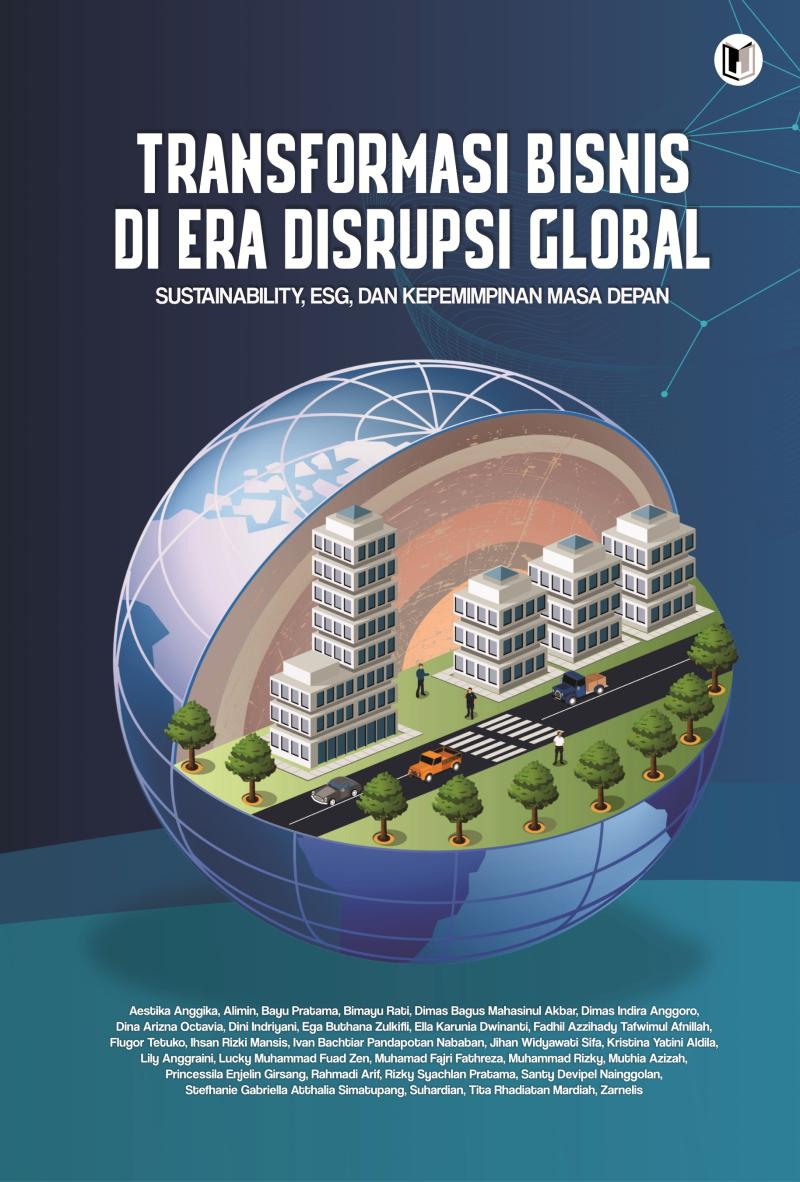
TRANSFORMASI BISNIS DI ERA DISRUPSI GLOBAL: SUSTAINABILITY, ESG, DAN KEPEMIMPINAN MASA DEPAN
Keywords:
Manajemen dan BisnisSynopsis
Disrupsi global yang dipicu oleh kemajuan teknologi, perubahan iklim, dinamika geopolitik, serta meningkatnya tuntutan masyarakat terhadap praktik bisnis yang bertanggung jawab telah mengubah paradigma pengelolaan organisasi di berbagai sektor. Perusahaan tidak lagi hanya berorientasi pada pencapaian keuntungan finansial, tetapi juga dituntut mampu menciptakan nilai jangka panjang melalui penerapan prinsip keberlanjutan (sustainability), tata kelola yang baik, tanggung jawab sosial, serta kepemimpinan yang adaptif terhadap perubahan. Dalam konteks tersebut, konsep Environmental, Social, and Governance (ESG) telah berkembang menjadi salah satu fondasi utama dalam membangun daya saing bisnis yang berkelanjutan di tingkat nasional maupun global.
Buku "Transformasi Bisnis di Era Disrupsi Global: Sustainability, ESG, dan Kepemimpinan Masa Depan" disusun sebagai referensi komprehensif yang membahas perubahan lanskap bisnis modern beserta strategi organisasi dalam menghadapi tantangan dan peluang di era transformasi digital dan ekonomi berkelanjutan. Pembahasan diawali dengan kajian mengenai karakteristik disrupsi global, perubahan model bisnis, perkembangan ekonomi digital, serta faktor-faktor yang mendorong organisasi untuk melakukan transformasi secara menyeluruh agar tetap kompetitif di tengah lingkungan bisnis yang dinamis.
Selanjutnya, buku ini mengupas konsep keberlanjutan sebagai strategi bisnis jangka panjang yang mengintegrasikan aspek ekonomi, sosial, dan lingkungan dalam setiap proses pengambilan keputusan. Pembahasan mengenai ESG disajikan secara sistematis, meliputi prinsip-prinsip dasar, indikator kinerja, tata kelola perusahaan, manajemen risiko, kepatuhan regulasi, transparansi pelaporan keberlanjutan, serta kontribusinya terhadap peningkatan nilai perusahaan, kepercayaan pemangku kepentingan, dan keberlangsungan usaha.
Selain aspek keberlanjutan, buku ini juga membahas pentingnya inovasi sebagai penggerak transformasi bisnis melalui pemanfaatan teknologi digital, kecerdasan buatan (artificial intelligence), analisis data, otomatisasi proses bisnis, ekonomi sirkular, dan model bisnis berbasis inovasi. Berbagai strategi adaptasi organisasi dijelaskan untuk membantu perusahaan meningkatkan efisiensi operasional, memperkuat ketahanan bisnis, serta menciptakan keunggulan kompetitif dalam menghadapi perubahan pasar yang berlangsung sangat cepat.
Downloads
Download data is not yet available.
References
Barney, J. (1991). Firm resources and sustained competitive advantage. Journal of Management, 17(1), 99-120.
Becker, G. S. (1964). Human Capital: A Theoretical and Empirical Analysis, with Special Reference to Education. Chicago: University of Chicago Press.
Herzberg, F., Mausner, B., & Snyderman, B. B. (1959). The Motivation to Work. New York: John Wiley & Sons.
SALIHIN. (2025). Capabilities Statement: Think Differently. Kuala Lumpur: SALIHIN International.
Verhoef, P. C., Broekhuizen, T., Bart, Y., Bhattacharya, A., Dong, J. Q., Fabian, N., & Haenlein, M. (2021). Digital transformation: A multidisciplinary reflection. Journal of Business Research, 122, 889–901. https://doi.org/10.1016/j.jbusres.2019.09.022
Whitman, M. E., & Mattord, H. J. (2021). Principles of Information Security (7th ed.). Boston, MA: Cengage Learning
Bansal, P., & Song, H. C. (2017). Similar but not the same: Differentiating corporate sustainability from corporate responsibility. Academy of Management Annals, 11(1), 105–149. https://doi.org/10.5465/annals.2015.0095
Bansal, P., Kistruck, G., & Eddleston, K. (2023). Sustainable development in organizations: Change management perspectives. Academy of Management Review, 48(3), 421–445.
Burnes, B. (2020). Managing change (8th ed.). Pearson Education.
By, R. T., Hughes, M., & Ford, J. (2022). Change leadership: Oxymoron and myths. Journal of Change Management, 22(1), 1–17.
Cameron, E., & Green, M. (2020). Making sense of change management: A complete guide to the models, tools and techniques of organizational change (5th ed.). Kogan Page.
Christensen, C. M., Ojomo, E., & Dillon, K. (2024). The prosperity paradox: How innovation can lift nations out of poverty (Updated ed.). Harper Business.
Christensen, C. M., Raynor, M. E., & McDonald, R. (2023). Disruptive innovation: An intellectual history and directions for future research. Harvard Business School Publishing.
Deloitte. (2024). ESG, change management, and organizational transformation. Deloitte Insights.
Dessler, G. (2023). Human resource management (17th ed.). Pearson Education.
Donaldson, L. (2021). The contingency theory of organizations (2nd ed.). SAGE Publications.
Eccles, R. G., Klimenko, S., & Ioannou, I. (2022). ESG integration and the investment process: A review of challenges and solutions. Journal of Applied Corporate Finance, 34(2), 16–27. https://doi.org/10.1111/jacf.12510
Eccles, R. G., Klimenko, S., & Serafeim, G. (2022). Corporate sustainability and ESG: From theory to practice. Journal of Applied Corporate Finance, 34(2), 8–17.
Elkington, J. (2020). Green swans: The coming boom in regenerative capitalism. Fast Company Press.
European Commission. (2021). Industry 5.0: Towards a sustainable, human-centric and resilient European industry. Publications Office of the European Union.
Forbes. (2025). The world’s billionaires. Forbes Magazine. https://www.forbes.com/billionaires/
Freeman, R. E., Dmytriyev, S., & Phillips, R. A. (2021). Stakeholder theory and the resource-based view of the firm. Journal of Management, 47(7), 1757–1770. https://doi.org/10.1177/0149206320957616
Friede, G., Busch, T., & Bassen, A. (2022). ESG and financial performance: New evidence and updated aggregation. Journal of Sustainable Finance & Investment, 12(4), 1093–1113.
Gond, J. P., El Akremi, A., Swaen, V., & Babu, N. (2022). The psychological microfoundations of sustainability change. Journal of Management Studies, 59(6), 1504–1538.
GoTo Group. (2023). About GoTo Group. https://www.gotocompany.com/about
Harvard Business Review. (2022). How leaders can manage change in the era of ESG. Harvard Business Publishing.
Hart, S. L., & Dowell, G. (2011). A natural-resource-based view of the firm: Fifteen years after. Journal of Management, 37(5), 1464–1479. https://doi.org/10.1177/0149206310390219
International Sustainability Standards Board. (2023). IFRS sustainability disclosure standards. IFRS Foundation.
Ivanov, D. (2021). Supply chain resilience: Viability-based supply chain management for surviving the COVID-19 pandemic. International Journal of Production Research, 59(12), 3535–3554. https://doi.org/10.1080/00207543.2020.1835124
Kotter, J. P. (2021). Change: How organizations achieve hard-to-imagine results in uncertain and volatile times. John Wiley & Sons.
Kotsantonis, S., & Serafeim, G. (2023). ESG reporting and data quality: Challenges and implications. Journal of Applied Corporate Finance, 35(1), 32–41.
La Torre, M., Sabelfeld, S., Blomkvist, M., & Dumay, J. (2023). Rebuilding trust: ESG as a change mechanism in organizations. Accounting, Auditing & Accountability Journal, 36(1), 1–28.
McKinsey Global Institute. (2022). The future of work after COVID-19. McKinsey & Company.
McKinsey & Company. (2023). The ESG premium: New perspectives on value and performance. McKinsey Global Institute.
Nahavandi, S. (2019). Industry 5.0—A human-centric solution. Sustainability, 11(16), 4371. https://doi.org/10.3390/su11164371
OECD. (2023). OECD guidelines for multinational enterprises on responsible business conduct. OECD Publishing.
OECD. (2023). OECD skills outlook 2023: Skills for a resilient green and digital transition. OECD Publishing. https://doi.org/10.1787/27452f29-en
Palmer, I., Dunford, R., & Buchanan, D. A. (2021). Managing organizational change: A multiple perspectives approach (4th ed.). McGraw-Hill Education.
Porter, M. E., & Kramer, M. R. (2019). Creating shared value. In G. Lenssen & N. Smith (Eds.), Managing sustainable business (pp. 323–346). Springer. https://doi.org/10.1007/978-94-024-1144-7_16
PwC. (2023). Embedding ESG into corporate transformation. PwC Global.
Rogers, E. M., Singhal, A., & Quinlan, M. M. (2024). Diffusion of innovations (6th ed.). Free Press.
Schwab, K., & Zahidi, S. (2023). The future of growth report 2023. World Economic Forum.
Schwab, K., & Zahidi, S. (2023). The global competitiveness report 2023: Technology, innovation, and disruption. World Economic Forum.
Senior, B., & Swailes, S. (2020). Organizational change (6th ed.). Pearson Education.
Strohmeier, S. (2020). Digital human resource management: A conceptual clarification. German Journal of Human Resource Management, 34(3), 345–365. https://doi.org/10.1177/2397002220921131
Teece, D. J. (2020). Fundamental issues in strategy: Time to reassess? Strategic Management Review, 1(1), 103–144. https://doi.org/10.1561/111.00000005
United Nations Global Compact. (2022). Integrating the SDGs into corporate strategy. United Nations.
United Nations Global Compact. (2023). Integrating the SDGs into corporate strategy. United Nations.
Vial, G. (2021). Understanding digital transformation: A review and a research agenda. Journal of Strategic Information Systems, 30(2), 101–120. https://doi.org/10.1016/j.jsis.2021.101647
Wikipedia contributors. (n.d.). List of oldest companies. Wikipedia. https://en.wikipedia.org/wiki/List_of_oldest_companies
World Economic Forum. (2023). Global risks report 2023 (18th ed.). World Economic Forum.
World Economic Forum. (2023). Measuring stakeholder capitalism: ESG metrics and disclosures. World Economic Forum.
Armstrong, M. (2014). Armstrong’s Handbook of Human Resource Management Practice. London: Kogan Page.
Barney, J. (1991). Firm resources and sustained competitive advantage. Journal of Management, 17(1), 99–120.
Deming, W. E. (1986). Out of the Crisis. Cambridge, MA: MIT Press.
Goetsch, D. L., & Davis, S. B. (2016). Manajemen Mutu for Organizational Excellence: Introduction to Total Manajemen Mutu. New York: Pearson.
ISO. (2015). ISO 9000: Manajemen Mutu Systems – Fundamentals and Vocabulary. Geneva: International Organization for Standardization.
Juran, J. M., & Godfrey, A. B. (1999). Juran’s Quality Handbook. New York: McGraw-Hill.
Robbins, S. P., & Coulter, M. (2018). Management. Boston: Pearson.
Buttle, F., & Maklan, S. (2019). Customer relationship management: Concepts and technologies (4th ed.). Routledge. https://doi.org/10.4324/9781351016551
Greenberg, P. (2020). CRM at the speed of light: Social CRM strategies, tools, and techniques for engaging your customers (5th ed.). McGraw-Hill Education.
Kotler, P., & Keller, K. L. (2016). Marketing management (15th ed.). Pearson Education.
Payne, A. (2012). Handbook of CRM: Achieving excellence in customer management. Butterworth-Heinemann.
Peppers, D., & Rogers, M. (2017). Managing customer experience and relationships: A strategic framework (3rd ed.). Wiley.
Turban, E., Pollard, C., & Wood, G. (2018). Information technology for management: On-demand strategies for performance, growth, and sustainability (11th ed.). Wiley.
Fatemi, A., Glaum, M., & Kaiser, S. (2018). ESG performance and firm value: The moderating role of disclosure. Global Finance Journal, 38, 45-64. doi:10.1016/j.gfj.2017.03.001.
Hart, S. L., & Dowell, G. (2011). A natural-resource-based view of the firm: Fifteen years after. Journal of Management, 37(5), 1464-1479.
Pratama, A. (2020). Sustainability Strategy and Corporate Performance: Evidence from Indonesian Listed Companies. Jurnal Akuntansi dan Keuangan, 22(2). (Sesuai untuk referensi lokal Indonesia).
Dauvergne, P. (2020). AI in the Wild: Sustainability in the Age of Artificial Intelligence. MIT Press.
AirAsia Management. (n.d.). 9.4 Case of AirAsia Berhad: Transformation to Capital A.
AirAsia Newsroom. (n.d.). The Beginning of a New Era: Divestment of airline business.
Capital A Berhad. (2024). Quarterly Balance Sheet: September 2024 Analysis.
Microsoft Corporation. (n.d.). 9.1 World Class Company: Vision and Mission Statements.
Organizational Behavior Research. (n.d.). 9. Organizational Culture Defined.
World Class Enterprises. (n.d.). 9.2 & 9.3 Core Values and Revenue Top 5
Iqbal, T. (2022). Key Stages of the Entrepreneurial Journey. Materi kuliah dan pengalaman praktis kewirausahaan.
Drucker, P. F. (1985). Innovation and Entrepreneurship. New York: Harper & Row.
Hisrich, R. D., Peters, M. P., & Shepherd, D. A. (2017). Entrepreneurship. New York: McGraw-Hill Education.
Kuratko, D. F. (2020). Entrepreneurship: Theory, Process, Practice. Boston: Cengage Learning
Aaker, D. A. (2014). Strategic market management (10th ed.). John Wiley & Sons.
Al Humairah, K., Yusuf, M., & Anwar, S. (2023). Crafting effective HRM strategies for enhancing organizational performance and employee engagement. Advances in Human Resource Management Research, 2(1), 22–35.
Armstrong, M. (2020). Armstrong’s handbook of human resource management practice (15th ed.). Kogan Page.
Becker, G. S. (1993). Human capital: A theoretical and empirical analysis, with special reference to education (3rd ed.). University of Chicago Press.
Chaffey, D. (2015). Digital marketing: Strategy, implementation and practice (6th ed.). Pearson Education.
Chartered Institute of Marketing. (2018). Marketing and the sustainable development goals. CIM Publishing.
Collings, D. G., & Mellahi, K. (2009). Strategic talent management: A review and research agenda. Human Resource Management Review, 19(4), 304–313. https://doi.org/10.1016/j.hrmr.2009.04.001
Ferrell, O. C., Fraedrich, J., & Ferrell, L. (2019). Business ethics: Ethical decision making and cases (12th ed.). Cengage Learning.
International Journal of Science and Management Studies. (2024). Human resource management practices, employees’ professional development, and work-life balance. IJSMS, 8(2), 118–125.
Junaidi, M., Putra, R. A., & Sari, D. P. (2023). Analysis of human resource management strategies in improving organizational performance. TARGET: Jurnal Manajemen Bisnis, 5(2), 145–156.
Kotler, P. (2019). Marketing 4.0: Moving from traditional to digital. John Wiley & Sons.
Kotler, P., & Keller, K. L. (2016). Marketing management (15th ed.). Pearson Education.
Kotler, P., & Sarkar, C. (2017). Finally, brand purpose. Marketing Journal, American Marketing Association.
Nagle, T. T., Hogan, J. E., & Zale, J. (2016). The strategy and tactics of pricing: A guide to growing more profitably (5th ed.). Routledge.
Putri, E. Y., Hidayat, R., & Prasetyo, A. (2021). Penerapan praktik manajemen sumber daya manusia dan hubungannya dengan kinerja karyawan. Jurnal Ekobis: Ekonomi, Bisnis & Manajemen, 11(2), 101–112.
SALIHIN International. (2024). About SALIHIN International. https://www.salihin.com
SALIHIN International. (2025). SALIHIN capabilities statement. https://www.salihin.com
SALIHIN International. (2025). SALIHIN capabilities statement. SALIHIN International
Senge, P. M. (2006). The fifth discipline: The art and practice of the learning organization (Revised ed.). Doubleday.
Wahyudi, A., Kurniawan, D., & Lestari, S. (2022). Manajemen sumber daya manusia berbasis kompetensi untuk meningkatkan produktivitas organisasi. Jurnal Ilmiah Ekonomi dan Manajemen, 9(1), 33–45.
Wright, P. M., & McMahan, G. C. (2011). Exploring human capital: Putting ‘human’ back into strategic human resource management. Human Resource Management Journal, 21(2), 93–104. https://doi.org/10.1111/j.1748-8583.2010.00165.x
Downloads
Published
July 30, 2026
Copyright (c) 2026 Aestika Anggika, Lily Anggraini, Lucky Muhammad Fuad Zen, Muhamad Fajri Fathreza, Muhammad Rizky, Muthia Azizah, Princessila Enjelin Girsang, Rahmadi Arif, Rahmadi Arif, Rizky Syachlan Pratama, Santy Devipel Nainggolan, Stefhanie Gabriella Atthalia Simatupang, Suhardian Suhardian, Tita Rhadiatan Mardiah, Kristina Yatini Aldila, Jihan Widyawati Sifa, Alimin Alimin, Bayu Pratama, Bimayu Rati, Dimas Bagus Mahasinul Akbar, Dimas Indira Anggoro, Dina Arizna Octavia, Dini Indriyani, Ega Buthana Zulkifli, Ella Karunia Dwinanti, Fadhil Azzihady Tafwimul Afnillah, Flugor Tetuko, Ihsan Rizki Mansis, Ivan Bachtiar Pandapotan Nababan, Zarnelis Zarnelis (Author)
License

This work is licensed under a Creative Commons Attribution-NonCommercial-ShareAlike 4.0 International License.
How to Cite
Anggika, A., Anggraini, L., Fuad Zen, L. M., Fajri Fathreza, M., Rizky, M., Azizah, M., Enjelin Girsang, P., Arif, R., Arif, R., Syachlan Pratama, R., Devipel Nainggolan, S., Gabriella Atthalia Simatupang, S., Suhardian, S., Rhadiatan Mardiah, T., Yatini Aldila, K., Widyawati Sifa, J., Alimin, A., Pratama, B., Rati, B., … Zarnelis, Z. (2026). TRANSFORMASI BISNIS DI ERA DISRUPSI GLOBAL: SUSTAINABILITY, ESG, DAN KEPEMIMPINAN MASA DEPAN. Widina Media Utama. https://doi.org/10.59818/p6zr0430