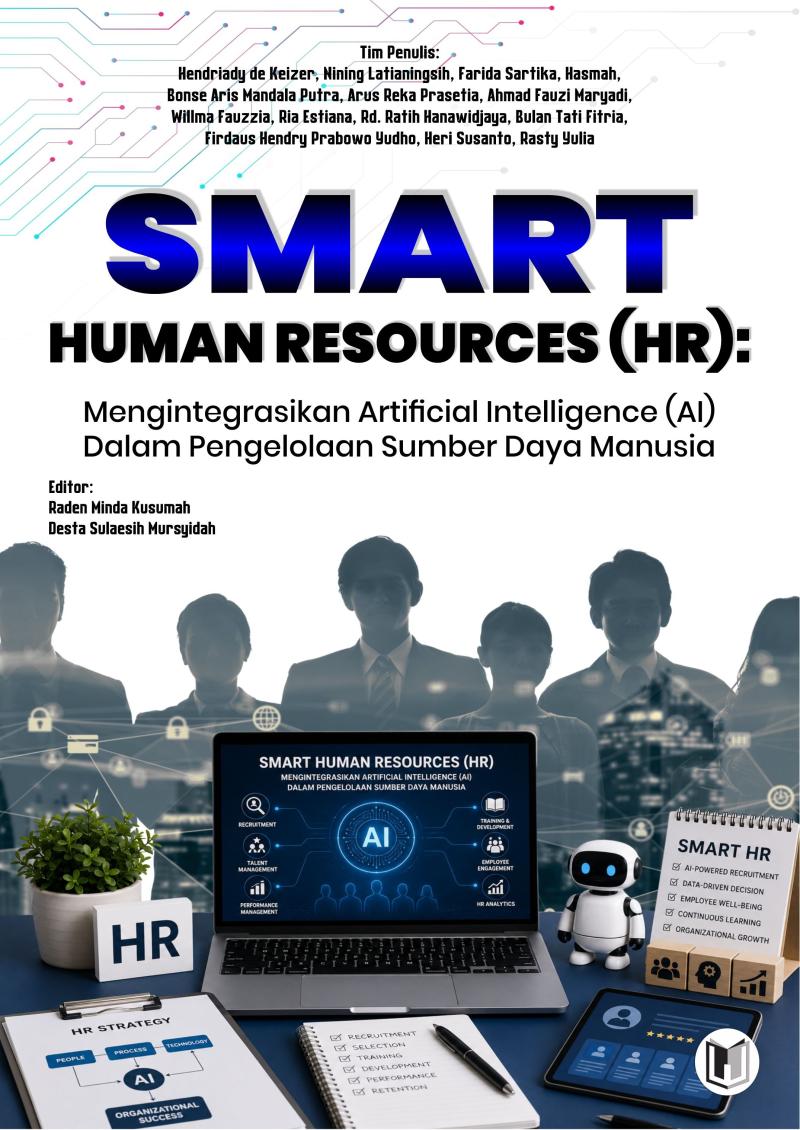
SMART HUMAN RESOURCES (HR): MENGINTEGRASIKAN ARTIFICIAL INTELLIGENCE (AI) DALAM PENGELOLAAN SUMBER DAYA MANUSIA
Keywords:
Smart Human Resources (Smart HR), Artificial Intelligence (AI), Manajemen Sumber Daya Manusia (MSDM)Synopsis
Buku Smart Human Resources (HR): Mengintegrasikan Artificial Intelligence (AI) dalam Pengelolaan Sumber Daya Manusia, membahas transformasi fungsi Human Resources di era digital melalui pemanfaatan teknologi kecerdasan buatan. HR tidak lagi hanya berperan sebagai fungsi administratif, tetapi berkembang menjadi mitra strategis yang mampu mengelola talenta, meningkatkan produktivitas, serta mendorong inovasi organisasi berbasis data.
Melalui pembahasan yang sistematis, buku ini mengulas konsep dasar AI, pembangunan infrastruktur digital HR, hingga penerapan AI dalam rekrutmen, onboarding, manajemen kinerja, pelatihan, employee engagement, workforce planning, payroll, dan administrasi SDM. Selain itu, buku ini juga menyoroti pentingnya budaya kerja digital, kepemimpinan modern, serta kolaborasi harmonis antara manusia dan mesin.
Tidak hanya berfokus pada peluang, buku ini juga membahas etika dan risiko penggunaan AI, seperti privasi data, bias algoritma, dan keamanan siber. Pada bagian akhir, pembaca diajak memahami strategi implementasi Smart HR secara efektif serta mempersiapkan organisasi menuju masa depan yang lebih cerdas, adaptif, dan kompetitif. Buku ini cocok bagi praktisi HR, pimpinan perusahaan, akademisi, mahasiswa, maupun siapa saja yang ingin memahami masa depan pengelolaan sumber daya manusia di era Artificial Intelligence.
Downloads
Download data is not yet available.
References
Agustina, S. B., Rahman, A., Putri, Y. D., & Purwanto, M. B. (2026). Menyiapkan talenta digital: Strategi pengembangan sumber daya manusia dalam menghadapi disrupsi AI. Jurnal Ilmu Manajemen, Ekonomi dan Kewirausahaan, 6(1), 709-727. https://doi.org/10.55606/jimek.v6i1.10027
Al-Amin, A., Maulidya, S., Reyhanda, H., & Zafar, T. S. (2026). Peran sumber daya manusia dalam manajemen perubahan: Strategi untuk keberhasilan organisasi modern. Triwikrama: Jurnal Ilmu Sosial, 11(10), 1391-1400.
Armstrong, M. (2020). Armstrong’s Handbook of Human Resource Management Practice. London: Kogan Page.
Asbari, M. (2026). Employee upskilling and reskilling strategies in workplace automation: A bibliometric study and practical implementation framework. 1(1), 1-18. Retrieved from Ayasophia Journal Article
Barasa, R. T., Damayanti, T. A., & Pusparini, M. (2025). Artificial intelligence integration in talent management and human resource development: A multi-case qualitative study in Indonesia’s banking industry. 8, 834-843. Retrieved from COSTING Journal Article
Barocas, S., & Selbst, A. D. (2016). Big data’s disparate impact. California Law Review, 104(3), 671-732.
Bauer, T. N. (2023). Onboarding New Employees: Maximizing Success. Alexandria: SHRM Foundation.
Bersin, J. (2020). The Employee Experience Imperative. New York: Deloitte Insights.
Bostrom, N. (2023). Superintelligence: Paths, Dangers, Strategies (Revised ed.). Oxford: Oxford University Press.
Botsman, R. (2017). Who Can You Trust? How Technology Brought Us Together and Why It Could Drive Us Apart. London: Penguin.
Boudreau, J. W. (2024). Transformative HR Practices in the Digital Age. Boston: Harvard Business Publishing.
Boudreau, J. W., & Ramstad, P. M. (2007). Beyond HR: The New Science of Human Capital. Boston: Harvard Business School Press.
Brown, T., Mann, B., Ryder, N., & Subbiah, M. (2022). Language models are few-shot learners: The GPT architecture. Advances in Neural Information Processing Systems, 33, 1877-1901.
Brynjolfsson, E., & McAfee, A. (2023). The Business of Artificial Intelligence: What it Can and Cannot do for Your Organization. Boston: Harvard Business Review Press.
Buiten, M. C. (2023). The black box of AI: Legal and ethical challenges for regulators. European Journal of Law and Technology, 14(1).
Cascio, W. F. (2019). Managing Human Resources: Productivity, Quality of Work Life, Profits (11th ed.). New York: McGraw-Hill.
Cascio, W. F., & Montealegre, R. (2023). Managing Human Resources: Productivity, Quality of Work Life, Profits (12th ed.). New York: McGraw-Hill.
Chollet, F. (2022). Deep Learning With Python (2nd ed.). Shelter Island: Manning Publications.
Chowdhury, S., Dey, P., Joel-Edgar, S., Bhattacharya, S., Rodriguez-Espindola, O., Abadie, A., & Truong, L. (2023). Unlocking the value of artificial intelligence in human resource management through AI capability framework. HRM Review, 33(1), Article 100899.
Crawford, K. (2022). Atlas of AI: Power, Politics, and the Planetary Costs of Artificial Intelligence. New Haven: Yale University Press.
D’Amour, A., et al. (2022). Underspecification presents challenges for credibility in modern machine learning. Journal of Machine Learning Research, 23(1), 1-61.
Daft, R. L. (2021). Organization Theory and Design (13th ed.). Boston: Cengage Learning.
Davenport, T. H. (2018). Artificial Intelligence for the Real World. Boston: Harvard Business Review Press.
Davenport, T. H., & Ronanki, R. (2018). Artificial intelligence for the real world. Harvard Business Review, 96(1), 108-116.
Davenport, T. H., Harris, J. G., & Shapiro, J. (2022). Competing on Talent Analytics: Data-Driven Decision Making for Human Resources. Boston: Harvard Business School Press.
Deloitte Insights. (2023). Global human capital trends report 2023. Deloitte University Press.
Deloitte. (2024). Global Human Capital Trends Report 2024. Deloitte Insights.
DeNisi, A. S., & Murphy, K. R. (2017). Performance appraisal and performance management: 100 years of progress? Journal of Applied Psychology, 102(3), 421-433.
Dessler, G. (2023). Human Resource Management (17th ed.). New York: Pearson Education.
Dignum, V. (2019). Responsible Artificial Intelligence: How to Develop and Use AI in a Responsible Way. Cham: Springer.
Drajat, A., Suryana, T., & Nugraha, R. (2025). Pengaruh budaya organisasi adaptif terhadap keberhasilan implementasi artificial intelligence pada perusahaan Indonesia. Jurnal Manajemen dan Teknologi Indonesia, 8(1), 15-29.
Drucker, P. F. (2007). Management Challenges for the 21st Century. New York: HarperBusiness.
Dweck, C. S. (2017). Mindset: The New Psychology of Success. New York: Random House.
Firat, M. (2023). Integrating AI applications into learning management systems to enhance e-learning. SSRN Electronic Journal, 4(1), 1-14. https://doi.org/10.1080/0142159X.2023.2294703
Fitz-enz, J., & Mattox, J. R. (2024). Predictive Analytics for Human Resources (2nd ed.). Hoboken: John Wiley & Sons.
Floridi, L. (2014). The Ethics of Information. Oxford: Oxford University Press.
Floridi, L. (2019). Establishing the Rules for Building Trustworthy AI. New York: Nature Machine Intelligence.
Floridi, L. (2023). The Ethics of Artificial Intelligence: Principles, Challenges, and Opportunities. Oxford: Oxford University Press.
Floridi, L., Cowls, J., Beltrametti, M., Chatila, R., Chazerand, P., Dignum, V., Lütge, C., Madelin, R., Pagallo, U., Rossi, F., Schafer, B., Valcke, P., & Vayena, E. (2018). AI4People-An ethical framework for a good AI society. Minds and Machines, 28, 689-707.
Fowler, M. (2014). Microservices: A Definition of This New Architectural Term. Chicago: ThoughtWorks.
Giamos, D., Doucet, O., & Léger, P. M. (2024). Continuous performance feedback: Investigating the effects of feedback content and feedback sources on performance, motivation to improve performance and task engagement. Journal of Organizational Behavior Management, 44(3), 194-213.
Goleman, D. (2018). Working with Emotional Intelligence. New York: Bantam Books.
Goodfellow, I., Bengio, Y., & Courville, A. (2023). Deep Learning: Foundations and Concepts. Cambridge: MIT Press.
Hamel, G. (2012). What Matters Now. San Francisco: Jossey-Bass.
Hasibuan, W., & Aisyah, S. (2023). Pengaruh pelatihan dan pengembangan sumber daya manusia terhadap kinerja pegawai di Kantor DPRD Labuhan Batu. 12(November), 2115-2120. Retrieved from Polgan Journal Article
Hassabis, D. (2025). The convergence of general AI and scientific discovery. Nature, 600(1), 20-35.
Hayes, T. L., et al. (2025). Workforce Planning: Strategies for the Modern Organization. New York: McGraw-Hill.
Hidayati, T., Huda, N., Nursabila, A., Salina, J., Tyas, D. N. N., & Rachmaniyah, S. (2024). Peran perubahan budaya organisasi terhadap kinerja karyawan. Neraca: Jurnal Ekonomi, Manajemen dan Akuntansi, 3(3), 573-583.
Hondro, S., Halawa, F., & Waruwu, E. (2025). Strategi talent management development dalam meningkatkan kapabilitas SDM melalui program reskilling dan upskilling di era transformasi digital. LIKUID: Jurnal Ekonomi dan Ilmu Berkaitan, 1(3), 254-260. Retrieved from LIKUID Journal Article
IBM Security. (2023). Cost of a data breach report 2023. IBM Corporation.
IBM. (2023). AI in Human Resources: Enhancing Employee Experience Through Automation. IBM Institute for Business Value.
Ivancevich, J. M., & Konopaske, R. (2023). Human Resource Management (14th ed.). New York: McGraw-Hill.
Jabid, A. W, Suci, R. P., Priyono, & Hasyim, W. (2022). Manajemen Sumber Daya Internasional. Malang: CV. Literasi Nusantara Abadi.
Jurafsky, D., & Martin, J. H. (2024). Speech and Language Processing (3rd ed.). Upper Saddle River: Prentice Hall.
Kaplan, R. S., & Norton, D. P. (2004). Strategy Maps: Converting Intangible Assets into Tangible Outcomes. Boston: Harvard Business School Press.
Kartajaya, H. (2024). Marketing 6.0: Human Spirit and Technology Transformation in Modern Business. Jakarta: Gramedia Pustaka Utama.
Kasali, R. (2024). Disruption and Digital Leadership: Strategi Memenangkan Perubahan di Era AI. Jakarta: Mizan.
Kaswan. (2019). Manajemen Sumber Daya Manusia Strategis. Yogyakarta: ANDI.
Kavanagh, M. J., & Johnson, R. D. (2021). Human Resource Information Systems: Basics, Applications, and Future Directions (4th ed.). Thousand Oaks: Sage Publications.
Kellogg, K. C., Valentine, M. A., & Christin, A. (2020). Algorithms at work: The new contested terrain of control. Academy of Management Annals, 14(1), 366-410.
Keristanti, R., Juliani, W., & Arifin, M. (2025). Personalized learning untuk Generasi Z: Peluang dan tantangan. DIAJAR: Jurnal Pendidikan dan Pembelajaran, 4(3), 411-417. https://doi.org/10.54259/diajar.v4i3.4419
Kirkpatrick, D. L., & Kirkpatrick, J. D. (2006). Evaluating Training Programs: The Four Levels. San Francisco: Berrett-Koehler.
Kizilcec, R. F., Perez-Sanagustín, M., & Maldonado, J. J. (2023). Adaptive learning in digital environments. Computers & Education, 190, 104-118.
Klein, H. J., & Polin, B. (2022). Are organizations onboard with best practices onboarding? Journal of Organizational Behavior.
Knowles, M. (2015). The Adult Learner: The Definitive Classic in Adult Education and Human Resource Development. New York: Routledge.
Kotter, J. P. (2012). Leading Change. Boston: Harvard Business Review Press.
Krizhevsky, A., Sutskever, I., & Hinton, G. E. (2022). ImageNet classification with deep convolutional neural networks: A retrospective. Communications of the ACM, 65(5), 84-90.
Larson, L., & DeChurch, L. A. (2020). Leading teams in the digital age: Four perspectives on technology and what they mean for leading teams. The Leadership Quarterly, 31(1), Article 101377.
Lathifaturahmah, Martoyo, A., Widayati, Suebudin, M., Susanti, L., Idrus, I., Rosminingsih, N. K. N., Mahendra, B., Slirna, I. K., & Maryadi, A. F. (2023). Manajemen Sumber Daya Manusia. Sukabumi: CV. Haura Utama.
LeCun, Y. (2024). A path towards autonomous machine intelligence. Journal of Machine Learning Research, 25(1), 1-22.
Linthicum, D. S. (2020). Cloud Computing and SOA Convergence in Your Enterprise. Boston: Addison-Wesley.
Marler, J. H., & Boudreau, J. W. (2017). An evidence-based review of HR Analytics. The International Journal of HRM, 28(1), 3-26.
Marler, J. H., & Boudreau, J. W. (2023). Human resource analytics: Transforming HR through data-driven decision making. Human Resource Management Review, 33(2), 100912.
Marler, J. H., & Parry, E. (2022). Human resource management, strategic involvement and e-HRM technology. International Journal of Human Resource Management, 27(19), 2233-2253.
Martcelina, W. L., Widyastuti, L. Y., & Damanik, N. R. (2023). Artificial intelligence: Sebuah usulan sistem training karyawan tanpa batas. Jurnal Serina Sosial Humaniora, 1(1), 482-492.
Mathieu, J. E., Gallagher, P. T., Domingo, M. A., & Klock, E. A. (2019). Embracing complexity: Reviewing the past decade of team effectiveness research. Annual Review of Organizational Psychology and Organizational Behavior, 6, 17-46.
Mathis, R. L., Jackson, J. H., & Valentine, S. R. (2022). Human Resource Management (16th ed.). Boston: Cengage Learning.
McKinsey Global Institute. (2023). The future of work in the age of automation.
Meijerink, J., Boons, M., Keegan, A., & Marler, J. (2021). Algorithmic human resource management: Synthesizing developments and cross-disciplinary insights on digital HRM. The International Journal of HRM, 32(12), 2545-2562.
Meister, J. C. (2023). The Future Workplace Experience: 10 Rules for Mastering Disruption in Recruiting and Engaging Employees. New York: McGraw-Hill.
Minbaeva, D. (2024). HR Analytics and Digital HR: A New Era for Human Resource Management. London: Routledge.
MIT Media Lab. (2018). Gender shades: Intersectional accuracy disparities in commercial gender classification. Proceedings of Machine Learning Research.
Mitchell, M. (2024). Artificial Intelligence: A Guide for Thinking Humans. London: Pelican Books.
Mitnick, K. (2011). The Art of Deception. Indianapolis: Wiley.
Mondy, R. W., & Martocchio, J. J. (2022). Human Resource Management (15th ed.). Pearson Education.
National Institute of Standards and Technology. (2023). Artificial Intelligence Risk Management Framework (AI RMF 1.0). NIST AI 100-1. U.S. Department of Commerce.
Ng, A. (2018). AI Transformation Playbook. Stanford: Stanford University.
Ng, A. (2018). Machine Learning Yearning: Technical Strategy for AI Engineers. Retrieved from https://www. mlyearning.org
Noe, R. A. (2023). Fundamentals of Human Resource Management (9th ed.). New York: McGraw-Hill.
Nugroho, D., Firmansyah, A., & Lestari, P. (2025). Perubahan mindset SDM dan dampaknya terhadap produktivitas kerja di era digital. Jurnal Sumber Daya Manusia Indonesia, 10(1), 66-82.
O’Neil, C. (2016). Weapons of Math Destruction. New York: Crown Publishing.
OECD. (2019). OECD principles on artificial intelligence. OECD Publishing.
Pane, J. F., Griffin, B. A., McCaffrey, D. F., & Karam, R. (2022). Effectiveness of adaptive learning technologies. Educational Evaluation and Policy Analysis, 44(2), 237-260.
Pranata, H., Hidayat, M., & Sari, N. (2025). Implementasi organisasi agile dan pengaruhnya terhadap produktivitas perusahaan di Indonesia. Jurnal Administrasi Bisnis Nasional, 9(2), 51-68.
Prasetia, A. R., Muchamad, W., Noraga, G. B., Suryadi, E., & Rasto. (2026). A systematic literature review on integrating ethics and axiology into organizational digital transformation strategies. Novatio: Journal of Management Technology and Innovation, 4(1), 1-21. doi:10.61978/novatio.v4i1.1259
Prasetyo, B., Nugroho, Y., & Sari, D. (2025). Kepemimpinan berbasis data dan pengaruhnya terhadap efektivitas pengambilan keputusan organisasi. Jurnal Manajemen Strategik Indonesia, 7(3), 40-57.
Prasetyo, C. A. (2025). Strategi manajemen talenta dalam mengembangkan potensi karyawan. 7, 40-48. Retrieved from UMMA Journal Article
PwC. (2023). Global Artificial Intelligence Study: Sizing the Prize. PricewaterhouseCoopers.
PwC. (2024). HR Analytics: Leveraging Data to Drive Business Outcomes. London: PricewaterhouseCoopers.
Quick, J. C., & Wright, T. A. (2022). Employee well-being and organizational performance: Foundations for sustainable work systems. Journal of Organizational Effectiveness, 9(3), 201-219.
Quinn, J. B. (1992). Intelligent Enterprise. New York: Free Press.
Rahman, A., & Hidayat, F. (2024). Strategi digitalisasi fungsi HR dan dampaknya terhadap efisiensi organisasi. Jurnal Manajemen Digital Indonesia, 5(2), 61-78.
Rahman, A., & Putri, D. S. (2024). Digitalisasi rekrutmen dan pengaruhnya terhadap efektivitas talent acquisition. Jurnal Manajemen SDM Indonesia, 6(1), 45-62.
Ribeiro, M. T., Singh, S., & Guestrin, C. (2016). “Why should I trust you?” Explaining the predictions of any classifier. KDD Conference Proceedings.
Robbins, S. P., & Judge, T. A. (2023). Organizational Behavior (19th ed.). Boston: Pearson Education.
Ross, J. W. (2019). Designed for Digital: How to Architect Your Business for Sustained Success. Cambridge: MIT Press.
Russell, S. (2019). Human Compatible: Artificial Intelligence and the Problem of Control. New York: Viking.
Russell, S., & Norvig, P. (2022). Artificial Intelligence: A Modern Approach (4th global ed.). Harlow: Pearson Education.
Saks, A. M. (2022). Caring human resources management and employee engagement. Human Resource Management Review, 32(3), 100835.
Saks, A. M., & Gruman, J. A. (2022). Organizational onboarding and socialization. Annual Review of Organizational Psychology and Organizational Behavior, 9, 195-219.
Salengke, T. H. (2022). Model triple helix dalam membangun bisnis berbasis SDM. Retrieved May 4, 2026, from Kompasiana Article
Santoso, B., Wibowo, H., & Lestari, R. (2025). Implementasi HR digital system dalam meningkatkan produktivitas perusahaan modern. Jurnal Sistem Informasi dan Bisnis, 8(1), 88-106.
Santoso, E., Pramudya, R., & Lestari, W. (2025). Kolaborasi manusia dan mesin dalam meningkatkan efisiensi operasional perusahaan Indonesia. Jurnal Teknologi dan Bisnis Digital, 6(2), 77-94.
Sarikaya, A., Correll, M., Bartram, L., Tory, M., & Fisher, D. (2019). What do we talk about when we talk about dashboards? IEEE Transactions on Visualization and Computer Graphics, 25(1), 682-692.
Schleicher, D. J., Baumann, H. M., Sullivan, D. W., Levy, P. E., Hargrove, D. C., & Barros-Rivera, B. A. (2018). Putting the system into performance management systems: A review and agenda for performance management research. Journal of Management, 44(6), 2209-2245.
Schneier, B. (2015). Data and Goliath: The Hidden Battles to Collect Your Data and Control Your World. New York: W.W. Norton & Company.
Senge, P. M. (2006). The Fifth Discipline: The Art and Practice of the Learning Organization. New York: Doubleday.
Shneiderman, B. (2022). Human-Centered AI. Oxford: Oxford University Press.
SHRM (Society for Human Resource Management). (2023). Onboarding and Employee Retention Report. SHRM Foundation.
SHRM (Society for Human Resource Management). (2025). Workforce Analytics and HR Metrics Guide. Alexandria: SHRM.
Stone, D. L., Deadrick, D. L., Lukaszewski, K. M., & Johnson, R. (2022). Human resource management and the digitalization of work: Emerging issues and future directions. Human Resource Management Review, 32(4), 100820.
Susskind, D. (2020). A World Without Work: Technology, Automation, and How We Should Respond. New York: Metropolitan Books.
Sutton, R. S., & Barto, A. G. (2023). Reinforcement Learning: An Introduction (Expanded ed.). Cambridge: MIT Press.
Szeliski, R. (2022). Computer Vision: Algorithms and Applications (2nd ed.). Cham: Springer.
Tambe, P., Cappelli, P., & Yakubovich, V. (2019). Artificial intelligence in human resources management: Challenges and a path forward. California Management Review, 61(4), 15-42.
Tegmark, M. (2022). Life 3.0: Being Human in the Age of Artificial Intelligence (Updated ed.). New York: Vintage Books.
Ulrich, D. (2016). HR from the Outside In: Six Competencies for the Future of Human Resources. New York: McGraw-Hill.
Ulrich, D., & Brockbank, W. (2023). The HR Value Proposition (Updated ed.). Boston: Harvard Business Review Press.
Ulrich, D., & Dulebohn, J. H. (2023). Are we there yet? What’s next for HR? Human Resource Management Review, 33(1).
Ulrich, Ng. (2023). Human Resource Champions Revisited: Insights for the Digital Era. Boston: Harvard Business School Press.
UNESCO. (2025). Yang perlu Anda ketahui tentang pembelajaran sepanjang hayat. Retrieved May 4, 2026, from UNESCO Lifelong Learning
Uyuni, B., Yasin, H., & Kohari, K. (2025). Pelatihan pemanfaatan artificial intelligence untuk meningkatkan kompetensi digital guru SMA. 3(1), 1-14. Retrieved from JUPAMU Journal Article
Valerio, J., Haludin, G., Vieri, D., Saputra, M. A., Mundzir, A., & Siboro, S. M. (2026). Peran Human Resource Development (HRD) dalam mengelola perubahan organisasi. Al-Zayn: Jurnal Ilmu Sosial dan Hukum, 4(1), 2800-2805.
Varma, A., Pereira, V. E., & Patel, P. (2024). Artificial intelligence and performance management. Organizational Dynamics, 53(1), Article 101037.
Weill, P., & Woerner, S. (2019). What’s Your Digital Business Model? Boston: Harvard Business Review Press.
Wieringa, M. (2020). What to account for when accounting for algorithms. FAT Conference Proceedings.
Wiguna, W., Suharni, S., Widyanti, L., & Burhannudin, B. (2026). Tantangan dan peran HR dalam organisasi modern. Journal of Management and Business, 8(1), 42-49.
World Economic Forum. (2025). The future of jobs report.
Wulansari, F., & Fauzi, A. (2023). Pengaruh coaching dan mentoring terhadap kinerja pegawai. Jurnal Akuntansi dan Manajemen Bisnis, 3(1), 121-126. https://doi.org/10.56127/jaman.v3i1.670
Yukl, G. (2023). Leadership in Organizations (10th ed.). Boston: Pearson Education.
Yusuf, B. (2023). Manajemen Sumber Daya Manusia di Era Digital. Jakarta: Prenadamedia Group.
Yuswohady. (2024). Digital Mindset: Strategi Membangun Organisasi Adaptif di Era Teknologi Cerdas. Jakarta: Kompas Gramedia.
Zhang, A., Lipton, Z. C., Li, M., & Smola, A. J. (2023). Dive into Deep Learning. Cambridge: Cambridge University Press.
Zuboff, S. (2019). The Age of Surveillance Capitalism. New York: PublicAffairs.
Downloads
Published
July 28, 2026
Copyright (c) 2026 Hendriady de Keizer, Nining Latianingsih, Farida Sartika, Hasmah Hasmah, Bonse Aris Mandala Putra, Arus Reka Prasetia, Ahmad Fauzi Maryadi, Willma Fauzzia, Ria Estiana, Rd. Ratih Hanawidjaya, Bulan Tati Fitria, Firdaus Hendry Prabowo Yudho, Heri Susanto, Rasty Yulia (Author)
License

This work is licensed under a Creative Commons Attribution-NonCommercial-ShareAlike 4.0 International License.
How to Cite
Hendriady de Keizer, Nining Latianingsih, Farida Sartika, Hasmah Hasmah, Bonse Aris Mandala Putra, Arus Reka Prasetia, Ahmad Fauzi Maryadi, Willma Fauzzia, Ria Estiana, Rd. Ratih Hanawidjaya, Bulan Tati Fitria, Firdaus Hendry Prabowo Yudho, Heri Susanto, & Rasty Yulia. (2026). SMART HUMAN RESOURCES (HR): MENGINTEGRASIKAN ARTIFICIAL INTELLIGENCE (AI) DALAM PENGELOLAAN SUMBER DAYA MANUSIA. Widina Media Utama. https://doi.org/10.59818/j3ta8j84