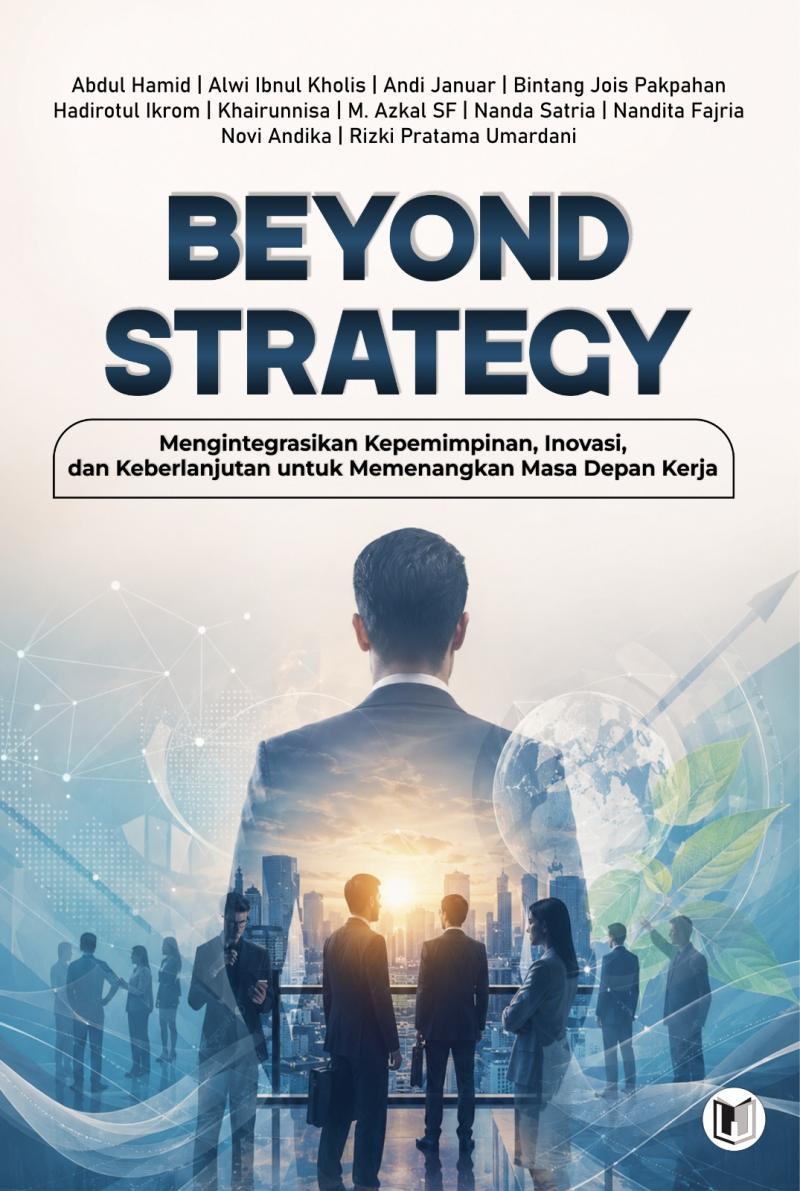
BEYOND STRATEGY MENGINTEGRASIKAN KEPEMIMPINAN, INOVASI, DAN KEBERLANJUTAN UNTUK MEMENANGKAN MASA DEPAN KERJA (FUTURE OF WORK)
Keywords:
Beyond, Strategi, Kepemimpinan, InovasiSynopsis
Buku ini menawarkan perspektif baru mengenai manajemen strategi di tengah perubahan dunia yang semakin cepat, kompleks, dan penuh ketidakpastian. Buku ini berangkat dari kenyataan bahwa strategi konvensional tidak lagi memadai untuk menghadapi era disrupsi digital, kecerdasan buatan, dan dinamika global. Melalui pendekatan Beyond Strategy Framework, pembaca diajak memahami bahwa keberhasilan organisasi tidak hanya ditentukan oleh kualitas perencanaan strategis, tetapi juga oleh kemampuan membangun kepemimpinan yang adaptif, budaya organisasi yang kuat, serta ketangkasan dalam merespons perubahan.
Disusun secara sistematis, buku ini mengulas sebelas bab yang membahas evolusi manajemen strategi, kepemimpinan strategis, analisis lingkungan bisnis, pemanfaatan data dan kecerdasan buatan, pengelolaan human capital, inovasi, keberlanjutan, transformasi digital, hingga strategi menghadapi masa depan dunia kerja. Berbagai teori mutakhir dipadukan dengan studi kasus perusahaan global maupun nasional, seperti Amazon, Microsoft, dan Bank Rakyat Indonesia, sehingga pembaca memperoleh pemahaman konseptual sekaligus wawasan praktis mengenai penerapan strategi yang relevan dengan tantangan organisasi masa kini.
Buku ini ditujukan bagi mahasiswa, dosen, akademisi, praktisi bisnis, pemimpin organisasi, serta siapa pun yang ingin memperluas cara pandang terhadap strategi dalam era modern. Dengan mengintegrasikan lima pilar utama, yaitu kepemimpinan, kecerdasan data dan sistem informasi, human capital, inovasi dan keberlanjutan, serta transformasi dan future of work, buku ini menjadi referensi yang tidak hanya menjelaskan bagaimana organisasi dapat bertahan, tetapi juga bagaimana membangun keunggulan kompetitif yang berkelanjutan dan menciptakan nilai bagi masa depan.
Downloads
Download data is not yet available.
References
Acemoglu, D. & Johnson, S. (2023). Power and Progress: Our Thousand-Year Struggle Over Technology and Prosperity. PublicAffairs. New York.
Agrawal, A., Gans, J., & Goldfarb, A. (2018). Prediction Machines: The Simple Economics of Artificial Intelligence. Harvard Business Review Press.
Alnuaimi, B. K., Kumar, S., Ren, S., & Budhwar, P. (2022). Mastering digital transformation: The nexus between leadership, agility, and digital strategy. Journal of Business Research, 145, 636–648.
Analisis mengenai digitalisasi sektor informal di Indonesia seringkali merujuk pada integrasi teknologi sebagai pendorong inklusi ekonomi, sejalan dengan prinsip inovasi nilai dalam Blue Ocean Strategy.
Ansoff, H. I. (1965). Corporate Strategy: An Analytic Approach to Business Policy for Growth and Expansion. McGraw-Hill, New York.
Ansoff, H. I. (1975). Managing strategic surprise by response to weak signals. California Management Review, 18(2), 21–33.
Asosiasi Gig Economy Indonesia & ILO Jakarta. (2022). Landscape Pekerja Platform Digital di Indonesia. ILO Country Office for Indonesia. Jakarta.
Asosiasi Penyelenggara Jasa Internet Indonesia (APJII). (2023). Laporan Survei Penetrasi Internet Indonesia 2022–2023. Jakarta: APJII.
Autonomy Research Ltd. (2023). The Results Are In: The UK's Four-Day Week Pilot. Report with Henley Business School & Cambridge University. London.
Autor, D. H. (2015). Why Are There Still So Many Jobs? The History and Future of Workplace Automation. Journal of Economic Perspectives, 29(3), 3-30. doi:10.1257/jep.29.3.3
Awad, M., & Martín Rojas, R. (2024). Digital transformation, organizational learning, and resilience: An integrated framework. Journal of Innovation and Entrepreneurship, 13(15), 1–17.
Bank Rakyat Indonesia. (2023). Annual report 2023: Transformasi berkelanjutan untuk tumbuh semakin kuat dan hebat. https://www.ir-bri.com/misc/AR/flipbook/AR2023-EN/
Barney, J. B. (1991). Firm resources and sustained competitive advantage. Journal of Management, 17(1), 99–120.
Barney, J. B. (1991). Firm resources and sustained competitive advantage. Journal of Management, 17(1), 99–120.
Barton, Dominic, dan Mark Wiseman. “Focusing Capital on the Long Term.” Harvard Business Review 92, no. 1–2 (2014): 44–51.
Bass, Bernard M., dan Ronald E. Riggio. Transformational Leadership. 2nd ed. New Jersey: Lawrence Erlbaum Associates, 2006.
Becker, G. S. (1964). Human capital: A theoretical and empirical analysis, with special reference to education. University of Chicago Press. https://www.nber.org/books-and-chapters/human-capital-theoretical-and-empirical-analysis-special-reference-education-first-edition
Bennett, N., & Lemoine, G. J. (2014). What a difference a word makes: Understanding threats to performance in a VUCA world. Business Horizons, 57(3), 311–317.
Bill George. Authentic Leadership: Rediscovering the Secrets to Creating Lasting Value. San Francisco: Jossey-Bass, 2003.
Bloom, N., Han, R., & Liang, J. (2022). How Hybrid Working from Home Works Out. NBER Working Paper No. 30292. National Bureau of Economic Research. Cambridge, MA.
Bloomberg Intelligence. (2021). ESG assets may hit $53 trillion by 2025, a third of global AUM. Bloomberg Intelligence ESG Research. New York.
Brandenburger, A. M., & Nalebuff, B. J. (1996). Co-opetition. Doubleday.
Brown, T. (2008). Design Thinking. Harvard Business Review.
Bruce J. Avolio, Bruce J., dan William L. Gardner. “Authentic Leadership Development: Getting to the Root of Positive Forms of Leadership.” The Leadership Quarterly 16, no. 3 (2005): 315–338.
Brynjolfsson, E. & McAfee, A. (2014). The Second Machine Age: Work, Progress, and Prosperity in a Time of Brilliant Technologies. W.W. Norton & Company. New York.
Cadwalladr, Carole, dan Emma Graham-Harrison. “Revealed: 50 Million Facebook Profiles Harvested for Cambridge Analytica.” The Guardian, 17 Maret 2018.
Carter, David A., Betty J. Simkins, dan W. Gary Simpson. “Corporate Governance, Board Diversity, and Firm Value.” The Financial Review 38, no. 1 (2003): 33–53.
Cascio, J. (2020). Facing the Age of Chaos. Institute for the Future, Palo Alto.
Chandler, A. D. (1962). Strategy and Structure: Chapters in the History of the American Industrial Enterprise. MIT Press, Cambridge, MA.
Chesbrough, H. W. (2003). Open Innovation. Harvard Business School Press. (Strategi integrasi eksternal untuk mempercepat inovasi internal).
Chesbrough, H. W. (2003). Open Innovation: The New Imperative for Creating and Profiting from Technology. Harvard Business School Press. (Buku fundamental yang meruntuhkan tembok R&D tradisional dan memperkenalkan kolaborasi eksternal).
Chouinard, Y., Ellison, J., & Ridgeway, R. (2011). The Sustainable Economy. Harvard Business Review, 89(10), 52-62. Lihat juga: Figueres, C. (2022). Patagonia's bold move. Time Magazine, October 2022.
Christensen, C. M. (1997). The Innovator's Dilemma: When New Technologies Cause Great Firms to Fail. Harvard Business School Press, Boston.
Christensen, C. M., Hall, T., Dillon, K., & Duncan, D. S. (2016). Know your customers' jobs to be done. Harvard Business Review, 94(9), 54–62.
Coleman, J. S. (1988). Social capital in the creation of human capital. American Journal of Sociology, 94, S95-S120. https://doi.org/10.1086/228943
Collins, J. (2001). Good to Great: Why Some Companies Make the Leap and Others Don't. New York: HarperBusiness.
Covey, S. R. (1989). The 7 habits of highly effective people: Powerful Lessons in Personal Change. New York: Free Press.
Daly, J., & Overton, L. (2017). The new learning organization. Towards Maturity.
Daniel Goleman. Emotional Intelligence. New York: Bantam Books, 1995.
Davenport, T. H., & Ronanki, R. (2018). Artificial intelligence for the real world. Harvard Business Review, 96(1), 108–116.
David J. Teece, Gary Pisano, and Amy Shuen, “Dynamic Capabilities and Strategic Management,” Strategic Management Journal Vol. 18, No. 7 (1997): 509–533.
David L. Rogers, The Digital Transformation Playbook (New York: Columbia University Press, 2016).
David, F. R. (2011). Strategic Management: Concepts and Cases (13th ed.). Prentice Hall.
Day, G. S., & Schoemaker, P. J. H. (2006). Peripheral Vision: Detecting the Weak Signals That Will Make or Break Your Company. Harvard Business School Press.
Doerr, J. (2018). Measure What Matters: How Google, Bono, and the Gates Foundation Rock the World with OKRs. Portfolio/Penguin.
Doz, Y., & Kosonen, M. (2010). Embedding strategic agility: A leadership agenda for accelerating business model renewal. Long Range Planning, 43(2-3), 370–382.
Drucker, P. F. (1954). The Practice of Management. New York: Harper & Row.
Duhigg, C. (2016, February 25). What Google learned from its quest to build the perfect team. The New York Times Magazine. https://www.nytimes.com/2016/02/28/magazine/what-google-learned-from-its-quest-to-build-the-perfect-team.html
Dweck, Carol S. Mindset: The New Psychology of Success. New York: Random House, 2006.
Eccles, R. G., Ioannou, I., & Serafeim, G. (2014). The impact of corporate sustainability on organizational processes and performance. Management Science, 60(11), 2835-2857. doi:10.1287/mnsc.2014.1984
Edgar H. Schein. Organizational Culture and Leadership. 4th ed. San Francisco: Jossey-Bass, 2010.
Edmondson, A. C. (2019). The fearless organization: Creating psychological safety in the workplace for learning, innovation, and growth. John Wiley & Sons.
Edmondson, Amy C. The Fearless Organization: Creating Psychological Safety in the Workplace for Learning, Innovation, and Growth. New Jersey: Wiley, 2018.
Edwin Locke dan Gary Latham (1990). A Theory of Goal Setting & Task Performance (New Jersey: Prentice Hall, 1990).
Elkington, J. (1997). Cannibals with Forks: The Triple Bottom Line of 21st Century Business. Capstone Publishing. Oxford.
Ellen MacArthur Foundation. (2015). Towards the Circular Economy Vol. 1-3: Economic and Business Rationale for an Accelerated Transition. EMF. Cowes, Isle of Wight.
Ellström, D., Holtström, J., Berg, E., & Josefsson, C. (2021). Dynamic capabilities for digital transformation. Journal of Strategy and Management, 15(2), 272–286.
European Securities and Markets Authority (ESMA). (2022). Greenwashing in the EU Financial Sector: Preliminary Findings. ESMA. Paris.
Feinzig, S. (2016). Predictive analytics in HR: Case studies. IBM Smarter Workforce Institute.
Fink, L. (2020). A Fundamental Reshaping of Finance. Annual Letter to CEOs. BlackRock, Inc. New York. https://www.blackrock.com/corporate/investor-relations/2020-larry-fink-ceo-letter.
Floridi, Luciano, Josh Cowls, Monica Beltrametti, Raja Chatila, Patrice Chazerand, Virginia Dignum, Christoph Luetge, et al. “AI4People—An Ethical Framework for a Good AI Society.” Minds and Machines 28, no. 4 (2018): 689–707.
Freeman, R. Edward. Strategic Management: A Stakeholder Approach. Boston: Pitman Publishing, 1984.
Fukuyama, Francis. Trust: The Social Virtues and the Creation of Prosperity. New York: Free Press, 1995.
Geoffrey G. Parker, Marshall W. Van Alstyne, dan Sangeet Paul Choudary, Platform Revolution (New York: W. W. Norton, 2016).
Gioia, D. A., & Chittipeddi, K. (1991). Sensemaking and Sensegiving in Strategic Change Initiation. Strategic Management Journal, 12(6), 433–448.
Gloat. (2021). How Unilever uses AI to retain, engage, and develop talent. https://resources.gloat.com/unilever-gloat-case-study-download/
Gojek. (2018, March 23). How GOJEK manages 1 million drivers with 12 engineers. Gojek Tech Blog. https://www.gojek.io/blog/how-gojek-manages-1-million-drivers-with-12-engineers-part-1
Goleman, Daniel. Emotional Intelligence: Why It Can Matter More Than IQ. New York: Bantam Books, 1995.
GoTo Group. (2023). Annual Report 2022. Jakarta: PT GoTo Gojek Tokopedia Tbk.
Grant, R. M. (1996). Toward a knowledge-based theory of the firm. Strategic Management Journal, 17(S2), 109–122.
Hambrick, Donald C., dan Phyllis A. Mason. “Upper Echelons: The Organization as a Reflection of Its Top Managers.” Academy of Management Review 9, no. 2 (1984): 193–206.
Hamel, G., & Prahalad, C. K. (1994). Competing for the Future. Boston: Harvard Business School Press.
Hastings, R., & McCord, P. (2009). Netflix culture: Freedom & responsibility. Netflix.
Hastings, R., & Meyer, E. (2020). No rules rules: Netflix and the culture of reinvention. Penguin Press.
Hatch, N. W., & Dyer, J. H. (2004). Human capital and learning as a source of sustainable competitive advantage. Strategic Management Journal, 25(12), 1155–1178. https://doi.org/10.1002/smj.421
Hawken, P., Lovins, A., & Lovins, L. H. (1999). Natural Capitalism: Creating the Next Industrial Revolution. Little, Brown and Company. New York.
Heifetz, Ronald A., dan Marty Linsky. Leadership on the Line: Staying Alive Through the Dangers of Leading. Boston: Harvard Business School Press, 2002.
Henderson, R. M., & Clark, K. B. (1990). Architectural innovation: The reconfiguration of existing product technologies and the failure of established firms. Administrative Science Quarterly, 35(1), 9–30.
Hidayat, R., & Nugroho, A. (2022). Transformasi digital dan keunggulan kompetitif organisasi di era disrupsi. Jurnal Manajemen dan Bisnis Indonesia, 8(2), 145–156.
Iara. (2026). The impact of AI-driven predictive analytics on employee retention strategies. International Journal of Artificial Intelligence Research, 13(1), 6–10.
IBM. (2024). AI transforming HR at IBM: A case study. https://www.ibm.com/think/topics/ai-in-employee-engagement
Indofood Agri Resources Ltd. (2023). Sustainability Report 2022: Towards Responsible and Sustainable Palm Oil. IndoAgri. Singapore.
Insignia Business Review. (2022, April 14). Superconnectors, counter-cultures, and hypergrowth: The story of the GoTo Mafia. https://review.insignia.vc/2022/04/14/superconnectors-counter-cultures-hypergrowth-goto-mafia/
Janis, Irving L. Victims of Groupthink. Boston: Houghton Mifflin, 1972.
Jensen, Michael C., dan William H. Meckling. “Theory of the Firm: Managerial Behavior, Agency Costs and Ownership Structure.” Journal of Financial Economics 3, no. 4 (1976): 305–360.
John P. Kotter, Leading Change, 2nd ed. (Boston: Harvard Business Review Press, 2012).
John Sweller, “Cognitive Load During Problem Solving: Effects on Learning,” Cognitive Science Vol. 12, No. 2 (1988): 257–285.
J-PAL Southeast Asia. (2022). Evaluasi Dampak Program Kartu Prakerja: Temuan Awal Studi Eksperimental. Abdul Latif Jameel Poverty Action Lab. Jakarta.
Kahneman, D. (2011). Thinking, Fast and Slow. New York: Farrar, Straus and Giroux.
Kaplan, R. S., & Norton, D. P. (1992). The balanced scorecard: Measures that drive performance. Harvard Business Review, 70(1), 71–79.
Kelley, D., & Kelley, T. (2013). Creative Confidence. Crown Business Publishing.
Kim, W. C., & Mauborgne, R. (2005). Blue Ocean Strategy: How to Create Uncontested Market Space and Make the Competition Irrelevant. Harvard Business School Press.
Klaus Schwab, The Fourth Industrial Revolution (New York: Crown Business, 2017).
Kotter, J. P. (1996). Leading Change. Boston: Harvard Business School Press.
Laudon, K. C., & Laudon, J. P. (2021). Management Information Systems (16th ed.). Pearson.
Lucas, H. C., & Goh, J. M. (2009). Disruptive technology: How Kodak missed the digital photography revolution. Journal of Strategic Information Systems, 18(1), 46–55.
Luthans, F., Youssef, C. M., & Avolio, B. J. (2007). Psychological capital: Developing the human competitive edge. Oxford University Press. https://doi.org/10.1093/acprof:oso/9780195187526.001.0001
Majhi, R. K., et al. (2026). Team-level social capital and its impact on performance dynamics in AI environments. Journal of Management Research.
Manajemen Pelaksana Program Kartu Prakerja. (2023). Laporan Perkembangan Program Prakerja 2020-2023. Kemenko Perekonomian RI. Jakarta.
McAfee, Andrew, dan Erik Brynjolfsson. Machine, Platform, Crowd: Harnessing Our Digital Future. New York: W. W. Norton & Company, 2017.
McCord, P. (2018). Powerful: Building a culture of freedom and responsibility. Silicon Guild.
McGrath, R. G. (2013). The End of Competitive Advantage: How to Keep Your Strategy Moving as Fast as Your Business. Harvard Business Review Press, Boston.
McKinsey & Company. (2022). Network effects: How to rebuild social capital and improve corporate performance. https://www.mckinsey.com/capabilities/people-and-organizational-performance/our-insights/network-effects-how-to-rebuild-social-capital-and-improve-corporate-performance
McKinsey & Company. (2024). The war for talent 2.0. McKinsey Quarterly.
McKinsey & Company. (2025). Superagency in the workplace: Empowering people to unlock AI’s full potential. https://www.mckinsey.com/capabilities/tech-and-ai/our-insights/superagency-in-the-workplace-empowering-people-to-unlock-ais-full-potential-at-work
McKinsey Global Institute. (2019). Indonesia's coming wave: Seizing the productivity opportunity. McKinsey & Company. Jakarta. Angka 52,6 juta merujuk pada estimasi 51,4% dari pekerjaan yang teranalisis memiliki potensi otomasi lebih dari 60% dari aktivitas kerjanya.
Michael E. Porter dan James E. Heppelmann, “How Smart, Connected Products Are Transforming Competition,” Harvard Business Review 92, no. 11 (2014): 64–88.
Michaels, E., Handfield-Jones, H., & Axelrod, B. (2001). The war for talent. Harvard Business School Press.
Microsoft. Microsoft Annual Report 2024. Washington: Microsoft Corporation, 2024.
Microsoft. Responsible AI Standard. Version 2. Washington: Microsoft Corporation, 2023.
Mintzberg, H. (1994). The rise and fall of strategic planning: Reconceiving roles for planning, plans, planners. Free Press, New York.
MIT Sloan Management Review. “Why AI Cannot Replace Strategic Leadership.” 2022.
Muliasari, L. (2022). Digital banking strategy analysis of BRI. Jurnal Ekonomi, 11(2), 846-851. http://ejournal.seaninstitute.or.id/index.php/Ekonomi
Nadella, Satya, Greg Shaw, dan Jill Tracie Nichols. Hit Refresh: The Quest to Rediscover Microsoft’s Soul and Imagine a Better Future for Everyone. New York: Harper Business, 2017.
O’Reilly III, Charles A., dan Michael L. Tushman. Lead and Disrupt: How to Solve the Innovator’s Dilemma. California: Stanford University Press, 2016.
O’Reilly, C. A., & Tushman, M. L. (2016). Lead and Disrupt: How to Solve the Innovator’s Dilemma. Stanford University Press.
OECD. (2019). OECD Future of Education and Skills 2030: OECD Learning Compass 2030. OECD Publishing. Paris.
Parasuraman, R., & Manzey, D. H. (2010). Complacency and bias in human use of automation: An attentional integration. Human Factors, 52(3), 381–410.
Ployhart, R. E., Nyberg, A. J., Reilly, G., & Maltarich, M. A. (2014). Strategic human capital resources: A review and synthesis. Academy of Management Annals, 8(1), 371–403. https://doi.org/10.5465/19416520.2014.862812
Porter, M. E. (1980). Competitive Strategy: Techniques for Analyzing Industries and Competitors. Free Press, New York.
Porter, M. E. (1985). Competitive Advantage: Creating and Sustaining Superior Performance. Free Press, New York.
Porter, M. E., & Kramer, M. R. (2011). Creating shared value: How to reinvent capitalism — and unleash a wave of innovation and growth. Harvard Business Review, 89(1/2), 62-77.
Pratama, Y., & Sari, D. P. (2021). Learning organization sebagai strategi peningkatan kinerja perusahaan. Jurnal Administrasi Bisnis, 17(1), 67–78.
PT Bank Rakyat Indonesia (Persero) Tbk. Annual Report 2025. Jakarta: BRI, 2025.
PT Pertamina (Persero). Sustainability Report 2024. Jakarta: Pertamina, 2024.
PwC. (2025). PwC 2025 global AI jobs barometer: AI linked to a fourfold increase in productivity growth. https://www.pwc.com/gx/en/news-room/press-releases/2025/ai-linked-to-a-fourfold-increase-in-productivity-growth.html
QIC-WD. (2021). Umbrella summary: Psychological capital. Quality Improvement Center for Workforce Development. https://www.qic-wd.org/umbrella-summary/psychological-capital
Raffiee, J., & Coff, R. (2015). Micro-foundations of firm-specific human capital: When do employees perceive their skills to be relatively firm-specific? Academy of Management Journal, 59(3). https://doi.org/10.5465/amj.2014.0205
Rahmawati, I., & Putra, M. R. (2024). Peran teknologi digital dalam meningkatkan organizational agility pada perusahaan modern. Jurnal Bisnis Digital, 5(1), 33–47.
Reuters. (2018). Amazon scraps secret AI recruiting tool that showed bias against women. Reuters.
Rogers, D. L. (2016). The Digital Transformation Playbook: Rethink Your Business for the Digital Age. Columbia Business School Publishing, New York.
RSPO. (2019). Statement on Indofood Agri Resources. Roundtable on Sustainable Palm Oil. Kuala Lumpur. https://rspo.org/news-and-events/news/rspo-statement-on-indofood-agri-resources-ltd
Rubio-Andrés, M., Linuesa-Langreo, J., Gutiérrez-Broncano, S., & Sastre-Castillo, M. A. (2025). Tackling digital transformation strategy: How it affects firm innovation and organizational effectiveness. The Journal of Technology Transfer, 50, 1893–1918.
Rumelt, R. P. (2011). Good Strategy Bad Strategy: The Difference and Why It Matters. Crown Business, New York.
Russell, Stuart, dan Peter Norvig. Artificial Intelligence: A Modern Approach. 4th ed. London: Pearson, 2021.
Saputra, H., & Lestari, N. (2020). Integrasi strategi dan inovasi dalam menciptakan keberlanjutan organisasi. Jurnal Manajemen Strategi dan Aplikasi Bisnis, 3(2), 89–101.
Schein, E. H. (2010). Organizational Culture and Leadership (4th ed.). San Francisco: Jossey-Bass.
Schwab, Klaus, dan Peter Vanham. Stakeholder Capitalism. New Jersey: Wiley, 2021.
Schwartz, P. (1991). The Art of the Long View: Planning for the Future in an Uncertain World. Currency Doubleday. New York.
Senge, P. M. (1990). The fifth discipline: The art and practice of the learning organization. New York: Doubleday/Currency.
Senge, Peter M. The Fifth Discipline: The Art and Practice of the Learning Organization. New York: Doubleday, 2006.
Setzke, D. S., Riasanow, T., Böhm, M., & Krcmar, H. (2021). Pathways to digital service innovation: The role of digital transformation strategies in established organizations. Information Systems Frontiers, 25, 1017–1037.
Shearon, D. (2007, December 17). Psychological capital: PsyCap. Positive Psychology News. https://positivepsychologynews.com/news/dave-shearon/20071217523
Simon, Herbert A. The New Science of Management Decision. Englewood Cliffs: Prentice-Hall, 1977.
Stewart, T. A. (1997). Intellectual capital: The new wealth of organizations. Doubleday/Currency. https://doi.org/10.1016/s0024-6301(97)80956-9
Stone, B. (2013). The Everything Store: Jeff Bezos and the Age of Amazon. Little, Brown and Company, New York.
Teece, D. J., Pisano, G., & Shuen, A. (1997). Dynamic Capabilities and Strategic Management. Strategic Management Journal, 18(7), 509–533.
The Economist. (2017, May 6). The world's most valuable resource is no longer oil, but data. The Economist. https://www.economist.com/leaders/2017/05/06/the-worlds-most-valuable-resource-is-no-longer-oil-but-data
Toffler, Alvin. Future Shock. New York: Random House, 1970.
U.S. Department of Education. (2024). Four stages of AI integration in education. https://www.ed.gov/about/homeroom-blog/four-stages-of-ai-integration-education
U.S. Securities and Exchange Commission (SEC). (2024). The Enhancement and Standardization of Climate-Related Disclosures for Investors. Final Rule, March 2024. SEC. Washington D.C.
Uhl-Bien, Mary, Russ Marion, dan Bill McKelvey. “Complexity Leadership Theory: Shifting Leadership from the Industrial Age to the Knowledge Era.” The Leadership Quarterly 18, no. 4 (2007): 298–318.
Unilever PLC. (2023). Unilever Annual Report and Accounts 2023: Future of Work Initiative. Unilever. London. https://www.unilever.com/investor-relations/annual-report-and-accounts/
Unilever. (2021). FLEX experiences: Democratizing career development at Unilever. https://www.unilever.com/news/news-search/2021/flex-experiences-democratizing-career-development/
United Nations Global Compact. (2004). Who Cares Wins: Connecting Financial Markets to a Changing World. UN Global Compact. New York.
UNPRI. (2023). Principles for Responsible Investment Annual Report 2023. United Nations-supported Principles for Responsible Investment. London. https://www.unpri.org/annual-report-2023
Warren Bennis, Warren, dan Burt Nanus. Leaders: Strategies for Taking Charge. New York: Harper & Row, 1985.
Weick, Karl E. Sensemaking in Organizations. California: Sage Publications, 1995.
Weihrich, H. (1982). The TOWS matrix: A tool for situational analysis. Long Range Planning, 15(2), 54–66.
Wijaya, T., & Kurniawan, F. (2023). Pengaruh budaya organisasi terhadap keberhasilan implementasi strategi perusahaan. Jurnal Ekonomi dan Manajemen, 12(3), 201–214.
World Economic Forum. (2023). Future of Jobs Report 2023. WEF. Geneva. https://www.weforum.org/reports/the-future-of-jobs-report-2023
World Economic Forum. (2023). Future of jobs report 2023. WEF. https://www3.weforum.org/docs/WEF_Future_of_Jobs_2023.pdf
World Economic Forum. (2023). Op. cit. Proyeksi net job displacement: 14 juta pekerjaan (2023-2027), setara 2% total pekerjaan global.
World Economic Forum. (2025). AI’s new dual-workforce challenge: Balancing overcapacity and talent shortages. https://www.weforum.org/stories/2025/10/ai-s-new-dual-workforce-challenge-balancing-overcapacity-and-talent-shortages/
World Economic Forum. Global Risks Report 2025. Geneva: WEF, 2025.
Yin, Robert K. Case Study Research and Applications: Design and Methods. 6th ed. California: Sage Publications, 2018.
Yoffie, D. B., & Cusumano, M. A. (2015). Strategy Rules: Five Timeless Lessons from Bill Gates, Andy Grove, and Steve Jobs. Harper Business.
Downloads
Published
July 28, 2026
Copyright (c) 2026 Abdul Hamid, Novi Andika, Nandita Fajria, Nanda Satria, M. Azkal SF, Khairunnisa Khairunnisa,, Hadirotul Ikrom, Bintang Jois Pakpahan, Andi Januar, Alwi Ibnul Kholis, Rizki Pratama Umardani (Author)
License

This work is licensed under a Creative Commons Attribution-NonCommercial-ShareAlike 4.0 International License.
Details about this monograph
ISBN-13 (15)
978-634-317-156-0
How to Cite
Hamid, A., Andika, N., Fajria, N., Satria, N., SF, M. A., Khairunnisa, K., Ikrom, H., Pakpahan, B. J., Januar, A., Kholis, A. I., & Umardani, R. P. (2026). BEYOND STRATEGY MENGINTEGRASIKAN KEPEMIMPINAN, INOVASI, DAN KEBERLANJUTAN UNTUK MEMENANGKAN MASA DEPAN KERJA (FUTURE OF WORK). Widina Media Utama. https://doi.org/10.59818/xzencf42