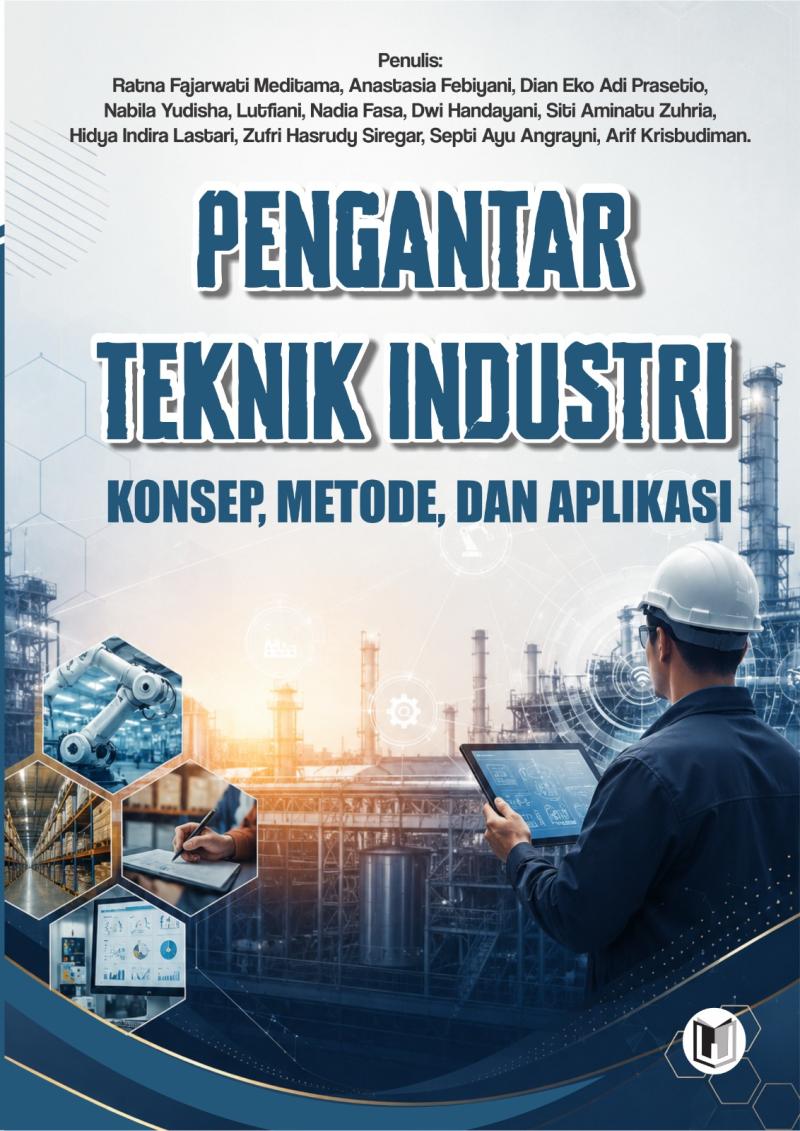
PENGANTAR TEKNIK INDUSTRI KONSEP METODE DAN APLIKASI
Keywords:
Teknik, IndustriSynopsis
Buku ini disusun sebagai bahan ajar dan referensi dasar bagi mahasiswa, akademisi, maupun praktisi yang ingin memahami ruang lingkup dan perkembangan ilmu teknik industri secara komprehensif. Buku ini membahas berbagai konsep fundamental teknik industri yang berfokus pada peningkatan efektivitas, efisiensi, produktivitas, serta optimalisasi sistem kerja dalam dunia industri modern. Materi disusun secara sistematis mulai dari pengenalan konsep dasar, pendekatan sistem, manajemen kerja, ergonomi, hingga penerapan teknologi industri masa kini.
Pembahasan dalam buku ini tidak hanya menitikberatkan pada aspek teoritis, tetapi juga menghubungkan konsep dengan aplikasi nyata di lingkungan industri. Setiap bab menguraikan metode dan pendekatan yang digunakan dalam pengelolaan produksi, pengendalian kualitas, manajemen rantai pasok, tata letak fasilitas, hingga riset operasi dan simulasi sistem industri. Dengan pendekatan tersebut, pembaca diharapkan mampu memahami bagaimana teknik industri berperan dalam menyelesaikan berbagai permasalahan operasional dan manajerial secara terintegrasi.
Selain itu, buku ini juga memberikan wawasan mengenai pentingnya ergonomi, keselamatan kerja, serta pengambilan keputusan berbasis analisis ekonomi teknik dalam mendukung keberlanjutan sistem industri. Pembahasan mengenai optimasi, simulasi, dan teknologi digital menjadi bagian penting dalam memperkenalkan transformasi industri yang semakin berkembang. Materi disusun menggunakan bahasa yang jelas dan mudah dipahami sehingga dapat membantu pembaca dalam mempelajari konsep-konsep teknik industri secara bertahap.
Pada bagian akhir, buku ini mengangkat perkembangan teknik industri di era Industry 4.0 yang ditandai dengan pemanfaatan Internet of Things (IoT), big data, kecerdasan buatan, dan sistem otomatisasi. Kehadiran teknologi tersebut menuntut insinyur industri untuk memiliki kemampuan adaptif, inovatif, dan multidisipliner dalam menghadapi tantangan global. Oleh karena itu, buku ini diharapkan dapat menjadi sumber pembelajaran yang relevan dalam membentuk pemahaman, keterampilan, dan kesiapan pembaca menghadapi dunia industri masa depan.
Downloads
Download data is not yet available.
References
Badiru, A. B. (2019). Industrial engineering handbook. CRC Press.
Bridger, R. S. (2018). Introduction to ergonomics (4th ed.). CRC Press.
Groover, M. P. (2020). Automation, production systems, and computer-integrated manufacturing (5th ed.). Pearson.
Heizer, J., Render, B., & Munson, C. (2020). Operations management: Sustainability and supply chain management (13th ed.). Pearson.
Kagermann, H., Wahlster, W., & Helbig, J. (2019). Recommendations for implementing the strategic initiative INDUSTRIE 4.0. German National Academy of Science and Engineering.
Niebel, B. W., & Freivalds, A. (2019). Methods, standards, and work design (14th ed.). McGraw-Hill.
Salvendy, G. (2018). Handbook of industrial engineering: Technology and operations management (3rd ed.). Wiley.
Stevenson, W. J. (2021). Operations management (14th ed.). McGraw-Hill Education.
Sutalaksana, I. Z. (2006). Teknik perancangan sistem kerja. ITB Press.
Sritomo Wignjosoebroto. (2020). Ergonomi, studi gerak dan waktu. Guna Widya.
Telsang, M. (2018). Industrial engineering and production management. S. Chand Publishing.
Tompkins, J. A., White, Y. A., Bozer, Y. A., & Tanchoco, J. M. A. (2018). Facilities planning (5th ed.). Wiley.
United Nations Industrial Development Organization. (2022). Industrial development report 2022: The future of industrialization in a post-pandemic world. UNIDO.
World Economic Forum. (2023). The future of jobs report 2023. World Economic Forum.
Yamit, Z. (2020). Manajemen produksi dan operasi. Ekonisia.
Maynard and K. B. Zandin, Maynard's Industrial Engineering Handbook Fifth Edition, McGraw-Hill, 2004.
T. A. Samadhi, "Pendidikan dan Keilmuan Teknik Industri Masa Depan di Indonesia," in Seminar Nasional Pendidikan Teknik Industri Konvensi Nasional I, BKSTI, Jakarta, 2012.
D. B. Bailey and S. R. Barley, "Return to Work : Toward Post-Industrial Engineering," IIE Transactions, vol. 37:8, no. Taylor & Francis, pp. 737 - 752, 2005.
G. Salvendy, Handbook of Industrial Engineering: Technology and Operations, United States: John Willey & Sons, INC, 2001.
Albrecht, S. L., Bakker, A. B., Gruman, J. A., Macey, W. H., & Saks, A. M. (2015). Employee engagement, human resource management practices and competitive advantage: An integrated approach. Journal of Organizational Effectiveness: People and Performance, 2(1), 7–35.
Alves, J., Lima, T. M., & Gaspar, P. D. (2023). Is industry 5.0 a human-centred approach? A systematic review. Processes, 11(1), 193.
Andayanti, W. (2025). Transformasi Manajemen Sumber Daya Manusia dalam Menghadapi Industri 5.0: Kajian Literatur Sistematis. Indonesia Economic Journal, 1(2), 1486–1491.
Asghar, F., Akram, N., Abbas, K., Abbasi, M. H., & Bangash, S. A. (2026). Industry 5.0, Human-Centric Innovation, and Green Operational Efficiency: Evidence from Smart Sustainable Workflows. The Asian Bulletin of Big Data Management, 6(1), 1–14.
Bakker, A. B., & Demerouti, E. (2017). Job demands–resources theory: Taking stock and looking forward. Journal of Occupational Health Psychology, 22(3), 273.
Barnes, R. M. (1991). Motion and time study: Design and measurement of work. John Wiley & Sons. https://www.google.com/books?hl=en&lr=&id=gByjEAAAQBAJ&oi=fnd&pg=PA1&dq=barnes+1980+time+study&ots=6ffa5dyGG9&sig=fRy_c8KPISgTmlM3D98_gO84LB8
Boxall, P., & Macky, K. (2009). Research and theory on high‐performance work systems: Progressing the high‐involvement stream. Human Resource Management Journal, 19(1), 3–23. https://doi.org/10.1111/j.1748-8583.2008.00082.x
Colombo, B., Zanchi, M., & Gaiardelli, P. (2025). The role of Lean Management methodologies within the current Industry 5.0 manufacturing context: A bibliometric analysis. IFAC-PapersOnLine, 59, 1420–1425. https://doi.org/10.1016/j.ifacol.2025.09.239
De Giovanni, P. (2012). Do internal and external environmental management contribute to the triple bottom line? International Journal of Operations & Production Management, 32(3), 265–290.
Drucker, P. (2012). Management challenges for the 21st century. Routledge. https://api.taylorfrancis.com/content/books/mono/download?identifierName=doi&identifierValue=10.4324/9780080942384&type=googlepdf
Dul, J., & Neumann, W. P. (2009). Ergonomics contributions to company strategies. Applied Ergonomics, 40(4), 745–752.
Dul, J., & Weerdmeester, B. (2008). Work Organization Jobs and Tasks. Ergonomics for Beginners. A Quick Reference Guide (3a Ed.). CRC Press Eswaramoorthi.
Frank, A. G., Sturgeon, T. J., Benitez, G. B., Marodin, G. A., & e Cunha, S. F. (2025). How lean and industry 4.0 affect worker outcomes and operational performance: A quantitative assessment of competing models. International Journal of Production Economics, 279, 109475.
Groover, M. P. (2016). Automation, production systems, and computer-integrated manufacturing. Pearson Education India.
Hidayati, K., & Basuki, D. (2016). Analisis Perancangan Pengembangan Sistem Pengukuran Kinerja Berbasis Balance Scorecard Method Untuk Industri Manufaktur Jawa Timur (Studi Kasus Pada PT. Pencu Metal Abadi). E-Jurnal Manajemen Kinerja, 2(2), 1–24.
Holweg, M., & Bicheno, J. (2016). The Reverse Amplification Effect in Supply Chains. In K. S. Pawar, H. Rogers, A. Potter, & M. Naim (Eds.), Developments in Logistics and Supply Chain Management (pp. 52–58). Palgrave Macmillan UK. https://doi.org/10.1057/9781137541253_5
Horngren, C., Sundem, G. L., Stratton, W. O., Burgstahler, D., & Schatzberg, J. O. (2013). Introduction to Management Accounting, Global Edition (Chapters 1-7). Pearson Education. https://books.google.co.id/books?id=jP2oBwAAQBAJ
Hussain, Z., Mohammad, S. I., Vasudevan, A., Awad, A., & Bansal, R. (2025). Exploring the effect of industry 5.0 human-centric sustainability and green knowledge automation in enhancing green process adaptability: The mediating role of sustainable human-tech interaction. Journal of Cleaner Production, 537, 147240. https://doi.org/10.1016/j.jclepro.2025.147240
Jourabchi Amirkhizi, P., Pedrammehr, S., & Pakzad, S. (2025). A system-based approach to value prioritization in industry 5.0 for sustainable value creation. Discover Sustainability, 6(1), 364. https://doi.org/10.1007/s43621-025-01134-8
Kaplan, R. S., & Norton, D. P. (2015). Balanced Scorecard Success: The Kaplan-Norton Collection (4 Books). Harvard Business Review Press. https://www.google.com/books?hl=en&lr=&id=0mVhCwAAQBAJ&oi=fnd&pg=PP3&dq=balanced+scorecard+kaplan&ots=C-wDAHnm71&sig=kN7IRIUmCGy16VMiu_DV6p7aIug
Kaswan, M. S., Rathi, R., & Garza-Reyes, J. A. (2025). Industry 5.0: Concepts and strategies for digital transformation. CRC Press. https://www.google.com/books?hl=en&lr=&id=5bZUEQAAQBAJ&oi=fnd&pg=PP9&dq=Kaswan,+M.+S.,+Rathi,+R.,+%26+Garza-Reyes,+J.+A.+(2025).+Industry+5.0:+Concepts+and+Strategies+for+Digital+Transformation.+CRC+Press.&ots=0pbV9hbB6z&sig=W-hqpi3CPJGhqc_SfXhtcEPL8XU
Kotter, J. P. (2012). Leading change. Harvard business press. https://www.google.com/books?hl=en&lr=&id=xpGX1EWL_EMC&oi=fnd&pg=PR7&dq=Kotter,+J.+P.+(2012).+Leading+Change.+Harvard+Business+Review+Press.&ots=Te_7KeQsHC&sig=VxNZujXw872waAQHuTjoIAQHY_o
Liker, J. (2020). The Toyota way: 14 management principles from the world’s greatest manufacturer. McGraw-Hill. https://katalog.ub.uni-heidelberg.de/titel/68662771
Martínez, M. A. D., Rubio, Y. A. F., Salinas, R. V. R., Ramírez, J. R. G., & Maciel, J. D. (2026). A systematic review of Industry 5.0 and sustainability in manufacturing: Clustering of concepts, characteristics, and technological enablers. Discover Sustainability, 7(1), 175. https://doi.org/10.1007/s43621-025-02453-6
Milkovich, A. K. Z. (2016). Institutional portfolio management: A model of integrated planning. Montana State University. https://search.proquest.com/openview/31009dfe20f2f84a95460478d851163d/1?pq-origsite=gscholar&cbl=18750
Nazarian, H., & Khan, S. A. (2024). The impact of industry 5.0 on supply chain performance. International Journal of Engineering Business Management, 16, 18479790241297022. https://doi.org/10.1177/18479790241297022
Negri, E., & Abdel-Aty, T. A. (2023). Clarifying concepts of metaverse, digital twin, digital thread and AAS for CPS-based production systems. IFAC-PapersOnLine, 56(2), 6351–6357.
Nesterak, J., Szelągowski, M., & Radziszewski, P. (2025). Workplace performance measurement: Digitalization of work observation and analysis. Journal of Intelligent Manufacturing, 36(5), 3569–3585. https://doi.org/10.1007/s10845-024-02419-x
Niebel, B. W., & Freivalds, A. (2009). Niebel’s methods, standards, and work design. McGraw-Hill higher education. https://danmccarthy.co/wp-content/uploads/2023/05/ovyyvtgrx-niebels-methods-standards-work-design-17241861-qnazp.pdf
Nur, M., & Yani, D. (2019). Pengukuran Kinerja Perusahaan dengan Menggunakan Integrated Performance Measurement Systems. Industrial Engineering Journal, 8(2). https://journal.unimal.ac.id/miej/article/view/400
Ohno, T. (2019). Toyota production system: Beyond large-scale production. Productivity press. https://www.taylorfrancis.com/books/mono/10.4324/9780429273018/toyota-production-system-taiichi-ohno
(PDF) The Relevance of Scientific Management Theory In Today’s Technology-Driven Workplaces. (2026, February 11). ResearchGate. https://www.researchgate.net/publication/400590912_The_Relevance_of_Scientific_Management_Theory_In_Today's_Technology-Driven_Workplaces
Porter, M. E., & Linde, C. van der. (1995). Toward a new conception of the environment-competitiveness relationship. Journal of Economic Perspectives, 9(4), 97–118.
Punnett, L., & Wegman, D. H. (2004). Work-related musculoskeletal disorders: The epidemiologic evidence and the debate. Journal of Electromyography and Kinesiology, State of the Art Research Perspectives on Muscoskeletal Disorder Causation and Control, 14(1), 13–23. https://doi.org/10.1016/j.jelekin.2003.09.015
R, P., & Wedono, B. W. (2026, February 27). Integration of Industry 5.0 Principles in Sustainable Manufacturing Systems: A Literature Review on the Role of Human–Machine Collaboration and Its Impact on Productivity | Journal of Renewable Engineering. https://ejournal-nawalaedu.com/index.php/JORE/article/view/2521
Ramadhan, M. F., Kukreja, R., & Duran, C. (2024). Productivity Improvement through Work Measurement and Time Study Analysis. RESWARA: Jurnal Riset Ilmu Teknik, 2(3), 93–99.
Robbins, S. P., & Coulter, M. A. (2020). Management, Global Edition. Pearson Education.
Robbins, S. P., & Coulter, M. K. (2009). Management. Pearson Education India.
Schein, E. H. (2010). Organizational culture and leadership (Vol. 2). John Wiley & Sons. https://www.google.com/books?hl=en&lr=&id=DlGhlT34jCUC&oi=fnd&pg=PR9&dq=Schein,+E.+H.+(2010).+Organizational+Culture+and+Leadership+(4th+ed.).+Jossey-Bass.&ots=-ft23jVnxX&sig=qGKyAGJ_a-i3BJLjoySiHUPVscs
Setiawan, N., & Farmansyah, A. (2016). Desain Key Performance Indicator untuk Pengukuran Kinerja Industri Jasa Berdasarkan Budaya Organisasi dengan Menggunakan Metode Bsc-ahp (Studi Kasus Hotel di Semarang). Teknoin, 22(1). https://journal.uii.ac.id/index.php/jurnal-teknoin/article/view/4654
Simbolon, F. (2015). Perbandingan sistem pengukuran kinerja perusahaan. Binus Business Review, 6(1), 91–100.
Suwignjo, P. (2009). Perilaku Disfungsional dalam Pengukuran Kinerja Perusahaan. Jurnal Teknik Industri, 10(2), 128–135.
Szelągowski, M., & Berniak-Woźny, J. (2024). BPM challenges, limitations and future development directions–a systematic literature review. Business Process Management Journal, 30(2), 505–557.
Tashkinov, A. G. (2024). The implementation of lean and digital management techniques using artificial intelligence in industrial settings. Discover Artificial Intelligence, 4(1), 94. https://doi.org/10.1007/s44163-024-00186-5
Verma, D. (2024). Industry 5.0: A human-centric and sustainable approach to industrial development. Transition, 12(1), 1–15.
Viljakainen, A., Silmukari, J., & Čaić, M. (2026). Making work meaningful in Industry 5.0: Institutional arrangements shaping blue-collar work. Interacting with Computers, iwag014.
Womack, J. P., & Jones, D. T. (2010). Lean Thinking: Banish Waste and Create Wealth in Your Corporation. Simon and Schuster.
Yusuf, S., Setiyawati, A., Arda, A., Maulana, I., & Soleh, J. (2022). Implementasi Ilmu Manajemen Sumber Daya Manusia (MSDM) Dalam Pengelolaan Keuangan Usaha Mikro, Kecil, dan Menengah (UMKM) Cibodas Jasa Kota Tangerang. Jurnal PADMA: Pengabdian Dharma Masyarakat, 2(2).
Zandin, K. B. (2002). MOST work measurement systems. CRC press. https://api.taylorfrancis.com/content/books/mono/download?identifierName=doi&identifierValue=10.1201/9781482275940&type=googlepdf
Bridger, S. (2018). Introduction to human factors and ergonomics (4th ed.). CRC Press.
Bernard, B. (2019). Musculoskeletal disorders and workplace factors. NIOSH.
Dianat, M., et al. (2020). Impact of ergonomic intervention on worker performance and musculoskeletal complaints. Applied Ergonomics.
Grandjean, S. (2017). Fitting the task to the human. Taylor & Francis.
Hart, S., & Staveland, L. (2018). NASA-TLX: Task load index. In Human mental workload.
Hasle, P. (2021). Ergonomics and safety integration. Safety Science.
Hendrick, H. W. (2018). Macroergonomics. Applied Ergonomics.
IEA. (2020). Definition and domains of ergonomics. International Ergonomics Association.
ISO 45001. (2018). Occupational health and safety management systems.
ISO 9241-210. (2019). Human-centred design for interactive systems.
Kroemer, P. (2017). Ergonomics: How to design for ease and efficiency.
Lee, J. D. (2017). Human factors and ergonomics. Wiley.
Nurmianto, E. (2018). Ergonomi: Konsep dasar dan aplikasinya. Guna Widya.
Ramli, S. (2020). Sistem manajemen K3. Dian Rakyat.
Tarwaka. (2019). Ergonomi industri. Harapan Press.
Wickens, C. (2017). Engineering psychology and human performance.
Young, M., et al. (2019). Mental workload review. Ergonomics.
APICS. (2020). APICS dictionary (16th ed.). ASCM.
Chase, R., Jacobs, F., & Aquilano, N. (2019). Operations and supply chain management. McGraw-Hill.
Dolgui, A., Ivanov, D., & Sokolov, B. (2020). Reconfigurable supply chain: The X-network. International Journal of Production Research, 58(13), 4138–4163.
Heizer, J., Render, B., & Munson, C. (2017). Operations management: Sustainability and supply chain management. Pearson.
Krajewski, L., Malhotra, M., & Ritzman, L. (2019). Operations management: Processes and supply chains. Pearson.
Kusuma, A. B., & Nugroho, R. E. (2025). Operational efficiency improvement through integrated inventory management and control: Case study of PT XYZ. International Journal of Social and Management Studies.
Nahmias, S., & Olsen, T. (2015). Production and operations analysis. Waveland Press.
Slack, N., Brandon-Jones, A., & Burgess, N. (2020). Operations management. Pearson.
Stevenson, W. J. (2018). Operations management. McGraw-Hill.
Vollmann, T., Berry, W., Whybark, D., & Jacobs, F. (2017). Manufacturing planning and control for supply chain management. McGraw-Hill.
Bruhn, M. (2023). Quality Management for Services. Springer Berlin Heidelberg. https://doi.org/10.1007/978-3-662-67032-3
Goetsch, D. L. ., & Davis, Stanley. (2014). Quality management for organizational excellence : introduction to total quality. Pearson.
Heizer, Jay., Render, Barry., & Munson, Chuck. (2024). Operations management : sustainability and supply chain management. Pearson.
Krajewski, L. J., Malhotra, M. K., York, N., Francisco, S., & Kong, H. (2022). Operations Management Processes and Supply Chains THIRTEENTH EDITION GLOBAL EDITION. https://support.pearson.com/getsupport/s/contactsupport
Mitra, A. (2021). Fundamentals of Quality Control and Improvement. Wiley. https://doi.org/10.1002/9781119692379
Pyzdek, Thomas., & Keller, P. A. . (2024). The Six Sigma handbook : a complete guide for green belts, black belts, and managers at all levels. McGraw Hill.
Slack, Nigel., Brandon-Jones, Alistair., & Burgess, Nicola. (2022). Operations management. Pearson.
Stevenson, W. J. . (2021). Operations management. McGraw-Hill Education.
The Council for Six Sigma Certification. (2018). Six Sigma: A Complete Step by Step Guide.
Ben-Daya, M., Hassini, E., & Bahroun, Z. (2019). Internet of things and supply chain management: A literature review. International Journal of Production Research, 57(15–16), 4719–4742.
Chopra, S., & Meindl, P. (2016). Supply chain management: Strategy, planning, and operation (6th ed.). Pearson.
Hübner, A., Holzapfel, A., & Kuhn, H. (2016). Distribution systems in omni-channel retailing. Business Research, 9(2), 255–296.
Ivanov, D., Dolgui, A., & Sokolov, B. (2019). The impact of digital technology and Industry 4.0 on supply chain resilience. International Journal of Production Research, 57(3), 829–846.
Kshetri, N. (2018). Blockchain’s roles in supply chain management. International Journal of Information Management, 39, 80–89.
Pujawan, I. N., & Mahendrawathi, E. (2017). Supply chain management (3rd ed.). Andi.
Simchi-Levi, D., Kaminsky, P., & Simchi-Levi, E. (2021). Designing and managing the supply chain (4th ed.). McGraw-Hill.
Wang, G., Gunasekaran, A., Ngai, E. W. T., & Papadopoulos, T. (2016). Big data analytics in logistics and supply chain management. International Journal of Production Economics, 176, 98–110.
Benitez, J., Ferreira-Lima, P., & Ribeiro, J. L. D. (2019). Facility layout design using Blocplan and optimization approaches. International Journal of Industrial Engineering and Management, 10(2), 85–94.
Garcia-Diaz, A., & Smith, J. M. (2024). Facility planning and design for Industry 4.0 systems. Springer.
Goecks, V. G., Voß, S., & Becker, T. (2018). Activity relationship chart analysis for facility layout optimization. Procedia Manufacturing, 21, 518–525.
Heizer, J., Render, B., & Munson, C. (2022). Operations management: Sustainability and supply chain management (14th ed.). Pearson.
Kikolski, M. (2018). Study of production flows in context of production layout and material handling optimization. Management and Production Engineering Review, 9(2), 23–33. https://doi.org/10.24425/119518
Maina, K. E., Shitote, S. M., & Kanali, C. L. (2018). Application of systematic layout planning in manufacturing industries. International Journal of Engineering Research and Technology, 11(4), 560–568.
Muther, R. (2019). Systematic layout planning (4th ed.). Management & Industrial Research Publications.
Project Management Institute. (2017). A guide to the project management body of knowledge (PMBOK® guide) (6th ed.). Project Management Institute.
Puspita, D., & Abda’u, J. (2019). Analisis aliran material menggunakan flow process chart pada sistem produksi. Jurnal Teknik Industri, 20(1), 45–53.
Putri, S. S., Zulkifli, Z., Tumanggor, W., Felix, F., & Halim, A. (2024). Analisis dan perancangan aplikasi manajemen proyek. Repository AMIKOM, 25(9), 1331–1339.
Sholahuddin, S. (2013). Strategi pengembangan produk di industri media cetak di Indonesia: Bertahan di tengah persaingan dengan media online. Jurnal Manajemen dan Bisnis, 17(1), 9–17.
Stevenson, W. J. (2021). Operations management (14th ed.). McGraw-Hill Education.
Suwinardi, S. (2016). Manajemen resiko proyek. Orbith, 12(3), 145–151.
Tompkins, J. A., White, J. A., Bozer, Y. A., & Tanchoco, J. M. A. (2021). Facilities planning (5th ed.). Wiley.
Amjath, Mohamed; Kerbache, Laoucine; Elomri, Adel; Smith, J. M. (2024). Queueing network models for the analysis and optimisation of material handling systems: a systematic literature review. Flexible Services and Manufacturing Journal, 36, 668–709. https://doi.org/10.1007/s10696-023-09505-x
Badan Pusat Statistik. (2025). Ekonomi Indonesia tahun 2024 tumbuh 5,03 persen (C-to-C), ekonomi Indonesia triwulan IV-2024 tumbuh 5,02 persen (Y-on-Y), ekonomi Indonesia triwulan IV-2024 tumbuh 0,53 persen (Q-to-Q). https://www.bps.go.id/id/pressrelease/2025/02/05/2408/ekonomi-indonesia-tahun-2024-tumbuh-5-03-persen--c-to-c---ekonomi-indonesia-triwulan-iv-2024-tumbuh-5-02-persen--y-on-y---ekonomi-indonesia-triwulan-iv-2024-tumbuh-0-53-persen--q-to-q--.html
Clautiaux, Francois; Ljubic, I. (2025). Last fifty years of integer linear programming: A focus on recent practical advances. European Journal of Operational Research, 324(3), 707–731. https://doi.org/10.1016/j.ejor.2024.11.018
Hillier, Frederick S.; Lieberman, G. J. (2021). Introduction Operations Research (11th ed). McGraw-Hill Education.
Huang, Kerry; Wang, Kedi; Lee, Peter K.C.; Yeung, A. C. L. (2023). The impact of industry 4.0 on supply chain capability and supply chain resilience: A dynamic resource-based view. International Journal of Production Economics, 262. https://doi.org/10.1016/j.ijpe.2023.108913
Lakatos, Laszlo; Szeidl, Laszlo; Telek, M. (2019). Introduction to Queueing Systems with Telecommunication Applications (2nd ed.). Springer International Publishing. https://doi.org/10.1007/978-3-030-15142-3
Li, Guanghui; Zhang, Taihua; Tsai, Chieh-Yuan; Yao, L. (2024). Review of the metaheuristic algorithms in applications: Visual analysis based on bibliometrics. Expert Systems with Applications, 255. https://doi.org/10.1016/j.eswa.2024.124857
Stentoft, Jan; Wickstrom, Kent Adsboll; Haug, A. (2025). The operational performance effect of digitalized manufacturing processes and the mediation effect of supply chain resilience. Journal of Manufacturing Technology Management, 36(6), 1165–1186. https://doi.org/10.1108/JMTM-12-2024-0674
Taha, H. A. (2017). Operation Research: An Introduction (10th ed). Pearson.
Taylor, B. W. . I. (2019). Introduction to Management Science (13th ed). Pearson.
Bendowska, K., & Zawadzki, P. (2023). Development and Verification of a Simulation Model of an Automated Assembly Line. Applied Sciences (Switzerland), 13(18), 10142. https://doi.org/10.3390/app131810142
Chen, H. Q., Dong, Y. De, Hu, F., Liu, M. M., & Zhang, S. B. (2023). Simulation and optimization of scrap wagon dismantling system based on Plant Simulation. Visual Computing for Industry, Biomedicine, and Art, 6(1), 6–7. https://doi.org/10.1186/s42492-023-00134-7
Chydzinski, A. (2023). Waiting Time in a General Active Queue Management Scheme. IEEE Access, 11, 66535–66543. https://doi.org/10.1109/ACCESS.2023.3291392
Fussone, R., Dominguez, R., Cannella, S., & Framinan, J. M. (2024). Bullwhip effect in closed-loop supply chains with multiple reverse flows: a simulation study. Flexible Services and Manufacturing Journal, 36(0123456789), 250–278. https://doi.org/10.1007/s10696-023-09486-x
Galvão Scheidegger, A. P., Fernandes Pereira, T., Moura de Oliveira, M. L., Banerjee, A., & Barra Montevechi, J. A. (2018). An introductory guide for hybrid simulation modelers on the primary simulation methods in industrial engineering identified through a systematic review of the literature. Computers & Industrial Engineering, 124, 474–492. https://doi.org/https://doi.org/10.1016/j.cie.2018.07.046
Gärtner, S., Marx-Schubach, T., Gaderer, M., Schmitz, G., & Sterner, M. (2023). Techno-Economic Analysis of Carbon Dioxide Separation for an Innovative Energy Concept towards Low-Emission Glass Melting. Energies, 16(5). https://doi.org/10.3390/en16052140
Gholinejad, M., Edwin, B., Elle, O. J., Dankelman, J., & Loeve, A. J. (2023). Process model analysis of parenchyma sparing laparoscopic liver surgery to recognize surgical steps and predict impact of new technologies. Surgical Endoscopy, 37(9), 7083–7099. https://doi.org/10.1007/s00464-023-10166-y
Iliuţă, M. E., Moisescu, M. A., Pop, E., Ionita, A. D., Caramihai, S. I., & Mitulescu, T. C. (2024). Digital Twin—A Review of the Evolution from Concept to Technology and Its Analytical Perspectives on Applications in Various Fields. Applied Sciences (Switzerland), 14(13), 5454. https://doi.org/10.3390/app14135454
Ivanov, D. (2023). Collaborative emergency adaptation for ripple effect mitigation in intertwined supply networks. Annals of Operations Research, 359(30 June 2023), 1727–1743. https://doi.org/10.1007/s10479-023-05408-0
Jiang, M., Feng, J., Zhou, J., Zhou, L., Ma, F., Wu, G., & Zhang, Y. (2023). Multi-Terminal Berth and Quay Crane Joint Scheduling in Container Ports Considering Carbon Cost. Sustainability (Switzerland), 15(6), 5018. https://www.mdpi.com/2071-1050/15/6/5018
Karlsson, J., & Grauers, A. (2023). Agent-Based Investigation of Charger Queues and Utilization of Public Chargers for Electric Long-Haul Trucks. Energies, 16(12), 4704. https://doi.org/10.3390/en16124704
Kim, G. (2023). Dynamic Vehicle Routing Problem with Fuzzy Customer Response. Sustainability (Switzerland), 15(5), 4376. https://doi.org/10.3390/su15054376
Luan, T. (2024). A Comprehensive Review of Simulation Technology: Development, Methods, Applications, Challenges and Future Trends. International Journal of Emerging Technologies and Advanced Applications, 1(5), 9–14. https://doi.org/10.62677/ijetaa.2405119
Mo, F., Monetti, F. M., Torayev, A., Rehman, H. U., Mulet Alberola, J. A., Rea Minango, N., Nguyen, H. N., Maffei, A., & Chaplin, J. C. (2023). A maturity model for the autonomy of manufacturing systems. International Journal of Advanced Manufacturing Technology, 126(1–2), 405–428. https://doi.org/10.1007/s00170-023-10910-7
Mourtzis, D. (2020). Simulation in the design and operation of manufacturing systems: state of the art and new trends. International Journal of Production Research, 58(7), 1927–1949. https://doi.org/10.1080/00207543.2019.1636321
Rodríguez-Espíndola, O. (2023). Two-stage stochastic formulation for relief operations with multiple agencies in simultaneous disasters. OR Spectrum, 45(2), 477–523. https://doi.org/10.1007/s00291-023-00705-3
Schutz, J., Sauvey, C., Nițu, E. L., & Gavriluță, A. C. (2025). A Practical and Sustainable Approach to Industrial Engineering Discrete-Event Simulation with Free Mathematical and Programming Software. Sustainability (Switzerland), 17(9), 1–55. https://doi.org/10.3390/su17093973
Tsinarakis, G., Sarantinoudis, N., & Arampatzis, G. (2022). A Discrete Process Modelling and Simulation Methodology for Industrial Systems within the Concept of Digital Twins. Applied Sciences (Switzerland), 12(2), 870. https://doi.org/10.3390/app12020870
Turgay, S., & Akar, N. (2023). Maximizing Efficiency and Cost Savings through Digital Twin Simulation: Optimizing Cellular Manufacturing. Manufacturing and Service Operations Management, 4(4), 18–28. https://doi.org/10.23977/msom.2023.040403
Giatman, M. (2006). Ekonomi teknik. PT Raja Grafindo Persada.
Ibrahim, M. F., & Rinienta, M. (2019). Ekonomi teknik. Penerbit Andi.
Pujawan, I. N. (2019). Ekonomi teknik (Edisi ke-3). Guna Widya.
Raharjo, F. (2007). Ekonomi teknik analisis pengambilan keputusan. Penerbit Andi.
Wignjosoebroto, S. (2003). Pengantar teknik & manajemen industri (Edisi Pertama). Guna Widya.
Zainuri. (2021). Ekonomi teknik. CV Jasa Surya.
Andreja Rojko. 2017. Industri 4.0 Concept: Background and Overview. International Journal of Interactive Mobile Technologies (iJIM) ‒ Vol. 11, No. 5, 2017. eISSN: 1865-7923.
Chamidi, Safrudin. (2004). “Kaitan antara Data dan Informasi Pendidikan dengan Perencanaan Pendidikan,” Jurnal Pendidikan dan Kebudayaan (48) 10, hlm. 311—328.
Cheruvu, S., Kumar, A., Smith, N., & Wheeler, D. M. (2020). Demystifying Internet of Things Security: Successful IoT Device/Edge and Platform Security Deployment. Springer Nature.
Cholissodin, Imam; Riyandani, E. Analisis Big Data. Fakultas Ilmu Komputer, Universitas Brawijaya, Malang, 2016, 197-469.
De Mauro, Andrea; Greco, Marco; Grimaldi, Michele. What is big data? A consensual definition and a review of key research topics. In: AIP conference proceedings. American Institute of Physics, 2015. p. 97-104.
European Commission. 2017. Germany: Industrie 4.0. Digital Transformation Monitor. January 2017.
Han, J., Pei, J., & Kamber, M. 2011. Data mining: concepts and techniques. Elsevier.
Hasibuan, Sayuti. 2000. Manajemen Sumber Daya Manusia: Pendekatan non sekuler. Surakarta: Muhammadiyah University Press.
Herzig, A., Lorini, E., & Pearce, D. 2017. Social Intelligence.
Hoedi Prasetyo dan Wahyudi Sutopo. 2018. Industri 4.0: Telaah Klasifikasi Aspek dan Arah Perkembangan Riset. Jurnal Teknik Industri, vol 13, No 1, Januari 2018. Universitas Diponegoro.
https://about.bnef.com/insights/finance/technology-trends-iot-cloud-computing-blockchain/ (diakses tanggal 27 April 2026).
https://IoTlearners.com/four-pillars-of-IoT-m2m-rfid-scada-wsn/ (diakses tanggal 27 April 2026).
https://upttik.undiksha.ac.id/internet-of-things/ (diakses tanggal 27 April 2026).
https://www.niaga.asia/aplikasi-gojek-kembali-normal/ (diakses tanggal 27 April 2026).
https://www.sas.com/en_us/home.html (diakses tanggal 27 April 2026).
Hurwitz, J. S., Nugent, A., Halper, F., & Kaufman, M. 2013. Big data for dummies. John Wiley & Sons.
Jamaludin, J. et al. (2020) Tren Teknologi Masa Depan. Medan: Yayasan Kita Menulis.
Kagermann, Henning; Wahlster, Wolfgang; Helbig, Johannes. Securing the future of German manufacturing industry: Recommendations for implementing the strategic initiative INDUSTRIE 4.0. Final report of the Industrie, 2013, 4.0.
Karumban, S., Sanyal, S., Laddunuri, M. M., Sivalinga, V. D., Shanmugam, V., Bose, V., & Murugan, S. P. (2023). Industrial Automation and Its Impact on Manufacturing Industries. In Revolutionizing Industrial Automation Through the Convergence of Artificial Intelligence and the Internet of Things. IGI Global.
Khan, J. Y. (2019) ‘Introduction to IoT Systems’, Internet of Things (IoT), (January), pp. 1–24. doi: https://10.1201/9780429399084-1.
Khan, J. Y., & Yuce, M. R. (Eds.). (2019). Internet of Things (IoT): Systems and Applications. CRC Press.
Lakhwani, K., Gianey, H. K., Wireko, J. K., & Hiran, K. K. (2020). Internet of Things (IoT): Principles, Paradigms and Applications of IoT. Bpb Publications.
Liu, C., Su, Z., Xu, X., & Lu, Y. (2022). Service-oriented Industrial Internet of Things Gateway for Cloud Manufacturing. Robotics and Computer Integrated Manufacturing, 73.
Madakam, S., & Uchiya, T. (2019). Industrial Internet of Things (IIoT): Principles, Processes and Protocols. In The Internet of Things in the Industrial Sector: Security and Device Connectivity, Smart Environments, and Industry 4.0 (pp. 35-53). CRC Press.
Madakam, S., Ramaswamy, R. and Tripathi, S. (2015) ‘Internet of Things (IoT): A Literature Review’, Journal of Computer and Communications, 03(05), pp. 164–173. doi: https://10.4236/jcc.2015.35021.
Martin. "Artificial Intelligence: A Complete Guide". 2015. https://www.cleverism.com/artificialintelligence-complete-guide/, diakses pada 14 November 2019.
Mekonnen, Y. et al. (2019) ‘IoT Sensor Network Approach for Smart Farming: An Application in Food, Energy and Water System’, GHTC 2018 – IEEE Global Humanitarian Technology Conference, Proceedings. IEEE, pp. 1–5. doi: https://10.1109/GHTC.2018.8601701.
Mrugalska-Banaszak, Magdalena. Wielkie Garbary. (No Title), 2017.
Muhtadi, Asep Saeful. Komunikasi. Bandung: Remaja Rosdakarya, 2012.
Mulyasa, H. E. Implementasi kurikulum 2013 revisi: dalam era industri 4.0. Bumi Aksara, 2021.
Muttaqin, M. et al. (2023) Internet of Things (IoT): Teori dan Implementasi. Yayasan Kita Menulis.
Nayyar, A., & Kumar, A. (Eds.). (2020). A Roadmap to Industry 4.0: Smart Production, Sharp Business and Sustainable Development. Springer.
Paiola, M., & Gebauer, H. (2020). Internet of Things Technologies, Digital Servitization and Business Model Innovation in BtoB Manufacturing Firms. Industrial Marketing Management, 89, pp. 245-264.
Peng, S. L., Pal, S., & Huang, L. (Eds.). (2020). Principles of Internet of Things (IoT) Ecosystem: Insight Paradigm. Springer International Publishing.
Permana, Y. 2016. www.codepolitan.com. (29 Mei 2016). Diakses pada 20 September 2019, dari https://www.codepolitan.com/mengenal-big-data.
Qin, Jian; Liu, Ying; GROSVENOR, Roger. A categorical framework of manufacturing for industry 4.0 and beyond. Procedia cirp, 2016, 52: 173-178.
Rezvanian, Alireza, et al. Cellular learning automata. In: Recent Advances in Learning Automata. Cham: Springer International Publishing, 2018. p. 21-88.
Russell, S. J., & Norvig, P. 2016. Artificial intelligence: a modern approach. Malaysia; Pearson Education Limited.
Saxena, A., Tyagi, M. and Singh, P. (2018) ‘Digital Outing System Using RFID and Raspberry Pi with MQTT Protocol’, Proceedings - 2018 3rd International Conference On Internet of Things: Smart Innovation and Usages, IoT-SIU 2018. IEEE, pp. 1–4. doi: https://10.1109/IoTSIU.2018.8519923.
Schumacher, Andreas; Erol, Selim; Sihn, Wilfried. A maturity model for assessing Industry 4.0 readiness and maturity of manufacturing enterprises. Procedia cirp, 2016, 52: 161-166.
Schwab, Klaus. The fourth industrial revolution. Crown Currency, 2017.
Schwab, Klaus, et al. The fourth industrial revolution. In: World Economic Forum. 2016.
Sharma, C. and Gondhi, N. K. (2018) ‘Communication Protocol Stack for Constrained IoT Systems’, Proceedings - 2018 3rd International Conference On Internet of Things: Smart Innovation and Usages, IoTSIU 2018. IEEE, pp. 1–6. doi: https://10.1109/IoT-SIU.2018.8519904.
Shi‐Nash, A., & Hardoon, D. R. 2017. Data analytics and predictive analytics in the era of Big Data. Internet of Things and Data Analytics Handboosk, 329-345.
Simarmata, J. et al. (2022) Dasar-Dasar Teknologi Internet of Things (IoT). Yayasan Kita Menulis.
Song, Hang. Internet of Everything: Key Technologies, Practical Applications and Security of IoT. World Scientific, 2022.
Soori, M., Arezoo, B., & Dastres, R. (2023). Internet of Things for Smart Factories in Industry 4.0: A Review. Internet of Things and CyberPhysical Systems.
Soumyalatha, S. G. H. 2016. Study of IoT: Understanding IoT architecture, applications, issues and challenges. In 1st International Conference on Innovations in Computing & Networking (ICICN16), CSE, RRCE. International Journal of Advanced Networking &Applications.
Sperber, dan Wilson, Deirdre. Teori Relevansi Komunikasi dan Kognisi. Yogyakarta: Pustaka Pelajar, 2009.
Tay, Shu Ing, et al. An overview of industry 4.0: Definition, components, and government initiatives. Journal of Advanced Research in Dynamical and Control Systems, 2018, 10.14: 1379-1387.
Trilling, B. and Fadel, C. 2009. 21st Century Skills: Learning for Life in Our Times. San Francisco, Calif., Jossey-Bass/John Wiley & Sons, Inc.
Vermesan, O., & Friess, P. (Eds.). (2022). Digitising the Industry Internet of Things: Connecting the Physical, Digital and Virtual Worlds. CRC Press.
Wang, Shiyong, et al. Implementing smart factory of industrie 4.0: an outlook. International journal of distributed sensor networks, 2016, 12.1: 3159805.
www.plattform-i40.de (diakses tanggal 27 April 2026).
Downloads
Published
June 20, 2026
Copyright (c) 2026 Ratna Fajarwati Meditama, Septi Ayu Angrayni, Zufri Hasrudy Siregar, Hidya Indira Lastari, Siti Aminatu Zuhria, Dwi Handayani, Nadia Fasa, Lutfiani Lutfiani, Nabila Yudisha, Dian Eko Adi Prasetio, Anastasia Febiyani, Arif Krisbudiman (Author)
License

This work is licensed under a Creative Commons Attribution-NonCommercial-ShareAlike 4.0 International License.
Details about this monograph
ISBN-13 (15)
978-634-317-019-8
How to Cite
Meditama, R. F., Angrayni, S. A., Siregar, Z. H., Lastari, H. I., Zuhria, S. A., Handayani, D., Fasa, N., Lutfiani, L., Yudisha, N., Prasetio, D. E. A., Febiyani, A., & Krisbudiman, A. (2026). PENGANTAR TEKNIK INDUSTRI KONSEP METODE DAN APLIKASI. Widina Media Utama. https://doi.org/10.59818/j2r3ty43