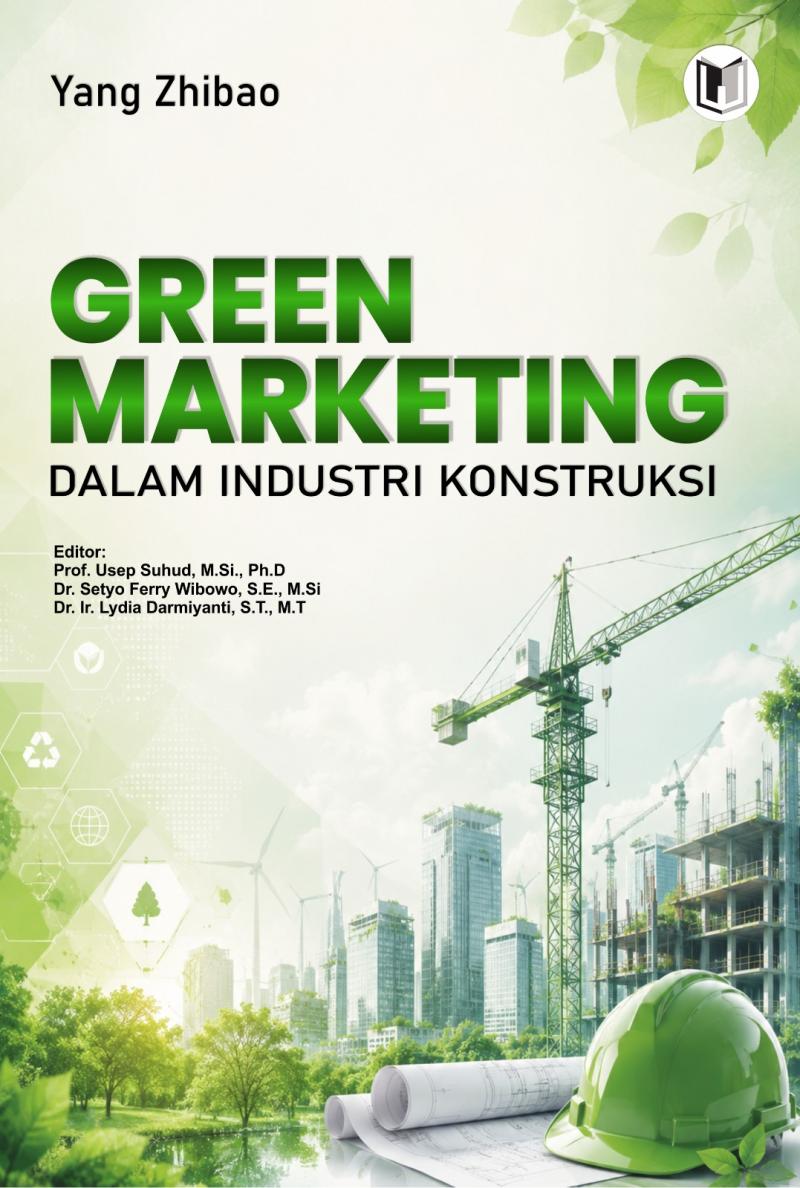
GREEN MARKETING DALAM INDUSTRI KONSTRUKSI
Keywords:
Green, Marketing, Industri, KonstruksiSynopsis
Buku ini membahas bagaimana konsep pemasaran hijau berkembang menjadi strategi penting dalam menghadapi tuntutan keberlanjutan di sektor konstruksi. Di tengah meningkatnya isu perubahan iklim, emisi karbon, dan eksploitasi sumber daya alam, industri konstruksi dituntut untuk tidak hanya berorientasi pada keuntungan ekonomi, tetapi juga memperhatikan dampak sosial dan lingkungan. Buku ini menguraikan dasar-dasar green marketing serta keterkaitannya dengan pembangunan berkelanjutan dan praktik green construction.
Pembahasan dalam buku disusun secara sistematis dengan mengintegrasikan berbagai landasan teori seperti Stakeholder Theory, Resource-Based View (RBV), Natural Resource-Based View (NRBV), Triple Bottom Line, Legitimacy Theory, dan Institutional Theory. Selain memberikan pemahaman konseptual, buku ini juga menjelaskan bagaimana perusahaan konstruksi dapat membangun keunggulan kompetitif melalui inovasi hijau, pengelolaan sumber daya yang berkelanjutan, serta penguatan hubungan dengan para pemangku kepentingan.
Lebih lanjut, buku ini mengupas strategi implementasi green marketing dalam perusahaan konstruksi, mulai dari segmentasi pasar hijau, green branding, penciptaan nilai perusahaan, hingga evaluasi kinerja keberlanjutan. Dengan memadukan perspektif akademik dan praktik bisnis, buku ini menjadi referensi yang relevan bagi mahasiswa, dosen, peneliti, maupun praktisi yang ingin memahami peran green marketing dalam mendorong transformasi industri konstruksi menuju pembangunan yang lebih ramah lingkungan, berdaya saing, dan berkelanjutan.
Downloads
Download data is not yet available.
References
Albertini, E. (2013). Does Environmental Management Improve Financial Performance? A Meta-Analytical Review. Organization & Environment, 26(4). https://doi.org/10.1177/1086026613510301
Barney, J. (1991). Firm Resources and Sustained Cometitive Advantage. Journal of Management, 17(1), 99–120.
Chen, Y. (2018). The Drivers of Green Brand Equity : Green Brand Image , Green Satisfaction , and Green Trust. 93(2), 307–319. https://doi.org/10.1007/sl0551-009-0223-9
Chen, Y., Lai, S., & Wen, C. (2006). The Influence of Green Innovation Performance on Corporate Advantage in Taiwan. Journal of Business Ethics, 67(331), 331–339. https://doi.org/10.1007/s10551-006-9025-5
Dangelico, R. M., & Vocalelli, D. (2017). “ Green Marketing ” : An analysis of de fi nitions , strategy steps , and tools through a systematic review of the literature. Journal of Cleaner Production, 165, 1263–1279. https://doi.org/10.1016/j.jclepro.2017.07.184
Delmas, M. A., & Burbano, V. C. (2011). The Drivers of Greenwashing. California Management Review, 54(1). http://www.jstor.org/stable/10.1525/cmr.2011.54.1.64 .
Elkington, J. (1997). Cannibals With Fork: The Triple Line of 21st Century Business. Capstone Publishing Limited.
Fields, O., Dimaggio, P. J., & Powell, W. W. (2014). The Iron Cage Revisted : Institutional Isomorphism and Collective Rationality in Organizational Fields. American Sociological Review, 8(2). https://doi.org/10.17323/1726-3247-2010-1-34-56
Fombrun, C. J. (2018). Reputation: Realizing Value from the Corporate Image (20 th Anni). Harvard Business School Press.
Freeman, R. E., & McVea, J. (2001). A Stakeholder Approach to Strategic Management. SSRN Electronic Journal, 01. https://doi.org/DOI:10.2139/ssrn.263511
Hart, S. (1995). A Natural Resources Based View of The Firm. Academy of Management Review, 20(4), 986–1014. https://doi.org/https://doi.org/10.2307/258963
Hart, S. L., & Dowell, G. (2011). A Natural-Resource-Based View of the Firm : Fifteen Years After. Journal of Management, 37(5), 1464–1479. https://doi.org/10.1177/0149206310390219
Klassen, R. D., & Mclaughlin, C. (1996). The Impact of Environmental Management on Firm Performance. Management Science, 42(8). https://doi.org/DOI:10.1287/mnsc.42.8.1199
Kotler, P., Keller, K. L., Chernev, A., Sneth, J. N., & Shainesh, G. (2022). Marketing Management (16th ed.). Pearson India Education Services Pvt. Ltd. https://medium.com/@arifwicaksanaa/pengertian-use-case-a7e576e1b6bf
Milosevic, D., Donaldson, T., & Preston, L. E. (2019). The Stakeholder Theory of The Corporation : Concepts , Evidence , And Implications. The Academy of Management Review, 20(1), 65–91. https://doi.org/https://doi.org/10.2307/258887
Orlitzky, M., Schmidt, F. L., Rynes, S. L., & Rynes, S. L. (2000). Corporate Social and Financial Performance : A Meta-analysis. Organization Studies, 24(3), 403–441.
Payne, A., & Frow, P. (2017). The customer value proposition : evolution , development , and application in marketing. Journal of the Academy of Marketing Science, 45. https://doi.org/https://doi.org/10.1007/s11747-017-0523-z
Peattie, K. (2001). Towards Sustainability: The Third Age of Green Marketing. The Marketing Review, 2, 129–146.
Peattie, K., & Belz, F.-M. (2010). Sustainability Marketing: An Innovative Conception of Marketing. Marketing Review St Gallen, 27(5). https://doi.org/DOI:10.1007/s11621-010-0085-7
Porter, M. E., & Linde, C. Van Der. (1995). Green and Competitive : Ending the Stalemate. Harvard Business Review.
Scott, W. R. (2014). Institution and Organization: Idea, Interest, and Identitie (Fourth Edi). SAGE Publications Ltd.
SKANSKA. (2024). Annual and Sustainability Report 2024. https://www.skanska.com/group/en/media/press-releases/2025/skanska-publishes-annual-and-sustainability-report-2024-solid-performance-and-strong-financial-position
Slaper, T. F., & Hall, T. J. (2011). The Triple Bottom Line : What Is It and How Does It Work ? Spring, 86(1), 4–8.
Suchman, M. C. (1995). Managing Legitimacy: Stategic and Institutional Approaches. Academy of Management Review, 20(3), 571–610.
Turban, D. B., & Greening, D. W. (1996). Corporate Social Performance and Organizational Attractiveness to Prospective Employees. Academy of Management Journal, 40(3), 658–672.
UN. (1987). Report of the World Commission on Environment and Development : Our Common Future Acronyms and Note on Terminology From One Earth to One World.
Wernerfelt, B. (2007). A Resource-based View of the Firm. Strategic Management Journal, 5(2), 171–180.
Downloads
Published
July 25, 2026
Copyright (c) 2026 Yang Zhibao (Author)
License

This work is licensed under a Creative Commons Attribution-NonCommercial-ShareAlike 4.0 International License.
Details about this monograph
ISBN-13 (15)
978-634-317-136-2
How to Cite
Zhibao, Y. (2026). GREEN MARKETING DALAM INDUSTRI KONSTRUKSI. Widina Media Utama. https://doi.org/10.59818/9r5qjw78