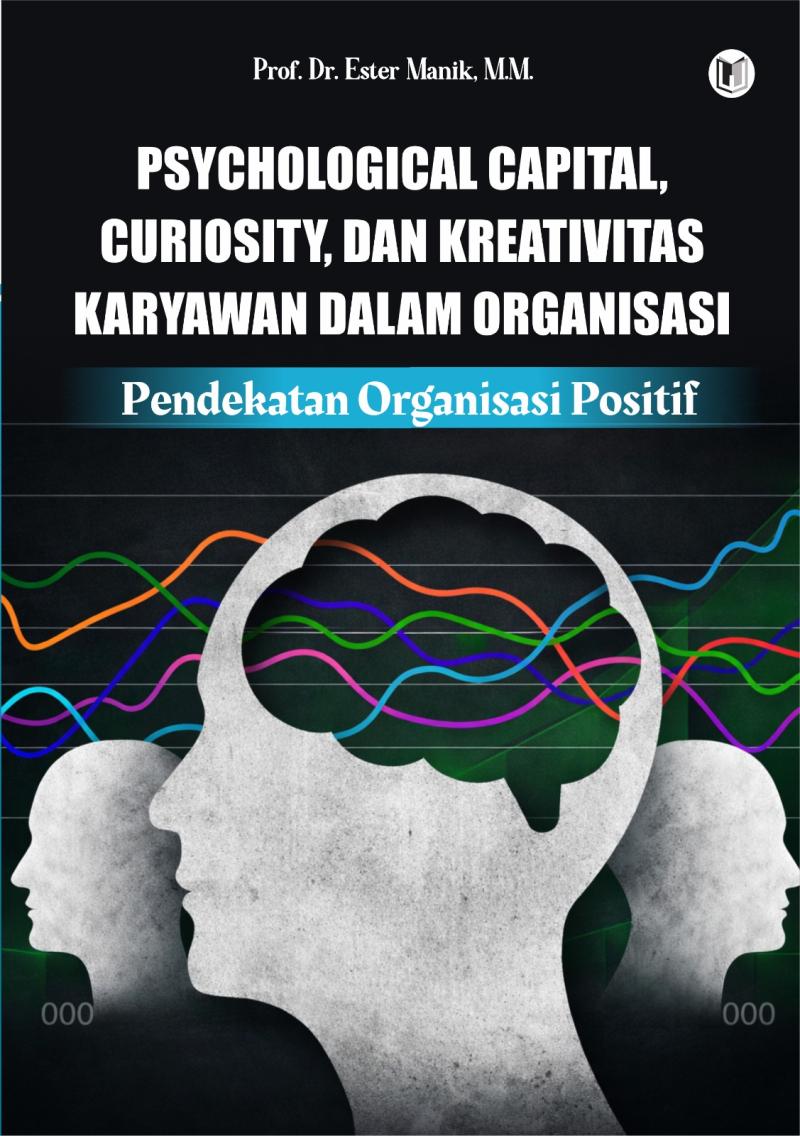
PSYCHOLOGICAL CAPITAL, CURIOSITY, DAN KREATIVITAS KARYAWAN DALAM ORGANISASI: PENDEKATAN PSIKOLOGI ORGANISASI POSITIF
Keywords:
Psychological Capital, Curiosity, Kreativitas Karyawan, Organisasi, Psikologi, ManajemenSynopsis
Buku ini disusun sebagai refleksi akademik yang mendalam atas transformasi paradigma pengelolaan sumber daya manusia di era globalisasi dan disrupsi digital. Dalam lanskap organisasi yang semakin kompleks dan penuh ketidakpastian, keunggulan kompetitif tidak lagi semata ditentukan oleh aset fisik dan intelektual, melainkan oleh kekuatan modal psikologis individu yang mampu mendorong lahirnya kreativitas dan inovasi berkelanjutan.
Buku ini menempatkan psychological capital sebagai konstruksi utama yang terdiri atas self-efficacy, hope, resilience, dan optimism. Keempat dimensi tersebut dielaborasi tidak hanya sebagai konsep teoretis, tetapi juga sebagai energi psikologis yang secara sistemik membentuk orientasi berpikir, daya juang, serta kapasitas adaptif karyawan dalam menghadapi dinamika organisasi modern.
Buku ini mengangkat curiosity sebagai variabel kunci yang berfungsi sebagai mekanisme kognitif dan afektif dalam menjembatani potensi psychological capital menuju aktualisasi kreativitas. Rasa ingin tahu dipahami sebagai dorongan intrinsik yang memungkinkan individu melampaui batas rutinitas, mengeksplorasi kemungkinan baru, serta merekonstruksi pengetahuan menjadi ide-ide inovatif yang bernilai strategis bagi organisasi.
Keunggulan buku ini terletak pada penyusunan model konseptual integratif yang mengaitkan secara sistematis psychological capital, curiosity, dan kreativitas karyawan dalam satu kerangka teoritis yang koheren. Model ini tidak hanya memiliki kekuatan konseptual, tetapi juga didukung oleh pengujian empiris yang memperkuat validitas hubungan antar variabel, sehingga memberikan kontribusi signifikan terhadap pengembangan kajian perilaku organisasi kontemporer.
Pada akhirnya, buku ini tidak sekadar menawarkan wacana akademik, melainkan juga memberikan arah praksis bagi organisasi dalam merancang strategi pengembangan sumber daya manusia yang berbasis pada penguatan modal psikologis dan budaya eksploratif. Dengan demikian, buku ini layak menjadi rujukan utama bagi akademisi, peneliti, dan praktisi yang berkomitmen membangun organisasi yang kreatif, adaptif, dan berdaya saing tinggi di tengah perubahan zaman yang terus bergerak dinamis.
Downloads
Download data is not yet available.
References
Abbas, M., & Raja, U. (2015). Impact of Psychological capital on innovative performance and job stress. Canadian Journal of Administrative Sciences, 32(2), 128–138. https://doi.org/10.1002/cjas.1314
Agarwal, P., & Farndale, E. (2017). High performance work systems and Creativity implementation: The role of Psychological capital and Psychological safety. Human Resource Management Journal, 27(3), 440–458. https://doi.org/10.1111/1748-8583.12148
Akkermans, J., Richardson, J., & Kraimer, M. L. (2020). The COVID-19 crisis as a career shock: Implications for careers and vocational behavior. Journal of Vocational Behavior, 119, 103434. https://doi.org/10.1016/j.jvb.2020.103434
Alessandri, G., Consiglio, C., Luthans, F., & Borgogni, L. (2018). Testing a dynamic model of the impact of Psychological capital on work engagement and job performance. Career Development International, 23(1), 33–47. https://doi.org/10.1108/cdi-11-2016-0210
Altig, D., Baker, S., Barrero, J. M., Bloom, N., Bunn, P., Chen, S., & Mihaylov, E. (2020). Economic uncertainty before and during the COVID-19 pandemic. Journal of Public Economics, 191, 104274.
Alzghoul, A., Elrehail, H., Emeagwali, O. L., & AlShboul, M. K. (2018). Knowledge management, workplace climate, Creativity and performance: The role of authentic leadership. Journal of Workplace Learning, 30(8), 592–612. https://doi.org/10.1108/jwl-12-2017-0111
Amabile, T. M., Conti, R., Coon, H., Lazenby, J., & Herron, M. (1996). Assessing the work environment for Creativity. Academy of Management Journal, 39(5), 1154–1184. https://doi.org/10.5465/256995
Anwar, A., Abid, G., & Waqas, A. (2019). Authentic leadership and Creativity: Moderated mediation model of resilience and hope in the health sector. European Journal of Investigation in Health, Psychology and Education, 10(1), 18–29. https://doi.org/10.3390/ejihpe10010003
Avey, J. B., Luthans, F., & Jensen, S. M. (2009). Psychological capital: A positive resource for combating employee stress and turnover. Human Resource Management, 48(5), 677–693. https://doi.org/10.1002/hrm.20294
Bakas, D., & Triantafyllou, A. (2020). Commodity price volatility and the economic uncertainty of pandemics. Economics Letters, 193, 109283. https://doi.org/10.1016/j.econlet.2020.109283
Baker, S. R., Bloom, N., Davis, S. J., & Terry, S. J. (2020). COVID-induced economic uncertainty (NBER Working Paper No. 26983). National Bureau of Economic Research.
Bierema, L. L. (2020). HRD research and practice after “The Great COVID-19 Pause”: The time is now for bold, critical research. Human Resource Development International, 23(4), 347–360. https://doi.org/10.1080/13678868.2020.1779912
Bloom, N. (2020). How working from home works out. Stanford Institute for Economic Policy Research.
Bolisani, E., Scarso, E., Ipsen, C., Kirchner, K., & Hansen, J. P. (2020). Working from home during COVID-19 pandemic: Lessons learned and issues. Management & Marketing: Challenges for the Knowledge Society, 15(S1), 458–476. https://doi.org/10.2478/mmcks-2020-0027
Byass, P. (2020). Eco-epidemiological assessment of the COVID-19 epidemic in China, January–February 2020. Global Health Action, 13(1), 1760490. https://doi.org/10.1080/16549716.2020.1760490
Cai, W., Lysova, E. I., Bossink, B. A., Khapova, S. N., & Wang, W. (2019). Psychological capital and self reported employee Creativity: The moderating role of supervisor support and job characteristics. Creativity and Innovation Management, 28(1), 30–41. https://doi.org/10.1111/caim.12277
Černe, M., Nerstad, C. G., Dysvik, A., & Škerlavaj, M. (2014). What goes around comes around: Knowledge hiding, perceived motivational climate, and Creativity. Academy of Management Journal, 57(1), 172–192.
Chang, Y. Y., & Shih, H. Y. (2019). Work curiosity: A new lens for understanding employee Creativity. Human Resource Management Review, 29(4), 100672. https://doi.org/10.1016/j.hrmr.2018.10.005
Chen, Y., Liu, D., Tang, G., & Hogan, T. M. (2021). Workplace events and employee Creativity: A multistudy field investigation. Personnel Psychology, 74(2), 211–236. https://doi.org/10.1111/peps.12399
Chirico, A., Lucidi, F., Galli, F., Giancamilli, F., Vitale, J., Borghi, S., & Codella, R. (2020). COVID-19 outbreak and physical activity in the Italian population. Frontiers in Psychology, 11, 2100. https://doi.org/10.3389/fpsyg.2020.02100
Choi, W., Noe, R., & Cho, Y. (2019). What is responsible for the Psychological capital job performance relationship? Journal of Managerial Psychology, 35(1), 28–41.
Darvishmotevali, M., & Ali, F. (2020). Job insecurity, subjective well being and job performance: The moderating role of Psychological capital. International Journal of Hospitality Management, 87, 102462. https://doi.org/10.1016/j.ijhm.2020.102462
George, J. M., & Zhou, J. (2002). Understanding when bad moods foster Creativity and good ones do not. Journal of Applied Psychology, 87(4), 687–697. https://doi.org/10.1037/0021-9010.87.4.687
Ghosh, K. (2015). Developing organizational Creativity and innovation. Management Research Review, 38(11), 1126–1148. https://doi.org/10.1108/mrr-01-2014-0017
Gross, M. E., Zedelius, C. M., & Schooler, J. W. (2020). Cultivating an understanding of curiosity as a seed for Creativity. Current Opinion in Behavioral Sciences, 35, 77–82. https://doi.org/10.1016/j.cobeha.2020.07.015
Hagtvedt, L. P., Dossinger, K., Harrison, S. H., & Huang, L. (2019). Curiosity made the cat more creative. Organizational Behavior and Human Decision Processes, 150, 1–13. https://doi.org/10.1016/j.obhdp.2018.10.007
Hammond, M. M., Neff, N. L., Farr, J. L., Schwall, A. R., & Zhao, X. (2011). Predictors of individual level innovation at work. Psychology of Aesthetics, Creativity, and the Arts, 5(1), 90–105.
Han, G. H., & Bai, Y. (2020). Leaders can facilitate Creativity. Journal of Managerial Psychology, 35(5), 405–417. https://doi.org/10.1108/jmp-02-2019-0106
Harari, M. B., Reaves, A. C., & Viswesvaran, C. (2016). Creative and innovative performance. European Journal of Work and Organizational Psychology, 25(4), 495–511. https://doi.org/10.1080/1359432x.2015.1134491
Hardy, J. H., Ness, A. M., & Mecca, J. (2017). Epistemic curiosity as a predictor of creative problem solving. Personality and Individual Differences, 104, 230–237. https://doi.org/10.1016/j.paid.2016.08.004
Harrison, S. H., & Dossinger, K. (2017). Pliable guidance. Academy of Management Journal, 60(6), 2051–2072. https://doi.org/10.5465/amj.2015.0247
Hite, L. M., & McDonald, K. S. (2020). Careers after COVID-19. Human Resource Development International, 23(4), 427–437. https://doi.org/10.1080/13678868.2020.1779576
Hobfoll, S. E. (2002). Social and Psychological resources and adaptation. Review of General Psychology, 6(4), 307–324. https://doi.org/10.1037/1089-2680.6.4.307
Horstmeyer, A. (2018). How VUCA is changing the learning landscape and how curiosity can help. Development and Learning in Organizations: An International Journal, 33(1), 5–8. https://doi.org/10.1108/DLO-09-2018-0119
Hunter, J. A., Abraham, E. H., Hunter, A. G., Goldberg, L. C., & Eastwood, J. D. (2016). Personality and boredom proneness in the prediction of Creativity and curiosity. Thinking Skills and Creativity, 22, 48–57. https://doi.org/10.1016/j.tsc.2016.08.002
Jaiswal, A., & Arun, C. J. (2020). Unlocking the COVID-19 lockdown: Work from home and its impact on employees. 1–24. https://doi.org/10.21203/rs.3.rs-34556/v1
Karwowski, M. (2012). Did curiosity kill the cat? Relationship between trait curiosity, creative Self-Efficacy and creative personal identity. Europe’s Journal of Psychology, 8(4), 547–558. https://doi.org/10.5964/ejop.v8i4.513
Kashdan, T. B., Gallagher, M. W., Silvia, P. J., Winterstein, B. P., Breen, W. E., Terhar, D., & Steger, M. F. (2009). The curiosity and exploration inventory-II: Development, factor structure, and psychometrics. Journal of Research in Personality, 43(6), 987–998. https://doi.org/10.1016/j.jrp.2009.04.011
Kashdan, T. B., Rose, P., & Fincham, F. D. (2004). Curiosity and exploration: Facilitating positive subjective experiences and personal growth opportunities. Journal of Personality Assessment, 82(3), 291–305. https://doi.org/10.1207/s15327752jpa8203_05
Li, Z., Dai, L., Chin, T., & Rafiq, M. (2019). Understanding the role of Psychological capital in humorous leadership–employee Creativity relations. Frontiers in Psychology, 10, 1636. https://doi.org/10.3389/fpsyg.2019.01636
Liu, H. Y., Chang, C. C., Wang, I. T., & Chao, S. Y. (2020). The association between Creativity, creative components of personality, and innovation among Taiwanese nursing students. Thinking Skills and Creativity, 35, 100629. https://doi.org/10.1016/j.tsc.2020.100629
Liu, J., Wang, Y., & Zhu, Y. (2020). Climate for innovation and employee Creativity. International Journal of Manpower, 41(4), 341–356.
Luthans, F. (2002). The need for and meaning of positive Organizational Behavior. Journal of Organizational Behavior, 23(6), 695–706. https://doi.org/10.1002/job.165
Luthans, F., & Youssef-Morgan, C. M. (2017). Psychological capital: An evidence-based positive approach. Annual Review of Organizational Psychology and Organizational Behavior, 4(1), 339–366. https://doi.org/10.1146/annurev-orgpsych-032516-113324
Luthans, F., Avey, J. B., Avolio, B. J., & Peterson, S. J. (2010). The development and resulting performance impact of positive Psychological capital. Human Resource Development Quarterly, 21(1), 41–67. https://doi.org/10.1002/hrdq.20034
Luthans, F., Avolio, B. J., Avey, J. B., & Norman, S. M. (2007). Positive Psychological capital: Measurement and relationship with performance and satisfaction. Personnel Psychology, 60(3), 541–572. https://doi.org/10.1111/j.1744-6570.2007.00083.x
Luthans, F., Youssef, C. M., & Rawski, S. L. (2011). A tale of two paradigms: The impact of Psychological capital and reinforcing feedback on problem solving and innovation. Journal of Organizational Behavior Management, 31(4), 333–350. https://doi.org/10.1080/01608061.2011.619421
Ma, Z., Gong, Y., Long, L., & Zhang, Y. (2021). Team-level high-performance work systems, Self-Efficacy and Creativity: Differential moderating roles of person–job fit and goal difficulty. The International Journal of Human Resource Management, 32(2), 478–511. https://doi.org/10.1080/09585192.2020.1854816
Manik, E., Sidharta, I., Zulfikar, V. A., Rahman, R. S., Fitria, B. T., Resawati, R., & Nurdiansyah, H. (2023). Creativity: The impact of Psychological capital and curiosity from the employee’s perspective in Bandung, Indonesia. International Journal of Management and Sustainability, 12(2), 204-213.
Miao, R., & Cao, Y. (2019). High-performance work system, work well-being, and employee Creativity: Cross-level moderating role of transformational leadership. International Journal of Environmental Research and Public Health, 16(9), 1640. https://doi.org/10.3390/ijerph16091640
Noda, Y. (2020). Socioeconomical transformation and mental health impact by the COVID-19’s ultimate VUCA era: Toward the new normal, the new Japan, and the new world. Asian Journal of Psychiatry, 54, 102262. https://doi.org/10.1016/j.ajp.2020.102262
Pathak, D., & Joshi, G. (2021). Impact of Psychological capital and life satisfaction on organizational resilience during COVID-19: Indian tourism insights. Current Issues in Tourism, 24(17), 2398–2415. https://doi.org/10.1080/13683500.2020.1844643
Pattnaik, S. C., & Sahoo, R. (2021). Employee engagement, Creativity and task performance: Role of perceived workplace autonomy. South Asian Journal of Business Studies, 10(2), 227–241. https://doi.org/10.1108/SAJBS-11-2019-0196
Schutte, N. S., & Malouff, J. M. (2020). Connections between curiosity, flow and Creativity. Personality and Individual Differences, 152, 109555. https://doi.org/10.1016/j.paid.2019.109555
Silla, I., & Gamero, N. (2018). Psychological safety climate and professional drivers’ well-being: The mediating role of time pressure. Transportation Research Part F: Traffic Psychology and Behaviour, 53, 84–92. https://doi.org/10.1016/j.trf.2017.12.002
Sipa, M. (2018). The factors determining the Creativity of the Human Capital in the conditions of sustainable development. European Journal of Sustainable Development, 7(2), 1–1. https://doi.org/10.14207/ejsd.2018.v7n2p1
Sweetman, D., Luthans, F., Avey, J. B., & Luthans, B. C. (2011). Relationship between positive Psychological capital and creative performance. Canadian Journal of Administrative Sciences, 28(1), 4–13. https://doi.org/10.1002/cjas.175
Van Knippenberg, D., & Hirst, G. (2020). A motivational lens model of person × situation interactions in employee Creativity. Journal of Applied Psychology, 105(10), 1129–1144. https://doi.org/10.1037/apl0000486
Wagstaff, M. F., Flores, G. L., Ahmed, R., & Villanueva, S. (2021). Measures of curiosity: A literature review. Human Resource Development Quarterly, 32(3), 363–389. https://doi.org/10.1002/hrdq.21417
Wang, Y., Liu, J., & Zhu, Y. (2018). How does humble leadership promote follower Creativity? The roles of Psychological capital and growth need strength. Leadership & Organization Development Journal, 39(4), 507–521. https://doi.org/10.1108/LODJ-03-2017-0069
Yaakobi, E., & Weisberg, J. (2020). Organizational citizenship behavior predicts quality, Creativity, and efficiency performance: The roles of occupational and collective efficacies. Frontiers in Psychology, 11, 758. https://doi.org/10.3389/fpsyg.2020.00758
Yu, X., Li, D., Tsai, C. H., & Wang, C. (2019). The role of Psychological capital in employee Creativity. Career Development International, 24(5), 420–437.
Zaremba, A., Kizys, R., Aharon, D. Y., & Demir, E. (2020). Infected markets: Novel coronavirus, government interventions, and stock return volatility around the globe. Finance Research Letters, 35, 101597.
Zhang, W., Xu, F., & Sun, B. (2020). Openness to experience, job characteristics, and employee Creativity: An interactionist perspective. Social Behavior and Personality: An International Journal, 48(4), 1–12. https://doi.org/10.2224/sbp.9047
Zhang, X., & Bartol, K. M. (2010). Linking empowering leadership and employee Creativity: The influence of Psychological empowerment, intrinsic motivation, and creative process engagement. Academy of Management Journal, 53(1), 107–128. https://doi.org/10.5465/amj.2010.48037118
Zinchenko, Y. P., Morosanova, V. I., Kondratyuk, N. G., & Fomina, T. G. (2020). Conscious self-regulation and self-organization of life during the COVID-19 pandemic. Psychology in Russia: State of the Art, 13(4), 168–182. https://doi.org/10.11621/pir.2020.0411
Downloads
Published
April 15, 2026
Copyright (c) 2026 Ester Manik (Author)
License

This work is licensed under a Creative Commons Attribution-NonCommercial-ShareAlike 4.0 International License.
Details about this monograph
ISBN-13 (15)
978-634-317-155-3
How to Cite
Manik, E. (2026). PSYCHOLOGICAL CAPITAL, CURIOSITY, DAN KREATIVITAS KARYAWAN DALAM ORGANISASI: PENDEKATAN PSIKOLOGI ORGANISASI POSITIF. Widina Media Utama. https://doi.org/10.59818/avd3js25