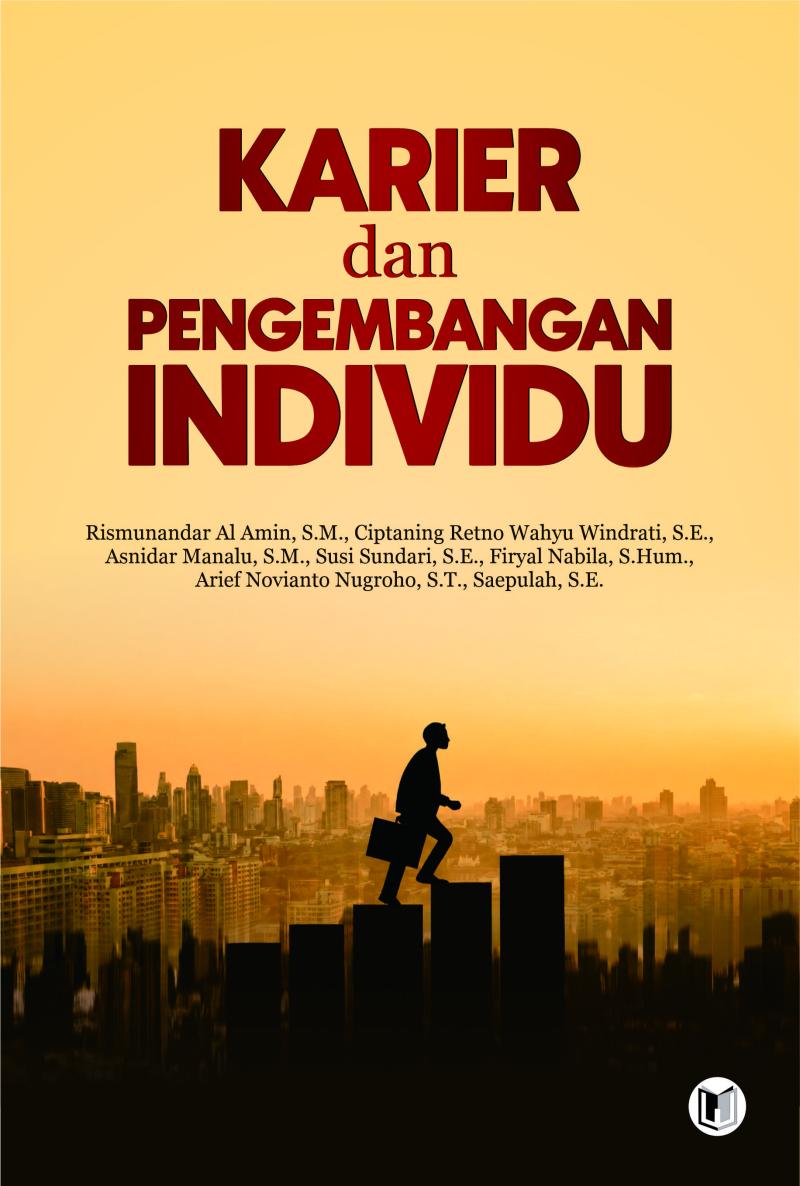
KARIER DAN PENGEMBANGAN INDIVIDU
Keywords:
Pengembangan Karier (Career Development), Pengembangan Individu (Individual Development), Manajemen Talenta (Talent Management), Kompetensi (Competence), Strategi Organisasi (Organizational Strategy), Dunia Kerja Modern (Modern Workspace), Perencanaan Karier (Career Planning)Synopsis
Ditengah perubahan dunia kerja yang berlangsung semakin cepat, karier tidak lagi dipandang sebagai sekadar perjalanan menuju jabatan yang lebih tinggi, melainkan sebagai proses pengembangan diri yang berkelanjutan. Individu dituntut untuk terus belajar, beradaptasi, dan meningkatkan kompetensi agar mampu menghadapi tantangan sekaligus memanfaatkan peluang yang muncul di berbagai sektor industri. Dalam konteks inilah, pengembangan karier menjadi salah satu faktor penting yang menentukan keberhasilan individu maupun organisasi. Buku Karier dan Pengembangan Individu hadir untuk memberikan pemahaman yang komprehensif mengenai berbagai strategi, praktik, dan model pengembangan karier dalam dunia kerja modern. Pembahasan disusun secara sistematis dengan mengintegrasikan konsep-konsep teoritis, praktik industri, analisis kesenjangan, serta implikasi manajerial yang relevan dengan kebutuhan organisasi saat ini.
Melalui berbagai kajian pada sektor retail, manufaktur, teknologi, perbankan, hospitality, e-commerce, hingga sektor publik, buku ini menggambarkan bagaimana setiap industri memiliki karakteristik, tantangan, dan pendekatan yang berbeda dalam mengelola serta mengembangkan potensi sumber daya manusia. Pembaca diajak memahami pentingnya perencanaan karier, pengembangan kompetensi, pengelolaan talenta, kepemimpinan, hingga peran organisasi dalam menciptakan lingkungan kerja yang mendukung pertumbuhan individu secara berkelanjutan. Dengan pendekatan yang aplikatif dan berorientasi pada kebutuhan dunia kerja, buku ini tidak hanya memperluas wawasan mengenai pengembangan karier, tetapi juga memberikan inspirasi bagi pembaca untuk merancang perjalanan profesionalnya secara lebih terarah. Pada saat yang sama, buku ini menawarkan perspektif yang dapat membantu organisasi membangun strategi pengembangan sumber daya manusia yang adaptif, inovatif, dan berkelanjutan guna menghadapi dinamika dunia kerja masa kini dan masa depan.
Downloads
Download data is not yet available.
References
(ISC)². (2022). Cybersecurity Workforce Study. (ISC)² Research. https://www.isc2.org/Research/Workforce-Study
Aguinis, H. (2019). Performance Management (4th ed.). Pearson.
AHM. (2023). Career Path & Development. PT Astra Honda Motor. https://www.astra-honda.com/career/career-path-development
Al-Emran, M., Al-Sharafi, A., Al-Qurneh, M., & Al-Emran, M. (2020). The impact of e-learning on students’ academic performance: A review of the literature. International Journal of Emerging Technologies in Learning (iJET), 15(1), 108–122.
Al-Omari, K. A., & Al-Omari, A. A. (2017). The impact of career management on employee retention in Jordanian commercial banks. International Journal of Business and Management, 12(1), 163–172.
Al-Omari, K. A., Al-Hawary, S. I. S., & Al-Qudah, M. K. (2023). The impact of training and development on employee performance in the manufacturing sector: A case study. Journal of Human Resources Management Research, 13(1), 1–15.
Armstrong, M. (2020). Armstrong's Handbook of Human Resource Management Practice (15th ed.). Kogan Page. https://books.google.co.id/books?id=2-71DwAAQBAJ
Arthur, M. B., & Rousseau, D. M. (Eds.). (1996). The Boundaryless Career: A New Employment Principle for a New Organizational Era. Oxford University Press.
Arthur, M. B., Hall, D. T., & DeFillippi, R. J. (2019). The boundaryless career: A new perspective for organizational inquiry. Journal of Organizational Behavior, 40(1), 1–15.
Arthur, M. B., Inkson, K., & Pringle, J. (2019). The New Careers: Individual Action and Organizational Response. SAGE Publications.
Bandura, A. (2001). Social cognitive theory: An agentic perspective. Annual Review of Psychology, 52(1), 1–26.
Baum, T. (2007). Human Resource Management for Tourism, Hospitality and Leisure: An International Perspective. Routledge.
Baum, T. (2015). Human Resources in Hospitality and Tourism: Skills, Knowledge and Attitudes. Goodfellow Publishers.
Baum, T. (2015). Human resources in tourism: Still a Cinderella industry? Tourism Management, 47, 203–212.
Becker, G. S. (1964). Human Capital: A Theoretical and Empirical Analysis, with Special Reference to Education. Columbia University Press. https://books.google.co.id/books?id=660iAQAAIAAJ
Bersin by Deloitte. (2020). The Social Enterprise at Work: Paradox as a Path Forward. Deloitte Insights.
Bersin by Deloitte. (2021). The Employee Experience: How Leading Companies Are Changing the Way They Engage Their Workforce.
Bersin by Deloitte. (2021). The Employee Experience: How Leading Companies Are Redefining HR. Deloitte Insights.
Bersin, J. (2018). The Reskilling Revolution: How to Prepare Your Workforce for the Future. Deloitte Insights. https://www2.deloitte.com/us/en/insights/focus/human-capital-trends/2018/reskilling-the-workforce-for-the-future.html
Briscoe, J. P., & Hall, D. T. (2006). The interplay of boundaryless and protean careers: Combinations and implications. Journal of Vocational Behavior, 69(1), 1–18.
Briscoe, J. P., Hall, D. T., & DeMuth, R. L. (2019). Protean careers: A review of the literature and a research agenda. Journal of Vocational Behavior, 110, 1–19.
Cascio, W. F., & Aguinis, H. (2019). Applied Psychology in Talent Management (8th ed.). SAGE Publications.
Chen, C. C., & Wang, Y. C. (2022). The impact of e-learning on employee competence and organizational performance in the tourism and hospitality industry. Journal of Hospitality & Tourism Education, 34(1), 1–15.
Chen, Y., & Huang, L. (2022). The impact of career path clarity on employee engagement and turnover intention in the retail industry. Journal of Retail Management, 15(3), 210–225.
Chen, Y., & Wang, L. (2023). The impact of digital transformation on employee skill development and organizational performance in the retail sector. Journal of Retail Management, 15(2), 112–128.
Chen, Y., Li, J., & Wang, L. (2021). The effect of job rotation on employee turnover intention and job satisfaction: A case study of an automotive manufacturing company. International Journal of Human Resource Management, 32(10), 2150–2170.
Chen, Y., Wang, Y., & Li, J. (2022). The impact of human resource management practices on employee performance in the retail industry: The mediating role of employee engagement. Journal of Retailing and Consumer Services, 64, 102790.
Choi, Y., & Kim, S. (2019). The effects of job demands and resources on burnout and turnover intention in the hotel industry. Journal of Hospitality and Tourism Management, 38, 1–9.
CIPD. (2021). Employee Turnover and Retention. Chartered Institute of Personnel and Development.
Cross, J. (2019). Informal Learning: Rediscovering the Natural Pathways That Inspire Innovation and Performance. John Wiley & Sons. https://books.google.com/books?id=y96uDwAAQBAJ
Davenport, T. H., & Beck, J. C. (2001). The Attention Economy: Understanding the New Currency of Business. Harvard Business Press.
Davidson, M. C., Timo, N., & Wang, Y. (2019). How to reduce employee turnover in the hospitality industry. International Journal of Contemporary Hospitality Management, 31(1), 176–192.
Dawis, R. V., & Lofquist, L. H. (1984). A Psychological Theory of Work Adjustment: An Individual-Differences Model and Its Applications. University of Minnesota Press.
De Meuse, K. P., & Tang, K. Y. (2022). Learning Agility: The Key to Career Success. Routledge.
De Meuse, K. P., Dai, G., & Hallenbeck, G. S. (2010). Learning agility: A construct whose time has come. Industrial and Organizational Psychology, 3(4), 495–497.
De Vos, A., Dries, N., & Van der Heijden, B. I. J. M. (2019). Career management and career success: A review and research agenda. Journal of Vocational Behavior, 110, 1–17.
De Vos, A., Van der Heijden, B. I. J. M., & Akkermans, J. (2020). Sustainable careers: Concepts, theory, and practice. Journal of Vocational Behavior, 117, 103371.
Deery, M. (2008). Talent management, work-life balance and retention strategies. International Journal of Contemporary Hospitality Management, 20(7), 792–806.
Deery, M., & Jago, L. (2015). Revisiting talent management in hospitality: A review of the literature. International Journal of Contemporary Hospitality Management, 27(7), 1391–1402.
Deery, M., & Jago, L. (2015). Revisiting talent management, work-life balance and retention strategies. International Journal of Contemporary Hospitality Management, 27(3), 453–472.
Deery, M., & Jago, L. (2015). Revisiting the causes of turnover among hospitality employees. International Journal of Contemporary Hospitality Management, 27(5), 693–712.
Deery, M., & Jago, L. (2019). The impact of work-life balance on employee retention in the hospitality industry. International Journal of Contemporary Hospitality Management, 31(1), 234–250.
Deloitte. (2020). The Social Enterprise at Work: Paradox as a Path Forward. Deloitte Global Human Capital Trends. https://www2.deloitte.com/content/dam/Deloitte/global/Documents/HumanCapital/hc-trends-2020.pdf
Deloitte. (2021). The Social Enterprise in a World in Flux: Deloitte Global Human Capital Trends 2021. https://www2.deloitte.com/content/dam/Deloitte/global/Documents/About-Deloitte/gx-deloitte-global-human-capital-trends-2021.pdf
Deloitte. (2022). Global Human Capital Trends 2022: The Great Realignment. Deloitte Insights. https://www2.deloitte.com/us/en/insights/topics/human-capital-trends/2022/global-human-capital-trends.html
Deloitte. (2022). Global Human Capital Trends 2022: The Great Reimagination. Deloitte Insights.
Deloitte. (2023). Future of Banking: Navigating the Next Wave of Transformation. Deloitte Insights.
Deloitte. (2023). Global Powers of Retailing 2023.
Dewi, N. P. A. S., & Putra, I. M. A. D. (2022). Pengaruh keadilan prosedural, keadilan interaksional, dan keadilan distributif terhadap kepuasan kerja karyawan. Jurnal Manajemen dan Bisnis, 19(1), 1–10.
Dweck, C. S. (2006). Mindset: The New Psychology of Success. Random House. https://books.google.com/books?id=h-y-o_22y0kC
Dwivedi, Y. K., Kshetri, N., Hughes, L., Slade, E. L., Jeyaraj, A., Kar, A. K., Baabdullah, A. M., Koohang, A., Raghavan, V., Rahman, M. M., Patil, P., & Pandey, N. (2023). So what if ChatGPT wrote it? Multidisciplinary perspectives on opportunities, challenges and implications of generative conversational AI for research, practice and policy. International Journal of Information Management, 71, 102642.
Edmondson, A. C. (2018). The Fearless Organization: Creating Psychological Safety in the Workplace for Learning, Innovation, and Growth. John Wiley & Sons.
Ferrari, A., Punie, Y., & Redecker, C. (2013). DIGCOMP: A Framework for Developing and Understanding Digital Competence in Europe. Publications Office of the European Union.
Gallup. (2021). State of the Global Workplace 2021 Report. Gallup.
Gallup. (2022). State of the Global Workplace 2022 Report. https://www.gallup.com/workplace/394510/state-global-workplace-2022-report.aspx
Gartner. (2023). Top Strategic Technology Trends for 2023. https://www.gartner.com/en/articles/top-strategic-technology-trends-for-2023
Gössling, S., Scott, D., & Hall, C. M. (2020). Pandemics, tourism and global change: A rapid assessment of COVID-19. Journal of Sustainable Tourism, 29(1), 1–20.
Greenhaus, J. H., Callanan, G. A., & Godshalk, V. M. (2010). Career Management (4th ed.). Sage Publications.
Gupta, A., & Sharma, R. (2022). Adapting career development strategies for the evolving retail landscape: A case study approach. International Journal of Human Resource Management, 33(7), 1450–1470.
Gupta, S., & Kumar, A. (2019). Role of job rotation in enhancing employee skills and performance in retail sector. International Journal of Human Resource Management and Research, 9(4), 1–10.
Hall, D. T. (1976). Careers in Organizations. Goodyear Publishing Company.
Hall, D. T. (2002). Careers in and Out of Organizations. SAGE Publications.
IBM. (2020). The Value of Skills: How to Close the Skills Gap and Drive Business Growth. IBM Institute for Business Value. https://www.ibm.com/thought-leadership/institute-business-value/report/value-of-skills
IBM. (2023). IBM SkillsBuild. https://www.ibm.com/skillsbuild
IBM. (n.d.). IBM SkillsBuild. Retrieved from https://skillsbuild.org/
Jiang, L., Li, M., & Zhang, Y. (2022). Career stagnation and employee motivation in service industries: The moderating role of organizational support. Service Industries Journal, 42(5–6), 380–400.
Jiang, W., Wang, Y., & Wang, C. (2021). Career development and turnover intention of hotel employees: The mediating role of job satisfaction. Journal of Hospitality and Tourism Management, 46, 1–9.
Johnson, R., & Miller, S. (2023). Transparency in promotion processes and its effect on employee trust and organizational performance in retail. Journal of Business Ethics and Leadership, 18(1), 45–60.
Johnson, R., & Williams, L. (2020). Career development programs and employee retention in the retail sector: A comparative study. International Journal of Human Resource Management, 31(12), 1500–1520.
Kim, B., & Kim, S. (2019). The effects of career development programs on organizational commitment and turnover intention in the hotel industry. Journal of Hospitality and Tourism Management, 38, 1–9.
Kim, H. J., & Kim, J. J. (2021). The role of emotional intelligence in leadership development for hospitality managers. International Journal of Contemporary Hospitality Management, 33(3), 987–1005.
Kim, H. J., Kim, J. H., & Kim, J. H. (2019). The effect of career development programs on job satisfaction and organizational commitment in the hotel industry. Journal of Hospitality and Tourism Management, 38, 1–9.
Kim, H., & Kim, J. (2019). The effects of career development programs on employee satisfaction and organizational commitment in the hotel industry. Journal of Hospitality and Tourism Management, 38, 1–9.
Kim, H., & Kim, S. (2020). The impact of emotional labor on job satisfaction and turnover intention in the hotel industry: The moderating role of emotional intelligence. Journal of Hospitality and Tourism Management, 42, 1–9.
Kim, H., & Kim, W. G. (2019). The effect of organizational learning culture on employee job satisfaction and turnover intention in the hotel industry. Journal of Hospitality and Tourism Management, 38, 1–9.
Kim, H., & Kim, W. G. (2019). The effects of career development programs on employees' career commitment and turnover intention in the hotel industry. Journal of Hospitality and Tourism Management, 38, 1–9.
Kim, H., & Kim, Y. (2019). The effects of career development programs on employee satisfaction and organizational commitment in the hotel industry. Journal of Hospitality and Tourism Management, 38, 1–9.
Kim, J., & Lee, H. (2022). The effectiveness of training programs on sales performance and customer service quality in retail. Service Industries Journal, 42(7–8), 521–540.
Kim, S., & Kim, J. (2020). The effect of training and development on employee performance and customer satisfaction in the retail industry. Journal of Business Research, 118, 123–132.
Kim, S., & Lee, J. (2020). The effect of perceived fairness of promotion on job satisfaction and organizational commitment: The mediating role of trust in supervisor. Journal of Business Research, 111, 1–10.
Kim, S., Lee, J., & Park, H. (2022). Merit-based promotion system and organizational commitment in manufacturing firms. Journal of Organizational Behavior, 43(5), 800–815.
Kong, H., Sun, S., & Kim, S. (2020). The impact of career management on employee retention in the hospitality industry: The mediating role of perceived organizational support. International Journal of Hospitality Management, 84, 102345.
KPMG. (2022). Future of HR in Retail: Navigating the New Normal.
Kristof-Brown, A. L., Zimmerman, R. D., & Johnson, E. C. (2005). Consequences of individuals' fit at work: A meta-analysis of person-job, person-organization, person-group, and person-supervisor fit. Personnel Psychology, 58(2), 281–342.
Kuijpers, M. A. C., Schyns, B., & Wittekind, A. (2020). Career competencies and career success: A meta-analysis. Journal of Vocational Behavior, 117, 103372.
Kurniawan, A., & Sari, D. P. (2021). Analisis pengaruh pengembangan karir dan lingkungan kerja terhadap kinerja karyawan pada PT Bank Mandiri (Persero) Tbk. Cabang Medan. Jurnal Ilmiah Manajemen dan Bisnis, 22(1), 1–12.
Kusluvan, S., Kusluvan, Z., Ilhan, I., & Buyruk, L. (2010). The human resources strategies and policies in hotels in Turkey. Journal of Hospitality and Tourism Management, 17(1), 1–12.
Lee, H., & Kim, Y. (2021). Career development opportunities and employee turnover intention in the retail sector: A mediated moderation model. Journal of Organizational Behavior, 42(3), 345–360.
Lee, J. S., & Ok, C. M. (2019). The role of career development in reducing turnover intention in the hospitality industry. Journal of Hospitality Marketing & Management, 28(1), 1–20.
Lee, J. S., & Ok, C. M. (2020). The effects of mentoring on job satisfaction and turnover intention in the hotel industry: The mediating role of career commitment. Journal of Hospitality & Tourism Research, 44(2), 291–310.
Lee, J., & Chen, Y. (2022). The impact of continuous learning on career advancement in the fintech industry. Journal of Financial Technology and Innovation, 8(3), 123–138.
Lee, M., & Kim, S. (2020). Career ladders vs. career lattices: A comparative study of career path models in the retail industry. Journal of Organizational Behavior and Human Decision Processes, 35(2), 123–138.
Lee, S., & Kim, H. (2021). Perceived career opportunities and employee turnover intention in the retail industry: The moderating role of organizational support. Journal of Business Research, 129, 88–97.
Lengnick-Hall, M. L., Beck, T. E., & Lengnick-Hall, C. A. (2011). Developing a capacity for organizational resilience through strategic human resource management. Human Resource Management Review, 21(3), 243–255.
Lent, R. W., & Brown, S. D. (2013). Social cognitive career theory. Dalam S. D. Brown & R. W. Lent (Eds.), Career Development and Counseling: Putting Theory and Research to Work (2nd ed., pp. 115–146). John Wiley & Sons.
Lent, R. W., Brown, S. D., & Hackett, G. (1994). Toward a unifying social cognitive theory of career and academic interest, choice, and performance. Journal of Vocational Behavior, 45(1), 79–122.
Manyika, J., Chui, M., Miremadi, M., Bughin, J., George, K., Dahlström, P., & Van Kuiken, A. (2017). Jobs Lost, Jobs Gained: Workforce Transitions in a Time of Automation. McKinsey Global Institute. https://www.mckinsey.com/featured-insights/future-of-work/jobs-lost-jobs-gained-workforce-transitions-in-a-time-of-automation
Marriott International. (2023). Careers at Marriott. Retrieved from https://careers.marriott.com/
Marriott International. (2023). Voyage Global Leadership Development Program. Retrieved from https://careers.marriott.com/students-and-graduates/voyage-program/
Meyer, J. P., & Allen, N. J. (1991). A three-component conceptualization of organizational commitment. Human Resource Management Review, 1(1), 61–89.
Microsoft. (2023). Microsoft Work Trend Index 2023: The New AI at Work Is Here. Are You Ready? https://www.microsoft.com/en-us/worklab/work-trend-index/ai-at-work-is-here-are-you-ready
Mishra, P., & Singh, R. (2020). Impact of promotion opportunities on employee motivation and performance in the retail sector. Journal of Human Resources Management, 12(2), 87–102.
Ng, T. W. H., & Feldman, D. C. (2014). Subjective career success: A meta-analytic review. Journal of Vocational Behavior, 85(3), 304–314.
Noe, R. A., Hollenbeck, J. R., Gerhart, B., & Wright, P. M. (2017). Human Resource Management: Gaining a Competitive Advantage (10th ed.). McGraw-Hill Education.
Noe, R. A., Hollenbeck, J. R., Gerhart, B., & Wright, P. M. (2022). Human Resource Management: Gaining a Competitive Advantage (12th ed.). McGraw-Hill Education. https://books.google.com/books?id=J_20zgEACAAJ
Noe, R. A., Hollenbeck, J. R., Gerhart, B., & Wright, P. M. (2022). Human Resource Management: Gaining a Competitive Advantage (13th ed.). McGraw-Hill Education. https://books.google.co.id/books?id=75t0EAAAQBAJ
Occupational Safety and Health Administration. (2023). OSHA Fact Sheet: Manufacturing Industry. U.S. Department of Labor. https://www.osha.gov/sites/default/files/publications/OSHA3996.pdf
OECD. (2021). OECD Skills Outlook 2021: Learning for Life. OECD Publishing.
OpenAI. (2023). ChatGPT. https://openai.com/blog/chatgpt/
Pizam, A. (2010). International Encyclopedia of Hospitality Management. Butterworth-Heinemann.
Poon, J. M. L. (2018). Mentoring and career success: A meta-analytic review. Journal of Vocational Behavior, 106, 1–16.
Pratama, A. A., & Wijaya, C. (2022). Pengaruh promosi jabatan dan lingkungan kerja terhadap kepuasan kerja karyawan PT Bank Central Asia Tbk. Jurnal Manajemen Bisnis dan Kewirausahaan, 6(1), 1–10.
Pulakos, E. D., Arad, S., Donovan, M. A., & Plamondon, K. E. (2000). Adaptability in the workplace: Development of a taxonomy of adaptive performance. Journal of Applied Psychology, 85(4), 612–624.
PwC. (2020). The VR Training Advantage: How Virtual Reality Is Transforming Corporate Learning. Retrieved from https://www.pwc.com/us/en/services/consulting/technology/emerging-technology/vr-training-advantage.html
PwC. (2022). PwC’s 25th Annual Global CEO Survey: The Great Resignation and the Future of Work. https://www.pwc.com/gx/en/ceo-agenda/ceosurvey/2022/report.html
PwC. (2022). Upskilling Hopes and Fears 2022. PwC.
PwC. (2023). Global Workforce Hopes and Fears Survey 2023.
Ragins, B. R., & Kram, K. E. (Eds.). (2007). The Handbook of Mentoring at Work: Theory, Research, and Practice. SAGE Publications.
Rahman, M. A., Islam, M. R., & Hossain, M. A. (2020). Training and development practices and their impact on employee career advancement in the manufacturing sector of Bangladesh. Journal of Business and Management Sciences, 8(3), 78–85.
Robbins, S. P., & Judge, T. A. (2019). Organizational Behavior (18th ed.). Pearson. https://www.pearson.com/us/higher-education/program/Robbins-Organizational-Behavior-18th-Edition/PGM236024.html
Saks, A. M., & Haccoun, R. R. (2019). Managing Performance Through Training and Development (8th ed.). SAGE Publications. https://books.google.co.id/books?id=75t0EAAAQBAJ
Schein, E. H. (1996). Career anchors revisited: Implications for career development in the 21st century. Academy of Management Executive, 10(4), 80–88.
Schultz, T. W. (1961). Investment in human capital. The American Economic Review, 51(1), 1–17. https://www.jstor.org/stable/1818907
Sharma, A., & Singh, P. (2021). Fast-track career development programs for high-potential employees in the Indian retail industry. Asian Journal of Management Research, 12(1), 1–15.
SHRM. (2022). Employee Job Satisfaction and Engagement: The Doors of Opportunity Are Open. Society for Human Resource Management.
Smith, A., & Jones, B. (2023). The psychological impact of career stagnation on employee motivation in service industries. Journal of Organizational Behavior, 44(3), 345–360.
Smith, J., & Jones, A. (2021). Perceptions of fairness in promotion processes: A case study in the banking sector. Journal of Organizational Behavior, 42(3), 345–360.
Smith, J., & Jones, A. (2021). The role of career clarity in employee engagement and turnover intentions in the retail sector. European Journal of Work and Organizational Psychology, 30(5), 678–692.
Smith, J., & Jones, A. (2023). Building a Culture of Transparency: Lessons from Innovative Retailers. New York: Business Press.
Spencer, L. M., & Spencer, S. M. (1993). Competence at Work: Models for Superior Performance. John Wiley & Sons.
Studi Kasus Internal. (2022). Laporan Tahunan Pengembangan Karyawan The Serenity Resort. (Data internal, tidak dipublikasikan).
Super, D. E. (1990). A life-span, life-space approach to career development. Dalam D. Brown & L. Brooks (Eds.), Career Choice and Development: Applying Contemporary Theories to Practice (2nd ed., pp. 197–261). Jossey-Bass.
Suryani, L., & Hidayat, R. (2023). Pengaruh pelatihan dan pengembangan karir terhadap kinerja karyawan pada PT Bank Rakyat Indonesia (Persero) Tbk. Cabang Jakarta. Jurnal Ekonomi dan Bisnis, 10(1), 1–15.
Toyota Global. (n.d.). Human Resources Development. Retrieved from https://global.toyota/en/company/vision-and-philosophy/human-resources-development/
Tracey, J. B., & Hinkin, T. R. (2008). Contextual factors and the efficacy of 360-degree feedback. Journal of Hospitality & Tourism Research, 32(2), 161–178.
Vroom, V. H. (1964). Work and Motivation. John Wiley & Sons.
Wang, L., & Chen, Y. (2023). Leadership development programs for supervisors in the retail industry: A case study approach. Journal of Leadership & Organizational Studies, 30(2), 187–202.
Wang, L., Li, X., & Zhang, Y. (2021). Addressing the skills gap in Industry 4.0: A case study in the manufacturing sector. Journal of Manufacturing Technology Management, 32(7), 1389–1408.
Wang, X., & Liu, P. (2020). Competency-based career development and its impact on employee performance in the service industry. Human Resource Management Review, 30(4), 100765.
Wibowo, A., & Santoso, B. (2020). Talent management dan perencanaan suksesi dalam meningkatkan kinerja organisasi. Jurnal Manajemen Sumber Daya Manusia, 14(2), 123–135.
Womack, J. P., & Jones, D. T. (2003). Lean Thinking: Banish Waste and Create Wealth in Your Corporation. Free Press. https://books.google.co.id/books?id=75t0EAAAQBAJ
Womack, J. P., & Jones, D. T. (2021). Lean Thinking: Banish Waste and Create Wealth in Your Corporation (3rd ed.). Free Press. https://books.google.co.id/books/about/Lean_Thinking.html?id=2-4uEAAAQBAJ&redir_esc=y
World Economic Forum. (2023). Future of Jobs Report 2023. World Economic Forum. https://www.weforum.org/reports/future-of-jobs-report-2023/
Zhang, L., Chen, H., & Wu, J. (2021). Rethinking career progression in the retail sector: Beyond vertical promotion. Journal of Human Resources Management, 28(1), 45–62.
Downloads
Published
July 24, 2026
Copyright (c) 2026 Rismunandar Al Amin, Ciptaning Retno Wahyu Windrati, Asnidar Manalu, Susi Sundari, Firyal Nabila, Arief Novianto Nugroho, Saepulah, (Author)
License

This work is licensed under a Creative Commons Attribution-NonCommercial-ShareAlike 4.0 International License.
How to Cite
Rismunandar Al Amin, Ciptaning Retno Wahyu Windrati, Asnidar Manalu, Susi Sundari, Firyal Nabila, Arief Novianto Nugroho, & Saepulah,. (2026). KARIER DAN PENGEMBANGAN INDIVIDU. Widina Media Utama. https://doi.org/10.59818/m56dts43