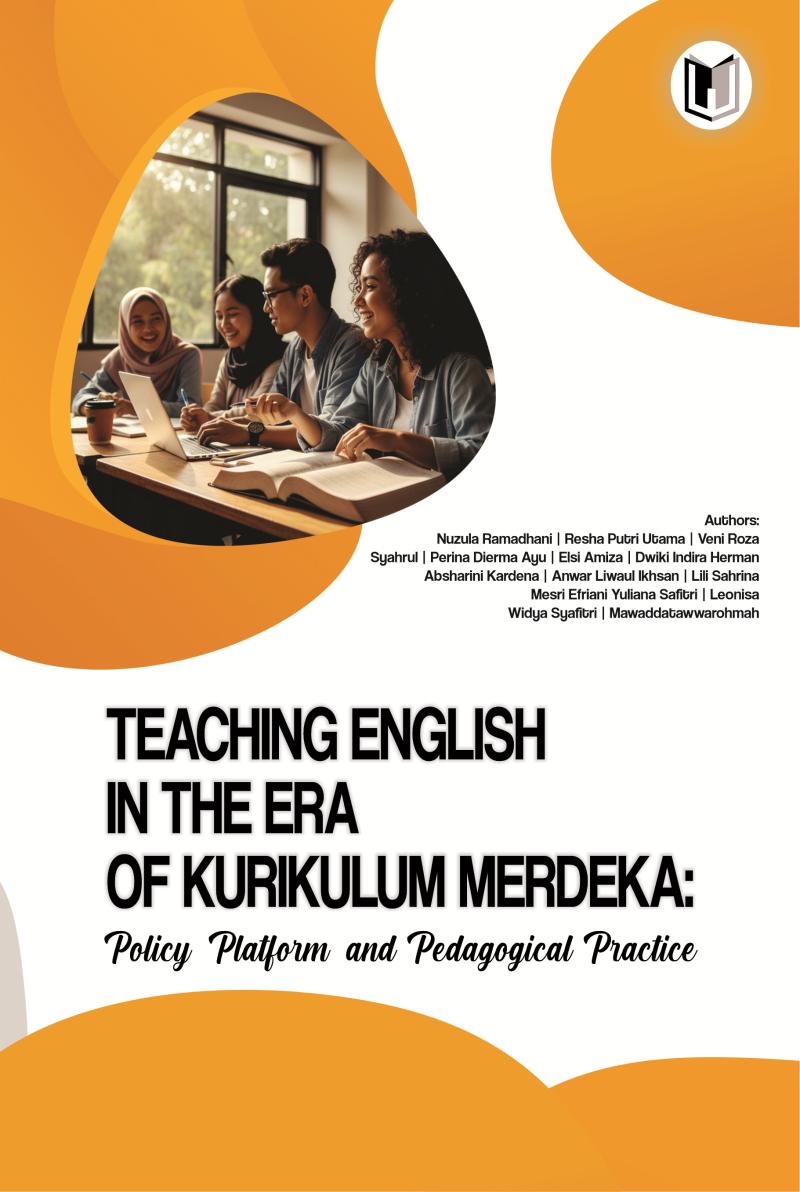
TEACHING ENGLISH IN THE ERA OF KURIKULUM MERDEKA: POLICY, PLATFORM, AND PEDAGOGICAL PRACTICE
Keywords:
PENDIDIKANSynopsis
This book offers a comprehensive and timely contribution to understanding the philosophical foundations, technological infrastructure, and pedagogical implications of the Merdeka Belajar initiative, particularly within the field of English Language Teaching. By integrating policy analysis, exploration of the Platform Merdeka Mengajar, and practical classroom applications, the author successfully bridges the gap between national educational reform and everyday teaching practice. The work provides both conceptual clarity and actionable guidance for teachers navigating the complexities of curriculum change.
Downloads
Download data is not yet available.
References
Allen, V. F. (1983). Techniques in teaching vocabulary. Oxford University Press.
Bjork, R. A. (1994). Memory and metamemory considerations in the training of human beings. In J. Metcalfe & A. P. Shimamura (Eds.), Metacognition: Knowing about knowing (pp. 185-205). MIT Press.
Brett, A., Rothlein, L., & Hurley, M. (1996). Vocabulary acquisition from listening to stories and explanations of target words. The Elementary School Journal, 96(4), 415-422.
Browne, C., Culligan, B., & Phillips, J. (2013). The New General Service List. Retrieved from www.newgeneralservicelist.org
Bruner, J. (1961). The act of discovery. Harvard Educational Review, 31(1), 21-32.
Cobb, T. (2007). Computing the vocabulary demands of L2 reading. Language Learning and Technology, 11(3), 38-63.
Coady, J., & Huckin, T. (Eds.). (1997). Second language vocabulary acquisition. Cambridge University Press.
DeCarrico, J. S. (2001). Vocabulary learning and teaching. In M. Celce-Murcia (Ed.), Teaching English as a second or foreign language (3rd ed., pp. 285-299). Heinle & Heinle.
Elley, W. B. (1989). Vocabulary acquisition from listening to stories. Reading Research Quarterly, 24(2), 174-187.
Elley, W., & Mangubhai, F. (1983). The impact of reading on second language learning. Reading Research Quarterly, 19(1), 53-67.
Heimlich, J. E., & Pittelman, S. D. (1986). Semantic mapping: Classroom applications. International Reading Association.
Hulstijn, J. H. (2001). Intentional and incidental second language vocabulary learning: A reappraisal of elaboration, rehearsal and automaticity. In P. Robinson (Ed.), Cognition and second language instruction (pp. 258-286). Cambridge University Press.
Johnson, D. D., & Pearson, P. D. (1984). Teaching reading vocabulary (2nd ed.). Holt, Rinehart and Winston.
Johnson, D. W., & Johnson, R. T. (1989). Cooperation and competition: Theory and research. Interaction Book Company.
Koolstra, C. M., & Beentjes, J. W. (1999). Children's vocabulary acquisition in a foreign language through watching subtitled television programs at home. Educational Technology Research and Development, 47(1), 51-60.
Kornell, N. (2009). Optimising learning using flashcards: Spacing is more effective than cramming. Applied Cognitive Psychology, 23(9), 1297-1317.
Krashen, S. D. (1985). The input hypothesis: Issues and implications. Longman.
Laufer, B., & Hulstijn, J. H. (2001). Incidental vocabulary acquisition in a second language: The construct of task-induced involvement. Applied Linguistics, 22(1), 1-26.
Lave, J., & Wenger, E. (1991). Situated learning: Legitimate peripheral participation. Cambridge University Press.
Lewis, M. (1993). The lexical approach: The state of ELT and a way forward. Language Teaching Publications.
Mayer, R. E. (2001). Multimedia learning. Cambridge University Press.
Mayer, R. E., & Harris, C. L. (2010). Game-based assessment. In D. Gibson & Y. Baek (Eds.), Digital simulations for improving education (pp. 226-245). IGI Global.
Nakata, T. (2011). Computer-assisted second language vocabulary learning in a paired-associate paradigm: A critical investigation of flashcard software. Computer Assisted Language Learning, 24(1), 17-38.
Nation, I. S. P. (1990). Teaching and learning vocabulary. Newbury House.
Nation, I. S. P. (2001). Learning vocabulary in another language. Cambridge University Press.
Nation, I. S. P. (2007). The four strands. Innovation in Language Learning and Teaching, 1(1), 2-13.
Nation, I. S. P. (2008). Teaching vocabulary: Strategies and techniques. Heinle.
Nation, I. S. P., & Beglar, D. (2007). A vocabulary size test. The Language Teacher, 31(7), 9-13.
Nation, I. S. P., & Waring, R. (1997). Vocabulary size, text coverage and word lists. In N. Schmitt & M. McCarthy (Eds.), Vocabulary: Description, acquisition and pedagogy (pp. 6-19). Cambridge University Press.
Nation, I. S. P., & Webb, S. (2011). Researching and analyzing vocabulary. Heinle.
Newton, J. (2001). Options for vocabulary learning through communication tasks. ELT Journal, 55(1), 30-37.
Paivio, A. (1986). Mental representations: A dual coding approach. Oxford University Press.
Pigada, M., & Schmitt, N. (2006). Vocabulary acquisition from extensive reading: A case study. Reading in a Foreign Language, 18(1), 1-28.
Rumelhart, D. E., & McClelland, J. L. (1986). Parallel distributed processing. MIT Press.
Sayer, P. (2015). More & earlier: Neoliberalism and primary English education in Mexican public schools. L2 Journal, 7(3), 40-56.
Schmitt, N. (2000). Vocabulary in language teaching. Cambridge University Press.
Schmitt, N. (2008). Review article: Instructed second language vocabulary learning. Language Teaching Research, 12(3), 329-363.
Schmitt, N., Schmitt, D., & Clapham, C. (2001). Developing and exploring the behaviour of two new versions of the Vocabulary Levels Test. Language Testing, 18(1), 55-88.
Sundqvist, P., & Sylven, L. K. (2014). Language-related computer use: Focus on young L2 English learners in Sweden. ReCALL, 26(1), 3-20.
Tomasello, M. (2003). Constructing a language: A usage-based theory of language acquisition. Harvard University Press.
Topping, K. (2001). Peer assisted learning: A practical guide for teachers. Brookline Books.
Vygotsky, L. S. (1978). Mind in society: The development of higher psychological processes. Harvard University Press.
Webb, S. (2010). A corpus driven study of the potential for vocabulary learning through watching movies. International Journal of Corpus Linguistics, 15(4), 497-519.
Wood, D., Bruner, J. S., & Ross, G. (1976). The role of tutoring in problem solving. Journal of Child Psychology and Psychiatry, 17(2), 89-100.
Wright, A., Betteridge, D., & Buckby, M. (2006). Games for language learning (3rd ed.). Cambridge University Press.
Policy Documents and Curriculum Resources
Badan Standar, Kurikulum, dan Asesmen Pendidikan (BSKAP). (2022). Capaian Pembelajaran Bahasa Inggris Fase D (SMP). Kemendikbudristek.
Browne, C. (2014). The Academic Vocabulary List. Retrieved from www.academicvocabulary.info
Coxhead, A. (2000). A new academic word list. TESOL Quarterly, 34(2), 213-238.
Kemendikbudristek. (2022). Panduan Pengembangan Modul Ajar. Direktorat Jenderal PAUD, Pendidikan Dasar dan Pendidikan Menengah.
Kemendikbudristek. (2022). Kurikulum Merdeka: Buku Panduan Guru Bahasa Inggris Kelas VII. Pusat Perbukuan.
Kemendikbudristek. (2023). Panduan Pembelajaran dan Asesmen. Direktorat Jenderal PAUD, Pendidikan Dasar dan Pendidikan Menengah.
Permendikbudristek No. 16 Tahun 2022 tentang Standar Proses pada Pendidikan Anak Usia Dini, Jenjang Pendidikan Dasar, dan Jenjang Pendidikan Menengah.
West, M. (1953). A general service list of English words. Longmans, Green & Co.
Downloads
Published
July 22, 2026
Copyright (c) 2026 Nuzula Ramadhani, Widya Syafitri, Leonisa Leonisa, Yuliana Safitri, Mesri EfrianiMesri Efriani, Lili Sahrina, Anwar Liwaul Ikhsan, Absharini Kardena, Dwiki Indira Herman, Elsi Amiza, Perina Dierma Ayu, Syahrul Syahrul, Veni Roza, Resha Putri Utama, Mawaddatawwarohmah Mawaddatawwarohmah (Author)
License

This work is licensed under a Creative Commons Attribution-NonCommercial-ShareAlike 4.0 International License.
How to Cite
Ramadhani, N., Syafitri, W., Leonisa, L., Safitri, Y., EfrianiMesri Efriani, M., Sahrina, L., Liwaul Ikhsan, A., Kardena, A., Indira Herman, D., Amiza, E., Dierma Ayu, P., Syahrul, S., Roza, V., Putri Utama, R., & Mawaddatawwarohmah, M. (2026). TEACHING ENGLISH IN THE ERA OF KURIKULUM MERDEKA: POLICY, PLATFORM, AND PEDAGOGICAL PRACTICE. Widina Media Utama. https://doi.org/10.59818/5ggkyc45