GREEN HUMAN RESOURCE MANAGEMENT: STRATEGI SUMBER DAYA MANUSIA BERKELANJUTAN UNTUK ORGANISASI MODERN
Keywords:
Green Human Resource Management (GHRM), Manajemen Sumber Daya Manusia Berkelanjutan (Sustainable HRM), Budaya Organisasi Hijau (Green Organizational Culture)Synopsis
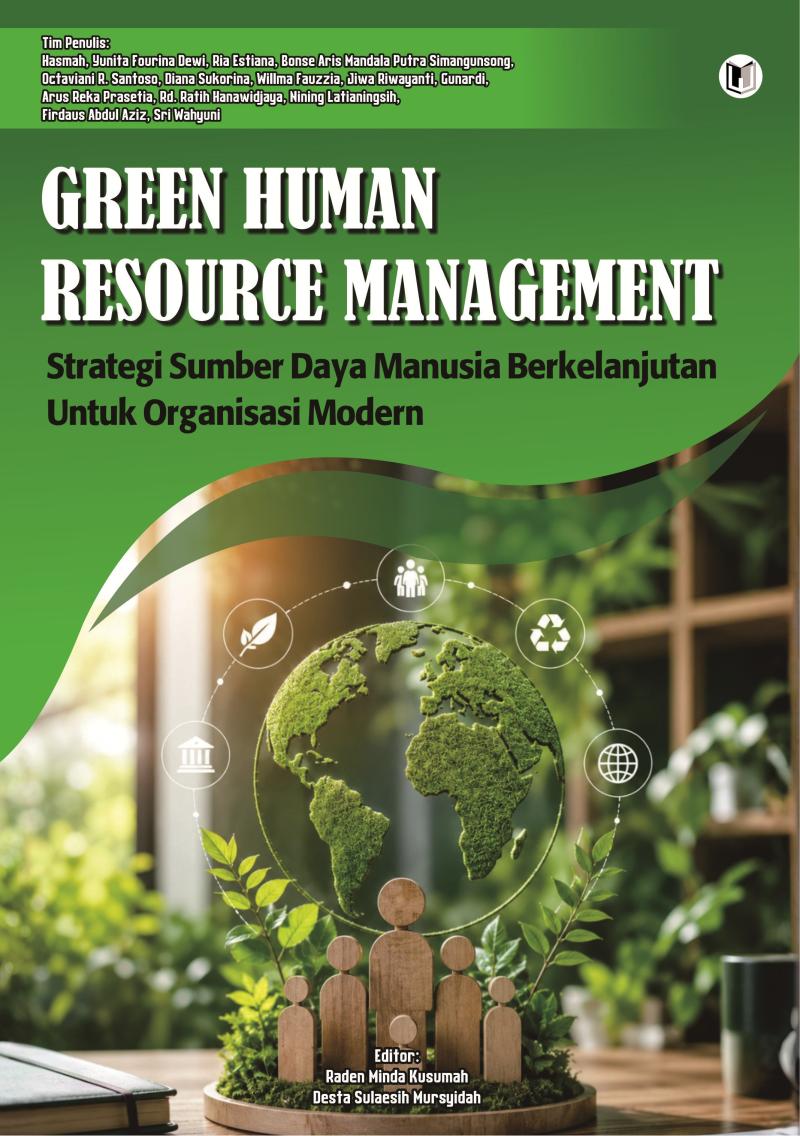
Buku Green Human Resource Management: Strategi Sumber Daya Manusia Berkelanjutan untuk Organisasi Modern membahas pentingnya pengelolaan sumber daya manusia berbasis keberlanjutan di tengah perkembangan dunia kerja yang semakin dinamis dan digital. Buku ini mengulas konsep dasar Green Human Resource Management, sustainability, budaya organisasi hijau, hingga strategi penerapan sumber daya manusia berkelanjutan dalam organisasi modern. Pembahasan disusun secara sistematis agar pembaca memahami bagaimana aspek lingkungan, sosial, dan teknologi dapat terintegrasi dalam praktik manajemen SDM.
Selain membahas teori, buku ini juga mengupas implementasi Green Human Resource Management melalui green recruitment, green training, green performance management, green leadership, serta pemanfaatan teknologi digital seperti Artificial Intelligence dan Human Resource Information System dalam mendukung efisiensi organisasi. Buku ini diharapkan menjadi referensi bagi mahasiswa, akademisi, praktisi sumber daya manusia, dan pimpinan organisasi dalam menciptakan lingkungan kerja yang produktif, inovatif, ramah lingkungan, dan berorientasi pada keberlanjutan di era Society 5.0.
Downloads
Download data is not yet available.
References
Ababneh, O. M. A. (2021). How do green HRM practices affect employees’ green behaviors? The role of employee engagement and personality attributes. Journal of Environmental Planning and Management, 64(7), 1204-1226.
Abau, K. (2025). Green human resource management (GHRM) sebagai instrumen implementasi etika lingkungan: Bukti dari perusahaan manufaktur di Indonesia. Aliansi: Jurnal Manajemen dan Bisnis, 20(2), 79-87. https://doi.org/10.46975/ga7q8w82
Aboramadan, M., Crawford, J., Türkmenoglu, M. A., & Farao, C. (2022). Green inclusive leadership and employee green behaviors in the hotel industry: Does perceived green organizational support matter? International Journal of Hospitality Management, 107, 103330. https://doi.org/10.1016/j.ijhm.2022.103330
Ademi, B., Sætre, A. S., & Klungseth, N. J. (2024). What do established companies do to factor in sustainability into their business models? Business Strategy and the Environment, 1-20. https://doi.org/10.1002/bse.3980
Aggarwal, P., & Agarwala, T. (2025). Green organizational culture: An exploration of dimensions. Global Business Review, 26(4), 1103-1126.
Ahmad, S., Islam, T., Sadiq, M., & Kaleem, A. (2021). Promoting green behavior through ethical leadership: A model of green human resource management and environmental knowledge. Leadership & Organization Development Journal, 42(4), 531-547. https://doi.org/10.1108/LODJ-01-2020-0027
Ajzen, I. (1991). The theory of planned behavior. Organizational Behavior and Human Decision Processes, 50(2), 179-211.
Al-Ghazali, B. M., Gelaidan, H. M., Shah, S. H. A., & Amjad, R. (2022). Green transformational leadership and green creativity? The mediating role of green thinking and green organizational identity in SMEs. Frontiers in Psychology, 13, 977998.
Alqarni, K., Agina, M. F., Khairy, H. A., Al-Romeedy, B. S., Farrag, D. A., & Abdallah, R. M. (2023). The effect of electronic human resource management systems on sustainable competitive advantages: The roles of sustainable innovation and organizational agility. Sustainability, 15(23), 16382. https://doi.org/10.3390/su152316382
Al-Swidi, A. K., Gelaidan, H. M., & Saleh, R. M. (2021). The joint impact of green human resource management, leadership and organizational culture on employees' green behaviour and organisational environmental performance. Journal of Cleaner Production, 316, 128112. https://doi.org/10.1016/j.jclepro.2021.128112
Amjad, F., Abbas, W., Zia-ur-Rehman, M., Baig, S. A., Hashim, M., Khan, H., & Rehman, H. U. (2021). Effect of green human resource management practices on organizational sustainability: The mediating role of environmental and employee performance. Environmental Science and Pollution Research, 28(22), 28191-28206. https://doi.org/10.1007/s11356-020-11307-9
Amrutha, V. N., & Geetha, S. N. (2020). A systematic review on green human resource management: Implications for social sustainability. Journal of Cleaner Production, 247, 119131.
Armstrong, M., & Taylor, S. (2020). Armstrong’s handbook of human resource management practice (15th ed.). London: Kogan Page.
Arowoshegbe, A. O., Emmanuel, U., & Gina, A. (2018). Sustainability and triple bottom line: An overview of two interrelated concepts. Igbinedion University Journal of Accounting, 2, 88-126.
Aslaksen, H. M., Hildebrandt, C., & Johnsen, H. C. G. (2021). The long-term transformation of the concept of CSR: Towards a more comprehensive emphasis on sustainability. International Journal of Corporate Social Responsibility, 6(11), 1-14.
Attridge, M., & Dickens, S. P. (2022). Health and work outcomes of brief counseling from an EAP in Vermont: Follow-up survey results, client satisfaction, and estimated cost savings. SAGE Open, 12(1). https://doi.org/10.1177/21582440221087278
Aust, I., Matthews, B., & Muller-Camen, M. (2023). Common Good HRM: A paradigm shift in Sustainable HRM? Human Resource Management Review, 33(2), 100898. https://doi.org/10.1016/j.hrmr.2022.100898
Avotra, A. A. R. N., Chenyun, Y., Yongmin, W., Lijuan, Z., & Nawaz, A. (2021). Conceptualizing the state of the art of corporate social responsibility (CSR) in green construction and its nexus to sustainable development. Frontiers in Environmental Science, 9, 1-15.
Aycan, Z., Cinli, D., & Robertson, J. L. (2025). Green leadership’s predictors and outcomes. Nature Reviews Psychology, 4(3), 207-221.
Bansal, P., & Song, H. C. (2017). Similar but not the same: Differentiating corporate sustainability from corporate responsibility. Academy of Management Annals, 11(1), 105-149. https://doi.org/10.5465/annals.2015.0095
Bass, B. M., & Riggio, R. E. (2006). Transformational leadership (2nd ed.). New York: Psychology Press.
Baykal, E., & Divrik, B. (2023). Employee involvement in sustainability projects in emergent markets: Evidence from Turkey. Sustainability, 15(18), 13929. https://doi.org/10.3390/su151813929
Benkert, J. (2021). Reframing business sustainability decision-making with value-focussed thinking. Journal of Business Ethics, 174(2), 441-456.
Bianchi, G., Pisiotis, U., & Cabrera Giraldez, M. (2022). GreenComp: The European sustainability competence framework. Luxembourg: Publications Office of the European Union.
Bondarouk, T. V., Ruël, H. J. M., & van der Heijden, B. (2009). e-HRM effectiveness in a public sector organization: A multi-stakeholder perspective. The International Journal of Human Resource Management, 20(3), 578-590. https://doi.org/10.1080/09585190802707359
Boudreau, J. W., & Ramstad, P. M. (2005). Talentship and the new paradigm for human resource management: from strategic hrm to strategic talentship. Human Resource Planning, 28(2), 17-26.
Bridges, W. (2009). Managing transitions: Making the most of change. Da Capo Lifelong Books.
Broadstock, D. C., Chan, K., Cheng, L. T. W., & Wang, X. (2021). The role of ESG performance during times of financial crisis: Evidence from COVID-19 in China. Finance Research Letters, 38, 101716. https://doi.org/10.1016/j.frl.2020.101716
Brundiers, K., Barth, M., Cebrián, G., Cohen, M., Diaz, L., Doucette-Remington, S., and Zint, M. (2021). Key competencies in sustainability in higher education. Sustainability Science, 16(1), 13-29.
Budhwar, P., Malik, A., De Silva, M. T., & Thevisuthan, P. (2022). Artificial intelligence challenges and opportunities for international HRM: A review and research agenda. The International Journal of Human Resource Management, 33(6), 1065-1097. https://doi.org/10.1080/09585192.2022.2035161
Carroll, A. B. (2021). Corporate social responsibility: Perspectives on the CSR construct’s development and future. Business & Society, 60(6), 1258-1278.
Chaudhary, R. (2020). Green human resource management and employee green behavior: An empirical analysis. Corporate Social Responsibility and Environmental Management, 27(2), 630-641.
Chen, Y. S. (2008). The positive effect of green intellectual capital on competitive advantages of firms. Journal of Business Ethics, 77(3), 271-286.
Daily, B. F., Bishop, J. W., & Massoud, J. A. (2012). The role of training and empowerment in environmental performance. International Journal of Operations & Production Management, 32(3), 331-347.
Delphinus, L., & Mwita, K. M. (2024). The role green human resource management practices on environmental performance: The mediating role of perceived organisational support toward the environment. SEISENSE Journal of Management, 7(1), 153-169. https://doi.org/10.33215/yrvjx551
Dessler, G. (2020). Human resource management (16th ed.). Boston: Pearson Education.
Dumont, J., Shen, J., & Deng, X. (2017). Effects of green HRM practices on employee workplace green behavior: The role of psychological green climate and employee green values. Human Resource Management, 56(4), 613-627.
Dyllick, T., & Muff, K. (2016). Clarifying the meaning of sustainable business: Introducing a typology from business-as-usual to true business sustainability. Organization & Environment, 29(2), 156-174. https://doi.org/10.1177/1086026615575176
Dzhengiz, T., & Niesten, E. (2020). Competences for environmental sustainability. Journal of Business Ethics, 162(4), 881-906.
Eccles, R. G., Ioannou, I., & Serafeim, G. (2014). The impact of corporate sustainability on organizational processes and performance. Management Science, 60(11), 2835-2857. https://doi.org/10.1287/mnsc.2014.1984
Edmans, A. (2020). Grow the pie: How great companies deliver both purpose and profit. Cambridge: Cambridge University Press.
Effendy, O. U. (2017). Ilmu komunikasi: Teori dan praktik. Bandung: Remaja Rosdakarya.
Elkington, J. (1997). Cannibals with forks: The triple bottom line of 21st century business. Oxford: Capstone Publishing.
Elkington, J. (2018). 25 years ago I coined the phrase “triple bottom line.” Here’s why it’s time to rethink it. Harvard Business Review Press.
Fahmi, I. (2013). Manajemen kepemimpinan teori dan aplikasi. Bandung: Alfabeta.
Fahmi, I. (2016). Manajemen sumber daya manusia teori dan aplikasi. Bandung: Alfabeta.
Faisal, S. (2023). Green human resource management A synthesis. Sustainability, 15(3), 2259. https://doi.org/10.3390/su15032259
Farooq, O., Farooq, M., & Reynaud, E. (2019). Does employees' participation in decision making increase the level of corporate social and environmental sustainability? An investigation in South Asia. Sustainability, 11(2), 511. https://doi.org/10.3390/su11020511
Fatema, S., & Moniruzzaman, M. (2025). Green training and employee engagement toward sustainable organizations. International Journal of Sustainable Human Resource Management, 8(1), 55-69.
Fatma, M., Rahman, Z., & Khan, I. (2020). Measuring consumer perception of CSR in tourism industry: Scale development and validation. Journal of Hospitality and Tourism Management, 45, 132-140.
Friede, G., Busch, T., & Bassen, A. (2015). ESG and financial performance: Aggregated evidence from more than 2000 empirical studies. Journal of Sustainable Finance & Investment, 5(4), 210-233. https://doi.org/10.1080/20430795.2015.1118917
Fukuyama, M. (2018). Society 5.0: Aiming for a new human-centered society. Japan SPOTLIGHT, 27(5), 47-50.
Gelencsér, M., Szabó-Szentgróti, G., Kőmüves, Z. S., & Hollosy-Vadasz, G. (2023). The holistic model of labour retention: The impact of workplace wellbeing factors on employee retention. Administrative Sciences, 13(5), 121. https://doi.org/10.3390/admsci13050121
George, G., Merrill, R. K., & Schillebeeckx, S. J. D. (2021). Digital sustainability and entrepreneurship: How digital innovations are helping tackle climate change and sustainable development. Entrepreneurship Theory and Practice, 45(5), 999-1027. https://doi.org/10.1177/1042258721993883
Gillan, S. L., Koch, A., & Starks, L. T. (2021). Firms and social responsibility: A review of ESG and CSR research in corporate finance. Journal of Corporate Finance, 66, 101889. https://doi.org/10.1016/j.jcorpfin.2021.101889
Guerci, M., Longoni, A., & Luzzini, D. (2016). Translating green human resource management practices into environmental performance: The role of green organizational culture. Journal of Cleaner Production, 136, 184-194.
Hahn, T., Pinkse, J., Preuss, L., & Figge, F. (2015). Tensions in corporate sustainability. Journal of Business Ethics, 127(2), 297-316.
Hammer, J., & Pivo, G. (2017). The triple bottom line and sustainable economic development theory and practice. Economic Development Quarterly, 31(1), 25-36. https://doi.org/10.1177/0891242416674808
Harris, L. C., & Crane, A. (2002). The greening of organizational culture: Management views on the depth, degree and diffusion of change. Journal of Organizational Change Management, 15(3), 214-234. https://doi.org/10.1108/09534810210429273
Haryanto, A., & Putri, D. (2022). Pengaruh komunikasi internal berbasis sustainability terhadap partisipasi karyawan dalam program lingkungan perusahaan. Jurnal Manajemen dan Organisasi, 13(1), 66-78.
Hasibuan, M. S. P. (2019). Manajemen sumber daya manusia (Edisi revisi). Jakarta: Bumi Aksara.
Hidayat, L. F., Amaliyah, R. S., Naila, A. P., & Aliyah, N. N. (2025). Analisis faktor budaya organisasi dan keterlibatan karyawan dalam implementasi Green Human Resources Management di Indonesia: Systematic literature review. COMSERVA: Jurnal Penelitian dan Pengabdian Masyarakat, 5(2), 112-124.
Hosain, M. S. (2025). Green HRM practices and firm environmental performance: Mediating role of employee green behavior. Journal of Advances in Management Research, 23(2), 215-244. https://doi.org/10.1108/JAMR-04-2023-0099
Hubbard, G. (2009). Measuring organizational performance: Beyond the triple bottom line. Business Strategy and the Environment, 18(3), 177-191.
Hussein, S. H., & Zakhem, N. B. (2024). The impact of green human resource management practices on brand citizenship behavior and employee turnover intention: A mixed methods approach. Sustainability, 16(15), 6528. https://doi.org/10.3390/su16156528
Huynh, H. T. N., Nguyen, N. T. T., & Vo, N. N. Y. (2024). The influence of knowledge management, green transformational leadership, green organizational culture on green innovation and sustainable performance: The case of Vietnam. Journal of Open Innovation: Technology, Market, and Complexity, 10(4), 100436.
Iftikhar, U., Zaman, K., Rehmani, M., Ghias, W., & Islam, T. (2021). Impact of green human resource management on service recovery: Mediating role of environmental commitment and moderation of transformational leadership. Frontiers in Psychology, 12, 1-15.
International Labour Organization. (2019). Skills for a greener future: A global view. Geneva: International Labour Office.
Jabbour, C. J. C., & de Sousa Jabbour, A. B. L. (2016). Green human resource management and green supply chain management: Linking two emerging agendas. Journal of Cleaner Production, 112, 1824-1833.
Jabbour, C. J. C., & Santos, F. C. A. (2008). The central role of human resource management in the search for sustainable organizations. The International Journal of Human Resource Management, 19(12), 2133-2154. https://doi.org/10.1080/09585190802479389
Jabbour, C. J. C., & Santos, F. C. A. (2023). Green human resource management and green supply chain management: Linking two emerging agendas. Journal of Cleaner Production, 112, 1824-1833. https://doi.org/10.1016/j.jclepro.2015.01.052
Jabbour, C. J. C., Santos, F. C. A., & Nagano, M. S. (2013). Green human resource management and green supply chain management: Linking two emerging agendas. Journal of Cleaner Production, 112, 1824-1833.
Jackson, S. E., Renwick, D. W. S., Jabbour, C. J. C., & Muller-Camen, M. (2011). State-of-the-art and future directions for green human resource management: Introduction to the special issue. German Journal of Human Resource Management, 25(2), 99-116.
Jamal, T., Zahid, M., Martins, J. M., & Mata, M. N. (2021). Perceived green human resource management practices and corporate sustainability: Multigroup analysis and major industries perspectives. Sustainability, 13(6), 1-18.
Jamil, S., Zaman, S. I., Kayikci, Y., & Khan, S. A. (2023). The role of green recruitment on organizational sustainability performance: A study within the context of green human resource management. Sustainability, 15(21), 15567. https://doi.org/10.3390/su152115567
Jogiyanto, H. M. (2017). Sistem teknologi informasi. Yogyakarta: Andi.
Kainzbauer, A., Rungruang, P., & Hallinger, P. (2021). How does research on sustainable human resource management contribute to corporate sustainability. Sustainability, 13(21), 1-20.
Kamboj, J., & Eronimus, A. (2024). Mapping the green human resource management practices: A systematic scoping review and its implications for employees’ well-being. Human Systems Management, 43(6), 932-970. https://doi.org/10.3233/HSM-230183
Kambur, E., & Yildirim, T. (2023). From traditional to smart human resources management. International Journal of Manpower, 44(3), 422–452. https://doi.org/10.1108/IJM-10-2021-0622
Karatepe, O. M., Hsieh, H., & Aboramadan, M. (2022). The effects of green human resource management and perceived organizational support for the environment on green and non-green hotel employee outcomes. International Journal of Hospitality Management, 103, 103202. https://doi.org/10.1016/j.ijhm.2022.103202
Kasmir. (2019). Manajemen sumber daya manusia (Teori dan praktik). Depok: RajaGrafindo Persada.
Kassier, L. (2024). Interconnected or disconnected? A review of sustainability, resilience, and sustainable business model constructs in the academic business literature. Journal of the Knowledge Economy, 15, 15931-15958. https://doi.org/10.1007/s13132-023-01712-z
Katz, I. M., Rauvola, R. S., Rudolph, C. W., & Zacher, H. (2022). Employee green behavior: A meta-analysis. Corporate Social Responsibility and Environmental Management, 29(5), 1146-1157.
Kelloway, E. K., Dimoff, J. K., & Gilbert, S. (2023). Mental health in the workplace. Annual Review of Organizational Psychology and Organizational Behavior, 10, 363-387. https://doi.org/10.1146/annurev-orgpsych-120920-050527
Kementerian Lingkungan Hidup dan Kehutanan (2025). Program PROPER. Jakarta: KLHK.
Khan, M., Serafeim, G., & Yoon, A. (2016). Corporate sustainability: First evidence on materiality. The Accounting Review, 91(6), 1697-1724. https://doi.org/10.2308/accr-51383
Kivinda, M. P., Su, Q., Hau, H. T., & Hashmi, H. B. A. (2021). Green HRM for employer branding: Evidence from ISO 14001 EMS certified firms. The Journal of Developing Areas, 55(3), 393-409. https://doi.org/10.1353/jda.2021.0071
Kramar, R. (2022). Sustainable human resource management: Concepts, strategies, and future directions. Asia Pacific Journal of Human Resources, 60(1), 1-17. https://doi.org/10.1111/1744-7941.12319
Latif, K. F., Pérez, A., & Sahibzada, U. F. (2020). Corporate social responsibility and customer loyalty: Exploring the role of corporate reputation and customer satisfaction. Journal of Retailing and Consumer Services, 56, 1-10.
Lawter, L., & Garnjost, P. (2025). Green human resource management and organizational performance: A systematic review. Sustainability, 17(7), 3132. https://doi.org/10.3390/su17073132
Lee, D., & Ahn, J.-Y. (2024). Unlocking the potential of green human resource management in Korea: A comprehensive review. Asia Pacific Business Review, 31(1), 133-156. https://doi.org/10.1080/13602381.2024.2358945
Lestari, N., & Widodo, S. (2021). Pengaruh partisipasi karyawan dalam program sustainability terhadap budaya kerja hijau perusahaan. Jurnal Manajemen Indonesia, 21(2), 101-112.
Lewin, K. (1951). Field theory in social science. New York: Harper & Row.
Li, Z., Xue, J., Li, R., Chen, H., & Wang, T. (2020). Environmentally specific transformational leadership and employee’s pro-environmental behavior. Frontiers in Psychology, 11, 1408.
Lin, L. W., Cheng, J. H., & Lu, K. L. (2024). The impact of environmental protection, economic development, social responsibility and governance on the sustainable development of enterprises. Discover Sustainability, 5(497). https://doi.org/10.1007/s43621-024-00705-5
Liu, X., & Yu, X. (2023). Green transformational leadership and employee organizational citizenship behavior for the environment in the manufacturing industry: A social information processing perspective. Frontiers in Psychology, 13, 1097655. https://doi.org/10.3389/fpsyg.2022.1097655
Lozano, R. (2018). Proposing a definition and a framework of organisational sustainability: A review of efforts and a survey of approaches to change. Sustainability, 10(4), 1157. https://doi.org/10.3390/su10041157
Lu, Y., Zhang, M. M., Yang, M. M., & Wang, Y. (2023). Sustainable human resource management practices, employee resilience, and employee outcomes: Toward common good values. Human Resource Management, 62(3), 331–353. https://doi.org/10.1002/hrm.22153
Madero-Gomez, S., Martinez-Martinez, A., & Rodriguez-Delgado, V. (2025). Green human resource management and sustainable performance: A systematic literature review. Sustainable Futures, 8, 101580. https://doi.org/10.1016/j.sftr.2025.101580
Mahdy, F., Alqahtani, M., & Binzafrah, F. (2023). Imperatives, benefits, and initiatives of Green Human Resource Management (GHRM): A systematic literature review. Sustainability, 15(6), 4866. https://doi.org/10.3390/su15064866
Malik, S. Y., Mughal, Y. H., Azam, T., Cao, Y., Wan, Z., & Zhu, H. (2021). Corporate social responsibility, green human resources management, and sustainable performance. Sustainability, 13(3), 1-17.
Mangkunegara, A. A. A. P. (2017). Manajemen sumber daya manusia perusahaan. Bandung: Remaja Rosdakarya.
Manita, R., Bruna, M. G., Dang, R., & Houanti, L. (2018). Board gender diversity and ESG disclosure: Evidence from the USA. Journal of Applied Accounting Research, 19(2), 206-224. https://doi.org/10.1108/JAAR-01-2017-0024
Marchiori, D., Coniglio, I., Ferraris, A., & Arslan, A. (2023). Big data and human resource management: Paving the way toward sustainability. European Journal of Innovation Management, 26(7), 552–590. https://doi.org/10.1108/EJIM-01-2023-0048
Memon, K. R., Ghani, B., Hyder, S. I., Han, H., Zada, M., Ariza-Montes, A., & Arraño-Muñoz, M. (2022). Management of knowledge and competence through human resource information system: A structured review. Frontiers in Psychology, 13, 944276. https://doi.org/10.3389/fpsyg.2022.944276
Merta-Staszczak, A., & Walecka-Jankowska, K. (2024). Social dimension of sustainable development and social outcomes of businesses. Studies in Logic, Grammar and Rhetoric, 69(1), 589-602. https://doi.org/10.2478/slgr-2024-0020
Miaha, M., Szabo-Szentgroti, G., & Walter, V. (2024). A systematic literature review on green human resource management (GHRM): An organizational sustainability perspective. Cogent Business & Management, 11(1). https://doi.org/10.1080/23311975.2024.2371983
Mishra, P. (2017). Green human resource management: A framework for sustainable organizational development. International Journal of Organizational Analysis, 25(5), 762-788.
Mittal, S., & Dhar, R. L. (2016). Effect of green transformational leadership on green creativity. Tourism Management, 57, 118-127.
Molina-Azorín, J. F., Tarí, J. J., Pereira-Moliner, J., Lopez-Gamero, M. D., & Pertusa-Ortega, E. M. (2015). The effects of quality and environmental management on competitive advantage: A mixed methods study in the healthcare sector. Total Quality Management & Business Excellence, 26(11-12), 1224-1238.
Mulyana, D. (2016). Ilmu komunikasi: Suatu pengantar. Bandung: Remaja Rosdakarya.
Nicolás-Agustín, Á., Jiménez-Jiménez, D., & Maeso-Fernandez, F. (2022). The role of human resource practices in the implementation of digital transformation. International Journal of Manpower, 43(2), 395-410. https://doi.org/10.1108/IJM-03-2021-0176
Nikolaou, I. E., Tsalis, T. A., & Evangelinos, K. I. (2019). A framework to measure corporate sustainability performance: The triple bottom line approach. Corporate Social Responsibility and Environmental Management, 26(5), 1008-1018. https://doi.org/10.1002/csr.1739
Nitisemito, A. S. (2015). Manajemen personalia. Jakarta: Ghalia Indonesia.
Noe, R. A., Hollenbeck, J. R., Gerhart, B., & Wright, P. M. (2021). Human resource management: Gaining a competitive advantage (12th ed.). New York: McGraw-Hill Education.
Norton, T. A., Parker, S. L., Zacher, H., & Ashkanasy, N. M. (2015). Employee green behavior: A theoretical framework, multilevel review, and future research agenda. Organization & Environment, 28(1), 103-125.
Nosratabadi, S., Mosavi, A., Shamshirband, S., Zavadskas, E. K., Rakotonirainy, A., & Chau, K. W. (2019). Sustainable business models: A review. Sustainability, 11(6), 1663. https://doi.org/10.3390/su11061663
Nurasa, H., Putri, S. S. U., Abdillah, A., & Widianingsih, I. (2025). Green leadership in policy making towards sustainable future. Polish Journal of Environmental Studies, 34(1), 519-534.
Nurmala, R. (2025). Analysis of green training on green employee performance with green behavior as a mediating variable in employees of PT Charoen Pokphand Jaya Farm. Dinasti International Journal of Economics, Finance & Accounting, 6(4), 2765-2775. https://doi.org/10.38035/dijefa.v6i4.4826
O'Donohue, W., & Torugsa, N. (2016). The moderation effect of financial resource slack on the relationship between green human resource management and environmental performance. International Journal of Human Resource Management, 27(2), 239-253.
OJK (2017). Peraturan Otoritas Jasa Keuangan Nomor 51/POJK.03/2017 tentang Penerapan Keuangan Berkelanjutan... Jakarta: OJK.
Oktaviani, A. R., Hamid, S., & Afi'ah, M. (2025). Peningkatan employee green behavior dan kepuasan karyawan melalui green transformational leadership. Paradoks: Jurnal Ilmu Ekonomi, 9(1), 183-194. https://doi.org/10.57178/paradoks.v9i1.1874
Opatha, H. H. D. N. P., & Arulrajah, A. A. (2014). Green human resource management: Simplified general reflections. International Business Research, 7(8), 101-112. https://doi.org/10.5539/ibr.v7n8p101
Pauwah, I. (2025). Tantangan dan strategi implementasi green human resource management di era digital. AMNESIA: Jurnal Manajemen Sumber Daya Manusia, 3(1), 45-57.
Pazienza, M., de Jong, M., & Schoenmaker, D. (2022). Clarifying the concept of corporate sustainability and providing convergence for its definition. Sustainability, 14(13), 7838. https://doi.org/10.3390/su14137838
Peña, I., Andrade, S. M., Muñoz, R. M., & Barba-Sánchez, V. (2024). Wellness programs, perceived organizational support, and their influence on organizational performance: An analysis within the framework of sustainable human resource management. Sage Open, 14(1). https://doi.org/10.1177/21582440241229358
Pérez, A., & Rodriguez del Bosque, I. (2017). Corporate social responsibility and customer loyalty: Exploring the role of identification, satisfaction and type of company. Journal of Services Marketing, 31(3), 1-13.
Pham, N. T., Tuckova, Z., & Chiappetta Jabbour, C. J. (2020). Greening the hospitality industry: How do green human resource management practices influence organizational citizenship behavior in hotels? Tourism Management, 72, 386-399. https://doi.org/10.1016/j.tourman.2018.12.008
Pham, N. T., Tuckova, Z., & Chiappetta Jabbour, C. J. (2024). Greening the workforce: The role of Green HRM in environmental sustainability. Journal of Cleaner Production, 428, 139245. https://doi.org/10.1016/j.jclepro.2023.139245
Pham, N. T., Tuckova, Z., & Jabbour, C. J. C. (2019). Greening the hospitality industry: How do green human resource management practices influence organizational citizenship behavior in hotels? International Journal of Hospitality Management, 72, 1-11.
Podgorodnichenko, N., Edgar, F., & McAndrew, I. (2023). The role of HRM in developing sustainable organizations in the digital era. Employee Relations, 45(4), 921-938.
Prakoso, R., & Lestari, D. (2021). Green workplace dan pengaruhnya terhadap produktivitas kerja karyawan. Jurnal Ekonomi dan Manajemen, 12(2), 88-99.
Prasetyo, R., & Hidayat, A. (2022). Big data dalam pengelolaan sumber daya manusia dan efektivitas organisasi. Jurnal Manajemen dan Sistem Informasi, 10(2), 70-82.
Prasetyo, R., & Ramadhan, F. (2022). Digitalisasi sumber daya manusia dan pengaruhnya terhadap produktivitas organisasi. Jurnal Bisnis dan Teknologi, 11(1), 55-67.
Pratiwi, D., & Hidayat, A. (2022). Pengaruh lingkungan kerja sehat terhadap employee engagement dan produktivitas kerja karyawan. Jurnal Manajemen dan Organisasi, 11(2), 85-97.
Priansa, D. J. (2018). Perencanaan dan pengembangan SDM. Bandung: Alfabeta.
Purvis, B., Mao, Y., & Robinson, D. (2019). Three pillars of sustainability: In search of conceptual origins. Sustainability Science, 14(3), 681-695. https://doi.org/10.1007/s11625-018-0627-5
Putra, A., & Hidayah, N. (2022). Green organizational culture dan pengaruhnya terhadap loyalitas kerja karyawan. Jurnal Ekonomi dan Bisnis Indonesia, 14(1), 70-82.
Putri, R., & Rahardja, E. (2021). Pengaruh green human resource management terhadap employee engagement pada perusahaan manufaktur di Indonesia. Jurnal Manajemen dan Organisasi, 12(2), 115-126.
Ramadhani, F., & Putra, R. (2021). Pengaruh desain tempat kerja ramah lingkungan terhadap produktivitas karyawan. Jurnal Ekonomi dan Organisasi, 10(1), 73-84.
Ramdhan, R. M., Kisahwan, D., Winarno, A., & Hermana, D. (2022). Internal corporate social responsibility as a microfoundation of employee well-being and job performance. Sustainability, 14(15), 9065. https://doi.org/10.3390/su14159065
Rasool, S. F., Wang, M., Tang, M., Saeed, A., & Iqbal, J. (2021). How toxic workplace environment effects the employee engagement: The mediating role of organizational support and employee wellbeing. International Journal of Environmental Research and Public Health, 18(5), 2294. https://doi.org/10.3390/ijerph18052294
Redman, A., & Wiek, A. (2021). Competencies for advancing transformations towards sustainability. Frontiers in Education, 6, 785163.
Renwick, D. W. S., Redman, T., & Maguire, S. (2013). Green human resource management: A review and research agenda. International Journal of Management Reviews, 15(1), 1-14. https://doi.org/10.1111/j.1468-2370.2011.00328.x
Robertson, J. L., & Barling, J. (2013). Greening organizations: The roles of leadership and organizational citizenship behaviors for the environment. Journal of Organizational Behavior, 34(2), 176-194.
Roscoe, S., Subramanian, N., Jabbour, C. J. C., & Chong, T. (2019). Green human resource management and the enablers of green organisational culture: Enhancing a firm's environmental performance for sustainable development. Business Strategy and the Environment, 28(5), 737-749. https://doi.org/10.1002/bse.2277
Sahar, R., Jahid, M. A., & Rashid, M. H. U. (2025). Organizational sustainability in the face of digital transformation with a bibliometric and content analysis for future research agenda. Discover Sustainability, 6(1383). https://doi.org/10.1007/s43621-025-02188-4
Saputra, R., & Hidayah, N. (2021). Pengaruh budaya kerja hijau dan employee engagement terhadap loyalitas karyawan. Jurnal Manajemen dan Bisnis Indonesia, 7(2), 134-145.
Sathish, A. S., & Indradevi, R. (2026). Attracting value driven talent through sustainable recruitment practices. Discover Sustainability, 7, 559. https://doi.org/10.1007/s43621-026-03122-y
Schaltegger, S., Girschik, V., Trittin-Ulbrich, H., Weissbrod, I., & Daudigeos, T. (2024). Corporate change agents for sustainability: Transforming organizations from the inside out. Business Ethics, the Environment & Responsibility, 33(2), 145-156. https://doi.org/10.1111/beer.12645
Schein, E. H. (2017). Organizational culture and leadership (5th ed.). Hoboken: Wiley.
Schwab, K. (2017). The fourth industrial revolution. New York: Crown Business.
Sedarmayanti. (2017). Tata kerja dan produktivitas kerja. Bandung: Mandar Maju.
Sheehy, B., & Farneti, F. (2021). Corporate social responsibility, sustainability, sustainable development and corporate sustainability: What is the difference, and does it matter? Sustainability, 13(11), 1-17.
Siagian, S. P. (2014). Manajemen sumber daya manusia. Jakarta: Bumi Aksara.
Sinaga, O., Mulyati, Y., Darrini, A., Galdeano, D. M., & Prasetya, A. R. (2019). Green supply chain management organizational performance. International Journal of Supply Chain Management, 8(2), 76-85. doi:10.59160/ijscm.v8i2.2977
Singh, S. K., Del Giudice, M., Chierici, R., & Graziano, D. (2020). Green innovation and environmental performance. Technological Forecasting and Social Change, 150, 119762.
Slaper, T. F., & Hall, T. J. (2011). The triple bottom line: What is it and how does it work? Indiana Business Review, 86(1), 4-8.
Suharti, L., & Sugiarto, A. (2020). A qualitative study of green HRM practices and their benefits in the organization: An Indonesian company experience. Business: Theory and Practice, 21(1), 200-211.
Sulich, A. (2021). The green employer external branding. International Journal of Learning and Change, 13(4/5), 437-458. https://doi.org/10.1504/IJLC.2021.116657
Susanto, P., Hoque, M. E., Jannat, T., Emely, B., Zona, M. A., & Islam, M. A. (2022). Work-life balance, job satisfaction, and job performance of SMEs employees: The moderating role of family-supportive supervisor behaviors. Frontiers in Psychology, 13, 906876. https://doi.org/10.3389/fpsyg.2022.906876
Susita, D., & Murdiono, J. (2024). Green human resource: A new perspective green recruitment, employee workplace green behavior and green training (Study literature review). Greenation International Journal of Law and Social Sciences, 2(4). https://doi.org/10.38035/gijlss.v2i4.296
Sutabri, T. (2016). Sistem informasi manajemen (Edisi revisi). Yogyakarta: Andi.
Sutrisno, E. (2018). Budaya organisasi. Jakarta: Kencana.
Sutrisno, E. (2020). Manajemen sumber daya manusia. Jakarta: Kencana.
Tjahjadi, B., Soewarno, N., Anwar, D. N., & Fairuzi, A. (2024). Effect of human capital and information capital readiness on business sustainability: Do market orientation and business performance matter? SAGE Open, 14(1). https://doi.org/10.1177/21582440231221320
Trizotto, R. C. A. (2024). Sustainability, business strategy and innovation: A thematic literature review. Sustainability Accounting, Management and Policy Journal, 15(6), 1338-1377. https://doi.org/10.1108/SAMPJ-03-2023-0136
Tsalis, T. A., Nikolaou, I. E., Grigoroudis, E., & Tsagarakis, K. P. (2020). A framework development to evaluate the needs of SMEs in order to adopt sustainability approaches. Journal of Cleaner Production, 257, 120488. https://doi.org/10.1016/j.jclepro.2020.120488
Tweneboa Kodua, L., Xiao, Y., Adjei, N. O., Asante, D., Ofosu, B. O., & Amankona, D. (2022). Barriers to green human resources management (GHRM) implementation in developing countries: Evidence from Ghana. Journal of Cleaner Production, 340, 130671. https://doi.org/10.1016/j.jclepro.2022.130671
United Nations. (2015). Transforming our world: The 2030 agenda for sustainable development. New York: United Nations.
Utomo, S. B., Murwaningsih, T., & Subarno, A. (2023). Penerapan kebijakan paperless di Badan Kepegawaian, Pendidikan dan Pelatihan Daerah Kota Surakarta. Jurnal Informasi dan Komunikasi Administrasi Perkantoran, 7(3), 196-203. https://doi.org/10.20961/jikap.v7i3.60667
Van der Voordt, T., & Jensen, P. A. (2022). The impact of healthy workplaces on employee satisfaction, productivity and costs. Journal of Corporate Real Estate, 25(1), 29-49. https://doi.org/10.1108/JCRE-03-2021-0012
Veerasamy, U., Joseph, M. S., & Parayitam, S. (2024). Green human resource management and employee green behaviour: Participation and involvement, and training and development as moderators. Vision: The Journal of Business Perspective, 28(3), 277-309. https://doi.org/10.1177/23220937221144361
Velte, P. (2022). Meta-analyses on corporate social responsibility (CSR): A literature review. Management Review Quarterly, 72(3), 627-675. https://doi.org/10.1007/s11301-021-00211-2
Wang, J., Tang, L., Zhang, T., Phillips, C., & Aldawish, L. S. (2024). The implementation and barriers of green recruitment: A qualitative study on green human resource management. Businesses, 4(3), 411-425. https://doi.org/10.3390/businesses4030025
Wang, Z., & Makhbul, Z. K. M. (2024). Green Human Resource Management as a catalyst for sustainable performance: Unveiling the role of green innovations. Sustainability, 16(4), 1453. https://doi.org/10.3390/su16041453
Wibowo. (2013). Budaya organisasi: Sebuah kebutuhan untuk meningkatkan kinerja jangka panjang. Jakarta: RajaGrafindo Persada.
Wibowo. (2016). Manajemen kinerja (Edisi kelima). Jakarta: RajaGrafindo Persada.
Widyaningsih, N. P. P., Putra, I. G. N. A., & Dewi, N. P. R. (2025). Peluang dan tantangan implementasi green human resource management dalam bisnis pariwisata. Journal of Tourism and Interdisciplinary Studies, 2(1), 55-67.
Wijaya, A., & Ramadhan, F. (2022). Sustainability workplace dan pengaruhnya terhadap loyalitas kerja karyawan. Jurnal Ekonomi dan Bisnis, 14(1), 59-71.
World Economic Forum. (2025). The future of jobs report 2025. Geneva: WEF.
Xie, H., & Lau, T. C. (2023). Evidence-based Green Human Resource Management: A systematic literature review. Sustainability, 15(14), 10941. https://doi.org/10.3390/su151410941
Yadav, R., Dash, G., Chakraborty, D., & Kumar, M. (2022). Perceived CSR and corporate reputation: The mediating role of employee trust. Journal of Business Research, 140, 682-691. https://doi.org/10.1016/j.jbusres.2021.11.057
Yong, J. Y., Yusliza, M. Y., & Fawehinmi, O. (2023). Green human resource management and employee workplace green behavior: The mediating role of green commitment. Corporate Social Responsibility and Environmental Management, 30(4), 1652-1664. https://doi.org/10.1002/csr.2457
Yong, J. Y., Yusliza, M. Y., & Fawehinmi, O. O. (2019). Green human resource management: A systematic literature review from 2007 to 2019. Benchmarking: An International Journal, 27(7), 2005-2027. https://doi.org/10.1108/BIJ-12-2018-0438
Yong, J. Y., Yusliza, M. Y., Ramayah, T., & Fawehinmi, O. (2024). Sustainable development goals and green human resource management: A comprehensive review of environmental performance. Journal of Environmental Management, 370, 122495. https://doi.org/10.1016/j.jenvman.2024.122495
Yuan, Y., Ren, S., Tang, G., Ji, H., Cooke, F. L., & Wang, Z. (2024). How green human resource management affects employee voluntary workplace green behaviour: An integrated model. Human Resource Management Journal, 34(1), 91-121. https://doi.org/10.1111/1748-8583.12510
Yusoff, Y. M., Nejati, M., Kee, D. M. H., & Amran, A. (2024). Linking green human resource management practices to environmental performance in hotel industry. Global Business Review, 25(1), 1-18. https://doi.org/10.1177/09721509211012345
Zacher, H., Kühner, C., Katz, I. M., & Rudolph, C. W. (2024). Leadership and environmental sustainability. Group & Organization Management, 49(2), 365-394.
Zacher, H., Rudolph, C. W., & Katz, I. M. (2023). Employee green behavior as the core of environmentally sustainable organizations. Annual Review of Organizational Psychology and Organizational Behavior, 10, 465-494. https://doi.org/10.1146/annurev-orgpsych-120920-050421
Zahrani, A. A. (2024). The influence of green human resource management practices on organizational environmental performance: Mediating roles of green innovation and employee performance. Cogent Business & Management, 11(1), 2387378. https://doi.org/10.1080/23311975.2024.2387378
Zainal, V. R., Hadad, M. D., & Ramly, M. (2024). Kepemimpinan dan perilaku organisasi (Edisi ketiga). Jakarta: RajaGrafindo Persada.
Zebua, A. I. (2025). Green human resource management: Kajian literatur tentang konsep, praktik dan implikasinya terhadap keberlanjutan organisasi. Indonesia Economic Journal, 4(1), 33-46.
Zhang, B., Yang, L., Cheng, X., & Chen, F. (2021). How does employee green behavior impact employee well-being? An empirical analysis. International Journal of Environmental Research and Public Health, 18(4), 1669. https://doi.org/10.3390/ijerph18041669
Downloads
Published
July 21, 2026
Copyright (c) 2026 Hasmah Hasmah, Yunita Fourina Dewi, Ria Estiana, Bonse Aris Mandala Putra Simangunsong, Octaviani R. Santoso, Diana Sukorina, Willma Fauzzia, Jiwa Riwayanti, Gunardi Gunardi, Arus Reka Prasetia, Rd. Ratih Hanawidjaya, Nining Latianingsih, Firdaus Abdul Aziz, Sri Wahyuni (Author)
License

This work is licensed under a Creative Commons Attribution-NonCommercial-ShareAlike 4.0 International License.
How to Cite
Hasmah Hasmah, Yunita Fourina Dewi, Ria Estiana, Bonse Aris Mandala Putra Simangunsong, Octaviani R. Santoso, Diana Sukorina, Willma Fauzzia, Jiwa Riwayanti, Gunardi Gunardi, Arus Reka Prasetia, Rd. Ratih Hanawidjaya, Nining Latianingsih, Firdaus Abdul Aziz, & Sri Wahyuni. (2026). GREEN HUMAN RESOURCE MANAGEMENT: STRATEGI SUMBER DAYA MANUSIA BERKELANJUTAN UNTUK ORGANISASI MODERN. Widina Media Utama. https://doi.org/10.59818/awgws566