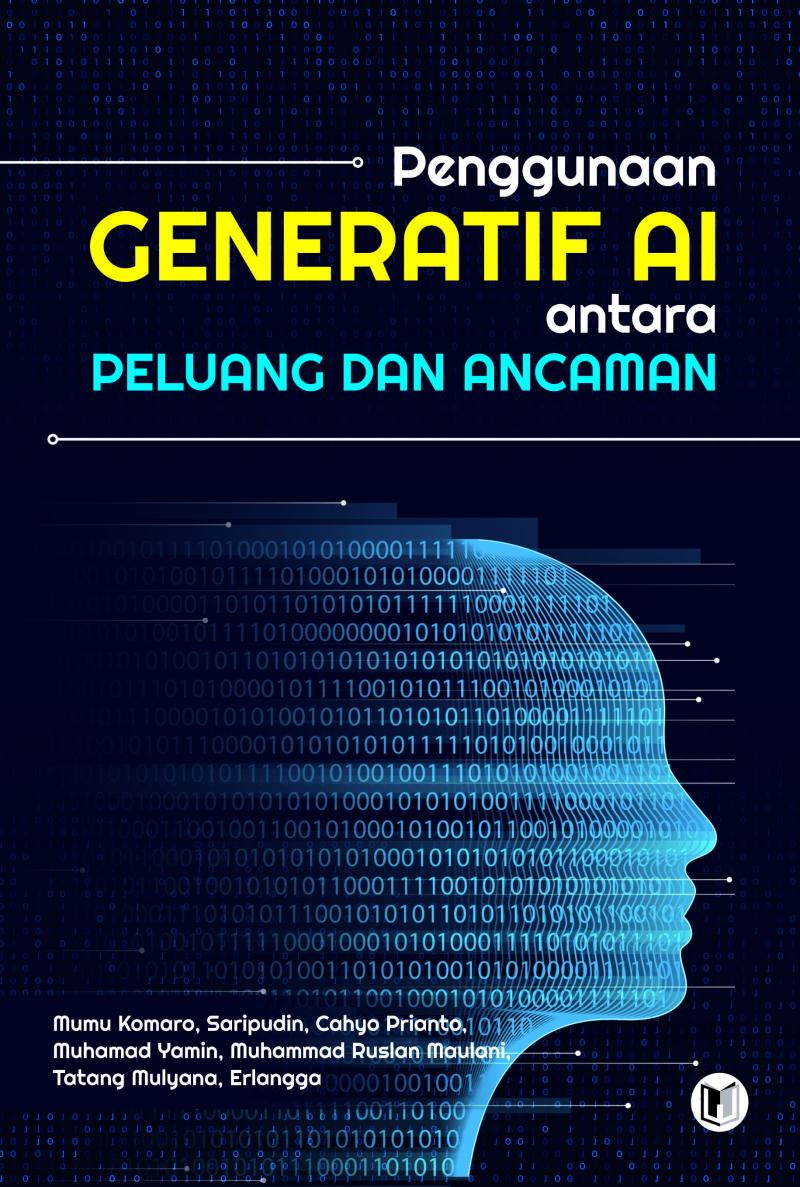
PENGGUNAAN GENERATIF AI DALAM PENDIDIKANANTARA PELUANG DAN ANCAMAN
Keywords:
Kecerdasan Buatan Generatif (Generative AI), Pendidikan (Education), Etika Digital (Digital Ethics), Pembelajaran Adaptif (Adaptive Learning), Transformasi Pembelajaran (Learning Transformation), Plagiarisme Digital (Digital Plagiarism), Strategi Implementasi AI (AI Implementation Strategy)Synopsis
Kecerdasan Buatan Generatif (Generative Artificial Intelligence/GenAI) telah mengubah cara manusia belajar, mengajar, dan mengelola pendidikan. Di satu sisi, teknologi ini menawarkan peluang besar untuk menciptakan pembelajaran yang lebih personal, adaptif, dan efisien. Di sisi lain, kehadirannya juga memunculkan berbagai tantangan, mulai dari persoalan etika, plagiarisme digital, bias algoritma, hingga potensi menurunnya kemampuan berpikir kritis peserta didik.
Buku ini mengajak pembaca memahami secara komprehensif dinamika penggunaan GenAI dalam dunia pendidikan melalui perspektif akademik, praktis, dan kritis. Dimulai dari pembahasan mengenai transformasi pembelajaran berbasis AI, buku ini mengulas berbagai peluang strategis bagi institusi pendidikan, mengkaji risiko dan ancaman implementasinya, serta menganalisis perubahan peran dan kompetensi pendidik di era kecerdasan buatan. Pada bagian akhir, buku ini menawarkan strategi implementasi AI yang bertanggung jawab, etis, dan berorientasi pada pengembangan manusia.
Downloads
Download data is not yet available.
References
Abiola Ajuwon, O., Shukurat Animashau, E., & Rita Chiekezie, N. (2024). Integrating AI and technology in educational administration: Improving efficiency and educational quality. Open Access Research Journal of Science and Technology, 11(2), 116–127. https://doi.org/10.53022/oarjst.2024.11.2.0102
Alshamy, A., Al-Harthi, A. S. A., & Abdullah, S. (2025). Perceptions of generative AI tools in higher education: Insights from students and academics at Sultan Qaboos University. Education Sciences, 15(4). https://doi.org/10.3390/educsci15040501
Athanassopoulos, S., Tzavara, A., Aravantinos, S., Lavidas, K., Komis, V., & Papadakis, S. (2026). Teacher education students’ practices, benefits, and challenges in the use of generative AI tools in higher education. Education Sciences, 16(2). https://doi.org/10.3390/educsci16020228
Baker, R. S., & Hawn, A. (2024). Algorithmic bias in education. International Journal of Artificial Intelligence in Education, 34(2), 215–235.
Bearman, M., & Ajjawi, R. (2024). Learning to work with the black box: Pedagogy for a world with artificial intelligence. British Journal of Educational Technology, 55(4), 1120–1135.
Biberman-Shalev, L. (2025). Prompting theory into practice: Utilizing ChatGPT-4 in a curriculum planning course. Education Sciences, 15(2). https://doi.org/10.3390/educsci15020196
Biesta, G. J. J. (2010). Good education in an age of measurement: Ethics, politics, democracy. Paradigm Publishers.
Bonk, C. J. (2020). Pandemic ponderings, 30 years to today: Synchronous signals, saviors, or survivors? Distance Education, 41(4), 589–599. https://doi.org/10.1080/01587919.2020.1821610
Boud, D., & Falchikov, N. (2006). Aligning assessment with long-term learning. Assessment & Evaluation in Higher Education, 31(4), 399–413. https://doi.org/10.1080/02602930600679050
Bozkurt, A., et al. (2024). A global outlook to the interruption of education due to AI disruption. Asian Journal of Distance Education, 19(1), 85–110.
Bruner, J. (1996). The culture of education. Harvard University Press.
Campbell, E. (2003). The ethical teacher. Open University Press.
Çela, E., Fonkam, M. M., & Potluri, R. M. (2024). Risks of AI-assisted learning on student critical thinking: A case study of Albania. International Journal of Risk and Contingency Management, 12(1), 1–19. https://doi.org/10.4018/IJRCM.350185
Celik, I., Kontkanen, S., Laru, J., & Dalyanci, A. A. (2026). Co-constructing adaptive lesson plans with GenAI: Pre-service teachers’ Intelligent-TPACK and prompt engineering strategies. Computers & Education, 241. https://doi.org/10.1016/j.compedu.2025.105485
Chen, D., Wang, T., Liu, J., Lu, Q., & Wang, M. (2025). Research on the construction and practical path of an intelligent teaching feedback system driven by generative AI. In Proceedings of the 2025 2nd International Symposium on Artificial Intelligence for Education (pp. 701–707). https://doi.org/10.1145/3775073.3775183
Chen, L., Chen, P., & Lin, Z. (2025). Artificial intelligence in education: A review. IEEE Access, 13, 10245–10258.
Chiu, T. K. (2025). Student engagement in K–12 online learning amid generative AI era. Computers & Education, 195, 104715.
Choi, Y. (2025). Integrating ChatGPT into the design of 5E-based earth science lessons. Education Sciences, 15(7). https://doi.org/10.3390/educsci15070815
Chu, T. S., & Ashraf, M. (2025). Artificial intelligence in curriculum design: A data-driven approach to higher education innovation. Knowledge, 5(3), 14. https://doi.org/10.3390/knowledge5030014
Chung, J. Y., & Jeong, S. H. (2024). Exploring the perceptions of Chinese pre-service teachers on the integration of generative AI in English language teaching: Benefits, challenges, and educational implications. Online Journal of Communication and Media Technologies, 14(4). https://doi.org/10.30935/ojcmt/15266
Conrad, E. J., & Rees, L. K. (2024). Generative AI as a catalyst to elevate school health education. Journal of Physical Education, Recreation & Dance, 95(6), 45–51. https://doi.org/10.1080/07303084.2024.2355865
Cope, B., & Kalantzis, M. (2017). Conceptualizing e-learning. In B. Cope & M. Kalantzis (Eds.), E-learning ecologies (pp. 1–45). Routledge.
Cope, B., & Kalantzis, M. (2025). Making sense of generative AI in learning. Cambridge University Press.
Cotton, D. R. E., Cotton, P. A., & Shipway, J. R. (2024). Chatting and cheating: Ensuring academic integrity in the era of ChatGPT. Innovations in Education and Teaching International, 61(2), 228–239. https://doi.org/10.1080/14703297.2023.2190148
Dede, C. (2022). Reconsidering how to serve all students equitably in online learning. Educational Technology, 62(1), 3–10.
Dede, C., & Richards, J. (2025). The 60-year curriculum: New models for lifelong learning in the digital economy. Routledge.
Dickey, E., & Bejarano, A. (2024). GAIDE: A framework for using generative AI to assist in course content development. In 2024 IEEE Frontiers in Education Conference (FIE) (pp. 1–9). https://doi.org/10.1109/FIE61694.2024.10893132
Ding, Z. (2025). The synergy of AI and VR for personalized learning. Lecture Notes in Education Psychology and Public Media, 93(1), 120–125. https://doi.org/10.54254/2753-7048/2025.BO25217
du Plessis, E. (2025). Embracing project-based assessments in the age of AI in open distance e-learning. International Journal of Information and Education Technology, 15(2), 372–381. https://doi.org/10.18178/ijiet.2025.15.2.2249
Education International. (2023). Teachers and AI: A global survey on readiness and integration.
El-Soussi, A., & Yousef, D. (2026). Ai-RACE as a framework for writing assignment design in higher education. Education Sciences, 16(1), 119. https://doi.org/10.3390/educsci16010119
Erkan, A., Suiçmez, İ., Kanbul, S., & Öznacar, M. (2026). Educating aspiring teachers with AI by strengthening sustainable pedagogical competence in changing educational landscapes. Sustainability, 18(2), 757. https://doi.org/10.3390/su18020757
Ertmer, P. A. (1999). Addressing first- and second-order barriers to change: Strategies for technology integration. Educational Technology Research and Development, 47(4), 47–61. https://doi.org/10.1007/BF02299597
Floridi, L. (2025). The ethics of artificial intelligence: Principles, challenges, and opportunities. Oxford University Press.
Floridi, L., Cowls, J., Beltrametti, M., Chatila, R., Chazerand, P., Dignum, V., & Vayena, E. (2018). An ethical framework for a good AI society: Opportunities, risks, principles, and recommendations. Minds and Machines, 28(4), 689–707. https://doi.org/10.1007/s11023-018-9482-5
Frey, C. B., & Osborne, M. A. (2017). The future of employment: How susceptible are jobs to computerisation? Technological Forecasting and Social Change, 114, 254–280. https://doi.org/10.1016/j.techfore.2016.08.019
GEM Report UNESCO. (2023). Global education monitoring report 2023: Technology in education: A tool on whose terms? (1st ed.). GEM Report UNESCO. https://doi.org/10.54676/UZQV8501
Gerlich, M. (2025). AI tools in society: Impacts on cognitive offloading and the future of critical thinking. Societies, 15(1), 6. https://doi.org/10.3390/soc15010006
Gjermeni, F., & Prodani, F. (2024). AI and student engagement: A comparative analysis. Interdisciplinary Journal of Research and Development, 11(3), 195. https://doi.org/10.56345/ijrdv11n326
Goodlad, J. I. (1994). Educational renewal: Better teachers, better schools. Jossey-Bass.
Gunawan, K. D. H., Ridhani, J., Khasanah, A. N., Antrakusuma, B., Gunawan, P. H., & Nur Hudha, M. (2025). Artificial intelligence and data-driven approaches in university science education: A review of applications and outcomes. In 2025 1st International Conference on Data Science and Geoinformatics (ICDSG) (pp. 19–24). https://doi.org/10.1109/ICDSG67714.2025.11381391
Haenlein, M., & Kaplan, A. (2019). A brief history of artificial intelligence: On the past, present, and future of artificial intelligence. California Management Review, 61(4), 5–14. https://doi.org/10.1177/0008125619864925
Hanh, N. V., & Duyen, N. T. (2025). AI-assisted academic cheating: A conceptual model based on postgraduate student voices. Frontiers in Computer Science, 7, 1682190. https://doi.org/10.3389/fcomp.2025.1682190
Harjanto, R., Mustafa, Z., Pertiwi, S. A., Nugroho, M. A., & Akib, S. (2024). Managing the intersection of artificial intelligence, digital typing, and handwriting for sustainable quality education enhancement. International Journal of Professional Business Review, 9(4), e04534. https://doi.org/10.26668/businessreview/2024.v9i4.4534
Hattie, J. (2009). Visible learning: A synthesis of over 800 meta-analyses relating to achievement. Routledge.
He, R., Cao, J., & Tan, T. (2025). Generative artificial intelligence: A historical perspective. National Science Review, 12(5), nwaf050. https://doi.org/10.1093/nsr/nwaf050
Holmes, W., & Porayska-Pomsta, K. (Eds.). (2024). The ethics of artificial intelligence in education. Routledge.
Holmes, W., Porayska-Pomsta, K., Holstein, K., Sutherland, E., Baker, T., Shum, S. B., & Koedinger, K. (2022). Ethics of AI in education: Towards a community-wide agenda. International Journal of Artificial Intelligence in Education, 32(2), 504–526. https://doi.org/10.1007/s40593-021-00239-1
Hong, S., Moon, J., Eom, T., Awoyemi, I. D., & Hwang, J. (2025). Generative AI-enhanced virtual reality simulation for pre-service teacher education: A mixed-methods analysis of usability and instructional utility for course integration. Education Sciences, 15(8). https://doi.org/10.3390/educsci15080997
Hwang, G. J., & Chien, S. Y. (2025). Definition, roles, and potential research issues of the metaverse in education. Computers and Education: Artificial Intelligence, 5, 100082.
Immordino-Yang, M. H. (2016). Emotions, learning, and the brain: Exploring the educational implications of affective neuroscience. W. W. Norton & Company.
Johnson, M. C., Magruder, M. L., Hahn, A. K., Tabbaa, A., Dennis, E., & Grosso, M. J. (2025). Accuracy of ChatGPT for literature citations in lower limb arthroplasty. Journal of Orthopaedic Reports, 100756. https://doi.org/10.1016/j.jorep.2025.100756
Karamuk, E. (2025). The automation trap: Unpacking the consequences of over-reliance on AI in education and its hidden costs. In M. B. Garcia, J. Rosak-Szyrocka, & A. Bozkurt (Eds.), Pitfalls of AI integration in education: Skill obsolescence, misuse, and bias (pp. 151–174). IGI Global. https://doi.org/10.4018/979-8-3373-0122-8.ch007
Kharadi, M., Sagar, V., Bhanot, D., Soumya, Smitha K., Singh, S., & Bayas, V. S. (2025). AI-powered graphic design tools: A paradigm shift in art curriculum. ShodhKosh: Journal of Visual and Performing Arts, 6(4s), 299–308. https://doi.org/10.29121/shodhkosh.v6.i4s.2025.6855
Kinder, A., Briese, F. J., Jacobs, M., Dern, N., Glodny, N., Jacobs, S., & Leßmann, S. (2025). Effects of adaptive feedback generated by a large language model: A case study in teacher education. Computers and Education: Artificial Intelligence, 8. https://doi.org/10.1016/j.caeai.2024.100349
King, A. (1993). From sage on the stage to guide on the side. College Teaching, 41(1), 30–35. https://doi.org/10.1080/87567555.1993.9926781
Knox, J. (2024). Artificial intelligence and education in China. Routledge.
Ko, U. H., Hartley, K., & Hayak, M. (2025). Exploring AI in education: Preservice teacher perspectives, usage, and considerations. Journal of Information Technology Education: Research, 24. https://doi.org/10.28945/5592
Koehler, M. J., & Mishra, P. (2006). Technological pedagogical content knowledge: A framework for teacher knowledge. Teachers College Record, 108(6), 1017–1054.
Krushinskaia, K., Elen, J., & Raes, A. (2026). Pre-service teachers’ agency during their interactions with generative AI while designing for learning: A process view on Intelligent-TPACK. Computers and Education Open, 10. https://doi.org/10.1016/j.caeo.2025.100325
Kwan, P., Kadel, R., Memon, T. D., & Hashmi, S. S. (2025). Reimagining flipped learning via Bloom’s taxonomy and student–teacher–GenAI interactions. Education Sciences, 15(4). https://doi.org/10.3390/educsci15040465
Leahy, K., Ozer, E., & Cummins, E. P. (2025). AI-ENGAGE: A multicentre intervention to support teaching and learning engagement with generative artificial intelligence tools. Education Sciences, 15(7). https://doi.org/10.3390/educsci15070807
Lee, H. P., Sarkar, A., Tankelevitch, L., Drosos, I., Rintel, S., Banks, R., & Wilson, N. (2025, April 26). The impact of generative AI on critical thinking: Self-reported reductions in cognitive effort and confidence effects from a survey of knowledge workers. Proceedings of the CHI Conference on Human Factors in Computing Systems. https://doi.org/10.1145/3706598.3713778
Li, H., Chai, C. S., & Wang, X. (2025). Promoting pre-service music teachers’ TPACK with generative AI: An intervention through designing with AI. Computers and Education: Artificial Intelligence, 9. https://doi.org/10.1016/j.caeai.2025.100525
Li, M. (2025). Exploring the digital divide in primary education: A comparative study of urban and rural mathematics teachers’ TPACK and attitudes towards technology integration in post-pandemic China. Education and Information Technologies, 30(2), 1913–1945. https://doi.org/10.1007/s10639-024-12890-x
Li, T., Zhan, Z., Ji, Y., & Li, T. (2025). Exploring human and AI collaboration in inclusive STEM teacher training: A synergistic approach based on self-determination theory. Internet and Higher Education, 65. https://doi.org/10.1016/j.iheduc.2025.101003
Liu, Z., Cheon, S., Stanbury, A., Jiao, X., Xing, W., & Kang, H. (2026). Towards contextual-based AI: A scoping review of artificial intelligence in X reality for personalized learning. Computers and Education: Artificial Intelligence, 10. https://doi.org/10.1016/j.caeai.2025.100523
Lourdu Vesna. (2025). Digital divide in AI-powered education: Challenges and solutions for equitable learning. Journal of Information Systems Engineering and Management, 10(21s), 300–308. https://doi.org/10.52783/jisem.v10i21s.3327
Lucas, M., Bem-haja, P., Zhang, Y., Llorente-Cejudo, C., & Palacios-Rodríguez, A. (2025). A comparative analysis of pre-service teachers’ readiness for AI integration. Computers and Education: Artificial Intelligence, 8. https://doi.org/10.1016/j.caeai.2025.100396
Luckin, R. (2025). Machine learning and human intelligence: The future of education for the 21st century (2nd ed.). UCL Press.
Luckin, R., Holmes, W., Griffiths, M., & Forcier, L. B. (2016). Intelligence unleashed: An argument for AI in education. Pearson Education.
Lye, C. Y., & Lim, L. (2024). Generative artificial intelligence in tertiary education: Assessment redesign principles and considerations. Education Sciences, 14(6), 569. https://doi.org/10.3390/educsci14060569
Mahmud, M. M., Lokman, A. S., Wong, S. F., Ramachandiran, C. R., Zakaria, S. F., Tazijan, F., Mat, N. H. C., & Lin, N. M. (2025). Application and distribution of interactive HTML5 content within online courses to increase learner engagement. In 2025 6th International Conference on Information Technology and Education Technology (ITET) (pp. 46–60). https://doi.org/10.1109/ITET65804.2025.11101641
Maral, S., Naycı, N., Bilmez, H., Erdemir, E. İ., & Satici, S. A. (2025). Problematic ChatGPT use scale: AI-human collaboration or unraveling the dark side of ChatGPT. International Journal of Mental Health and Addiction. https://doi.org/10.1007/s11469-025-01509-y
Mardiah, M., Sabda, S., & Cahyadi, A. (2022). Analisis relevansi neurosains dengan pembelajaran dan kesehatan spiritual. Journal on Education, 4(4), 1489–1510. https://doi.org/10.31004/joe.v5i4.2197
Martinez-Romo, J., Araujo, L., Plaza, L., & López-Ostenero, F. (2025). Generative AI for education: A retrieval-augmented system for effective feedback in self-assessment. In 2025 IEEE Global Engineering Education Conference (EDUCON) (pp. 1–9). https://doi.org/10.1109/EDUCON62633.2025.11016446
Maryati, I., Harun, M., Gumilar, S., & Rahayu, A. P. (2026). Adaptive learning and generative AI in mathematics teacher education: A systematic review. 1(1).
McKinsey Global Institute. (2023). The economic potential of generative AI: The next productivity frontier.
Mittal, U., Sai, S., Chamola, V., & Sangwan, D. (2024). A comprehensive review on generative AI for education. IEEE Access, 12, 142733–142759. https://doi.org/10.1109/ACCESS.2024.3468368
Mullah, A., & Jayachandran, S. (2025). AI-driven innovation in Education 4.0: An overview of generative AI tools, learning analytics, and gamified SQL learning. International Journal of Environmental Sciences, 11(9S), 1062–1066. https://doi.org/10.64252/829vnm63
Mundhe, S. S., Sable, N. P., Yenkikar, A., & Pandit, P. (2026). Artificial intelligence as personalized tutor in regional language. In 2026 IEEE International Conference on Interdisciplinary Approaches in Technology and Management for Social Innovation (IATMSI) (pp. 1–6). https://doi.org/10.1109/IATMSI68868.2026.11465596
Ng, D. T. K., Chan, E. K. C., & Lo, C. K. (2025). Opportunities, challenges and school strategies for integrating generative AI in education. Computers and Education: Artificial Intelligence, 8, 100373. https://doi.org/10.1016/j.caeai.2025.100373
Noble, S. U. (2018). Algorithms of oppression: How search engines reinforce racism. New York University Press.
Noddings, N. (1984). Caring: A feminine approach to ethics and moral education. University of California Press.
OECD. (2023). OECD digital education outlook 2023: Towards an effective digital education ecosystem. OECD Publishing. https://doi.org/10.1787/c74f03de-en
OECD. (2025). Trends shaping education 2025. OECD Publishing. https://doi.org/10.1787/ee6587fd-en
Oh, S. (2025). Integration of MATH41 and generative AI in pre-service mathematics teacher education: An empirical study on lesson design competency. IEEE Access, 13, 128959–128973. https://doi.org/10.1109/ACCESS.2025.3586593
Otto, S., Lavi, R., & Brogaard Bertel, L. (2025). Human-GenAI interaction for active learning in STEM education: State-of-the-art and future directions. Computers & Education, 239. https://doi.org/10.1016/j.compedu.2025.105444
Ouyang, F., & Jiao, P. (2025). Artificial intelligence in education: The three paradigms. Computers and Education: Artificial Intelligence, 6, 100095.
Panda, S., & Mishra, P. (2026). A framework for applying generative AI in outcome-based teaching learning systems. Engineering and Technology Journal, 11(2). https://doi.org/10.47191/etj/v11i02.37
Pantic, I. V. (2026). Introducing the AI Addiction Scale (AIAS-21): A screening tool for problematic AI use. European Child & Adolescent Psychiatry, 35(1), 297. https://doi.org/10.1007/s00787-025-02874-8
Prilop, C. N., Mah, D. K., Jacobsen, L. J., Hansen, R. R., Weber, K. E., & Hoya, F. (2025). Generative AI in teacher education: Educators’ perceptions of transformative potentials and the triadic nature of AI literacy explored through AI-enhanced methods. Computers and Education: Artificial Intelligence, 9. https://doi.org/10.1016/j.caeai.2025.100471
Raimkulova, A., Ybyraimzhanov, K., Halmatov, M., Mailybayeva, G., & Khaimuldanov, Y. (2025). Pre-service EFL primary teachers adopting GenAI-powered game-based instruction. Education Sciences, 15(10), 1326. https://doi.org/10.3390/educsci15101326
Reynolds, D., Campbell, W., Richardson, F., Dagli, C., Sahin, C., Gadepally, V., Tran, A., Greenfield, K., Trepagnier, P., Hall, R., Zipkin, J., Roeser, C., Mohindra, S., Hennighausen, K., & Thornton, J. (2019). Artificial intelligence: Short history, present developments, and future outlook final report.
Rhitthica, A. L., Anija, S. S., & Senthil, D. S. (2026). AI-powered interactive system for visual learning and student engagement. International Journal on Advanced Computer Engineering and Communication Technology, 15(1), 214–222. https://doi.org/10.65521/ijacect.v15i1.2376
Robertson, S. L., & Komljenovic, J. (2016). Unbundling the university and making higher education markets. In K. Mundy, A. Green, B. Lingard, & A. Verger (Eds.), The handbook of global education policy (pp. 136–153). Wiley Blackwell.
Rodge, G. (2026). Sahayak AI: Adaptive intelligence for teaching and learning. International Journal for Research in Applied Science and Engineering Technology, 14(2), 450–456. https://doi.org/10.22214/ijraset.2026.77335
Salem, A. A. M. S. (2026). Generative AI-driven feedback in flipped writing workshops: Transforming business education through improved writing, communication, and self-regulation. Journal of Educational Computing Research. https://doi.org/10.1177/07356331261431156
Sefton-Green, J., Erstad, O., & Marsh, J. (2016). Towards a learning progression for digital literacy. In J. Sefton-Green, O. Erstad, & J. Marsh (Eds.), Learning and digital cultures (pp. 1–20). Springer.
Selwyn, N. (2022). Education and technology: Key issues and debates (3rd ed.). Bloomsbury Academic.
Selwyn, N. (2025). Education and technology: Key issues and debates (4th ed.). Bloomsbury Academic.
Seufert, S., Hartmann, P., & Spirgi, L. (2025). Fostering Intelligent-TPACK through AI-assistance: A multi-method study in pre-service teacher education. Computers and Education Open, 9, 100314. https://doi.org/10.1016/j.caeo.2025.100314
Shukla, V. K., & Merikapudi, S. (2026). Design and algorithmic validation of a hybrid Q-learning and generative AI framework for adaptive learning architectures. ICTACT Journal on Data Science and Machine Learning, 7(2), 996–1007. https://doi.org/10.21917/ijdsml.2026.0189
Siemens, G., & Gasevic, D. (2024). Learning analytics and AI in education. Springer.
Singh, A., Taneja, K., Guan, Z., & Ghosh, A. (2025). Protecting human cognition in the age of AI. Journal of AI in Education Review, 12(1), 45–62.
Soni, M. C. (2023). Gamified learning and NLP: Enhancing student engagement through AI-driven interactive education models. International Journal of Science and Research Archive, 9(1), 813–824. https://doi.org/10.30574/ijsra.2023.9.1.0496
Tafazoli, D. (2024). Exploring the potential of generative AI in democratizing English language education. Computers and Education: Artificial Intelligence, 7, 100275. https://doi.org/10.1016/j.caeai.2024.100275
Tasdelen, O., & Bodemer, D. (2025). Generative AI in the classroom: Effects of context-personalized learning material and tasks on motivation and performance. International Journal of Artificial Intelligence in Education, 35(5), 3049–3070. https://doi.org/10.1007/s40593-025-00491-9
Tzanoulinou, D., Triantafyllopoulos, L., Vorvilas, G., Paxinou, E., Karousos, N., & Dasaklis, T. (2026). Artificial intelligence and cost reduction in public higher education. Journal of Educational Technology, 11(2), 211–229.
UNESCO. (2021). Artificial intelligence in education: Challenges and opportunities for sustainable development. UNESCO.
UNESCO. (2023). Guidance for generative AI in education and research. UNESCO. https://doi.org/10.54675/EWZM9535
Ure-de-Oliveira, R., & Bonilla-Algovia, E. (2025). Digital divides and educational inclusion: Perceptions from the educational community in Spain. Education Sciences, 15(8), 939. https://doi.org/10.3390/educsci15080939
Uwosomah, E. E., & Dooly, M. (2025). It is not the huge enemy: Preservice teachers’ evolving perspectives on AI. Education Sciences, 15(2), 152. https://doi.org/10.3390/educsci15020152
van den Berg, G., & du Plessis, E. (2023). ChatGPT and generative AI: Possibilities for its contribution to lesson planning, critical thinking and openness in teacher education. Education Sciences, 13(10). https://doi.org/10.3390/educsci13100998
Voogt, J., & Roblin, N. P. (2012). A comparative analysis of international frameworks for 21st century competences. Journal of Curriculum Studies, 44(3), 299–321. https://doi.org/10.1080/00220272.2012.668938
Vygotsky, L. S. (1978). Mind in society: The development of higher psychological processes. Harvard University Press.
Wang, J., & Zhang, Z. (2025). Generative AI-driven personalized learning: Construction and application of a new teaching model. In Proceedings of the 2025 4th International Conference on Artificial Intelligence and Education (pp. 482–488). https://doi.org/10.1145/3797552.3797630
Wang, J., Yoon, J., Marzban, A., Castanos, R., Fruge, N., & Holman, I. (2025). Automatic daily drilling mud report processing using generative AI to maximize the operational efficiency. Offshore Technology Conference, D011S007R006. https://doi.org/10.4043/35625-MS
Williamson, B., & Komljenovic, J. (2024). The datafication of higher education. Routledge.
Williamson, B., Bayne, S., & Shay, S. (2020). The datafication of teaching in higher education: Critical issues and perspectives. Teaching in Higher Education, 25(4), 351–365. https://doi.org/10.1080/13562517.2020.1748811
Wing, J. M. (2006). Computational thinking. Communications of the ACM, 49(3), 33–35. https://doi.org/10.1145/1118178.1118215
Yan, L., Greiff, S., Teuber, Z., & Gašević, D. (2024). Promises and challenges of generative artificial intelligence for human learning. Nature Human Behaviour, 8(10), 1839–1850. https://doi.org/10.1038/s41562-024-02004-5
Yuliastrin, A., Vebrianto, R., Fiqri, M., & Berlian, M. (2023). The mapping students’ critical thinking ability on vibration and wave material: Pemetaan kemampuan berpikir kritis pada materi getaran dan gelombang. Science Education Journal, 7(2), 89–98. https://doi.org/10.21070/sej.v7i2.1633
Zawacki-Richter, O., & Jung, I. (Eds.). (2024). Handbook of open, distance and digital education. Springer.
Zawacki-Richter, O., Marín, V. I., Bond, M., & Gouverneur, F. (2024). Systematic review of research on artificial intelligence applications in higher education. International Journal of Educational Technology in Higher Education, 21(1), 1–25.
Zhai, C., Wibowo, S., & Li, L. D. (2024). The effects of over-reliance on AI dialogue systems on students’ cognitive abilities: A systematic review. Smart Learning Environments, 11(1), 28. https://doi.org/10.1186/s40561-024-00316-7
Zhang, J., Yang, D., Wang, Y., & Xu, H. (2025). Optimization of university teaching management in the era of artificial intelligence. Journal of Higher Education Teaching, 2(2), 84–89. https://doi.org/10.62517/jhet.202515212
Zhao, G., Sheng, H., Wang, Y., Cai, X., & Long, T. (2025). Generative artificial intelligence amplifies the role of critical thinking skills and reduces reliance on prior knowledge while promoting in-depth learning. Education Sciences, 15(5), 554. https://doi.org/10.3390/educsci15050554
Zhao, Y., & Cziko, G. A. (2001). Teacher adoption of technology: A perceptual control theory perspective. Journal of Technology and Teacher Education, 9(1), 5–30.
Ziying, L., Yongchun, H., & Qiaoping, Z. (2026). Harnessing artificial intelligence for preservice teachers’ development: A scoping review of applications, benefits, and challenges. Computers and Education Open, 10. https://doi.org/10.1016/j.caeo.2026.100330
Downloads
Published
July 21, 2026
Copyright (c) 2026 Mumu Komaro, Saripudin, Cahyo Prianto, Muhamad Yamin, Muhammad Ruslan Maulani, Tatang Mulyana, Erlangga (Author)
License

This work is licensed under a Creative Commons Attribution-NonCommercial-ShareAlike 4.0 International License.
How to Cite
Mumu Komaro, Saripudin, Cahyo Prianto, Muhamad Yamin, Muhammad Ruslan Maulani, Tatang Mulyana, & Erlangga. (2026). PENGGUNAAN GENERATIF AI DALAM PENDIDIKANANTARA PELUANG DAN ANCAMAN. Widina Media Utama. https://doi.org/10.59818/4m1p4621