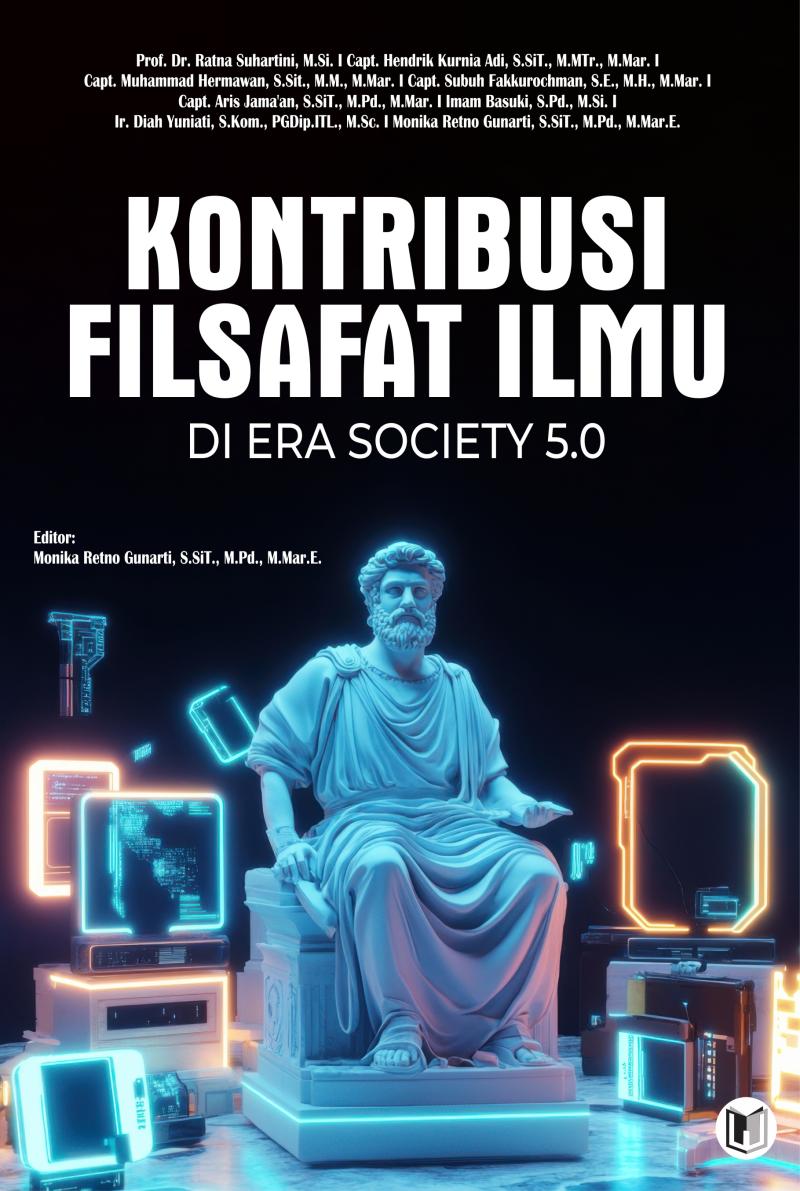
KONTRIBUSI FILSAFAT ILMU DI ERA SOCIETY 5.0
Keywords:
Filsafat, Teknologi, Society, PendidikanSynopsis
Di tengah derasnya arus transformasi digital dan kompleksitas era Society 5.0, manusia tidak lagi hanya berhadapan dengan teknologi sebagai alat, tetapi sebagai bagian integral dari kehidupan sosial, ekonomi, dan budaya. Buku Kontribusi Filsafat Ilmu di Era Society 5.0 hadir sebagai refleksi kritis sekaligus panduan konseptual dalam memahami relasi mendalam antara ilmu pengetahuan, teknologi, dan kemanusiaan.
Melalui pendekatan interdisipliner, buku ini mengupas peran filsafat ilmu dalam menjawab tantangan era disrupsi, mulai dari dinamika dunia kerja berbasis VUCA dan BANI, transformasi pendidikan vokasi, hingga integrasi kecerdasan buatan, digitalisasi, dan pengembangan kompetensi manusia. Pembahasan tidak hanya berhenti pada tataran teoritis, tetapi juga menembus ranah praktis melalui studi pada sektor strategis seperti maritim dan penerbangan.
Setiap bab menghadirkan sintesis antara landasan ontologis, epistemologis, dan aksiologis dengan realitas empiris, mencakup isu-isu penting seperti knowledge sharing, kepemimpinan transformatif, employee agility, kecerdasan emosional, hingga kesiapan kerja di era teknologi cerdas. Buku ini menegaskan bahwa kemajuan teknologi tanpa refleksi filosofis berisiko kehilangan arah kemanusiaannya.
Ditujukan bagi akademisi, praktisi, pengambil kebijakan, serta mahasiswa pascasarjana, buku ini menawarkan perspektif mendalam sekaligus relevan dalam merumuskan masa depan pendidikan, organisasi, dan pembangunan sumber daya manusia yang adaptif, etis, dan berkelanjutan.
Sebuah bacaan penting bagi siapa pun yang ingin memahami: bukan hanya bagaimana teknologi berkembang, tetapi ke mana arah peradaban manusia seharusnya dibawa.
Downloads
Download data is not yet available.
References
1000-Word Philosophy. (2025, April 23). Martin Heidegger on technology. https://1000wordphilosophy.com/2025/04/23/heidegger-on-technology/
Alavi, S., Abd Wahab, D., & Muhamad, N. A. (2020). Organizational knowledge sharing: A systematic literature review. Journal of Knowledge Management, 24(8), 1923–1946.
Alavi, S., Abd Wahab, D., & Muhamad, N. A. (2021). Antecedents and outcomes of employee agility: A review and research agenda. Journal of Organizational Effectiveness, 8(1), 45–65.
Albelo, J. L. D., & McIntire, S. (2024). Unveiling the promise of artificial intelligence in aviation education. Journal of Aviation/Aerospace Education & Research, 33(4).
https://commons.erau.edu/jaaer/vol33/iss4/5
Angle, S. C. (2012). Contemporary Confucian political philosophy. Polity Press.
Angle, S. C. (2018). Humaneness and virtue in Confucian ethics. Cambridge University Press.
Aristotle. (2009). Nicomachean ethics (W. D. Ross, Trans.). Oxford University Press.
Aristotle. (2014). Aristotle: Nicomachean ethics (R. Crisp, Ed.; 2nd ed.). Cambridge, UK: Cambridge University Press.
Aurelius, M. (2002). Meditations (G. Hays, Trans.). Modern Library. (Karya asli ditulis ca. 180 C.E.)
Australian Maritime Pilots Institute. (2021). Guidelines for marine pilotage SMS in Australia.
Avey, J. B., Reichard, R. J., Luthans, F., & Mhatre, K. H. (2011). Meta-analysis of the impact of positive Psychological Capital on employee attitudes, behaviors, and performance. Human Resource Development Quarterly, 22(2), 127–152. https://doi.org/10.1002/hrdq.20070
Bakker, A. B., & Albrecht, S. L. (2018). Work engagement: Current trends. Career Development International, 23(1), 4–11.
https://doi.org/10.1108/CDI-11-2017-0207
Bakker, A. B., & de Vries, J. D. (2021). Job demands–resources theory and self-regulation: New explanations and remedies for job burnout. Anxiety, Stress, & Coping, 34(1), 1–17.
Bakker, A. B., & Demerouti, E. (2017). Job demands–resources theory: Taking stock and looking forward. Journal of Occupational Health Psychology, 22(3), 273–285. https://doi.org/10.1037/ocp0000056
Bakker, A. B., & van Wingerden, J. (2021). Personal resources and employee agility: A dynamic perspective. Journal of Vocational Behavior, 127, 103586.
Bandura, A. (1997). Self-efficacy: The exercise of control. W. H. Freeman.
Barrick, M. R., & Mount, M. K. (1991). The Big Five personality dimensions and job performance: a meta-analysis. Personnel Psychology, 44(1), 1–26.
Bennett, D., Knight, E., & Rowley, J. (2020). The role of employability in higher education. Journal of Teaching and Learning for Graduate Employability, 11(1), 1–15.
https://doi.org/10.21153/jtlge2020vol11no1art906
Bennett, N., & Lemoine, G. J. (2014). What a difference a word makes: Understanding threats to performance in a VUCA world. Business Horizons, 57(3), 311–317.
https://doi.org/10.1016/j.bushor.2014.01.001
Berry, C. M., Ones, D. S., & Sackett, P. R. (2011). Interpersonal deviance, organizational deviance, and their common correlates: A review and meta-analysis. Journal of Applied Psychology, 96(3), 457–480.
Bianchi, R., & Laurent, E. (2019). Burnout, depression and borderline personality: A 1-year longitudinal study. Psychiatry Research, 281, 112–512.
Billett, S. (2011). Vocational education: Purposes, traditions and prospects. Springer. https://doi.org/10.1007/978-94-007-1954-5
Billett, S., & Choy, S. (2013). Learning through work: Emerging perspectives and new challenges. Journal of Workplace Learning, 25(4), 264–276. https://doi.org/10.1108/13665621311316447
Bolisani & C. Bratianu (Eds.), Emergent knowledge strategies (pp. 1–22). Springer.
Bolisani, E., & Bratianu, C. (2018). The elusive definition of knowledge. In E.
Bono, J. E., & Judge, T. A. (2004). Personality and transformational and transactional leadership: A meta-analysis. Journal of Applied Psychology, 89(5), 901–910.
Bouchard, T. J., & Loehlin, J. C. (2001). Genes, evolution, and personality. Behavior Genetics, 31(3), 243–273.
Byrne, Z. S., Peters, J., & Weston, J. W. (2020). Understanding employee subjective experience at work: A phenomenological approach. Journal of Managerial Psychology, 35(4), 273–288.
Cain, S. (2012). Quiet: The power of introverts in a world that can’t stop talking. Crown Publishers.
Cascio, W. F. (2020a). Managing human resources in uncertain times. Human Resource Management Review, 30(2), 100699.
https://doi.org/10.1016/j.hrmr.2019.100699
Cedefop. (2020). Vocational education and training in Europe: Country reports. Publications Office of the European Union.
Chen, X. P., & Chen, C. C. (2021). Guanxi and organizational behavior in East Asia. Oxford University Press.
Church, A. T. (2016). Personality traits across cultures. Annual Review of Psychology, 67, 521–549.
Clarke, M. (2018). Rethinking graduate employability: The role of capital, individual attributes and context. Studies in Higher Education, 43(11), 1923–1937. https://doi.org/10.1080/03075079.2017.1294152
Confucius. (2020). The Analects (E. Slingerland, Trans.). Hackett Publishing.
Costa, P. T., Jr., & McCrae, R. R. (1992). Revised NEO Personality Inventory (NEO-PI-R) and NEO Five-Factor Inventory (NEO-FFI) professional manual. Psychological Assessment Resources.
Deloitte. (2023). 2023 Global human capital trends: New fundamentals for a boundaryless world. Deloitte Insights.
Dewey, J. (1916). Democracy and education. Macmillan.
Dewey, J. (1938). Experience and Education. New York, NY: Macmillan.
Dewey, J. (1980). Democracy and education: An introduction to the philosophy of education (Original work published 1916). Free Press.
Dewey, J. (1986). How we think: A restatement of the relation of reflective thinking to the educative process (Original work published 1933). D.C. Heath.
Diao, J., Tang, X., & Ding, X. (2025). How do nations around the world navigate the digitalization of vocational education policies? Education and Information Technologies, 30, 19803–19831.
https://doi.org/10.1007/s10639-025-13567-9
Diener, E., Oishi, S., & Tay, L. (2018). Handbook of well-being. DEF Publishers.
Epictetus. (2008). Discourses and selected writings (R. Dobbin, Trans.). Penguin Classics.
European Maritime Safety Agency (EMSA). (2018). Automated ships: Challenges and opportunities. EMSA Report.
Fan, R. (2010). Reconstructionist Confucianism. Springer.
Feenberg, A. (1988). Pragmatism and critical theory of technology. Science, Technology, & Human Values, 13(1), 12-22.
https://scholar.lib.vt.edu/ejournals/SPT/v7n1/pdf/feenberg.pdf
Frankl, V. E. (2006). Man’s search for meaning. Beacon Press. (Original work published 1946)
Freire, P. (2000). Pendidikan kaum tertindas (A. Hidayat, Penerj.). Yogyakarta, Indonesia: Pustaka Pelajar.
Funder, D. C. (2019). The personality puzzle (8th ed.). W. W. Norton.
Garcia, M., & Torres, R. (2021). Integrating humanistic values into vocational education for Industry 5.0. Journal of Vocational Studies, 12(3), 211–225.
Garibaldi, G. (2024). Effects of psychological empowerment and perceived organizational support on employee engagement: The mediating role of job crafting. International Journal of Integrative Sciences, 4(10). https://doi.org/10.55927/ijis.v4i10.643
Gibbs, G. (2017). Analyzing qualitative data (2nd ed.). SAGE Publications.
Goldberg, L. R. (1993). The structure of phenotypic personality traits. American Psychologist, 48(1), 26–34.
Goleman, D. (2011). Emotional intelligence: Why it can matter more than IQ (10th anniversary ed.). Bantam.
Gong, Z., Jiao, X., Zhang, M., Qu, Q., & Sun, B. (2022). Effects of personal growth initiative on occupational engagement of college students in the uncertain social context: A cross-lagged model and a moderated mediation model. Frontiers in Psychology, 13, 988737.
https://doi.org/10.3389/fpsyg.2022.988737
González, M., & Hernández, S. (2017). The role of peer support in higher education: Impact on student success and engagement. Educational Review, 69(4), 520-533.
https://doi.org/10.1080/00131911.2017.1287710
Grant, A. (2013). Give and take: A revolutionary approach to success. Viking.
Grant, A. (2021). Think again: The power of knowing what you don’t know. Viking.
Graziano, W. G., & Eisenberg, N. (1997). Agreeableness: A dimension of personality. In R. Hogan, J. Johnson, & S. Briggs (Eds.), Handbook of personality psychology (pp. 795–824). Academic Press.
Habermas, J. (2019). Auch eine Geschichte der Philosophie [A History of Philosophy] (2 vol.). Frankfurt am Main: Suhrkamp.
Hahn, S. E., & Murphy, L. R. (2008). A short scale for measuring safety climate. Safety science, 46(7), 1047-1066.
https://doi.org/10.1016/j.ssci.2007.06.002
Hamdani, H., Jalinus, N., Refdinal, R., & Ranuharja, F. (2023). Pendidikan vokasional dalam perspektif filosofi pragmatisme. Jurnal Pendidikan Teknologi Informasi dan Vokasional, 5(2), 145–153.
http://dx.doi.org/10.23960/jpvti
Hancock, P. A., & Matthews, G. (2023). Human adaptability and cognitive flexibility in complex systems. Human Factors, 65(2), 221–240.
Heidegger, M. (1962). Being and time (J. Macquarrie & E. Robinson, Trans.). Harper & Row. (Original work published 1927)
Heidegger, M. (1977). The question concerning technology and other essays (W. Lovitt, Trans.). Harper & Row (Original work published 1954).
Heinämaa, S. (2020). Phenomenology and the embodied mind. Routledge.
Helliwell, J., Layard, R., & Sachs, J. (2021). World happiness report 2021. Sustainable Development Solutions Network.
Herrero, C., & López Cobo, M. (2025). Supporting the digital transformation of vocational education and training. Joint Research Centre, European Commission.
https://publications.jrc.ec.europa.eu/repository/bitstream/JRC141881/JRC141881_01.pdf
Homer-Dixon, T., Maynard, J. L., Mildenberger, M., Milkoreit, M., Mock, S. J., Quilley, S., Schröder, T., & Thagard, P. (2015). Synchronous failure: The emerging causal architecture of global crisis. Ecology and Society, 20(3), Article 6. https://doi.org/10.5751/ES-07681-200306
Huang, Y., Chen, L., & Wang, J. (2022). Lifelong learning orientation and adaptability in vocational education: The mediating role of empowerment. International Journal of Training Research, 20(4), 355–370.
Hubla Dephub. (2025). Kemenhub uji coba tahap kedua penerapan E-Pilotage service di Indonesia.
Hui, H., & Yeo, G. (2016). Maritime education and training: The key to safe shipping. Maritime Education Journal, 15(1), 1-12.
https://doi.org/10.1016/j.marinedu.2016.01.001
Hursthouse, R., & Pettigrove, G. (2018). Virtue ethics. In E. N. Zalta (Ed.), The Stanford encyclopedia of philosophy (Fall 2018 ed.). Stanford University Press.
Husserl, E. (2012). Ideas: General introduction to pure phenomenology (W. R. Boyce Gibson, Trans.). Routledge. (Original work published 1913)
Hwang, K. K. (2019). Foundations of Chinese psychology: Confucian social relations. Routledge.
IMO (International Maritime Organization). (2020). International shipping: Fueling the future. IMO Publications.
International Civil Aviation Organization. (2023a). Global air transport outlook. ICAO.
International Labour Organization. (2020). Skills for a greener future: A global view. ILO.
International Maritime Organization. (2020). Fourth IMO greenhouse gas study. IMO.
International Maritime Organization. (2021). Human element, training and watchkeeping. IMO.
International Maritime Organization. (2022). Strategic plan for the organization. IMO.
Inters.org. (n.d.). Reflections on the new tasks of ethics.
https://inters.org/jonas-technology-responsability
Jackson, D. (2021). Employability skill development in work-integrated learning: Barriers and best practice. Studies in Higher Education, 46(10), 2260–2273.
https://doi.org/10.1080/03075079.2020.1712140
Jang, K. L., Livesley, W. J., & Vernon, P. A. (1996). Heritability of the big five personality dimensions and their facets: A twin study. Journal of Personality, 64(3), 577–591.
Jatmika, B. J., & Amalia, K. (2024). Epistemologi Pendidikan: Elaborasi Pengetahuan untuk Mencapai Keautentisitasan Kecerdasan Manusia. NUSRA: Jurnal Penelitian Dan Ilmu Pendidikan, 5(2), 561–573.
https://doi.org/10.55681/nusra.v5i2.2480
John, O. P., Naumann, L. P., & Soto, C. J. (2008). Paradigm shift to the integrative Big Five trait taxonomy. In O. P. John, R. W. Robins, & L. A. Pervin (Eds.), Handbook of personality: Theory and research (3rd ed., pp. 114–158). Guilford Press.
Johnson, R. (1998). Kant’s moral philosophy. Cambridge University Press.
Jonas, H. (1984). The imperative of responsibility: In search of ethics for the technological age. University of Chicago Press.
Journal Untar. (2025). Hans Jonas on the ethics of technology.
https://journal.untar.ac.id/index.php/jmishumsen/article/view/8978
Judge, T. A., & Bono, J. E., Ilies, R., & Gerhardt, M. W. (2002). Personality and leadership: A qualitative and quantitative review. Journal of Applied Psychology, 87(4), 765–780.
Judge, T. A., & Ilies, R. (2002). Relationship of personality to performance motivation: a meta-analytic review. Journal of Applied Psychology, 87(4), 797–807.
Judge, T. A., Rodell, J. B., Klinger, R. L., Simon, L. S., & Crawford, E. R. (2013). Hierarchical representations of the Five-Factor Model of personality in predicting job performance: Integrating three organizing frameworks with two theoretical perspectives. Journal of Applied Psychology, 98(6), 875–925.
Kang, D., & Kim, S. (2023). Digital transformation in maritime transport: Smart shipping and autonomous vessels. Maritime Policy & Management, 50(4), 487–503.
https://doi.org/10.1080/03088839.2022.2041897
Kant, I. (1996). Groundwork of the metaphysics of morals (M. Gregor, Trans.). Cambridge University Press. (Original work published 1785)
Keller, J. M., & Redman, T. S. (2020). Maritime logistics and global supply chains. Springer.
Kementerian Perhubungan Republik Indonesia. (2023). Peraturan Menteri Perhubungan Republik Indonesia Nomor PM 4 Tahun 2023. https://peraturan.bpk.go.id/Download/311035/2023pmkemenhub004-compressed.pdf
Khasanah, I. M., & Rahardjo, W. (2023). Psychological Capital and work engagement among vocational teachers: The mediating role of job satisfaction. Journal of Technical Education and Training, 15(1), 13–24. https://doi.org/10.30880/jtet.2023.15.01.002
Kim, K., & Strudler, A. (2020). Confucian virtues and contemporary organizational ethics. Journal of Business Ethics, 164(3), 523–534.
Kim, S., & Park, J. (2022). Humanistic approaches to vocational education: The role of psychological empowerment. Journal of Educational Development, 18(2), 145–160.
Kozlowski, S. W. J., & Chao, G. T. (2021). Individual adaptability and performance under change: Contemporary perspectives. Annual Review of Organizational Psychology, 8, 1–27.
Kristjánsson, K. (2015). Aristotelian character education: A virtue-ethics perspective. Routledge.
KSOP Sampit. (2025). KSOP Sampit sukses lakukan uji coba E-Pilotage dengan MPAS 70 di alur pemanduan luar biasa. https://www.titikomapost.com/2025/05/ksop-sampit-sukses-lakukan-uji-coba-e-pilotage-dengan-mpas-70-di-alur-pemanduan-luar-biasa/
Laloux, F. (2014). Reinventing organizations. Nelson Parker.
Lesener, T., Gusy, B., & Wolter, C. (2020). The job demands-resources model: A meta-analytic review. Work & Stress, 34(1), 1–18.
https://doi.org/10.1080/02678373.2019.1569340
Li, X., Pu, X., & Liao, Y. (2022). The impacts of innovation capability and social adaptability on undergraduates’ employability: The role of self-efficacy. Frontiers in Psychology, 13, 954828.
https://doi.org/10.3389/fpsyg.2022.954828
Li, X., Zhang, Y., & Chen, H. (2023). AI-based decision support systems in aviation vocational training. Journal of Applied Technology in Education, 15(1), 33–47.
Luthans, F., & Youssef-Morgan, C. (2017). Psychological capital: An evidence-based positive approach. Annual Review of Organizational Psychology and Organizational Behavior, 4, 339–366.
Luthans, F., & Youssef-Morgan, C. M., & Avolio, B. J. (2015). Psychological capital and beyond. Oxford University Press.
Luthans, F., Avolio, B. J., Avey, J. B., & Norman, S. M. (2007). Positive psychological capital: Measurement and relationship with performance and satisfaction. Personnel Psychology, 60(3), 541–572.
Luthans, F., Youssef, C. M., & Avolio, B. J. (2015). Psychological Capital and beyond. Oxford University Press.
https://doi.org/10.1093/acprof:oso/9780199316472.001.0001
MacIntyre, A. (2007). After virtue: A study in moral theory (3rd ed.). University of Notre Dame Press.
Mananna, M. A., Safutra, N. E., & Sirozi, M. (2025). Philosophy of education of John Dewey’s pragmatism and its relevance to the education system in Indonesia. Journal of Educational Sciences, 9(6), 6110–6120. https://doi.org/10.31258/jes.9.6.p.6110-6120
Marine Pilots' Institute. (2022). Performance assessment in full-scale simulators.
Maritime and Port Authority of Singapore. (n.d.). Pilotage guidelines.
https://www.mpa.gov.sg/port-marine-ops/marine-services/pilotage-and-towage/pilotage-guidelines
Maritime Safety Innovation Lab. (2022). Performance assessment in full-scale simulators.
Maslach, C., & Leiter, M. P. (2016). Burnout: A multidimensional perspective. In C. L. Cooper (Ed.), The handbook of stress and health (pp. 81–99). Wiley.
Mayer, J. D., Caruso, D. R., & Salovey, P. (2016). The ability model of emotional intelligence: Principles and updates. Emotion Review, 8(4), 290–300.
Mayer, J. D., Salovey, P., & Caruso, D. R. (2004). Emotional intelligence: Theory, findings, and implications. Psychological Inquiry, 15(3), 197–215.
McCrae, R. R., & Costa, P. T. (2008). The five-factor theory of personality. In O. P. John, R. W. Robins, & L. A. Pervin (Eds.), Handbook of personality: Theory and research (3rd ed., pp. 159–181). Guilford Press.
McCrae, R. R., & Costa, P. T., Jr. (1999). A five-factor theory of personality. In L. A. Pervin & O. P. John (Eds.), Handbook of personality: Theory and research (2nd ed., pp. 139–153). Guilford Press.
McCrae, R. R., & Costa, P. T., Jr. (2003). Personality in adulthood: A five-factor theory perspective (2nd ed.). Guilford Press.
McGrath, R. E., & Brown, M. (2020). Using the VIA classification for character strengths in assessment and practice. Frontiers in Psychology, 11, 598907.
Mencius. (2018). The Mencius (B. Van Norden, Trans.). Hackett Publishing.
Mindful Technics. (2023, August 29). Heidegger on the essence of technology. https://mindfultechnics.com/heidegger/
Mõttus, R. (2022). Traits as hierarchically structured patterns of behavior. European Journal of Personality, 36(1), 3–21.
Muduli, A., Pandya, G., & Dutta, R. (2020). Employee agility and organizational agility: A systematic literature review. Human Resource Development Review, 19(4), 321–349.
Nguyen, T., Pham, H., & Le, Q. (2023). Digital transformation and empowerment in vocational education: Evidence from Asia-Pacific. Journal of Vocational Innovation, 14(2), 101–118.
Nonaka, I., & Takeuchi, H. (2019). The Wise Company: How companies create continuous innovation. Oxford University Press.
Nussbaum, M. C. (1997). Cultivating humanity: A classical defense of reform in liberal education. Harvard University Press.
OECD. (2021). Innovation in vocational education and training. OECD Publishing. https://doi.org/10.1787/0304e6a0-en
OECD. (2021a). Global value chains and supply chain resilience. OECD Publishing. https://doi.org/10.1787/5c4d9f94-en
OECD. (2021b). Transport strategies for net-zero systems. OECD Publishing. https://doi.org/10.1787/ca380f83-en
Paredes, J. L., & Buenaventura, R. D. (2024). Work engagement and employability among vocational students: Mediating effects of psychological resources. International Journal of Educational Research, 124, 102293. https://doi.org/10.1016/j.ijer.2024.102293
Park, S., & Park, S. (2020). Employee adaptive performance: Integrating psychological and behavioral perspectives. Human Resource Management Review, 30(4), 100704.
Parratt, J., Fahy, K., & Hastie, C. (2016). Facilitating student learning in clinical work-based contexts: Teamwork and supervision. Nurse Education in Practice, 17, 6–12.
https://doi.org/10.1016/j.nepr.2015.11.003
Pertiwi, H. I., & Pramono, R. B. (2024). Keterkaitan personal growth initiative dan harapan dengan adaptabilitas karir pada mahasiswa vokasi. Jurnal Psikologi Perseptual, 9(2).
https://jurnal.umk.ac.id/index.php/perseptual/article/view/13850
Peterson, C., & Seligman, M. E. P. (2004). Character strengths and virtues: A handbook and classification. Oxford University Press.
Philosophical.chat. (2025, March 3). Hans Jonas: Ethics, technology, and the responsibility.
Plato. (1997). Complete works (J. M. Cooper, Ed.). Hackett.
Pratama, W., & Pardjono, P. (2016). Model pembelajaran karakter pelaut. Jurnal Pendidikan Vokasi, 6(3), 318–334.
https://doi.org/10.21831/jpv.v6i3.11446
Purwaningtyas, D. A., Ardiansyah, I., & Widayati, W. (2022). Developing aviation smart campus through digital transformation for vocational education: Case study at Indonesia Aviation Polytechnic. Journal of Innovation in Educational and Cultural Research, 3(2), 177–184.
https://doi.org/10.46843/jiecr.v3i2.75
PwC. (2022). The future of smart airports and digital aviation. PwC Global.
Raharjo, M. A., Rossydi, A., Burhanuddin, F., Octavianie, A., Idyaningsih, N., & Sukarman. (2025). Integrating artificial intelligence in vocational higher education: A case study at Politeknik Penerbangan Makassar. International Journal of Recent Educational Research, 6(6).
https://doi.org/10.46245/ijorer.v6i6.1107
Rahayu, N. W., Ferdiana, R., & Kusumawardani, S. S. (2022). A systematic review of ontology use in E-Learning recommender system. Computers and Education: Artificial Intelligence, 3, 100047.
https://doi.org/10.1016/j.caeai.2022.100047
Rauner, F., & Maclean, R. (2018). Handbook of technical and vocational education and training research. Springer.
Roberts, B. W., Wood, D., & Caspi, A. (2007). The development of personality traits in adulthood. Current Directions in Psychological Science, 16(1), 31–35.
Roberts, B. W., Yoon, H. J., & Harms, P. D. (2017). Personality development and organizational behavior. Annual Review of Organizational Psychology and Organizational Behavior, 4, 45–69.
Robertson, D. (2019). Stoicism and the art of happiness (2nd ed.). Teach Yourself.
Rogers, C. R. (1988). Belajar untuk bebas (A. S. Suryabrata, Penerj.). Jakarta, Indonesia: Gramedia.
Ryan, R. M., & Deci, E. L. (2017). Self-determination theory: Basic psychological needs in motivation, development, and wellness. Guilford Press.
Ryff, C. D. (2014). Psychological well-being revisited: Advances in the science and practice of eudaimonia. Psychotherapy and Psychosomatics, 83(1), 10–28.
Salanova, M., Schaufeli, W. B., Xanthopoulou, D., & Bakker, A. B. (2020). The measurement of work engagement with a short questionnaire. Educational and Psychological Measurement, 80(1), 1–18.
https://doi.org/10.1177/0013164419887891
Salgado, J. F. (1997). The five-factor model of personality and job performance in the European community. Journal of Applied Psychology, 82(1), 30–43.
Sartre, J.-P. (2007). Existentialism is a humanism (C. Macomber, Trans.). Yale University Press.
Schön, D. A. (1983). The reflective practitioner: How professionals think in action. Basic Books.
Schwab, K. (2016). The fourth industrial revolution. World Economic Forum.
Schwab, K., & Vanham, P. (2021). Stakeholder capitalism: A global economy that works for progress, people and planet. Wiley.
Seligman, M. E. P. (2011). Flourish: A visionary new understanding of happiness and well-being. Free Press.
Selznick, P., & Mayhew, M. J. (2018). Innovation as a learning process in vocational education. Journal of Vocational Education & Training, 70(3), 425–440. https://doi.org/10.1080/13636820.2018.1460492
Seneca. (2010). Letters from a Stoic (R. Campbell, Trans.). Penguin Classics.
Serenko, A. (2021). Knowledge sharing research: A bibliometric analysis. Journal of Knowledge Management, 25(8), 1837–1867.
Sharma, R., & Sharma, P. (2020). Personal growth initiative and psychological empowerment: Implications for work performance. Journal of Organizational Psychology, 20(3), 211–225.
Simanjuntak, P. D., & Guntoro, R. H. (2025). Integrating Sustainability into Maritime Vocational Education: Focus on Marine Engineering for Naval Electrical Cadets. DIAJAR: Jurnal Pendidikan dan Pembelajaran, 4(2), 283-290. https://doi.org/10.54259/diajar.v4i2.4247
Spencer, L. M., & Spencer, S. M. (1993). Competence at work: Models for superior performance. Wiley.
Spöttl, G., & Windelband, L. (2021). The 4th industrial revolution—Its impact on vocational skills. Journal of Education and Work, 34(1), 29–45. https://doi.org/10.1080/13639080.2020.1858230
Steel, P. (2007). The nature of procrastination: a meta-analytic and theoretical review of quintessential self-regulatory failure. Psychological Bulletin, 133(1), 65–94.
Surtiningtyas, S. R., Agustono, A., Bahrawi, A., Rosmayanti, L., & Larasati, E. R. (2025). Fostering engagement in aviation vocational higher education students: The mediating role of personal best goals. Journal of Applied Research in Higher Education.
https://doi.org/10.1108/JARHE-04-2025-0295
Taleb, N. N. (2012). Antifragile: Things that gain from disorder. Random House.
The New Atlantis. (2021, June 16). Understanding Heidegger on technology. https://www.thenewatlantis.com/publications/understanding-heidegger-on-technology
Thielmann, I., Spadaro, G., & Balliet, D. (2020). Personality and prosocial behavior: A theoretical framework and meta-analysis. Psychological Bulletin, 146(1), 30–90.
Tu, W. M. (2014). Confucianism and human rights. Springer.
Turoff, M., & Hiltz, S. R. (2003). Cybereducation: The future of distance learning. In M. R. Spector & M. D. G. O’Connor (Eds.), Learning and knowledge: Technology-enhanced learning. Springer.
UNCTAD. (2023). Review of maritime transport 2023. United Nations Conference on Trade and Development.
UNESCO-UNEVOC. (2018). TVET systems and labour markets. UNESCO.
UNESCO-UNEVOC. (2020). Innovating technical and vocational education and training. UNESCO.
Virtanen, A., Tynjälä, P., & Eteläpelto, A. (2021). Factors promoting work-based learning in higher vocational education. Journal of Vocational Education & Training, 73(1), 1–21.
https://doi.org/10.1080/13636820.2020.1725463
Vygotsky, L. S. (1978). Mind in society: The development of higher psychological processes. Harvard University Press.
Wahyuni, N., Ernawati, E., & Mardizal, J. (2025). Filsafat Pendidikan Kejuruan: Kontribusinya terhadap Pengembangan Kebijakan Pendidikan Berbasis Kompetensi. Journal on Education, 7(2), 10363-10369. https://doi.org/10.31004/joe.v7i2.8026
Wasitohadi, W. (2021). Pragmatisme, humanisme dan implikasinya bagi dunia pendidikan di Indonesia. Satya Widya, Universitas Kristen Satya Wacana. https://ejournal.uksw.edu/satyawidya/article/download/134/122
Widiger, T. A., & Oltmanns, J. R. (2017). Neuroticism is a fundamental domain of personality with enormous public health implications. World Psychiatry, 16(2), 144–145.
Wittgenstein, L. (1953). Philosophical investigations (G. E. M. Anscombe, Trans.). Oxford, UK: Basil Blackwell.
Wong, C. A., Cummings, G. G., & Ducharme, F. (2022). Adaptation in dynamic work environments: A phenomenological review of employee experience. International Journal of Nursing Studies, 124, 104115.
Wood, A. W. (2008). Kantian ethics. Cambridge University Press.
World Economic Forum. (2020). The future of jobs report 2020. WEF.
World Economic Forum. (2023). The future of jobs report.
World Maritime University. (2021). The state of maritime technology: Challenges and opportunities. WMU Publications.
Wrathall, M. A. (2020). Heidegger and existentialism. Cambridge University Press.
Xunzi. (2014). Xunzi: The complete text (E. Hutton, Trans.). Princeton University Press.
Yao, X. (2000). An introduction to Confucianism. Cambridge University Press.
Yorke, M. (2006). Employability in higher education: What it is and what it is not. Higher Education Academy.
Zahavi, D. (2019). Phenomenology: The basics. Routledge.
Zhang, A., Liu, B., & Chen, C. (2025). Redefining entrepreneurial happiness based on personality traits: the role of the Big Five. Journal of Innovation and Entrepreneurship.
Zhang, J., & Wang, L. (2019). Big data applications in the maritime industry: Transforming the future of shipping. Springer.
Zhang, L., Li, S., & Wang, Y. (2022). Employability and career adaptability in vocational education: A structural model. Education + Training, 64(8), 1051–1065. https://doi.org/10.1108/ET-01-2022-0021
Zhang, L., Li, S., & Wang, Y. (2022). Employability and career adaptability in vocational education: A structural model. Education + Training, 64(8), 1051–1066. https://doi.org/10.1108/ET-01-2022-0021
Zhou, H., & Wu, Y. (2021). Innovation capability and learning outcomes in vocational education. Journal of Education and Work, 34(5), 512–526. https://doi.org/10.1080/13639080.2021.1931174
Zurn, P., et al. (2020). Education and skills for transport in a changing world. Springer.
Downloads
Published
June 18, 2026
Copyright (c) 2026 Ratna Suhartini, Hendrik Kurnia Adi, Muhammad Hermawan, Subuh Fakkurochman, Aris Jama'an, Imam Basuki, Diah Yuniati, Monika Retno Gunarti (Author); Monika Retno Gunarti (Volume editor)
License

This work is licensed under a Creative Commons Attribution-NonCommercial-ShareAlike 4.0 International License.
How to Cite
Ratna Suhartini, Hendrik Kurnia Adi, Muhammad Hermawan, Subuh Fakkurochman, Aris Jama'an, Imam Basuki, Diah Yuniati, & Monika Retno Gunarti. (2026). KONTRIBUSI FILSAFAT ILMU DI ERA SOCIETY 5.0 (Monika Retno Gunarti, Ed.). Widina Media Utama. https://doi.org/10.59818/x020kw24