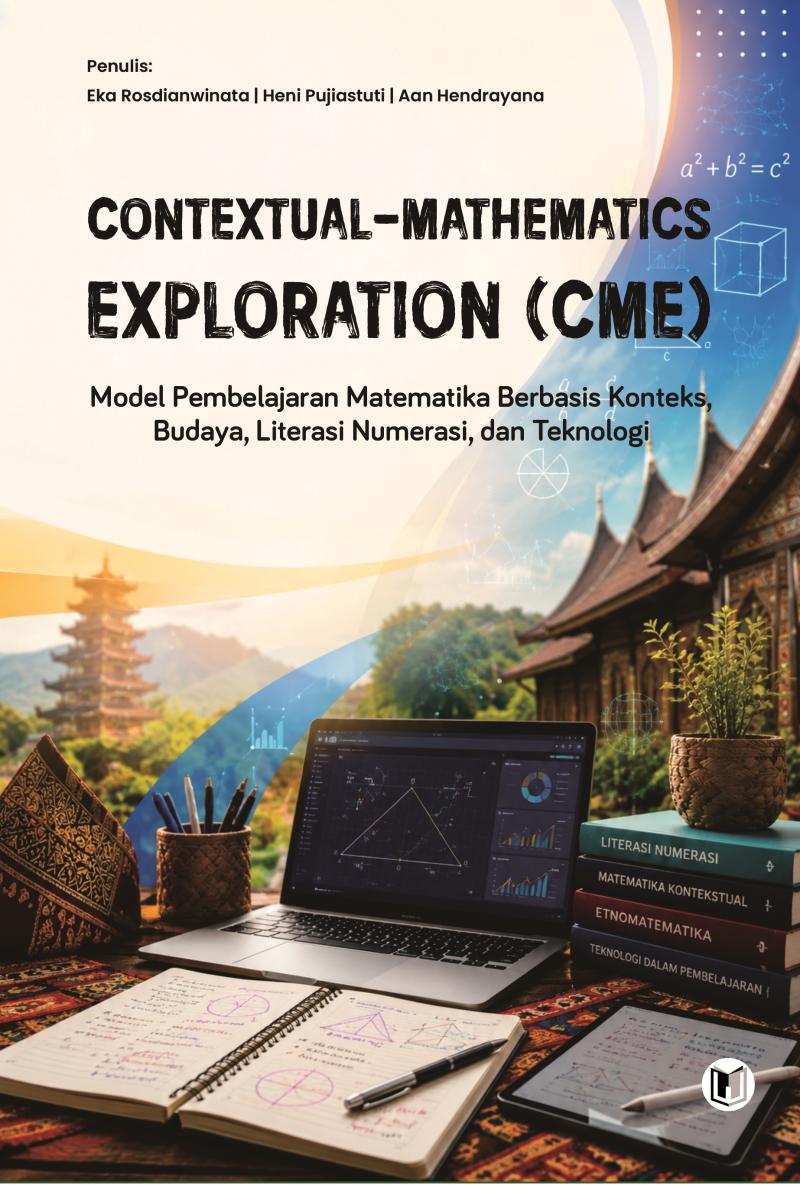
CONTEXTUAL-MATHEMATICS EXPLORATION (CME): MODEL PEMBELAJARAN MATEMATIKA BERBASIS KONTEKS, BUDAYA, LITERASI NUMERASI, DAN TEKNOLOGI
Keywords:
PENDIDIKANSynopsis
Matematika pada hakikatnya bukan sekadar kumpulan rumus, simbol, dan prosedur abstrak, melainkan aktivitas intelektual manusia yang tumbuh dari proses eksplorasi, penalaran, pemodelan, dan pemecahan masalah dalam kehidupan nyata. Oleh karena itu, pembelajaran matematika perlu direorientasikan menjadi pengalaman belajar yang mampu menghubungkan konsep formal dengan konteks kehidupan, budaya lokal, literasi numerasi, dan pemanfaatan teknologi secara bermakna.
Buku ini menawarkan model Contextual-Mathematics Exploration (CME) sebagai paradigma pedagogis multidimensional yang mengintegrasikan pendekatan kontekstual, Realistic Mathematics Education (RME), etnomatematika, literasi numerasi, serta teknologi digital dalam pembelajaran matematika.
Melalui model CME, peserta didik diposisikan bukan sebagai penerima informasi pasif, tetapi sebagai penjelajah matematis yang aktif membangun pengetahuan melalui observasi, eksplorasi budaya, investigasi numerasi, pemodelan matematis, refleksi kritis, dan eksplorasi teknologi. Model ini diharapkan mampu menghadirkan pembelajaran matematika yang lebih hidup, relevan, eksploratif, dan dekat dengan pengalaman sosial peserta didik.
Downloads
Download data is not yet available.
References
Abdullah, I. (2015). Konstruksi dan reproduksi kebudayaan. Pustaka Pelajar.
Adam, S. (2004). Using learning outcomes: A consideration of the nature, role, application and implications for European education of employing learning outcomes at the local, national and international levels. United Kingdom Bologna Seminar. https://www.hrk-nexus.de/fileadmin/redaktion/hrk-nexus/07-Downloads/07-03-Material/Using_Learning_Outcomes_Stephen_Adam_2004.pdf
Artigue, M. (2016). Inquiry-based mathematics education: From implementation to the sustainable embedding of a new paradigm. ZDM Mathematics Education, 48(4), 565–577.
Ashcraft, M. H., & Moore, A. M. (2009). Mathematics anxiety and the affective drop in mathematics performance. Journal of Psychoeducational Assessment, 27(3), 197–205. https://doi.org/10.1177/0734282908330580
Attard, C., & Holmes, K. (2020). An exploration of teacher and student perceptions of blended learning in four secondary mathematics classrooms. Mathematics Education Research Journal, 32(4), 719–740. https://doi.org/10.1007/s13394-020-00359-2
Bandura, A. (1997). Self-efficacy: The exercise of control. W. H. Freeman.
Barwell, R. (2013). The mathematics education of climate change: A critical numeracy perspective. Mathematics Education Research Journal, 25(1), 57–69.
Becker, J. P., & Shimada, S. (1997). The open-ended approach: A new direction for mathematics teaching. National Council of Teachers of Mathematics.
Berns, R. G., & Erickson, P. M. (2001). Contextual teaching and learning: Preparing students for the new economy. National Dissemination Center for Career and Technical Education.
Bishop, A. J. (1988). Mathematical enculturation: A cultural perspective on mathematics education. Kluwer Academic Publishers.
Black, P., & Wiliam, D. (2018). Classroom assessment and formative assessment. Assessment in Education: Principles, Policy & Practice, 25(6), 551–575. https://doi.org/10.1080/0969594X.2018.1441807
Boaler, J. (2016). Mathematical mindsets: Unleashing students’ potential through creative math, inspiring messages and innovative teaching. Jossey-Bass.
Brookhart, S. M. (2013). How to create and use rubrics for formative assessment and grading. ASCD.
Bruner, J. S. (1960). The process of education. Harvard University Press.
Bruner, J. S. (1966). Toward a theory of instruction. Harvard University Press.
Carraher, T. N., Carraher, D. W., & Schliemann, A. D. (1985). Mathematics in the streets and in schools. British Journal of Developmental Psychology, 3(1), 21–29. https://doi.org/10.1111/j.2044-835X.1985.tb00951.x
Creswell, J. W., & Creswell, J. D. (2018). Research design: Qualitative, quantitative, and mixed methods approaches (5th ed.). SAGE Publications.
D’Ambrosio, U. (2016). An overview of the history of ethnomathematics. In M. Rosa, U. D’Ambrosio, D. C. Orey, L. Shirley, & W. V. Alangui (Eds.), Current and future perspectives of ethnomathematics as a program (pp. 5–10). Springer.
Drijvers, P. (2019). Tools and technology in mathematics education. Springer.
Freudenthal, H. (1991). Revisiting mathematics education: China lectures. Kluwer Academic Publishers.
Freire, P. (2005). Pedagogy of the oppressed (30th anniversary ed.). Continuum. (Original work published 1970)
Gal, I. (2021). Understanding numeracy: A critical perspective. In D. O. Schmitt & J. FitzSimons (Eds.), Numeracy as social practice: Global and local perspectives (pp. 15–35). Springer.
Geiger, V., Forgasz, H., & Goos, M. (2015). A critical orientation to numeracy across the curriculum. ZDM Mathematics Education, 47(4), 611–624.
Goos, M., Geiger, V., & Dole, S. (2020). Teaching and learning mathematics with digital technologies. In S. Lerman (Ed.), Encyclopedia of mathematics education (2nd ed.). Springer.
Gravemeijer, K. (2020). Developing realistic mathematics education. Utrecht University.
Hendrayana, A. (2020). Pembelajaran matematika kontekstual dan pengembangan literasi numerasi peserta didik. FKIP Untirta Press.
Holmes, W., Bialik, M., & Fadel, C. (2022). Artificial intelligence in education: Promises and implications for teaching and learning. Center for Curriculum Redesign.
Johnson, E. B. (2002). Contextual teaching and learning: What it is and why it’s here to stay. Corwin Press.
Joyce, B., Weil, M., & Calhoun, E. (2015). Models of teaching (9th ed.). Pearson.
Kementerian Pendidikan, Kebudayaan, Riset, dan Teknologi. (2022). Panduan pembelajaran dan asesmen Kurikulum Merdeka. https://ypab.org/wp-content/uploads/2022/07/Panduan-Pembelajarn-dan-Asesmen1.pdf
Kilpatrick, J., Swafford, J., & Findell, B. (2001). Adding it up: Helping children learn mathematics. National Academy Press.
Koehler, M. J., & Mishra, P. (2006). Technological pedagogical content knowledge: A framework for teacher knowledge. Teachers College Record, 108(6), 1017–1054. https://doi.org/10.1111/j.1467-9620.2006.00684.x
Lesh, R., & Doerr, H. M. (2003). Beyond constructivism: Models and modeling perspectives on mathematics problem solving, learning, and teaching. Lawrence Erlbaum Associates.
National Council of Teachers of Mathematics. (2000). Principles and standards for school mathematics. NCTM.
Niess, M. L. (2018). Transforming teachers’ knowledge for teaching with technologies. IGI Global.
Niss, M., & Højgaard, T. (2019). Mathematical competencies revisited. Springer. https://doi.org/10.1007/978-3-030-14792-2
OECD. (2019). PISA 2018 assessment and analytical framework. OECD Publishing.
OECD. (2023). PISA 2022 assessment and analytical framework: Mathematics, reading, science and financial literacy. OECD Publishing. https://doi.org/10.1787/dfe0bf9c-en
Papert, S. (1980). Mindstorms: Children, computers, and powerful ideas. Basic Books.
Partnership for 21st Century Skills. (2019). Framework for 21st century learning. P21.
Pepin, B., Gueudet, G., & Trouche, L. (2022). Digital curriculum resources in mathematics education. Springer.
Piaget, J. (1970). Science of education and the psychology of the child. Orion Press.
Piaget, J. (1972). The psychology of the child. Basic Books.
Pólya, G. (1973). How to solve it: A new aspect of mathematical method (2nd ed.). Princeton University Press.
Pujiastuti, H. (2021). Etnomatematika dan inovasi pembelajaran matematika abad ke-21. Media Edukasi Indonesia.
Rosa, M., & Orey, D. C. (2021). Ethnomathematics and culturally relevant pedagogy. Springer.
Schoenfeld, A. H. (2016). Learning to think mathematically: Problem solving, metacognition, and sense making in mathematics. Journal of Education, 196(2), 1–38. https://doi.org/10.1177/002205741619600202
Shadiq, F. (2014). Pembelajaran matematika: Cara meningkatkan kemampuan berpikir peserta didik. Graha Ilmu.
Skemp, R. R. (1976). Relational understanding and instrumental understanding. Mathematics Teaching, 77, 20–26.
Skovsmose, O. (2020). Critical mathematics education. Springer. https://doi.org/10.1007/978-3-030-55144-6
Steen, L. A. (2001). Mathematics and democracy: The case for quantitative literacy. National Council on Education and the Disciplines.
Stiggins, R. J. (2005). From formative assessment to assessment for learning: A path to success in standards-based schools. Phi Delta Kappan, 87(4), 324–328. https://doi.org/10.1177/003172170508700414
Sullivan, P., Borcek, C., Walker, N., & Rennie, M. (2015). Exploring a structure for mathematics lessons that initiate learning by activating cognition on challenging tasks. Journal of Mathematics Teacher Education, 18(2), 159–170. https://doi.org/10.1007/s10857-014-9282-9
Van den Heuvel-Panhuizen, M. (2019). Realistic mathematics education and its role in mathematics education. Freudenthal Institute.
Van den Heuvel-Panhuizen, M., & Drijvers, P. (2020). Realistic mathematics education. In S. Lerman (Ed.), Encyclopedia of mathematics education (2nd ed.). Springer. https://doi.org/10.1007/978-3-030-15789-0_170
Vygotsky, L. S. (1978). Mind in society: The development of higher psychological processes. Harvard University Press.
Wiggins, G. (1998). Educative assessment: Designing assessments to inform and improve student performance. Jossey-Bass.
Yackel, E., & Cobb, P. (1996). Sociomathematical norms, argumentation, and autonomy in mathematics. Journal for Research in Mathematics Education, 27(4), 458–477. https://doi.org/10.2307/749877
Downloads
Published
July 16, 2026
Copyright (c) 2026 Eka Rosdianwinata, Heni Pujiastuti, Aan Hendrayana (Author)
License

This work is licensed under a Creative Commons Attribution-NonCommercial-ShareAlike 4.0 International License.
How to Cite
Rosdianwinata, E., Pujiastuti, H., & Hendrayana, A. (2026). CONTEXTUAL-MATHEMATICS EXPLORATION (CME): MODEL PEMBELAJARAN MATEMATIKA BERBASIS KONTEKS, BUDAYA, LITERASI NUMERASI, DAN TEKNOLOGI. Widina Media Utama. https://doi.org/10.59818/rdhtej69