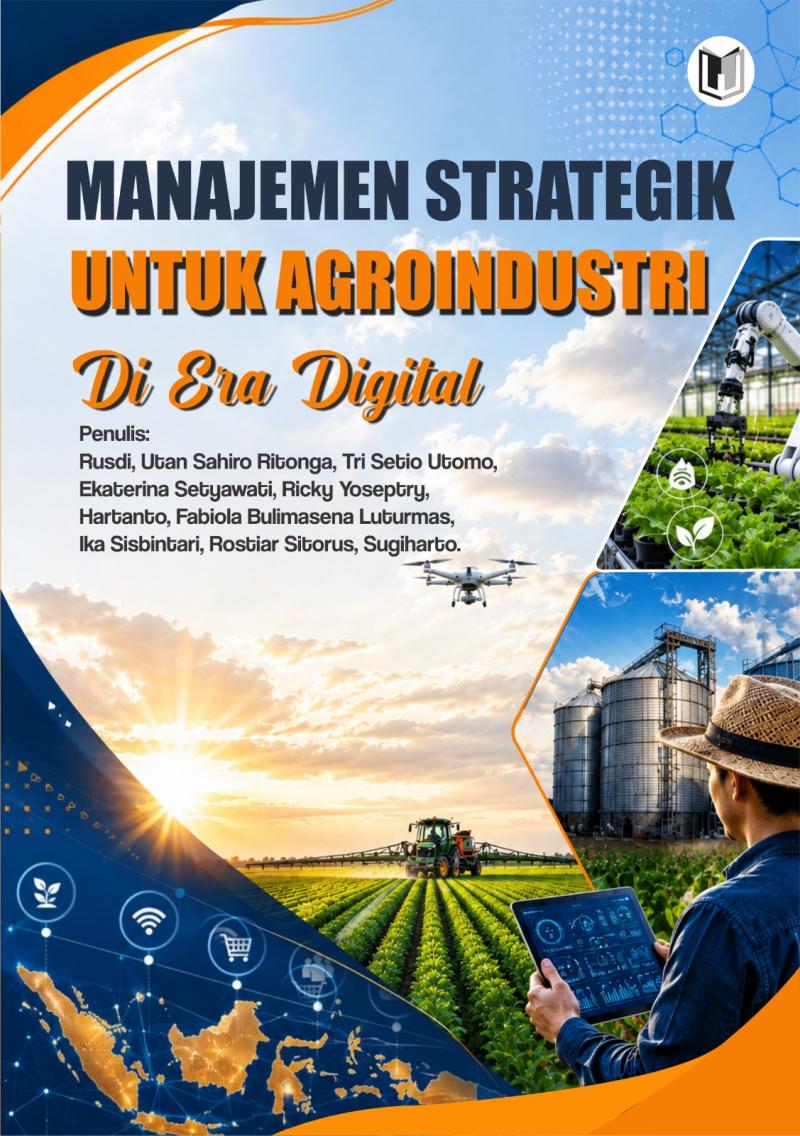
MANAJEMEN STRATEGIK UNTUK AGROINDUSTRI DI ERA DIGITAL
Keywords:
Manajemen, Agroindustri, DigitalSynopsis
Buku Manajemen Strategik untuk Agroindustri di Era Digital disusun sebagai referensi yang membahas penerapan manajemen strategik dalam pengembangan agroindustri modern di tengah pesatnya transformasi digital. Buku ini menghadirkan pemahaman mengenai konsep dasar manajemen strategik, ruang lingkup agroindustri, serta pentingnya strategi dalam meningkatkan daya saing industri berbasis pertanian. Pembahasan diawali dengan analisis lingkungan bisnis agroindustri, baik internal maupun eksternal, yang dipengaruhi oleh perubahan pasar global dan perkembangan teknologi digital.
Selanjutnya, buku ini menguraikan proses perencanaan strategik yang meliputi penyusunan visi dan misi perusahaan, penetapan tujuan strategik, hingga pengambilan keputusan yang tepat dalam pengelolaan usaha agroindustri. Transformasi digital menjadi fokus penting dalam buku ini melalui pembahasan digitalisasi proses produksi, pemanfaatan teknologi informasi, serta dampaknya terhadap efisiensi dan produktivitas industri. Selain itu, manajemen produksi, pengendalian kualitas, dan pengelolaan rantai pasok juga dibahas sebagai bagian penting dalam menciptakan sistem agroindustri yang efektif dan berkelanjutan.
Dalam aspek pemasaran dan sumber daya manusia, buku ini menjelaskan strategi pemasaran digital, pemanfaatan media sosial, branding produk, serta pengembangan kompetensi SDM di era digital. Pembaca juga diajak memahami pentingnya inovasi dan kewirausahaan berbasis teknologi sebagai upaya menciptakan peluang bisnis baru dalam sektor agroindustri. Pembahasan mengenai keuangan, investasi, serta pengelolaan risiko turut memberikan wawasan praktis dalam mendukung keberlangsungan usaha agroindustri modern.
Pada bagian akhir, buku ini menyoroti konsep keberlanjutan agroindustri dan masa depan agroindustri digital melalui penerapan smart agroindustry, efisiensi energi, serta tanggung jawab sosial perusahaan. Dengan pendekatan yang sistematis dan kontekstual, buku ini diharapkan dapat menjadi sumber pembelajaran bagi mahasiswa, akademisi, praktisi, maupun pelaku usaha agroindustri dalam menghadapi tantangan dan memanfaatkan peluang di era digital secara strategis dan inovatif.
Downloads
Download data is not yet available.
References
Arifudin, O. (2021). Manajemen strategik teori dan implementasi.
Fauzi, M. (2015). Manajemen Strategik. Semarang: Karya Abadi Jaya.
Jahrizal, D. N. S., Khonsa, H. D., Jovanka, A. D., Permana, R., Ramadhan, M. N., Purba, M. B., & Idham, S. S. (2026). Konsep Dasar Dan Sistem Agroindustri. Penerbit Kbm Indonesia.
Maulidah, S., & Sahro, H. (2023). Manajemen Strategis Agribisnis. Universitas Brawijaya Press.
Melly, S., Ernita, Y., Annisa, A., Marni, Y., Komala, R., Hendrita, V., ... & Jarlis, R. (2025). Manajemen Rantai Pasok Agroindustri. Yayasan Tri Edukasi Ilmiah.
Nasir, M. (2024). Manajemen Strategik. STAIHA Press.
Saleh, L., Syarbiah, S., Junus, M., Sukratman, I. M., & Amartani, K. (2025). Buku Referensi Pengantar Agroindustri: Konsep, Sistem, Dan Implementasi. Pt. Sonpedia Publishing Indonesia.
Sholikhah, V. (2021). Manajemen Strategi Ekonomi Agribisnis Dalam Konteks Ilmu Ekonomi Mikro. Lan Tabur: Jurnal Ekonomi Syariah, 2(2), 113-129.
Wahyudi, S. E., Sopi, S. E., Jefri Heridiansyah, S. E., SE, M., & Ukie Tukinah, S. H. (1996). Manajemen strategis. Penerbit Adab.
Waluyo, I. T. (2024). Teori Dan Strategi Manajemen Agribisnis. Mega Press Nusantara.
Yunus, M., Ibrahim, M., Musnadi, S., Buchari, A. M., Maihani, S., Syauqi, T. M., ... & Sawitri, R. (2024). Manajemen strategi. Deepublish.
Ahi, P., & Searcy, C. (2013). A comparative literature analysis of de fi nitions for green and sustainable supply chain management. Journal of Cleaner Production, 52, 329–341. https://doi.org/10.1016/j.jclepro.2013.02.018
Barney, J. (1991). Firm resources and Sustained Competitive Adventage. Journal of Management, 17(1), 99–120. https://doi.org/https://doi.org/10.1177/014920639101700108
Bharadwaj, A., Sawy, O. A. El, Pavlou, P. A., & Venkatraman, N. (2013). Digital Business Strategy: Toward A Next Generation of Insights. MIS Quarterly, 37(2), 471–482.
FAO. (2024). The State of Food and Agriculture 2024 – Value-driven transformation of agrifood systems. https://doi.org/https://doi.org/10.4060/cd2616en The
Gereffi, G., Humphrey, J., & Sturgeon, T. (2005). The governance of global value chains. Review of International Political Economy, 12(1), 78–104. https://doi.org/10.1080/09692290500049805
Grant, R. M. (1991). The Resource-Based Theory of Competitive Advantage: Implications for Strategy Formulation. California Management Review, 33(3), 114–135. https://doi.org/https://doi.org/10.2307/41166664
Ivanov, D., & Dolgui, A. (2020). Viability of intertwined supply networks : extending the supply chain resilience angles towards survivability. A position paper motivated by COVID-19 outbreak. International Journal of Production Research, 58(10), 1–12. https://doi.org/10.1080/00207543.2020.1750727
Klerkx, L., Jakku, E., & Labarthe, P. (2019). A review of social science on digital agriculture , smart farming and agriculture 4.0: New contributions and a future research agenda. NJAS - Wageningen Journal of Life Sciences, 90–91(1), 1–16. https://doi.org/10.1016/j.njas.2019.100315
Klerkx, L., & Rose, D. (2020). Dealing with the game-changing technologies of Agriculture 4.0: How do we manage diversity and responsibility in food system transition pathways? Global Food Security, 24(March), 100347. https://doi.org/10.1016/j.gfs.2019.100347
Kotler, P., & Keller, K. L. (2016). Marketing management (15th ed.). Pearson Education.
Nambisan, S., Lyytinen, K., Majchrzak, A., & Song, M. (2017). Digital innovation management: reinventing innovation management research in a digital world. MIS Quarterly, 41(1), 223–238. https://doi.org/https://doi.org/10.25300/MISQ/2017/41:1.03
Noe, R. A. (2010). Employee Training and Development (5th ed.). McGraw-Hill Education.
OECD, & FAO. (2025). OECD‑FAO Agricultural Outlook 2025‑2034. https://doi.org/https://doi.org/10.1787/601276cd-en
Reardon, T., Barrett, C. B., Berdegue, J. A., & Swinnen, J. F. M. (2009). Agrifood Industry Transformation and Small Farmers in Developing Countries. World Development, 37(11), 1717–1727. https://doi.org/10.1016/j.worlddev.2008.08.023
Reardon, T., & Timmer, C. P. (2012). The Economics of the Food System Revolution. The Annual Review of Resource Economics Is, 4, 225–264. https://doi.org/10.1146/annurev.resource.050708.144147
Teece, D. J., Pisano, G., & Shuen, A. (1997). Dynamic capabilities and strategic management. Strategic Management Journal, 18(7), 509–533. https://doi.org/https://doi.org/10.1002/(SICI)1097-0266(199708)18:7%3C509::AID-SMJ882%3E3.0.CO;2-Z
Trienekens, J. H. (2011). Agricultural Value Chains in Developing Countries A Framework for Analysis. International Food and Agribusiness Management Review, 14(2), 51–82.
Vorst, J. G. A. J. van der, Silva, C. A. da, & Trienekens, J. H. (2007). Agro-industrial supply chain management: concepts and applications. Agricultural Management, Marketing and Finance Occasional Paper, No. 17(FAO).
Wernerfelt, B. (1984). A Resource-based View of the Firm. Strategic Management Journal, 5(2), 171–180. https://doi.org/https://doi.org/10.1002/smj.4250050207
Wolfert, S., Ge, L., Verdouw, C., & Bogaardt, M. (2017). Big Data in Smart Farming – A review. Agricultural Systems, 153, 69–80. https://doi.org/10.1016/j.agsy.2017.01.023
Astra Agro Lestari. (2025). Performing & transforming sustainability: Sustainability report 2025 [Laporan keberlanjutan]. https://www.astra-agro.co.id/wp-content/uploads/2026/03/
Astra Agro Lestari. (2025). Performing & transforming sustainability: Annual report 2025 [Laporan tahunan]. https://www.astra-agro.co.id/wp-content/uploads/2026/03/AR-2025-AALI-web.pdf
Badan Perencanaan Pembangunan Nasional (BAPPENAS). (2025). Rencana Pembangunan Jangka Menengah Nasional (RPJMN) 2025–2029. https://perpustakaan.bappenas.go.id/e-library/file_upload/koleksi/dokumenbappenas/konten/Dokumen%202025/Konten/%7BDigital%7D%20Ringkasan%20RPJMN%20Tahun%202025-2029.pdf
Balai Besar Penerapan Modernisasi Pertanian. (2024). Kalender tanam terpadu (KATAM Terpadu-SC). Kementerian Pertanian Republik Indonesia. https://jatim.brmp.pertanian.go.id/layanan/layanan-lainnya/kalender-tanam-terpadu/
Barney, J. B., & Hesterly, W. S. (2021). Strategic management and competitive advantage: Concepts and cases (6th ed.). Pearson. https://www.pearson.com/en-us/subject-catalog/p/strategic-management-and-competitive-advantage-concepts-and-cases/P200000005821/9780136878674?srsltid=AfmBOorfO2db_FhYL-QIfYAoJmB5QV0vvQtpjcEdGZ5Kx-7_8hnfyyuB
Collins, J. C., & Porras, J. I. (1994). Built to last: Successful habits of visionary companies. HarperBusiness. https://www.academia.edu/32646559/Built_to_Last_J_Collins
David, F. R., & David, F. R. (2021). Strategic management: A competitive advantage approach, concepts and cases (17th ed.). Pearson. https://www.pearson.com/en-us/subject-catalog/p/strategic-management-a-competitive-advantage-approach-concepts-and-cases/P200000005870/9780135637142?srsltid=AfmBOorefGKTqecOsPN7FTjL-wuy0P_7XGBD44gH1HblkH9ZDlzMjOfV
Doran, G. T. (1981). There’s a S.M.A.R.T. way to write management’s goals and objectives. Management Review, 70(11), 35–36. https://www.eval.fr/wp-content/uploads/2020/01/S.M.A.R.T-Way-Management-Review-eval.fr_.pdf
Drucker, P. F. (2008). Management: Tasks, responsibilities, practices. HarperBusiness. (Original work published 1973). https://www.academia.edu/2133258/Management_Tasks_responsibilities_practices
European Commission. (2023). EU regulation on deforestation-free products (EUDR). https://erwaysolutions.com/?gad_source=1&gad_campaignid=23776752716&gbraid=0AAAABB8O94D0LxXakhMiNXAekMudU3gD5&gclid=Cj0KCQjw_vnQBhCxARIsADcZyxKc1pYXkGv2SvO1v4btrWa86lsUbhioh6OMjqe3zYTdA6dHWaQvXJoaAmHFEALw_wcB
Firzandiniari. (2024, November 12). Tanihub: Revolusi agribisnis dengan teknologi dan circular economy. MarkPlus Institute. https://markplusinstitute.com/explore/tanihub-merevolusi-agribisnis-dengan-teknologi-dan-circular-economy/
Food and Agriculture Organization (FAO). (2023). The state of food and agriculture 2023. https://openknowledge.fao.org/items/1516eb79-8b43-400e-b3cb-130fd70853b0
Freeman, R. E. (2010). Strategic management: A stakeholder approach. Cambridge University Press. https://www.cambridge.org/core/books/strategic-management/7277C2F6B0A5C1C3B6A1C5E62E1E7B60
Hunger, J. D., & Wheelen, T. L. (2015). Strategic management and business policy: Globalization, innovation, and sustainability (14th ed.). Pearson. https://studentebookhub.com/wp-content/uploads/2024/preview/9781292215488.pdf
Krisandini, K. (2025, May 22). Hemat waktu saat input data budi daya dengan fitur catat pintar JALA App. JALA Tech. https://jala.tech/id/blog/update-produk/fitur-catat-pintar-jala-app/
Kaplan, R. S., & Norton, D. P. (1992). The balanced scorecard—Measures that drive performance. Harvard Business Review, 70(1), 71–79. https://hbr.org/1992/01/the-balanced-scorecard-measures-that-drive-performance-2
Lindblom, C. E. (1959). The science of “muddling through.” Public Administration Review, 19(2), 79–88. https://www.jstor.org/stable/973677
Perum BULOG. (2024, June 20). Perum BULOG menjamin dan memastikan rantai pasok beras untuk mewujudkan ketahanan pangan. https://bulog.co.id/2024/06/20/perum-bulog-menjamin-dan-memastikan-rantai-pasok-beras-untuk-mewujudkan-ketahanan-pangan/
Porter, M. E. (1980). Competitive strategy: Techniques for analyzing industries and competitors. Free Press. https://books.google.co.id/books/about/Competitive_Strategy.html?hl=id&id=5xxHAAAAMAAJ&redir_esc=y
Porter, M. E., & Heppelmann, J. E. (2014). How smart, connected products are transforming competition. Harvard Business Review, 92(11), 64–88. https://hbr.org/2014/11/how-smart-connected-products-are-transforming-competition
Seputar Publik. (2026, April 14). PTPN I percepat transformasi, fokus digitalisasi dan hilirisasi menuju global champion 2036 [Tangkapan layar artikel berita]. https://seputarpublik.com/ptpn-i-percepat-transformasi-fokus-digitalisasi-dan-hilirisasi-menuju-global-champion-2036/
Thompson, A. A., Peteraf, M. A., Gamble, J. E., & Strickland, A. J. (2020). Crafting and executing strategy: The quest for competitive advantage: Concepts and cases (23rd ed.). McGraw-Hill Education. https://books.google.co.id/books?id=7MovEAAAQBAJ&printsec=copyright&hl=id#v=onepage&q&f=false
United Nations Development Programme (UNDP) Indonesia. (2023). Sustainable Development Goals in Indonesia. https://www.undp.org/indonesia/publications/undp-indonesia-2023-annual-report
Voice of Asia. (2026, April 13). Holding Perkebunan Nusantara akselerasi transformasi, PTPN I fokus digitalisasi dan hilirisasi. https://voiceofasean.com/newsroom/holding-perkebunan-nusantara-akselerasi-transformasi-ptpn-i-fokus-digitalisasi-dan-hilirisasi/
Wheelen, T. L., Hunger, J. D., Hoffman, A. N., & Bamford, C. E. (2018). Strategic management and business policy: Globalization, innovation, and sustainability (15th ed.). Pearson. https://books.google.co.id/books/about/Strategic_Management_and_Business_Policy.html?hl=id&id=buerswEACAAJ&redir_esc=y
Wilmar International. (2025). Stakeholder engagement. https://www.wilmar-international.com/sustainability/policies/stakeholder-engagement
Braun, A. T., Colangelo, E., & Steckel, T. (2018). Farming in the era of Industrie 4.0. Procedia CIRP, 72, 979–984. https://www.sciencedirect.com/science/article/pii/S2212827118303342?via%3Dihub
Balafoutis, A. T., Beck, B., Fountas, S., Tsiropoulos, Z., Vangeyte, J., van der Wal, T., ... & Eory, V. (2017). Precision agriculture technologies positively contributing to GHG emissions mitigation, farm productivity and economics. Sustainability, 9(8), 1339.
https://www.mdpi.com/2071-1050/9/8/1339
Budiawati, Y. (2025). Smart agriculture vs pertanian konvensional: Tantangan dan peluang. Jurnal Agri Wiralodra, 17(1), 27–40. https://www.researchgate.net/publication/380487846_Agricultural_40_Leveraging_on_Technological_Solutions_Study_for_Smart_Farming_Sector
Eastwood, C., Klerkx, L., Ayre, M., & Dela Rue, B. (2017). Managing socio-ethical challenges in the development of smart farming. NJAS: Wageningen Journal of Life Sciences, 90–91, 100289.
Food and Agriculture Organization. (2022). Digital agriculture and artificial intelligence innovation. FAO.
https://www.fao.org/innovation/digital-agriculture-and-ai-innovation/en
Food and Agriculture Organization. (2017). Information and communication technology (ICT) in agriculture. FAO E-Agriculture.
Food and Agriculture Organization. (2019). Digital technologies in agriculture and rural areas. Rome: FAO. https://openknowledge.fao.org/items/ba78b670-0947-4e73-ad10-091009c0dfc3
Gyamfi, E. K., ElSayed, Z., Kropczynski, J., Yakubu, M. A., & Elsayed, N. (2024). Agricultural 4.0 Leveraging on Technological Solutions: Study for Smart Farming Sector. arXiv. https://www.researchgate.net/publication/380487846_Agricultural_40_Leveraging_on_Technological_Solutions_Study_for_Smart_Farming_Sector
International Labour Organization. (2020). The future of work in the digital economy. ILO.
https://www.ilo.org/media/391191/download
Javaid, M., Haleem, A., Singh, R. P., Suman, R., & Rab, S. (2022). Significance of machine learning in healthcare: Features, pillars and applications. International Journal of Intelligent Networks, 3, 58–73.
https://www.sciencedirect.com/science/article/pii/S2666603022000069?via%3Dihub
Kamilaris, A., Kartakoullis, A., & Prenafeta-Boldú, F. X. (2017). A review on the practice of big data analysis in agriculture. Computers and Electronics in Agriculture, 143, 23–37.
https://www.sciencedirect.com/science/article/abs/pii/S0168169917301230?via%3Dihub
Klerkx, L., Jakku, E., & Labarthe, P. (2021). A review of social science on digital agriculture, smart farming and agriculture 4.0. NJAS: Wageningen Journal of Life Sciences, 90–91, 10031
https://www.tandfonline.com/doi/full/10.1016/j.njas.2019.100315
Liakos, K. G., Busato, P., Moshou, D., Pearson, S., & Bochtis, D. (2021). Machine learning in agriculture: A review. Sensors, 18(8), 2674.
https://www.mdpi.com/1424-8220/18/8/2674
Lowenberg-DeBoer, J., & Erickson, B. (2021). Setting the record straight on precision agriculture adoption. Agronomy Journal, 111(4), 1552–1569.
https://acsess.onlinelibrary.wiley.com/doi/full/10.2134/agronj2018.12.0779
McKinsey & Company. (2024). From bytes to bushels: How generative AI can shape the future of agriculture. McKinsey Insights.
McKinsey & Company. (2024). Global farmer insights 2024. McKinsey & Company.
https://www.mckinsey.com/industries/agriculture/our-insights/global-farmer-insights-2024
Mangurai, S. U. N., Octaviani, E. A., Anidah, Solikhin, A., Darmawan, R. D., Putri, L. S., Al-Faritsi, M. F., & Kurniawan, T. (2024). Digitalization in Indonesia’s agrifood sector in the wake of the COVID-19 pandemic. Asian Journal of Agriculture and Development, 21(1), 93–120.
https://doi.org/10.37801/ajad2024.21.1.6
Omnivore, Beanstalk AgTech, & Briter. (2026). The opportunity for AgriTech investment in Southeast and South Asia. Beanstalk AgTech & Briter. https://www.beanstalkagtech.com/reports-and-publications
Organisation for Economic Co-operation and Development. (2022). The Digitalisation Of Agriculture. OECD.
https://www.oecd.org/en/publications/the-digitalisation-of-agriculture_285cc27d-en.html
Pei, W., & Pei, W. (2025). Digital rural development, green agricultural transformation, and digital inclusive finance. Finance Research Letters, 86(Part G), 108879. https://doi.org/10.1016/j.frl.2025.108879
Rachmawati, R. R. (2021). Smart farming 4.0 untuk mewujudkan pertanian Indonesia modern. Forum penelitian Agro Ekonomi 38(2):137. https://www.researchgate.net/publication/357350440_SMART_FARMING_40_UNTUK_MEWUJUDKAN_PERTANIAN_INDONESIA_MAJU_MANDIRI_DAN_MODERN
Rijswijk, K., Klerkx, L., Bacco, M., Bartolini, F., Bulten, E., Debruyne, L., ... & Brunori, G. (2021). Digital transformation of agriculture and rural areas. Wageningen University & Research.
https://www.sciencedirect.com/science/article/pii/S074301672100125X?via%3Dihub
Rose, D. C., Wheeler, R., Winter, M., Lobley, M., & Chivers, C. A. (2021). Agriculture 4.0: Making it work for people, production, and the planet. Land Use Policy, 100, 104933.
https://www.sciencedirect.com/science/article/abs/pii/S0264837719319489?via%3Dihub
Sharma, R., Kamble, S. S., Gunasekaran, A., Kumar, V., & Kumar, A. (2022). A systematic literature review on machine learning applications for sustainable agriculture supply chain performance. Computers & Operations Research, 119, 104926.
https://doi.org/10.1016/j.cor.2020.104926
Spanaki, K., Sivarajah, U., Fakhimi, M., Despoudi, S., & Irani, Z. (2022). Disruptive technologies in agricultural operations: A systematic review of AI-driven AgriTech research. Annals of Operations Research.
https://link.springer.com/article/10.1007/s10479-020-03922-z
United Nations Conference on Trade and Development. (2021). Digital Economy Report 2021. UNCTAD.
https://unctad.org/system/files/official-document/der2021_en.pdf
Verdouw, C. N., Wolfert, J., Beulens, A. J. M., & Rialland, A. (2021). Virtualization of food supply chains with the internet of things. Journal of Food Engineering, 176, 128–136.
https://www.sciencedirect.com/science/article/pii/S026087741530056X?via%3Dihub
Wolfert, S., Ge, L., Verdouw, C., & Bogaardt, M. J. (2021). Big data in smart farming: A review. Agricultural Systems, 153, 69–80.
https://www.sciencedirect.com/science/article/pii/S0308521X16303754
World Bank. (2020). Indonesia Agro-Value Chain Assessment: Issues and Options in Promoting Digital Agriculture. Washington DC: World Bank.
World Bank. (2022). Future of food: Harnessing digital technologies to improve food system outcomes. World Bank Group.
https://openknowledge.worldbank.org/entities/publication/52f37cc3-66c3-5fd0-aa51-85a5823c64f7
World Bank. (2023). Indonesia agro-value chain assessment. World Bank Group.
https://openknowledge.worldbank.org/entities/publication/d024937a-b01d-5f9a-a549-35137166ed59
World Economic Forum. (2026). How AI is enabling agricultural intelligence and revolutionizing farming.
https://www.weforum.org/stories/2026/01/ai-agricultural-intelligence-revolutionize-farming/
Yadav, G., Luthra, S., Huisingh, D., Mangla, S. K., Narkhede, B. E., & Liu, Y. (2023). Development of a sustainable smart agriculture framework using Internet of Things and artificial intelligence. Journal of Cleaner Production, 388, 135978.
https://www.sciencedirect.com/science/article/pii/S0959652622045678
Zhai, Z., Martínez, J. F., Beltran, V., & Martínez, N. L. (2021). Decision support systems for agriculture 4.0: Survey and challenges. Computers and Electronics in Agriculture, 170, 105256.
https://www.sciencedirect.com/science/article/pii/S0168169919316497?via%3Dihub
Zhong, R., Xu, X., Klotz, E., & Newman, S. T. (2021). Intelligent manufacturing in the context of Industry 4.0: A review. Engineering, 3(5), 616–630.
https://www.engineering.org.cn/engi/EN/10.1016/J.ENG.2017.05.015
Atzori, L., Iera, A., & Morabito, G. (2017). Understanding the Internet of Things: Definition, potentials, and societal role. Computer Networks, 56(15), 2787–2805.
Christopher, M. (2022). Logistics and supply chain management (6th ed.). Pearson.
Codex Alimentarius Commission. (2022). Principles and guidelines for the application of HACCP. FAO/WHO.
FAO. (2023). The state of food and agriculture 2023. Food and Agriculture Organization of the United Nations.
Fellows, P. J. (2017). Food processing technology: Principles and practice (4th ed.). Woodhead Publishing.
Food and Agriculture Organization. (2023). The state of food and agriculture 2023. FAO.
Groover, M. P. (2020). Automation, production systems, and computer-integrated manufacturing (5th ed.). Pearson.
Heizer, J., Render, B., & Munson, C. (2023). Operations management: Sustainability and supply chain management (15th ed.). Pearson.
International Organization for Standardization. (2015). ISO 9001:2015 Quality management systems—Requirements. ISO.
Kementerian Perindustrian Republik Indonesia. (2024). Laporan kinerja sektor agroindustri Indonesia 2024. Kementerian Perindustrian RI.
Kotler, P., Keller, K. L., & Chernev, A. (2022). Marketing management (16th ed.). Pearson.
Kusiak, A. (2018). Smart manufacturing. International Journal of Production Research, 56(1–2), 508–517.
Marr, B. (2021). Big data in practice: How 45 successful companies used big data analytics to deliver extraordinary results (2nd ed.). Wiley.
Montgomery, D. C. (2020). Introduction to statistical quality control (8th ed.). Wiley.
Russell, S., & Norvig, P. (2021). Artificial intelligence: A modern approach (4th ed.). Pearson.
Schwab, K. (2017). The fourth industrial revolution. Crown Business.
Singh, R. P., & Heldman, D. R. (2019). Introduction to food engineering (6th ed.). Academic Press.
Slack, N., Brandon-Jones, A., & Burgess, N. (2022). Operations and process management: Principles and practice for strategic impact (7th ed.). Pearson.
Stone, H., Bleibaum, R., & Thomas, H. A. (2020). Sensory evaluation practices (5th ed.). Academic Press.
United Nations Industrial Development Organization. (2023). Industrial development report 2023. UNIDO.
United Nations. (2024). World population prospects 2024. United Nations Department of Economic and Social Affairs.
Womack, J. P., & Jones, D. T. (2003). Lean thinking: Banish waste and create wealth in your corporation (2nd ed.). Free Press.
World Economic Forum. (2023). Shaping the future of advanced manufacturing and value chains. World Economic Forum.
World Health Organization. (2022). Food safety: Key facts and global challenges. WHO.
Atmosudirdjo, Prajudi. (1995). Hukum Administrasi Negara (Edisi Revisi). Jakarta: Ghalia Indonesia. ISBN 979450047X.
Caiden, G. E. (1969). Administrative reform. Chicago, IL: Aldine Publishing Company.
David Osborne, & Ted Gaebler. (1996). Mewirausahakan Birokrasi (Reinventing Government). Jakarta: Pustaka Binaman Pressindo.
Jan Kooiman. (2008). Governance and Governability. Dalam Stephen P. Osborne (Ed.), The New Public Governance? London: Routledge.
Dwiyanto, Agus. (2012). Reformasi Tata Pemerintahan dan Otonomi Daerah. Yogyakarta: Gadjah Mada University Press.
Kotler, P. (2016). Marketing management (15th ed.). Pearson Education.
Lembaga Administrasi Negara. (2020). Reformasi birokrasi dalam perspektif administrasi publik. Jakarta: LAN RI.
Lembaga Administrasi Negara. (2020). Reformasi birokrasi dalam perspektif administrasi publik. Jakarta: LAN RI.
Mardiasmo. (2018). Akuntansi sektor publik. Yogyakarta: Andi Offset.
Max Weber. (1968). Bureaucracy. Dalam H. H. Gerth & C. Wright Mills (Ed.), From Max Weber: Essays in Sociology. New York: Oxford University Press.
Moenir, A. S. (2010). Manajemen pelayanan umum di Indonesia. Jakarta: Bumi Aksara.
Peraturan Presiden Nomor 81 Tahun 2010 tentang Grand Design Reformasi Birokrasi 2010–2025. (2010). Jakarta: Pemerintah Republik Indonesia.
Ratminto, & Atik Septi Winarsih. (2007). Pelayanan Prima: Pedoman Penerapan Momen Kritis Pelayanan dari A sampai Z. Yogyakarta: Pustaka Pelajar.
Sedarmayanti. (2018). Reformasi administrasi publik, reformasi birokrasi, dan kepemimpinan masa depan. Bandung: Refika Aditama.
Siagian, S. P. (2020). Filsafat Administrasi (Edisi revisi). Jakarta: Bumi Aksara.
Sinambela, L. P. (2019). Reformasi pelayanan publik: Teori, kebijakan, dan implementasi. Jakarta: Bumi Aksara.
Syafiie, I. K. (2013). Ilmu pemerintahan. Jakarta: Bumi Aksara.
The Liang Gie. (2009). Administrasi perkantoran modern. Yogyakarta: Liberty.
Thoha, M. (2014). Birokrasi dan politik di Indonesia. Jakarta: Rajawali Pers.
Waldo, D. (2023). The Study of Public Administration. Legare Street Press.
Weber, M. (1978). Economy and society: An outline of interpretive sociology. Berkeley, CA: University of California Press.
White, L. D. (1955). Introduction to the study of public administration (4th ed.). New York, NY: Macmillan.
World Bank. (2020). Worldwide Governance Indicators. Washington, D.C.: The World Bank.
United Nations Development Programme. (1997). Governance for sustainable human development. New York, NY: UNDP.
Zeithaml, V. A., Parasuraman, A., & Berry, L. L. (1990). Delivering quality service: Balancing customer perceptions and expectations. New York, NY: The Free Press.
Badan Pusat Statistik. (2023). Statistik Indonesia 2023. BPS-Statistics Indonesia.
Badan Riset dan Inovasi Nasional. (2023). Laporan kinerja inovasi agroindustri Indonesia 2023. BRIN.
Bank Indonesia. (2023). Laporan perekonomian Indonesia: Digitalisasi sektor pertanian. Bank Indonesia.
Blank, S., & Dorf, B. (2020). The startup owner's manual: The step-by-step guide for building a great company (2nd ed.). Wiley.
Brown, T. (2019). Change by design: How design thinking transforms organizations and inspires innovation (Revised ed.). HarperBusiness.
Chesbrough, H. (2020). Open innovation results: Going beyond the hype and getting down to business. Oxford University Press.
Christensen, C. M. (2019). The innovator's dilemma: When new technologies cause great firms to fail (Reprint ed.). Harvard Business Review Press.
Cooper, R. G. (2019). Winning at new products: Creating value through innovation (5th ed.). Basic Books.
Drucker, P. F. (2019). Innovation and entrepreneurship: Practice and principles (Reissue ed.). HarperBusiness.
Ellen MacArthur Foundation. (2021). The circular economy: A transformative strategy for agri-food systems. Ellen MacArthur Foundation.
FAO. (2022). The state of food and agriculture 2022: Leveraging automation in agriculture. Food and Agriculture Organization of the United Nations.
Fountas, S., Espejo-Garcia, B., Kasimati, A., Mylonas, N., & Darra, N. (2020). The future of digital agriculture: Technologies and opportunities. IT Professional, 22(1), 24–28. https://doi.org/10.1109/MITP.2019.2963412
Gompers, P., & Lerner, J. (2020). The venture capital cycle (2nd ed.). MIT Press.
Hamel, G., & Prahalad, C. K. (2019). Competing for the future. Harvard Business Review Press.
Kementerian Komunikasi dan Informatika RI. (2022). Survei indeks literasi digital nasional 2022. Kemenkominfo.
Kementerian Komunikasi dan Informatika RI. (2023). Peta jalan ekonomi digital Indonesia 2021–2030. Kemenkominfo.
Kementerian Pertanian RI. (2022). Rencana strategis Kementerian Pertanian 2020–2024 (Revisi). Kementerian Pertanian RI.
Kementerian Pertanian RI. (2023). Laporan tahunan Kementerian Pertanian 2023: Transformasi digital pertanian. Kementerian Pertanian RI.
Kotler, P., & Keller, K. L. (2022). Marketing management (16th ed.). Pearson Education.
Lundvall, B.-Å. (2016). The learning economy and the economics of hope. Anthem Press.
McKinsey Global Institute. (2022). Southeast Asia's decade: The economic outlook for the ASEAN region. McKinsey & Company.
Moore, J. F. (2018). Predators and prey: A new ecology of competition. Harvard Business Review, 71(3), 75–86.
OECD. (2018). Oslo manual 2018: Guidelines for collecting, reporting and using data on innovation (4th ed.). OECD Publishing. https://doi.org/10.1787/9789264304604-en
Osterwalder, A., & Pigneur, Y. (2020). Business model generation: A handbook for visionaries, game changers, and challengers (2nd ed.). Wiley.
Otoritas Jasa Keuangan. (2023). Survei nasional literasi dan inklusi keuangan 2022. OJK.
Porter, M. E. (2020). Competitive strategy: Techniques for analyzing industries and competitors (Reissue ed.). Free Press.
Prahalad, C. K., & Hammond, A. (2020). Serving the world's poor, profitably. Harvard Business Review, 80(9), 4–11.
Romer, P. M. (2018). Endogenous technological change. Journal of Political Economy, 98(5, Part 2), S71–S102. https://doi.org/10.1086/261725
Schwab, K. (2019). The fourth industrial revolution. Currency.
Suryana. (2020). Kewirausahaan: Kiat dan proses menuju sukses (5th ed.). Salemba Empat.
Tidd, J., & Bessant, J. R. (2021). Managing innovation: Integrating technological, market and organizational change (7th ed.). Wiley.
Alamoush, A. S., Ölçer, A. I., & Ballini, F. (2022). Ports’ role in shipping decarbonisation: A common port incentive scheme for shipping greenhouse gas emissions reduction. Cleaner Logistics and Supply Chain, 3, 100021. https://doi.org/https://doi.org/10.1016/j.clscn.2021.100021
Anwar, U. A. A., Rahayu, A., Wibowo, L. A., Sultan, M. A., Aspiranti, T., Furqon, C., & Rani, A. M. (2025). Supply chain integration as the implementation of strategic management in improving business performance. Discover Sustainability, 6(1). https://doi.org/10.1007/s43621-025-00867-w
Charlebois, S., Latif, N., Ilahi, I., Sarker, B., Music, J., & Vezeau, J. (2024). Digital Traceability in Agri-Food Supply Chains: A Comparative Analysis of OECD Member Countries. In Foods (Vol. 13, Number 7). Multidisciplinary Digital Publishing Institute (MDPI). https://doi.org/10.3390/foods13071075
Gonçalves, C., Fernandes, J., & Brites, C. (2025). Blockchain-Enabled Traceability in the Rice Supply Chain: Insights from the TRACE-RICE Project. Foods, 14(21). https://doi.org/10.3390/foods14213711
Hadiguna, R. A. (2016). MANAJEMEN RANTAI PASOK AGROINDUSTRI (Pendekatan Berkelanjutan untuk Pengukuran Kinerja dan Peniliaian Risiko) (D. Fahrezionaldo, Ed.). Andalas University Press.
Hayati, E. N. (2014). SUPPLY CHAIN MANAGEMENT (SCM) DAN LOGISTIC MANAGEMENT.
He, X., Hu, W., Li, W., & Hu, R. (2023). Digital transformation, technological innovation, and operational resilience of port firms in case of supply chain disruption. Marine Pollution Bulletin, 190, 114811. https://doi.org/https://doi.org/10.1016/j.marpolbul.2023.114811
Hermalena, L., Noer, M., Nazir, N., & Hadiguna, R. A. (2022). Hal-153 MANAJEMEN RANTAI PASOK AGROINDUSTRI RUMPUT LAUT. 12(02), 153–163.
Huang, J., & Liu, H. (2022). Application of Internet of Things (IoT) in Inventory Management for Perishable Produce (pp. 163–177). https://doi.org/10.1007/978-3-030-75166-1_10
Jose, A., & Shanmugam, P. V. (2020). Supply chain issues in SME food sector: a systematic review. In Journal of Advances in Management Research (Vol. 17, Number 1, pp. 19–65). Emerald Group Holdings Ltd. https://doi.org/10.1108/JAMR-02-2019-0010
Kuncorosidi, K., & Pamungkas, R. A. (2024). Systematic Literature Review: Digitalisasi Rantai Pasok untuk Disrupsi Pada Masa Depan Supply Chain Management. Jurnal Bisnis, 12(2), 183–212. https://doi.org/10.62739/jb.v12i2.78
Luturmas, F. B., Adham, M., & Syam, H. (2023). EDUKASI DIGITAL MARKETING BAGI IBU DASAWISMA MARKISA KELURAHAN LEMPAKE SAMARINDA. Community Development Journal, 4(2), 5128–5132.
Paul, B., Mani, P., Ramesh, A., V.M, M., & Sharma, S. (2025). Logistics and Supply Chain In the Digital Era. International Journal of Research Publication and Reviews, 6, 2414–2418. https://doi.org/10.55248/gengpi.6.0325.1189
Putri, F. P., Marimin, & Yuliasih, I. (2020). PENINGKATAN EFEKTIVITAS DAN EFISIENSI MANAJEMEN RANTAI PASOK AGROINDUSTRI BUAH: TINJAUAN LITERATUR DAN RISET SELANJUTNYA. Jurnal Teknologi Industri Pertanian, 338–354. https://doi.org/10.24961/j.tek.ind.pert.2020.30.3.338
Rahmatul Wajdah, R., & Nurmalina, R. (2024). Transformation Digital Supply Chain Management in Agriculture: A Systematic Literature Review (Vol. 1).
Setiawan, E. B., & Setiyadi, A. (2017). IMPLEMENTASI SUPPLY CHAIN MANAGEMENT (SCM) DALAM SISTEM INFORMASI GUDANG UNTUK MENINGKATKAN EFEKTIFITAS DAN EFISIENSI PROSES PERGUDANGAN.
Simchi-Levi, David., Kaminsky, Philip., & Simchi-Levi, Edith. (2000). Designing and managing the supply chain : concepts, strategies, and case studies. Irwin/McGraw-Hill.
Waluyo, T. (2024). Utilization of digital technology in marketing agribusiness products. Jurnal Multidisiplin Sahombu, 4. https://doi.org/10.58471/jms.v4i01
Witi, F. L., Hidayat, M. R., Haryati, T., Leatemia, E. D., Luturmas, F. B., Jafar, I., Indra, A. M., Sudirman, A., Mokoginta, S. C., & Muliyani, A. (2023). ELECTRONIC BUSINESS (TEORI DAN PRAKTIK). In E. Damayanti (Ed.), CV WIDINA MEDIA UTAMA. CV WIDINA MEDIA UTAMA.
Xu, L., Yin, Y., & Lee, S.-H. (2025). Environmental corporate social responsibility and port privatization in a mixed port supply chain competition. Research in Transportation Economics, 114, 101640. https://doi.org/https://doi.org/10.1016/j.retrec.2025.101640
Zhan, Z., Chin, T. A., Kaihan, Y., & Qi, Q. (2024). Green Supply Chain Management Practices and Sustainability Performance: A Review and Future Perspectives. International Journal of Academic Research in Business and Social Sciences, 14(12). https://doi.org/10.6007/ijarbss/v14-i12/24075
Badan Penelitian dan Pembangunan Pertanian. 2018. Teknologi Tepat Guna Pascapanen untuk UMKM Agroindustri. Kementrian Pertanian RI. Jakarta.
Badan Kebijakan Fiskal Kemenkeu RI. 2023. Kajian Risiko Investasi Sektor Agroindustri UMKM. Badan kebijakan Fiskal Kemenkeu RI dan BRI Research institute. JakaSoekartawi. 1995. Analisis Usahatani, UI-Press, Universitas Indonesia.
Food and Agriculture Organization. 2019. Managing Risks in Agricultural Value Chains. Food and Agriculture Organization (FAO) of the United Nation.Soekartawi. 2001. Agribisnis: Teori dan Aplikasinya, Rajs Grafindo Persada, Jakarta.
Gumbira-Sa’id, & E. Sa’id. 2001. Manajemen Agribisnis, Ghalia Indonesia, Jakarta.
Khan, M., & Hameed, W. U. (2021). Financial management practices and organizational performance: An agro-industry perspective. Journal of Cleaner Production, 315, 128175. https://doi.org/10.1016/j.jclepro.2021.128175
Kementrian Koordinator Bidang Perekonomian RI. 2024. Pedoman Pelaksanaan Kredit Usaha Rakyat, Kemenko Perekonomian. Jakarta.
Kementrian Koperasi RI. SK Kementrian Negara KUKM No. 19.4/Per/M. KUKM/VIII/2006.
Kementrian Perindustrian RI. Peta Jalan Pengembangan Agroindustri Nasional 2020 – 2024. 2020. Kementrian Perindustrian RI. DirektoratJendral Agro dan Kimia, Jakarta.
LPDP Kemenkeu RI. 2024. Pedoman Pendaan Riset dan Inovasi. LPDP. Jakarta.
Ratna Winardi. 2021. Manajemen Risiko Agribisnis. CV. Media Sains Indonesia. Bandung
Rosminah, Mardia, Marzuti Isra, Fitriani Tupa R. Silalahi Ulidesi Siadari, Dadan Zulkifli, Yusdianto, Silvia Permata Sari Muharman Lubis, Cindy Paloma, Yuriko Boekoesoe. 2024. Manajemen Agroindustri: Stategi dan Inplementasi. Yayasan Kita Menulis.
Supriyono, A., & Utomo, S. (2020). Manajemen keuangan dalam pengembangan agroindustri di Indonesia. Jurnal Agroindustri Indonesia, 9(1), 15-28. https://doi.org/10.1234/jai2020.01.002
Aditya, R., Gunawan, H., & Lestari, S. (2024). AI-Driven Micro-Climate Forecasting: Reducing Crop Failure Risks for Smallholder Farmers. Journal of Smart Agriculture and Environmental Sciences, 12(3), 145-152.
APJII. (2024). Survei Penetrasi Internet Indonesia 2024. Asosiasi Penyelenggara Jasa Internet Indonesia. Jakarta.
Aziz, N. I. H. A., & Hanafiah, M. M. (2020). Development of Biogas from Palm Oil Mill Effluent (POME): Optimizing Economic, Environmental, and Energy Value. Wageningen University & Research (WUR) eDepot Policy Brief.
Badan Pusat Statistik (BPS). (2024). Profil Petani Indonesia 2024. Jakarta: BPS.
Badan Pusat Statistik (BPS). (2026). Laporan Ketenagakerjaan Februari 2026: Tingkat Pengangguran Terbuka dan Profil Penduduk Bekerja. Jakarta: BPS.
Bocken, N. (2025). Circular Business Models and Industrial Symbiosis in Modern Agro-ecosystems. Journal of Cleaner Production, 412, 118-132. (Membahas pentingnya integrasi kebijakan dan simbiosis industri dalam pemanfaatan limbah).
Chandipwisa, C., Uwishema, O., Debebe, A., Abdalmotalib, M. M., Barakat, R., Oumer, A.& Onyeaka, H. (2025). Climate change and the global food chain: a catalyst for emerging infectious diseases?. International journal of emergency medicine, 18(1), 149.
Crippa, M., Solazzo, E., Guizzardi, D., Monforti-Ferrario, F., Tubiello, F. N., & Leip, A. (2021). Food systems are responsible for a third of global anthropogenic GHG emissions. Nature Food, 2(3), 198-209. doi.org
Dev.Pro. (2026). Blockchain in Agriculture: Farm to Fork Transparency. Diakses 27 Mei 2026 dari https://dev.pro/insights/blockchain-in-agriculture-farm-to-fork-transparency/
Elkington, J. (1998). Cannibals with Forks: The Triple Bottom Line of 21st Century Business. New Society Publishers. (Konsep dasar Triple Bottom Line dalam keberlanjutan industri).
FAO. (2019). The State of Food and Agriculture 2019: Moving forward on food loss and waste reduction. Rome: Food and Agriculture Organization of the United Nations. (Urgensi reduksi food loss/waste dalam sistem sirkular).
FAO. (2024). The State of the World's Land and Water Resources for Food and Agriculture: Systems at breaking point. Food and Agriculture Organization of the United Nations. Rome.
FAO. (2024). The State of Food and Agriculture 2024: Moving forward on food loss and waste reduction. Food and Agriculture Organization of the United Nations. Rome.
Fitriani, D., Fiqri, M. I., Purba, A. H., Maulana, A. K., & Harahap, L. M. (2026). Model Kemitraan Agribisnis Berbasis Digital dalam Meningkatkan Kesejahteraan Petani Milenial. MASIP: Jurnal Manajemen Administrasi Bisnis dan Publik Terapan, 4(2), 25-35.
Fitzpatrick, S. (2026). AI Demand Forecasting for Food Manufacturers to Reduce Waste. FoodReady Industry Insights.
Global Food IoT Solutions. (2026). Predictive Market Analytics: Minimizing Food Waste in Modern Supply Chains. Diakses dari https://www.globalfoodiot.com/insights/predictive-market-analytics-food-waste
Hegade, M. S., & Durgha Devi, P. (2025). Blockchain – Powered Traceability for Safe and Transparent Agriculture. International Journal of Computer Applications, 187(58), 53-56.
IPCC. (2019). Climate Change and Land: An IPCC Special Report on Climate Change, Desertification, Land Degradation, Sustainable Land Management, Food Security, and Greenhouse Gas Fluxes in Terrestrial Ecosystems [P. R. Shukla et al. (eds.)]. in Pers.
Joint Research Centre. (2026). Climate change could expose over 1 billion people to food crises by 2100. European Commission Report. (Data proyeksi dampak iklim terhadap kerawanan pangan global).
Kementerian Ketenagakerjaan RI. (2026). Informalitas Ekonomi Digital: Kerentanan di Balik Fleksibilitas. Majalah SENTA (Seputar Binapenta), edisi Mei 2026.
Kemendesa PDTT. (2024). Laporan Kinerja Kementerian Desa, Pembangunan Daerah Tertinggal, dan Transmigrasi 2024. Kementerian Desa PDTT RI. Jakarta.
Kementerian Komunikasi dan Digital RI. (2026). Akselerasi Transformasi dan Peta Jalan Pemenuhan Kebutuhan Talenta Digital Nasional. Laporan Analisis Strategis Komdigi, Edisi Maret 2026.
Farming and Digitalization in Palm Oil Practices. Jakarta: DSNG Corporate Publication
Kumar, A., & Patel, V. (2024). IoT-Driven Precision Water Management: Optimizing Crop Yield and Water Use Efficiency under Climate Scarcity. International Journal of Agricultural and Environmental Engineering, 18(2), 112-119.
MDPI. (2025). Impacts of Global Climate Change on Agricultural Production: A Comprehensive Review. Agronomy Journal, 15(7), 1360. (Studi mengenai degradasi tanah dan penurunan produktivitas akibat perubahan iklim).
Mishra, S. (2025). Water Scarcity: A Global Hindrance to Sustainable Development and Agricultural Production. Cambridge Prisms: Water, 3, e12. (Data mengenai lonjakan populasi dan kebutuhan peningkatan produksi pangan dunia).
OJK. (2026). Annual Report Award: OJK Soroti Masalah Laporan Keberlanjutan Perusahaan dan Kepatuhan Pasar Modal. Otoritas Jasa Keuangan RI. Siaran Pers, Maret 2026.
Paredes Rodríguez, Andrés Mauricio & Orejuela-Cabrera, Juan & Osorio, Juan. (2024). Integrating sustainability and resilience in agri-food supply chains. International Journal of Sustainable Engineering. 17. 1122-1138. 10.1080/19397038.2024.2430514.
Poore, J., & Nemecek, T. (2018). Reducing food’s environmental impacts through producers and consumers. Science, 360(6392), 987-992.
PT Dharma Satya Nusantara Tbk. (2024). Sustainability Report 2023: Precision Ritchie, H. And Max Roser (2025, December 5). Environmental impacts of food and agriculture. Our World in Data. https://www.planksip.org/environmental-impacts-of-food-production/
Sigala, M., Higham, J., & Biggs, D. (2025). AI-enabled automatic waste-tracking systems and behavioral changes in commercial food operations. Journal of Food Engineering and Technology, 34(1), 112-125.
Sitorus, R., & Zasari, M. (2023). Identification and economic contribution of intercrops to the income of oil palm farmers on Bangka Island. Equity: Jurnal Ekonomi, 11(1), 18-25.
Smit, A., et al. (2025). Vertical Integration as a Tool for Climate Adaptation in Smallholder Farming. Agricultural Systems, 224, 103-115. (Membahas transfer teknologi dan pertanian regeneratif melalui kemitraan terintegrasi).
Sutawa, G. K. (2025). Community-Based Tourism and Sustainable Rural Development: A Longitudinal Study of Penglipuran Village. Journal of Sustainable Tourism and Cultural Heritage Innovation, 14(2), 102-115.
Telkom Indonesia. (2025). Sustainability Report 2024: Empowering Communities Through Digital Integration. PT Telkom Indonesia (Persero) Tbk. Jakarta.
UNEP. (2024). Food Waste Index Report 2024. United Nations Environment Programme. Nairobi.
UNESCO. (2025). The United Nations World Water Development Report: Water Shortages and Agricultural Pressures. Paris: UNESCO. (Laporan mengenai persentase konsumsi air tawar dan ancaman krisis air).
United Nations. (2015). Transforming our world: The 2030 Agenda for Sustainable Development. New York: UN Publishing. (Panduan kerangka kerja SDGs nomor 12 dan 13 terkait industri dan iklim).
Unilever Indonesia. (2026). Unilever Indonesia Sustainability Report 2025: Perubahan Fundamental Menuju Ekosistem Tangguh dan Regeneratif. PT Unilever Indonesia Tbk. Jakarta.
WaterTech Global. (2026). Precision Hydrology: Sustainable Water Management Frameworks for Smart Cities and Agriculture. Diakses dari https://www.watertechglobal.org/insights/precision-water-management-2026
World Resources Institute. (2025). Scarcity on the Horizon: How Resource Depletion Threatens Global Agri-Food Systems by 2050. WRI Research Report. Washington, DC.
World Bank. (2025). Digital Transformation in Global Agrifood Chains: Reducing Waste, Maximizing Efficiency. Washington, DC: World Bank Publications. (Data mengenai efisiensi logistik digital dalam menekan emisi dan food loss).
World Economic Forum. (2025). Annual report 2024-2025. World Economic Forum. https://reports.weforum.org/docs/WEF_Annual_Report_2024_2025.p
Xue Bai, Yi Gong,Wei Wei, Wen Wang, Minghao Zhuang and Yi Yang. (2026). Global production potential and environmental benefits of alternative proteins from biowaste. Resources, Conservation and Recycling. Volume 228, 15 March 2026, 108818. https://www.sciencedirect.com/science/article/pii/S2352484721011380
Badan Perencanaan Pembangunan Nasional. (2021). Studi waste and loss pangan Indonesia. Bappenas.
Badan Pusat Statistik. (2023). Statistik Indonesia 2023. BPS-Statistics Indonesia.
Badan Riset dan Inovasi Nasional. (2023). Laporan kinerja inovasi agroindustri Indonesia 2023. BRIN.
Ellen MacArthur Foundation. (2021). The circular economy: A transformative strategy for agri-food systems. Ellen MacArthur Foundation.
FAO. (2022). The state of food and agriculture 2022: Leveraging automation in agriculture. Food and Agriculture Organization of the United Nations.
FAO. (2023). The future of food and agriculture 2023: Drivers and triggers for transformation. Food and Agriculture Organization of the United Nations.
Fountas, S., Espejo-Garcia, B., Kasimati, A., Mylonas, N., & Darra, N. (2020). The future of digital agriculture: Technologies and opportunities. IT Professional, 22(1), 24–28. https://doi.org/10.1109/MITP.2019.2963412
Good Food Institute. (2023). State of the industry report: Plant-based meat, seafood, eggs, and dairy. GFI.
Hamel, G., & Prahalad, C. K. (2019). Competing for the future. Harvard Business Review Press.
IPCC. (2022). Climate change 2022: Impacts, adaptation and vulnerability. Contribution of Working Group II to the Sixth Assessment Report of the IPCC. Cambridge University Press. https://doi.org/10.1017/9781009325844
Kementerian Komunikasi dan Informatika RI. (2022). Survei indeks literasi digital nasional 2022. Kemenkominfo.
Kementerian Komunikasi dan Informatika RI. (2023). Peta jalan ekonomi digital Indonesia 2021–2030. Kemenkominfo.
Kementerian Pertanian RI. (2022). Rencana strategis Kementerian Pertanian 2020–2024 (Revisi). Kementerian Pertanian RI.
Kementerian Pertanian RI. (2023). Laporan tahunan Kementerian Pertanian 2023: Transformasi digital pertanian. Kementerian Pertanian RI.
Lundvall, B.-Å. (2016). The learning economy and the economics of hope. Anthem Press.
McKinsey Global Institute. (2022). Southeast Asia’s decade: The economic outlook for the ASEAN region. McKinsey & Company.
Moore, J. F. (2018). Predators and prey: A new ecology of competition. Harvard Business Review, 71(3), 75–86.
OECD. (2021). Perspectives on digital government. OECD Publishing. https://doi.org/10.1787/1a72c2b4-en
Osterwalder, A., & Pigneur, Y. (2020). Business model generation: A handbook for visionaries, game changers, and challengers (2nd ed.). Wiley.
Otoritas Jasa Keuangan. (2023). Survei nasional literasi dan inklusi keuangan 2022. OJK.
Porter, M. E. (2020). Competitive strategy: Techniques for analyzing industries and competitors (Reissue ed.). Free Press.
Prahalad, C. K., & Hammond, A. (2020). Serving the world’s poor, profitably. Harvard Business Review, 80(9), 4–11.
Romer, P. M. (2018). Endogenous technological change. Journal of Political Economy, 98(5, Part 2), S71–S102. https://doi.org/10.1086/261725
Schwab, K. (2019). The fourth industrial revolution. Currency.
Suryana. (2020). Kewirausahaan: Kiat dan proses menuju sukses (5th ed.). Salemba Empat.
Tidd, J., & Bessant, J. R. (2021). Managing innovation: Integrating technological, market and organizational change (7th ed.). Wiley.
Wolfert, S., Ge, L., Verdouw, C., & Bogaardt, M.-J. (2017). Big data in smart farming – A review. Agricultural Systems, 153, 69–80. https://doi.org/10.1016/j.agsy.2017.01.023
World Economic Forum. (2021). Shaping the future of food systems: A framework for stakeholder action. WEF.
Downloads
Published
July 16, 2026
Copyright (c) 2026 Rusdi Rusdi, Rostiar Sitorus, Ika Sisbintari, Fabiola Bulimasena Luturmas, Hartanto Hartanto, Ricky Yoseptry, Ekaterina Setyawati, Tri Setio Utomo, Utan Sahiro Ritonga, Sugiharto Sugiharto (Author)
License

This work is licensed under a Creative Commons Attribution-NonCommercial-ShareAlike 4.0 International License.
Details about this monograph
ISBN-13 (15)
978-634-317-109-6
How to Cite
Rusdi, R., Sitorus, R., Sisbintari, I., Bulimasena Luturmas, F., Hartanto, H., Yoseptry, R., Setyawati, E., Setio Utomo, T., Ritonga, U. S., & Sugiharto, S. (2026). MANAJEMEN STRATEGIK UNTUK AGROINDUSTRI DI ERA DIGITAL. Widina Media Utama. https://doi.org/10.59818/ebp9mb89