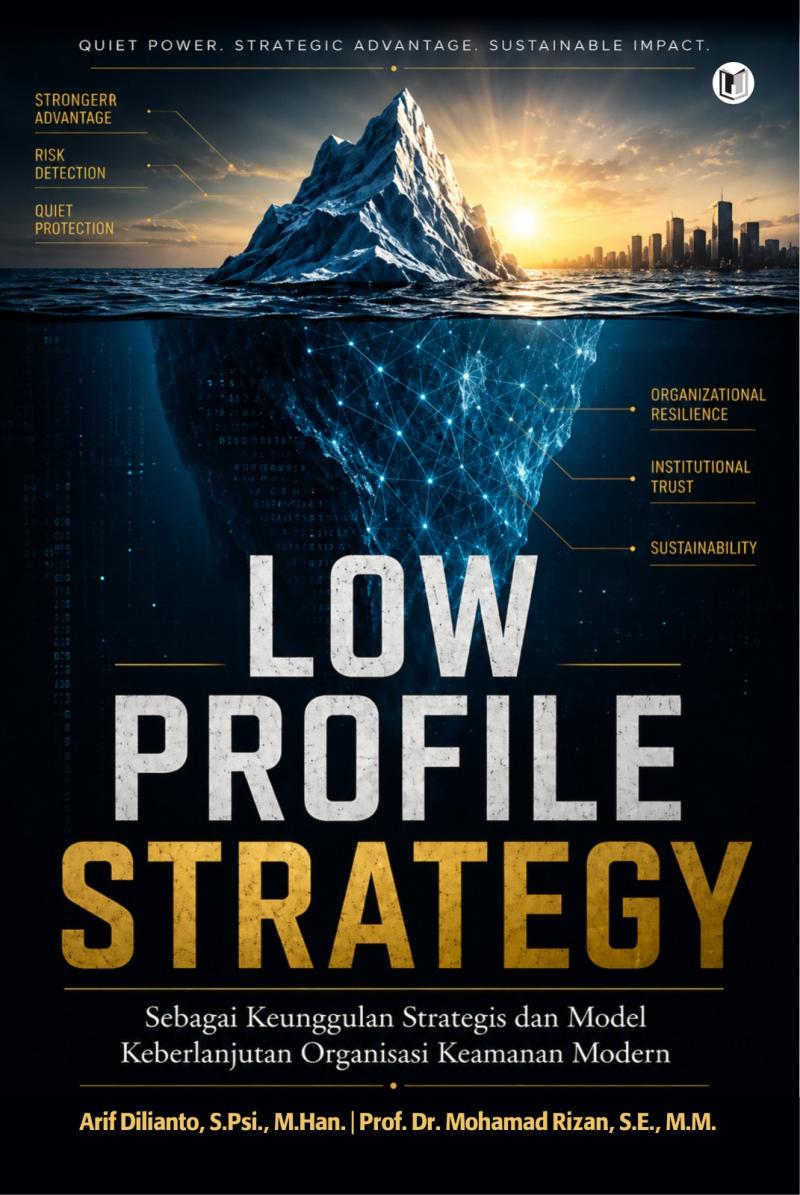
LOW PROFILE STRATEGY: Sebagai Keunggulan Strategis dan Model Keberlanjutan Organisasi Keamanan Modern
Keywords:
Low Profile Strategy, Model Keberlanjutan, Keunggulan StrategisSynopsis
Buku ini menawarkan perspektif baru mengenai pentingnya pengelolaan visibilitas dalam organisasi keamanan di era digital. Di tengah budaya eksposur yang semakin kuat akibat perkembangan media sosial, teknologi informasi, dan tuntutan transparansi publik, buku ini mengajak pembaca untuk mempertanyakan asumsi bahwa organisasi yang paling terlihat adalah organisasi yang paling efektif. Melalui kajian strategis, penulis menunjukkan bahwa visibilitas yang berlebihan justru dapat meningkatkan risiko, mengurangi keunggulan informasi, serta melemahkan efektivitas operasional organisasi.
Buku ini memperkenalkan konsep Low Profile Strategy sebagai pendekatan strategis yang menempatkan visibilitas sebagai sumber daya yang harus dikelola secara cermat. Berbagai konsep penting seperti Information Advantage, Quiet Power, Controlled Visibility, Controlled Transparency, hingga Low Profile Sustainability Strategy Framework (LPSS Framework) dibahas secara komprehensif untuk menjelaskan hubungan antara pengelolaan informasi, pengurangan risiko, perlindungan nilai organisasi, ketahanan institusional, serta keberlanjutan jangka panjang. Pembahasan tidak hanya berfokus pada aspek keamanan, tetapi juga mencakup kepemimpinan, tata kelola organisasi, manajemen risiko, dan strategi keberlanjutan.
Dengan pendekatan yang memadukan teori dan praktik, buku ini menjadi referensi penting bagi pimpinan organisasi keamanan, institusi pemerintah, akademisi, praktisi manajemen, serta pengambil kebijakan. Pesan utama yang diangkat adalah bahwa keunggulan strategis di era modern tidak selalu dimiliki oleh mereka yang paling banyak mendapat perhatian publik, melainkan oleh organisasi yang mampu mengelola visibilitas, informasi, dan kepercayaan secara cerdas. Buku ini menawarkan paradigma baru bahwa sikap low profile bukanlah simbol kelemahan atau ketertutupan, melainkan strategi untuk membangun organisasi yang lebih efektif, resilien, terpercaya, dan berkelanjutan.
Downloads
Download data is not yet available.
References
Barney, J. B. (1991). Firm resources and sustained competitive advantage. Journal of Management, 17(1), 99–120. https://doi.org/10.1177/014920639101700108
Bennett, N., & Lemoine, G. J. (2014). What VUCA really means for you. Harvard Business Review, 92(1–2), 27–42.
Collins, J. (2001). Good to Great: Why Some Companies Make the Leap... and Others Don't. HarperBusiness.
Davenport, T. H., & Beck, J. C. (2001). The Attention Economy: Understanding the New Currency of Business. Harvard Business School Press.
Fukuyama, F. (1995). Trust: The Social Virtues and the Creation of Prosperity. Free Press.
Hatch, M. J., & Schultz, M. (2003). Bringing the corporation into corporate branding. European Journal of Marketing, 37(7–8), 1041–1064. https://doi.org/10.1108/03090560310477654
Heifetz, R. A., Grashow, A., & Linsky, M. (2009). The Practice of Adaptive Leadership: Tools and Tactics for Changing Your Organization and the World. Harvard Business Press.
Heuer, R. J., Jr. (1999). Psychology of Intelligence Analysis. Center for the Study of Intelligence.
International Organization for Standardization. (2018). ISO 31000:2018 Risk Management - Guidelines. ISO.
Kahneman, D. (2011). Thinking, Fast and Slow. Farrar, Straus and Giroux.
Kaplan, A. M., & Haenlein, M. (2010). Users of the world, unite! The challenges and opportunities of social media. Business Horizons, 53(1), 59–68. https://doi.org/10.1016/j.bushor.2009.09.003
Lengnick-Hall, C. A., Beck, T. E., & Lengnick-Hall, M. L. (2011). Developing a capacity for organizational resilience through strategic human resource management. Human Resource Management Review, 21(3), 243–255. https://doi.org/10.1016/j.hrmr.2010.07.001
Mergel, I., Edelmann, N., & Haug, N. (2019). Defining digital transformation: Results from expert interviews. Government Information Quarterly, 36(4), 101385. https://doi.org/10.1016/j.giq.2019.06.002
Mintzberg, H. (1994). The Rise and Fall of Strategic Planning. Free Press.
Montoya, P., & Vandehey, T. (2009). The Brand Called You. McGraw-Hill.
Moore, M. H. (1995). Creating Public Value: Strategic Management in Government. Harvard University Press.
Moore, M. H. (2013). Recognizing Public Value. Harvard University Press.
Nonaka, I., & Takeuchi, H. (1995). The Knowledge-Creating Company: How Japanese Companies Create the Dynamics of Innovation. Oxford University Press.
Nye, J. S., Jr. (2011). The Future of Power. PublicAffairs.
Porter, M. E. (1996). What is strategy? Harvard Business Review, 74(6), 61–78.
Power, M. (2007). Organized Uncertainty: Designing a World of Risk Management. Oxford University Press.
Roberts, A. (2006). Blacked Out: Government Secrecy in the Information Age. Cambridge University Press.
Rumelt, R. P. (2011). Good Strategy, Bad Strategy: The Difference and Why It Matters. Crown Business.
Schneier, B. (2003). Beyond Fear: Thinking Sensibly About Security in an Uncertain World. Copernicus Books.
Senge, P. M. (2006). The Fifth Discipline: The Art and Practice of the Learning Organization (Rev. ed.). Doubleday.
Simon, H. A. (1971). Designing organizations for an information-rich world. In M. Greenberger (Ed.), Computers, Communications, and the Public Interest (pp. 37–72). Johns Hopkins Press.
Suchman, M. C. (1995). Managing legitimacy: Strategic and institutional approaches. Academy of Management Review, 20(3), 571–610. https://doi.org/10.2307/258788
Taleb, N. N. (2012). Antifragile: Things That Gain from Disorder. Random House.
Weick, K. E., & Sutcliffe, K. M. (2015). Managing the Unexpected: Sustained Performance in a Complex World (3rd ed.). Wiley.
Downloads
Published
July 16, 2026
Copyright (c) 2026 Arif Dilianto, Mohamad Rizan (Author)
License

This work is licensed under a Creative Commons Attribution-NonCommercial-ShareAlike 4.0 International License.
Details about this monograph
ISBN-13 (15)
978-634-317-110-2
How to Cite
Dilianto, A., & Rizan, M. (2026). LOW PROFILE STRATEGY: Sebagai Keunggulan Strategis dan Model Keberlanjutan Organisasi Keamanan Modern. Widina Media Utama. https://doi.org/10.59818/y3hfde41