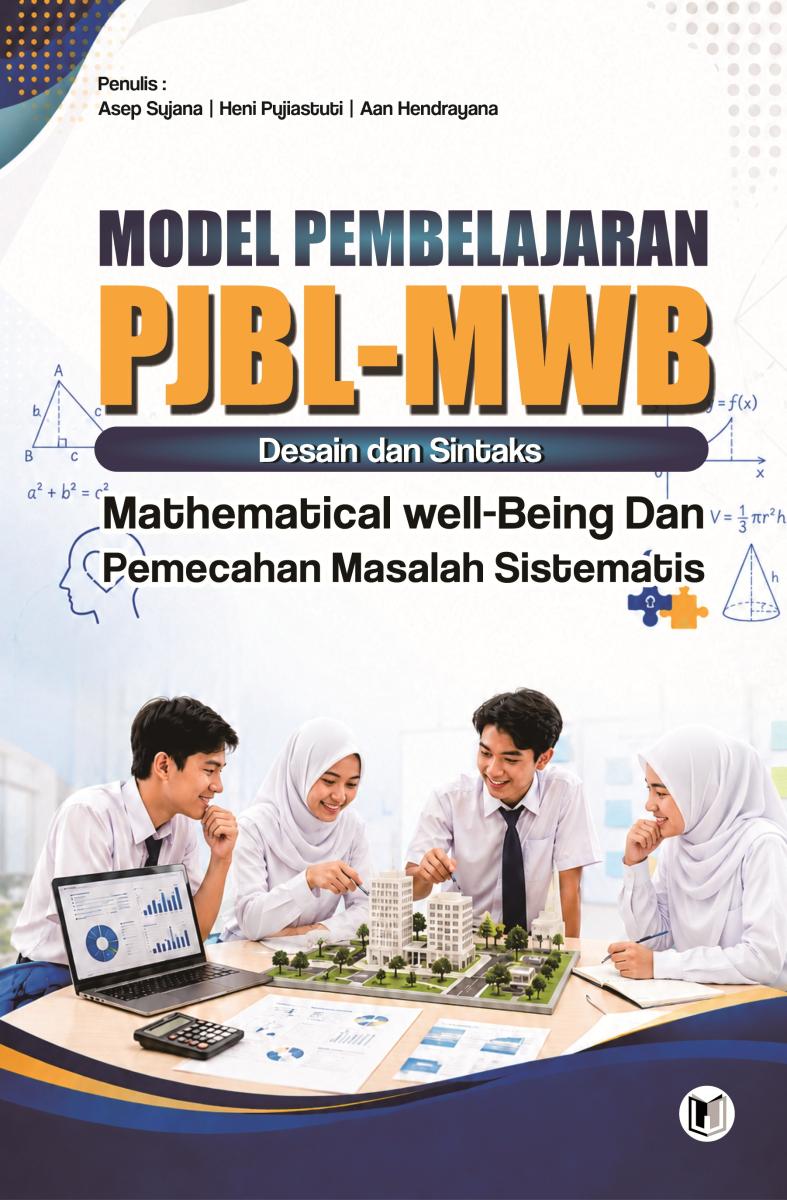
MODEL PEMBELAJARAN PJBL-MWB: DESAIN DAN SINTAKS MATHEMATICAL WELL-BEING DAN PEMECAHAN MASALAH MATEMATIS
Keywords:
PENDIDIKANSynopsis
Buku ini mengembangkan model Project-Based Learning berbasis Mathematical Well-Being (PjBL-MWB). Model ini memadukan kekuatan Project-Based Learning dengan orientasi Mathematical Well-Being. Project-Based Learning memberi ruang kepada siswa untuk belajar melalui masalah autentik, investigasi, kolaborasi, produk, dan presentasi. Mathematical Well-Being memberi arah agar proses belajar matematika memperhatikan tujuh dimensi inti, yaitu meaning, engagement, positive emotions, perseverance, relationships, accomplishment, dan cognitions.
Dalam buku ini, penulis secara tegas membedakan antara dimensi inti Mathematical Well-Being dan mekanisme pendukung pembelajaran. Autonomy support, competence support, confidence, metacognition, dan emotion awareness tidak ditempatkan sebagai dimensi inti MWB, tetapi sebagai mekanisme pendukung atau dampak pengiring yang dapat membantu berkembangnya kesejahteraan matematis siswa. Pembedaan ini penting agar model PjBL-MWB memiliki batas konsep yang jelas dan dapat dikembangkan secara lebih valid.
Downloads
Download data is not yet available.
References
Abd Ghani, A., Rosli, R., Iksan, Z., Halim, L., Osman, K., Maat, S. M., Mahmud, S. N. D., Mahmud, M. S., Rambely, A. S., & Lay, A. N. (2023). STEM professional development programs for science and mathematics primary school teachers: A systematic literature review. European Journal of Science and Mathematics Education, 11(4), 738-753. https://doi.org/10.30935/scimath/13629
Aiken, L. R. (1985). Three coefficients for analyzing the reliability and validity of ratings. Educational and Psychological Measurement, 45(1), 131-142. https://doi.org/10.1177/0013164485451012
American Educational Research Association, American Psychological Association, & National Council on Measurement in Education. (2014). Standards for educational and psychological testing. American Educational Research Association.
Anderson, T., & Shattuck, J. (2012). Design-based research: A decade of progress in education research? Educational Researcher, 41(1), 16-25. https://doi.org/10.3102/0013189X11428813
Andrade, H. L. (2010). Students as the definitive source of formative assessment: Academic self-assessment and the self-regulation of learning. In H. L. Andrade & G. J. Cizek (Eds.), Handbook of formative assessment (pp. 90-105). Routledge. https://doi.org/10.4324/9780203874851-8
Arroyo Resino, D., Constante-Amores, A., Gil Madrona, P., & Carrillo López, P. J. (2024). Student well-being and mathematical literacy performance in PISA 2018: A machine-learning approach. Educational Psychology, 44(3), 340-357. https://doi.org/10.1080/01443410.2024.2359104
Ashcraft, M. H., & Kirk, E. P. (2001). The relationships among working memory, math anxiety, and performance. Journal of Experimental Psychology: General, 130(2), 224-237. https://doi.org/10.1037/0096 3445.130.2.224
Ashcraft, M. H., & Moore, A. M. (2009). Mathematics anxiety and the affective drop in performance. Journal of Psychoeducational Assessment, 27(3), 197-205. https://doi.org/10.1177/0734282908330580
Ashcraft, M. H. (2002). Math anxiety: Personal, educational, and cognitive consequences. Current Directions in Psychological Science, 11(5), 181-185. https://doi.org/10.1111/1467-8721.00196
Averill, R. (2012). Caring teaching practices in multiethnic mathematics classrooms: Attending to health and well-being. Mathematics Education Research Journal, 24(2), 105-128. https://doi.org/10.1007/s13394-012-0036-2
Bakker, A., Smit, J., & Wegerif, R. (2015). Scaffolding and dialogic teaching in mathematics education: Introduction and review. ZDM Mathematics Education, 47, 1047-1065. https://doi.org/10.1007/s11858-015-0738-8
Bandura, A. (1997). Self-efficacy: The exercise of control. W. H. Freeman.
Barroso, C., Ganley, C. M., McGraw, A. L., Geer, E. A., Hart, S. A., & Daucourt, M. C. (2021). A meta-analysis of the relation between math anxiety and math achievement. Psychological Bulletin, 147(2), 134-168. https://doi.org/10.1037/bul0000307
Barrows, H. S. (1996). Problem-based learning in medicine and beyond: A brief overview. New Directions for Teaching and Learning, 1996(68), 3–12. https://doi.org/10.1002/tl.37219966804
Bell, S. (2010). Project-based learning for the 21st century: Skills for the future. The Clearing House: A Journal of Educational Strategies, Issues and Ideas, 83(2), 39-43. https://doi.org/10.1080/00098650903505415
Blumenfeld, P. C., Soloway, E., Marx, R. W., Krajcik, J. S., Guzdial, M., & Palincsar, A. (1991). Motivating project-based learning: Sustaining the doing, supporting the learning. Educational Psychologist, 26(3-4), 369-398. https://doi.org/10.1080/00461520.1991.9653139
Boateng, G. O., Neilands, T. B., Frongillo, E. A., Melgar-Quiñonez, H. R., & Young, S. L. (2018). Best practices for developing and validating scales for health, social, and behavioral research: A primer. Frontiers in Public Health, 6, Article 149. https://doi.org/10.3389/fpubh.2018.00149
Campbell, T. (2025). Mathematical wellbeing: An emerging construct with exciting potential. Mathematics Education Research Journal. Advance online publication. https://doi.org/10.1007/s13394-025-00532-5
Campbell, T. G., Kularajan, S., & Miles, S. (2025). Psychometric evaluation of the mathematical well-being scale for children aged 9-14. Mathematics Education Research Journal. Advance online publication. https://doi.org/10.1007/s13394-025-00545-0
Carey, E., Hill, F., Devine, A., & Szücs, D. (2016). The chicken or the egg? The direction of the relationship between mathematics anxiety and mathematics performance. Frontiers in Psychology, 6, Article 1987. https://doi.org/10.3389/fpsyg.2015.01987
Clarkson, P., Bishop, A. J., & Seah, W. T. (2010). Mathematics education and student values: The cultivation of mathematical wellbeing. In T. Lovat, R. Toomey, & N. Clement (Eds.), International research handbook on values education and student wellbeing (pp. 111-135). Springer. https://doi.org/10.1007/978-90-481-8675-4_7
Cuong, L. M., Tien-Trung, N., Ngu, P. N. H., Vangchia, V., Thao, N. P., & Thao, T. T. P. (2025). Mathematics problem-solving research in high school education: Trends and insights from the Scopus database (1983-2023). European Journal of Science and Mathematics Education, 13(2), 77-89. https://doi.org/10.30935/scimath/16038
Daniels, H. (2016). Vygotsky and pedagogy (2nd ed.). Routledge.
Daswarman, D., Sa’dijah, C., Gofur, A., & Mashfufah, A. (2025). Participatory learning for the improvement of math problem-solving: A systematic literature review. TEM Journal, 14(2), 1780-1790. https://doi.org/10.18421/TEM142-76
Deci, E. L., & Ryan, R. M. (2000). The “what” and “why” of goal pursuits: Human needs and the self-determination of behavior. Psychological Inquiry, 11(4), 227-268. https://doi.org/10.1207/S15327965PLI1104_01
Dowker, A., Sarkar, A., & Looi, C. Y. (2016). Mathematics anxiety: What have we learned in 60 years? Frontiers in Psychology, 7, Article 508. https://doi.org/10.3389/fpsyg.2016.00508
Downing, S. M. (2003). Validity: On the meaningful interpretation of assessment data. Medical Education, 37(9), 830-837. https://doi.org/10.1046/j.1365-2923.2003.01594.x
Dunn, T. J., Baguley, T., & Brunsden, V. (2014). From alpha to omega: A practical solution to the pervasive problem of internal consistency estimation. British Journal of Psychology, 105(3), 399-412. https://doi.org/10.1111/bjop.12046
Fatimah, P., Umar, U., & Makki, M. (2023). Pengaruh model pembelajaran project based learning (PjBL) terhadap hasil belajar matematika. Journal of Classroom Action Research, 5(Special Issue), 51-57. https://doi.org/10.29303/jcar.v5iSpecialIssue.3932
Fredricks, J. A., Blumenfeld, P. C., & Paris, A. H. (2004). School engagement: Potential of the concept, state of the evidence. Review of Educational Research, 74(1), 59-109. https://doi.org/10.3102/00346543074001059
Hart, S. A., & Ganley, C. M. (2019). The nature of math anxiety in adults: Prevalence and correlates. Journal of Numerical Cognition, 5(2), 122-139. https://doi.org/10.5964/jnc.v5i2.195
Hattie, J., & Timperley, H. (2007). The power of feedback. Review of Educational Research, 77(1), 81-112. https://doi.org/10.3102/003465430298487
Haynes, S. N., Richard, D. C. S., & Kubany, E. S. (1995). Content validity in psychological assessment: A functional approach to concepts and methods. Psychological Assessment, 7(3), 238-247. https://doi.org/10.1037/1040-3590.7.3.238
Hendrayana, A. (2015). Pengaruh pembelajaran pendekatan rigorous mathematical thinking (RMT) terhadap pemahaman konseptual, kompetensi strategis, dan beban kognitif matematis siswa SMP boarding school [Disertasi doktoral, Universitas Pendidikan Indonesia]. UPI Repository. https://repository.upi.edu/17547/
Hendrayana, A. (2017). Pengaruh pembelajaran pendekatan rigorous mathematical thinking (RMT) terhadap pemahaman konseptual matematis siswa SMP. Jurnal Riset Pendidikan Matematika, 4(2), 186-199. https://doi.org/10.21831/jrpm.v4i2.15385
Hill, J. L., & Hunter, J. (2024). Diverse students’ mathematical wellbeing. New Zealand Journal of Educational Studies, 59, 211-234. https://doi.org/10.1007/s40841-024-00318-6
Hill, J. L., & Seah, W. T. (2023). Student values and wellbeing in mathematics education: Perspectives of Chinese primary students. ZDM - Mathematics Education, 55(2), 385-398. https://doi.org/10.1007/s11858-022-01418-7
Hill, J. L., & Seah, W. T. (2023). Student mathematical well being: A review and future directions. Mathematics Education Research Journal, 35, 1-24.
Hill, J. L., Kern, M. L., Seah, W. T., & van Driel, J. (2021). Feeling good and functioning well in mathematics education: Exploring students’ conceptions of mathematical well being. Educational Studies in Mathematics, 106, 349-368.
Hill, J. L., Kern, M. L., Seah, W. T., & van Driel, J. (2021). Feeling good and functioning well in mathematics education: Exploring students’ conceptions of mathematical well-being and values. ECNU Review of Education, 4(2), 349-375. https://doi.org/10.1177/2096531120928084
Himmi, N., Armanto, D., & Amry, Z. (2025). Implementation of project based learning (PjBL) in mathematics education: A systematic analysis of international practices and theoretical foundations. Science Insights Education Frontiers, 26(2), 4305-4321. https://doi.org/10.15354/sief.25.or699
Hembree, R. (1990). The nature, effects, and relief of mathematics anxiety. Journal for Research in Mathematics Education, 21(1), 33-46. https://doi.org/10.2307/749455
Hinkin, T. R. (1995). A review of scale development practices in the study of organizations. Journal of Management, 21(5), 967-988. https://doi.org/10.1177/014920639502100509
Hmelo-Silver, C. E. (2004). Problem-based learning: What and how do students learn? Educational Psychology Review, 16(3), 235–266. https://doi.org/10.1023/B:EDPR.0000034022.16470.f3
Hmelo-Silver, C. E., Duncan, R. G., & Chinn, C. A. (2007). Scaffolding and achievement in problem-based and inquiry learning: A response to Kirschner, Sweller, and Clark (2006). Educational Psychologist, 42(2), 99-107. https://doi.org/10.1080/00461520701263368
Hofer, S. I., & Reinhold, F. (2025). Scaffolding of learning activities: Aptitude-treatment-interaction effects in math? Learning and Instruction, 99, Article 102177. https://doi.org/10.1016/j.learninstruc.2025.102177
Hopko, D. R., Mahadevan, R., Bare, R. L., & Hunt, M. K. (2003). The abbreviated math anxiety scale (AMAS): Construction, validity, and reliability. Assessment, 10(2), 178-182. https://doi.org/10.1177/1073191103010002008
Ibrahim, A. (2025). Identifying gaps and contributions of project-based learning in vocational education and STEM fields: A comprehensive bibliometric analysis. Journal of Scientometric Research, 14(1), 86-98. https://doi.org/10.5530/jscires.20250763
Islahiyah, I., Pujiastuti, H., & Mutaqin, A. (2021). Pengembangan e-modul dengan model pembelajaran berbasis masalah untuk meningkatkan kemampuan pemecahan masalah matematis siswa. AKSIOMA: Jurnal Program Studi Pendidikan Matematika, 10(4), 2107-2118. https://doi.org/10.24127/ajpm.v10i4.3908
Jian, X., Wijaya, T. T., & Yu, Q. (2023). Key factors affecting mathematics teachers’ well-being and stress levels: An extended engagement theory. International Journal of Environmental Research and Public Health, 20(1), Article 548. https://doi.org/10.3390/ijerph20010548
Julius, R., Abd Halim, M. S., Abdul Hadi, N., Alias, A. N., Mohd Khalid, M. H., Mahfodz, Z., & Ramli, F. F. (2021). Bibliometric analysis of research in mathematics education using Scopus database. Eurasia Journal of Mathematics, Science and Technology Education, 17(12), Article em2040. https://doi.org/10.29333/ejmste/11329
Juliyanti, A., & Pujiastuti, H. (2020). Pengaruh kecemasan matematis dan konsep diri terhadap hasil belajar matematika siswa. Prima: Jurnal Pendidikan Matematika, 4(2), 75-83. https://jurnal.umt.ac.id/index.php/prima/article/view/2591
Karakus, M., Ersozlu, Z., Usak, M., & Ocean, J. (2021). Self-efficacy, affective well-being, and intent-to-leave by science and mathematics teachers: A structural equation model. Journal of Baltic Science Education, 20(2), 237-251. https://doi.org/10.33225/jbse/21.20.237
Kern, M. L., Benson, L., Steinberg, E. A., & Steinberg, L. (2016). The EPOCH measure of adolescent well-being. Psychological Assessment, 28(5), 586-597. https://doi.org/10.1037/pas0000201
Kokka, K. (2019). Healing-informed social justice mathematics: Promoting students’ sociopolitical consciousness and well-being in mathematics class. Urban Education, 54(9), 1179-1209. https://doi.org/10.1177/0042085918806947
Kokotsaki, D., Menzies, V., & Wiggins, A. (2016). Project-based learning: A review of the literature. Improving Schools, 19(3), 267-277. https://doi.org/10.1177/1365480216659733
Krajcik, J. S., & Shin, N. (2014). Project-based learning. In R. K. Sawyer (Ed.), The Cambridge handbook of the learning sciences (2nd ed., pp. 275-297). Cambridge University Press. https://doi.org/10.1017/CBO9781139519526.018
Kusmaryono, I., Jupriyanto, J., & Kusumaningsih, W. (2021). Construction of students’ mathematical knowledge in the zone of proximal development and zone of potential construction. European Journal of Educational Research, 10(1), 341-351. https://doi.org/10.12973/eu-jer.10.1.341
Lawshe, C. H. (1975). A quantitative approach to content validity. Personnel Psychology, 28(4), 563-575. https://doi.org/10.1111/j.1744-6570.1975.tb01393.x
Lester, F. K., Jr. (1980). Research on mathematical problem solving. In R. J. Shumway (Ed.), Research in mathematics education (pp. 286-323). National Council of Teachers of Mathematics.
Lynn, M. R. (1986). Determination and quantification of content validity. Nursing Research, 35(6), 382-386. https://doi.org/10.1097/00006199-198611000-00017
Martin, M., Syamsuri, S., Pujiastuti, H., & Hendrayana, A. (2021). Pengembangan e-modul berbasis pendekatan contextual teaching and learning pada materi barisan dan deret untuk meningkatkan minat belajar siswa SMP. Jurnal Derivat: Jurnal Matematika dan Pendidikan Matematika, 8(2), 72-87. https://doi.org/10.31316/j.derivat.v8i2.1927
Martín-Cudero, D., Cid-Cid, A. I., & Guede-Cid, R. (2024). Analysis of mathematics education from a STEAM approach at secondary and pre-universitary educational levels: A systematic review. Journal of Technology and Science Education, 14(2), 507-528. https://doi.org/10.3926/jotse.2349
Meika, I., & Sujana, A. (2017). Kemampuan berpikir kreatif dan pemecahan masalah matematis siswa SMA. Jurnal Penelitian dan Pembelajaran Matematika, 10(2), 8-13. https://doi.org/10.30870/jppm.v10i2.2025
Mercer, N., & Littleton, K. (2007). Dialogue and the development of children’s thinking: A sociocultural approach. Routledge.
Messick, S. (1995). Validity of psychological assessment: Validation of inferences from persons’ responses and performances as scientific inquiry into score meaning. American Psychologist, 50(9), 741-749. https://doi.org/10.1037/0003-066X.50.9.741
Molina-Muñoz, D., Contreras-García, J. M., & Molina-Portillo, E. (2023). Does the psychoemotional well-being of Spanish students influence their mathematical literacy? Evidence from PISA 2018. Frontiers in Psychology, 14, Article 1196529. https://doi.org/10.3389/fpsyg.2023.1196529
National Council of Teachers of Mathematics. (2000). Principles and standards for school mathematics. National Council of Teachers of Mathematics.
Öcal, Z. M., Yüzüak, A. V., & Gökkurt Özdemir, B. (2025). 21st century skills in mathematics and science education: A bibliometric analysis. International Journal of Education in Mathematics, Science and Technology, 13(2), 333-356. https://doi.org/10.46328/ijemst.4659
OECD. (2023). PISA 2022 results: Indonesia country note. OECD Publishing.
OECD. (2023). PISA 2022 results (Volume I): The state of learning and equity in education. OECD Publishing. https://doi.org/10.1787/53f23881-en.
Parhiala, P., Torppa, M., Vasalampi, K., Eklund, K., Poikkeus, A. M., & Aro, T. (2018). Profiles of school motivation and emotional well-being among adolescents: Associations with math and reading performance. Learning and Individual Differences, 61, 196-204. https://doi.org/10.1016/j.lindif.2017.12.003
Pekrun, R. (2006). The control-value theory of achievement emotions: Assumptions, corollaries, and implications for educational research and practice. Educational Psychology Review, 18(4), 315-341. https://doi.org/10.1007/s10648-006-9029-9
Permana, D. A., Hendrayana, A., & Sukirwan, S. (2023). Pengaruh model problem based learning termodifikasi cognitive load theory terhadap kemampuan pemecahan masalah matematika siswa. Wilangan: Jurnal Inovasi dan Riset Pendidikan Matematika, 4(2), 160-167. https://jurnal.untirta.ac.id/index.php/wilangan/article/view/19479
Piaget, J. (1970). The science of education and the psychology of the child. Orion Press.
Piaget, J. (1970). Science of education and the psychology of the child. Viking Press.
Polit, D. F., Beck, C. T., & Owen, S. V. (2007). Is the CVI an acceptable indicator of content validity? Appraisal and recommendations. Research in Nursing & Health, 30(4), 459-467. https://doi.org/10.1002/nur.20199
Pólya, G. (1945). How to solve it: A new aspect of mathematical method. Princeton University Press.
Pujiastuti, H. (2014). Pembelajaran inquiry co-operation model untuk meningkatkan kemampuan pemecahan masalah, komunikasi, dan self-esteem matematis siswa SMP [Disertasi doktoral, Universitas Pendidikan Indonesia]. UPI Repository. https://repository.upi.edu/6749/
Purnomo, H., Abdullah, A. H., Afnia, P. N., & Shiddieqy, A. A. (2025). Project-based learning in mathematics classrooms: How it improves students’ problem-solving skills. JMPM: Jurnal Matematika dan Pendidikan Matematika, 10(1), 29-42. https://doi.org/10.26594/jmpm.v10i1.5590
Ramadanti, F., Mutaqin, A., & Hendrayana, A. (2021). Pengembangan e-modul matematika berbasis PBL (problem-based learning) pada materi penyajian data untuk siswa SMP. Jurnal Cendekia: Jurnal Pendidikan Matematika, 5(3), 2733-2745. https://doi.org/10.31004/cendekia.v5i3.759
Ramirez, G., Gunderson, E. A., Levine, S. C., & Beilock, S. L. (2013). Math anxiety, working memory, and math achievement in early elementary school. Journal of Cognition and Development, 14(2), 187-202. https://doi.org/10.1080/15248372.2012.664593
Ramirez, G., Shaw, S. T., & Maloney, E. A. (2018). Math anxiety: Past research, promising interventions, and a new interpretation framework. Educational Psychologist, 53(3), 145-164. https://doi.org/10.1080/00461520.2018.1447384
Rani, P. R., Lestari, A., Mutmainah, F., Ishak, K. A., Delima, R., Siregar, P. S., & Marta, E. (2021). Pengaruh metode PjBL terhadap hasil belajar matematika di sekolah dasar. Journal for Lesson and Learning Studies, 4(2), 264-270. https://doi.org/10.23887/jlls.v4i2.34570
Reiser, B. J. (2004). Scaffolding complex learning: The mechanisms of structuring and problematizing student work. The Journal of the Learning Sciences, 13(3), 273-304. https://doi.org/10.1207/s15327809jls1303_2
Renkl, A. (2014). Toward an instructionally oriented theory of example-based learning. Cognitive Science, 38(1), 1-37. https://doi.org/10.1111/cogs.12086
Rigusti, W., & Pujiastuti, H. (2020). Analisis kemampuan pemecahan masalah ditinjau dari motivasi belajar matematika siswa. Prima: Jurnal Pendidikan Matematika, 4(1), 1-10. https://doi.org/10.31000/prima.v4i1.2079
Rio, M., & Pujiastuti, H. (2020). Analisis kemampuan pemecahan masalah matematik siswa SMP pada materi bilangan bulat. AKSIOMA: Jurnal Matematika dan Pendidikan Matematika, 11(1), 70-81. https://doi.org/10.26877/aks.v11i1.6105
Rodríguez, S., Regueiro, B., Piñeiro, I., Valle, A., Sánchez, B., Vieites, T., & Rodríguez-Llorente, C. (2020). Success in mathematics and academic wellbeing in primary-school students. Sustainability, 12(9), Article 3796. https://doi.org/10.3390/su12093796
Rubio, D. M. G., Berg-Weger, M., Tebb, S. S., Lee, E. S., & Rauch, S. (2003). Objectifying content validity: Conducting a content validity study in social work research. Social Work Research, 27(2), 94-104. https://doi.org/10.1093/swr/27.2.94
Ryan, R. M., & Deci, E. L. (2017). Self determination theory: Basic psychological needs in motivation, development, and wellness. Guilford Press.
Ryan, R. M., & Deci, E. L. (2000). Self-determination theory and the facilitation of intrinsic motivation, social development, and well-being. American Psychologist, 55(1), 68-78. https://doi.org/10.1037/0003-066X.55.1.68
Ryan, R. M., & Deci, E. L. (2001). On happiness and human potentials: A review of research on hedonic and eudaimonic well-being. Annual Review of Psychology, 52, 141-166. https://doi.org/10.1146/annurev.psych.52.1.141
Ryan, R. M., & Deci, E. L. (2020). Intrinsic and extrinsic motivation from a self-determination theory perspective: Definitions, theory, practices, and future directions. Contemporary Educational Psychology, 61, Article 101860. https://doi.org/10.1016/j.cedpsych.2020.101860
Sadaruddin, Ahmad, A., Jabu, B., Syamsuardi, Usman, & Hasmawaty. (2023). Needs analysis of project-based learning model development in stimulating children’s creativity. European Journal of Education and Pedagogy, 4(6), 24-29. https://doi.org/10.24018/ejedu.2023.4.6.719
Sagita, L., Putri, R. I. I., Zulkardi, & Prahmana, R. C. I. (2022). Promising research studies between mathematics literacy and financial literacy through project-based learning. Journal on Mathematics Education, 13(4), 753-772. https://doi.org/10.22342/jme.v13i4.pp753-772
Sammallahti, E., Finell, J., Jonsson, B., & Korhonen, J. (2023). A meta-analysis of math anxiety interventions. Journal of Numerical Cognition, 9(2), 346-362. https://doi.org/10.5964/jnc.8401
Scalise, N. R., Santiago, I. M., & Canning, E. A. (2025). When we were young: Memories of early mathematics experiences. Journal of Numerical Cognition, 11, Article e14771. https://doi.org/10.5964/jnc.14771
Schoenfeld, A. H. (1985). Mathematical problem solving. Academic Press.
Seligman, M. E. P. (2011). Flourish: A visionary new understanding of happiness and well-being. Free Press.
Shoshani, A. (2021). Growth mindset in the maths classroom: A key to teachers’ well-being and effectiveness. Teachers and Teaching, 27(8), 730-752. https://doi.org/10.1080/13540602.2021.2007370
Sireci, S., & Faulkner-Bond, M. (2014). Validity evidence based on test content. Psicothema, 26(1), 100-107. https://doi.org/10.7334/psicothema2013.256
Soe, H. Y., Zhang, D., Fu, D., & Cui, Y. (2025). How an autonomy-supportive learning environment influences students’ achievements in science and mathematics. Social Psychology of Education, 28, Article 53. https://doi.org/10.1007/s11218-024-09970-8
Sujana, A. (2015). Penerapan model pembelajaran PBL untuk mengembangkan kemampuan pemecahan masalah matematika. Pasundan Journal of Mathematics Education: Jurnal Pendidikan Matematika, 5(1), 37-45. https://doi.org/10.23969/pjme.v5i1.2520
Sujana, A., Rifa’i, R., & Astuti, N. (2019). Penerapan strategi konflik kognitif untuk meningkatkan kemampuan berpikir kritis matematis siswa SMP. Jurnal Penelitian dan Pembelajaran Matematika, 12(1), 173-181. https://doi.org/10.30870/jppm.v12i1.4864
Suleiman, A. D., Hou, D., Liu, Y., DeWaters, J., Shepherd, D. C., & De Souza, J. G. (2025). Systematic literature review on project-based learning in computing education. ACM Transactions on Computing Education, 25(4), Article 50. https://doi.org/10.1145/3743684
Susanto, H. S., Wedyaswari, M. W., & Dalimunthe, K. L. (2023). A content validity and cognitive interview to develop the HARMONI items: Instrument measuring student well-being in West Java, Indonesia. Frontiers in Education, 8, Article 1132031. https://doi.org/10.3389/feduc.2023.1132031
Sweller, J., Ayres, P., & Kalyuga, S. (2011). Cognitive load theory. Springer.
Sweller, J. (2020). Cognitive load theory and educational technology. Educational Technology Research and Development, 68(1), 1-16. https://doi.org/10.1007/s11423-019-09701-3
Sweller, J., Ayres, P., & Kalyuga, S. (2011). Cognitive load theory. Springer. https://doi.org/10.1007/978-1-4419-8126-4
Sweller, J., van Merriënboer, J. J. G., & Paas, F. (2019). Cognitive architecture and instructional design: 20 years later. Educational Psychology Review, 31, 261-292. https://doi.org/10.1007/s10648-019-09465-5
Sweller, J. (2021). Instructional design. In R. E. Mayer & L. Fiorella (Eds.), The Cambridge handbook of multimedia learning (third edition, pp. 403 to 419). Cambridge University Press.
Tanjung, A. Q., Arifin, S., & Faizah, S. (2024). Mathematics anxiety in primary education: A systematic review of foundations, causes, and interventions. Jurnal Gantang, 9(2), 117-134. https://doi.org/10.31629/jg.v9i2.7508
Tavakol, M., & Dennick, R. (2011). Making sense of Cronbach’s alpha. International Journal of Medical Education, 2, 53-55. https://doi.org/10.5116/ijme.4dfb.8dfd
Thomas, J. W. (2000). A review of research on project-based learning. Autodesk Foundation.
Valero Larico, D., Benavente Gutierrez, M. A., Talavera-Mendoza, F., & Rucano Paucar, F. H. (2026). Digital applications in mathematics learning for secondary school students: A systematic literature review. Eurasia Journal of Mathematics, Science and Technology Education, 22(1), Article em2768. https://doi.org/10.29333/ejmste/17760
van de Pol, J., Volman, M., & Beishuizen, J. (2010). Scaffolding in teacher-student interaction: A decade of research. Educational Psychology Review, 22, 271-296. https://doi.org/10.1007/s10648-010-9127-6
van Merriënboer, J. J. G., & Sweller, J. (2005). Cognitive load theory and complex learning: Recent developments and future directions. Educational Psychology Review, 17(2), 147-177. https://doi.org/10.1007/s10648-005-3951-0
van Merriënboer, J. J. G., & Sweller, J. (2010). Cognitive load theory in health professional education: Design principles and strategies. Medical Education, 44(1), 85-93. https://doi.org/10.1111/j.1365-2923.2009.03498.x
Vansteenkiste, M., Ryan, R. M., & Soenens, B. (2020). Basic psychological need theory: Advancements, critical themes, and future directions. Motivation and Emotion, 44, 1-31. https://doi.org/10.1007/s11031-019-09818-1
Vygotsky, L. S. (1978). Mind in society: The development of higher psychological processes. Harvard University Press.
Wen, R., & Dubé, A. K. (2022). A systematic review of secondary students’ attitudes towards mathematics and its relations with mathematics achievement. Journal of Numerical Cognition, 8(2), 295-325. https://doi.org/10.5964/jnc.7937
Widlund, A., Tuominen, H., & Korhonen, J. (2018). Academic well-being, mathematics performance, and educational aspirations in lower secondary education: Changes within a school year. Frontiers in Psychology, 9, Article 297. https://doi.org/10.3389/fpsyg.2018.00297
Wijaya, T. T., Rahmadi, I. F., Chotimah, S., Jailani, J., & Wutsqa, D. U. (2022). A case study of factors that affect secondary school mathematics achievement: Teacher-parent support, stress levels, and students’ well-being. International Journal of Environmental Research and Public Health, 19(23), Article 16247. https://doi.org/10.3390/ijerph192316247
Wilson Fadiji, A., & Reddy, V. (2023). Well-being and mathematics achievement: The role of gender, instructional clarity, and parental involvement. Frontiers in Psychology, 13, Article 1044261. https://doi.org/10.3389/fpsyg.2022.1044261
Wood, D., Bruner, J. S., & Ross, G. (1976). The role of tutoring in problem solving. Journal of Child Psychology and Psychiatry, 17(2), 89-100. https://doi.org/10.1111/j.1469-7610.1976.tb00381.x
Yao, Y., Kong, Q., & Cai, J. (2018). Investigating elementary and middle school students’ subjective well-being and mathematical performance in Shanghai. International Journal of Science and Mathematics Education, 16(Suppl. 1), 107-127. https://doi.org/10.1007/s10763-017-9827-1
Zhong, J., Seah, W. T., Cao, Y., & Zhang, Y. (2024). The role of teacher knowledge in fostering student fulfillment of values crucial for mathematical wellbeing. In Y. Dede, G. Marschall, & P. Clarkson (Eds.), Values and valuing in mathematics education: Moving forward into practice (pp. 237-258). Springer. https://doi.org/10.1007/978-981-99-9454-0_12
Zimmerman, B. J. (2002). Becoming a self-regulated learner: An overview. Theory Into Practice, 41(2), 64-70. https://doi.org/10.1207/S15430421TIP4102_2
Downloads
Published
July 16, 2026
Copyright (c) 2026 Asep Sujana, Heni Pujiastuti, Aan Hendrayana (Author)
License

This work is licensed under a Creative Commons Attribution-NonCommercial-ShareAlike 4.0 International License.
How to Cite
Sujana, A., Pujiastuti, H., & Hendrayana, A. (2026). MODEL PEMBELAJARAN PJBL-MWB: DESAIN DAN SINTAKS MATHEMATICAL WELL-BEING DAN PEMECAHAN MASALAH MATEMATIS. Widina Media Utama. https://doi.org/10.59818/9wq1tg27